jacking OPEL CALIBRA 1988 Service User Guide
[x] Cancel search | Manufacturer: OPEL, Model Year: 1988, Model line: CALIBRA, Model: OPEL CALIBRA 1988Pages: 525, PDF Size: 58.26 MB
Page 129 of 525
b)Always keep the ignition and fuel systems
well maintained according to the
manufacturers schedule (see “Routine
maintenance” and the relevant Chapter).
In particular, ensure that the air cleaner
filter element, the fuel filter and the spark
plugs are renewed at the correct intervals.
If the inlet air/fuel mixture is allowed to
become too rich due to neglect, the
unburned surplus will enter and burn in
the catalytic converter, overheating the
element and eventually destroying the
converter.
c)If the engine develops a misfire, do not
drive the vehicle at all (or at least as little
as possible) until the fault is cured. The
misfire will allow unburned fuel to enter
the converter, which will result in its
overheating, as noted above.
d)The engine control indicator (the outline
of an engine with a lightning symbol
superimposed), will light when the ignition
is switched on and the engine is started,
then it will go out. While it may light briefly
while the engine is running, it should go
out again immediately and stays unlit. If it
lights and stays on while the engine is
running, seek the advice of a Vauxhall
dealer as soon as possible. A fault has
occurred in the fuel injection/ignition
system that, apart from increasing fuel
consumption and impairing the engine’s
performance, may damage the catalytic
converter.
e)DO NOT push or tow-start the vehicle.
This will soak the catalytic converter in
unburned fuel causing it to overheat when
the engine does start see (b) above.
f)DO NOT switch off the ignition at high
engine speeds. If the ignition is switched
off at anything above idle speed,
unburned fuel will enter the (very hot)
catalytic converter, with the possible risk
of its igniting on the element and
damaging the converter.
g)DO NOT use fuel or engine oil additives.
These may contain substances harmful to
the catalytic converter.
h)DO NOT continue to use the vehicle if the
engine burns oil to the extent of leaving a
visible trail of blue smoke. The unburned
carbon deposits will clog the converter
passages and reduce its efficiency; in
severe cases the element will overheat.
i)Remember that the catalytic converter
operates at very high temperatures hence
the heat shields on the vehicle’s under-
body and the casing will become hot
enough to ignite combustible materials
that brush against it. DO NOT, therefore,
park the vehicle in dry undergrowth, over
long grass or over piles of dead leaves.
j)Remember that the catalytic converter is
FRAGlLE. Do not strike it with tools during
servicing work. Take great care when
working on the exhaust system. Ensure
that the converter is well clear of any
jacks or other lifting gear used to raise thevehicle. Do not drive the vehicle over
rough ground, road humps, etc., in such a
way as to ground the exhaust system.
k)In some cases, particularly when the
vehicle is new and/or is used for
stop/start driving, a sulphurous smell (like
that of rotten eggs) may be noticed from
the exhaust. This is common to many
catalytic converter-equipped vehicles and
seems to be due to the small amount of
sulphur found in some petrol’s reacting
with hydrogen in the exhaust to produce
hydrogen sulphide (CS) gas. While this
gas is toxic, it is not produced in sufficient
amounts to be a problem. Once the
vehicle has covered a few thousand miles
the problem should disappear. In the
meanwhile a change of driving style or of
the brand of petrol may effect a solution.
l)The catalytic converter, used on a
well-maintained and well-driven vehicle,
should last for between 50 000 and 100
000 miles. From this point on, careful
checks should be made at all specified
service intervals of the CO level to ensure
that the converter is still operating
efficiently. If the converter is no longer
effective it must be renewed.
11Carbon canister - removal
and refitting
3
Removal
1Apply the handbrake, then jack up the front
of the vehicle, and support securely on axle
stands placed under the body side members
(see “Jacking and Vehicle Support”).
2Remove the front right hand wheel and
wheel arch liner.
3Note the hose and pipe connections to the
canister, or label them, to ensure that they are
reconnected to their original unions, then
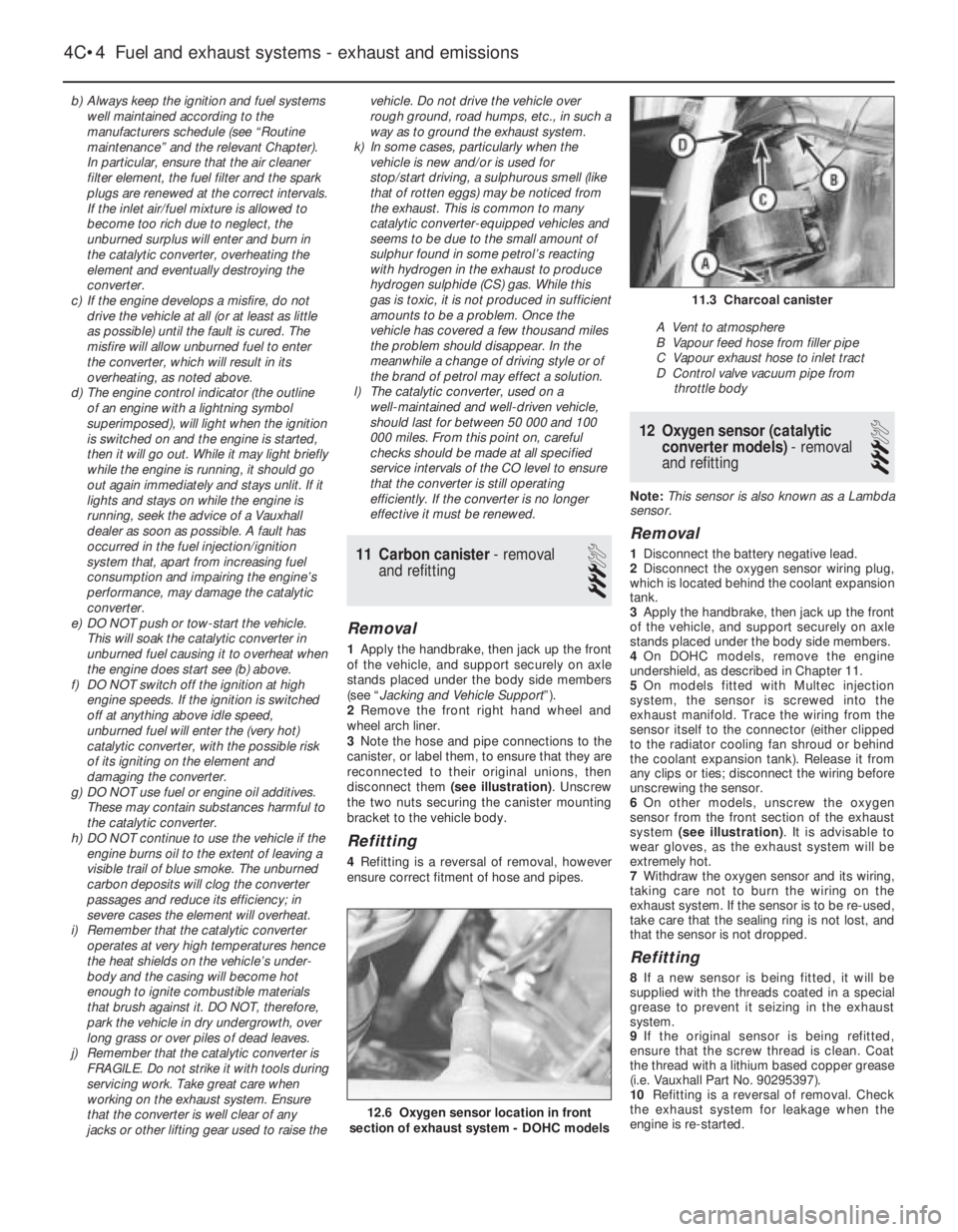
disconnect them (see illustration). Unscrew
the two nuts securing the canister mounting
bracket to the vehicle body.
Refitting
4Refitting is a reversal of removal, however
ensure correct fitment of hose and pipes.
12Oxygen sensor (catalytic
converter models) - removal
and refitting
3
Note: This sensor is also known as a Lambda
sensor.
Removal
1Disconnect the battery negative lead.
2Disconnect the oxygen sensor wiring plug,
which is located behind the coolant expansion
tank.
3Apply the handbrake, then jack up the front
of the vehicle, and support securely on axle
stands placed under the body side members.
4On DOHC models, remove the engine
undershield, as described in Chapter 11.
5On models fitted with Multec injection
system, the sensor is screwed into the
exhaust manifold. Trace the wiring from the
sensor itself to the connector (either clipped
to the radiator cooling fan shroud or behind
the coolant expansion tank). Release it from
any clips or ties; disconnect the wiring before
unscrewing the sensor.
6On other models, unscrew the oxygen
sensor from the front section of the exhaust
system (see illustration). It is advisable to
wear gloves, as the exhaust system will be
extremely hot.
7Withdraw the oxygen sensor and its wiring,
taking care not to burn the wiring on the
exhaust system. If the sensor is to be re-used,
take care that the sealing ring is not lost, and
that the sensor is not dropped.
Refitting
8If a new sensor is being fitted, it will be
supplied with the threads coated in a special
grease to prevent it seizing in the exhaust
system.
9If the original sensor is being refitted,
ensure that the screw thread is clean. Coat
the thread with a lithium based copper grease
(i.e. Vauxhall Part No. 90295397).
10Refitting is a reversal of removal. Check
the exhaust system for leakage when the
engine is re-started.
4C•4Fuel and exhaust systems - exhaust and emissions
12.6 Oxygen sensor location in front
section of exhaust system - DOHC models
11.3 Charcoal canister
A Vent to atmosphere
B Vapour feed hose from filler pipe
C Vapour exhaust hose to inlet tract
D Control valve vacuum pipe from
throttle body
Page 130 of 525
13Exhaust manifold - removal
and refitting
3
Note:New manifold-to-cylinder head, and
manifold-to-downpipe, gaskets must be used
on refitting. Exhaust manifolds on DOHC
models are of tubular design, which form part
of the front section of the exhaust.
Removal
1Disconnect the battery negative lead.
2Disconnect the HT leads from the spark
plugs, if necessary labelling them to ensure
refitting to the correct cylinders.
3Loosen the clamp screw and disconnect
the air cleaner hot air tube from the shroud on
the manifold, if fitted. Remove the securing
screws and withdraw the hot air shroud from
the manifold.
4Working under the manifold, unscrew and
remove the four bolts securing the exhaust
downpipe to the manifold.
5If fitted, disconnect the oxygen sensor
wiring
6Separate the downpipe from the manifold,
and support with wire or string. Do not allow
the front section of the exhaust system to hang
under its own weight. Recover the gasket.
7Unscrew the securing nuts, and withdraw
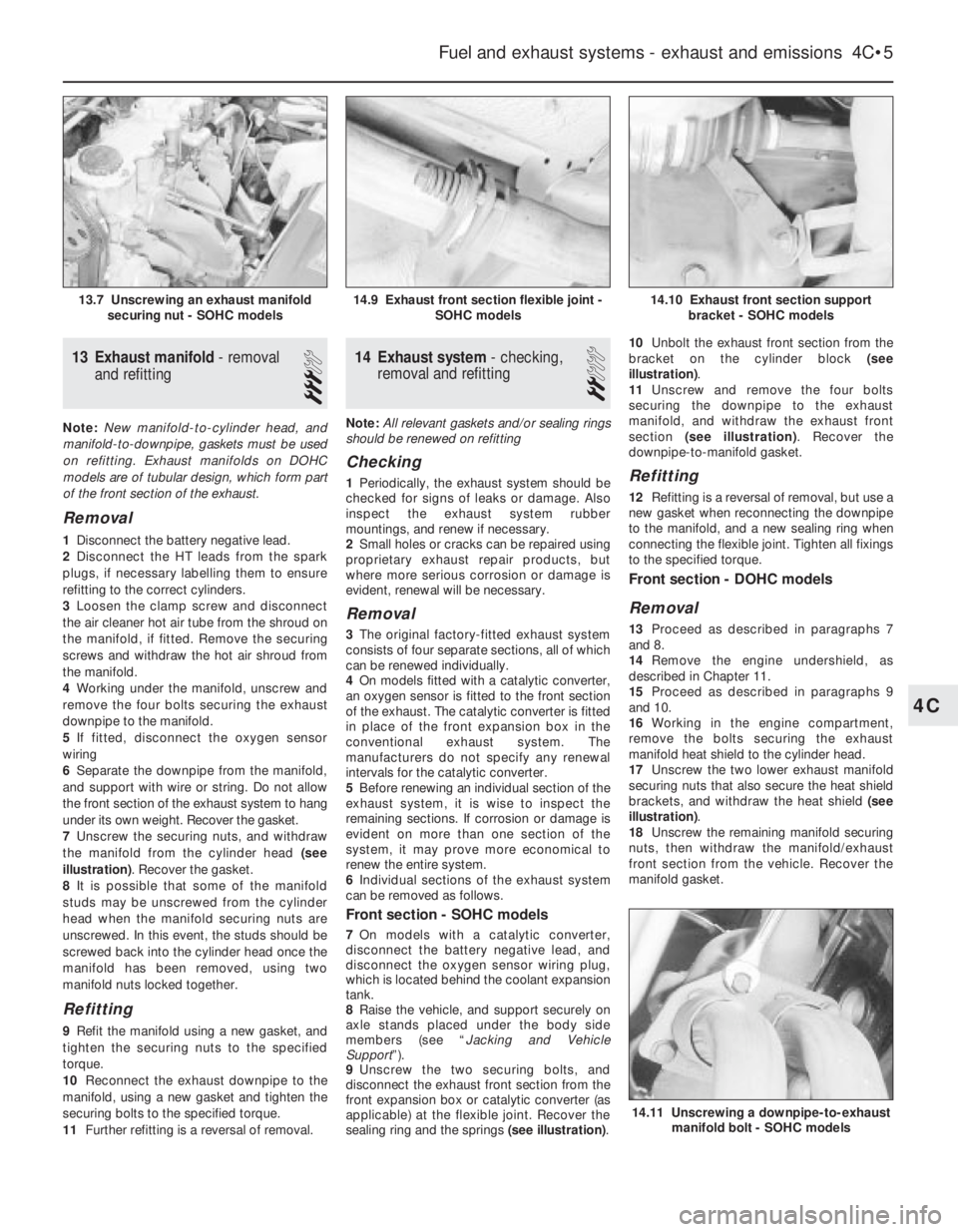
the manifold from the cylinder head (see
illustration). Recover the gasket.
8It is possible that some of the manifold
studs may be unscrewed from the cylinder
head when the manifold securing nuts are
unscrewed. In this event, the studs should be
screwed back into the cylinder head once the
manifold has been removed, using two
manifold nuts locked together.
Refitting
9Refit the manifold using a new gasket, and
tighten the securing nuts to the specified
torque.
10Reconnect the exhaust downpipe to the
manifold, using a new gasket and tighten the
securing bolts to the specified torque.
11Further refitting is a reversal of removal.
14Exhaust system - checking,
removal and refitting
2
Note: All relevant gaskets and/or sealing rings
should be renewed on refitting
Checking
1Periodically, the exhaust system should be
checked for signs of leaks or damage. Also
inspect the exhaust system rubber
mountings, and renew if necessary.
2Small holes or cracks can be repaired using
proprietary exhaust repair products, but
where more serious corrosion or damage is
evident, renewal will be necessary.
Removal
3The original factory-fitted exhaust system
consists of four separate sections, all of which
can be renewed individually.
4On models fitted with a catalytic converter,
an oxygen sensor is fitted to the front section
of the exhaust. The catalytic converter is fitted
in place of the front expansion box in the
conventional exhaust system. The
manufacturers do not specify any renewal
intervals for the catalytic converter.
5Before renewing an individual section of the
exhaust system, it is wise to inspect the
remaining sections. If corrosion or damage is
evident on more than one section of the
system, it may prove more economical to
renew the entire system.
6Individual sections of the exhaust system
can be removed as follows.
Front section - SOHC models
7On models with a catalytic converter,
disconnect the battery negative lead, and
disconnect the oxygen sensor wiring plug,
which is located behind the coolant expansion
tank.
8Raise the vehicle, and support securely on
axle stands placed under the body side
members (see “Jacking and Vehicle
Support”).
9Unscrew the two securing bolts, and
disconnect the exhaust front section from the
front expansion box or catalytic converter (as
applicable) at the flexible joint. Recover the
sealing ring and the springs (see illustration).10Unbolt the exhaust front section from the
bracket on the cylinder block (see
illustration).
11Unscrew and remove the four bolts
securing the downpipe to the exhaust
manifold, and withdraw the exhaust front
section (see illustration). Recover the
downpipe-to-manifold gasket.
Refitting
12Refitting is a reversal of removal, but use a
new gasket when reconnecting the downpipe
to the manifold, and a new sealing ring when
connecting the flexible joint. Tighten all fixings
to the specified torque.
Front section - DOHC models
Removal
13Proceed as described in paragraphs 7
and 8.
14Remove the engine undershield, as
described in Chapter 11.
15Proceed as described in paragraphs 9
and 10.
16Working in the engine compartment,
remove the bolts securing the exhaust
manifold heat shield to the cylinder head.
17Unscrew the two lower exhaust manifold
securing nuts that also secure the heat shield
brackets, and withdraw the heat shield (see
illustration).
18Unscrew the remaining manifold securing
nuts, then withdraw the manifold/exhaust
front section from the vehicle. Recover the
manifold gasket.
Fuel and exhaust systems - exhaust and emissions 4C•5
14.10 Exhaust front section support
bracket - SOHC models
14.11 Unscrewing a downpipe-to-exhaust
manifold bolt - SOHC models
14.9 Exhaust front section flexible joint -
SOHC models13.7 Unscrewing an exhaust manifold
securing nut - SOHC models
4C
Page 135 of 525
4Front disc pads - inspection,
removal and refitting
3
Note: When working on the brake
components, take care not to disperse brake
dust into the air, or to inhale it, since it may
contain asbestos, which can damage your
health.
Inspection
1Where applicable, remove the wheel trims,
then loosen the front roadwheel bolts and
apply the handbrake. Jack up the front of the
vehicle, and support on axle stands (see
“Jacking and Vehicle Support”) positioned
under the body side members.
2Remove the roadwheels. Turn the steering to
full right-hand lock, and check the wear of the
friction material on the right-hand brake pads.
Check that the thickness of the friction material
(including the backing plate) is not less than the
minimum given in the Specifications.
3Turn the steering to full left-hand lock, and
check the left-hand brake pads in the same
way.
4If any brake pad is worn below the specified
minimum thickness, renew all the front pads
as a set.
5If the pads require renewal, continue as
follows according to model.
Removal
1.4, 1.6 and 1.8 litre models
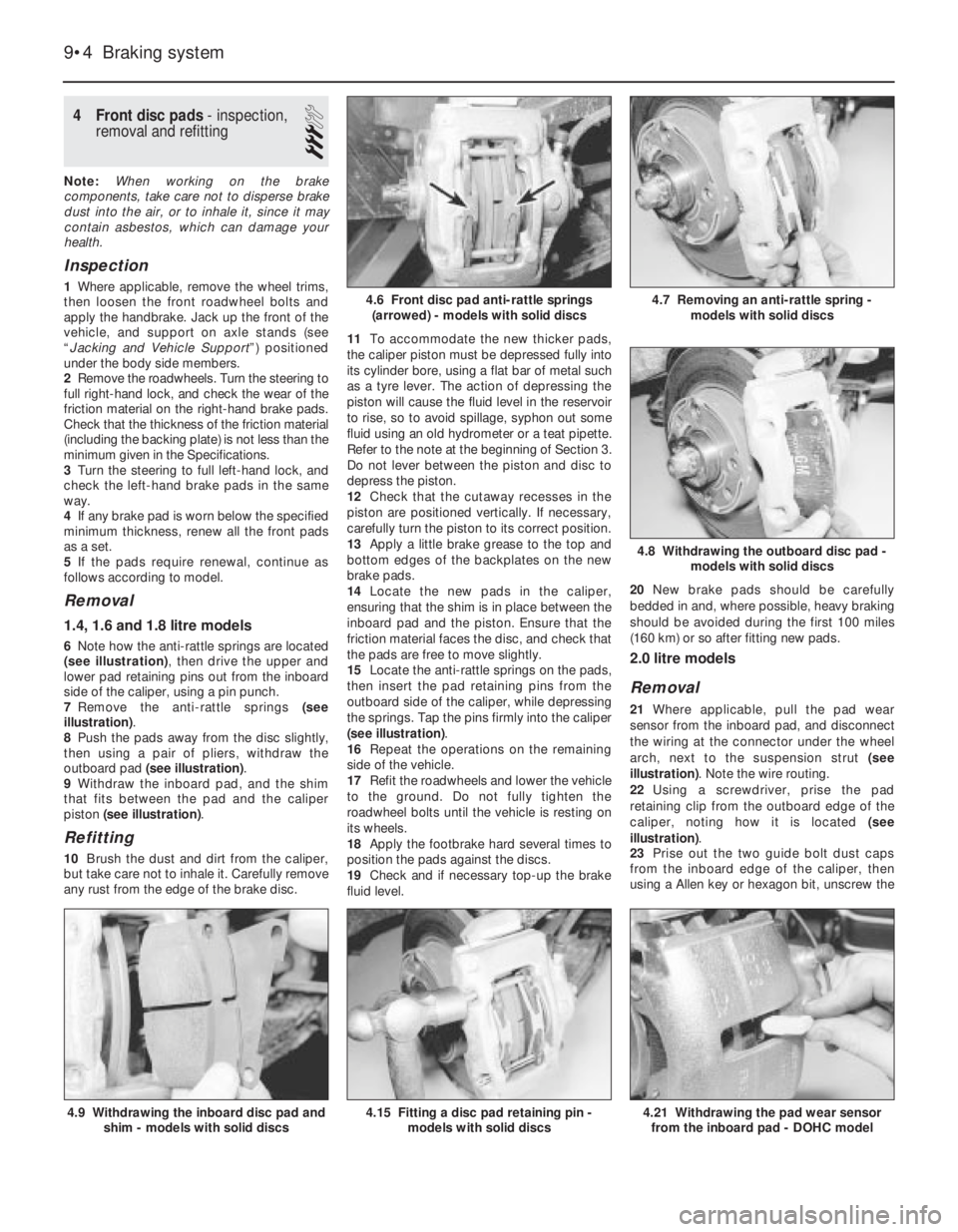
6Note how the anti-rattle springs are located
(see illustration), then drive the upper and
lower pad retaining pins out from the inboard
side of the caliper, using a pin punch.
7Remove the anti-rattle springs (see
illustration).
8Push the pads away from the disc slightly,
then using a pair of pliers, withdraw the
outboard pad (see illustration).
9Withdraw the inboard pad, and the shim
that fits between the pad and the caliper
piston (see illustration).
Refitting
10Brush the dust and dirt from the caliper,
but take care not to inhale it. Carefully remove
any rust from the edge of the brake disc.11To accommodate the new thicker pads,
the caliper piston must be depressed fully into
its cylinder bore, using a flat bar of metal such
as a tyre lever. The action of depressing the
piston will cause the fluid level in the reservoir
to rise, so to avoid spillage, syphon out some
fluid using an old hydrometer or a teat pipette.
Refer to the note at the beginning of Section 3.
Do not lever between the piston and disc to
depress the piston.
12Check that the cutaway recesses in the
piston are positioned vertically. If necessary,
carefully turn the piston to its correct position.
13Apply a little brake grease to the top and
bottom edges of the backplates on the new
brake pads.
14Locate the new pads in the caliper,
ensuring that the shim is in place between the
inboard pad and the piston. Ensure that the
friction material faces the disc, and check that
the pads are free to move slightly.
15Locate the anti-rattle springs on the pads,
then insert the pad retaining pins from the
outboard side of the caliper, while depressing
the springs. Tap the pins firmly into the caliper
(see illustration).
16Repeat the operations on the remaining
side of the vehicle.
17Refit the roadwheels and lower the vehicle
to the ground. Do not fully tighten the
roadwheel bolts until the vehicle is resting on
its wheels.
18Apply the footbrake hard several times to
position the pads against the discs.
19Check and if necessary top-up the brake
fluid level.20New brake pads should be carefully
bedded in and, where possible, heavy braking
should be avoided during the first 100 miles
(160 km) or so after fitting new pads.
2.0 litre models
Removal
21Where applicable, pull the pad wear
sensor from the inboard pad, and disconnect
the wiring at the connector under the wheel
arch, next to the suspension strut (see
illustration). Note the wire routing.
22Using a screwdriver, prise the pad
retaining clip from the outboard edge of the
caliper, noting how it is located (see
illustration).
23Prise out the two guide bolt dust caps
from the inboard edge of the caliper, then
using a Allen key or hexagon bit, unscrew the
9•4Braking system
4.6 Front disc pad anti-rattle springs
(arrowed) - models with solid discs
4.8 Withdrawing the outboard disc pad -
models with solid discs
4.21 Withdrawing the pad wear sensor
from the inboard pad - DOHC model4.15 Fitting a disc pad retaining pin -
models with solid discs4.9 Withdrawing the inboard disc pad and
shim - models with solid discs
4.7 Removing an anti-rattle spring -
models with solid discs
Page 136 of 525
guide bolts, and lift the caliper and inboard
pad from the bracket. Recover the outboard
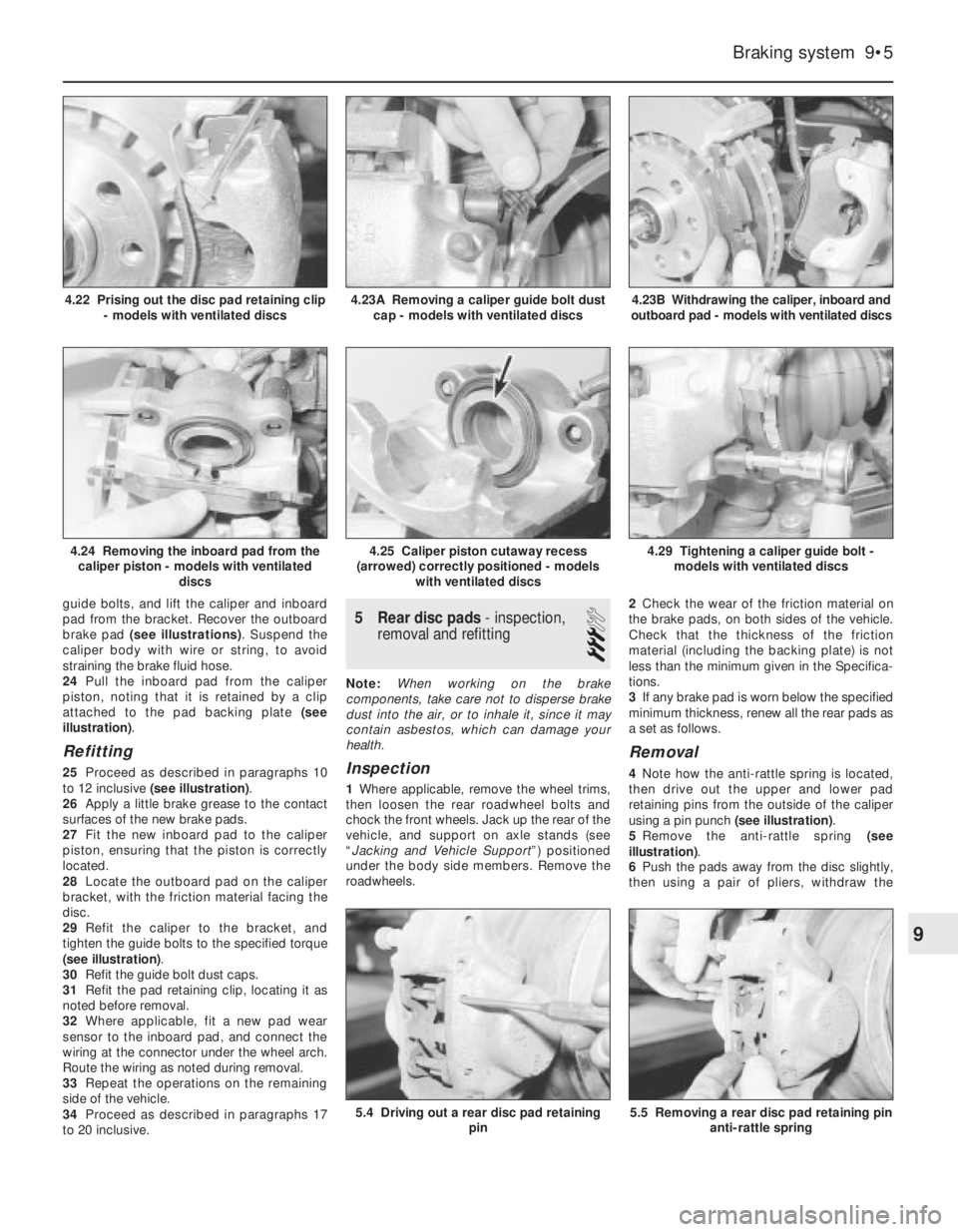
brake pad (see illustrations). Suspend the
caliper body with wire or string, to avoid
straining the brake fluid hose.
24Pull the inboard pad from the caliper
piston, noting that it is retained by a clip
attached to the pad backing plate (see
illustration).
Refitting
25Proceed as described in paragraphs 10
to 12 inclusive (see illustration).
26Apply a little brake grease to the contact
surfaces of the new brake pads.
27Fit the new inboard pad to the caliper
piston, ensuring that the piston is correctly
located.
28Locate the outboard pad on the caliper
bracket, with the friction material facing the
disc.
29Refit the caliper to the bracket, and
tighten the guide bolts to the specified torque
(see illustration).
30Refit the guide bolt dust caps.
31Refit the pad retaining clip, locating it as
noted before removal.
32Where applicable, fit a new pad wear
sensor to the inboard pad, and connect the
wiring at the connector under the wheel arch.
Route the wiring as noted during removal.
33Repeat the operations on the remaining
side of the vehicle.
34Proceed as described in paragraphs 17
to 20 inclusive.
5Rear disc pads - inspection,
removal and refitting
3
Note: When working on the brake
components, take care not to disperse brake
dust into the air, or to inhale it, since it may
contain asbestos, which can damage your
health.
Inspection
1Where applicable, remove the wheel trims,
then loosen the rear roadwheel bolts and
chock the front wheels. Jack up the rear of the
vehicle, and support on axle stands (see
“Jacking and Vehicle Support”) positioned
under the body side members. Remove the
roadwheels.2Check the wear of the friction material on
the brake pads, on both sides of the vehicle.
Check that the thickness of the friction
material (including the backing plate) is not
less than the minimum given in the Specifica-
tions.
3If any brake pad is worn below the specified
minimum thickness, renew all the rear pads as
a set as follows.
Removal
4Note how the anti-rattle spring is located,
then drive out the upper and lower pad
retaining pins from the outside of the caliper
using a pin punch (see illustration).
5Remove the anti-rattle spring (see
illustration).
6Push the pads away from the disc slightly,
then using a pair of pliers, withdraw the
Braking system 9•5
4.23B Withdrawing the caliper, inboard and
outboard pad - models with ventilated discs
5.5 Removing a rear disc pad retaining pin
anti-rattle spring5.4 Driving out a rear disc pad retaining
pin
4.29 Tightening a caliper guide bolt -
models with ventilated discs4.25 Caliper piston cutaway recess
(arrowed) correctly positioned - models
with ventilated discs4.24 Removing the inboard pad from the
caliper piston - models with ventilated
discs
4.23A Removing a caliper guide bolt dust
cap - models with ventilated discs4.22 Prising out the disc pad retaining clip
- models with ventilated discs
9
Page 137 of 525
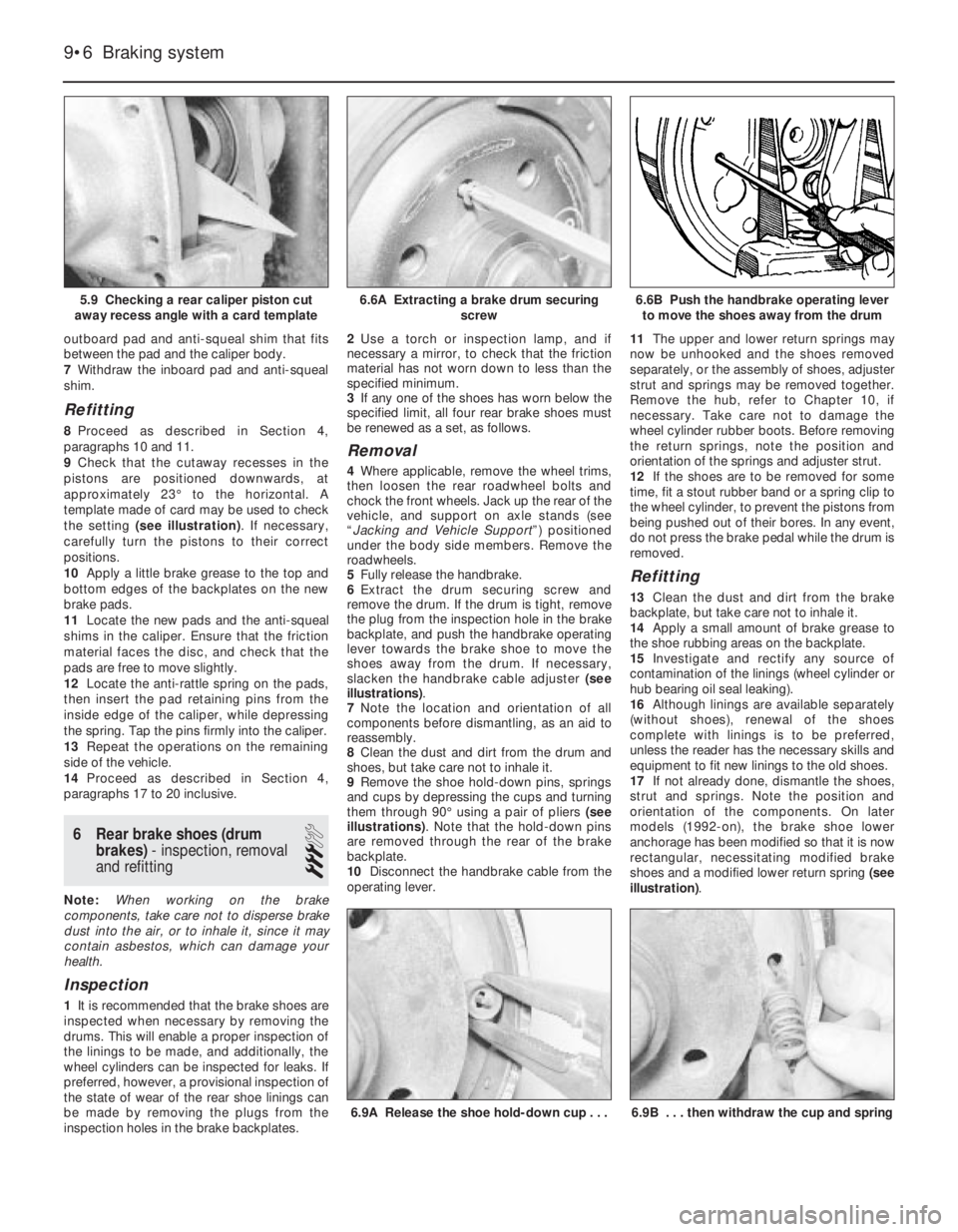
outboard pad and anti-squeal shim that fits
between the pad and the caliper body.
7Withdraw the inboard pad and anti-squeal
shim.
Refitting
8Proceed as described in Section 4,
paragraphs 10 and 11.
9Check that the cutaway recesses in the
pistons are positioned downwards, at
approximately 23°to the horizontal. A
template made of card may be used to check
the setting (see illustration). If necessary,
carefully turn the pistons to their correct
positions.
10Apply a little brake grease to the top and
bottom edges of the backplates on the new
brake pads.
11Locate the new pads and the anti-squeal
shims in the caliper. Ensure that the friction
material faces the disc, and check that the
pads are free to move slightly.
12Locate the anti-rattle spring on the pads,
then insert the pad retaining pins from the
inside edge of the caliper, while depressing
the spring. Tap the pins firmly into the caliper.
13Repeat the operations on the remaining
side of the vehicle.
14Proceed as described in Section 4,
paragraphs 17 to 20 inclusive.
6Rear brake shoes (drum
brakes) - inspection, removal
and refitting
3
Note: When working on the brake
components, take care not to disperse brake
dust into the air, or to inhale it, since it may
contain asbestos, which can damage your
health.
Inspection
1It is recommended that the brake shoes are
inspected when necessary by removing the
drums. This will enable a proper inspection of
the linings to be made, and additionally, the
wheel cylinders can be inspected for leaks. If
preferred, however, a provisional inspection of
the state of wear of the rear shoe linings can
be made by removing the plugs from the
inspection holes in the brake backplates.2Use a torch or inspection lamp, and if
necessary a mirror, to check that the friction
material has not worn down to less than the
specified minimum.
3If any one of the shoes has worn below the
specified limit, all four rear brake shoes must
be renewed as a set, as follows.
Removal
4Where applicable, remove the wheel trims,
then loosen the rear roadwheel bolts and
chock the front wheels. Jack up the rear of the
vehicle, and support on axle stands (see
“Jacking and Vehicle Support”) positioned
under the body side members. Remove the
roadwheels.
5Fully release the handbrake.
6Extract the drum securing screw and
remove the drum. If the drum is tight, remove
the plug from the inspection hole in the brake
backplate, and push the handbrake operating
lever towards the brake shoe to move the
shoes away from the drum. If necessary,
slacken the handbrake cable adjuster (see
illustrations).
7Note the location and orientation of all
components before dismantling, as an aid to
reassembly.
8Clean the dust and dirt from the drum and
shoes, but take care not to inhale it.
9Remove the shoe hold-down pins, springs
and cups by depressing the cups and turning
them through 90°using a pair of pliers (see
illustrations). Note that the hold-down pins
are removed through the rear of the brake
backplate.
10Disconnect the handbrake cable from the
operating lever.11The upper and lower return springs may
now be unhooked and the shoes removed
separately, or the assembly of shoes, adjuster
strut and springs may be removed together.
Remove the hub, refer to Chapter 10, if
necessary. Take care not to damage the
wheel cylinder rubber boots. Before removing
the return springs, note the position and
orientation of the springs and adjuster strut.
12If the shoes are to be removed for some
time, fit a stout rubber band or a spring clip to
the wheel cylinder, to prevent the pistons from
being pushed out of their bores. In any event,
do not press the brake pedal while the drum is
removed.
Refitting
13Clean the dust and dirt from the brake
backplate, but take care not to inhale it.
14Apply a small amount of brake grease to
the shoe rubbing areas on the backplate.
15Investigate and rectify any source of
contamination of the linings (wheel cylinder or
hub bearing oil seal leaking).
16Although linings are available separately
(without shoes), renewal of the shoes
complete with linings is to be preferred,
unless the reader has the necessary skills and
equipment to fit new linings to the old shoes.
17If not already done, dismantle the shoes,
strut and springs. Note the position and
orientation of the components. On later
models (1992-on), the brake shoe lower
anchorage has been modified so that it is now
rectangular, necessitating modified brake
shoes and a modified lower return spring (see
illustration).
9•6Braking system
5.9 Checking a rear caliper piston cut
away recess angle with a card template6.6B Push the handbrake operating lever
to move the shoes away from the drum
6.9B . . . then withdraw the cup and spring6.9A Release the shoe hold-down cup . . .
6.6A Extracting a brake drum securing
screw
Page 139 of 525
5If any one of the shoes has worn below the
specified limit, all four handbrake shoes must
be renewed as a set, as follows.
SOHC models
Removal
6Clean the dust and dirt from the various
components, but take care not to inhale it.
7Disconnect the handbrake cable and the
return spring from the handbrake operating
lever at the brake backplate. If necessary,
slacken the handbrake cable adjustment, with
reference to Section 26.
8Remove the shoe hold-down pins, springs
and cups by depressing the cups and turning
them through 90°using a pair of pliers. Note
that the hold-down pins are removed through
the rear of the brake backplate.
9The shoes, adjuster, handbrake operating
lever and return springs can now be removed
together as an assembly.
10Note the position and orientation of all
components, then unhook the upper and
lower return springs from the shoes, and
recover the handbrake operating lever and the
adjuster.
Refitting
11Apply a little brake grease to the threads
of the adjuster, then screw it together to its
minimum length. Also apply a little brake
grease to the shoe rubbing areas on the
lockplate.
12Fit one of the new brake shoes, and
secure it to the backplate with the hold-down
pin, spring and cup.
13Fit the handbrake operating lever in
position.
14Fit the remaining brake shoe, and secure
with the hold-down pin, spring and cup.
15Hook the upper return spring onto the
shoes.
16Fit the adjuster between the lower ends of
the shoes, as noted before dismantling, then
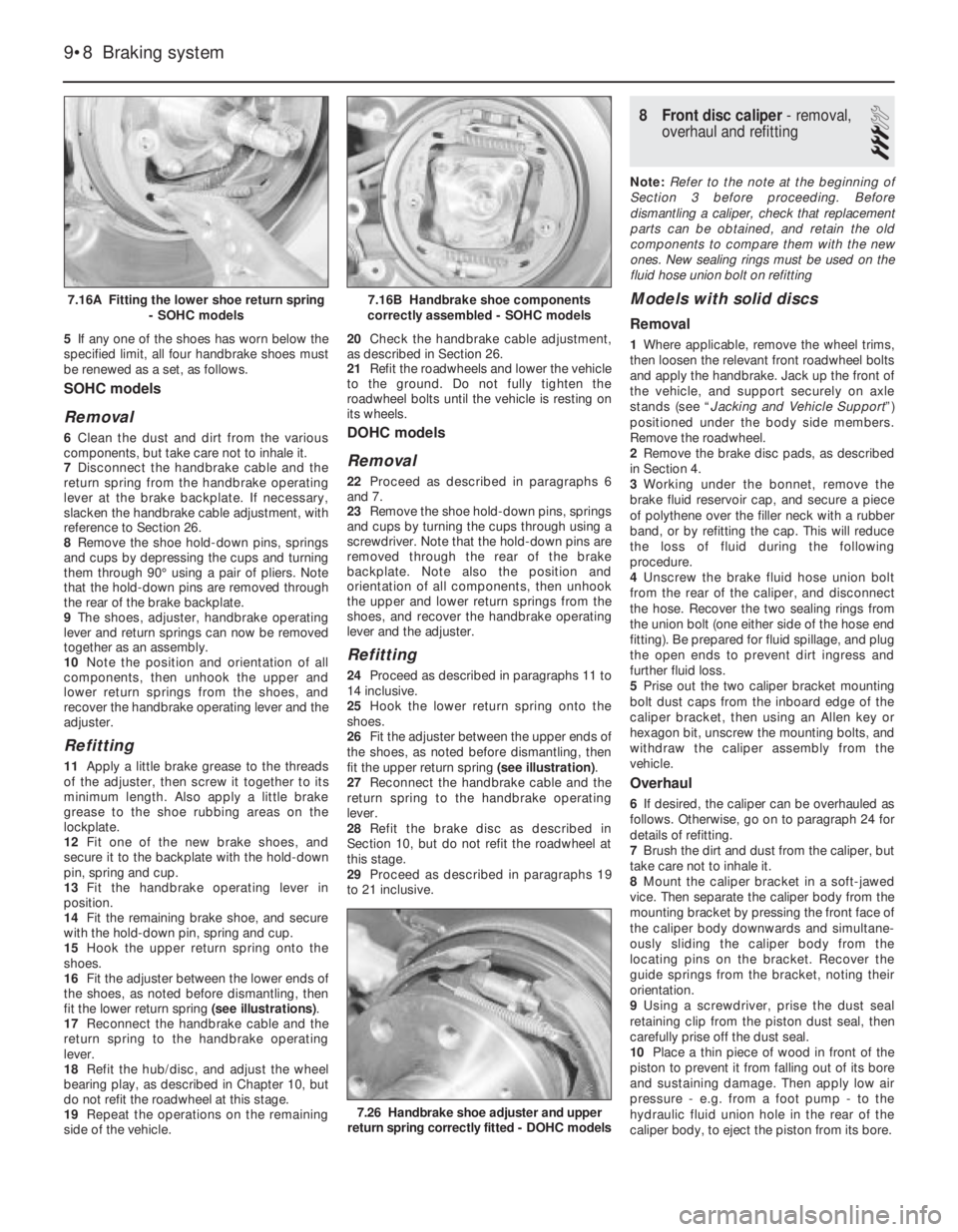
fit the lower return spring (see illustrations).
17Reconnect the handbrake cable and the
return spring to the handbrake operating
lever.
18Refit the hub/disc, and adjust the wheel
bearing play, as described in Chapter 10, but
do not refit the roadwheel at this stage.
19Repeat the operations on the remaining
side of the vehicle.20Check the handbrake cable adjustment,
as described in Section 26.
21Refit the roadwheels and lower the vehicle
to the ground. Do not fully tighten the
roadwheel bolts until the vehicle is resting on
its wheels.
DOHC models
Removal
22Proceed as described in paragraphs 6
and 7.
23Remove the shoe hold-down pins, springs
and cups by turning the cups through using a
screwdriver. Note that the hold-down pins are
removed through the rear of the brake
backplate. Note also the position and
orientation of all components, then unhook
the upper and lower return springs from the
shoes, and recover the handbrake operating
lever and the adjuster.
Refitting
24Proceed as described in paragraphs 11 to
14 inclusive.
25Hook the lower return spring onto the
shoes.
26Fit the adjuster between the upper ends of
the shoes, as noted before dismantling, then
fit the upper return spring (see illustration).
27Reconnect the handbrake cable and the
return spring to the handbrake operating
lever.
28Refit the brake disc as described in
Section 10, but do not refit the roadwheel at
this stage.
29Proceed as described in paragraphs 19
to 21 inclusive.
8Front disc caliper - removal,
overhaul and refitting
3
Note: Refer to the note at the beginning of
Section 3 before proceeding. Before
dismantling a caliper, check that replacement
parts can be obtained, and retain the old
components to compare them with the new
ones. New sealing rings must be used on the
fluid hose union bolt on refitting
Models with solid discs
Removal
1Where applicable, remove the wheel trims,
then loosen the relevant front roadwheel bolts
and apply the handbrake. Jack up the front of
the vehicle, and support securely on axle
stands (see “Jacking and Vehicle Support”)
positioned under the body side members.
Remove the roadwheel.
2Remove the brake disc pads, as described
in Section 4.
3Working under the bonnet, remove the
brake fluid reservoir cap, and secure a piece
of polythene over the filler neck with a rubber
band, or by refitting the cap. This will reduce
the loss of fluid during the following
procedure.
4Unscrew the brake fluid hose union bolt
from the rear of the caliper, and disconnect
the hose. Recover the two sealing rings from
the union bolt (one either side of the hose end
fitting). Be prepared for fluid spillage, and plug
the open ends to prevent dirt ingress and
further fluid loss.
5Prise out the two caliper bracket mounting
bolt dust caps from the inboard edge of the
caliper bracket, then using an Allen key or
hexagon bit, unscrew the mounting bolts, and
withdraw the caliper assembly from the
vehicle.
Overhaul
6If desired, the caliper can be overhauled as
follows. Otherwise, go on to paragraph 24 for
details of refitting.
7Brush the dirt and dust from the caliper, but
take care not to inhale it.
8Mount the caliper bracket in a soft-jawed
vice. Then separate the caliper body from the
mounting bracket by pressing the front face of
the caliper body downwards and simultane-
ously sliding the caliper body from the
locating pins on the bracket. Recover the
guide springs from the bracket, noting their
orientation.
9Using a screwdriver, prise the dust seal
retaining clip from the piston dust seal, then
carefully prise off the dust seal.
10Place a thin piece of wood in front of the
piston to prevent it from falling out of its bore
and sustaining damage. Then apply low air
pressure - e.g. from a foot pump - to the
hydraulic fluid union hole in the rear of the
caliper body, to eject the piston from its bore.
9•8Braking system
7.16A Fitting the lower shoe return spring
- SOHC models
7.26 Handbrake shoe adjuster and upper
return spring correctly fitted - DOHC models
7.16B Handbrake shoe components
correctly assembled - SOHC models
Page 140 of 525
11Remove the wood and carefully withdraw
the piston.
12Carefully prise the seal from the groove in
the caliper piston bore, using a plastic or
wooden instrument.
13Inspect the surfaces of the piston and its
bore in the caliper for scoring, or evidence of
metal-to-metal contact. If evident, renew the
complete caliper assembly.
14If the piston and bore are in good
condition, discard the seals and obtain a
repair kit, which will contain all the necessary
renewable items.
15Clean the piston and cylinder bore with
brake fluid or methylated spirit, nothing else!
16Begin reassembly by fitting the seal into
the caliper bore.
17Locate the dust seal in its groove in the
piston. Dip the piston in clean brake fluid and
insert it squarely into the cylinder. Check that
the cutaway recesses in the piston are
positioned horizontally. If necessary, carefully
turn the piston to its correct position.
18When the piston has been partially
depressed, engage the dust seal with the rim
of the caliper bore, and fit the retaining clip.
19Push the piston further into its bore, but
not as far as the stop, ensuring that it does
not jam.
20If desired, the caliper body locating pin
rubbers can be renewed. Extract the nylon
compression sleeve from within each rubber,
then carefully compress the rubber shoulder,
and push the rubber through the hole in the
caliper body to remove it from the inboard
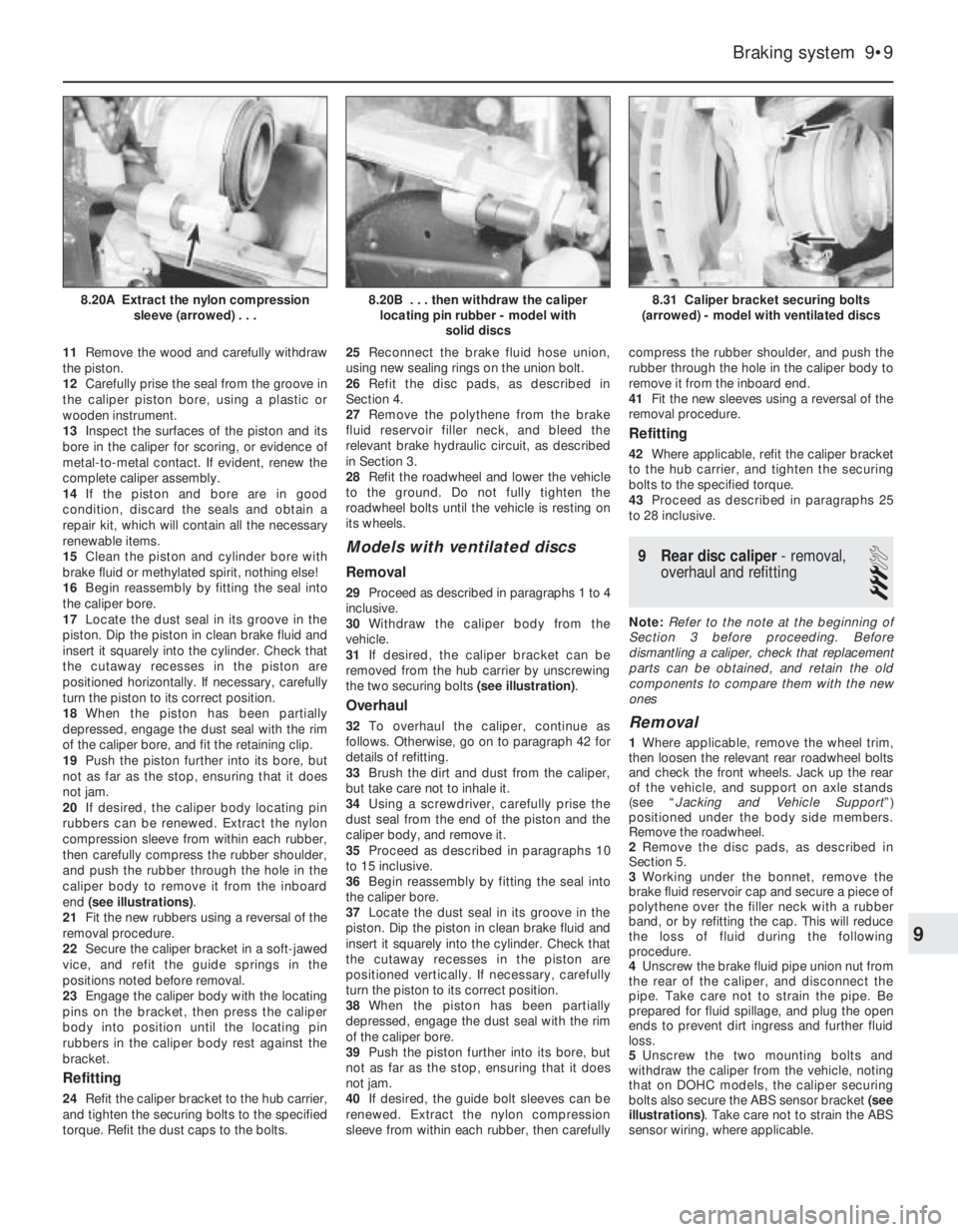
end (see illustrations).
21Fit the new rubbers using a reversal of the
removal procedure.
22Secure the caliper bracket in a soft-jawed
vice, and refit the guide springs in the
positions noted before removal.
23Engage the caliper body with the locating
pins on the bracket, then press the caliper
body into position until the locating pin
rubbers in the caliper body rest against the
bracket.
Refitting
24Refit the caliper bracket to the hub carrier,
and tighten the securing bolts to the specified
torque. Refit the dust caps to the bolts.25Reconnect the brake fluid hose union,
using new sealing rings on the union bolt.
26Refit the disc pads, as described in
Section 4.
27Remove the polythene from the brake
fluid reservoir filler neck, and bleed the
relevant brake hydraulic circuit, as described
in Section 3.
28Refit the roadwheel and lower the vehicle
to the ground. Do not fully tighten the
roadwheel bolts until the vehicle is resting on
its wheels.
Models with ventilated discs
Removal
29Proceed as described in paragraphs 1 to 4
inclusive.
30Withdraw the caliper body from the
vehicle.
31If desired, the caliper bracket can be
removed from the hub carrier by unscrewing
the two securing bolts (see illustration).
Overhaul
32To overhaul the caliper, continue as
follows. Otherwise, go on to paragraph 42 for
details of refitting.
33Brush the dirt and dust from the caliper,
but take care not to inhale it.
34Using a screwdriver, carefully prise the
dust seal from the end of the piston and the
caliper body, and remove it.
35Proceed as described in paragraphs 10
to 15 inclusive.
36Begin reassembly by fitting the seal into
the caliper bore.
37Locate the dust seal in its groove in the
piston. Dip the piston in clean brake fluid and
insert it squarely into the cylinder. Check that
the cutaway recesses in the piston are
positioned vertically. If necessary, carefully
turn the piston to its correct position.
38When the piston has been partially
depressed, engage the dust seal with the rim
of the caliper bore.
39Push the piston further into its bore, but
not as far as the stop, ensuring that it does
not jam.
40If desired, the guide bolt sleeves can be
renewed. Extract the nylon compression
sleeve from within each rubber, then carefullycompress the rubber shoulder, and push the
rubber through the hole in the caliper body to
remove it from the inboard end.
41Fit the new sleeves using a reversal of the
removal procedure.
Refitting
42Where applicable, refit the caliper bracket
to the hub carrier, and tighten the securing
bolts to the specified torque.
43Proceed as described in paragraphs 25
to 28 inclusive.
9Rear disc caliper - removal,
overhaul and refitting
3
Note: Refer to the note at the beginning of
Section 3 before proceeding. Before
dismantling a caliper, check that replacement
parts can be obtained, and retain the old
components to compare them with the new
ones
Removal
1Where applicable, remove the wheel trim,
then loosen the relevant rear roadwheel bolts
and check the front wheels. Jack up the rear
of the vehicle, and support on axle stands
(see “Jacking and Vehicle Support”)
positioned under the body side members.
Remove the roadwheel.
2Remove the disc pads, as described in
Section 5.
3Working under the bonnet, remove the
brake fluid reservoir cap and secure a piece of
polythene over the filler neck with a rubber
band, or by refitting the cap. This will reduce
the loss of fluid during the following
procedure.
4Unscrew the brake fluid pipe union nut from
the rear of the caliper, and disconnect the
pipe. Take care not to strain the pipe. Be
prepared for fluid spillage, and plug the open
ends to prevent dirt ingress and further fluid
loss.
5Unscrew the two mounting bolts and
withdraw the caliper from the vehicle, noting
that on DOHC models, the caliper securing
bolts also secure the ABS sensor bracket (see
illustrations). Take care not to strain the ABS
sensor wiring, where applicable.
Braking system 9•9
8.31 Caliper bracket securing bolts
(arrowed) - model with ventilated discs8.20B . . . then withdraw the caliper
locating pin rubber - model with
solid discs8.20A Extract the nylon compression
sleeve (arrowed) . . .
9
Page 141 of 525
Overhaul
6If desired, the caliper can be overhauled as
follows. Otherwise, go on to paragraph 20 for
details of refitting.
7Brush the dirt and dust from the caliper, but
take care not to inhale it.
8Note that no attempt must be made to
separate the two halves of the caliper.
9Using a screwdriver, prise the dust seal
retaining clips from the piston dust seals, then
carefully prise off the dust seals.
10Using a clamp, secure one of the pistons
in its fully retracted position. Then apply low
air pressure (e.g. from a foot pump), to the
hydraulic fluid union hole in the rear of the
caliper body, to eject the remaining piston
from its bore. Take care not to drop the
piston, which may result in damage.
11Temporarily close off the bore of the
removed piston, using a flat piece of wood or
similar improvised tool. Then remove the
clamp from the remaining piston, and again
apply air pressure to the caliper union to eject
the piston.
12Carefully prise the seals from the grooves
in the caliper piston bores, using a plastic or
wooden instrument.
13Inspect the surfaces of the pistons and
their bores in the caliper for scoring, or
evidence of metal-to-metal contact. If evident,
renew the complete caliper assembly.
14If the pistons and bores are in good
condition, discard the seals and obtain a
repair kit, which will contain all the necessary
renewable items. Also obtain a tube of brake
cylinder paste.
15Clean the piston and cylinder bore with
brake fluid or methylated spirit - nothing else!
16Apply a little brake cylinder paste to the
pistons, cylinder bores and piston seals.
17Begin reassembly by fitting the seals to
the grooves in the caliper bores.
18Locate the dust seals in their grooves in
the pistons, then insert the pistons carefully
into their bores until they enter the seals. It
may be necessary to rotate the pistons to
prevent them from jamming in the seals.
19When the pistons have been partially
depressed, engage the dust seals with the
rims of the caliper bores, and fit the retaining
clips.
Refitting
20Refit the caliper and tighten the securing
bolts to the specified torque, ensuring that the
ABS sensor bracket is in position, where
applicable.
21Reconnect the brake fluid pipe to the
caliper, and tighten the union nut.
22Refit the disc pads, as described in
Section 5.
23Remove the polythene from the brake
fluid reservoir filler neck and bleed the
relevant brake hydraulic circuit, as described
in Section 3.
24Refit the roadwheel and lower the vehicle
to the ground. Do not fully tighten the
roadwheel bolts until the vehicle is resting on
its wheels.
10Brake disc - inspection,
removal and refitting
3
Inspection
1Where applicable, remove the wheel trim,
then loosen the relevant roadwheel bolts. If
checking a front disc, apply the handbrake,
and if checking a rear disc, chock the front
wheels, then jack up the relevant end of the
vehicle and support on axle stands (see
“Jacking and Vehicle Support”) positioned
under the body side members. Remove the
roadwheel.
2Where applicable, check that the brake disc
securing screw is tight. Then fit a spacer
approximately 10.0 mm (0.4 in) thick to one of
the roadwheel bolts, and refit and tighten the
bolt in the hole opposite the disc securing
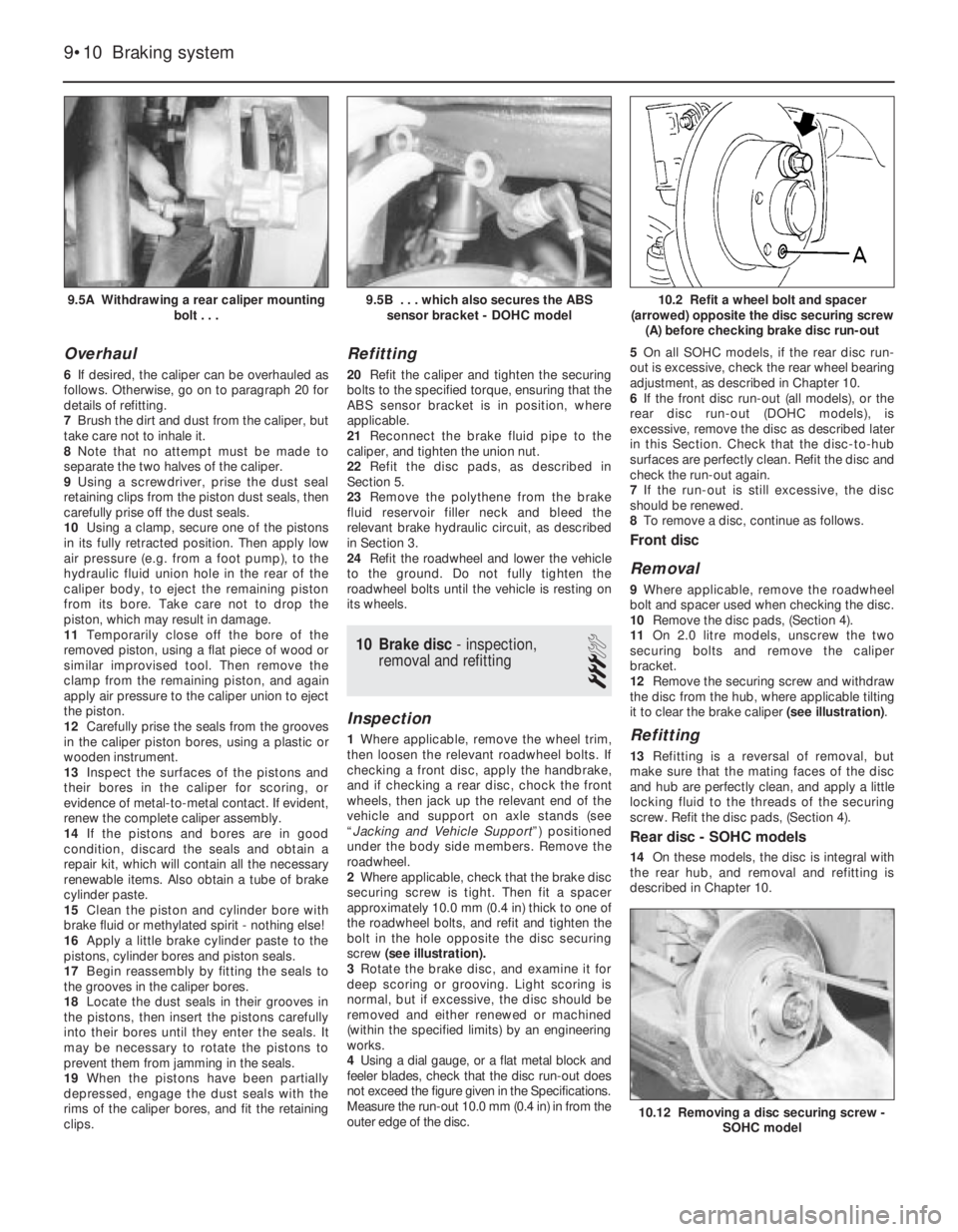
screw (see illustration).
3Rotate the brake disc, and examine it for
deep scoring or grooving. Light scoring is
normal, but if excessive, the disc should be
removed and either renewed or machined
(within the specified limits) by an engineering
works.
4Using a dial gauge, or a flat metal block and
feeler blades, check that the disc run-out does
not exceed the figure given in the Specifications.
Measure the run-out 10.0 mm (0.4 in) in from the
outer edge of the disc. 5On all SOHC models, if the rear disc run-
out is excessive, check the rear wheel bearing
adjustment, as described in Chapter 10.
6If the front disc run-out (all models), or the
rear disc run-out (DOHC models), is
excessive, remove the disc as described later
in this Section. Check that the disc-to-hub
surfaces are perfectly clean. Refit the disc and
check the run-out again.
7If the run-out is still excessive, the disc
should be renewed.
8To remove a disc, continue as follows.
Front disc
Removal
9Where applicable, remove the roadwheel
bolt and spacer used when checking the disc.
10Remove the disc pads, (Section 4).
11On 2.0 litre models, unscrew the two
securing bolts and remove the caliper
bracket.
12Remove the securing screw and withdraw
the disc from the hub, where applicable tilting
it to clear the brake caliper (see illustration).
Refitting
13Refitting is a reversal of removal, but
make sure that the mating faces of the disc
and hub are perfectly clean, and apply a little
locking fluid to the threads of the securing
screw. Refit the disc pads, (Section 4).
Rear disc - SOHC models
14On these models, the disc is integral with
the rear hub, and removal and refitting is
described in Chapter 10.
9•10Braking system
9.5A Withdrawing a rear caliper mounting
bolt . . .10.2 Refit a wheel bolt and spacer
(arrowed) opposite the disc securing screw
(A) before checking brake disc run-out
10.12 Removing a disc securing screw -
SOHC model
9.5B . . . which also secures the ABS
sensor bracket - DOHC model
Page 142 of 525
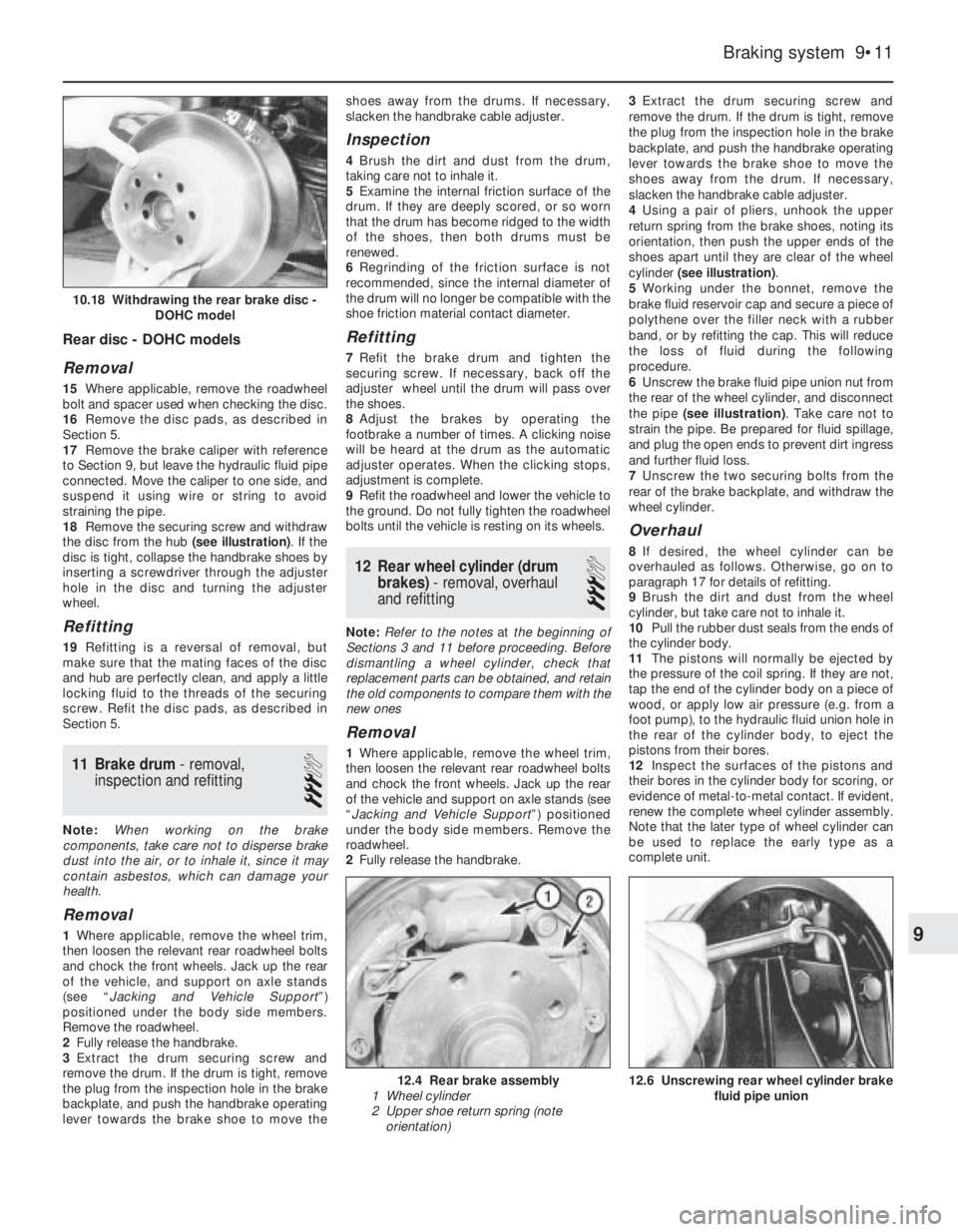
Rear disc - DOHC models
Removal
15Where applicable, remove the roadwheel
bolt and spacer used when checking the disc.
16Remove the disc pads, as described in
Section 5.
17Remove the brake caliper with reference
to Section 9, but leave the hydraulic fluid pipe
connected. Move the caliper to one side, and
suspend it using wire or string to avoid
straining the pipe.
18Remove the securing screw and withdraw
the disc from the hub (see illustration). If the
disc is tight, collapse the handbrake shoes by
inserting a screwdriver through the adjuster
hole in the disc and turning the adjuster
wheel.
Refitting
19Refitting is a reversal of removal, but
make sure that the mating faces of the disc
and hub are perfectly clean, and apply a little
locking fluid to the threads of the securing
screw. Refit the disc pads, as described in
Section 5.
11Brake drum - removal,
inspection and refitting
3
Note: When working on the brake
components, take care not to disperse brake
dust into the air, or to inhale it, since it may
contain asbestos, which can damage your
health.
Removal
1Where applicable, remove the wheel trim,
then loosen the relevant rear roadwheel bolts
and chock the front wheels. Jack up the rear
of the vehicle, and support on axle stands
(see “Jacking and Vehicle Support”)
positioned under the body side members.
Remove the roadwheel.
2Fully release the handbrake.
3Extract the drum securing screw and
remove the drum. If the drum is tight, remove
the plug from the inspection hole in the brake
backplate, and push the handbrake operating
lever towards the brake shoe to move theshoes away from the drums. If necessary,
slacken the handbrake cable adjuster.
Inspection
4Brush the dirt and dust from the drum,
taking care not to inhale it.
5Examine the internal friction surface of the
drum. If they are deeply scored, or so worn
that the drum has become ridged to the width
of the shoes, then both drums must be
renewed.
6Regrinding of the friction surface is not
recommended, since the internal diameter of
the drum will no longer be compatible with the
shoe friction material contact diameter.
Refitting
7Refit the brake drum and tighten the
securing screw. If necessary, back off the
adjuster wheel until the drum will pass over
the shoes.
8Adjust the brakes by operating the
footbrake a number of times. A clicking noise
will be heard at the drum as the automatic
adjuster operates. When the clicking stops,
adjustment is complete.
9Refit the roadwheel and lower the vehicle to
the ground. Do not fully tighten the roadwheel
bolts until the vehicle is resting on its wheels.
12Rear wheel cylinder (drum
brakes) - removal, overhaul
and refitting
3
Note: Refer to the notes at the beginning of
Sections 3 and 11 before proceeding. Before
dismantling a wheel cylinder, check that
replacement parts can be obtained, and retain
the old components to compare them with the
new ones
Removal
1Where applicable, remove the wheel trim,
then loosen the relevant rear roadwheel bolts
and chock the front wheels. Jack up the rear
of the vehicle and support on axle stands (see
“Jacking and Vehicle Support”) positioned
under the body side members. Remove the
roadwheel.
2Fully release the handbrake.3Extract the drum securing screw and
remove the drum. If the drum is tight, remove
the plug from the inspection hole in the brake
backplate, and push the handbrake operating
lever towards the brake shoe to move the
shoes away from the drum. If necessary,
slacken the handbrake cable adjuster.
4Using a pair of pliers, unhook the upper
return spring from the brake shoes, noting its
orientation, then push the upper ends of the
shoes apart until they are clear of the wheel
cylinder (see illustration).
5Working under the bonnet, remove the
brake fluid reservoir cap and secure a piece of
polythene over the filler neck with a rubber
band, or by refitting the cap. This will reduce
the loss of fluid during the following
procedure.
6Unscrew the brake fluid pipe union nut from
the rear of the wheel cylinder, and disconnect
the pipe (see illustration). Take care not to
strain the pipe. Be prepared for fluid spillage,
and plug the open ends to prevent dirt ingress
and further fluid loss.
7Unscrew the two securing bolts from the
rear of the brake backplate, and withdraw the
wheel cylinder.
Overhaul
8If desired, the wheel cylinder can be
overhauled as follows. Otherwise, go on to
paragraph 17 for details of refitting.
9Brush the dirt and dust from the wheel
cylinder, but take care not to inhale it.
10Pull the rubber dust seals from the ends of
the cylinder body.
11The pistons will normally be ejected by
the pressure of the coil spring. If they are not,
tap the end of the cylinder body on a piece of
wood, or apply low air pressure (e.g. from a
foot pump), to the hydraulic fluid union hole in
the rear of the cylinder body, to eject the
pistons from their bores.
12Inspect the surfaces of the pistons and
their bores in the cylinder body for scoring, or
evidence of metal-to-metal contact. If evident,
renew the complete wheel cylinder assembly.
Note that the later type of wheel cylinder can
be used to replace the early type as a
complete unit.
Braking system 9•11
12.6 Unscrewing rear wheel cylinder brake
fluid pipe union12.4 Rear brake assembly
1 Wheel cylinder
2 Upper shoe return spring (note
orientation)
10.18 Withdrawing the rear brake disc -
DOHC model
9
Page 143 of 525
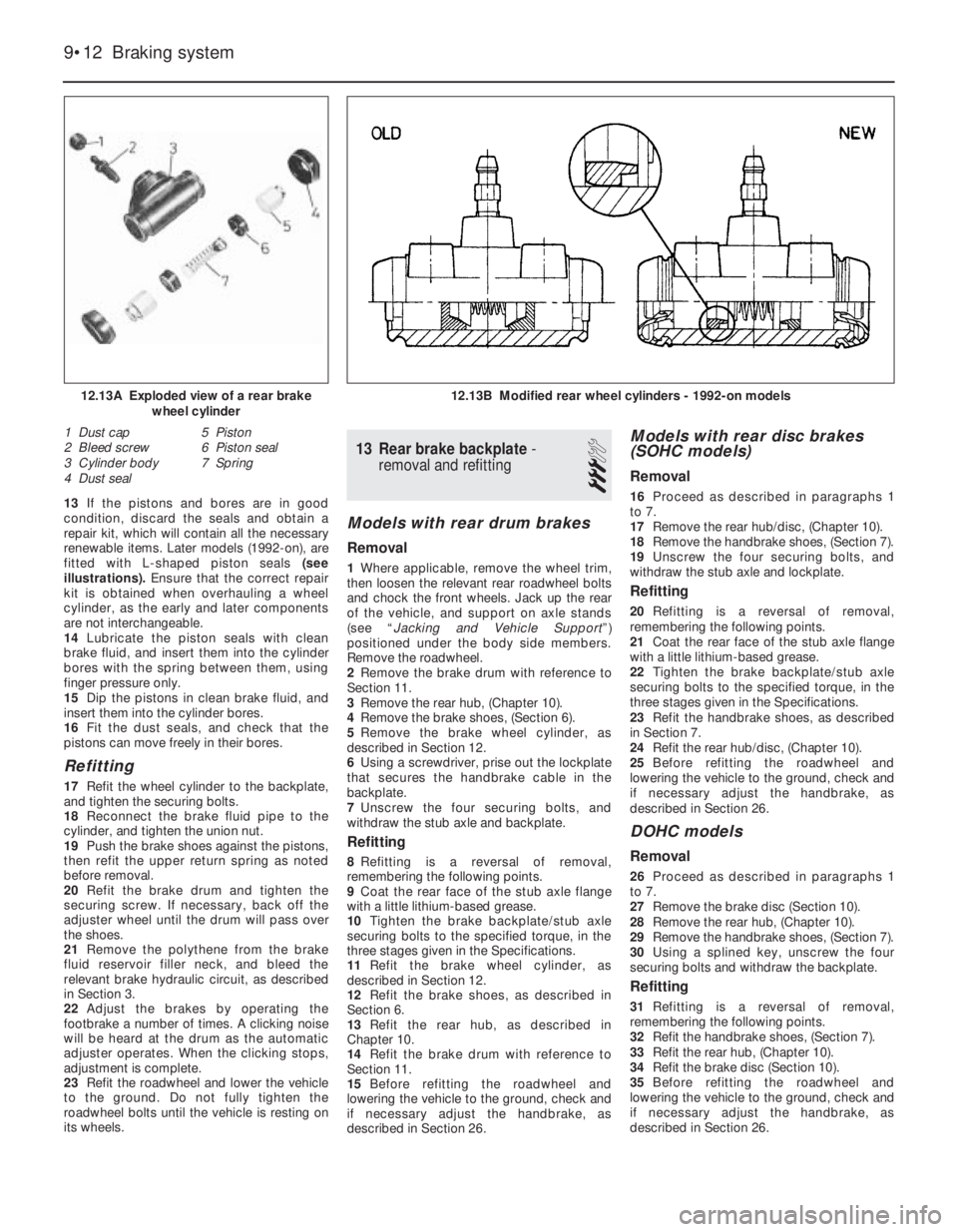
13If the pistons and bores are in good
condition, discard the seals and obtain a
repair kit, which will contain all the necessary
renewable items. Later models (1992-on), are
fitted with L-shaped piston seals (see
illustrations). Ensure that the correct repair
kit is obtained when overhauling a wheel
cylinder, as the early and later components
are not interchangeable.
14Lubricate the piston seals with clean
brake fluid, and insert them into the cylinder
bores with the spring between them, using
finger pressure only.
15Dip the pistons in clean brake fluid, and
insert them into the cylinder bores.
16Fit the dust seals, and check that the
pistons can move freely in their bores.
Refitting
17Refit the wheel cylinder to the backplate,
and tighten the securing bolts.
18Reconnect the brake fluid pipe to the
cylinder, and tighten the union nut.
19Push the brake shoes against the pistons,
then refit the upper return spring as noted
before removal.
20Refit the brake drum and tighten the
securing screw. If necessary, back off the
adjuster wheel until the drum will pass over
the shoes.
21Remove the polythene from the brake
fluid reservoir filler neck, and bleed the
relevant brake hydraulic circuit, as described
in Section 3.
22Adjust the brakes by operating the
footbrake a number of times. A clicking noise
will be heard at the drum as the automatic
adjuster operates. When the clicking stops,
adjustment is complete.
23Refit the roadwheel and lower the vehicle
to the ground. Do not fully tighten the
roadwheel bolts until the vehicle is resting on
its wheels.
13Rear brake backplate -
removal and refitting
3
Models with rear drum brakes
Removal
1Where applicable, remove the wheel trim,
then loosen the relevant rear roadwheel bolts
and chock the front wheels. Jack up the rear
of the vehicle, and support on axle stands
(see “Jacking and Vehicle Support”)
positioned under the body side members.
Remove the roadwheel.
2Remove the brake drum with reference to
Section 11.
3Remove the rear hub, (Chapter 10).
4Remove the brake shoes, (Section 6).
5Remove the brake wheel cylinder, as
described in Section 12.
6Using a screwdriver, prise out the lockplate
that secures the handbrake cable in the
backplate.
7Unscrew the four securing bolts, and
withdraw the stub axle and backplate.
Refitting
8Refitting is a reversal of removal,
remembering the following points.
9Coat the rear face of the stub axle flange
with a little lithium-based grease.
10Tighten the brake backplate/stub axle
securing bolts to the specified torque, in the
three stages given in the Specifications.
11Refit the brake wheel cylinder, as
described in Section 12.
12Refit the brake shoes, as described in
Section 6.
13Refit the rear hub, as described in
Chapter 10.
14Refit the brake drum with reference to
Section 11.
15Before refitting the roadwheel and
lowering the vehicle to the ground, check and
if necessary adjust the handbrake, as
described in Section 26.
Models with rear disc brakes
(SOHC models)
Removal
16Proceed as described in paragraphs 1
to 7.
17Remove the rear hub/disc, (Chapter 10).
18Remove the handbrake shoes, (Section 7).
19Unscrew the four securing bolts, and
withdraw the stub axle and lockplate.
Refitting
20Refitting is a reversal of removal,
remembering the following points.
21Coat the rear face of the stub axle flange
with a little lithium-based grease.
22Tighten the brake backplate/stub axle
securing bolts to the specified torque, in the
three stages given in the Specifications.
23Refit the handbrake shoes, as described
in Section 7.
24Refit the rear hub/disc, (Chapter 10).
25Before refitting the roadwheel and
lowering the vehicle to the ground, check and
if necessary adjust the handbrake, as
described in Section 26.
DOHC models
Removal
26Proceed as described in paragraphs 1
to 7.
27Remove the brake disc (Section 10).
28Remove the rear hub, (Chapter 10).
29Remove the handbrake shoes, (Section 7).
30Using a splined key, unscrew the four
securing bolts and withdraw the backplate.
Refitting
31Refitting is a reversal of removal,
remembering the following points.
32Refit the handbrake shoes, (Section 7).
33Refit the rear hub, (Chapter 10).
34Refit the brake disc (Section 10).
35Before refitting the roadwheel and
lowering the vehicle to the ground, check and
if necessary adjust the handbrake, as
described in Section 26.
9•12Braking system
12.13A Exploded view of a rear brake
wheel cylinder
1 Dust cap
2 Bleed screw
3 Cylinder body
4 Dust seal5 Piston
6 Piston seal
7 Spring
12.13B Modified rear wheel cylinders - 1992-on models