airbag OPEL COMBO 2010 User Guide
[x] Cancel search | Manufacturer: OPEL, Model Year: 2010, Model line: COMBO, Model: OPEL COMBO 2010Pages: 212, PDF Size: 2.49 MB
Page 56 of 212
50 Seats, InteriorBelt tensioners In the event of a head-on or rear-end
collision of a certain severity, the front seat
belts are pulled down at the buckles and
thereby tightened.
Picture no: 11594s.tif
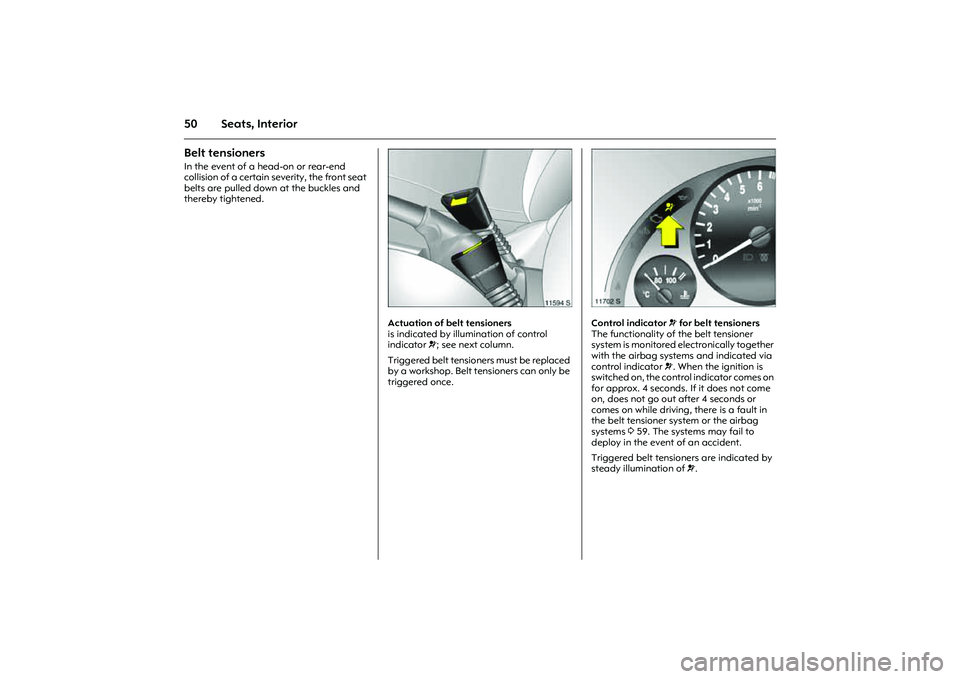
Actuation of belt tensioners
is indicated by illumination of control
indicator v; see next column.
Triggered belt tensioners must be replaced
by a workshop. Belt tensioners can only be
triggered once.
Picture no: 11702s.tif
Control indicator v for belt tensioners
The functionality of the belt tensioner
system is monitored electronically together
with the airbag systems and indicated via
control indicator v. When the ignition is
switched on, the control indicator comes on
for approx. 4 seconds. If it does not come
on, does not go out after 4 seconds or
comes on while driving, there is a fault in
the belt tensioner system or the airbag
systems 359. The systems may fail to
deploy in the event of an accident.
Triggered belt tensioners are indicated by
steady illumination of v.
Page 57 of 212
51
Seats, Interior
The system’s integrated self-diagnostics
allows faults to be quickly remedied. Important
zDo not affix or place accessories or other
objects within the deployment zone of
the belt tensioners (in the area of the belt
buckle). Do not make any modifications
to belt tensioner components and the
inertia real device because this will
invalidate the vehicle type approval. zThe belt tensioner and airbag system
control electronics can be found in the
centre console area. In order to avoid
malfunctions, do not store magnetic
objects in this area.
zWhen using the rear seat, make sure that
the components of the front seat belt are
not damaged by shoes or other objects.
Not dirt must get into the inertia reel of
the seat belt.
zWe recommend that you have the seats
removed by a workshop.
zThe belt tensioners only deploy once,
which can be detected by illumination of
the control indicator v. Have deployed
belt tensioners replaced by a workshop.
zThe applicable safety regulations must
be adhered to when the vehicle is
disposed of. The vehicle should therefore
be disposed of by a recycling company.
9 Warning
Have cause of fault remedied
immediately by a workshop.
9 Warning
Incorrect handling (e.g. removal or
fitting of seat belts or belt buckles) can
cause the belt tensioners to deploy, with
risk of injury.
Page 62 of 212
56 Seats, Interior
Picture no: 16424s.tif
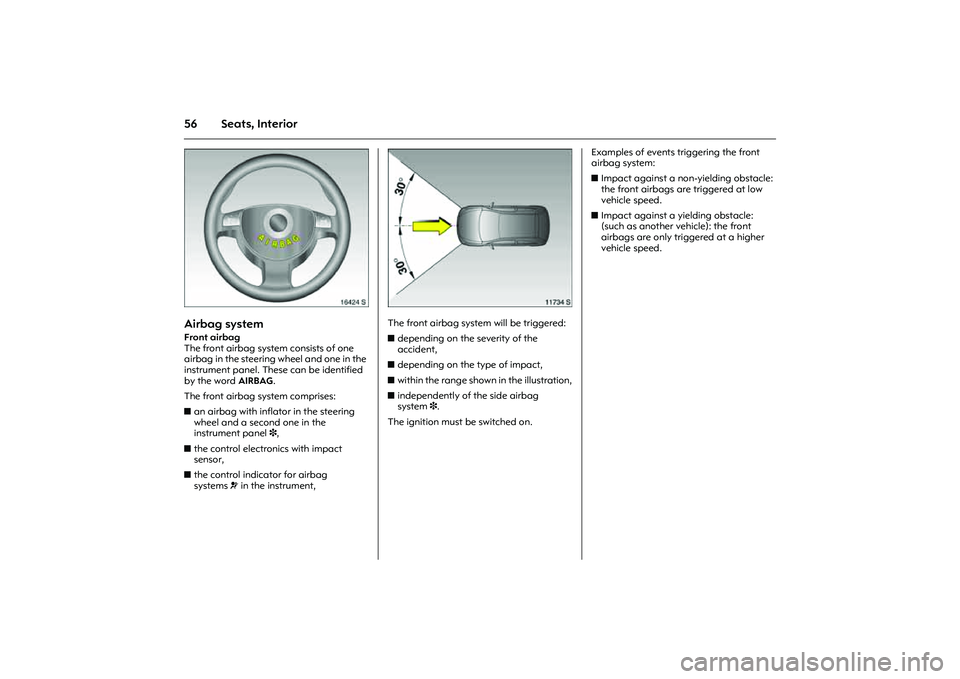
Airbag system Front airbag
The front airbag system consists of one
airbag in the steering wheel and one in the
instrument panel. These can be identified
by the word AIRBAG.
The front airbag system comprises:
zan airbag with inflator in the steering
wheel and a second one in the
instrument panel 3,
zthe control electronics with impact
sensor,
zthe control indicator for airbag
systemsv in the instrument,
Picture no: 11734s.tif
The front airbag system will be triggered:
zdepending on the severity of the
accident,
zdepending on the type of impact,
zwithin the range shown in the illustration,
zindependently of the side airbag
system3.
The ignition must be switched on. Examples of events triggering the front
airbag system:
zImpact against a non-yielding obstacle:
the front airbags are triggered at low
vehicle speed.
zImpact against a yielding obstacle:
(such as another vehicle): the front
airbags are only triggered at a higher
vehicle speed.
Page 63 of 212
57
Seats, Interior
Picture no: 11600s.tif
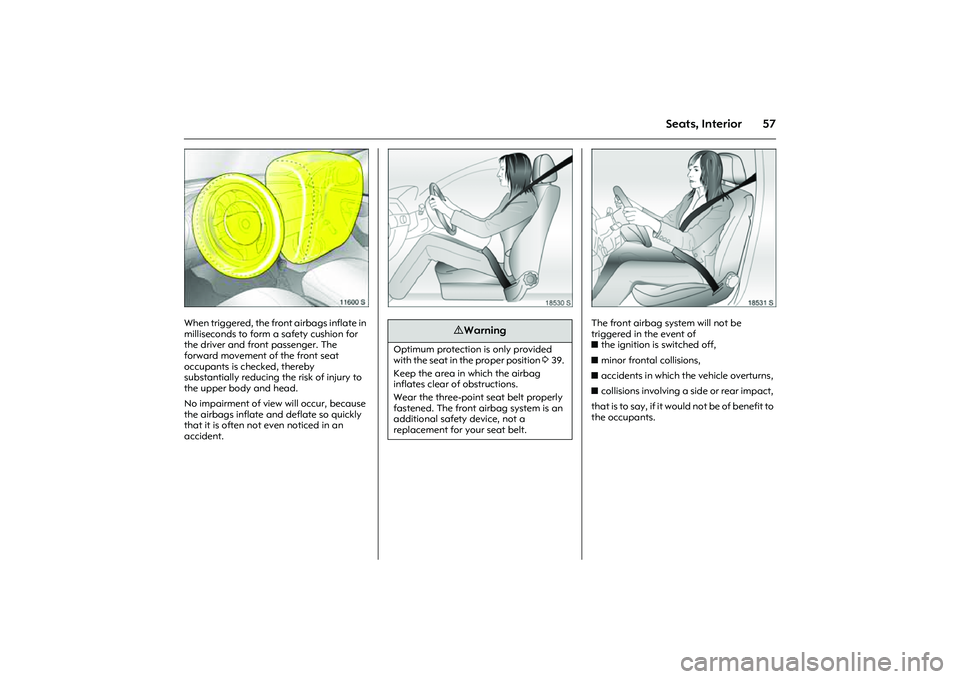
When triggered, the front airbags inflate in
milliseconds to form a safety cushion for
the driver and front passenger. The
forward movement of the front seat
occupants is checked, thereby
substantially reducing the risk of injury to
the upper body and head.
No impairment of view will occur, because
the airbags inflate and deflate so quickly
that it is often not even noticed in an
accident.
Picture no: 18530s.tif Picture no: 18531s.tif
The front airbag system will not be
triggered in the event of
zthe ignition is switched off,
zminor frontal collisions,
zaccidents in which the vehicle overturns,
zcollisions involving a side or rear impact,
that is to say, if it would not be of benefit to
the occupants.
9 Warning
Optimum protection is only provided
with the seat in the proper position 339.
Keep the area in which the airbag
inflates clear of obstructions.
Wear the three-point seat belt properly
fastened. The front airbag system is an
additional safety device, not a
replacement for your seat belt.
Page 64 of 212
58 Seats, Interior
Picture no: 11601s.tif
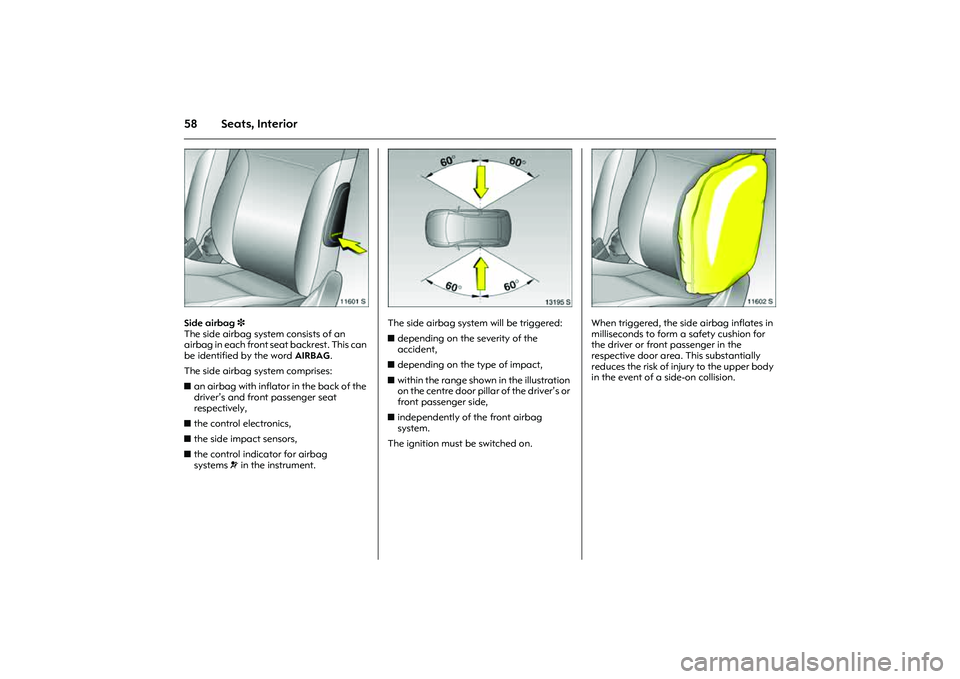
Side airbag 3
The side airbag system consists of an
airbag in each front seat backrest. This can
be identified by the word AIRBAG.
The side airbag system comprises:
zan airbag with inflator in the back of the
driver’s and front passenger seat
respectively,
zthe control electronics,
zthe side impact sensors,
zthe control indicator for airbag
systemsv in the instrument.
Picture no: 13195s.tif
The side airbag system will be triggered:
zdepending on the severity of the
accident,
zdepending on the type of impact,
zwithin the range shown in the illustration
on the centre door pillar of the driver’s or
front passenger side,
zindependently of the front airbag
system.
The ignition must be switched on.
Picture no: 11602s.tif
When triggered, the side airbag inflates in
milliseconds to form a safety cushion for
the driver or front passenger in the
respective door area. This substantially
reduces the risk of injury to the upper body
in the event of a side-on collision.
Page 65 of 212
59
Seats, Interior
The side airbags will not be triggered in the
event of
zthe ignition is switched off,
zfrontal collisions,
zaccidents in which the vehicle overturns,
zcollisions involving a rear impact,
zcollisions involving a side impact outside
the passenger cell.
Picture no: 11702s.tif
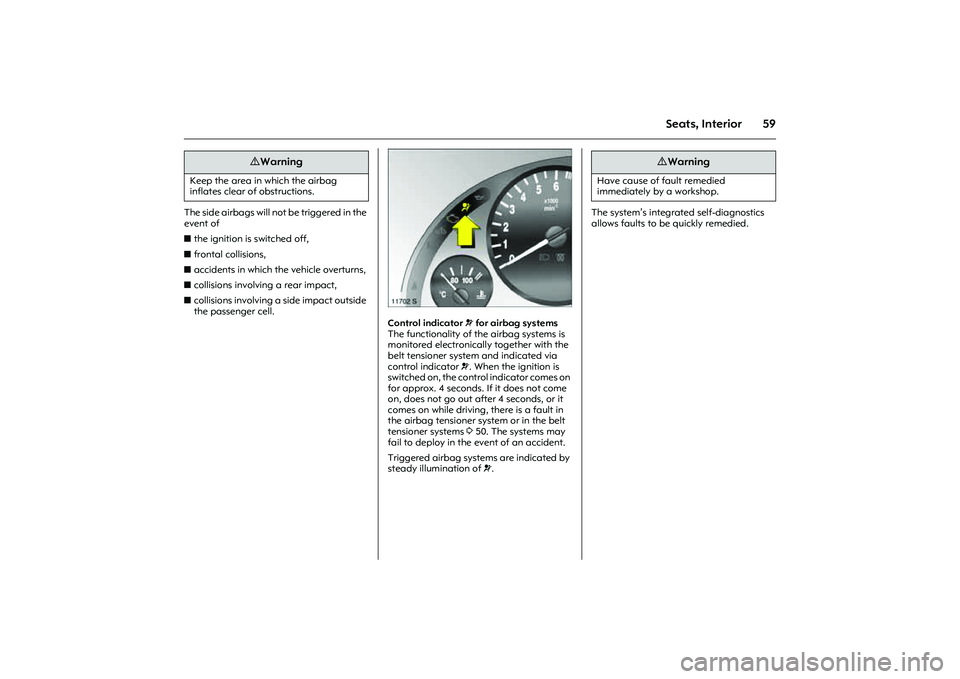
Control indicator v for airbag systems
The functionality of the airbag systems is
monitored electronically together with the
belt tensioner system and indicated via
control indicator v. When the ignition is
switched on, the control indicator comes on
for approx. 4 seconds. If it does not come
on, does not go out after 4 seconds, or it
comes on while driving, there is a fault in
the airbag tensioner system or in the belt
tensioner systems 350. The systems may
fail to deploy in the event of an accident.
Triggered airbag systems are indicated by
steady illumination of v. The system’s integrated self-diagnostics
allows faults to be quickly remedied.
9 Warning
Keep the area in which the airbag
inflates clear of obstructions.
9 Warning
Have cause of fault remedied
immediately by a workshop.
Page 66 of 212
60 Seats, InteriorImportant
zNo objects or accessories must be placed
in the area in which the airbags inflate,
as they could cause injury when the
components are deployed.
zDo not place any objects between the
airbag systems and the vehicle
occupants. Danger of injury. Do not
install a child restraint system 3 on the
front passenger seat. Danger to life.
zUse the hooks in the roof frame only to
hang up light articles of clothing or coat
hangers. Do not place any objects in the
pockets of the hanging items – risk of
injury.
zThe airbag systems and belt tensioner
control electronics can be found in the
centre console area. In order to avoid
malfunctions, do not store magnetic
objects in this area. zDo not stick anything on the steering
wheel, instrumnet panel or front seat
backrests in the vicinity of the airbags.
Do not cover any of these areas with
other materials.
zUse only a dry cloth or interior cleaner to
clean the steering wheel, instrument
panel and front seat backrests. Do not
use any aggressive cleaning agents.
zOnly protective covers which are
approved for your vehicle with side
airbag may be fitted on the front seats.
When fitting the protective covers, make
sure that the airbag units on the
outboard sides of the front seat
backrests are not covered.
zThe airbag systems are triggered
independently of one another
depending on the severity of the
accident and type of impact.
zEach airbag is only deployed once. Have
deployed airbags replaced by a
workshop immediately.
zThe speeds, directions of movement and
deformation properties of the vehicles,
and the properties of the obstacle
concerned, determine the severity of the
accident and triggering of the airbags.
The degree of damage to your vehicle
and the resulting repair costs alone are
not indicative that the criteria for
triggering of the airbags were met. zDo not perform any alterations on the
components of the airbag system, as this
would render the vehicle unroadworthy.
zWe recommend having the steering
wheel, the instrument panel, all panelling
parts, the door seals, the handles and
the seats removed by a workshop.
zThe applicable safety regulations must
be adhered to when the vehicle is
disposed of. The vehicle should therefore
be disposed of by a recycling company.
zAnyone weighing less than 35 kg should
seat in the rear seat.
9 Warning
As with any other object, child restaint
systems must not be carried on a
passenger’s lap. Danger to life.
9 Warning
If handled improperly the airbag
systems can be triggered in an explosive
manner – risk of injury!
Page 73 of 212
67
Instruments
Picture no: 18529s.tif
Flashes when the ignition is onFault in the electronic immobiliser system;
the engine cannot be started 321.Z
Exhaust emission
Control indicator lights up and/or flashes
yellow
It illuminates when the ignition is switched
on and goes out shortly after the engine
starts.
Illuminates when the engine is running
Fault in emission control system. The
permissible emission limits may be
exceeded. Contact a workshop for
assistance immediately.
Picture no:
If it flashes when the engine is running:Fault that could lead to catalytic converter
damage. Ease up on the throttle until the
flashing stops 3115. Seek the immediate
assistance of a workshop. v
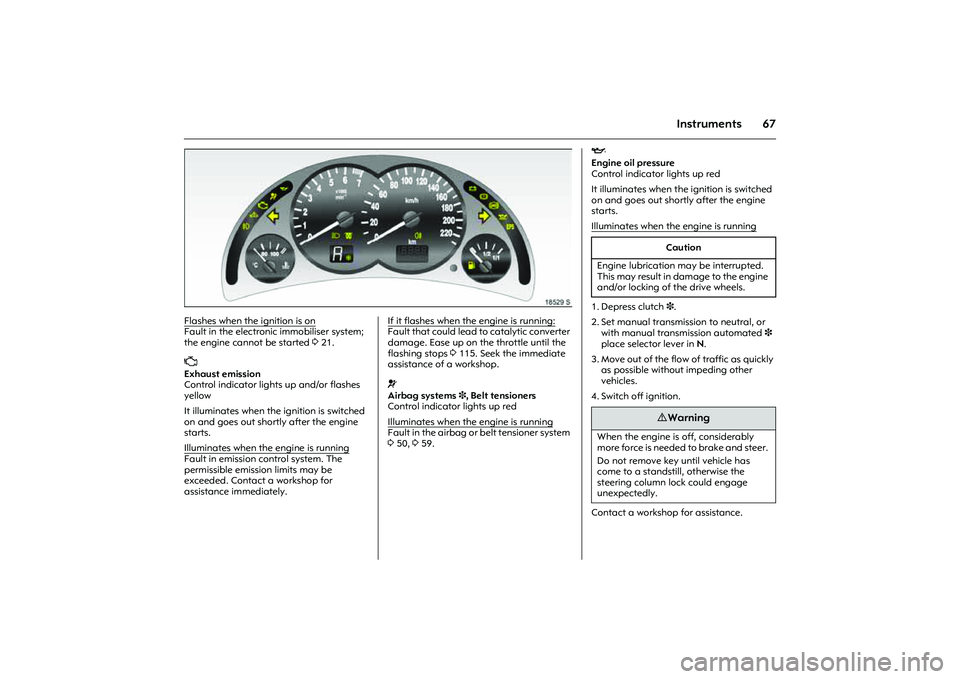
Airbag systems 3, Belt tensioners
Control indicator lights up red
Illuminates when the engine is runningFault in the airbag or belt tensioner system
350, 359.
I
Engine oil pressure
Control indicator lights up red
It illuminates when the ignition is switched
on and goes out shortly after the engine
starts.
Illuminates when the engine is running
1. Depress clutch 3.
2. Set manual transmission to neutral, or
with manual transmission automated 3
place selector lever in N.
3. Move out of the flow of traffic as quickly
as possible without impeding other
vehicles.
4. Switch off ignition.
Contact a workshop for assistance. Caution
Engine lubrication may be interrupted.
This may result in damage to the engine
and/or locking of the drive wheels.
9 Warning
When the engine is off, considerably
more force is needed to brake and steer.
Do not remove key until vehicle has
come to a standstill, otherwise the
steering column lock could engage
unexpectedly.
Page 155 of 212
149
Self-help, vehicle care
Picture no: 11743s.tif Picture no:
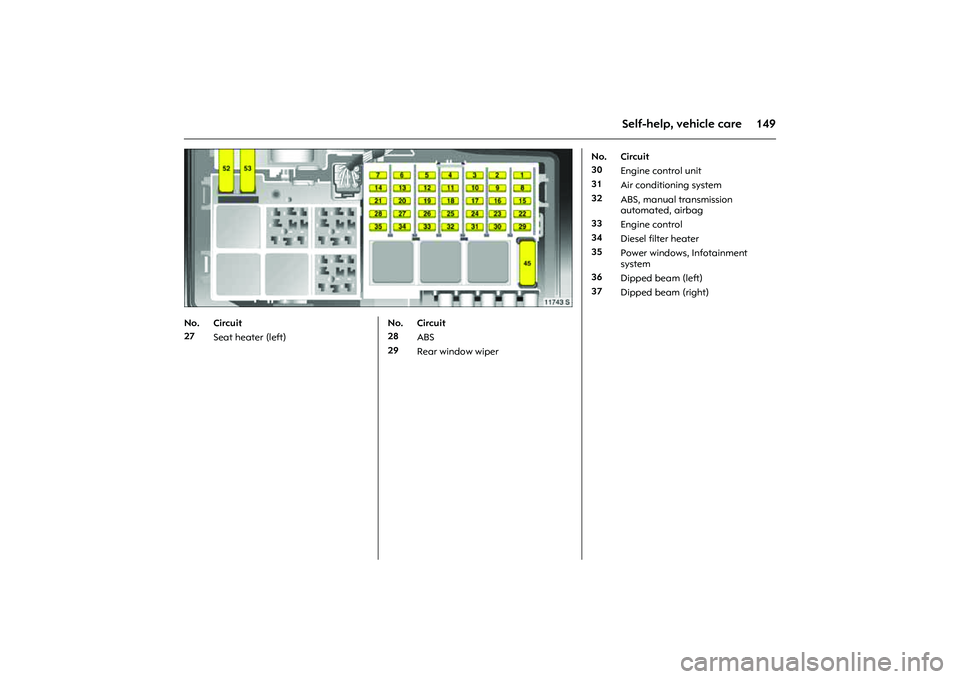
No. Circuit
27
Seat heater (left)
No. Circuit
28
ABS
29
Rear window wiperNo. Circuit
30
Engine control unit
31
Air conditioning system
32
ABS, manual transmission
automated, airbag
33
Engine control
34
Diesel filter heater
35
Power windows, Infotainment
system
36
Dipped beam (left)
37
Dipped beam (right)
Page 171 of 212
165 Opel Service, maintenance
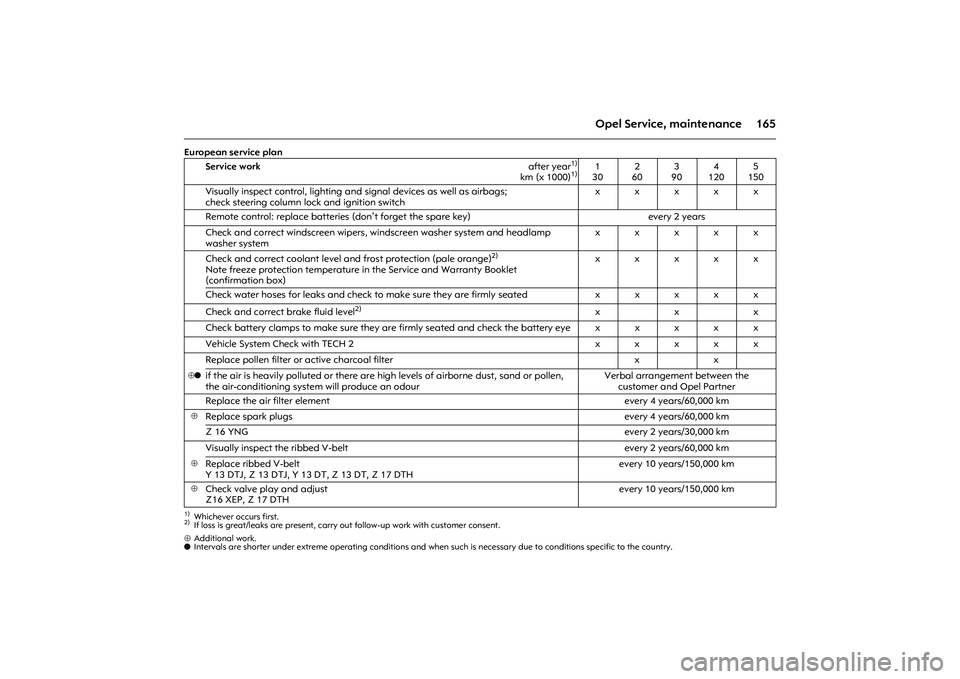
European service plan⊕Additional work.
o Intervals are shorter under extreme operating conditions and when such is necessary due to conditions specific to the country.
Service work after year
1)
km (x 1000)
1)
1)Whichever occurs first.
1
302
603
904
1205
150
Visually inspect control, lighting and signal devices as well as airbags;
check steering column lock and ignition switchxxxxx
Remote control: replace batteries (don’t forget the spare key) every 2 years
Check and correct windscreen wipers, windscreen washer system and headlamp
washer systemxxxxx
Check and correct coolant level and frost protection (pale orange)
2)
Note freeze protection temperature in the Service and Warranty Booklet
(confirmation box)
2)If loss is great/leaks are present, carry out follow-up work with customer consent.
xxxxx
Check water hoses for leaks and check to make sure they are firmly seated x x x x x
Check and correct brake fluid level
2) xxx
Check battery clamps to make sure they are firmly seated and check the battery eye x x x x x
Vehicle System Check with TECH 2 x x x x x
Replace pollen filter or active charcoal filter x x
⊕o
if the air is heavily polluted or there are high levels of airborne dust, sand or pollen,
the air-conditioning system will produce an odourVerbal arrangement between the
customer and Opel Partner
Replace the air filter element every 4 years/60,000 km
⊕
Replace spark plugsevery 4 years/60,000 km
Z 16 YNGevery 2 years/30,000 km
Visually inspect the ribbed V-belt every 2 years/60,000 km
⊕
Replace ribbed V-belt
Y 13 DTJ, Z 13 DTJ, Y 13 DT, Z 13 DT, Z 17 DTH every 10 years/150,000 km
⊕
Check valve play and adjust
Z16 XEP, Z 17 DTHevery 10 years/150,000 km