fuel OPEL COMBO 2010 Owner's Manual
[x] Cancel search | Manufacturer: OPEL, Model Year: 2010, Model line: COMBO, Model: OPEL COMBO 2010Pages: 212, PDF Size: 2.49 MB
Page 119 of 212
113 Driving and operation
Refuelling when driving abroad
When refuelling in another country, please note that country-specific expressions are used
for natural gas vehicles.
German Erdgasfahrzeuge Erdgas als Kraftstoff
English NGVs = Natural Gas Vehicles CNG = Compressed Natural Gas
French Véhicules au gaz naturel
– or –
Véhicules GNVGNV = Gaz Naturel (pour) Véhicules
– or –
CGN = carburant gaz naturel
Italian Metano auto Metano (per auto)
Picture no: 16882s.tif
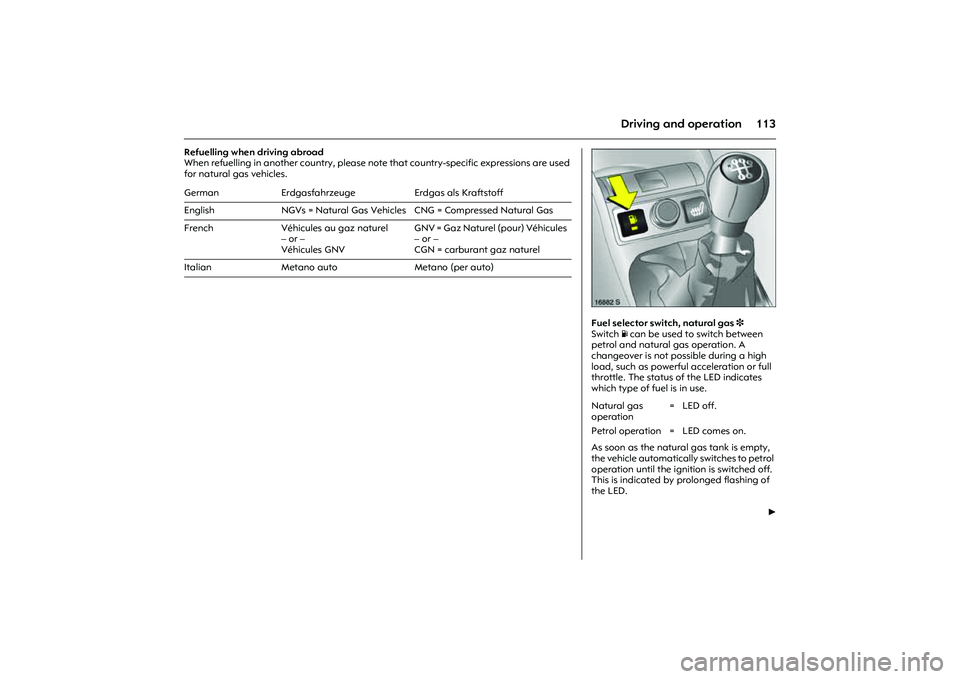
Fuel selector switch, natural gas 3
Switch
Y can be used to switch between
petrol and natural gas operation. A
changeover is not possible during a high
load, such as powerful acceleration or full
throttle. The status of the LED indicates
which type of fuel is in use.
As soon as the natural gas tank is empty,
the vehicle automatically switches to petrol
operation until the ignition is switched off.
This is indicated by prolonged flashing of
the LED.
6 Natural gas
operation=LED off.
Petrol operation = LED comes on.
Page 120 of 212
114 Driving and operationIf the natural gas tank is then not refilled,
petrol operation must be manually
selected the next time the engine is started.
This is necessary in order to prevent
damage to the catalytic converter
(overheating due to irregular fuel supply).
If the switch is pressed several times within
a brief period of time, a changeover
inhibitor is activated. The engine continues
with the current type of fuel. The inhibitor
remains active until the ignition is switched
off.
Minor power and torque losses are to
be expected during petrol operation,
therefore adjust driving style (e.g.
overtaking) and vehicle load (e.g. through
trailer load) accordingly.
Every 6 months, run the petrol tank down
to the reserve zone before refuelling. This is
necessary for petrol operation to obtain
the required system functionality and fuel
quality.Note:
Refuel and operate only w i t h f u e l o f a t l e a s t
95 octane (RON). Upon accidental
refuelling with petrol of an
octane rating (RON) less than 95, avoid
driving with fuel load (e.g. heavy
acceleration, full throttle), allow the tank to
reach the reserve zone and refuel with the
correct petrol.
In order to prevent corrosion in the tank,
please refuel the vehicle to the maximum
level at regular intervals.
Picture no: 6448u.tif
Catalytic converter, engine
exhaust Catalytic converter
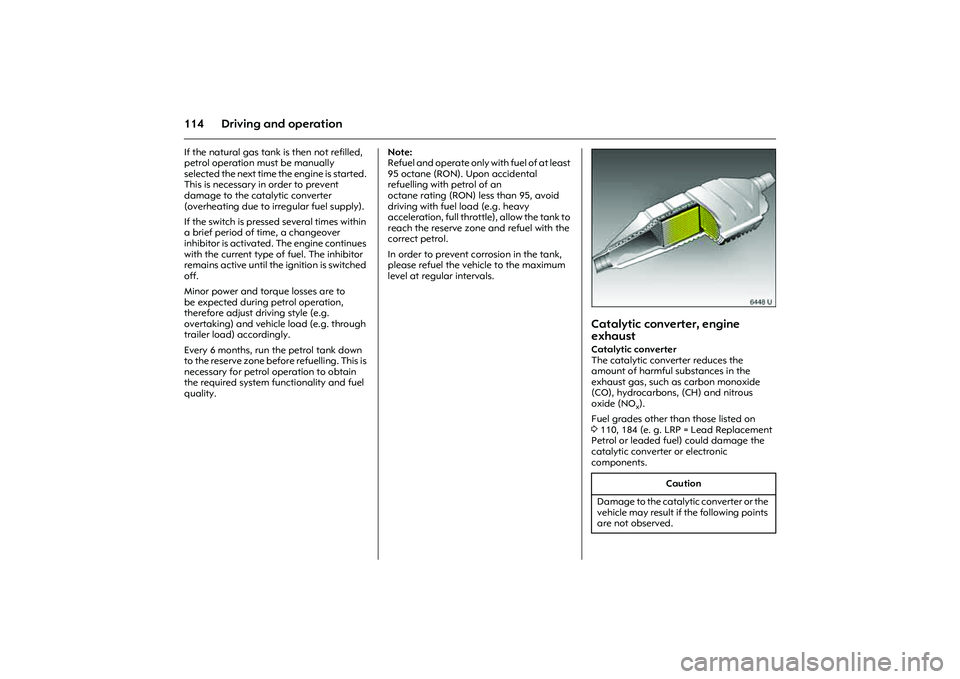
The catalytic converter reduces the
amount of harmful substances in the
exhaust gas, such as carbon monoxide
(CO), hydrocarbons, (CH) and nitrous
oxide (NO
x).
Fuel grades other than those listed on
3110, 184 (e. g. LRP = Lead Replacement
Petrol or leaded fuel) could damage the
catalytic converter or electronic
components.
Caution
Damage to the catalytic converter or the
vehicle may result if the following points
are not observed.
Page 121 of 212
115
Driving and operation
zIn the event of misfiring, uneven engine
running, a clear reduction in engine
performance or other unusual problems,
have the cause of the fault rectified by a
workshop as soon as possible. In an
emergency, driving can be continued for
a short period, keeping vehicle speed
and engine speed low.
zIf unburnt fuel enters the catalytic
converter of a petrol engine, this may
result in overheating and irreparable
damage to the catalytic converter.
You should therefore avoid
unnecessarily long use of the starter
when starting off, running the tank dry
and starting the engine by pushing or
towing.
Picture no: 18087s.tif
Controlling exhaust emission
Design measures, primarily in the fuel
injection system and ignition system zones
in combination with the catalytic converter,
the amount of hazardous substances in the
exhaust emissions, such as carbon
monoxide (CO), hydrocarbons (CH) and
nitrogen oxides (NO
x), are reduced to a
minimum.
Picture no: 11717s.tif
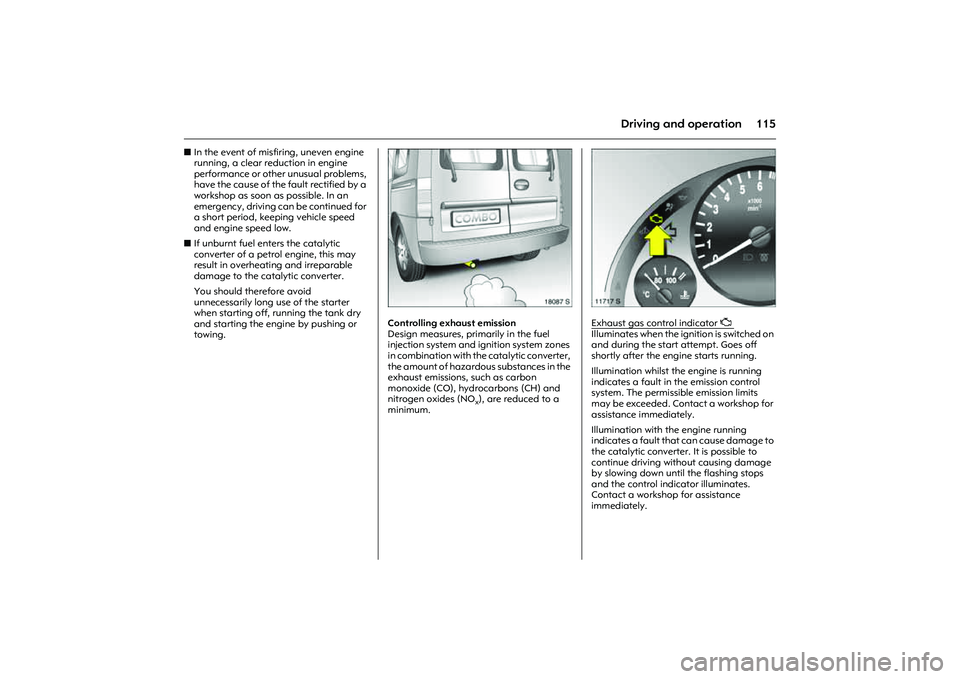
Exhaust gas control indicator
Z
Illuminates when the ignition is switched on
and during the start attempt. Goes off
shortly after the engine starts running.
Illumination whilst the engine is running
indicates a fault in the emission control
system. The permissible emission limits
may be exceeded. Contact a workshop for
assistance immediately.
Illumination with the engine running
indicates a fault that can cause damage to
the catalytic converter. It is possible to
continue driving without causing damage
by slowing down until the flashing stops
and the control indicator illuminates.
Contact a workshop for assistance
immediately.
Page 122 of 212

116 Driving and operation
Picture no: 11718s.tif
Control indicator
A
for engine electronics
Illuminates for a few seconds when ignition
is switched on.
If it comes on when the engine is running,
there is a fault in the engine or transmission
electronics. The electronics switch to the
emergency running programme, fuel
consumption may increase and the
driveability of the vehicle may be affected.
In some cases the fault can be remedied by
switching the engine off and starting it
again. If the control indicator continues to
illuminate whilst the engine is running,
contact a workshop for assistance in
remedying the cause of the fault. If it illuminates briefly, but does not recur, it
is of no significance.
If A illuminates, there may be water in the
diesel fuel filter 3. Have the fuel filter
checked for water residue by a workshop
3177.
I f i t f l a s h e s a f t e r t h e i g n i t i o n i s s w i t c h e d o n ,
there is a fault in the immobiliser system.
The engine cannot be started 321.
Engine exhaust Diesel particle filter 3
The diesel particle filter system filters
harmful soot particles out of the exhaust
gases. The system includes a self-cleaning
function that run automatically during
driving. The filter is cleaned by burning off
the soot particles at high temperature. This
process takes place automatically under
set driving conditions and may take up to
25 minutes. Fuel consumption may be
higher during this period. The emission of
smells and smoke during this process is
normal.
9 Warning
Engine exhaust gases contain poisonous
carbon monoxide, which is colourless
and odourless and could be fatal if
inhaled.
If exhaust gases penetrate the vehicle,
open windows and contact a workshop
for assistance.
Avoid driving with an open tailgate.
Otherwise, exhaust gases could get into
the interior.
Page 124 of 212
118 Driving and operationMaintenance
Have all maintenance work carried out at
the specified intervals. We recommend
that you entrust this work to your Opel
Partner, who has proper equipment and
trained personnel available. Electronic
testing systems permit rapid diagnosis and
remedy of faults. This way you can be
certain that all components of the vehicle’s
electrical, injection and ignition systems
operate correctly, that your vehicle has a
low level of pollutant emission and that the
catalytic converter system will have a long
service life.
You are thereby making an important
contribution towards keeping the air clean
and compliance with emissions legislation.
Checking and adjustment of the fuel-
injection and ignition systems is part of the
scope of inspection. For this reason you
should have all maintenance work carried
out at the intervals specified in your Service
and Warranty Booklet.
Picture no: 11629s.tif
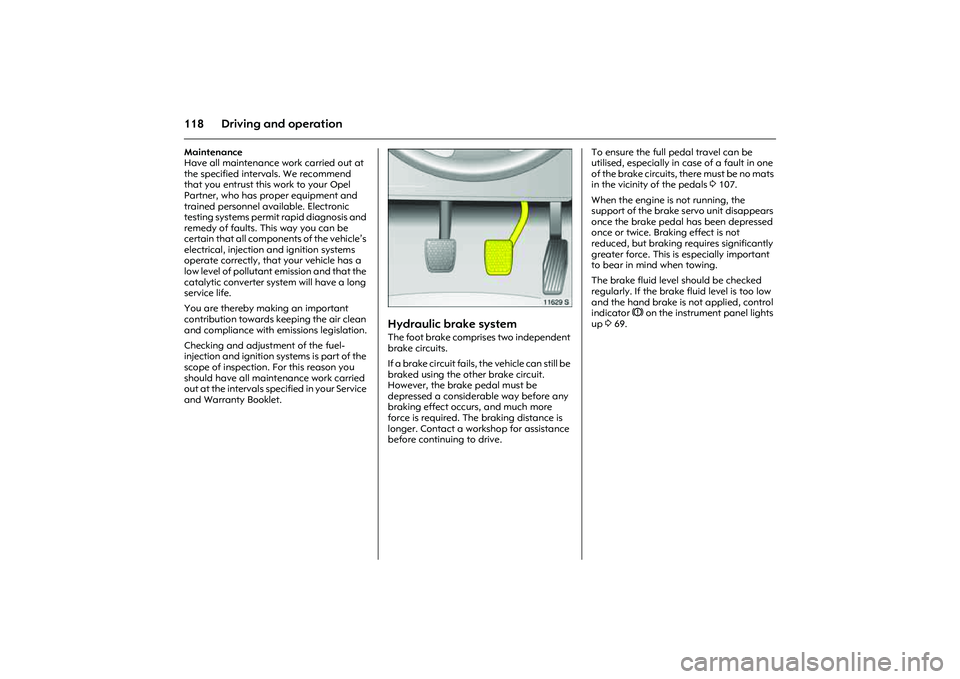
Hydraulic brake system The foot brake comprises two independent
brake circuits.
If a brake circuit fails, the vehicle can still be
braked using the other brake circuit.
However, the brake pedal must be
depressed a considerable way before any
braking effect occurs, and much more
force is required. The braking distance is
longer. Contact a workshop for assistance
before continuing to drive. To ensure the full pedal travel can be
utilised, especially in case of a fault in one
of the brake circuits, there must be no mats
in the vicinity of the pedals 3107.
When the engine is not running, the
support of the brake servo unit disappears
once the brake pedal has been depressed
once or twice. Braking effect is not
reduced, but braking requires significantly
greater force. This is especially important
to bear in mind when towing.
The brake fluid level should be checked
regularly. If the brake fluid level is too low
and the hand brake is not applied, control
indicator R on the instrument panel lights
up 369.
Page 128 of 212
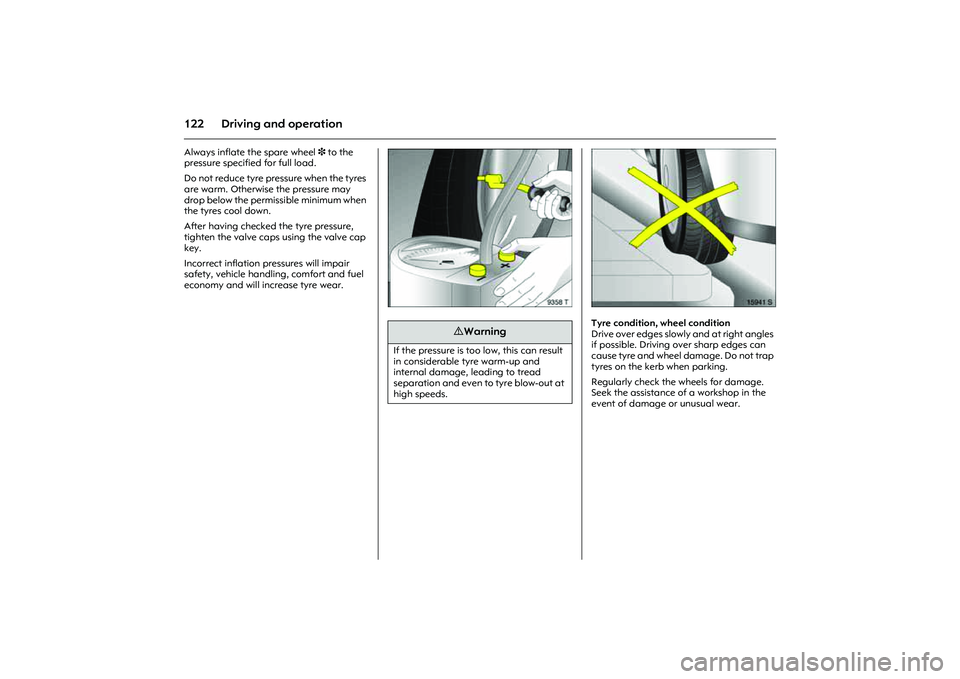
122 Driving and operationAlways inflate the spare wheel 3 to the
pressure specified for full load.
Do not reduce tyre pressure when the tyres
are warm. Otherwise the pressure may
drop below the permissible minimum when
the tyres cool down.
After having checked the tyre pressure,
tighten the valve caps using the valve cap
key.
Incorrect inflation pressures will impair
safety, vehicle handling, comfort and fuel
economy and will increase tyre wear.
Picture no: 9358t.tif Picture no: 15941s.tif
Tyre condition, wheel condition
Drive over edges slowly and at right angles
if possible. Driving over sharp edges can
cause tyre and wheel damage. Do not trap
tyres on the kerb when parking.
Regularly check the wheels for damage.
Seek the assistance of a workshop in the
event of damage or unusual wear.
9 Warning
If the pressure is too low, this can result
in considerable tyre warm-up and
internal damage, leading to tread
separation and even to tyre blow-out at
high speeds.
Page 134 of 212
128 Self-help, vehicle careSelf-help, vehicle care
Diesel fuel system, bleeding If the tank is allowed to run dry, the diesel
fuel system must be bled. Turn over the
ignition three times for 15 seconds at a
time. Then start the engine for a maximum
of 40 seconds
1). Repeat this process after
no less than 5 seconds. If the engine fails to
start, seek the assistance of a workshop.
Picture no: 16121s.tif
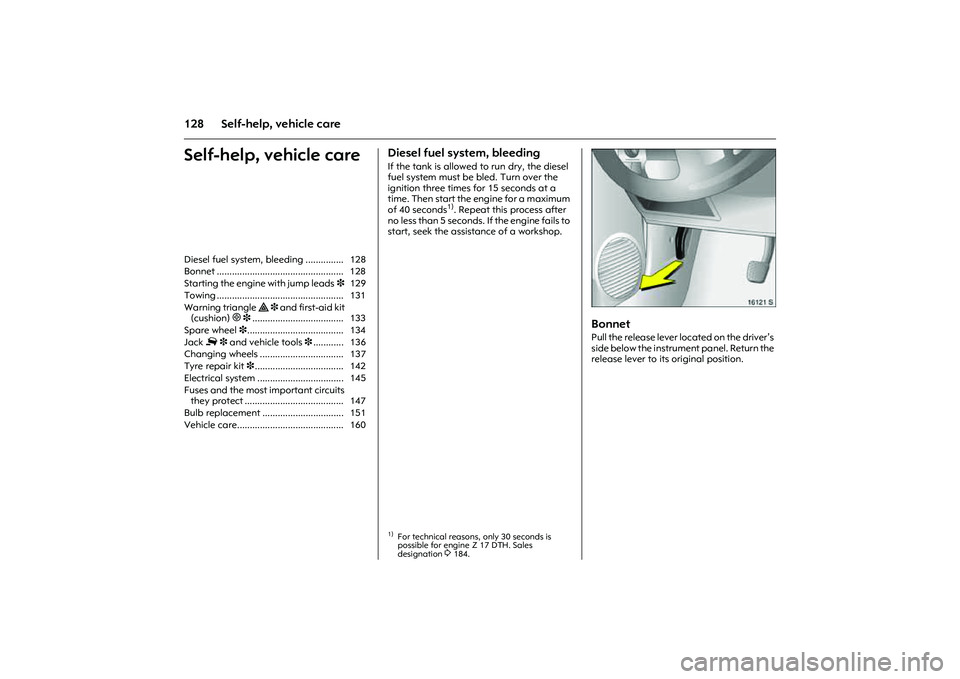
Bonnet Pull the release lever located on the driver’s
side below the instrument panel. Return the
release lever to its original position. Diesel fuel system, bleeding ............... 128
Bonnet .................................................. 128
Starting the engine with jump leads3 129
Towing .................................................. 131
Warning triangle ¨ 3 and first-aid kit
(cushion) + 3.................................... 133
Spare wheel 3...................................... 134
Jack £ 3 and vehicle tools3............ 136
Changing wheels ................................. 137
Tyre repair kit 3................................... 142
Electrical system .................................. 145
Fuses and the most important circuits
they protect ....................................... 147
Bulb replacement ................................ 151
Vehicle care.......................................... 160
1)For technical reasons, only 30 seconds is
possible for engine Z 17 DTH. Sales
designation
3184.
Page 153 of 212
147
Self-help, vehicle care
Picture no: 15543s.tif
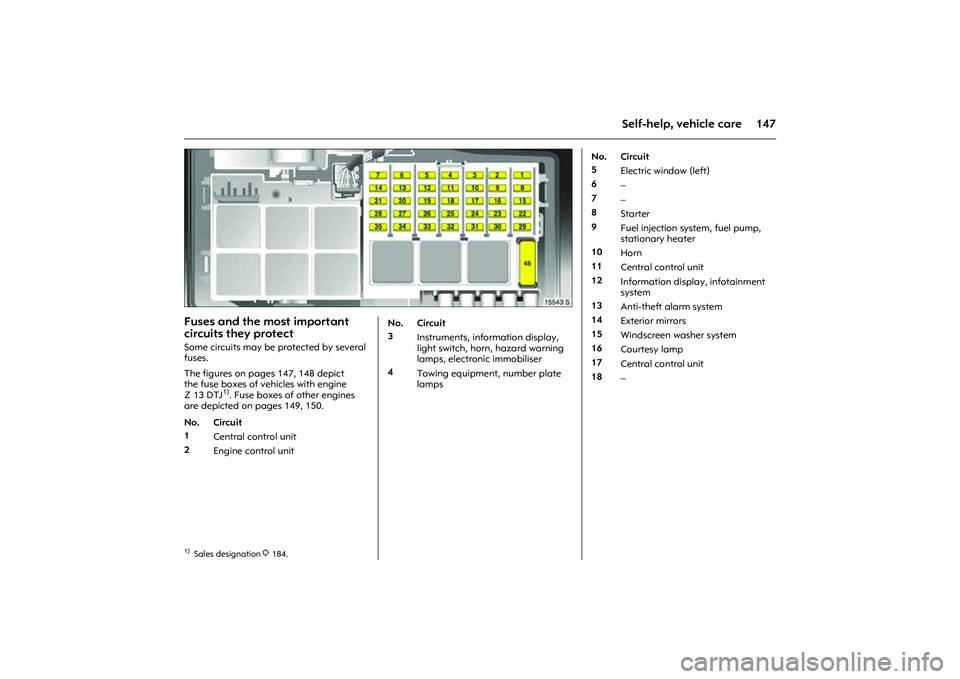
Fuses and the most important
circuits they protectSome circuits may be protected by several
fuses.
The figures on pages 147, 148 depict
the fuse boxes of vehicles with engine
Z13DTJ
1). Fuse boxes of other engines
are depicted on pages 149, 150.
Picture no:
1)Sales designation
3184.
No. Circuit
1
Central control unit
2
Engine control unit
No. Circuit
3
Instruments, information display,
light switch, horn, hazard warning
lamps, electronic immobiliser
4
Towing equipment, number plate
lampsNo. Circuit
5
Electric window (left)
6
–
7
–
8
Starter
9
Fuel injection system, fuel pump,
stationary heater
10
Horn
11
Central control unit
12
Information display, infotainment
system
13
Anti-theft alarm system
14
Exterior mirrors
15
Windscreen washer system
16
Courtesy lamp
17
Central control unit
18
–
Page 170 of 212
164 Opel Service, maintenanceOpel Service,
maintenance
Scheduled maintenanceThe service intervals apply to normal
operating conditions. For extreme
operating conditions, 3171.
Service interval display 3173.
European service intervals
Every 30,000 km or annually, whichever
occurs first.
International service intervals
Every 15,000 km or annually, whichever
occurs first.
Confirmations
Service is confirmed in the boxes provided
for such purposes in the Service and
Warranty Booklet. The workshop confirms
the date and mileage of service through a
stamp and signature.
Make sure that the Service and Warranty
Booklet has been correctly filled in as proof
of uninterrupted service is essential to the
granting of warranty or goodwill claims
and is a benefit when selling the vehicle.
Service planThe European service plan applies to the
following countries: Andorra, Austria,
Belgium, Cyprus, Czech Republic,
Denmark, Estonia, Finland, France,
Germany, Greece, Greenland, Hungary,
Iceland, Ireland, Italy, Latvia, Lithuania,
Luxembourg, Malta, the Netherlands,
Norway, Poland, Portugal, Slovakia,
Slovenia, Spain, Sweden, Switzerland,
Great Britain.
The International service plan applies to all
other countries. Scheduled maintenance ..................... 164
Service plan .......................................... 164
Additional service work ....................... 171
Recommended fluids and lubricants . 171
Inspection system ................................ 173
Genuine Opel Parts and Accessories . 174
Performing work .................................. 174
Engine oil .............................................. 175
Diesel fuel filter .................................... 177
Coolant ................................................. 177
Brakes ................................................... 178
Brake fluid ............................................ 179
Windscreen wiper replacement .......... 179
Windscreen washer system ................. 180
Battery .................................................. 180
Protecting electronic components ..... 180
Laying the vehicle up for a long
period of time .................................... 181
Putting the vehicle back into service . 181
Page 172 of 212
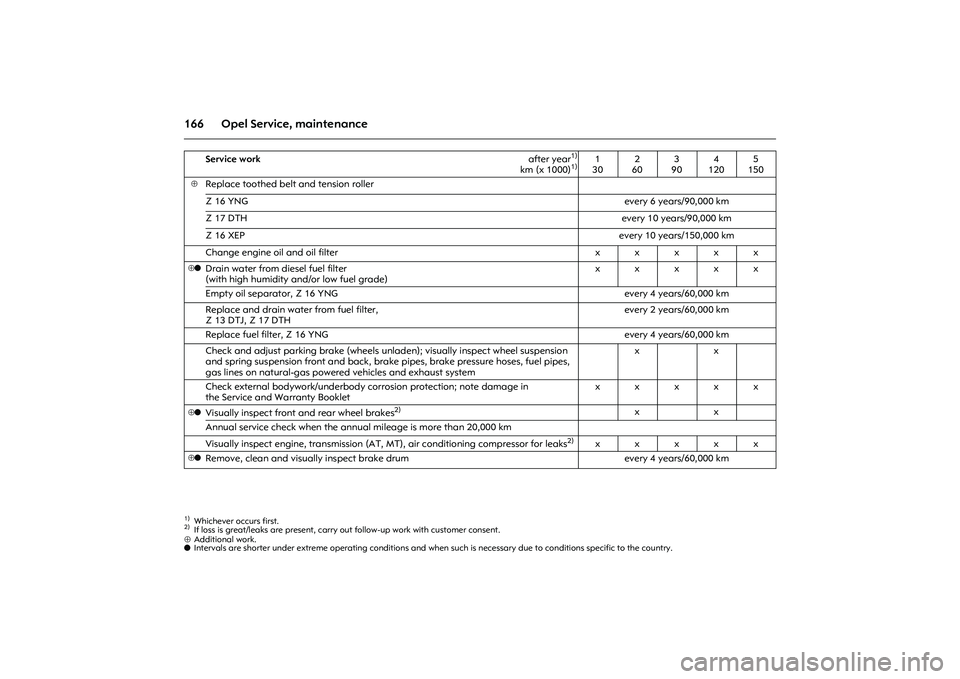
166 Opel Service, maintenance⊕Additional work.
o Intervals are shorter under extreme operating conditions and when such is necessary due to conditions specific to the country.
Service work after year
1)
km (x 1000)
1)
1)Whichever occurs first.
1
302
603
904
1205
150
⊕
Replace toothed belt and tension roller
Z 16 YNGevery 6 years/90,000 km
Z 17 DTHevery 10 years/90,000 km
Z 16 XEPevery 10 years/150,000 km
Change engine oil and oil filter x x x x x
⊕o
Drain water from diesel fuel filter
(with high humidity and/or low fuel grade)xxxxx
Empty oil separator, Z 16 YNG every 4 years/60,000 km
Replace and drain water from fuel filter,
Z 13 DTJ, Z 17 DTHevery 2 years/60,000 km
Replace fuel filter, Z 16 YNG every 4 years/60,000 km
Check and adjust parking brake (wheels unladen); visually inspect wheel suspension
and spring suspension front and back, brake pipes, brake pressure hoses, fuel pipes,
gas lines on natural-gas powered vehicles and exhaust systemxx
Check external bodywork/underbody corrosion protection; note damage in
the Service and Warranty Bookletxxxxx
⊕o
Visually inspect front and rear wheel brakes
2)
2)If loss is great/leaks are present, carry out follow-up work with customer consent.
xx
Annual service check when the annual mileage is more than 20,000 km
Visually inspect engine, transmission (AT, MT), air conditioning compressor for leaks
2)
xxxxx
⊕o
Remove, clean and visually inspect brake drum every 4 years/60,000 km