steering OPEL COMBO 2010 Owner's Manual
[x] Cancel search | Manufacturer: OPEL, Model Year: 2010, Model line: COMBO, Model: OPEL COMBO 2010Pages: 212, PDF Size: 2.49 MB
Page 96 of 212
90 Infotainment systemInfotainment system
Radio reception
3
Radio reception may be disrupted by
static, noise, distortion or loss of reception
due to
zChanges in distance from the
transmitter,
zmulti-path reception due to reflection
and
zshadowing. Infotainment system
3
The infotainment system is operated as
described in the operating instructions.
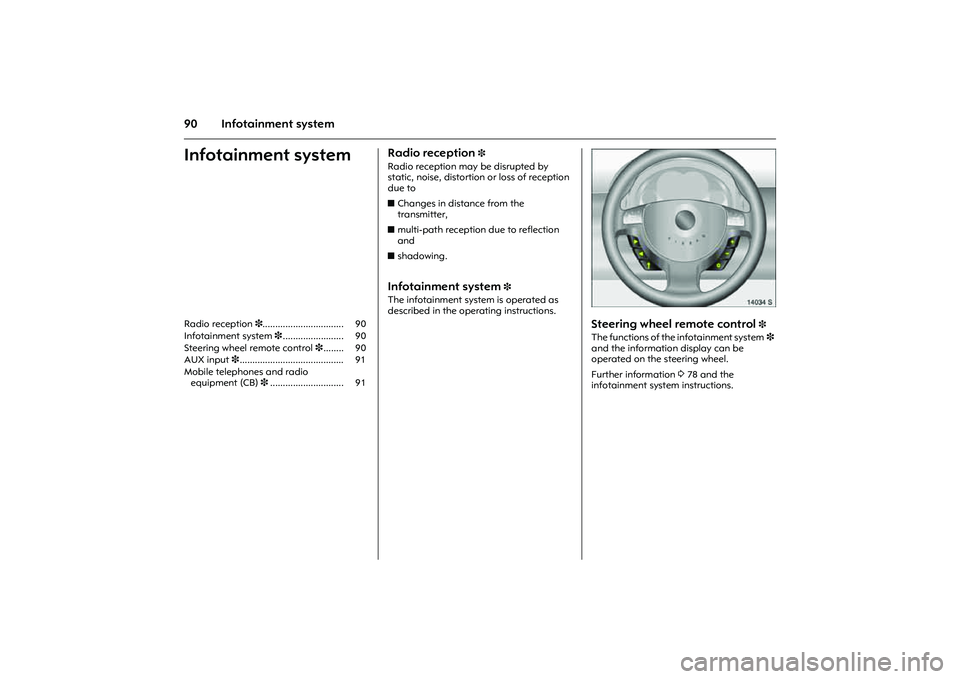
Picture no: 14034s.tif
Steering wheel remote control
3
The functions of the infotainment system3
and the information display can be
operated on the steering wheel.
Further information 378 and the
infotainment system instructions. Radio reception 3................................ 90
Infotainment system 3........................ 90
Steering wheel remote control 3........ 90
AUX input 3......................................... 91
Mobile telephones and radio
equipment (CB) 3............................. 91
Page 112 of 212
106 Driving and operationDriving hints The first 1000 km
Drive your vehicle at various speeds. Do
not use full throttle. Never allow the engine
to labour at low revs.
Change gear frequently. Do not press the
accelerator pedal more than approx.
3/4 in
all gears.
Do not drive faster than three quarters of
maximum speed.
Do not brake unnecessarily hard for the
first 200 km.
During the first drive, smoke may develop
because of wax and oil evaporating off the
exhaust system. Park the vehicle in the
open for a while after the first drive and
avoid inhaling the fumes.
Fuel and engine oil consumption is higher
than normal during the running-in period.
Never coast with engine not running
Many units will not function in this situation
(e.g. brake servo unit, power steering3).
Driving in this manner is a danger to
yourself and others. Brake servo unit
When the engine is not running, the brake
servo unit is no longer effective once the
brake pedal has been depressed once or
twice. Braking effect is not reduced, but
significantly greater force is required for
braking.
Electric power steering 3
If the power-assisted steering fails when
being towed with the engine switched off –
the vehicle can still be steered, but
considerably more force is required.
Driving in mountainous terrain or with a
trailer/caravan
The cooling fan is electrically operated. Its
cooling power is therefore independent of
the engine speed.
Since a considerable amount of heat is
generated at high engine speeds and less
at slower speeds, do not shift down when
climbing hills whilst the vehicle is still coping
with the gradient in the higher gear.
Diesel engines: On gradients of 10 % or
more, do not drive faster than 30 km/h in
first gear or 50 km/h in second gear. Driving with a roof load
Do not exceed the permissible roof load,
3189. For reasons of safety, distribute the
load evenly and strap it down firmly using
retaining straps so that it cannot slip.
Check the tyre pressure when the vehicle is
loaded. Do not travel faster than 120 km/h.
Check and re-tighten the straps frequently.
Observe country-specific regulations.
Switching off the engine
When you switch off, fans in the engine
compartment may continue running for a
time to cool the engine.
If the engine temperature is very high, e.g.
after driving in mountainous terrain: allow
the engine to idle for approximately two
minutes in order to prevent heat
accumulation.
Vehicles with turbocharged engine
After running at high engine speeds or high
engine loads, operate the engine briefly at
a low load or run in neutral for approx.
30 seconds before switching off in order
to protect the turbocharger.
Page 133 of 212
127
Driving and operation
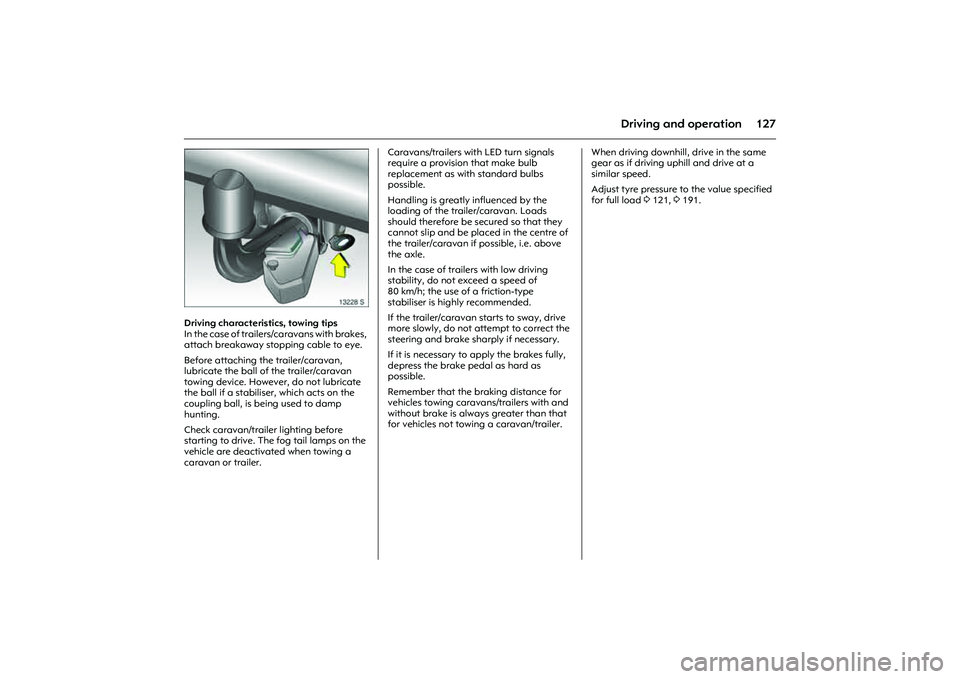
Picture no: 13228s.tif
Driving characteristics, towing tips
In the case of trailers/caravans with brakes,
attach breakaway stopping cable to eye.
Before attaching the trailer/caravan,
lubricate the ball of the trailer/caravan
towing device. However, do not lubricate
the ball if a stabiliser, which acts on the
coupling ball, is being used to damp
hunting.
Check caravan/trailer lighting before
starting to drive. The fog tail lamps on the
vehicle are deactivated when towing a
caravan or trailer. Caravans/trailers with LED turn signals
require a provision that make bulb
replacement as with standard bulbs
possible.
Handling is greatly influenced by the
loading of the trailer/caravan. Loads
should therefore be secured so that they
cannot slip and be placed in the centre of
the trailer/caravan if possible, i.e. above
the axle.
In the case of trailers with low driving
stability, do not exceed a speed of
80 km/h; the use of a friction-type
stabiliser is highly recommended.
If the trailer/caravan starts to sway, drive
more slowly, do not attempt to correct the
steering and brake sharply if necessary.
If it is necessary to apply the brakes fully,
depress the brake pedal as hard as
possible.
Remember that the braking distance for
vehicles towing caravans/trailers with and
without brake is always greater than that
for vehicles not towing a caravan/trailer. When driving downhill, drive in the same
gear as if driving uphill and drive at a
similar speed.
Adjust tyre pressure to the value specified
for full load 3121, 3191.
Page 138 of 212
132 Self-help, vehicle care
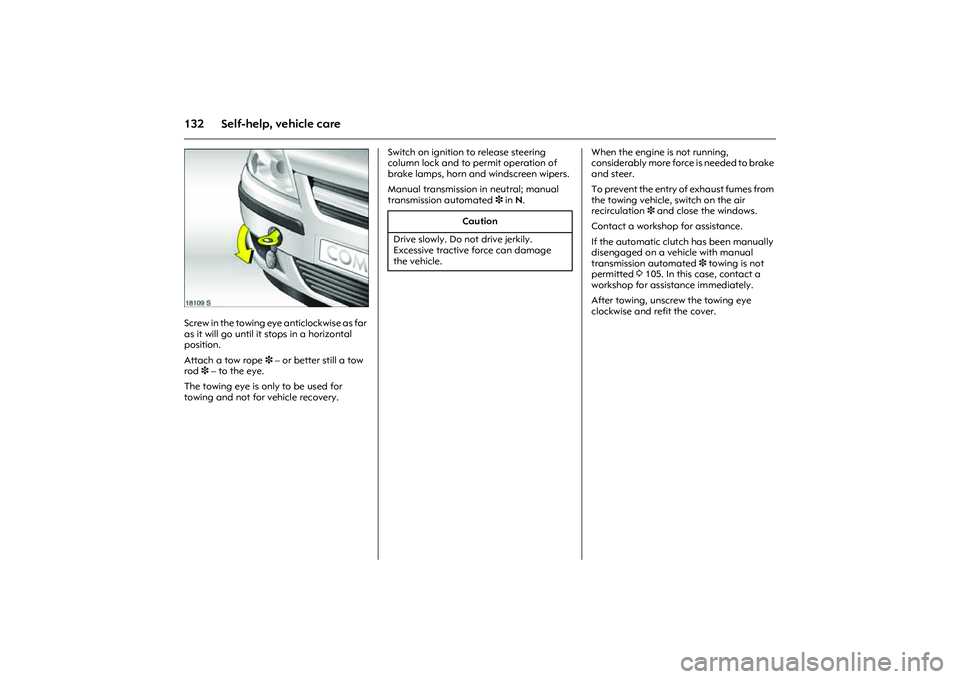
Picture no: 18109s.tif
Screw in the towing eye anticlockwise as far
as it will go until it stops in a horizontal
position.
Attach a tow rope 3 – or better still a tow
rod3 – to the eye.
The towing eye is only to be used for
towing and not for vehicle recovery. Switch on ignition to release steering
column lock and to permit operation of
brake lamps, horn and windscreen wipers.
Manual transmission in neutral; manual
transmission automated 3 in N. When the engine is not running,
considerably more force is needed to brake
and steer.
To prevent the entry of exhaust fumes from
the towing vehicle, switch on the air
recirculation 3 and close the windows.
Contact a workshop for assistance.
If the automatic clutch has been manually
disengaged on a vehicle with manual
transmission automated 3 towing is not
permitted 3105. In this case, contact a
workshop for assistance immediately.
After towing, unscrew the towing eye
clockwise and refit the cover.
Caution
Drive slowly. Do not drive jerkily.
Excessive tractive force can damage
the vehicle.
Page 148 of 212
142 Self-help, vehicle careTyre repair kit
3
Minor damage to the tyre tread or sidewall
can be repaired with the tyre repair kit.
Do not remove the foreign body from the
tyre.
T y r e d a m a g e e x c e e d i n g 4 m m o r t ha t i s o n
the rim cannot be repaired with the tyre
repair kit.
Important information 3145.
In the event of a flat tyre:
zSwitch on the hazard warning flashers,
apply the hand brake, engage first gear
or reverse.
zSet up the warning triangle correctly.
Warning triangle 3133.On the Combo, the tyre repair kit is located
behind a cover on the left in the side trim of
the luggage compartment. On the Combo
Van, it is located in a compartment behind
the driver’s seat.
To open the cover 3, press to release the
retaining lugs.
1. Remove bag containing tyre repair kit
from compartment. Carefully remove
parts from bag.
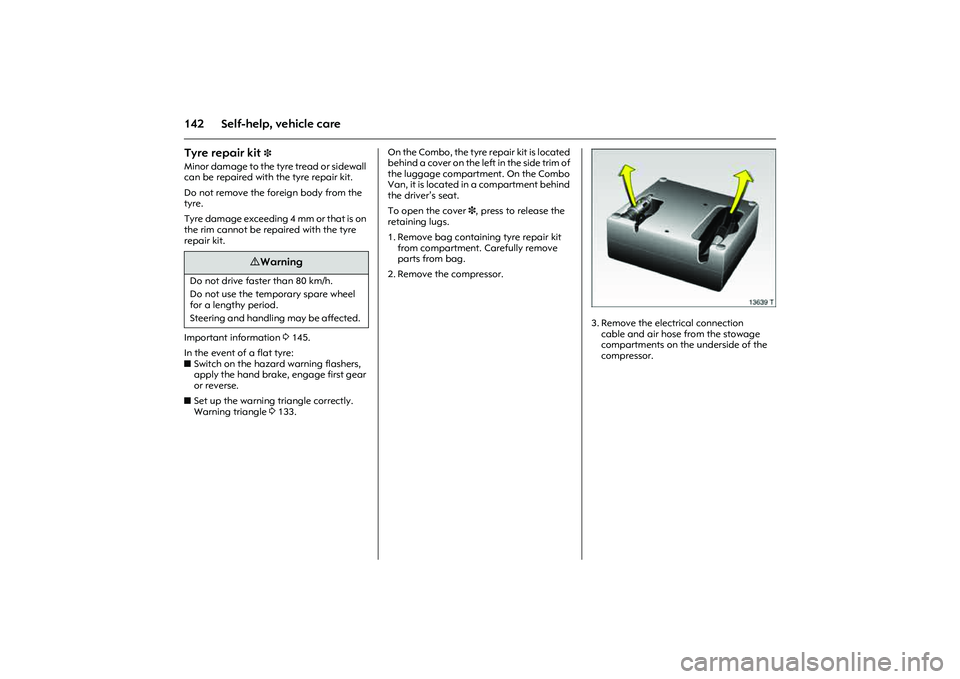
2. Remove the compressor.
Picture no: 13639T.tif
3. Remove the electrical connection
cable and air hose from the stowage
compartments on the underside of the
compressor.
9 Warning
Do not drive faster than 80 km/h.
Do not use the temporary spare wheel
for a lengthy period.
Steering and handling may be affected.
Page 171 of 212
165 Opel Service, maintenance
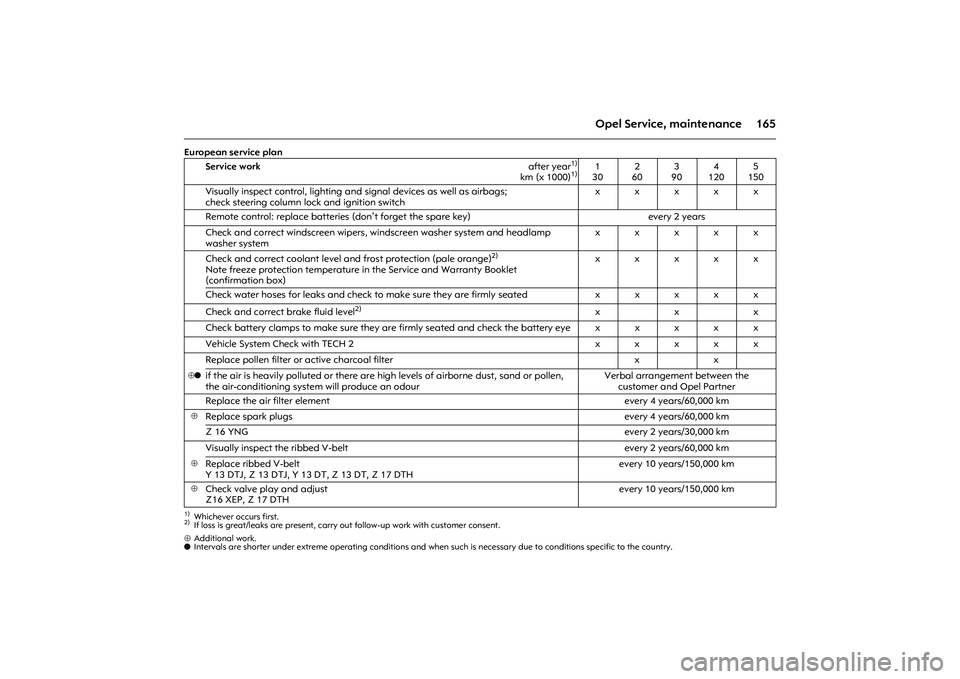
European service plan⊕Additional work.
o Intervals are shorter under extreme operating conditions and when such is necessary due to conditions specific to the country.
Service work after year
1)
km (x 1000)
1)
1)Whichever occurs first.
1
302
603
904
1205
150
Visually inspect control, lighting and signal devices as well as airbags;
check steering column lock and ignition switchxxxxx
Remote control: replace batteries (don’t forget the spare key) every 2 years
Check and correct windscreen wipers, windscreen washer system and headlamp
washer systemxxxxx
Check and correct coolant level and frost protection (pale orange)
2)
Note freeze protection temperature in the Service and Warranty Booklet
(confirmation box)
2)If loss is great/leaks are present, carry out follow-up work with customer consent.
xxxxx
Check water hoses for leaks and check to make sure they are firmly seated x x x x x
Check and correct brake fluid level
2) xxx
Check battery clamps to make sure they are firmly seated and check the battery eye x x x x x
Vehicle System Check with TECH 2 x x x x x
Replace pollen filter or active charcoal filter x x
⊕o
if the air is heavily polluted or there are high levels of airborne dust, sand or pollen,
the air-conditioning system will produce an odourVerbal arrangement between the
customer and Opel Partner
Replace the air filter element every 4 years/60,000 km
⊕
Replace spark plugsevery 4 years/60,000 km
Z 16 YNGevery 2 years/30,000 km
Visually inspect the ribbed V-belt every 2 years/60,000 km
⊕
Replace ribbed V-belt
Y 13 DTJ, Z 13 DTJ, Y 13 DT, Z 13 DT, Z 17 DTH every 10 years/150,000 km
⊕
Check valve play and adjust
Z16 XEP, Z 17 DTHevery 10 years/150,000 km
Page 173 of 212
167 Opel Service, maintenance
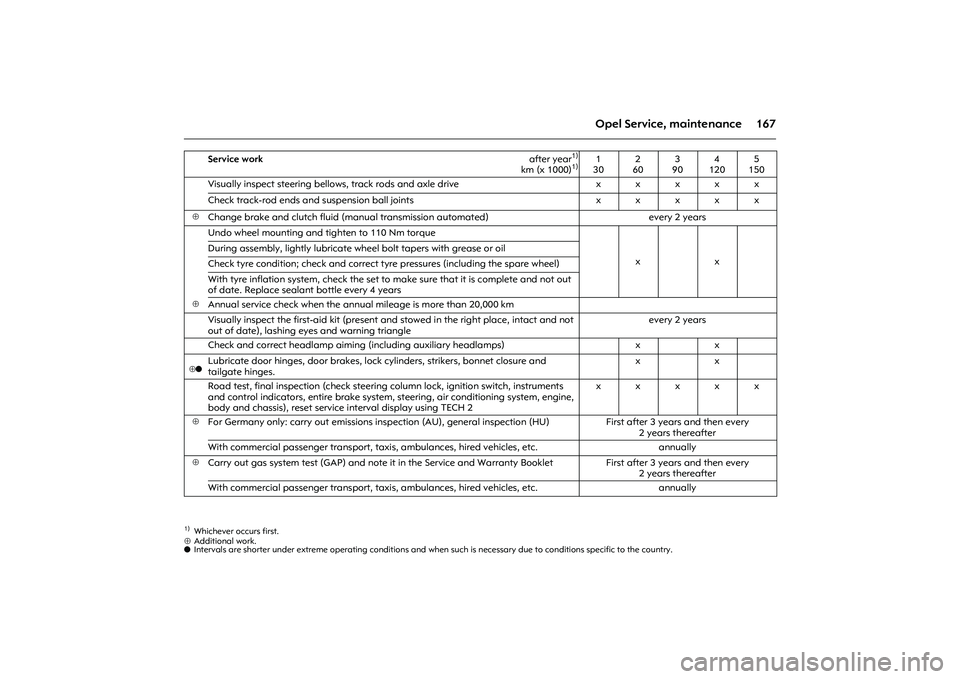
⊕Additional work.
o Intervals are shorter under extreme operating conditions and when such is necessary due to conditions specific to the country.
Service work after year
1)
km (x 1000)
1)
1)Whichever occurs first.
1
302
603
904
1205
150
Visually inspect steering bellows, track rods and axle drive xxxxx
Check track-rod ends and suspension ball joints xxxxx
⊕
Change brake and clutch fluid (manual transmission automated) every 2 years
Undo wheel mounting and tighten to 110 Nm torque
xx During assembly, lightly lubricate wheel bolt tapers with grease or oil
Check tyre condition; check and correct tyre pressures (including the spare wheel)
With tyre inflation system, check the set to make sure that it is complete and not out
of date. Replace sealant bottle every 4 years
⊕
Annual service check when the annual mileage is more than 20,000 km
Visually inspect the first-aid kit (present and stowed in the right place, intact and not
out of date), lashing eyes and warning triangleevery 2 years
Check and correct headlamp aiming (including auxiliary headlamps) x x
⊕o
Lubricate door hinges, door brakes, lock cylinders, strikers, bonnet closure and
tailgate hinges.xx
Road test, final inspection (check steering column lock, ignition switch, instruments
and control indicators, entire brake system, steering, air conditioning system, engine,
body and chassis), reset service interval display using TECH 2xxxxx
⊕
For Germany only: carry out emissions inspection (AU), general inspection (HU) First after 3 years and then every
2 years thereafter
With commercial passenger transport, taxis, ambulances, hired vehicles, etc. annually
⊕
Carry out gas system test (GAP) and note it in the Service and Warranty Booklet First after 3 years and then every
2 years thereafter
With commercial passenger transport, taxis, ambulances, hired vehicles, etc. annually
Page 174 of 212
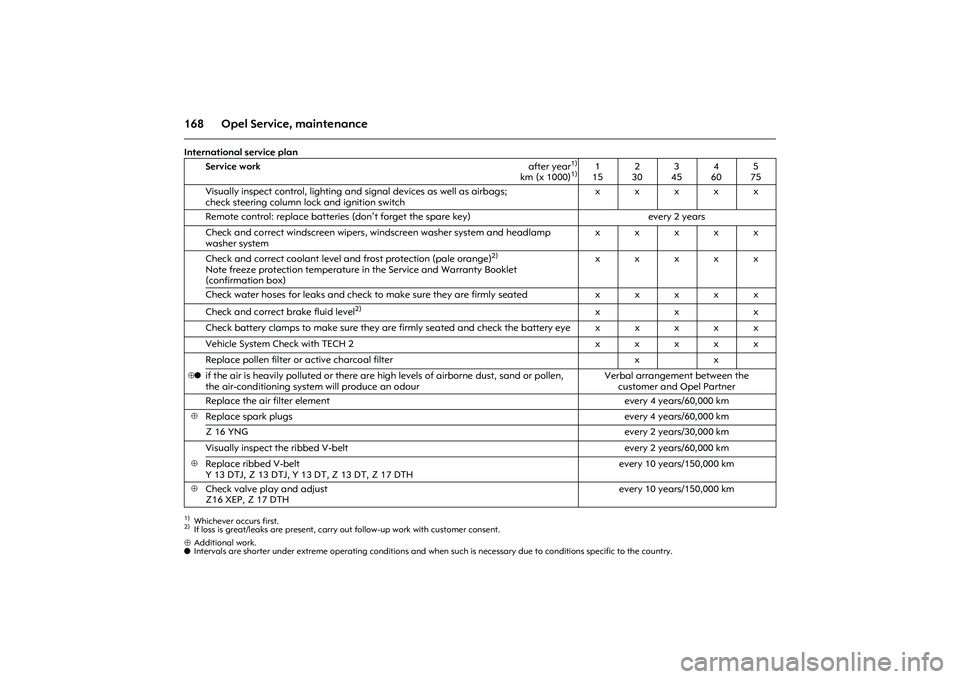
168 Opel Service, maintenanceInternational service plan⊕Additional work.
o Intervals are shorter under extreme operating conditions and when such is necessary due to conditions specific to the country.
Service work after year
1)
km (x 1000)
1)
1)Whichever occurs first.
1
152
303
454
605
75
Visually inspect control, lighting and signal devices as well as airbags;
check steering column lock and ignition switchxxxxx
Remote control: replace batteries (don’t forget the spare key) every 2 years
Check and correct windscreen wipers, windscreen washer system and headlamp
washer systemxxxxx
Check and correct coolant level and frost protection (pale orange)
2)
Note freeze protection temperature in the Service and Warranty Booklet
(confirmation box)
2)If loss is great/leaks are present, carry out follow-up work with customer consent.
xxxxx
Check water hoses for leaks and check to make sure they are firmly seated x x x x x
Check and correct brake fluid level
2) xxx
Check battery clamps to make sure they are firmly seated and check the battery eye x x x x x
Vehicle System Check with TECH 2 x x x x x
Replace pollen filter or active charcoal filter x x
⊕o
if the air is heavily polluted or there are high levels of airborne dust, sand or pollen,
the air-conditioning system will produce an odourVerbal arrangement between the
customer and Opel Partner
Replace the air filter element every 4 years/60,000 km
⊕
Replace spark plugsevery 4 years/60,000 km
Z 16 YNGevery 2 years/30,000 km
Visually inspect the ribbed V-belt every 2 years/60,000 km
⊕
Replace ribbed V-belt
Y 13 DTJ, Z 13 DTJ, Y 13 DT, Z 13 DT, Z 17 DTH every 10 years/150,000 km
⊕
Check valve play and adjust
Z16 XEP, Z 17 DTHevery 10 years/150,000 km
Page 176 of 212
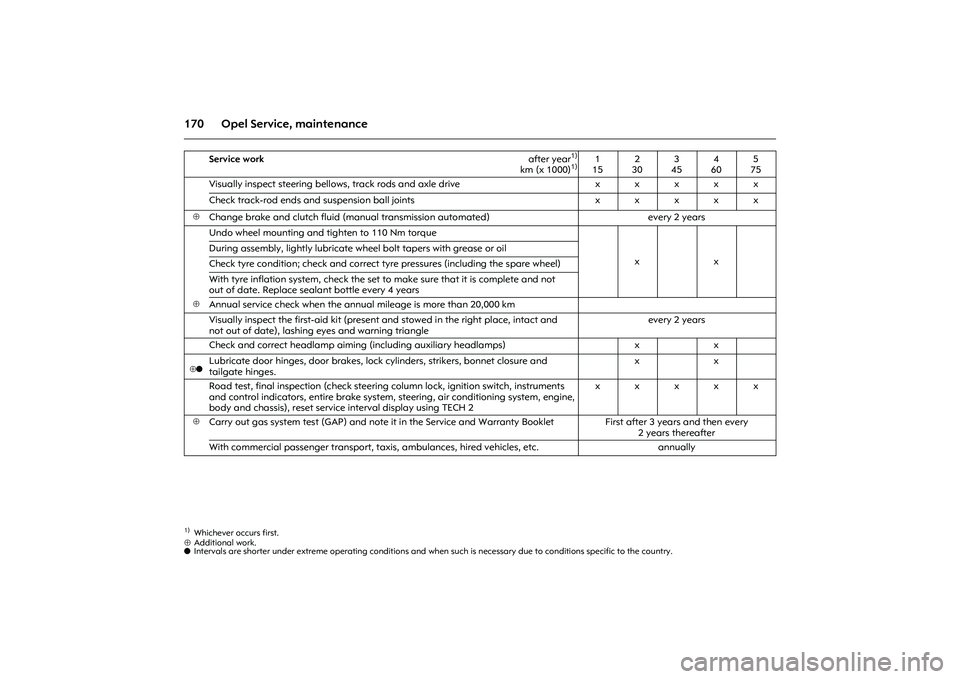
170 Opel Service, maintenance⊕Additional work.
o Intervals are shorter under extreme operating conditions and when such is necessary due to conditions specific to the country.
Service work after year
1)
km (x 1000)
1)
1)Whichever occurs first.
1
152
303
454
605
75
Visually inspect steering bellows, track rods and axle drive x x x x x
Check track-rod ends and suspension ball joints x x x x x
⊕
Change brake and clutch fluid (manual transmission automated) every 2 years
Undo wheel mounting and tighten to 110 Nm torque
xx During assembly, lightly lubricate wheel bolt tapers with grease or oil
Check tyre condition; check and correct tyre pressures (including the spare wheel)
With tyre inflation system, check the set to make sure that it is complete and not
out of date. Replace sealant bottle every 4 years
⊕
Annual service check when the annual mileage is more than 20,000 km
Visually inspect the first-aid kit (present and stowed in the right place, intact and
not out of date), lashing eyes and warning triangleevery 2 years
Check and correct headlamp aiming (including auxiliary headlamps) x x
⊕o
Lubricate door hinges, door brakes, lock cylinders, strikers, bonnet closure and
tailgate hinges.xx
Road test, final inspection (check steering column lock, ignition switch, instruments
and control indicators, entire brake system, steering, air conditioning system, engine,
body and chassis), reset service interval display using TECH 2xxxxx
⊕
Carry out gas system test (GAP) and note it in the Service and Warranty Booklet First after 3 years and then every
2 years thereafter
With commercial passenger transport, taxis, ambulances, hired vehicles, etc. annually
Page 205 of 212
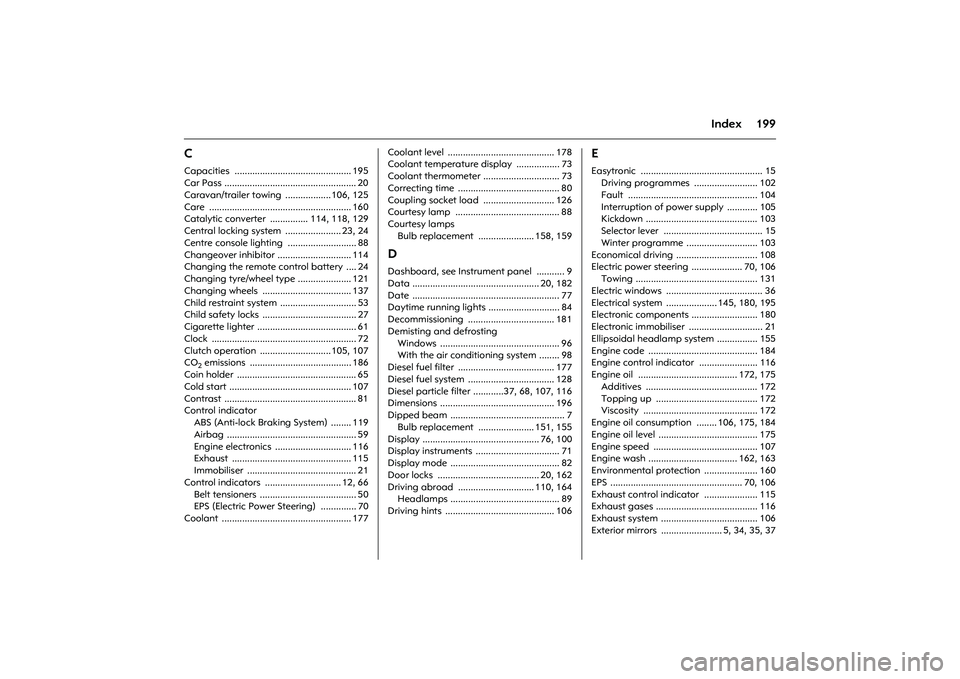
199
Index
CCapacities .............................................. 195
Car Pass .................................................... 20
Caravan/trailer towing .................. 106, 125
Care ........................................................ 160
Catalytic converter ............... 114, 118, 129
Central locking system ...................... 23, 24
Centre console lighting ........................... 88
Changeover inhibitor ............................. 114
Changing the remote control battery .... 24
Changing tyre/wheel type ..................... 121
Changing wheels ................................... 137
Child restraint system .............................. 53
Child safety locks ..................................... 27
Cigarette lighter ....................................... 61
Clock ......................................................... 72
Clutch operation ............................ 105, 107
CO
2 emissions ........................................ 186
Coin holder ............................................... 65
Cold start ................................................ 107
Contrast .................................................... 81
Control indicator
ABS (Anti-lock Braking System) ........ 119
Airbag ................................................... 59
Engine electronics .............................. 116
Exhaust ............................................... 115
Immobiliser ........................................... 21
Control indicators .............................. 12, 66
Belt tensioners ...................................... 50
EPS (Electric Power Steering) .............. 70
Coolant ................................................... 177Coolant level .......................................... 178
Coolant temperature display ................. 73
Coolant thermometer .............................. 73
Correcting time ........................................ 80
Coupling socket load ............................ 126
Courtesy lamp ......................................... 88
Courtesy lamps
Bulb replacement ...................... 158, 159
DDashboard, see Instrument panel ........... 9
Data .................................................. 20, 182
Date .......................................................... 77
Daytime running lights ............................ 84
Decommissioning .................................. 181
Demisting and defrosting
Windows ............................................... 96
With the air conditioning system ........ 98
Diesel fuel filter ...................................... 177
Diesel fuel system .................................. 128
Diesel particle filter ............37, 68, 107, 116
Dimensions ............................................. 196
Dipped beam ............................................. 7
Bulb replacement ...................... 151, 155
Display .............................................. 76, 100
Display instruments ................................. 71
Display mode ........................................... 82
Door locks ........................................ 20, 162
Driving abroad .............................. 110, 164
Headlamps ........................................... 89
Driving hints ........................................... 106
EEasytronic ................................................ 15
Driving programmes ......................... 102
Fault ................................................... 104
Interruption of power supply ............ 105
Kickdown ............................................ 103
Selector lever ....................................... 15
Winter programme ............................ 103
Economical driving ................................ 108
Electric power steering .................... 70, 106
Towing ................................................ 131
Electric windows ...................................... 36
Electrical system .................... 145, 180, 195
Electronic components .......................... 180
Electronic immobiliser ............................. 21
Ellipsoidal headlamp system ................ 155
Engine code ........................................... 184
Engine control indicator ....................... 116
Engine oil ....................................... 172, 175
Additives ............................................ 172
Topping up ........................................ 172
Viscosity ............................................. 172
Engine oil consumption ........ 106, 175, 184
Engine oil level ....................................... 175
Engine speed ......................................... 107
Engine wash ................................... 162, 163
Environmental protection ..................... 160
EPS .................................................... 70, 106
Exhaust control indicator ..................... 115
Exhaust gases ........................................ 116
Exhaust system ...................................... 106
Exterior mirrors ........................ 5, 34, 35, 37