weight OPEL COMBO 2010 Owners Manual
[x] Cancel search | Manufacturer: OPEL, Model Year: 2010, Model line: COMBO, Model: OPEL COMBO 2010Pages: 212, PDF Size: 2.49 MB
Page 4 of 212
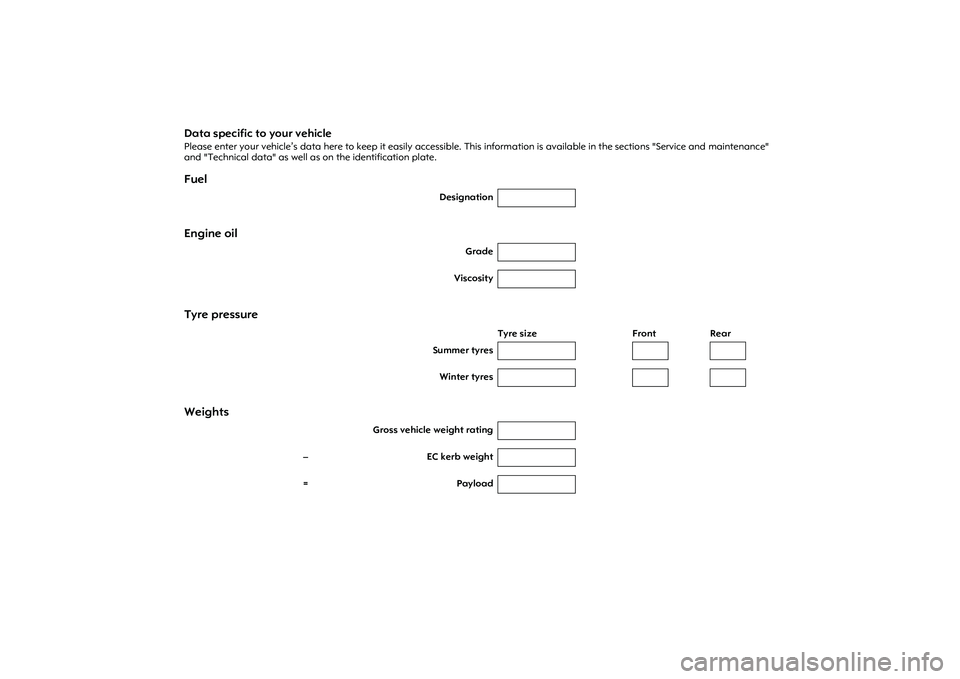
Data specific to your vehiclePlease enter your vehicle’s data here to keep it easily accessible. This information is available in the sections "Service and maintenance"
and "Technical data" as well as on the identification plate. Fuel
Designation
Engine oil
Grade
Viscosity
Tyre pressure
Tyre size Front Rear
Summer tyres
Winter tyres
Weights
Gross vehicle weight rating
– EC kerb weight
=Payload
Page 10 of 212
4In Brief
Picture no: 12429s.tif
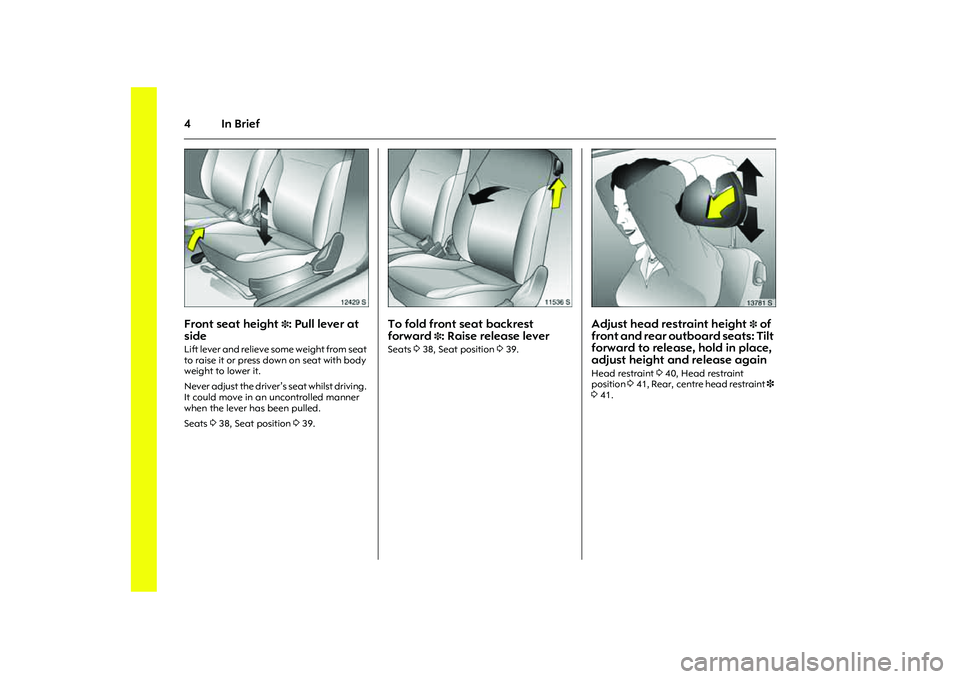
Front seat height
3: Pull lever at
side
Lift lever and relieve some weight from seat
to raise it or press down on seat with body
weight to lower it.
Never adjust the driver’s seat whilst driving.
It could move in an uncontrolled manner
when the lever has been pulled.
Seats 338, Seat position 339.
Picture no: 11536s.tif
To fold front seat backrest
forward
3: Raise release lever
Seats 338, Seat position 339.
Picture no: 13781s.tif
Adjust head restraint height
3 of
front and rear outboard seats: Tilt
forward to release, hold in place,
adjust height and release again
Head restraint 340, Head restraint
position 341, Rear, centre head restraint 3
341.
Page 33 of 212
27
Keys, doors, windows
Picture no: 18098s.tif
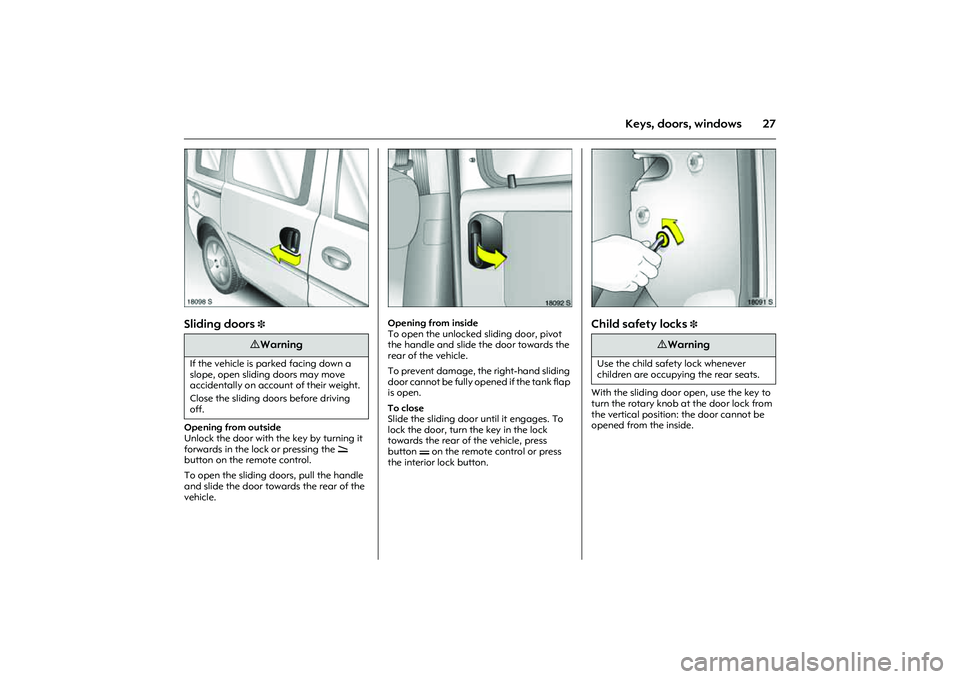
Sliding doors
3
Opening from outside
Unlock the door with the key by turning it
forwards in the lock or pressing the q
button on the remote control.
To open the sliding doors, pull the handle
and slide the door towards the rear of the
vehicle.
Picture no: 18092s.tif
Opening from inside
To open the unlocked sliding door, pivot
the handle and slide the door towards the
rear of the vehicle.
To prevent damage, the right-hand sliding
door cannot be fully opened if the tank flap
is open.
To close
Slide the sliding door until it engages. To
lock the door, turn the key in the lock
towards the rear of the vehicle, press
button p on the remote control or press
the interior lock button.
Picture no: 18091s.tif
Child safety locks
3
With the sliding door open, use the key to
turn the rotary knob at the door lock from
the vertical position: the door cannot be
opened from the inside.
9 Warning
If the vehicle is parked facing down a
slope, open sliding doors may move
accidentally on account of their weight.
Close the sliding doors before driving
off.
9 Warning
Use the child safety lock whenever
children are occupying the rear seats.
Page 45 of 212
39
Seats, Interior
Picture no: 12429s.tif
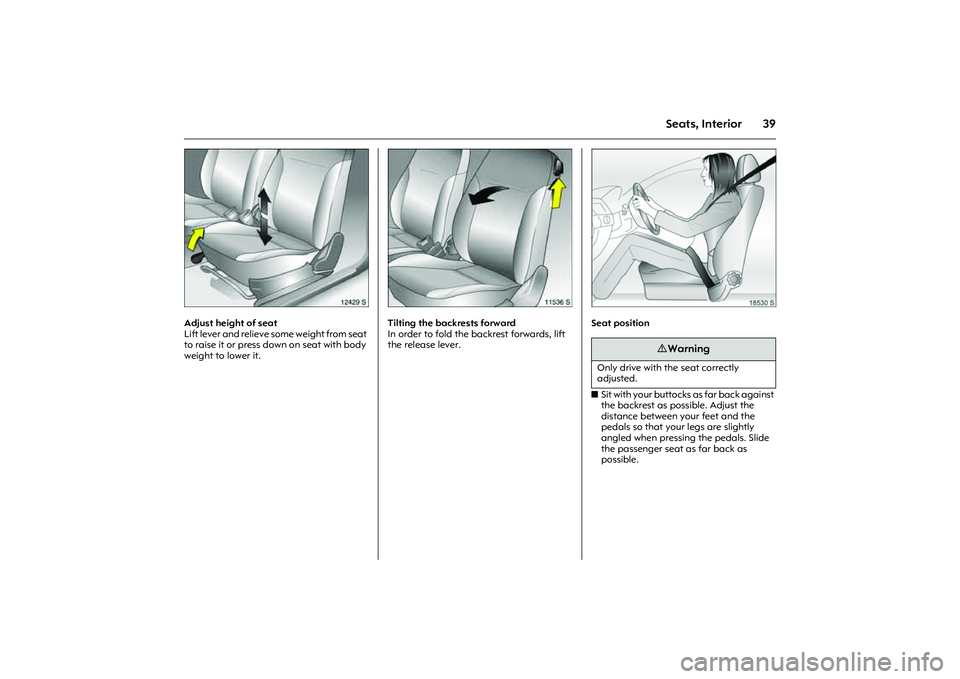
Adjust height of seat
Lift lever and relieve some weight from seat
to raise it or press down on seat with body
weight to lower it.
Picture no: 11536s.tif
Tilting the backrests forward
In order to fold the backrest forwards, lift
the release lever.
Picture no: 18530s.tif
Seat position
zSit with your buttocks as far back against
the backrest as possible. Adjust the
distance between your feet and the
pedals so that your legs are slightly
angled when pressing the pedals. Slide
the passenger seat as far back as
possible.
9 Warning
Only drive with the seat correctly
adjusted.
Page 53 of 212
47
Seats, Interior
Picture no: 18103s.tif
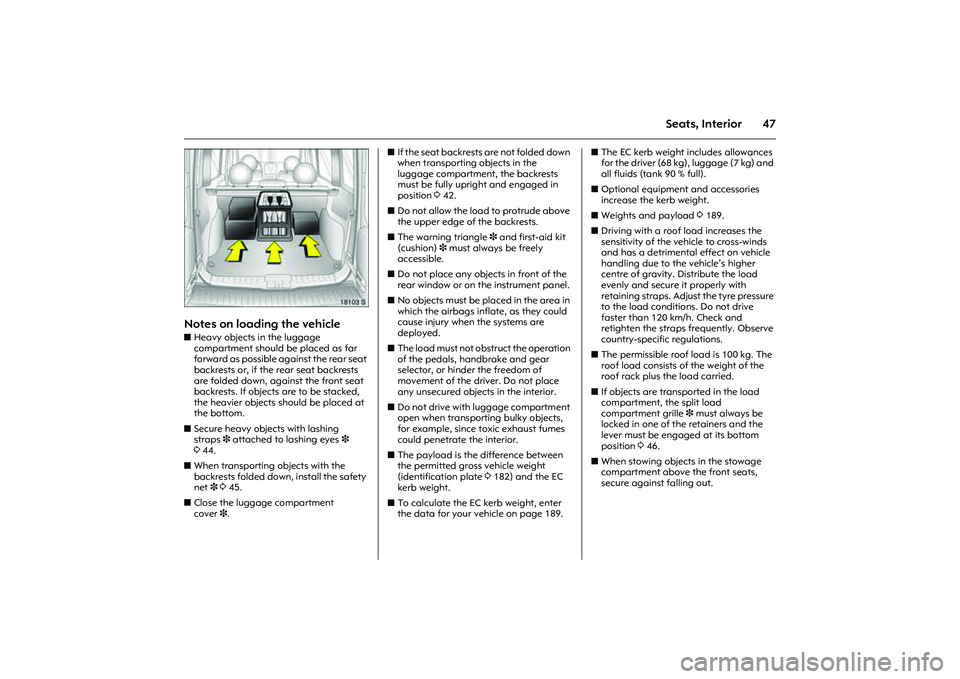
Notes on loading the vehicle zHeavy objects in the luggage
compartment should be placed as far
forward as possible against the rear seat
backrests or, if the rear seat backrests
are folded down, against the front seat
backrests. If objects are to be stacked,
the heavier objects should be placed at
the bottom.
zSecure heavy objects with lashing
straps3 attached to lashing eyes 3
344.
zWhen transporting objects with the
backrests folded down, install the safety
net 3 345.
zClose the luggage compartment
cover3. zIf the seat backrests are not folded down
when transporting objects in the
luggage compartment, the backrests
must be fully upright and engaged in
position 342.
zDo not allow the load to protrude above
the upper edge of the backrests.
zThe warning triangle 3 and first-aid kit
(cushion) 3 must always be freely
accessible.
zDo not place any objects in front of the
rear window or on the instrument panel.
zNo objects must be placed in the area in
which the airbags inflate, as they could
cause injury when the systems are
deployed.
zThe load must not obstruct the operation
of the pedals, handbrake and gear
selector, or hinder the freedom of
movement of the driver. Do not place
any unsecured objects in the interior.
zDo not drive with luggage compartment
open when transporting bulky objects,
for example, since toxic exhaust fumes
could penetrate the interior.
zThe payload is the difference between
the permitted gross vehicle weight
(identification plate 3182) and the EC
kerb weight.
zTo calculate the EC kerb weight, enter
the data for your vehicle on page 189. zThe EC kerb weight includes allowances
for the driver (68 kg), luggage (7 kg) and
all fluids (tank 90 % full).
zOptional equipment and accessories
increase the kerb weight.
zWeights and payload 3189.
zDriving with a roof load increases the
sensitivity of the vehicle to cross-winds
and has a detrimental effect on vehicle
handling due to the vehicle’s higher
centre of gravity. Distribute the load
evenly and secure it properly with
retaining straps. Adjust the tyre pressure
to the load conditions. Do not drive
faster than 120 km/h. Check and
retighten the straps frequently. Observe
country-specific regulations.
zThe permissible roof load is 100 kg. The
roof load consists of the weight of the
roof rack plus the load carried.
zIf objects are transported in the load
compartment, the split load
compartment grille
3 must always be
locked in one of the retainers and the
lever must be engaged at its bottom
position 346.
zWhen stowing objects in the stowage
compartment above the front seats,
secure against falling out.
Page 60 of 212
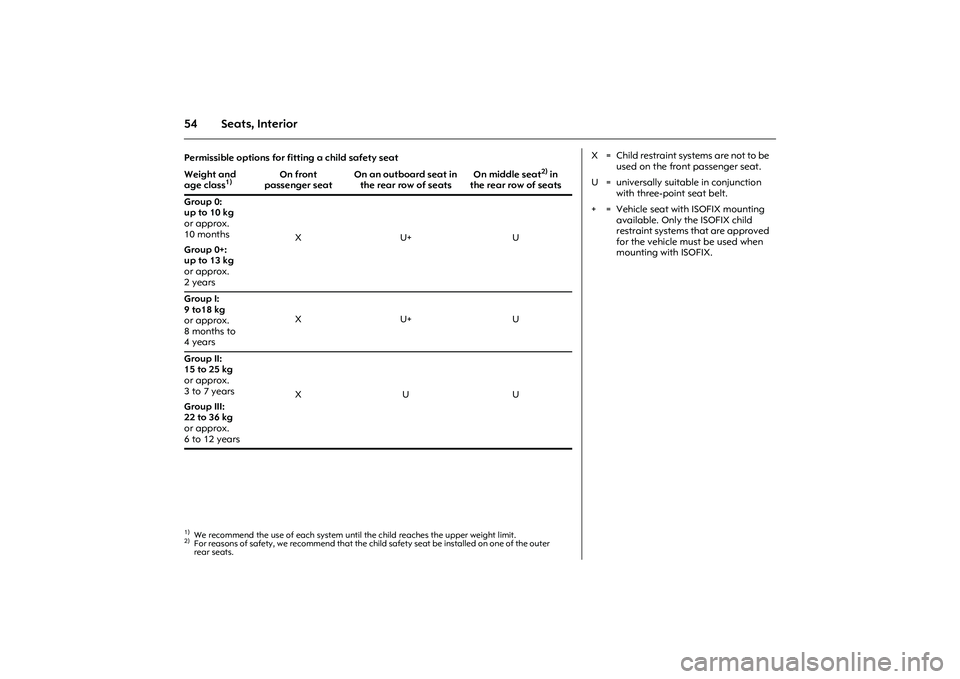
54 Seats, InteriorPermissible options for fitting a child safety seat
Weight and
age class
1)
1)We recommend the use of each system until the child reaches the upper weight limit.
On front
passenger seat On an outboard seat in
the rear row of seats On middle seat
2) in
the rear row of seats
2)For reasons of safety, we recommend that the child safety seat be installed on one of the outer
rear seats.Group 0:
up to 10 kg
or approx.
10 months
Group 0+:
up to 13 kg
or approx.
2yearsXU+ U
Group I:
9to18 kg
or approx.
8months to
4years XU+ U
Group II:
15 to 25 kg
or approx.
3to 7 years
Group III:
22 to 36 kg
or approx.
6to 12 years XU U
X = Child restraint systems are not to be
used on the front passenger seat.
U = universally suitable in conjunction
with three-point seat belt.
+ = Vehicle seat with ISOFIX mounting
available. Only the ISOFIX child
restraint systems that are approved
for the vehicle must be used when
mounting with ISOFIX.
Page 61 of 212
55
Seats, Interior
Note
zChildren under 12 years of age or 150 cm
must only travel in an appropriate child
restraint system on the seats in the rear
row 3.
zWhen transporting children, use the child
restraint systems suitable for the child’s
weight.
zBe sure that child restraint systems are
properly installed - see the instructions
accompanying the child restraint
system. zThe covers of the Opel child restraint
system can be wiped clean.
zDo not stick anything on the child
restraint systems and do not cover them
with any other materials.
zOnly allow the child to enter and exit on
the side of the vehicle facing away from
the road.
zA child restraint system which has been
subjected to stress in an accident must
be replaced.
zSecure or remove child restraint systems
that are in the vehicle but not in use.
Mounting clips
3 for ISOFIX child
restraint systems
The mounting eyes for the ISOFIX child
restraint system are located on the rear,
outer seats 3 between the seat back and
the seat cushion.
Fasten permitted ISOFIX child restraint
systems to the mounting brackets.
Closely follow the installation instructions
accompanying the ISOFIX child restraint
system.
Page 116 of 212
110 Driving and operationFuels, refuellingFuel consumption
Fuel consumption is determined under
specific driving conditions 3186.
Special equipment increases the weight of
the vehicle. As a result, they can increase
fuel consumption and reduce the specified
maximum speed.
There is increased friction between engine
and transmission parts during the first
1000 kilometres. This increases fuel
consumption. Fuel for petrol engines
Only use unleaded fuel that complies with
DIN EN 228.
Fuels with ethanol content greater than 5 %
may only be used if the vehicle has been
specifically developed and approved for
these fuels.
Use fuel with the recommended octane
rating (value in bold 3184). Use of fuel
with too low an octane rating can reduce
engine power and torque and slightly
increases fuel consumption. Fuel for diesel engines
Only use diesel fuel that complies with
DIN EN 590. The fuel must have low
sulphur content (max. 50 ppm).
Do not use marine diesel oils, heating oils
or entirely or partially plant-based diesel
fuels, such as rape seed oil or bio diesel,
Aquazole and similar diesel-water
emulsions. Diesel fuels must not be diluted
with fuels for petrol engines.
The flow and filterability of diesel fuel are
temperature-dependent. When
temperatures are low, refuel with diesel fuel
with guaranteed winter properties.
Fuel for natural gas operation
Use natural gas with a methane content of
approx. 78-99 %. L-gas (low) has approx.
78-87 % and H-gas (high) has approx.
87-99 %. Biogas with the same methane
content can also be used if it has been
chemically prepared and desulphurised.
Liquid gas or LPG must not be used. Caution
Use of fuel with too low an octane rating
could lead to uncontrolled combustion
and engine damage.
Page 132 of 212
126 Driving and operationTowing equipment
3
Only use towing equipment that has been
approved for your vehicle. Entrust
retrofitting of towing equipment to a
workshop. It may be necessary to make
changes that affect the cooling system,
heat shields or other equipment.
Installation dimensions of towing
equipment 3197.
Towing equipment with fixed coupling
ball bar3
In the case of trailers/caravans with brake,
attach break-away stopping cable to eye
to right of coupling ball bar. Caravan/trailer towingCaravan and trailer loads
1)
The permissible caravan/trailer loads are
vehicle and engine-dependent maximum
values which must not be exceeded. The
actual caravan/trailer load is the difference
between the actual gross weight of the
caravan/trailer and the actual coupling
socket load with the caravan/trailer
coupled.
The permissible caravan/trailer loads are
specified in the vehicle documents. In
general, they are valid for gradients up to
max. 12 %. The permitted caravan/trailer load applies
up to the specified incline and up to an
altitude of 1000 metres above sea level.
Since engine power decreases as altitude
increases because of the air becoming
thinner, therefore reducing climbing ability,
the permitted towing weight also
decreases by 10 % for every 1000 metres
of additional altitude. The towing weight
does not have to be reduced when driving
on roads with slight inclines (less than 8 %,
e. g. motorways).
The permissible gross train weight must not
be exceeded. This weight is specified on
the identification plate 3182. Coupling socket load
The coupling socket load is the load
exerted by the trailer/caravan on the
coupling ball. It can be varied by changing
the weight distribution when loading the
trailer/caravan.
The maximum permissible coupling socket
load (50 kg) is specified on the towing
equipment identification plate and in the
vehicle documents. Always aim for the
maximum load, especially in the case of
heavy caravans/trailers. The coupling
socket load should never fall below 25 kg.
When measuring the coupling socket load,
make sure that the drawbar of the loaded
trailer/caravan is at the same height as it
will be when the trailer/caravan is coupled
with the towing vehicle loaded. Particularly
important for trailers/caravans with
tandem axle.
Rear axle load during towing
The permissible axle loads must not be
exceeded. 1)Observe national regulations.
Page 188 of 212
182 Technical dataTechnical data
Picture no: 11679s.tif
Vehicle data The technical data is determined in
accordance with European Community
standards. We reserve the right to make
modifications. Specifications in the vehicle
documents always have priority over those
given in this Owner’s Manual.
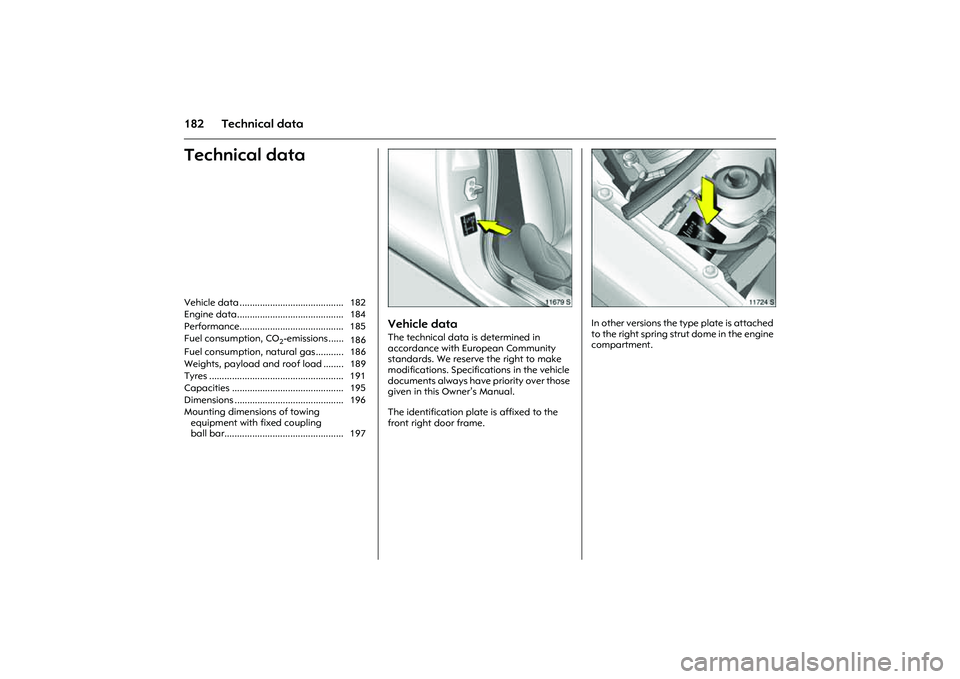
The identification plate is affixed to the
front right door frame.
Picture no: 11724s.tif
In other versions the type plate is attached
to the right spring strut dome in the engine
compartment. Vehicle data ......................................... 182
Engine data.......................................... 184
Performance......................................... 185
Fuel consumption, CO
2-emissions ......
186
Fuel consumption, natural gas........... 186
Weights, payload and roof load ........ 189
Tyres ..................................................... 191
Capacities ............................................ 195
Dimensions ........................................... 196
Mounting dimensions of towing
equipment with fixed coupling
ball bar............................................... 197