wipers OPEL COMBO 2010 Owners Manual
[x] Cancel search | Manufacturer: OPEL, Model Year: 2010, Model line: COMBO, Model: OPEL COMBO 2010Pages: 212, PDF Size: 2.49 MB
Page 15 of 212
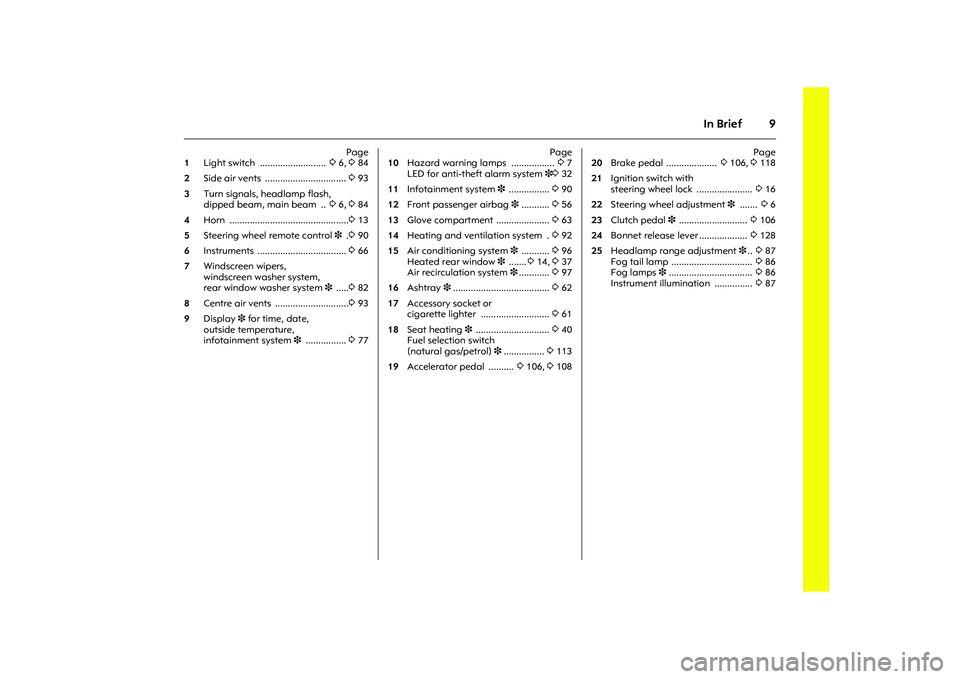
9
In Brief
Page
1Light switch .......................... 36, 384
2Side air vents ................................ 393
3Turn signals, headlamp flash,
dipped beam, main beam .. 36, 384
4Horn ...............................................313
5 Steering wheel remote control 3 .390
6Instruments ................................... 366
7 Windscreen wipers,
windscreen washer system,
rear window washer system 3 .....382
8Centre air vents .............................393
9Display 3 for time, date,
outside temperature,
infotainment system 3 ................ 377Page
10Hazard warning lamps ................. 37
LED for anti-theft alarm system 3332
11 Infotainment system 3 ................ 390
12 Front passenger airbag 3 ........... 356
13Glove compartment ..................... 363
14Heating and ventilation system . 392
15 Air conditioning system 3 ........... 396
Heated rear window 3 .......314, 337
Air recirculation system 3............ 397
16
Ashtray 3...................................... 362
17Accessory socket or
cigarette lighter ........................... 361
18 Seat heating 3 ............................. 340
Fuel selection switch
(natural gas/petrol) 3................ 3113
19Accelerator pedal .......... 3106, 3108Page
20Brake pedal .................... 3106, 3118
21Ignition switch with
steering wheel lock ...................... 316
22 Steering wheel adjustment 3 ....... 36
23 Clutch pedal 3 ........................... 3106
24Bonnet release lever ................... 3128
25 Headlamp range adjustment 3.. 387
Fog tail lamp ................................ 386
Fog lamps 3 ................................. 386
Instrument illumination ............... 387
Page 17 of 212
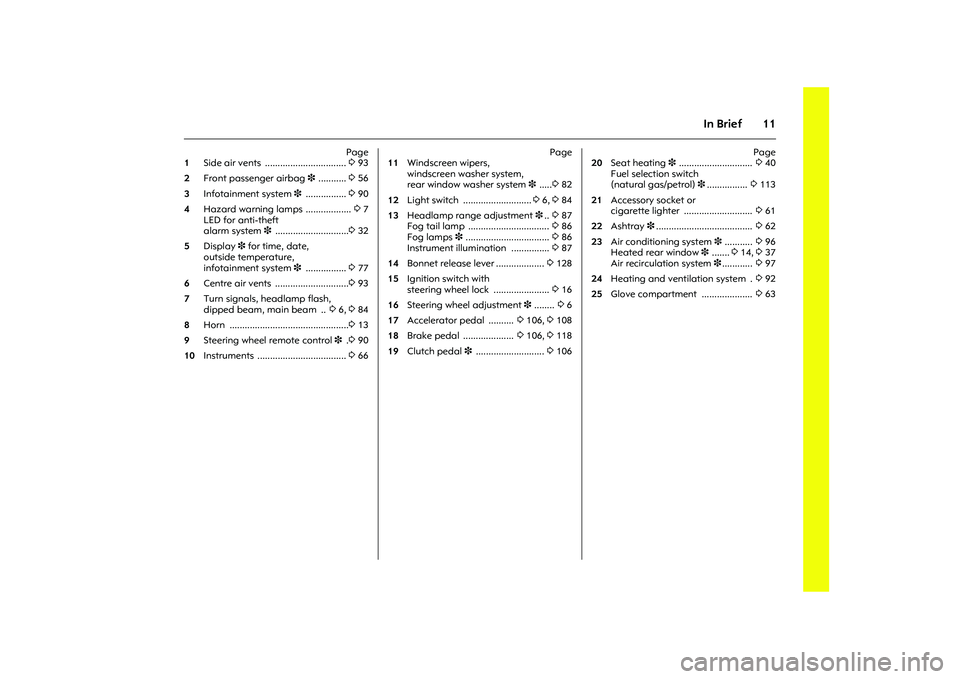
11
In Brief
Page
1Side air vents ................................ 393
2 Front passenger airbag 3 ........... 356
3 Infotainment system 3 ................ 390
4Hazard warning lamps .................. 37
LED for anti-theft
alarm system 3 .............................332
5Display 3 for time, date,
outside temperature,
infotainment system 3 ................ 377
6Centre air vents .............................393
7Turn signals, headlamp flash,
dipped beam, main beam .. 36, 384
8Horn ...............................................313
9 Steering wheel remote control 3 .390
10Instruments ................................... 366Page
11 Windscreen wipers,
windscreen washer system,
rear window washer system 3 .....382
12Light switch ...........................36, 384
13 Headlamp range adjustment 3.. 387
Fog tail lamp ................................ 386
Fog lamps 3 ................................. 386
Instrument illumination ............... 387
14Bonnet release lever ................... 3128
15Ignition switch with
steering wheel lock ...................... 316
16 Steering wheel adjustment 3 ........ 36
17Accelerator pedal .......... 3106, 3108
18Brake pedal .................... 3106, 3118
19 Clutch pedal 3 ........................... 3106Page
20 Seat heating 3 ............................. 340
Fuel selection switch
(natural gas/petrol) 3................ 3113
21Accessory socket or
cigarette lighter ........................... 361
22 Ashtray 3...................................... 362
23 Air conditioning system 3 ........... 396
Heated rear window 3 .......314, 337
Air recirculation system 3............ 397
24Heating and ventilation system . 392
25Glove compartment .................... 363
Page 20 of 212
14 In Brief
Picture no: 14057h.tif
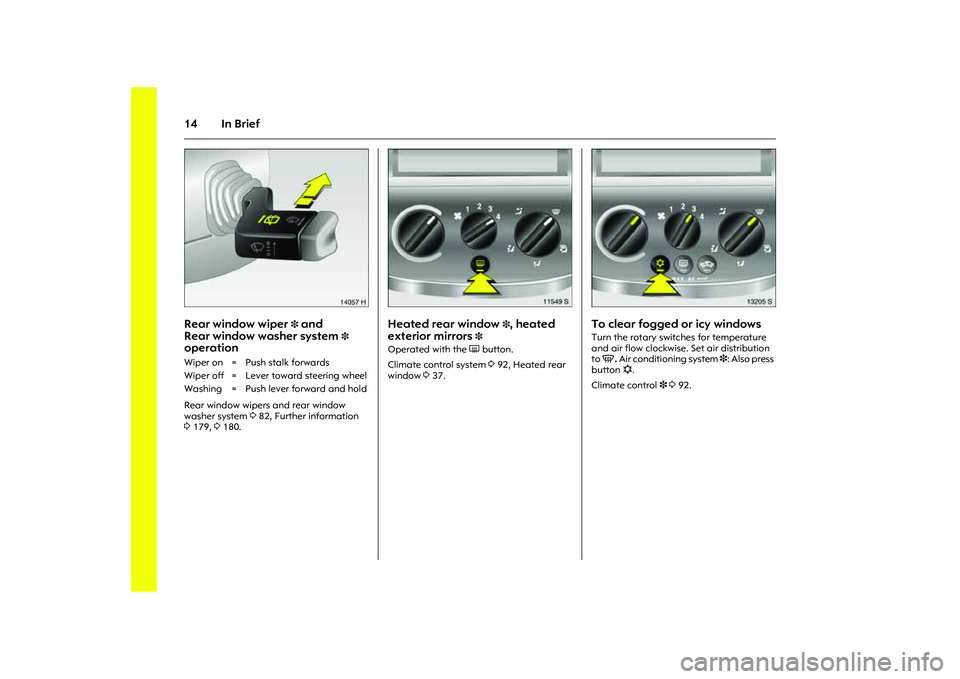
Rear window wiper
3 and
Rear window washer system
3
operation Rear window wipers and rear window
washer system 382, Further information
3179, 3180.
Picture no: 11549s.tif
Heated rear window
3, heated
exterior mirrors
3
Operated with the Ü button.
Climate control system 392, Heated rear
window 337.
Picture no: 13205s.tif
To clear fogged or icy windows Turn the rotary switches for temperature
and air flow clockwise. Set air distribution
to V. Air conditioning system 3: Also press
button n.
Climate control 3 392. Wiper on = Push stalk forwards
Wiper off = Lever toward steering wheel
Washing = Push lever forward and hold
Page 72 of 212
66 InstrumentsInstrumentsControl indicators ................................ 66
Instrument display ............................... 71
Information display ............................. 76
Warning buzzers.................................. 82
Windscreen wipers ............................... 82
Picture no: 18529s.tif
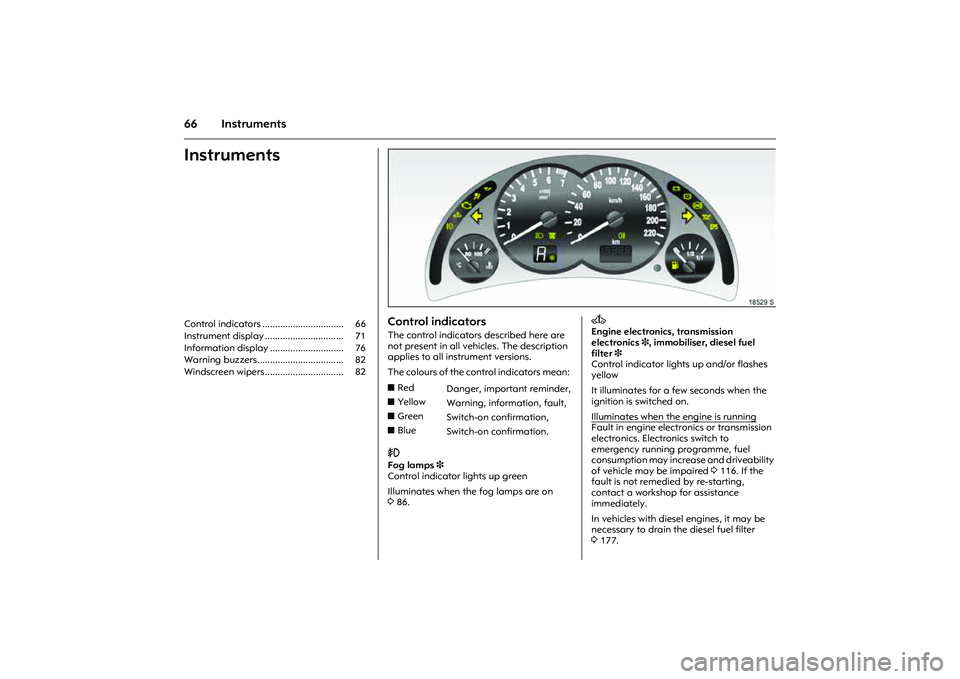
Control indicators The control indicators described here are
not present in all vehicles. The description
applies to all instrument versions.
The colours of the control indicators mean: >
Fog lamps 3
Control indicator lights up green
Illuminates when the fog lamps are on
386.
Picture no:
A
Engine electronics, transmission
electronics 3, immobiliser, diesel fuel
filter3
Control indicator lights up and/or flashes
yellow
It illuminates for a few seconds when the
ignition is switched on.
Illuminates when the engine is running
Fault in engine electronics or transmission
electronics. Electronics switch to
emergency running programme, fuel
consumption may increase and driveability
of vehicle may be impaired 3116. If the
fault is not remedied by re-starting,
contact a workshop for assistance
immediately.
In vehicles with diesel engines, it may be
necessary to drain the diesel fuel filter
3177. zRed
Danger, important reminder,
zYellow
Warning, information, fault,
zGreen
Switch-on confirmation,
zBlue
Switch-on confirmation.
Page 88 of 212
82 InstrumentsSetting display mode 3
Display brightness is independent of
vehicle lighting. Settings are made as
follows:
Select menu item Day / Night from the
Settings menu.
The options are displayed.
Automatic: Adapted based on vehicle
lighting.
Always day design: Black text on light
background.
Always night design: White text on dark
background.
Selections are indicated by a o in front of
the menu item.
Ignition logic 3
Setting, see infotainment system
instructions.
Warning buzzersWhen starting the engine or while driving:
zif seat belt 3 is not fastened.
zIf the speed programmed at the
factory3 is exceeded.
zIf the car has automated manual
transmission 3 and the driver’s door is
opened when the engine is running, a
gear is engaged and the foot brake is
not depressed.
When parking the vehicle and opening
the driver’s door:
zwhen the ignition key is in the ignition
switch.
zwith parking lamps or dipped beam on.
zif the turn signal lever is engaged.
Picture no: 14055h.tif
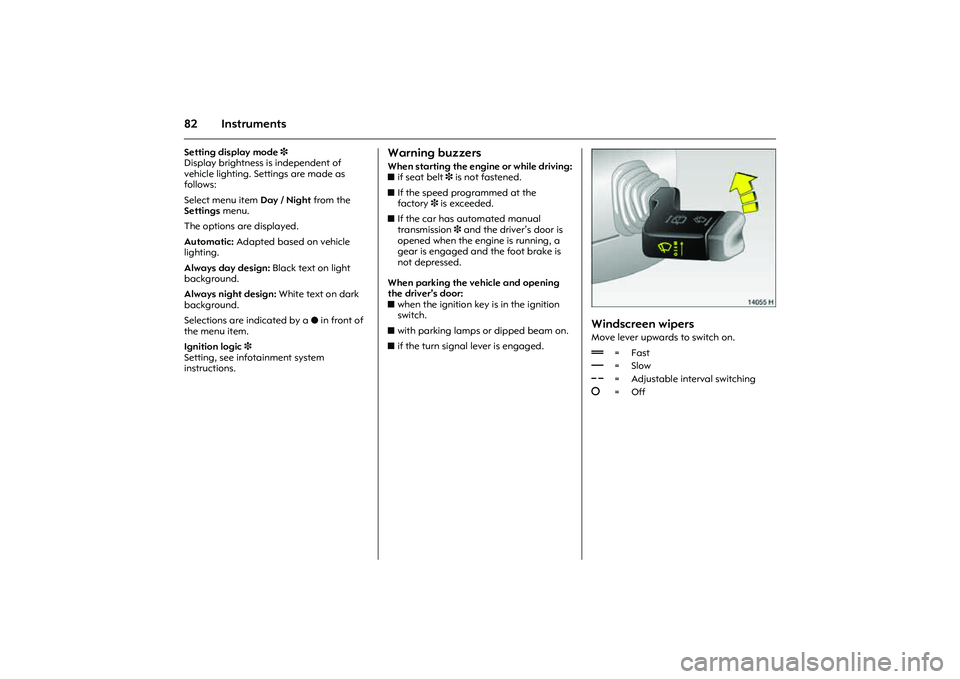
Windscreen wipers Move lever upwards to switch on.
&=Fast
%=Slow
$= Adjustable interval switching
§=Off
Page 89 of 212
83
Instruments
Adjustable wiper interval
To set the wiper interval to a value between
2 and 15 seconds:
Lever to interval operation $, lever to §,
wait for required interval delay, Level to
interval operation again $.
The selected interval will remain stored
until the next time it is changed or until the
ignition is switched off.
After switching on the ignition and moving
the lever up, $ the interval is set to
7seconds.
Picture no: 14056h.tif
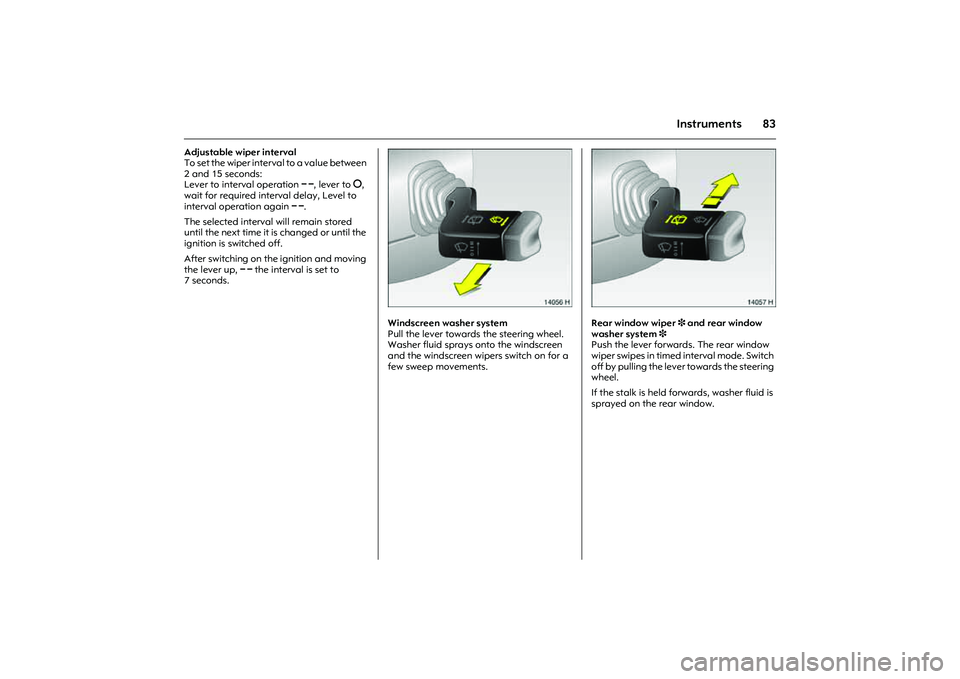
Windscreen washer system
Pull the lever towards the steering wheel.
Washer fluid sprays onto the windscreen
and the windscreen wipers switch on for a
few sweep movements.
Picture no: 14057h.tif
Rear window wiper 3 and rear window
washer system 3
Push the lever forwards. The rear window
wiper swipes in timed interval mode. Switch
off by pulling the lever towards the steering
wheel.
If the stalk is held forwards, washer fluid is
sprayed on the rear window.
Page 138 of 212
132 Self-help, vehicle care
Picture no: 18109s.tif
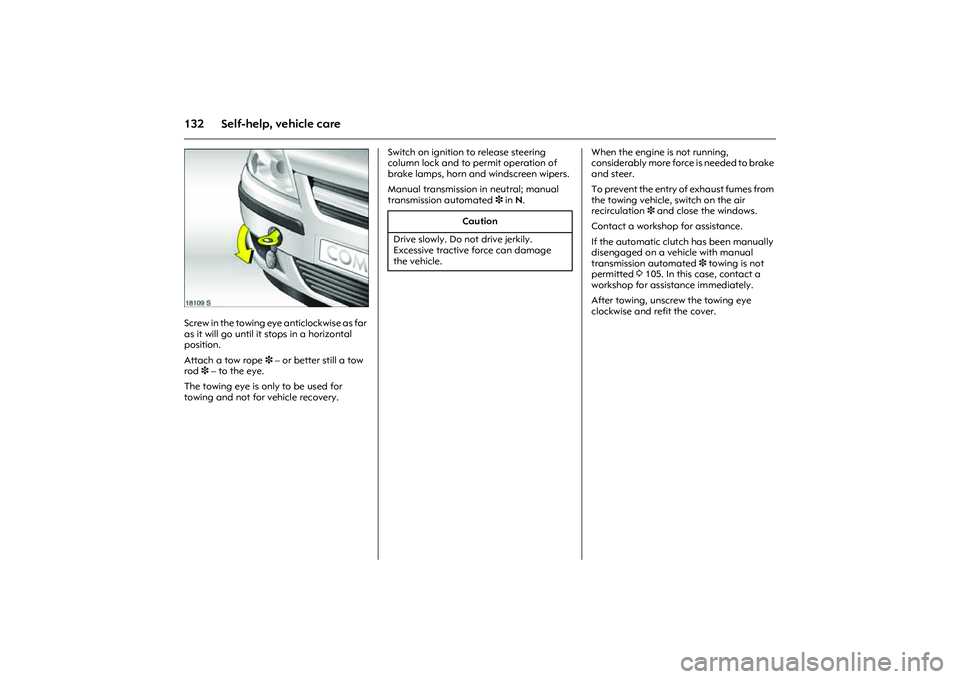
Screw in the towing eye anticlockwise as far
as it will go until it stops in a horizontal
position.
Attach a tow rope 3 – or better still a tow
rod3 – to the eye.
The towing eye is only to be used for
towing and not for vehicle recovery. Switch on ignition to release steering
column lock and to permit operation of
brake lamps, horn and windscreen wipers.
Manual transmission in neutral; manual
transmission automated 3 in N. When the engine is not running,
considerably more force is needed to brake
and steer.
To prevent the entry of exhaust fumes from
the towing vehicle, switch on the air
recirculation 3 and close the windows.
Contact a workshop for assistance.
If the automatic clutch has been manually
disengaged on a vehicle with manual
transmission automated 3 towing is not
permitted 3105. In this case, contact a
workshop for assistance immediately.
After towing, unscrew the towing eye
clockwise and refit the cover.
Caution
Drive slowly. Do not drive jerkily.
Excessive tractive force can damage
the vehicle.
Page 154 of 212
148 Self-help, vehicle care
Picture no: 15544s.tif Picture no:
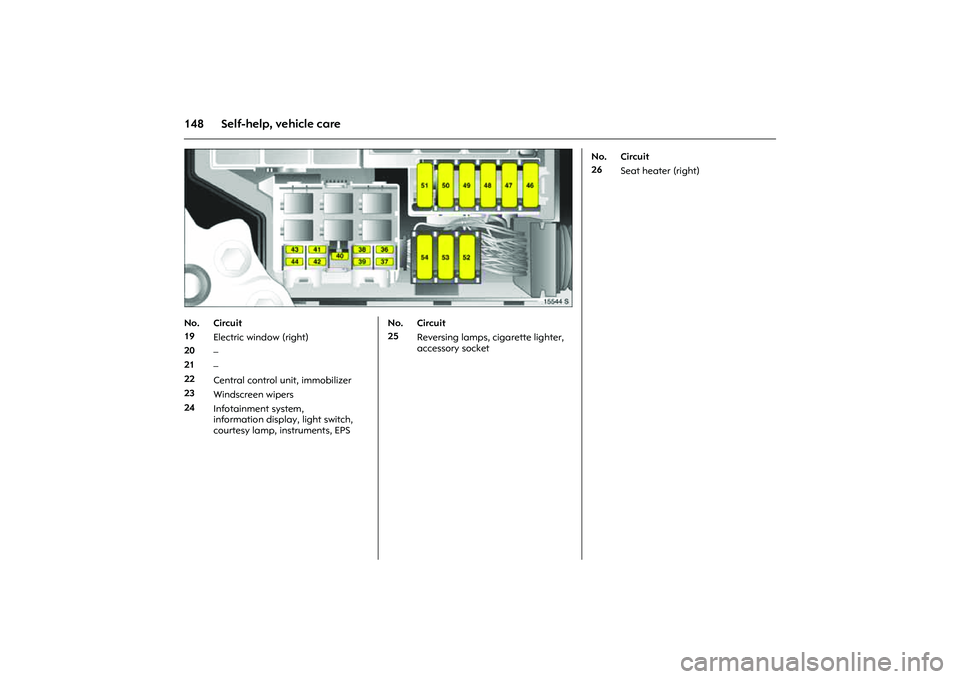
No. Circuit
19
Electric window (right)
20
–
21
–
22
Central control unit, immobilizer
23
Windscreen wipers
24
Infotainment system,
information display, light switch,
courtesy lamp, instruments, EPS
No. Circuit
25
Reversing lamps, cigarette lighter,
accessory socket No. Circuit
26
Seat heater (right)
Page 167 of 212
161
Self-help, vehicle care
Washing
The paintwork of your vehicle is exposed to
environmental influences. Wash and wax
your vehicle regularly. When using
automatic car washes, select a programme
that includes waxing.
Bird droppings, dead insects, resin, pollen
and the like should be cleaned off
immediately, as they contain aggressive
constituents which can cause paint
damage.
When using a car wash, follow the car-
wash manufacturer’s instructions. Switch
off the windscreen wipers 3. Unscrew the
antenna 3 and remove the roof rack 3.
If you wash your vehicle by hand, make
sure that the insides of the wings are also
thoroughly rinsed out.
Clean edges and folds on opened doors
and flaps as well as the areas they cover. Thoroughly rinse off and leather-off the
vehicle. Rinse leather frequently. Use
separate leathers for paint and window
surfaces: remnants of wax on the windows
will impair vision.
Do not use hard objects to remove spots of
tar. Use tar removal spray on painted
surfaces.
Polishing and waxing
Wax the vehicle regularly (at the latest
when water no longer beads). Otherwise,
the paintwork will dry out.
Polishing is necessary only if the paint has
become dull or if solid deposits have
become attached to it.
Paintwork polish with silicone forms a
protective film, making waxing
unnecessary.
Plastic body parts should not be treated
with wax and polish. Wheels and tyres
Do not use high-pressure jet cleaners.
Clean wheels with a pH-neutral wheel
cleaner.
Wheels are painted and can be treated
with the same agents as the body.
Paintwork damage
Rectify minor paintwork damage with a
touch-up pen before rust forms. Have more
extensive damage or rust areas repaired
by a workshop.
Page 171 of 212
165 Opel Service, maintenance
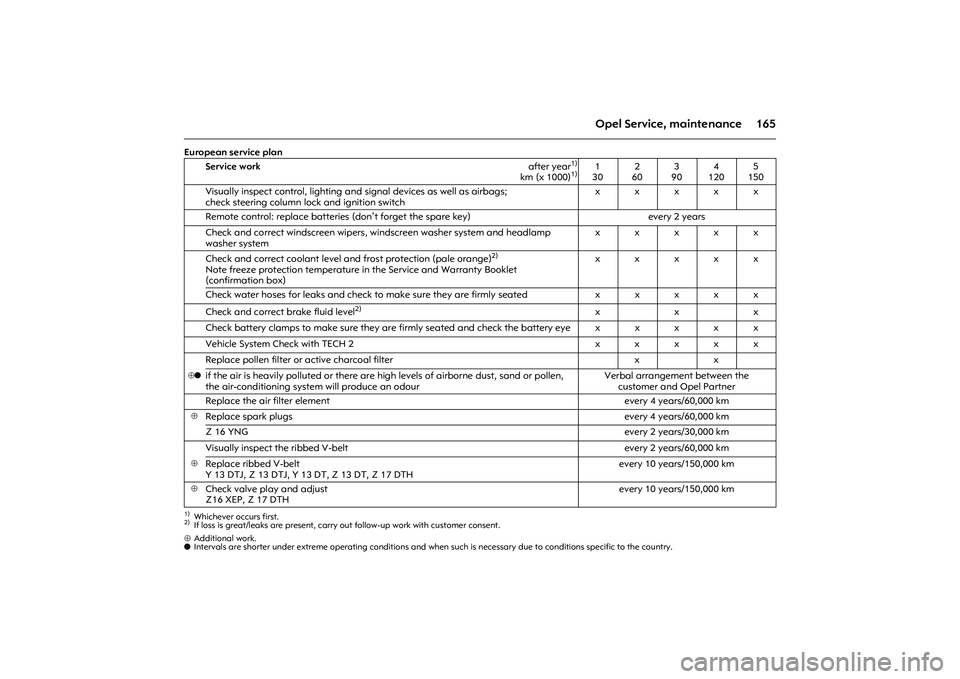
European service plan⊕Additional work.
o Intervals are shorter under extreme operating conditions and when such is necessary due to conditions specific to the country.
Service work after year
1)
km (x 1000)
1)
1)Whichever occurs first.
1
302
603
904
1205
150
Visually inspect control, lighting and signal devices as well as airbags;
check steering column lock and ignition switchxxxxx
Remote control: replace batteries (don’t forget the spare key) every 2 years
Check and correct windscreen wipers, windscreen washer system and headlamp
washer systemxxxxx
Check and correct coolant level and frost protection (pale orange)
2)
Note freeze protection temperature in the Service and Warranty Booklet
(confirmation box)
2)If loss is great/leaks are present, carry out follow-up work with customer consent.
xxxxx
Check water hoses for leaks and check to make sure they are firmly seated x x x x x
Check and correct brake fluid level
2) xxx
Check battery clamps to make sure they are firmly seated and check the battery eye x x x x x
Vehicle System Check with TECH 2 x x x x x
Replace pollen filter or active charcoal filter x x
⊕o
if the air is heavily polluted or there are high levels of airborne dust, sand or pollen,
the air-conditioning system will produce an odourVerbal arrangement between the
customer and Opel Partner
Replace the air filter element every 4 years/60,000 km
⊕
Replace spark plugsevery 4 years/60,000 km
Z 16 YNGevery 2 years/30,000 km
Visually inspect the ribbed V-belt every 2 years/60,000 km
⊕
Replace ribbed V-belt
Y 13 DTJ, Z 13 DTJ, Y 13 DT, Z 13 DT, Z 17 DTH every 10 years/150,000 km
⊕
Check valve play and adjust
Z16 XEP, Z 17 DTHevery 10 years/150,000 km