air conditioning OPEL CORSA 2009 User Guide
[x] Cancel search | Manufacturer: OPEL, Model Year: 2009, Model line: CORSA, Model: OPEL CORSA 2009Pages: 284, PDF Size: 4.96 MB
Page 158 of 284

152 Driving and operationOverrun
zThe fuel supply is shut off automatically
on overrun, e.g. when descending steep
hills or when braking 3150.
z To enable the overrun cut-off to come
into action and save fuel, do not
accelerate or declutch during overrun.
Correct gear selection
z High revs increase engine wear and fuel
consumption.
z Do not race your engine. Avoid driving at
high engine speeds.
Making use of the tachometer helps to
save fuel. Drive in a low engine speed
range for each gear as much as possible
with uniform engine speeds. Drive as
often as possible in top gear, select the
next higher gear as soon as possible,
and only change down when the engine
is no longer running perfectly smoothly.
High speed
z The higher the speed, the higher the
consumption and the noise level. At top
speed, you consume a great deal of fuel
and produce excessive noise and
exhaust emissions. z
Slightly releasing th e accelerator pedal
results in distinct fu el savings with no
major loss of speed.
Drive at no more than around three
quarters of maximum speed and you will
use up to 50 % less fuel, without losing a
great deal of time.
Tyre pressure
z Inadequate tyre pressure, leading to
higher road resistance, costs money in
two ways: for more fuel and increased
tyre wear.
z Regular checks (every 14 days) pay off.
Electrical loads
z The power consumption of electrical
equipment increases fuel consumption.
z Switch off all additional consumers (e.g.
air conditioning 3, heated rear window)
when not needed.
Roof racks, ski-holders
z Roof loads can increase fuel consumption
by approximately 1l/100 km due to air
resistance.
z Remove them if they are not being used. Repair and maintenance
z
Improper repairs or adjustment and
maintenance work can increase fuel
consumption. Do not carry out work on
the engine yourself.
You may out of ignorance infringe
environmental laws by not disposing of
materials properly.
Appropriate parts might not be recycled.
Contact with some of the materials
involved may pose a health hazard.
z We recommend that repair and
maintenance be entrusted to your Opel
Partner.
Extreme driving conditions
z Driving up steep slopes, cornering,
driving on poor roads and driving in ice
and snow all increase fuel consumption.
Fuel consumption increases dramatically
in urban traffic and at low temperatures,
especially on short trips when the engine
operating temperature is not reached.
z Following the instructions given above
will minimise consumption under these
conditions.
Back to overview
Page 215 of 284
209
Self-help, vehicle care
Picture no: 18588s.tif
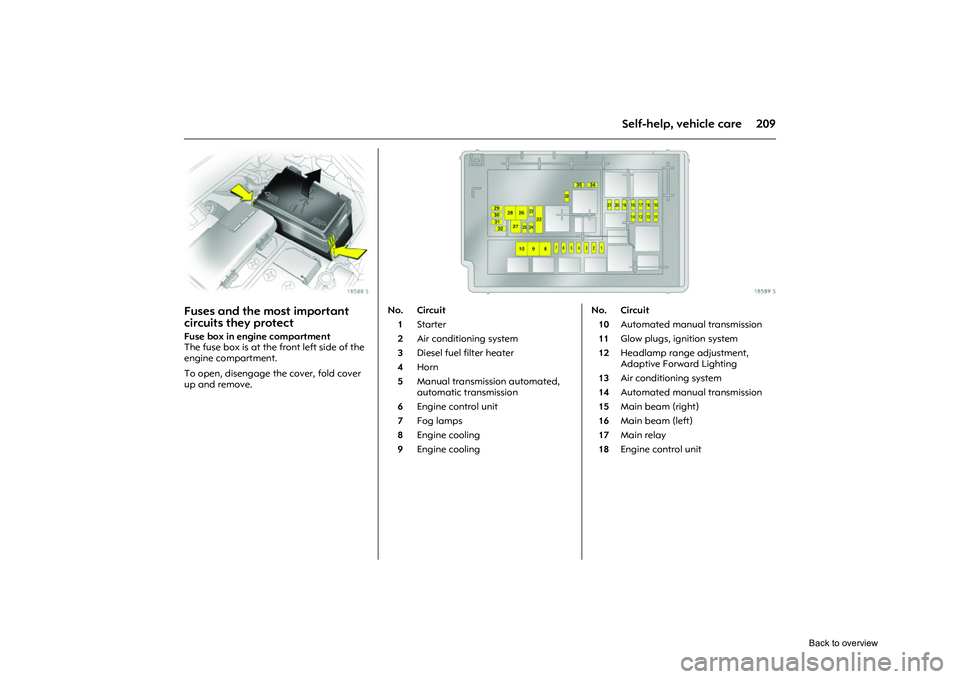
Fuses and the most important
circuits they protectFuse box in engine compartment
The fuse box is at the front left side of the
engine compartment.
To open, disengage the cover, fold cover
up and remove.
Picture no: 18589s.tif Picture no:
No. Circuit
1 Starter
2 Air conditioning system
3 Diesel fuel filter heater
4 Horn
5 Manual transmission automated,
automatic transmission
6 Engine control unit
7 Fog lamps
8 Engine cooling
9 Engine cooling
No. Circuit
10 Automated manual transmission
11 Glow plugs, ignition system
12 Headlamp range adjustment,
Adaptive Forward Lighting
13 Air conditioning system
14 Automated manual transmission
15 Main beam (right)
16 Main beam (left)
17 Main relay
18 Engine control unit
Back to overview
Page 216 of 284

210 Self-help, vehicle care
Picture no: 18272s.tif
Fuse box in interior
The fuse box is located behind the light
switch. Pull the top edge of the panel and
fold down.
Picture no: 18403s.tif
In right-hand drive cars, the fuse box is
located behind a cover in the glove
compartment. Open the glove
compartment and remove the cover. To
close, first put on the cover, then lock it into
position.
No. Circuit
19 Airbags
20 Main relay
21 Main relay
22 Central control unit
23 Tyre repair kit
24 Fuel pump
25 Anti-lock brake system
26 Heated rear window
27 Anti-lock brake system
28 Interior fan
29 Cigarette lighter
30 Air conditioning system
31 Electric window (left)
32 Electric window (right)
33 Heated exterior mirrors
34 –
35 –
Back to overview
Page 236 of 284
230 Self-help, vehicle careWindows
Use a soft lint-free cloth or chamois leather
together with window cleaner and insect
remover.
When cleaning the rear window, make sure
the heating element inside the window is
not damaged.
For mechanical removal of ice, use a sharp-
edged ice scraper. Press the scraper firmly
against the glass so that no dirt can get
under it and scratch the glass.
Clean smearing wiper blades with a soft
cloth and window cleaner.
Sun roof 3
Never clean with solvents or abrasives,
fuels, aggressive agents (e.g. paintwork
cleaner, solutions containing acetone,
etc.), acidic or strongly alkaline agents or
scourers.
No stickers may be applied to the sun roof. Locks
The locks are lubricated with a high-quality
locking cylinder grease
in the factory. Only
use de-icer in urgent cases, since it has a
de-greasing effect and affects the
operation of the locks. Have the locks re-
greased in a workshop after using de-icer.
Engine compartment
Clean painted surfaces in the engine
compartment like any other painted
surface.
It is advisable to wash the engine
compartment before and after winter and
preserve it with wax. Cover alternator and
brake fluid reservoir with plastic sheets
before washing the engine.
When washing the engine with a steam-jet
cleaner, do not direct the steam jet at
components of the anti-lock brake system,
the air conditioning system, the climate
control system, belt drive or the fuse box.
After an engine wash, have all engine room
components preserved thoroughly by a
workshop using protective wax.
Do not use high-pressure jet cleaners. Underbody
Some areas of the vehicle underbody have
a PVC undercoating while other critical
areas have a durable protective wax
coating.
After the underbody is washed, check the
underbody and have more protective wax
applied if necessary.
Bitumen/rubber materials could damage
the PVC coating. Have underbody work
carried out by a workshop.
Before and after winter, wash the
underbody and have the protective wax
coating checked.
Towing equipment
Do not clean the coupling ball bar with a
steam-jet or high-pressure jet cleaner.
Back to overview
Page 238 of 284
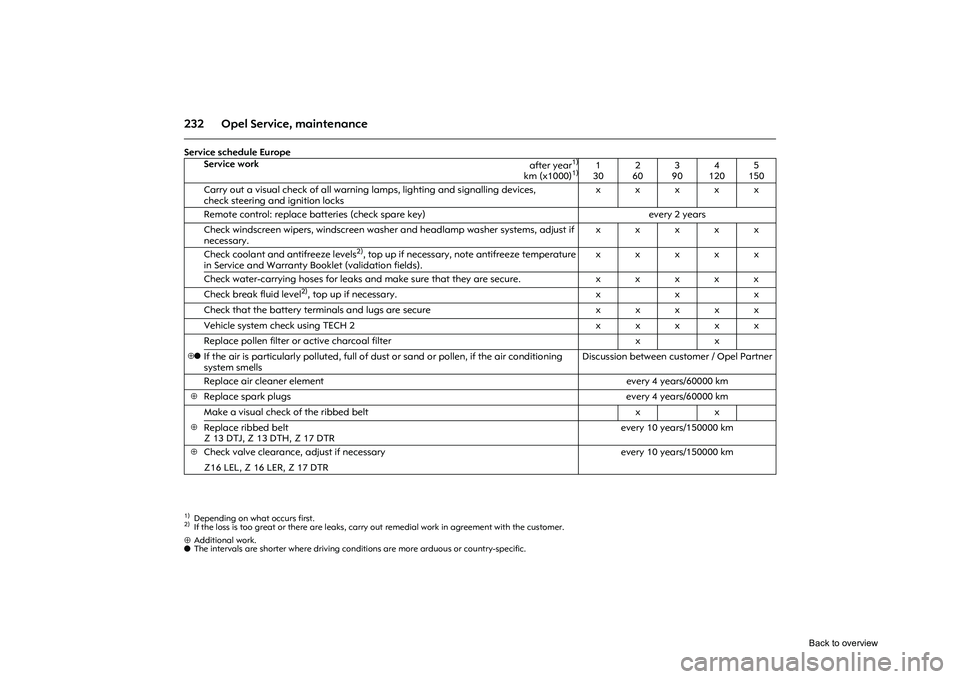
232 Opel Service, maintenanceService schedule Europe⊕Additional work.
o The intervals are shorter where driving conditions are more arduous or country-specific.
Service work
after year
1)
km (x1000)
1)
1)Depending on what occurs first.
1
30 2
60 3
90 4
120 5
150
Carry out a visual check of all warning lamps, lighting and signalling devices,
check steering and ignition locks xxxxx
Remote control: replace batterie s (check spare key) every 2 years
Check windscreen wipers, windscreen washer and headlamp washer systems, adjust if
necessary. xxxxx
Check coolant and antifreeze levels
2), top up if necessary, note antifreeze temperature
in Service and Warranty Booklet (validation fields).
2)If the loss is too great or there are leaks, carry out remedial work in agreement with the customer.
xxxxx
Check water-carrying hoses for leaks and make sure that they are secure. xxxxx
Check break fluid level
2), top up if necessary. xxx
Check that the battery terminals and lugs are secure xxxxx
Vehicle system check using TECH 2 xxxxx
Replace pollen filter or active charcoal filter xx
⊕o
If the air is particularly polluted, full of du st or sand or pollen, if the air conditioning
system smells Discussion between customer / Opel Partner
Replace air cleaner element every 4 years/60000 km
⊕
Replace spark plugs every 4 years/60000 km
Make a visual check of the ribbed belt x x
⊕
Replace ribbed belt
Z 13 DTJ, Z 13 DTH, Z 17 DTR every 10 years/150000 km
⊕
Check valve clearance,
adjust if necessary
Z16 LEL, Z 16 LER, Z 17 DTR every 10 years/150000 km
Back to overview
Page 239 of 284
233
Opel Service, maintenance
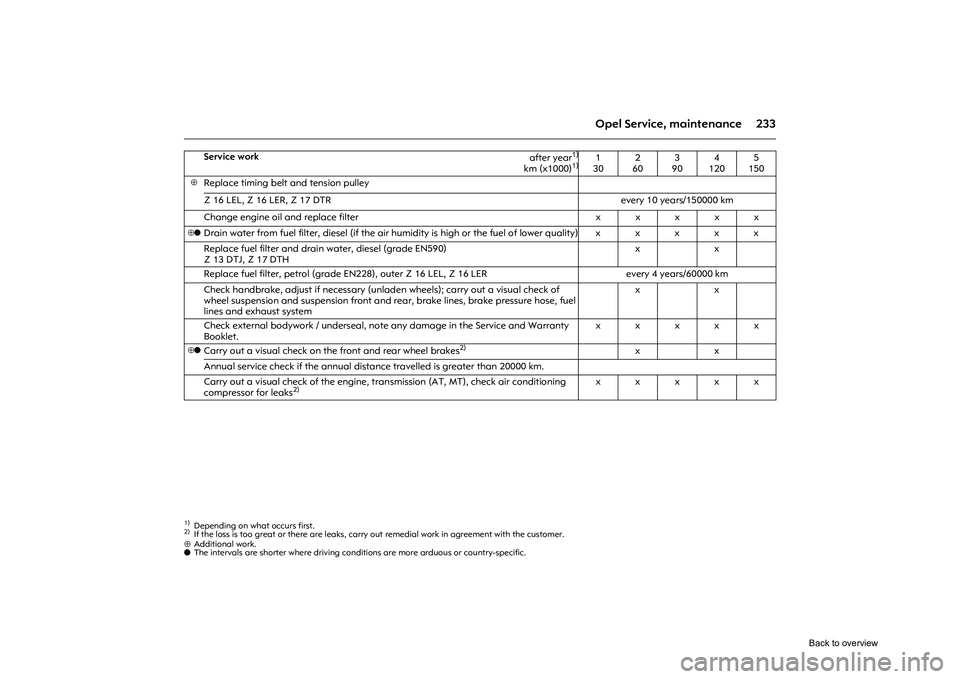
⊕ Additional work.
o The intervals are shorter where driving conditions are more arduous or country-specific.
Service work
after year
1)
km (x1000)
1)
1)Depending on what occurs first.
1
30 2
60 3
90 4
120 5
150
⊕
Replace timing belt and tension pulley
Z 16 LEL, Z 16 LER, Z 17 DTR every 10 years/150000 km
Change engine oil and replace filter xxxxx
⊕o
Drain water from fuel filter, diesel (if the air humidity is high or the fuel of lower quality)xxxxx
Replace fuel filter and drain water, diesel (grade EN590)
Z 13 DTJ, Z 17 DTH xx
Replace fuel filter, petrol (g rade EN228), outer Z 16 LEL, Z 16 LER every 4 years/60000 km
Check handbrake, adjust if necessary (unl aden wheels); carry out a visual check of
wheel suspension and suspension front and re ar, brake lines, brake pressure hose, fuel
lines and exhaust system xx
Check external bodywork / underseal, note any damage in the Service and Warranty
Booklet. xxxxx
⊕o
Carry out a visual check on the front and rear wheel brakes
2)
2)If the loss is too great or there are leaks, carry
out remedial work in agreement with the customer.
xx
Annual service check if the annual distance travelled is greater than 20000 km.
Carry out a visual check of the engine, tran smission (AT, MT), check air conditioning
compressor for leaks
2)
xxxxx
Back to overview
Page 241 of 284

235
Opel Service, maintenance
International service schedule⊕ Additional work.
o The intervals are shorter where driving conditions are more arduous or country-specific.
Service work
after year
1)
km (x1000)
1)
1)Depending on what occurs first.
1
15 2
30 3
45 4
60 5
75
Carry out a visual check of all warning lamps, lighting and signalling devices,
check steering and ignition locks xxxxx
Remote control: replace batterie s (check spare key) every 2 years
Check windscreen wipers, windscreen washer and headlamp washer systems, adjust if
necessary. xxxxx
Check coolant and antifreeze levels
2), top up if necessary, note antifreeze temperature
in Service and Warranty Booklet (validation fields).
2)If the loss is too great or there are leaks, carry out remedial work in agreement with the customer.
xxxxx
Check water-carrying hoses for leaks and make sure that they are secure. xxxxx
Check break fluid level
2), top up if necessary. xxx
Check that the battery terminals and lugs are secure xxxxx
Vehicle system check using TECH 2 xxxxx
Replace pollen filter or active charcoal filter xx
⊕o
If the air is particularly polluted, full of du st or sand or pollen, if the air conditioning
system smells Discussion between customer/Opel Partner
Replace air cleaner element every 4 years/60000 km
⊕
Replace spark plugs every 4 years/60000 km
Make a visual check of the ribbed belt x x
⊕
Replace ribbed belt
Z 13 DTJ, Z 13 DTH, Z 17 DTR every 10 years/150000 km
⊕
Check valve clearance,
adjust if necessary
Z16 LEL, Z 16 LER, Z 17 DTR every 10 years/150000 km
Back to overview
Page 242 of 284
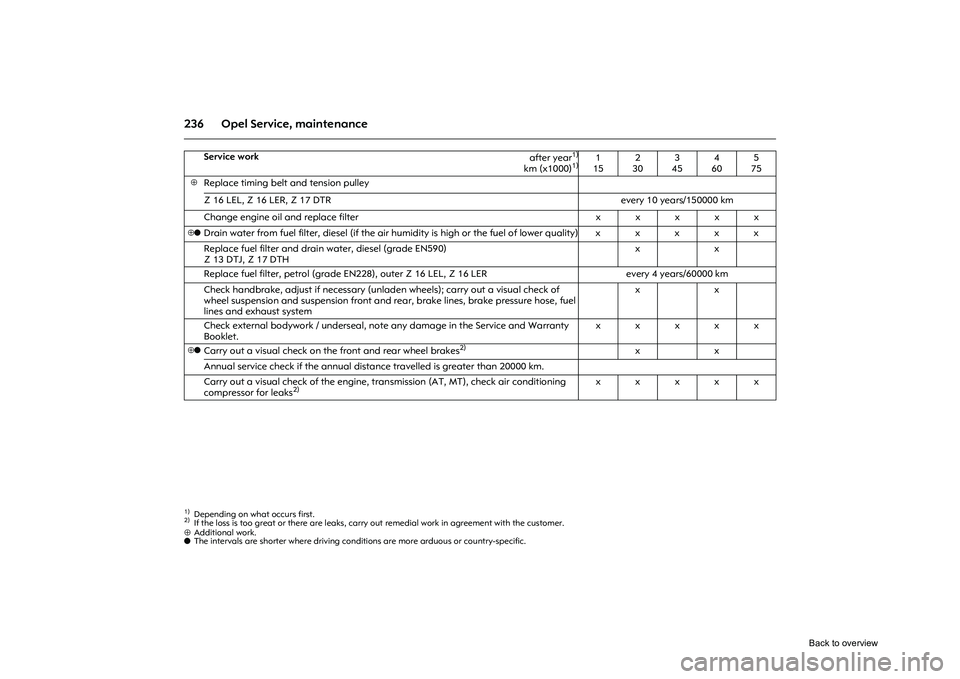
236 Opel Service, maintenance⊕Additional work.
o The intervals are shorter where driving conditions are more arduous or country-specific.
Service work
after year
1)
km (x1000)
1)
1)Depending on what occurs first.
1
15 2
30 3
45 4
60 5
75
⊕
Replace timing belt and tension pulley
Z 16 LEL, Z 16 LER, Z 17 DTR every 10 years/150000 km
Change engine oil and replace filter xxxxx
⊕o
Drain water from fuel filter, diesel (if the air humidity is high or the fuel of lower quality)xxxxx
Replace fuel filter and drain water, diesel (grade EN590)
Z 13 DTJ, Z 17 DTH xx
Replace fuel filter, petrol (g rade EN228), outer Z 16 LEL, Z 16 LER every 4 years/60000 km
Check handbrake, adjust if necessary (unl aden wheels); carry out a visual check of
wheel suspension and suspension front and re ar, brake lines, brake pressure hose, fuel
lines and exhaust system xx
Check external bodywork / underseal, note any damage in the Service and Warranty
Booklet. xxxxx
⊕o
Carry out a visual check on the front and rear wheel brakes
2)
2)If the loss is too great or there are leaks, carry
out remedial work in agreement with the customer.
xx
Annual service check if the annual distance travelled is greater than 20000 km.
Carry out a visual check of the engine, tran smission (AT, MT), check air conditioning
compressor for leaks
2)
xxxxx
Back to overview
Page 266 of 284

260 Technical DataTable 1, unladen weight
1), passenger car 5-door
1)According to EC Directive, including assumed weights for driver (68 kg), luggage (7 kg) and all fluids (tank 90 % full). ModelEngine Manual transmission Easytronic Automatic transmission
Corsa [kg]
Z 10 XEP 1145––
Z 12 XEP 11601160–
Z 14 XEP 1163–1188
Z 16 LEL 1280––
Z 13 DTJ 1235––
Z 13 DTH 12651265–
Z 17 DTR 1320––
Corsa with air
conditioning system
or climate control
system [kg] Z 10 XEP
1165––
Z 12 XEP 11801180–
Z 14 XEP 1183–1208
Z 16 LEL 1295––
Z 13 DTJ 1255––
Z 13 DTH 12851285–
Z 17 DTR 1340––
Corsa ECO [kg]
Z 13 DTJ 1210––
Corsa ECO with air
conditioning system [kg] Z 13 DTJ
1219––
Back to overview
Page 267 of 284

261
Technical Data
Table 1, unladen weight
1), passenger car 3-door
1)According to EC Directive, including assumed weights for driver (68 kg), luggage (7 kg) and all fluids (tank 90 % full). ModelEngine Manual transmission Easytronic Automatic transmission
Corsa [kg]
Z 10 XEP 1100––
Z 12 XEP 11301130–
Z 14 XEP 1140–1165
Z 16 LEL 1255––
Z 13 DTJ 1205––
Z 13 DTH 12351235–
Z 17 DTR 1278––
Corsa with air
conditioning system
or climate control
system [kg] Z 10 XEP
1120––
Z 12 XEP 11501150–
Z 14 XEP 1160–1185
Z 16 LEL 1270––
Z 13 DTJ 1225––
Z 13 DTH 12551255–
Z 17 DTR 1298––
Corsa OPC [kg]
Z 16 LER 1278––
Corsa OPC with air
conditioning system [kg] Z 16 LER
1298––
Corsa ECO [kg]
Z 13 DTJ 1163––
Corsa ECO with air
conditioning system [kg] Z 13 DTJ
1175––
Back to overview