warning OPEL CORSA 2009 Workshop Manual
[x] Cancel search | Manufacturer: OPEL, Model Year: 2009, Model line: CORSA, Model: OPEL CORSA 2009Pages: 284, PDF Size: 4.96 MB
Page 140 of 284
134 Climate control
Picture no: 18224s.tif
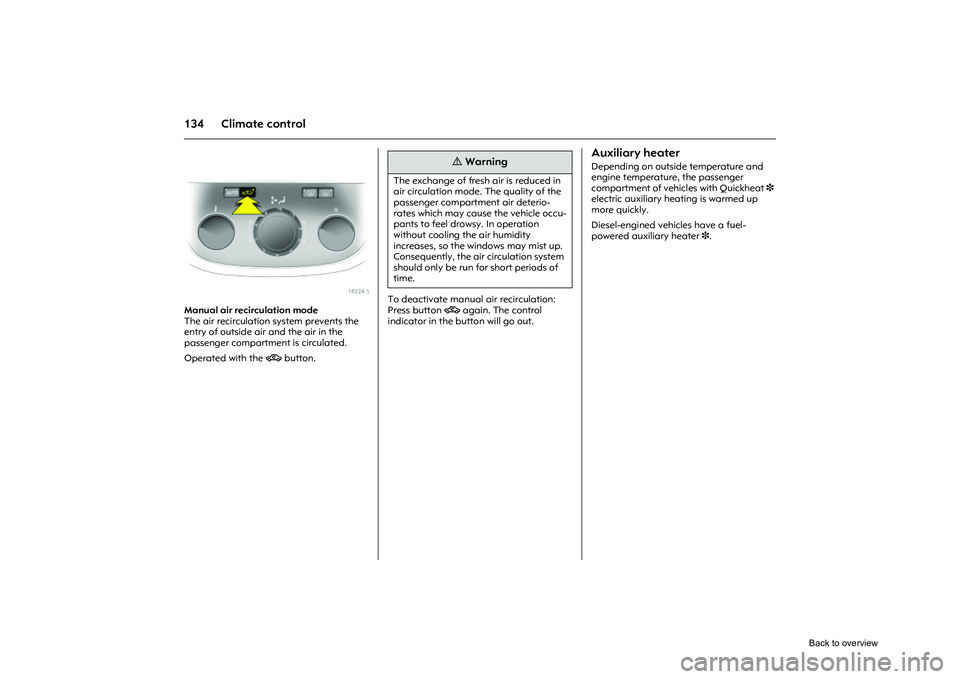
Manual air recirculation mode
The air recirculation system prevents the
entry of outside air and the air in the
passenger compartment is circulated.
Operated with the 4 button. To deactivate manual
air recirculation:
Press button 4 again. The control
indicator in the butt on will go out.
Auxiliary heater Depending on outside temperature and
engine temperature, the passenger
compartment of vehicles with Quickheat 3
electric auxiliary heating is warmed up
more quickly.
Diesel-engined vehicles have a fuel-
powered auxiliary heater 3.
9
Warning
The exchange of fresh air is reduced in
air circulation mode. The quality of the
passenger compartment air deterio-
rates which may cause the vehicle occu-
pants to feel drowsy. In operation
without cooling the air humidity
increases, so the windows may mist up.
Consequently, the air circulation system
should only be run for short periods of
time.
Back to overview
Page 145 of 284
139
Driving and operation
If the vehicle is in automatic mode, on
movement of the selector lever to
+ or
- the
manual transmission automated shifts to
manual mode and changes up or down.
The gear currently engaged appears on
the transmission display.
Move selector lever toward R
Reverse gear. Engage only when vehicle is
stationary.
Depress the foot brake, release the hand
brake and move the selector lever to R.
Reverse gear is engaged. "R" appears in
the transmission display.
The vehicle begins to "creep" when the foot
brake is released.
It is also possible to start off in reverse
without depressing the foot brake if the
accelerator pedal is operated directly after
moving the selector lever. If there is no
acceleration or the foot brake is not
depressed, no gear is engaged and "R"
flashes. After a few seconds, the display
resumes showing "N". Start off by
repeating the previously described
procedure. Stopping the vehicle
In Automatic or Manual mode, when the
vehicle has stopped first gear (with Winter
mode engaged, second gear) is engaged
automatically and the clutch released. In
R
reverse remains engaged.
A warning buzzer sounds when the driver’s
door is opened if the engine is running, a
gear is engaged and the foot brake is not
depressed. The vehicle creeps if the hand
brake is not engaged. Move the selector
lever to N and apply the hand brake.
When stopping on gradients, engage the
hand brake or depress the brake pedal. To
prevent overheating of the clutch, do not
increase engine speed to ensure smooth
idling when in gear.
To prevent damage to the automated
manual transmission, the clutch is closed
automatically at high clutch temperatures.
Switch off engine if stopping for a lengthy
period, e.g. in traffic jams or at level
crossings. Electronically controlled driving
programmes
z
Following a cold start, the operating
temperature program automatically
increases the engine revolutions to bring
the catalytic converter to the required
temperature.
z The adaptive program automatically
selects the gear according to the driving
conditions, e.g. increased load and
gradients.
Back to overview
Page 148 of 284
142 Driving and operation
Picture no: 18230s.tif
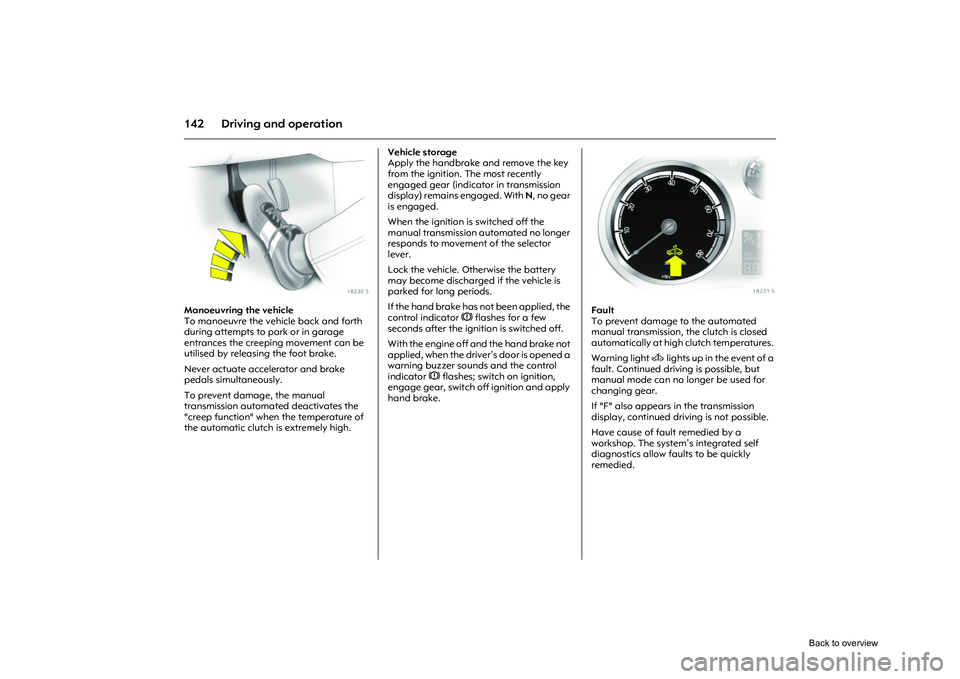
Manoeuvring the vehicle
To manoeuvre the vehicle back and forth
during attempts to park or in garage
entrances the creeping movement can be
utilised by releasing the foot brake.
Never actuate accelerator and brake
pedals simultaneously.
To prevent damage, the manual
transmission automated deactivates the
"creep function" when the temperature of
the automatic clutch is extremely high. Vehicle storage
Apply the handbrake and remove the key
from the ignition. The most recently
engaged gear (indicator in transmission
display) remains engaged. With
N, no gear
is engaged.
When the ignition is switched off the
manual transmission automated no longer
responds to movement of the selector
lever.
Lock the vehicle. Otherwise the battery
may become discharged if the vehicle is
parked for long periods.
If the hand brake has not been applied, the
control indicator R flashes for a few
seconds after the ignition is switched off.
With the engine off and the hand brake not
applied, when the driver ’s door is opened a
warning buzzer sounds and the control
indicator R flashes; switch on ignition,
engage gear, switch off ignition and apply
hand brake.
Picture no: 18231s.tif
Fault
To prevent damage to the automated
manual transmission, the clutch is closed
automatically at high clutch temperatures.
Warning light A lights up in the event of a
fault. Continued driving is possible, but
manual mode can no longer be used for
changing gear.
If "F" also appears in the transmission
display, continued driving is not possible.
Have cause of fault remedied by a
workshop. The system’s integrated self
diagnostics allow faults to be quickly
remedied.
Back to overview
Page 154 of 284
148 Driving and operation
Picture no: 18231s.tif
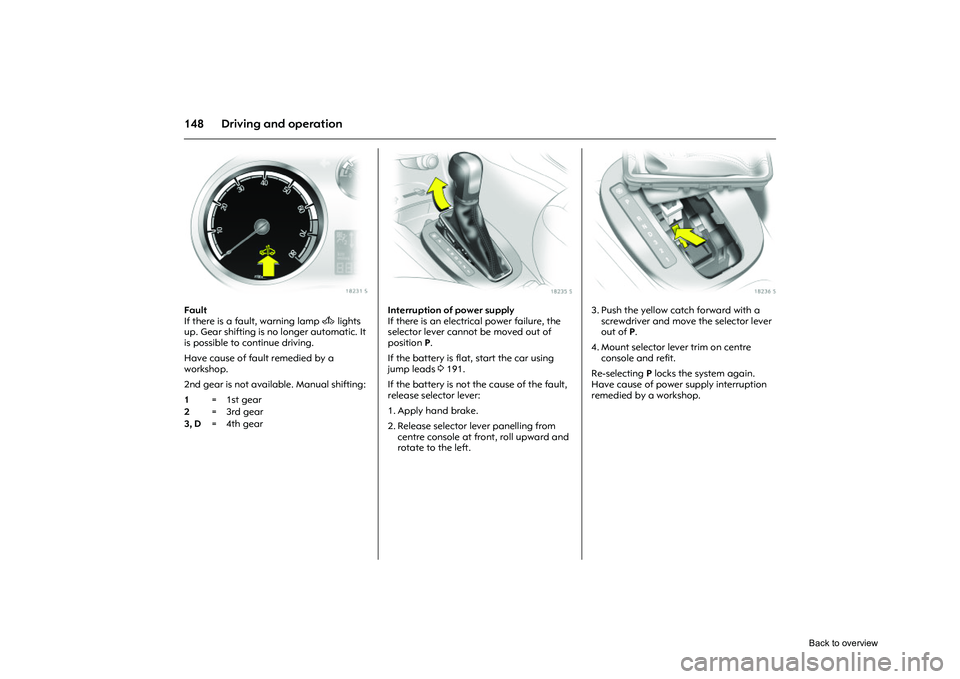
Fault
If there is a fault, warning lamp A lights
up. Gear shifting is no longer automatic. It
is possible to continue driving.
Have cause of fault remedied by a
workshop.
2nd gear is not available. Manual shifting:
Picture no: 18235s.tif
Interruption of power supply
If there is an electrical power failure, the
selector lever cannot be moved out of
position P.
If the battery is flat, start the car using
jump leads 3191.
If the battery is not the cause of the fault,
release selector lever:
1. Apply hand brake.
2. Release selector lever panelling from centre console at front, roll upward and
rotate to the left.
Picture no: 18236s.tif
3. Push the yellow catch forward with a
screwdriver and move the selector lever
out of P.
4. Mount selector lever trim on centre console and refit.
Re-selecting P locks the system again.
Have cause of power supply interruption
remedied by a workshop.
1 =1st gear
2 =3rd gear
3, D =4th gear
Back to overview
Page 159 of 284
153
Driving and operation
Fuels, refuelling Fuel consumption
Fuel consumption is determined under
specific driving conditions – see page
3256.
Special equipment increases the weight of
the vehicle. As a result, they can increase
fuel consumption and reduce the specified
maximum speed.
For the first few thousand kilometres,
friction between the engine and
transmission components is higher. This
increases fuel consumption.
Fuel for petrol engines
Only use unleaded fuel that complies
with DIN EN 228.
Fuels with ethanol content greater than 5 %
may only be used if the vehicle has been
specifically developed and approved for
these fuels.
Use fuel with the recommended octane
rating (value in bold 3254). Use of fuel
with too low an octane rating can reduce
engine power and torque and will slightly
increase fuel consumption. Fuel for diesel engines
Only use diesel fuel that complies
with DIN EN 590. The fuel must have
low sulphur content (maximum 50 ppm).
Do not use marine diesel oils, heating oils
or entirely or partially plant-based diesel
fuels, such as rape seed oil or bio diesel,
Aquazole and similar diesel-water
emulsions. Diesel fuels must not be diluted
with fuels for petrol engines.
The flow and filterabilit
y of diesel fuel are
temperature-dependent. When
temperatures are low, refuel with diesel fuel
with guaranteed wi nter properties.
Picture no: 18309s.tif
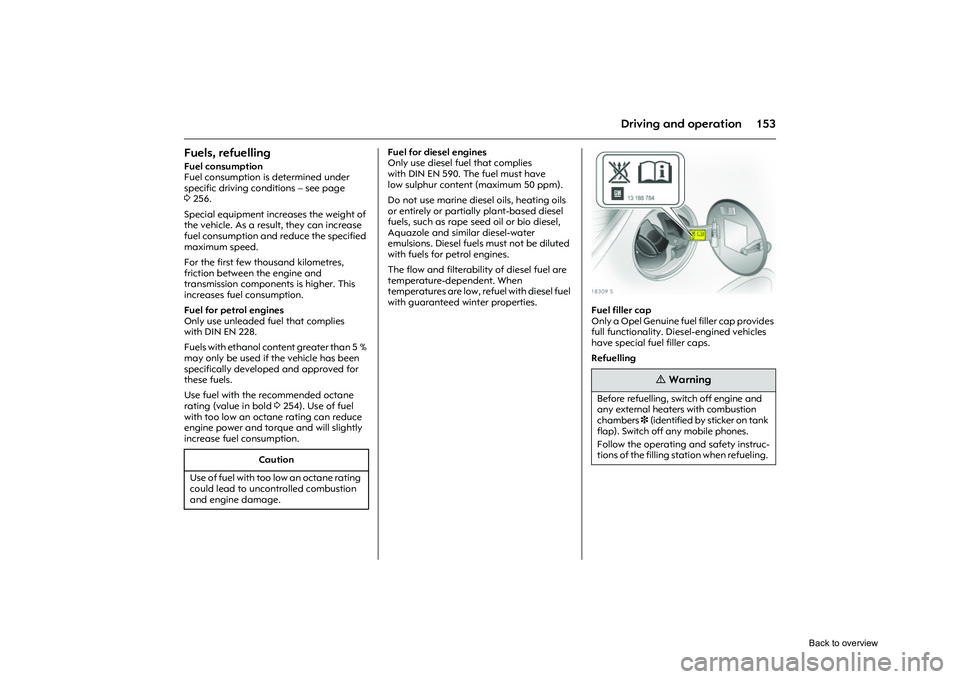
Fuel filler cap
Only a Opel Genuine fuel filler cap provides
full functionality. Di esel-engined vehicles
have special fuel filler caps.
Refuelling
Caution
Use of fuel with too low an octane rating
could lead to uncontrolled combustion
and engine damage.
9
Warning
Before refuelling, switch off engine and
any external heater s with combustion
chambers 3 (identified by sticker on tank
flap). Switch off any mobile phones.
Follow the operating and safety instruc-
tions of the filling stat ion when refueling.
Back to overview
Page 160 of 284
154 Driving and operation
Picture no: 18310s.tif
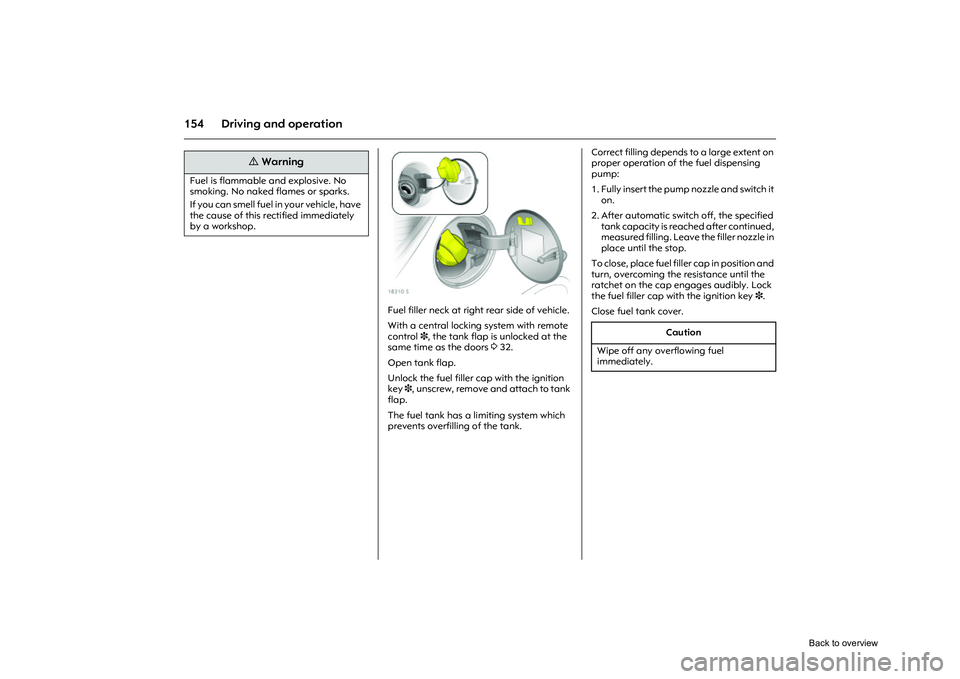
Fuel filler neck at right rear side of vehicle.
With a central locking system with remote
control 3, the tank flap is unlocked at the
same time as the doors 332.
Open tank flap.
Unlock the fuel filler cap with the ignition
key 3, unscrew, remove and attach to tank
flap.
The fuel tank has a limiting system which
prevents overfilling of the tank. Correct filling depends to a large extent on
proper operation of the fuel dispensing
pump:
1. Fully insert the pump nozzle and switch it
on.
2. After automatic switch off, the specified tank capacity is reached after continued,
measured filling. Leave the filler nozzle in
place until the stop.
To close, place fuel fill er cap in position and
turn, overcoming the resistance until the
ratchet on the cap engages audibly. Lock
the fuel filler cap with the ignition key 3.
Close fuel tank cover.
9
Warning
Fuel is flammable and explosive. No
smoking. No naked flames or sparks.
If you can smell fuel in your vehicle, have
the cause of this rectified immediately
by a workshop.
Caution
Wipe off any overflowing fuel
immediately.
Back to overview
Page 163 of 284
157
Driving and operation
Engine exhaust Diesel particle filter 3
The diesel particle filter system filters
harmful soot particles out of the exhaust
gases. The system includes a self-cleaning
function that run automatically during
driving. The filter is cleaned by burning off
the soot particles at hi gh temperature. This
process takes place automatically under
set driving conditions and may take up
to 25 minutes. Fuel consumption may be
higher during this period. The emission of
smells and smoke during this process is
normal.
Picture no: 18544s.tif
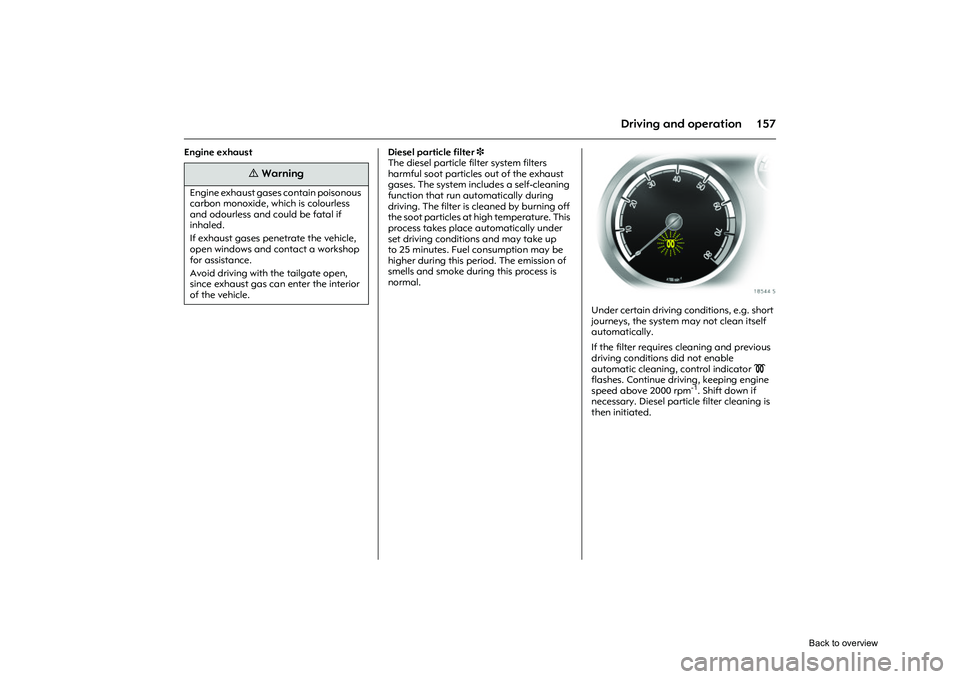
Under certain driving conditions, e.g. short
journeys, the system may not clean itself
automatically.
If the filter requires cleaning and previous
driving conditions did not enable
automatic cleaning, control indicator !
flashes. Continue driving, keeping engine
speed above 2000 rpm
-1. Shift down if
necessary. Diesel partic le filter cleaning is
then initiated.
9
Warning
Engine exhaust gases contain poisonous
carbon monoxide, which is colourless
and odourless and could be fatal if
inhaled.
If exhaust gases penetrate the vehicle,
open windows and contact a workshop
for assistance.
Avoid driving with the tailgate open,
since exhaust gas can enter the interior
of the vehicle.
Back to overview
Page 165 of 284
159
Driving and operation
Drive Control Systems Electronic Stability Program
(ESP
®Plus
) 3
ESP®
Plus
improves driving stability when
necessary in any driving situation
regardless of the type of road surface or
tyre grip. It also prevents the drive wheels
from spinning.
As soon as the vehicle starts to swerve
(understeer/oversteer), engine output is
reduced and the wheels are braked
individually. This considerably improves
the driving stability of the vehicle on
slippery road surfaces.
ESP®
Plus
is ready for operation as soon as
the ignition is switched on and control
indicator v goes out.
When the ESP®
Plus
comes into action,
v flashes. The vehicle is now in
a critical situation;
ESP®
Plus
allows you to keep control of the
vehicle and reminds you to match your
speed to the road conditions.
Picture no: 18252s.tif
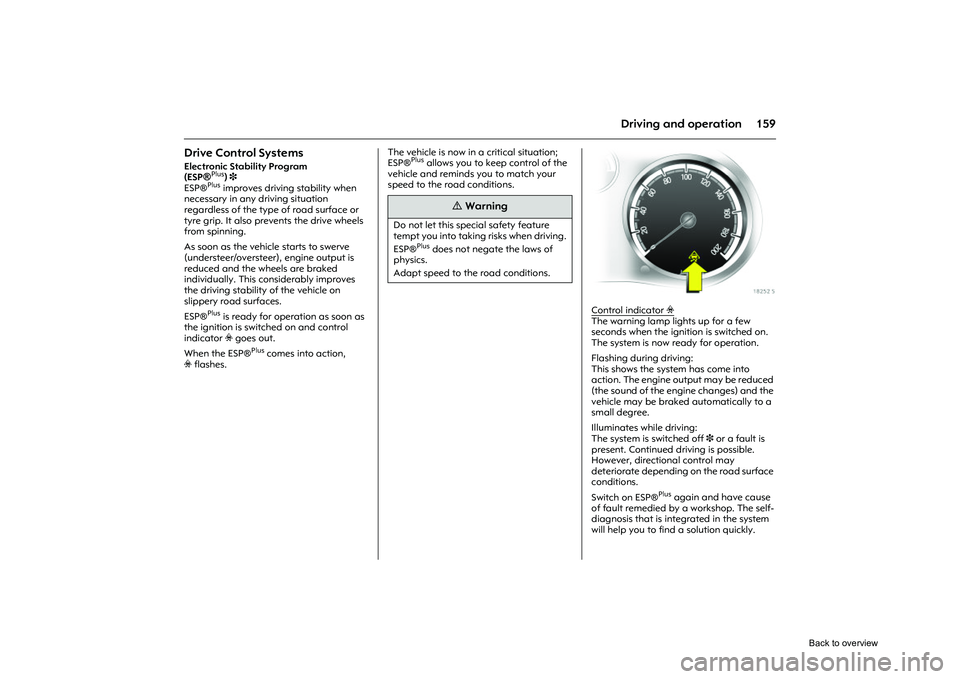
Control indicator
v
The warning lamp lights up for a few
seconds when the ignition is switched on.
The system is now ready for operation.
Flashing during driving:
This shows the system has come into
action. The engine output may be reduced
(the sound of the engine changes) and the
vehicle may be braked automatically to a
small degree.
Illuminates while driving:
The system is switched off 3 or a fault is
present. Continued driving is possible.
However, directional control may
deteriorate depending on the road surface
conditions.
Switch on ESP®
Plus
again and have cause
of fault remedied by a workshop. The self-
diagnosis that is integrated in the system
will help you to find a solution quickly.
9
Warning
Do not let this special safety feature
tempt you into taking risks when driving.
ESP®
Plus
does not negate the laws of
physics.
Adapt speed to the road conditions.
Back to overview
Page 166 of 284

160 Driving and operation
Picture no: 18470s.tif
Switching off
3
ESP®
Plus
can be deactivated by pressing
button v 3 .
Switching off is indicated by the control
indicator v lighting up in the
instrument. Also appears on the service
display ESPoff391.
Pressing the v button again or turning on
the ignition switches the ESP®
Plus
on again. Cruise control
3
Cruise control can store and maintain
speeds between 30 and 200 km/h.
Deviation from the stored speed may occur
when driving up or downhill.
For safety reasons the cruise control
system cannot be activated until the foot
brake has been operated, otherwise the
control indicator flashes m.
Cruise control is operated with switch m, g,
and button 0 on the turn signal stalk.
Do not use the cruise control if it is not
advisable to maintain a constant speed
(e.g. in situations presenting a danger to
yourself and other road users, in heavy
traffic or on winding, slippery or greasy
roads). With automatic transmission
3, engage
cruise control only in D, or with manual
transmission automated 3 in automatic
mode only.
9
Warning
If the vehicle has run-flat tyres 3 the
ESP®
Plus
must not be deactivated with
depressurised tyres.
9
Warning
When the cruise control is active, reac-
tion times may be increased due to the
different position of the feet.
Back to overview
Page 167 of 284
161
Driving and operation
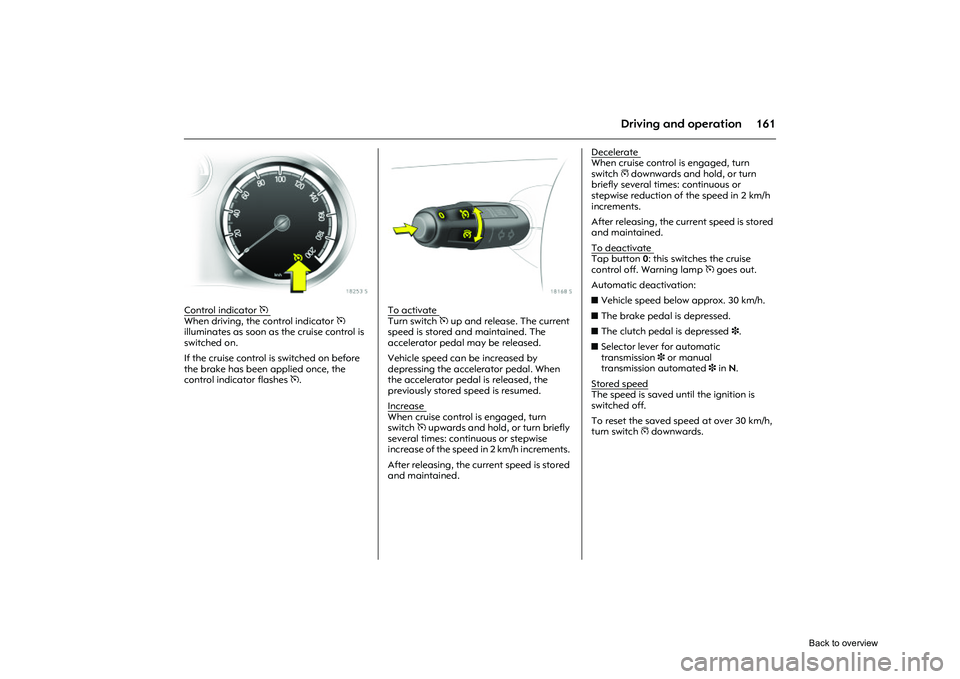
Picture no: 18253s.tif
Control indicator
m
When driving, the control indicator m
illuminates as soon as the cruise control is
switched on.
If the cruise control is switched on before
the brake has been applied once, the
control indicator flashes m.
Picture no: 18168s.tif
To activate Turn switch m up and release. The current
speed is stored and maintained. The
accelerator pedal may be released.
Vehicle speed can be increased by
depressing the accelerator pedal. When
the accelerator pedal is released, the
previously stored speed is resumed.
Increase When cruise control is engaged, turn
switch m upwards and hold, or turn briefly
several times: continuous or stepwise
increase of the speed in 2 km/h increments.
After releasing, the current speed is stored
and maintained. Decelerate
When cruise control is engaged, turn
switch
g downwards and hold, or turn
briefly several times: continuous or
stepwise reduction of the speed in 2 km/h
increments.
After releasing, the current speed is stored
and maintained.
To deactivate Tap button 0: this switches the cruise
control off. Warning lamp m goes out.
Automatic deactivation:
z Vehicle speed below approx. 30 km/h.
z The brake pedal is depressed.
z The clutch pedal is depressed 3.
z Selector lever for automatic
transmission 3 or manual
transmission automated 3 in N.
Stored speedThe speed is saved until the ignition is
switched off.
To reset the saved speed at over 30 km/h,
turn switch g downwards.
Back to overview