light OPEL CORSA 2009 Repair Manual
[x] Cancel search | Manufacturer: OPEL, Model Year: 2009, Model line: CORSA, Model: OPEL CORSA 2009Pages: 284, PDF Size: 4.96 MB
Page 215 of 284
209
Self-help, vehicle care
Picture no: 18588s.tif
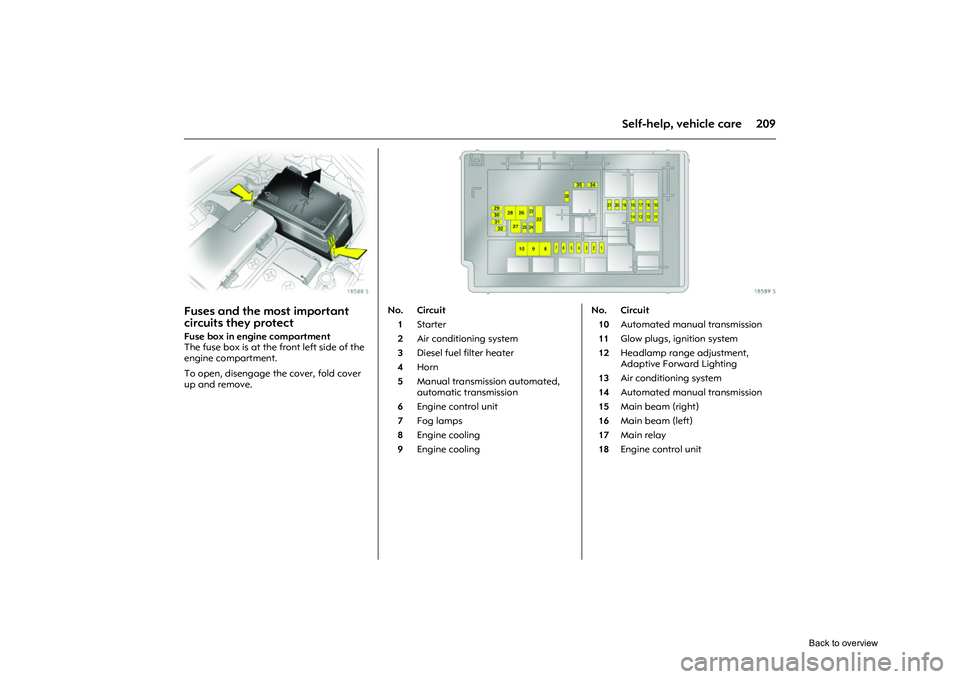
Fuses and the most important
circuits they protectFuse box in engine compartment
The fuse box is at the front left side of the
engine compartment.
To open, disengage the cover, fold cover
up and remove.
Picture no: 18589s.tif Picture no:
No. Circuit
1 Starter
2 Air conditioning system
3 Diesel fuel filter heater
4 Horn
5 Manual transmission automated,
automatic transmission
6 Engine control unit
7 Fog lamps
8 Engine cooling
9 Engine cooling
No. Circuit
10 Automated manual transmission
11 Glow plugs, ignition system
12 Headlamp range adjustment,
Adaptive Forward Lighting
13 Air conditioning system
14 Automated manual transmission
15 Main beam (right)
16 Main beam (left)
17 Main relay
18 Engine control unit
Back to overview
Page 216 of 284

210 Self-help, vehicle care
Picture no: 18272s.tif
Fuse box in interior
The fuse box is located behind the light
switch. Pull the top edge of the panel and
fold down.
Picture no: 18403s.tif
In right-hand drive cars, the fuse box is
located behind a cover in the glove
compartment. Open the glove
compartment and remove the cover. To
close, first put on the cover, then lock it into
position.
No. Circuit
19 Airbags
20 Main relay
21 Main relay
22 Central control unit
23 Tyre repair kit
24 Fuel pump
25 Anti-lock brake system
26 Heated rear window
27 Anti-lock brake system
28 Interior fan
29 Cigarette lighter
30 Air conditioning system
31 Electric window (left)
32 Electric window (right)
33 Heated exterior mirrors
34 –
35 –
Back to overview
Page 217 of 284
211
Self-help, vehicle care
Picture no: 18590s.tifPicture no: 18261s.tif
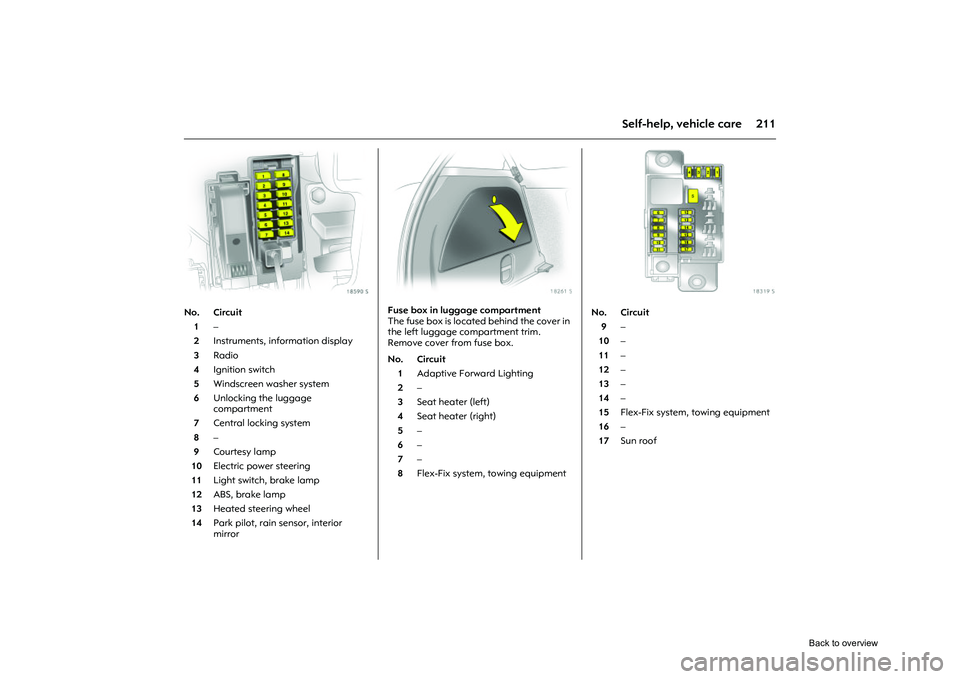
Fuse box in luggage compartment
The fuse box is located behind the cover in
the left luggage compartment trim.
Remove cover from fuse box.
Picture no: 18319s.tif
No. Circuit
1 –
2 Instruments, information display
3 Radio
4 Ignition switch
5 Windscreen washer system
6 Unlocking the luggage
compartment
7 Central locking system
8 –
9 Courtesy lamp
10 Electric power steering
11 Light switch, brake lamp
12 ABS, brake lamp
13 Heated steering wheel
14 Park pilot, rain sensor, interior
mirror
No. Circuit
1 Adaptive Forward Lighting
2 –
3 Seat heater (left)
4 Seat heater (right)
5 –
6 –
7 –
8 Flex-Fix system, towing equipment
No. Circuit
9 –
10 –
11 –
12 –
13 –
14 –
15 Flex-Fix system, towing equipment
16 –
17 Sun roof
Back to overview
Page 222 of 284
216 Self-help, vehicle care
Picture no: 18129s.tif
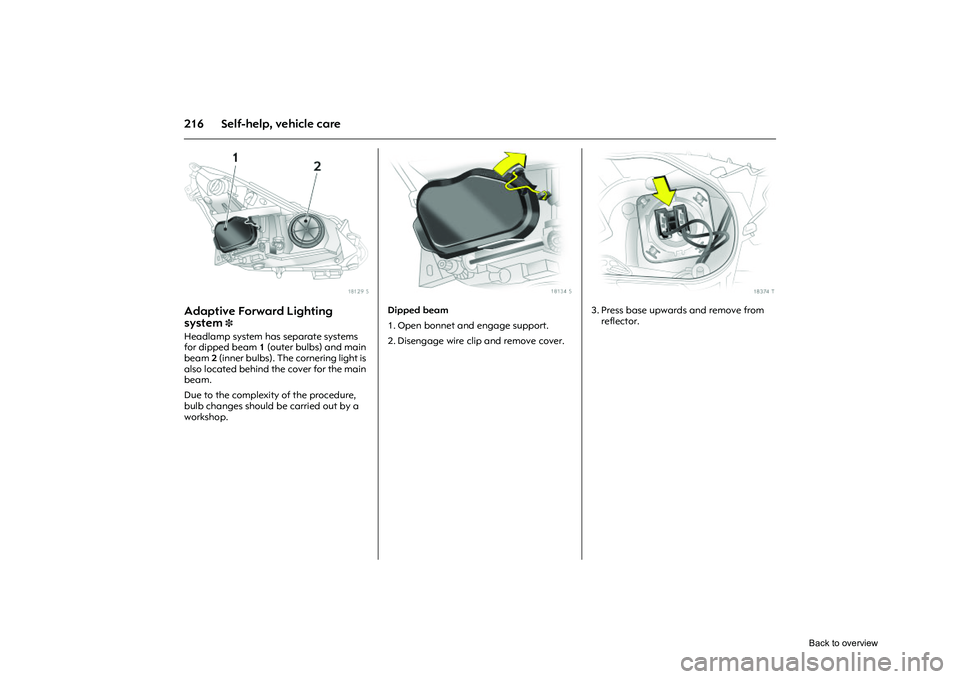
Adaptive Forward Lighting
system
3
Headlamp system has separate systems
for dipped beam 1 (outer bulbs) and main
beam 2 (inner bulbs). The cornering light is
also located behind the cover for the main
beam.
Due to the complexity of the procedure,
bulb changes should be carried out by a
workshop.
Picture no: 18134s.tif
Dipped beam
1. Open bonnet and engage support.
2. Disengage wire clip and remove cover.
Picture no: 18374s.tif
3. Press base upwards and remove from reflector.
Back to overview
Page 224 of 284

218 Self-help, vehicle care
Picture no: 18380s.tif
4. Disengage spring wire clip from retaining lugs by moving it and swivelling it to the
side.
5. Remove bulb from reflector housing.
6. When fitting the new bulb, insert lugs in the reflector recesses.
7. Engage spring wire clip, plug connector onto bulb.
8. Fit headlamp cap and rotate clockwise.
Picture no: 18130s.tif
Cornering light
1. Open bonnet and engage support.
2. Rotate the main beam headlamp cap
anticlockwise and remove.
Picture no: 18376s.tif
3. Detach plug connector from bulb.
Back to overview
Page 228 of 284
222 Self-help, vehicle care
Picture no: 18264s.tif
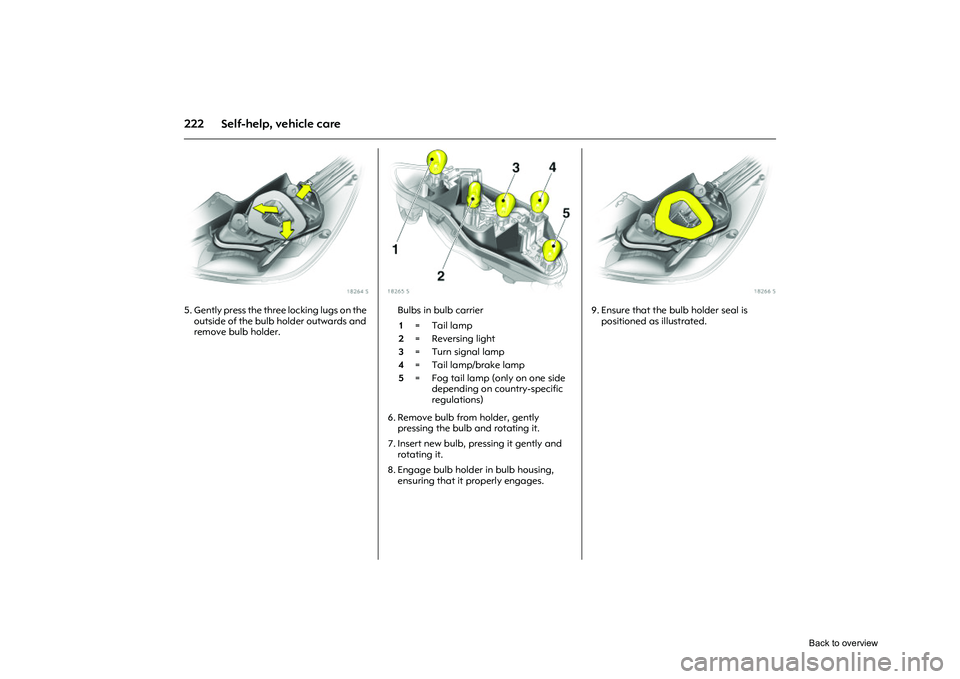
5. Gently press the three locking lugs on the outside of the bulb holder outwards and
remove bulb holder.
Picture no: 18265s.tif
Bulbs in bulb carrier
6. Remove bulb from holder, gently pressing the bulb and rotating it.
7. Insert new bulb, pressing it gently and rotating it.
8. Engage bulb holder in bulb housing, ensuring that it properly engages.
Picture no: 18266s.tif
9. Ensure that the bulb holder seal is
positioned as illustrated.
1 = Tail lamp
2 = Reversing light
3 = Turn signal lamp
4 = Tail lamp/brake lamp
5 = Fog tail lamp (only on one side
depending on country-specific
regulations)
Back to overview
Page 233 of 284
227
Self-help, vehicle care
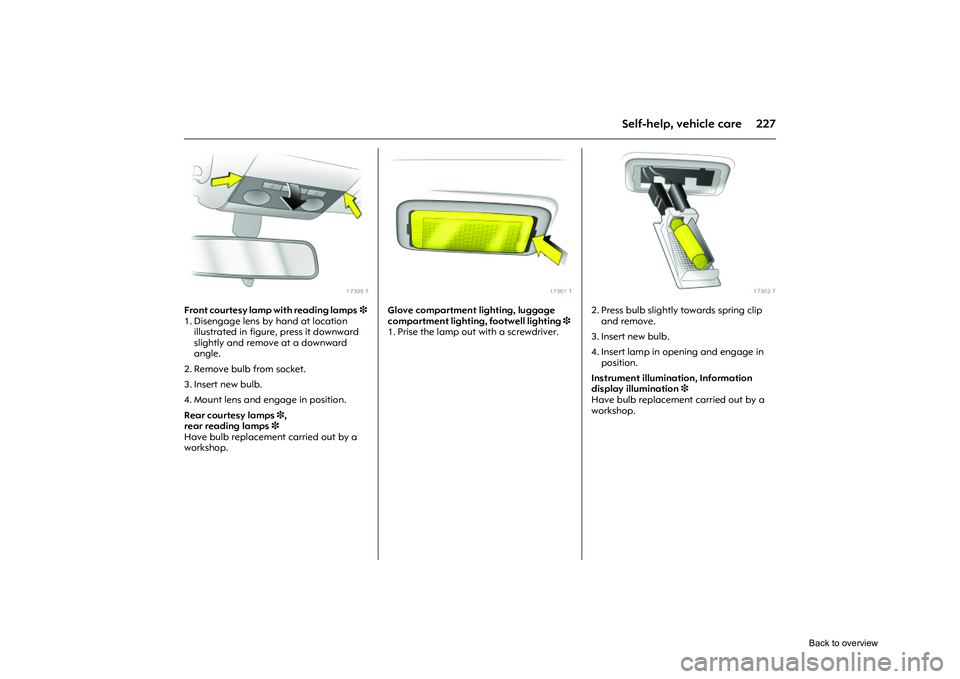
Picture no: 17300t.tif
Front courtesy lamp with reading lamps3
1. Disengage lens by hand at location illustrated in figure, press it downward
slightly and remove at a downward
angle.
2. Remove bulb from socket.
3. Insert new bulb.
4. Mount lens and engage in position.
Rear courtesy lamps 3,
rear reading lamps 3
Have bulb replacement carried out by a
workshop.
Picture no: 17301t.tif
Glove compartment lighting, luggage
compartment lighting, footwell lighting 3
1. Prise the lamp out with a screwdriver.
Picture no: 17302t.tif
2. Press bulb slightly towards spring clip
and remove.
3. Insert new bulb.
4. Insert lamp in op ening and engage in
position.
Instrument illumination, Information
display illumination 3
Have bulb replacement carried out by a
workshop.
Back to overview
Page 235 of 284

229
Self-help, vehicle care
Polishing and waxing
Wax the vehicle regularly (by the time the
water no longer beads at the latest).
Otherwise, the paintwork will dry out.
Polishing is necessary only if the paint has
become dull or if solid deposits have
become attached to it.
Paintwork polish with silicone forms a
protective film, making waxing
unnecessary.
Plastic body parts should not be treated
with wax and polish.
Wheels and tyres
Do not use high-pressure jet cleaners.
Clean wheels with a pH-neutral wheel
cleaner.
Wheels are painted and can be treated
with the same agents as the body.
Paintwork damage
Rectify minor paintwork damage with a
touch-up pen before rust forms. Have more
extensive damage or rust areas repaired
by a workshop. Exterior lights
Headlamp and other lamp covers are
made of plastic. Do not use any caustic
agents, do not use an ice scraper, and do
not clean them when dry.
Plastic and rubber parts
Plastic and rubber parts can be cleaned
with the same cleaner as used to clean the
body. Use interior cleaner if necessary. Do
not use any other agent. Avoid solvents
and petrol in particular. Do not use high-
pressure jet cleaners.
Interior and upholstery
Only clean the vehicle interior, including
the instrument panel fa
scia and panelling,
with a dry cloth or interior cleaner.
The instrument pane l should only be
cleaned using a soft damp cloth.
Clean fabric upholstery with a vacuum
cleaner and brush. Remove stains with an
upholstery cleaner.
Clean seat belts with lukewarm water or
interior cleaner.
Caution
Close Velcro fasteners as open Velcro
fasteners on clothing could damage
seat upholstery.
Back to overview
Page 238 of 284
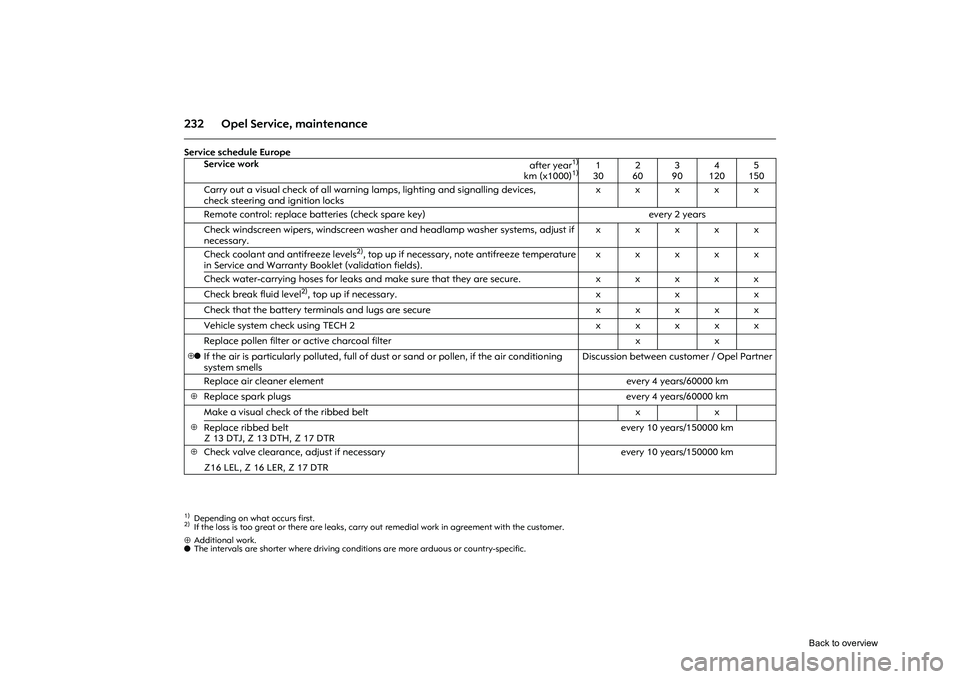
232 Opel Service, maintenanceService schedule Europe⊕Additional work.
o The intervals are shorter where driving conditions are more arduous or country-specific.
Service work
after year
1)
km (x1000)
1)
1)Depending on what occurs first.
1
30 2
60 3
90 4
120 5
150
Carry out a visual check of all warning lamps, lighting and signalling devices,
check steering and ignition locks xxxxx
Remote control: replace batterie s (check spare key) every 2 years
Check windscreen wipers, windscreen washer and headlamp washer systems, adjust if
necessary. xxxxx
Check coolant and antifreeze levels
2), top up if necessary, note antifreeze temperature
in Service and Warranty Booklet (validation fields).
2)If the loss is too great or there are leaks, carry out remedial work in agreement with the customer.
xxxxx
Check water-carrying hoses for leaks and make sure that they are secure. xxxxx
Check break fluid level
2), top up if necessary. xxx
Check that the battery terminals and lugs are secure xxxxx
Vehicle system check using TECH 2 xxxxx
Replace pollen filter or active charcoal filter xx
⊕o
If the air is particularly polluted, full of du st or sand or pollen, if the air conditioning
system smells Discussion between customer / Opel Partner
Replace air cleaner element every 4 years/60000 km
⊕
Replace spark plugs every 4 years/60000 km
Make a visual check of the ribbed belt x x
⊕
Replace ribbed belt
Z 13 DTJ, Z 13 DTH, Z 17 DTR every 10 years/150000 km
⊕
Check valve clearance,
adjust if necessary
Z16 LEL, Z 16 LER, Z 17 DTR every 10 years/150000 km
Back to overview
Page 241 of 284

235
Opel Service, maintenance
International service schedule⊕ Additional work.
o The intervals are shorter where driving conditions are more arduous or country-specific.
Service work
after year
1)
km (x1000)
1)
1)Depending on what occurs first.
1
15 2
30 3
45 4
60 5
75
Carry out a visual check of all warning lamps, lighting and signalling devices,
check steering and ignition locks xxxxx
Remote control: replace batterie s (check spare key) every 2 years
Check windscreen wipers, windscreen washer and headlamp washer systems, adjust if
necessary. xxxxx
Check coolant and antifreeze levels
2), top up if necessary, note antifreeze temperature
in Service and Warranty Booklet (validation fields).
2)If the loss is too great or there are leaks, carry out remedial work in agreement with the customer.
xxxxx
Check water-carrying hoses for leaks and make sure that they are secure. xxxxx
Check break fluid level
2), top up if necessary. xxx
Check that the battery terminals and lugs are secure xxxxx
Vehicle system check using TECH 2 xxxxx
Replace pollen filter or active charcoal filter xx
⊕o
If the air is particularly polluted, full of du st or sand or pollen, if the air conditioning
system smells Discussion between customer/Opel Partner
Replace air cleaner element every 4 years/60000 km
⊕
Replace spark plugs every 4 years/60000 km
Make a visual check of the ribbed belt x x
⊕
Replace ribbed belt
Z 13 DTJ, Z 13 DTH, Z 17 DTR every 10 years/150000 km
⊕
Check valve clearance,
adjust if necessary
Z16 LEL, Z 16 LER, Z 17 DTR every 10 years/150000 km
Back to overview