ESP OPEL KARL 2015 User Guide
[x] Cancel search | Manufacturer: OPEL, Model Year: 2015, Model line: KARL, Model: OPEL KARL 2015Pages: 217, PDF Size: 4.16 MB
Page 147 of 217
OPEL Karl Owner Manual (GMK-Localizing-EU RHD-9231168) - 2016 - crc -
5/7/15
146 Driving and Operating
Each time the engine is started, City
mode is deactivated.
Overload
If the steering in City mode is
heavily loaded, e.g. in long parking
manoeuvres or heavy city traffic, the
system is deactivated for overheat
protection. Steering operates in
normal mode until City mode
activates automatically.
Fault
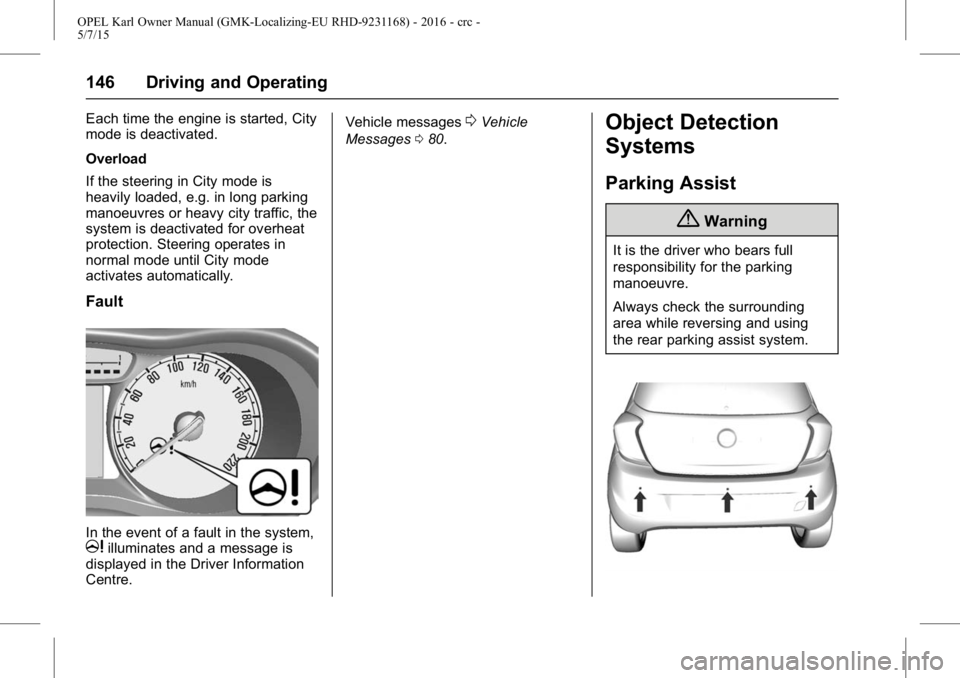
In the event of a fault in the system,milluminates and a message is
displayed in the Driver Information
Centre. Vehicle messages
0Vehicle
Messages 080.Object Detection
Systems
Parking Assist
{Warning
It is the driver who bears full
responsibility for the parking
manoeuvre.
Always check the surrounding
area while reversing and using
the rear parking assist system.
Page 149 of 217
OPEL Karl Owner Manual (GMK-Localizing-EU RHD-9231168) - 2016 - crc -
5/7/15
148 Driving and Operating
Driver Assistance
Systems
{Warning
Driver assistance systems are
developed to support the driver
and not to replace the driver's
attention.
The driver accepts full
responsibility when driving the
vehicle.
When using driver assistance
systems, always take care
regarding the current traffic
situation.
Cruise Control
The cruise control can store and
maintain speeds of approx. 25 to
170 km/h. Deviations from the
stored speeds may occur when
driving uphill or downhill.
For safety reasons, the cruise
control cannot be activated until the
foot brake has been operated once.Activating in first gear is not
possible.
Do not use the cruise control if it is
not advisable to maintain a constant
speed.
Control indicator
5
0Control
Indicators 065.
Switching on
Press5; control indicator5in
instrument cluster illuminates white.
Activation
Accelerate to the desired speed and
turn thumb wheel to SET/-, the
current speed is stored and
maintained. Control indicator
5in
instrument cluster illuminates green.
Accelerator pedal can be released.
Vehicle speed can be increased by
depressing the accelerator pedal.
When the accelerator pedal is
released, the previously stored
speed is resumed.
Cruise control remains activated
while changing gear.
Increase speed
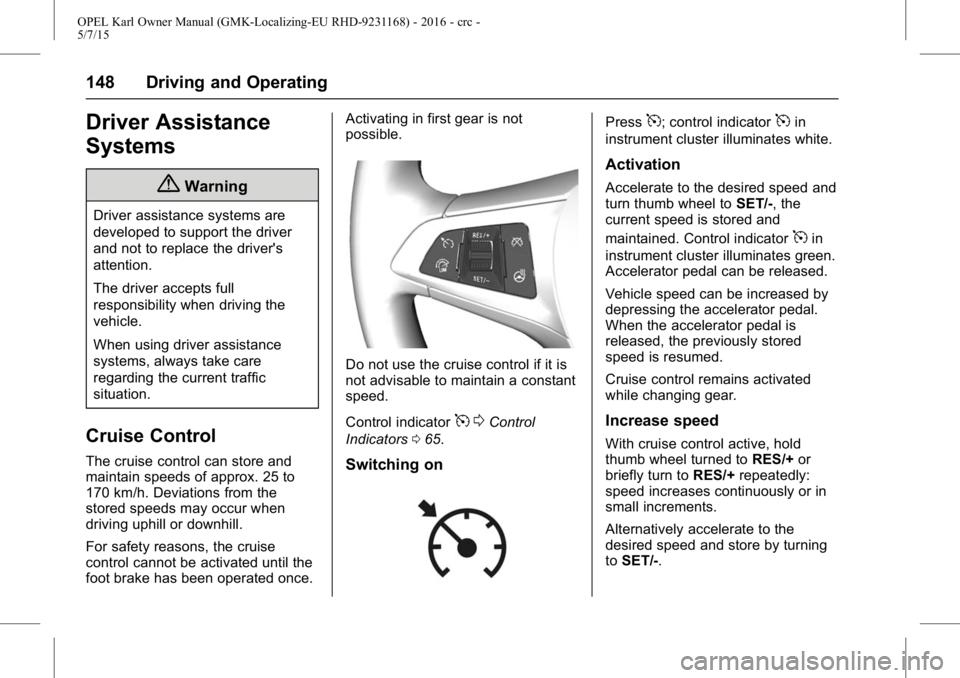
With cruise control active, hold
thumb wheel turned to RES/+or
briefly turn to RES/+repeatedly:
speed increases continuously or in
small increments.
Alternatively accelerate to the
desired speed and store by turning
to SET/-.
Page 151 of 217
OPEL Karl Owner Manual (GMK-Localizing-EU RHD-9231168) - 2016 - crc -
5/7/15
150 Driving and Operating
Presss. If cruise control has been
activated before, it is switched off
when speed limiter is activated and
control indicator
5extinguishes.
Set speed limit
With speed limiter active, hold
thumb wheel turned to RES/+or
briefly turn to RES/+repeatedly until
the desired maximum speed is
displayed in the DIC.
Alternatively, accelerate to the
desired speed and briefly turn
thumb wheel to SET/-: the current
speed is stored as maximum speed.
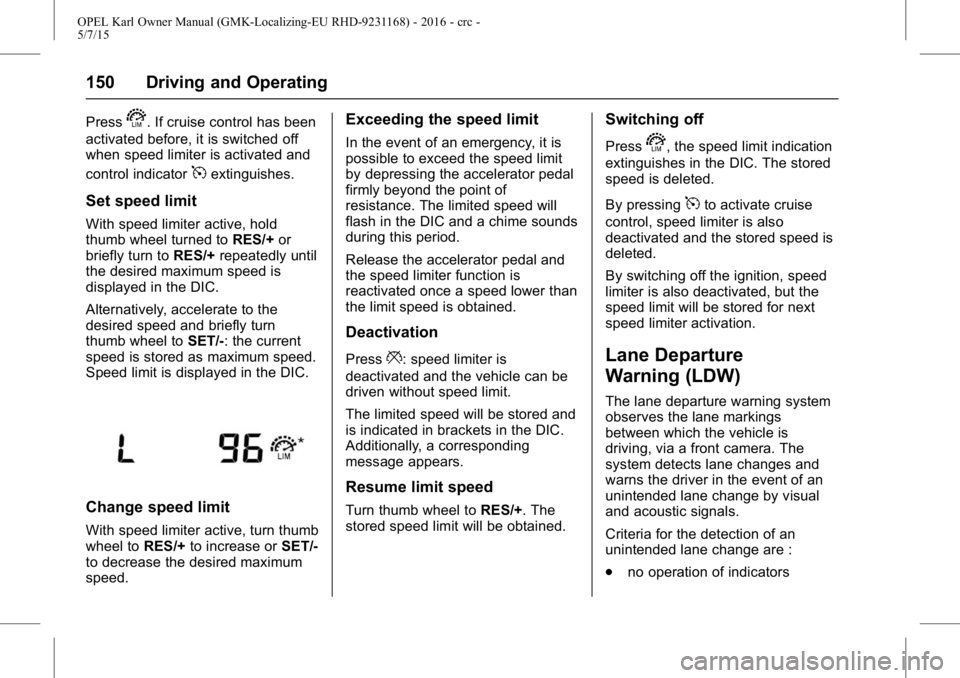
Speed limit is displayed in the DIC.
Change speed limit
With speed limiter active, turn thumb
wheel to RES/+to increase or SET/-
to decrease the desired maximum
speed.
Exceeding the speed limit
In the event of an emergency, it is
possible to exceed the speed limit
by depressing the accelerator pedal
firmly beyond the point of
resistance. The limited speed will
flash in the DIC and a chime sounds
during this period.
Release the accelerator pedal and
the speed limiter function is
reactivated once a speed lower than
the limit speed is obtained.
Deactivation
Press*: speed limiter is
deactivated and the vehicle can be
driven without speed limit.
The limited speed will be stored and
is indicated in brackets in the DIC.
Additionally, a corresponding
message appears.
Resume limit speed
Turn thumb wheel to RES/+. The
stored speed limit will be obtained.
Switching off
Presss, the speed limit indication
extinguishes in the DIC. The stored
speed is deleted.
By pressing
5to activate cruise
control, speed limiter is also
deactivated and the stored speed is
deleted.
By switching off the ignition, speed
limiter is also deactivated, but the
speed limit will be stored for next
speed limiter activation.
Lane Departure
Warning (LDW)
The lane departure warning system
observes the lane markings
between which the vehicle is
driving, via a front camera. The
system detects lane changes and
warns the driver in the event of an
unintended lane change by visual
and acoustic signals.
Criteria for the detection of an
unintended lane change are :
. no operation of indicators
Page 155 of 217
OPEL Karl Owner Manual (GMK-Localizing-EU RHD-9231168) - 2016 - crc -
5/7/15
154 Driving and Operating
Fuel Consumption -
CO2-Emissions
The fuel consumption (combined) of
the model Opel Karl is within a
range of to 4.5 to 4.3 l/100 km.
The CO
2emission (combined) is
within a range of 104 to 99 g/km.
For the values specific for your
vehicle, refer to the EEC Certificate
of Conformity provided with your
vehicle or other national registration
documents.
General information
The official fuel consumption and
specific CO2emission figures
quoted relate to the EU base model
with standard equipment.
Fuel consumption data and CO
2
emission data are determined
according to regulation R (EC) No.
715/2007 (in the version
respectively applicable), taking into
consideration the vehicle weight in
running order, as specified by the
regulation. The figures are provided only for the
purpose of comparison between
different vehicle variants and must
not be taken as a guarantee for the
actual fuel consumption of a
particular vehicle. Additional
equipment may result in slightly
higher results than the stated
consumption and CO
2figures.
Furthermore, fuel consumption is
dependent on personal driving style
as well as road and traffic
conditions.
Page 170 of 217
OPEL Karl Owner Manual (GMK-Localizing-EU RHD-9231168) - 2016 - crc -
5/7/15
Vehicle Care 169
Electrical System
Fuses
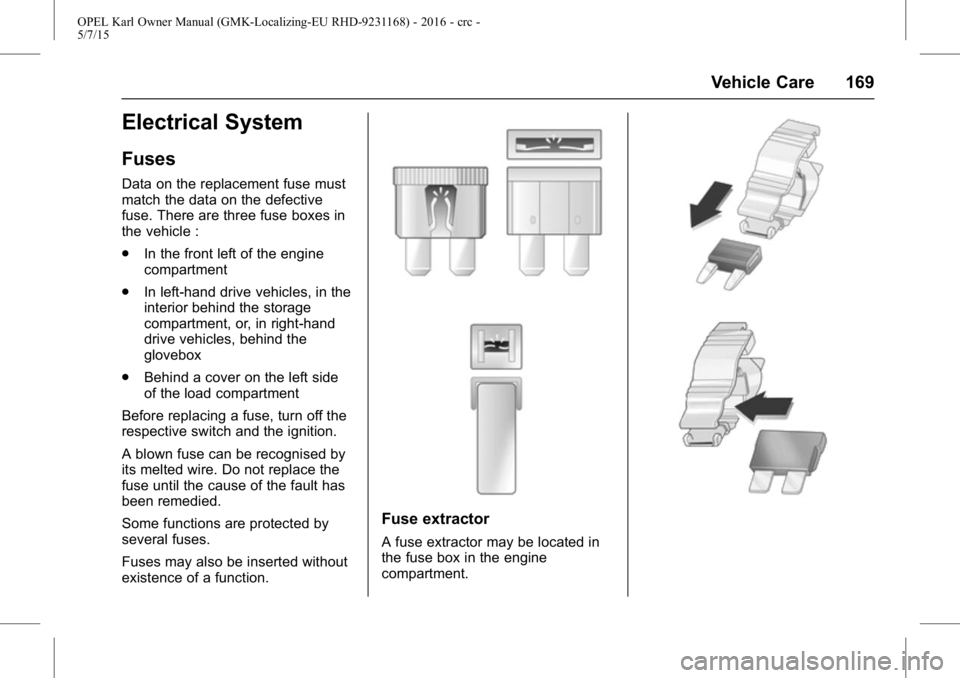
Data on the replacement fuse must
match the data on the defective
fuse. There are three fuse boxes in
the vehicle :
.In the front left of the engine
compartment
. In left-hand drive vehicles, in the
interior behind the storage
compartment, or, in right-hand
drive vehicles, behind the
glovebox
. Behind a cover on the left side
of the load compartment
Before replacing a fuse, turn off the
respective switch and the ignition.
A blown fuse can be recognised by
its melted wire. Do not replace the
fuse until the cause of the fault has
been remedied.
Some functions are protected by
several fuses.
Fuses may also be inserted without
existence of a function.
Fuse extractor
A fuse extractor may be located in
the fuse box in the engine
compartment.
Page 176 of 217
OPEL Karl Owner Manual (GMK-Localizing-EU RHD-9231168) - 2016 - crc -
5/7/15
Vehicle Care 175
Directional tyres
Directional tyres must be mounted
so that they rotate in the correct
direction. The proper rotation
direction is indicated by a symbol
(e.g. an arrow) on the sidewall.
Tyre Pressure
Check the pressure of cold tyres at
least every 14 days and before any
long journey. Do not forget the
spare wheel. This also applies to
vehicles with tyre pressure
monitoring system.
Unscrew the valve cap.
Tyre pressure0Tyre
Pressure 0204.
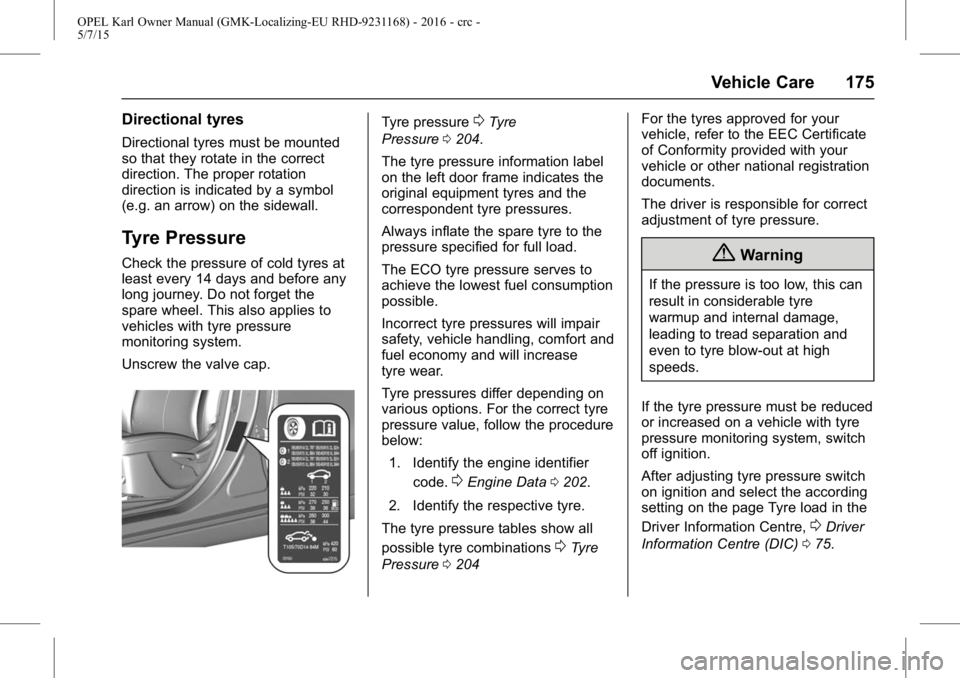
The tyre pressure information label
on the left door frame indicates the
original equipment tyres and the
correspondent tyre pressures.
Always inflate the spare tyre to the
pressure specified for full load.
The ECO tyre pressure serves to
achieve the lowest fuel consumption
possible.
Incorrect tyre pressures will impair
safety, vehicle handling, comfort and
fuel economy and will increase
tyre wear.
Tyre pressures differ depending on
various options. For the correct tyre
pressure value, follow the procedure
below: 1. Identify the engine identifier code.
0Engine Data 0202.
2. Identify the respective tyre.
The tyre pressure tables show all
possible tyre combinations
0Tyre
Pressure 0204 For the tyres approved for your
vehicle, refer to the EEC Certificate
of Conformity provided with your
vehicle or other national registration
documents.
The driver is responsible for correct
adjustment of tyre pressure.
{Warning
If the pressure is too low, this can
result in considerable tyre
warmup and internal damage,
leading to tread separation and
even to tyre blow-out at high
speeds.
If the tyre pressure must be reduced
or increased on a vehicle with tyre
pressure monitoring system, switch
off ignition.
After adjusting tyre pressure switch
on ignition and select the according
setting on the page Tyre load in the
Driver Information Centre,
0Driver
Information Centre (DIC) 075.
Page 177 of 217
OPEL Karl Owner Manual (GMK-Localizing-EU RHD-9231168) - 2016 - crc -
5/7/15
176 Vehicle Care
Tyre Pressure Monitor
System
The tyre pressure monitoring
system (TPMS) checks the pressure
of all four wheels once a minute
when vehicle speed exceeds a
certain limit.
Caution
Tyre pressure monitoring system
warns only about low tyre
pressure condition and does not
replace regular tyre maintenance
by the driver.
All wheels must be equipped with
pressure sensors and the tyres
must have the prescribed pressure.
Note
In countries where the tyre pressure
monitoring system is legally
required, the use of wheels without
pressure sensors will invalidate the
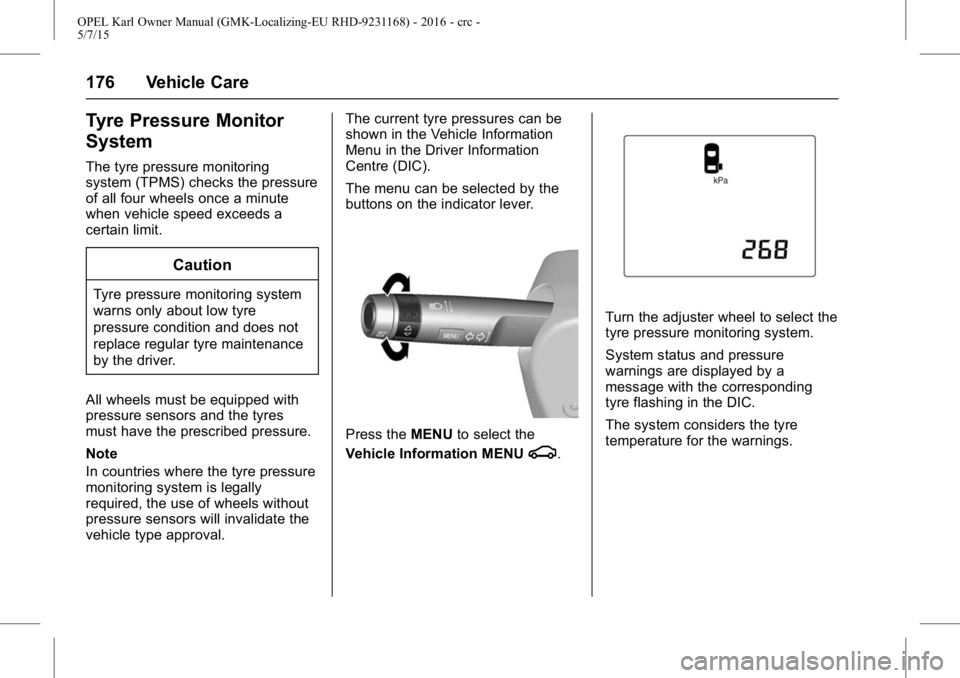
vehicle type approval. The current tyre pressures can be
shown in the Vehicle Information
Menu in the Driver Information
Centre (DIC).
The menu can be selected by the
buttons on the indicator lever.
Press the
MENUto select the
Vehicle Information MENU
g.
Turn the adjuster wheel to select the
tyre pressure monitoring system.
System status and pressure
warnings are displayed by a
message with the corresponding
tyre flashing in the DIC.
The system considers the tyre
temperature for the warnings.
Page 181 of 217
OPEL Karl Owner Manual (GMK-Localizing-EU RHD-9231168) - 2016 - crc -
5/7/15
180 Vehicle Care
Tyres age, even if they are not
used. We recommend tyre
replacement every 6 years.
Changing tyre and wheel size
If tyres of a different size than those
fitted at the factory are used, it may
be necessary to reprogramme the
speedometer as well as the nominal
tyre pressure and to make other
vehicle modifications
After converting to a different tyre
size, have the label with tyre
pressures replaced.
{Warning
Use of unsuitable tyres or wheels
may lead to accidents and will
invalidate the vehicle type
approval.
Wheel Covers
Wheel covers and tyres that are
factory approved for the respective
vehicle and comply with all of the
relevant wheel and tyre combination
requirements must be used.If the wheel covers and tyres used
are not factory approved, the tyres
must not have a rim protection
ridge.
Wheel covers must not impair brake
cooling.
{Warning
Use of unsuitable tyres or wheel
covers could lead to sudden
pressure loss and thereby
accidents.
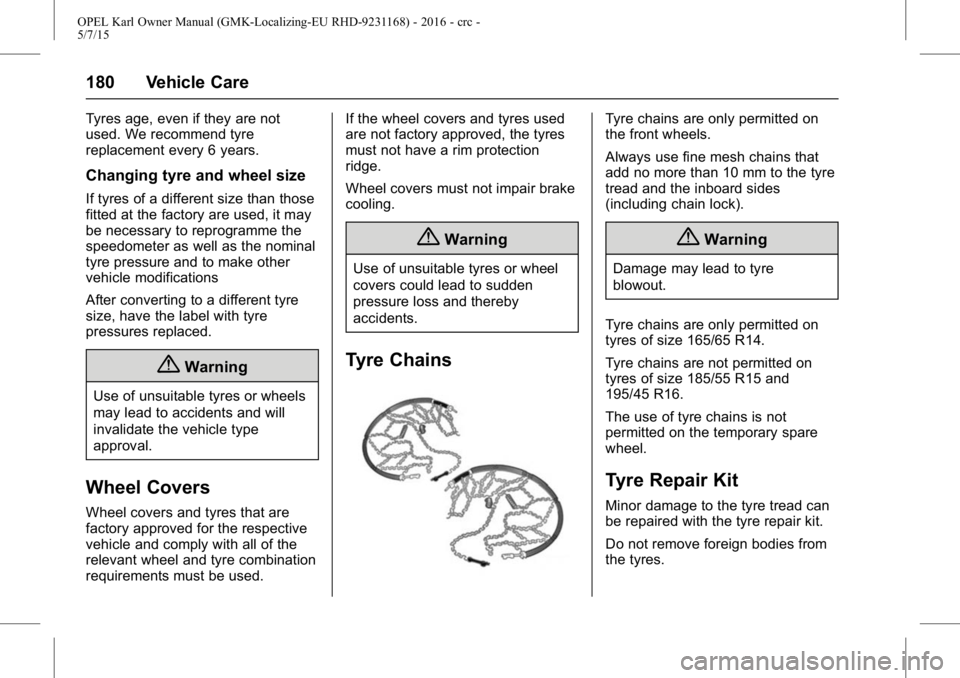
Tyre Chains
Tyre chains are only permitted on
the front wheels.
Always use fine mesh chains that
add no more than 10 mm to the tyre
tread and the inboard sides
(including chain lock).
{Warning
Damage may lead to tyre
blowout.
Tyre chains are only permitted on
tyres of size 165/65 R14.
Tyre chains are not permitted on
tyres of size 185/55 R15 and
195/45 R16.
The use of tyre chains is not
permitted on the temporary spare
wheel.
Tyre Repair Kit
Minor damage to the tyre tread can
be repaired with the tyre repair kit.
Do not remove foreign bodies from
the tyres.
Page 187 of 217
OPEL Karl Owner Manual (GMK-Localizing-EU RHD-9231168) - 2016 - crc -
5/7/15
186 Vehicle Care
4. Set the jack to the necessaryheight. Position it directly below
the jacking point in a manner
that prevents it from slipping.
Attach jack handle and with the
jack correctly aligned rotate
handle until wheel is clear of
the ground.
5. Unscrew the wheel bolts.
6. Change the wheel.
7. Screw on the wheel bolts.
8. Lower vehicle.
9. that it locates securely and tighten each bolt in a crosswise
sequence. Tightening torque is
140 Nm.
10. Align the valve hole in the wheel cover of the steel wheel
with the tyre valve before
installing.
Install wheel bolt caps or
centre cap on alloy wheel.
11. Install vehicle jacking point cover. 12. Stow and secure the replaced
wheel, the vehicle tools and the
adapter for the locking wheel
bolts.
13. Check the tyre pressure of the installed tyre and the wheel
bolt torque as soon as
possible.
Have the defective tyre
renewed or repaired as soon
as possible.
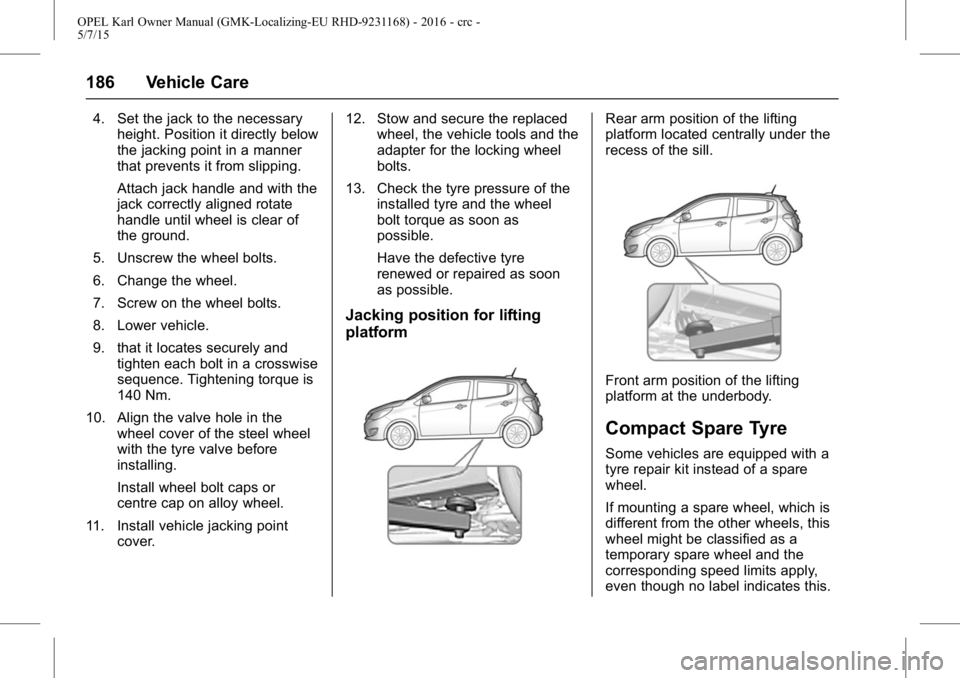
Jacking position for lifting
platform
Rear arm position of the lifting
platform located centrally under the
recess of the sill.
Front arm position of the lifting
platform at the underbody.
Compact Spare Tyre
Some vehicles are equipped with a
tyre repair kit instead of a spare
wheel.
If mounting a spare wheel, which is
different from the other wheels, this
wheel might be classified as a
temporary spare wheel and the
corresponding speed limits apply,
even though no label indicates this.
Page 194 of 217
OPEL Karl Owner Manual (GMK-Localizing-EU RHD-9231168) - 2016 - crc -
5/7/15
Vehicle Care 193
Clothing fabrics may not be
colour-fast. This could cause visible
discolourations, especially on light
coloured upholstery.
Removable stains and
discolourations should be cleaned
as soon as possible. Clean seat
belts with lukewarm water or interior
cleaner.
Caution
Close Velcro fasteners as open
Velcro fasteners on clothing could
damage seat upholstery.
The same applies to clothing with
sharp-edged objects, like Zips or
belts or studded jeans.
Plastic and rubber parts
Plastic and rubber parts can be
cleaned with the same cleaner as
used to clean the body. Use interior
cleaner if necessary. Do not use any
other agent. Avoid solvents and
petrol in particular. Do not use
high-pressure jet cleaners.