transmission OPEL KARL 2015 User Guide
[x] Cancel search | Manufacturer: OPEL, Model Year: 2015, Model line: KARL, Model: OPEL KARL 2015Pages: 217, PDF Size: 4.16 MB
Page 203 of 217
OPEL Karl Owner Manual (GMK-Localizing-EU RHD-9231168) - 2016 - crc -
5/7/15
202 Technical Data
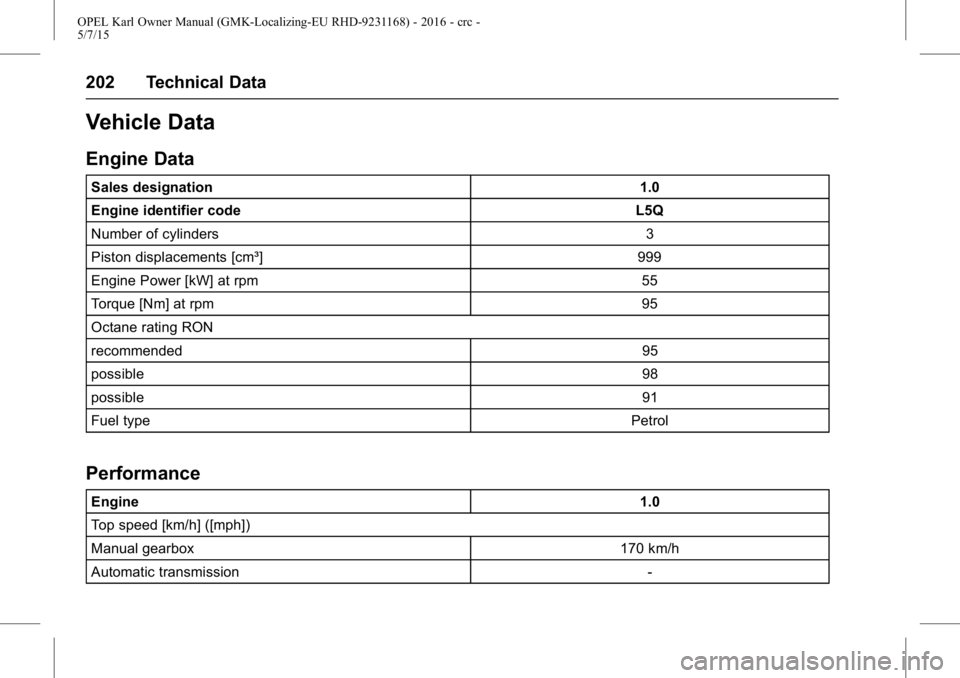
Vehicle Data
Engine Data
Sales designation1.0
Engine identifier code L5Q
Number of cylinders 3
Piston displacements [cm³] 999
Engine Power [kW] at rpm 55
Torque [Nm] at rpm 95
Octane rating RON
recommended 95
possible 98
possible 91
Fuel type Petrol
Performance
Engine 1.0
Top speed [km/h] ([mph])
Manual gearbox 170 km/h
Automatic transmission -
Page 206 of 217
OPEL Karl Owner Manual (GMK-Localizing-EU RHD-9231168) - 2016 - crc -
5/7/15
Customer Information 205
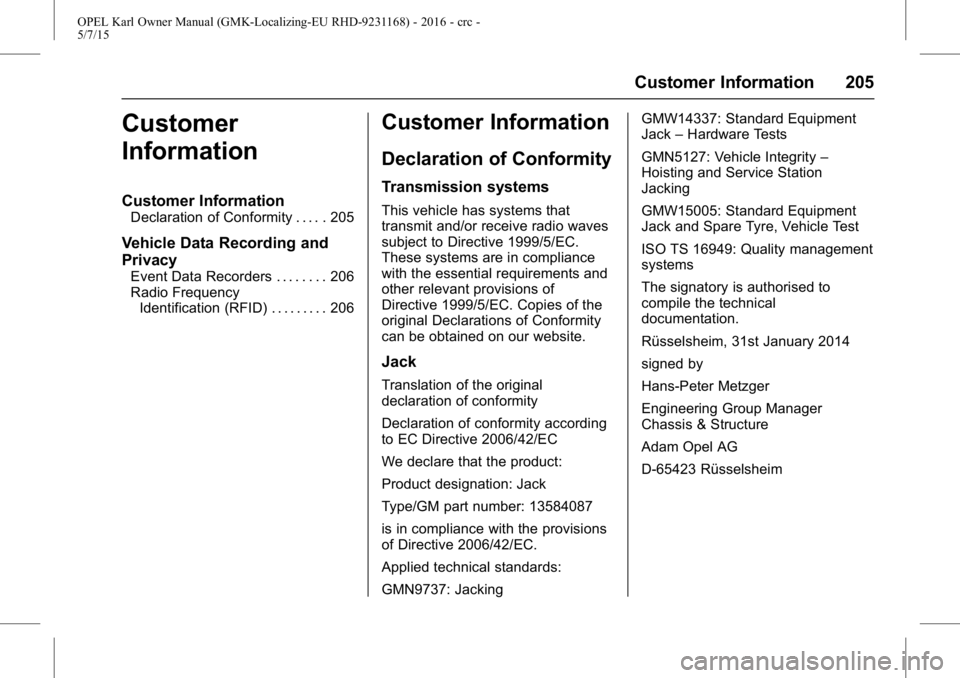
Customer
Information
Customer Information
Declaration of Conformity . . . . . 205
Vehicle Data Recording and
Privacy
Event Data Recorders . . . . . . . . 206
Radio FrequencyIdentification (RFID) . . . . . . . . . 206
Customer Information
Declaration of Conformity
Transmission systems
This vehicle has systems that
transmit and/or receive radio waves
subject to Directive 1999/5/EC.
These systems are in compliance
with the essential requirements and
other relevant provisions of
Directive 1999/5/EC. Copies of the
original Declarations of Conformity
can be obtained on our website.
Jack
Translation of the original
declaration of conformity
Declaration of conformity according
to EC Directive 2006/42/EC
We declare that the product:
Product designation: Jack
Type/GM part number: 13584087
is in compliance with the provisions
of Directive 2006/42/EC.
Applied technical standards:
GMN9737: Jacking GMW14337: Standard Equipment
Jack
–Hardware Tests
GMN5127: Vehicle Integrity –
Hoisting and Service Station
Jacking
GMW15005: Standard Equipment
Jack and Spare Tyre, Vehicle Test
ISO TS 16949: Quality management
systems
The signatory is authorised to
compile the technical
documentation.
Rüsselsheim, 31st January 2014
signed by
Hans-Peter Metzger
Engineering Group Manager
Chassis & Structure
Adam Opel AG
D-65423 Rüsselsheim
Page 207 of 217
OPEL Karl Owner Manual (GMK-Localizing-EU RHD-9231168) - 2016 - crc -
5/7/15
206 Customer Information
Vehicle Data
Recording and
Privacy
Event Data Recorders
Data storage modules in the
vehicle
A large number of electronic
components of your vehicle contain
data storage modules temporarily or
permanently storing technical data
about the condition of the vehicle,
events and errors. In general, this
technical information documents the
condition of parts, modules, systems
or the environment:
.Operating conditions of system
components (e.g. filling levels)
. Status messages of the vehicle
and its single components (e.g.
number of wheel revolutions /
rotational speed, deceleration,
lateral acceleration)
. Dysfunctions and defects in
important system components .
Vehicle reactions in particular
driving situations (e.g. inflation of
an airbag, activation of the
stability regulation system)
. Environmental conditions (e.g.
temperature)
This data is exclusively technical
and helps identify and correct errors
as well as optimise vehicle
functions.
Motion profiles indicating travelled
routes cannot be created with
these data.
If services are used (e.g. repair
works, service processes, warranty
cases, quality assurance),
employees of the service network
(manufacturer included) are able to
read out this technical information
from the event and error data
storage modules applying special
diagnostic devices. If required, you
will receive further information at
these workshops. After an error has
been corrected, the data is deleted
from the error storage module or
constantly overwritten. When using the vehicle, situations
may occur in which these technical
data related to other information
(accident report, damages on the
vehicle, witness statements etc.)
may be associated with a specific
person - possibly, with the
assistance of an expert.
Additional functions contractually
agreed upon with the client (e.g.
vehicle location in emergency
cases) allow the transmission of
particular vehicle data from the
vehicle.
Radio Frequency
Identification (RFID)
RFID technology is used in some
vehicles for functions such as tyre
deflation detection and ignition
system security. It is also used in
connection with conveniences such
as radio remote controls for door
locking/unlocking and starting, and
in-vehicle transmitters for garage
door openers. RFID technology in
Opel vehicles does not use or