tyre pressure OPEL KARL 2015 User Guide
[x] Cancel search | Manufacturer: OPEL, Model Year: 2015, Model line: KARL, Model: OPEL KARL 2015Pages: 217, PDF Size: 4.16 MB
Page 177 of 217
OPEL Karl Owner Manual (GMK-Localizing-EU RHD-9231168) - 2016 - crc -
5/7/15
176 Vehicle Care
Tyre Pressure Monitor
System
The tyre pressure monitoring
system (TPMS) checks the pressure
of all four wheels once a minute
when vehicle speed exceeds a
certain limit.
Caution
Tyre pressure monitoring system
warns only about low tyre
pressure condition and does not
replace regular tyre maintenance
by the driver.
All wheels must be equipped with
pressure sensors and the tyres
must have the prescribed pressure.
Note
In countries where the tyre pressure
monitoring system is legally
required, the use of wheels without
pressure sensors will invalidate the
vehicle type approval. The current tyre pressures can be
shown in the Vehicle Information
Menu in the Driver Information
Centre (DIC).
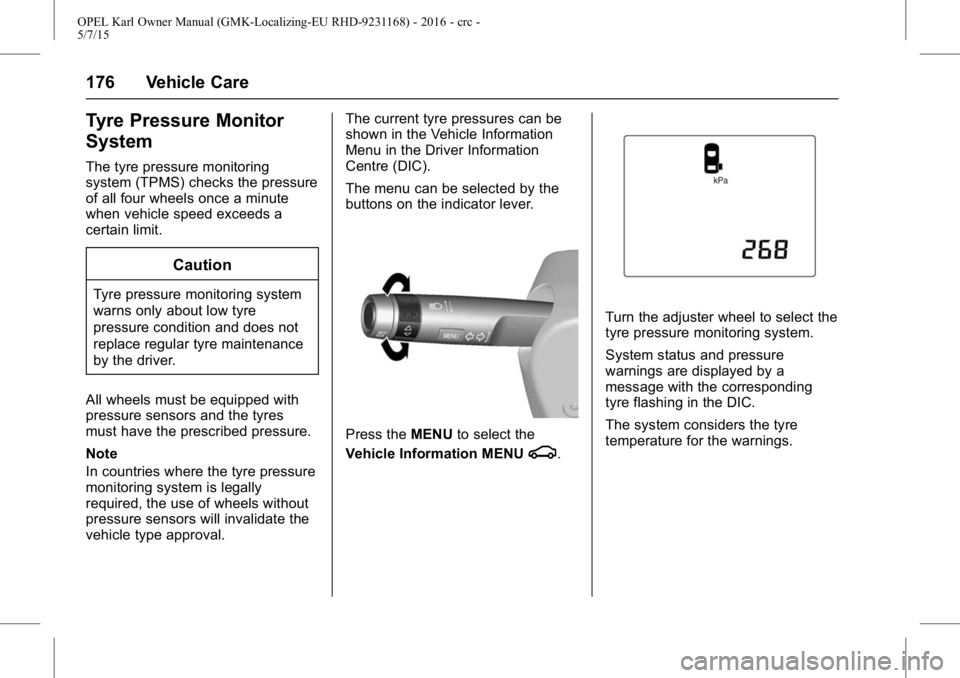
The menu can be selected by the
buttons on the indicator lever.
Press the
MENUto select the
Vehicle Information MENU
g.
Turn the adjuster wheel to select the
tyre pressure monitoring system.
System status and pressure
warnings are displayed by a
message with the corresponding
tyre flashing in the DIC.
The system considers the tyre
temperature for the warnings.
Page 178 of 217
OPEL Karl Owner Manual (GMK-Localizing-EU RHD-9231168) - 2016 - crc -
5/7/15
Vehicle Care 177
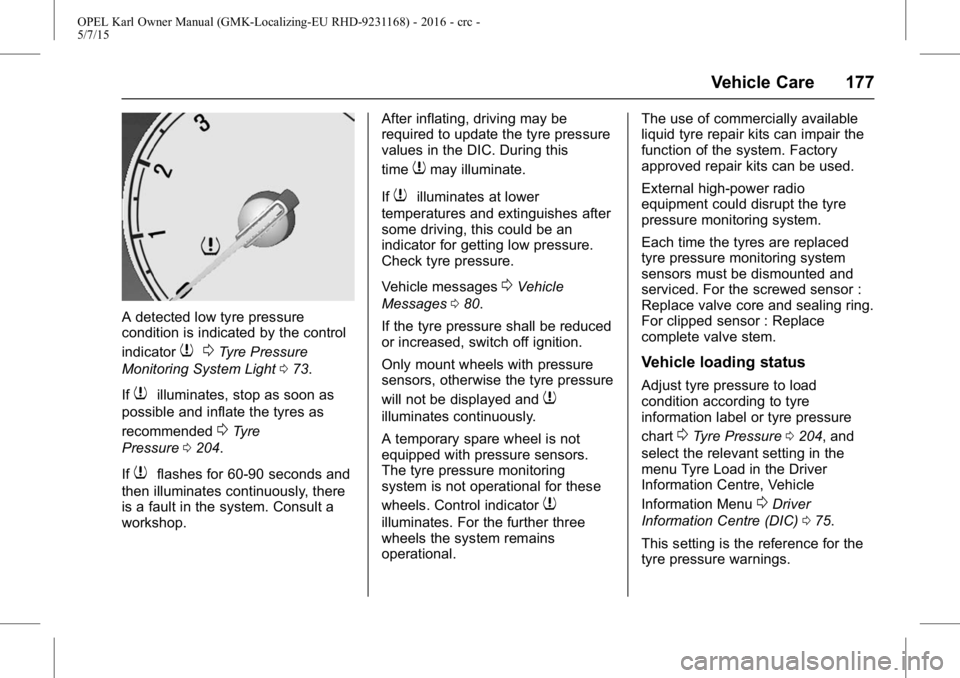
A detected low tyre pressure
condition is indicated by the control
indicator
70Tyre Pressure
Monitoring System Light 073.
If
7illuminates, stop as soon as
possible and inflate the tyres as
recommended
0Tyre
Pressure 0204.
If
7flashes for 60-90 seconds and
then illuminates continuously, there
is a fault in the system. Consult a
workshop. After inflating, driving may be
required to update the tyre pressure
values in the DIC. During this
time
7may illuminate.
If
7illuminates at lower
temperatures and extinguishes after
some driving, this could be an
indicator for getting low pressure.
Check tyre pressure.
Vehicle messages
0Vehicle
Messages 080.
If the tyre pressure shall be reduced
or increased, switch off ignition.
Only mount wheels with pressure
sensors, otherwise the tyre pressure
will not be displayed and
7
illuminates continuously.
A temporary spare wheel is not
equipped with pressure sensors.
The tyre pressure monitoring
system is not operational for these
wheels. Control indicator
7
illuminates. For the further three
wheels the system remains
operational. The use of commercially available
liquid tyre repair kits can impair the
function of the system. Factory
approved repair kits can be used.
External high-power radio
equipment could disrupt the tyre
pressure monitoring system.
Each time the tyres are replaced
tyre pressure monitoring system
sensors must be dismounted and
serviced. For the screwed sensor :
Replace valve core and sealing ring.
For clipped sensor : Replace
complete valve stem.
Vehicle loading status
Adjust tyre pressure to load
condition according to tyre
information label or tyre pressure
chart
0Tyre Pressure
0204, and
select the relevant setting in the
menu Tyre Load in the Driver
Information Centre, Vehicle
Information Menu
0Driver
Information Centre (DIC) 075.
This setting is the reference for the
tyre pressure warnings.
Page 179 of 217
OPEL Karl Owner Manual (GMK-Localizing-EU RHD-9231168) - 2016 - crc -
5/7/15
178 Vehicle Care
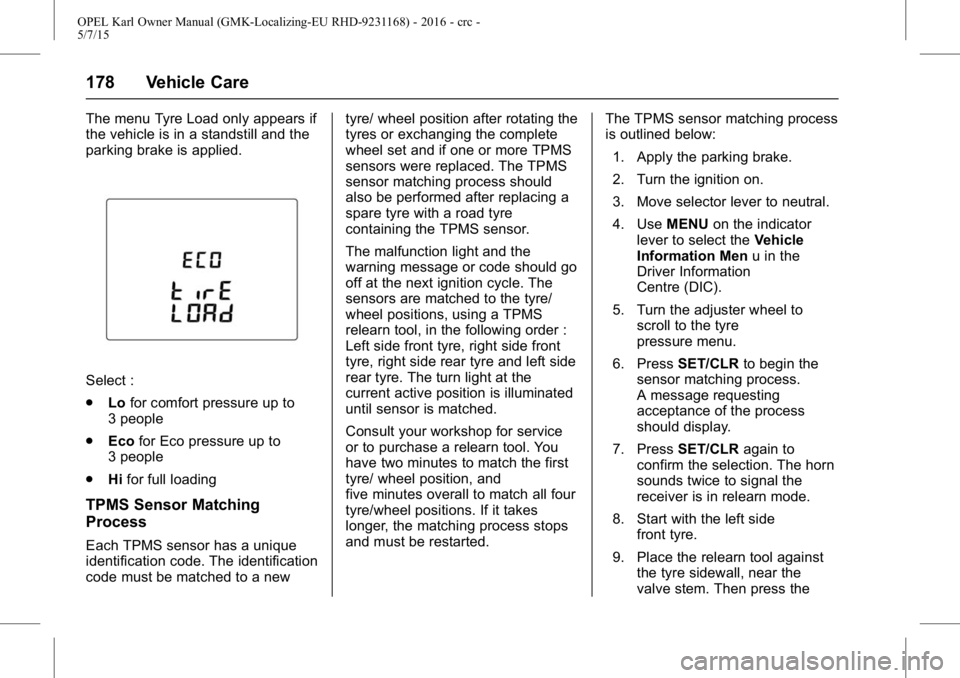
The menu Tyre Load only appears if
the vehicle is in a standstill and the
parking brake is applied.
Select :
.Lofor comfort pressure up to
3 people
. Eco for Eco pressure up to
3 people
. Hifor full loading
TPMS Sensor Matching
Process
Each TPMS sensor has a unique
identification code. The identification
code must be matched to a new tyre/ wheel position after rotating the
tyres or exchanging the complete
wheel set and if one or more TPMS
sensors were replaced. The TPMS
sensor matching process should
also be performed after replacing a
spare tyre with a road tyre
containing the TPMS sensor.
The malfunction light and the
warning message or code should go
off at the next ignition cycle. The
sensors are matched to the tyre/
wheel positions, using a TPMS
relearn tool, in the following order :
Left side front tyre, right side front
tyre, right side rear tyre and left side
rear tyre. The turn light at the
current active position is illuminated
until sensor is matched.
Consult your workshop for service
or to purchase a relearn tool. You
have two minutes to match the first
tyre/ wheel position, and
five minutes overall to match all four
tyre/wheel positions. If it takes
longer, the matching process stops
and must be restarted.
The TPMS sensor matching process
is outlined below:
1. Apply the parking brake.
2. Turn the ignition on.
3. Move selector lever to neutral.
4. Use MENUon the indicator
lever to select the Vehicle
Information Men u in the
Driver Information
Centre (DIC).
5. Turn the adjuster wheel to scroll to the tyre
pressure menu.
6. Press SET/CLR to begin the
sensor matching process.
A message requesting
acceptance of the process
should display.
7. Press SET/CLR again to
confirm the selection. The horn
sounds twice to signal the
receiver is in relearn mode.
8. Start with the left side front tyre.
9. Place the relearn tool against the tyre sidewall, near the
valve stem. Then press the
Page 180 of 217
OPEL Karl Owner Manual (GMK-Localizing-EU RHD-9231168) - 2016 - crc -
5/7/15
Vehicle Care 179
button to activate the TPMS
sensor. A horn chirp confirms
that the sensor identification
code has been matched to this
tyre and wheel position.
10. Proceed to the right side front tyre, and repeat the procedure
in Step 9.
11. Proceed to the right side rear tyre, and repeat the procedure
in Step 9.
12. Proceed to the left side rear tyre, and repeat the procedure
in Step 9. The horn sounds
twice to indicate the sensor
identification code has been
matched to the left side rear
tyre, and the TPMS sensor
matching process is no longer
active.
13. Turn off the ignition.
14. Set all four tyres to the recommended air pressure
level as indicated on the tyre
pressure label. 15. Ensure the tyre loading status
is set according selected
pressure
0Driver Information
Centre (DIC) 075.
Temperature dependency
The tyre pressure depends on the
temperature of the tyre. During
driving, tyre temperature and
pressure increase. Tyre pressure
values provided on the tyre
information label and tyre pressure
chart are valid for cold tyres, which
means at 20 °C. The pressure
increases by nearly 10 kPa for a
10 °C temperature increase. This
must be considered when warm
tyres are checked.
The tyre pressure value displayed in
the DIC shows the real tyre
pressure. A cooled down tyre will
show a decreased value, which
does not indicate an air leak.
Tread Depth
Check tread depth at regular
intervals. Tyres should be replaced for safety
reasons at a tread depth of 2-3 mm
(4 mm for winter tyres).
For safety reasons it is
recommended that the tread depth
of the tyres on one axle should not
vary by more than 2 mm.
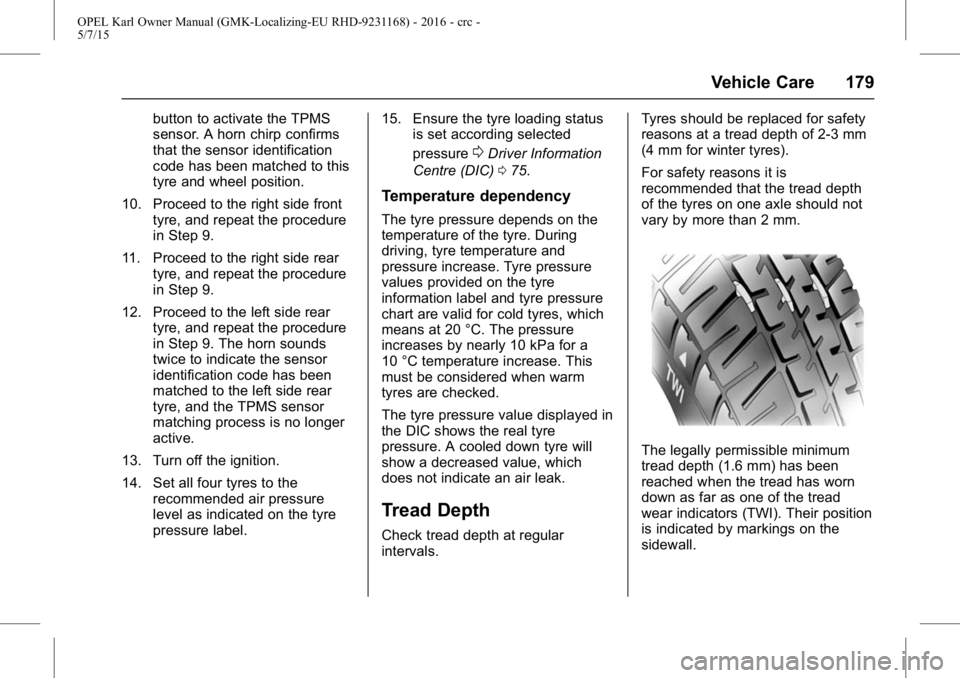
The legally permissible minimum
tread depth (1.6 mm) has been
reached when the tread has worn
down as far as one of the tread
wear indicators (TWI). Their position
is indicated by markings on the
sidewall.
Page 181 of 217
OPEL Karl Owner Manual (GMK-Localizing-EU RHD-9231168) - 2016 - crc -
5/7/15
180 Vehicle Care
Tyres age, even if they are not
used. We recommend tyre
replacement every 6 years.
Changing tyre and wheel size
If tyres of a different size than those
fitted at the factory are used, it may
be necessary to reprogramme the
speedometer as well as the nominal
tyre pressure and to make other
vehicle modifications
After converting to a different tyre
size, have the label with tyre
pressures replaced.
{Warning
Use of unsuitable tyres or wheels
may lead to accidents and will
invalidate the vehicle type
approval.
Wheel Covers
Wheel covers and tyres that are
factory approved for the respective
vehicle and comply with all of the
relevant wheel and tyre combination
requirements must be used.If the wheel covers and tyres used
are not factory approved, the tyres
must not have a rim protection
ridge.
Wheel covers must not impair brake
cooling.
{Warning
Use of unsuitable tyres or wheel
covers could lead to sudden
pressure loss and thereby
accidents.
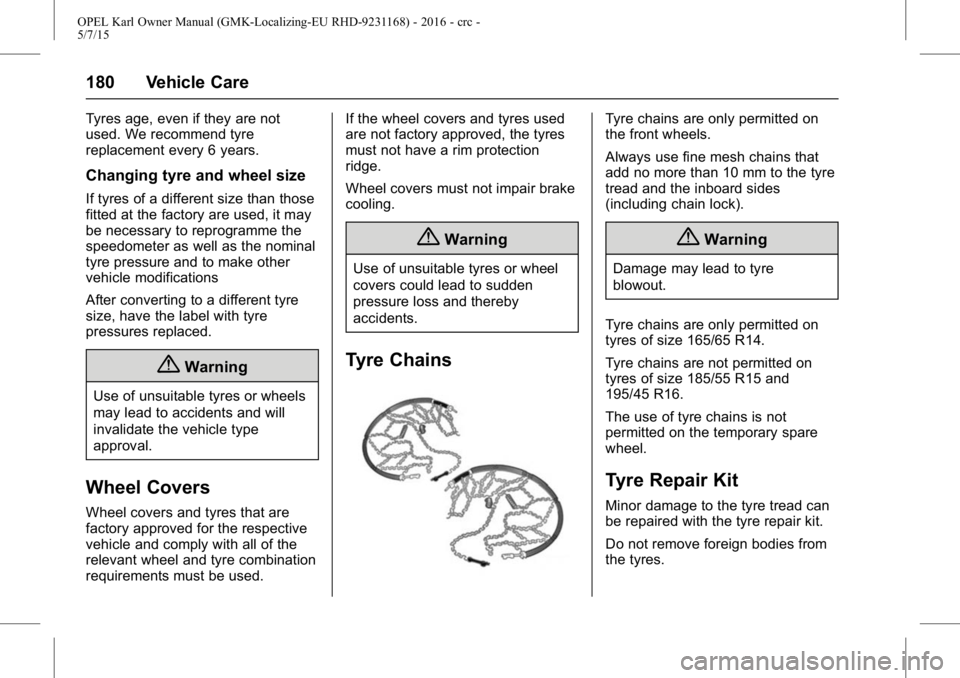
Tyre Chains
Tyre chains are only permitted on
the front wheels.
Always use fine mesh chains that
add no more than 10 mm to the tyre
tread and the inboard sides
(including chain lock).
{Warning
Damage may lead to tyre
blowout.
Tyre chains are only permitted on
tyres of size 165/65 R14.
Tyre chains are not permitted on
tyres of size 185/55 R15 and
195/45 R16.
The use of tyre chains is not
permitted on the temporary spare
wheel.
Tyre Repair Kit
Minor damage to the tyre tread can
be repaired with the tyre repair kit.
Do not remove foreign bodies from
the tyres.
Page 183 of 217
OPEL Karl Owner Manual (GMK-Localizing-EU RHD-9231168) - 2016 - crc -
5/7/15
182 Vehicle Care
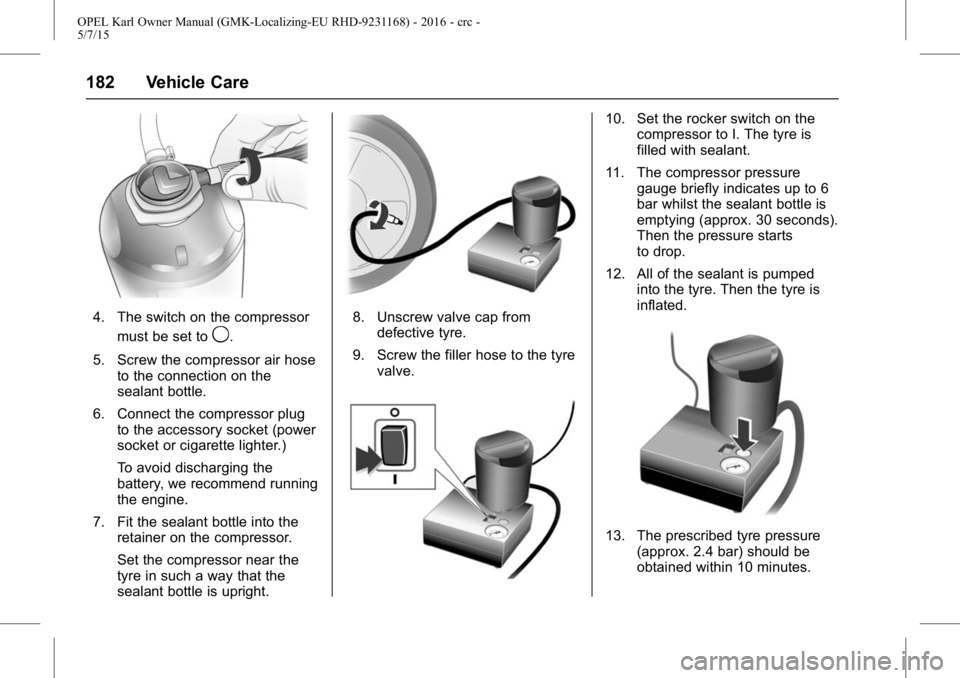
4. The switch on the compressormust be set to
9.
5. Screw the compressor air hose to the connection on the
sealant bottle.
6. Connect the compressor plug to the accessory socket (power
socket or cigarette lighter.)
To avoid discharging the
battery, we recommend running
the engine.
7. Fit the sealant bottle into the retainer on the compressor.
Set the compressor near the
tyre in such a way that the
sealant bottle is upright.
8. Unscrew valve cap from
defective tyre.
9. Screw the filler hose to the tyre valve.
10. Set the rocker switch on the compressor to I. The tyre is
filled with sealant.
11. The compressor pressure gauge briefly indicates up to 6
bar whilst the sealant bottle is
emptying (approx. 30 seconds).
Then the pressure starts
to drop.
12. All of the sealant is pumped into the tyre. Then the tyre is
inflated.
13. The prescribed tyre pressure(approx. 2.4 bar) should be
obtained within 10 minutes.
Page 184 of 217
OPEL Karl Owner Manual (GMK-Localizing-EU RHD-9231168) - 2016 - crc -
5/7/15
Vehicle Care 183
When the correct pressure is
obtained, switch off the
compressor.
If the prescribed tyre pressure
is not obtained within
10 minutes, remove the tyre
repair kit. Move the vehicle one
tyre rotation.
Reattach the tyre repair kit and
continue the filling procedure
for 10 minutes. If the
prescribed tyre pressure is still
not obtained, the tyre is too
badly damaged. Seek the
assistance of a workshop.
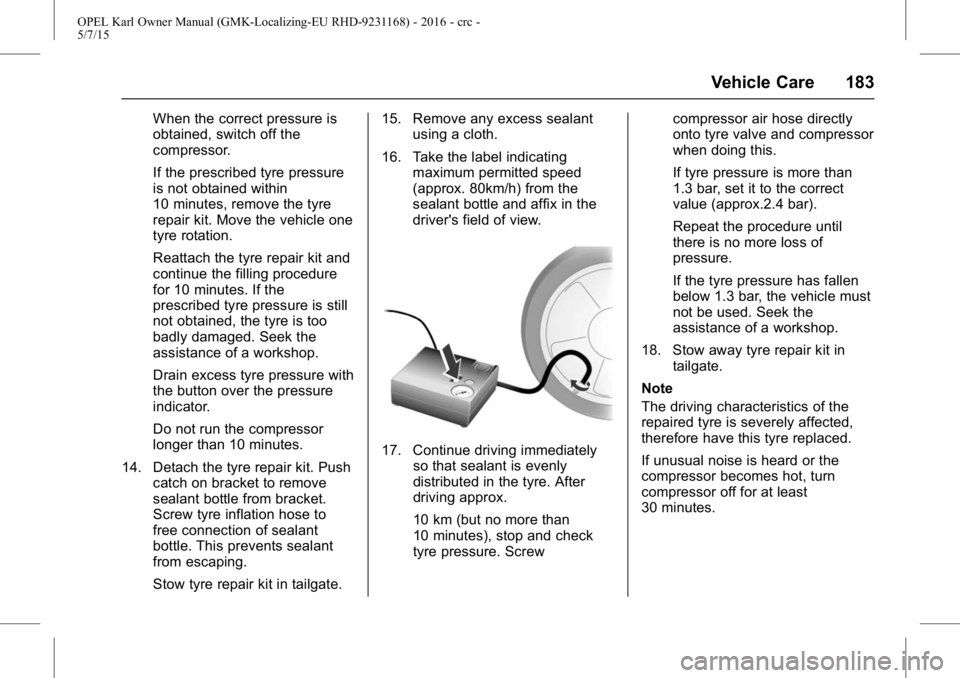
Drain excess tyre pressure with
the button over the pressure
indicator.
Do not run the compressor
longer than 10 minutes.
14. Detach the tyre repair kit. Push catch on bracket to remove
sealant bottle from bracket.
Screw tyre inflation hose to
free connection of sealant
bottle. This prevents sealant
from escaping.
Stow tyre repair kit in tailgate. 15. Remove any excess sealant
using a cloth.
16. Take the label indicating maximum permitted speed
(approx. 80km/h) from the
sealant bottle and affix in the
driver's field of view.
17. Continue driving immediatelyso that sealant is evenly
distributed in the tyre. After
driving approx.
10 km (but no more than
10 minutes), stop and check
tyre pressure. Screw compressor air hose directly
onto tyre valve and compressor
when doing this.
If tyre pressure is more than
1.3 bar, set it to the correct
value (approx.2.4 bar).
Repeat the procedure until
there is no more loss of
pressure.
If the tyre pressure has fallen
below 1.3 bar, the vehicle must
not be used. Seek the
assistance of a workshop.
18. Stow away tyre repair kit in tailgate.
Note
The driving characteristics of the
repaired tyre is severely affected,
therefore have this tyre replaced.
If unusual noise is heard or the
compressor becomes hot, turn
compressor off for at least
30 minutes.
Page 187 of 217
OPEL Karl Owner Manual (GMK-Localizing-EU RHD-9231168) - 2016 - crc -
5/7/15
186 Vehicle Care
4. Set the jack to the necessaryheight. Position it directly below
the jacking point in a manner
that prevents it from slipping.
Attach jack handle and with the
jack correctly aligned rotate
handle until wheel is clear of
the ground.
5. Unscrew the wheel bolts.
6. Change the wheel.
7. Screw on the wheel bolts.
8. Lower vehicle.
9. that it locates securely and tighten each bolt in a crosswise
sequence. Tightening torque is
140 Nm.
10. Align the valve hole in the wheel cover of the steel wheel
with the tyre valve before
installing.
Install wheel bolt caps or
centre cap on alloy wheel.
11. Install vehicle jacking point cover. 12. Stow and secure the replaced
wheel, the vehicle tools and the
adapter for the locking wheel
bolts.
13. Check the tyre pressure of the installed tyre and the wheel
bolt torque as soon as
possible.
Have the defective tyre
renewed or repaired as soon
as possible.
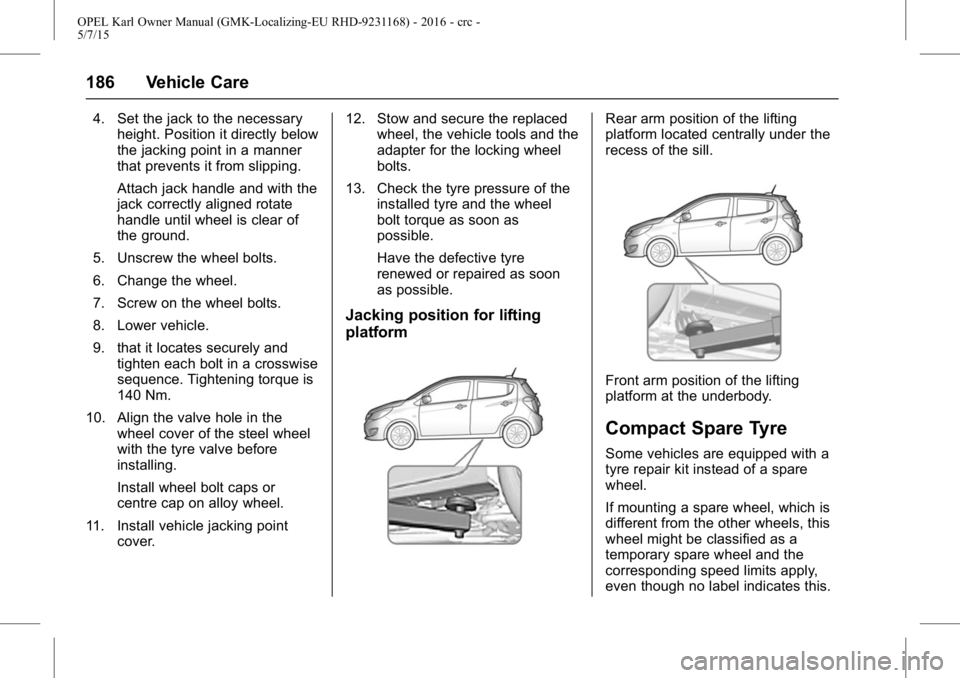
Jacking position for lifting
platform
Rear arm position of the lifting
platform located centrally under the
recess of the sill.
Front arm position of the lifting
platform at the underbody.
Compact Spare Tyre
Some vehicles are equipped with a
tyre repair kit instead of a spare
wheel.
If mounting a spare wheel, which is
different from the other wheels, this
wheel might be classified as a
temporary spare wheel and the
corresponding speed limits apply,
even though no label indicates this.
Page 193 of 217
OPEL Karl Owner Manual (GMK-Localizing-EU RHD-9231168) - 2016 - crc -
5/7/15
192 Vehicle Care
Plastic body parts must not be
treated with wax or polishing
agents.
Windows and windscreen
wiper blades
Use a soft lint-free cloth or chamois
leather together with window
cleaner and insect remover.
When cleaning the rear window,
make sure the heating element
inside is not damaged.
For mechanical removal of ice, use
a sharp-edged ice scraper. Press
the scraper firmly against the glass
so that no dirt can get under it and
scratch the glass.
Clean smearing wiper blades with a
soft cloth and window cleaner.
Sunroof
Never clean with solvents or
abrasive agents, fuels, aggressive
media (e.g. paint cleaner, acetone
containing solutions etc.), acidic or
highly alkaline media or abrasive
pads. Do not apply wax or polishing
agents to the sunroof.
Wheels and tyres
Do not use high-pressure jet
cleaners.
Clean rims with a pH-neutral wheel
cleaner.
Rims are painted and can be
treated with the same agents as
the body.
Paintwork damage
Rectify minor paintwork damage
with a touch-up pen before rust
forms. Have more extensive
damage or rust areas repaired by a
workshop.
Underbody
Some areas of the vehicle
underbody have a PVC
undercoating while other critical
areas have a durable protective wax
coating.
After the underbody is washed,
check the underbody and have it
waxed if necessary.Bitumen/rubber materials could
damage the PVC coating. Have
underbody work carried out by a
workshop.
Before and after winter, wash the
underbody and have the protective
wax coating checked.
Interior Care
Interior and upholstery
Only clean the vehicle interior,
including the instrument panel
fascia and panelling, with a dry cloth
or interior cleaner.
Clean the leather upholstery with
clear water and a soft cloth. In case
of heavy soiling, use leather care.
The instrument cluster and the
displays should only be cleaned
using a soft damp cloth.
If necessary use a weak soap
solution.
Clean fabric upholstery with a
vacuum cleaner and brush. Remove
stains with an upholstery cleaner.
Page 201 of 217
OPEL Karl Owner Manual (GMK-Localizing-EU RHD-9231168) - 2016 - crc -
5/7/15
200 Technical Data
Technical Data
Vehicle Identification
Vehicle IdentificationNumber (VIN) . . . . . . . . . . . . . . . 200
Engine Identification . . . . . . . . . . 200
Identification Plate . . . . . . . . . . . . 201
Vehicle Data
Engine Data . . . . . . . . . . . . . . . . . . 202
Performance . . . . . . . . . . . . . . . . . 202
Vehicle Weight . . . . . . . . . . . . . . . 203
Vehicle Dimensions . . . . . . . . . . 203
Capacities and Specifications . . . . . . . . . . . . . . . 204
Tyre Pressure . . . . . . . . . . . . . . . . 204
Vehicle Identification
Vehicle Identification
Number (VIN)
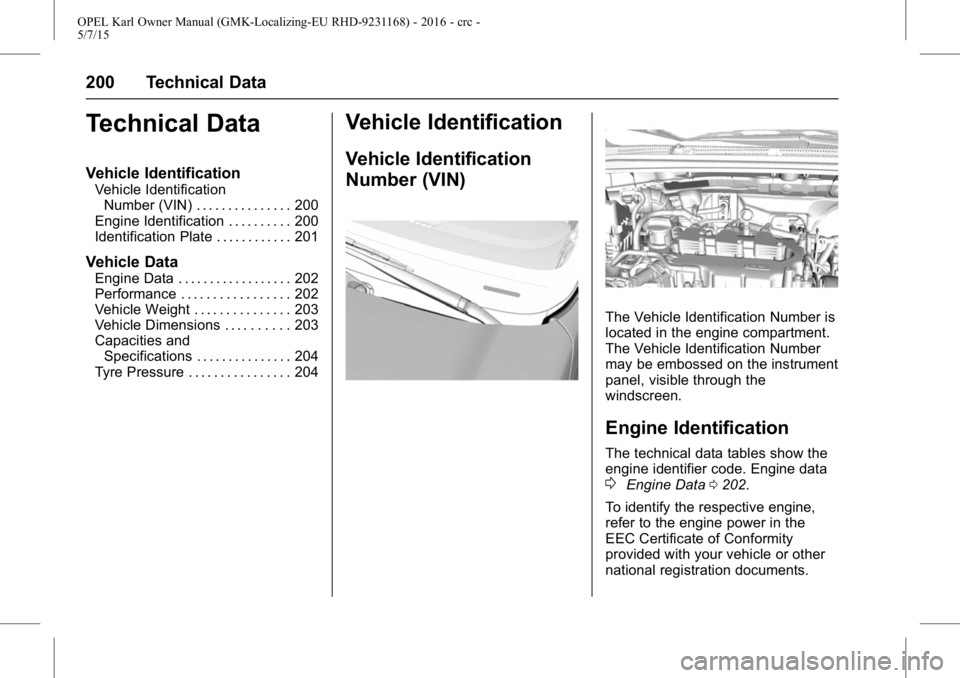
The Vehicle Identification Number is
located in the engine compartment.
The Vehicle Identification Number
may be embossed on the instrument
panel, visible through the
windscreen.
Engine Identification
The technical data tables show the
engine identifier code. Engine data
0Engine Data 0202.
To identify the respective engine,
refer to the engine power in the
EEC Certificate of Conformity
provided with your vehicle or other
national registration documents.