ECU OPEL KARL 2015 Owner's Manual
[x] Cancel search | Manufacturer: OPEL, Model Year: 2015, Model line: KARL, Model: OPEL KARL 2015Pages: 217, PDF Size: 4.16 MB
Page 191 of 217
OPEL Karl Owner Manual (GMK-Localizing-EU RHD-9231168) - 2016 - crc -
5/7/15
190 Vehicle Care
Towing the Vehicle
If towing service is not available in
an emergency, your vehicle may be
temporarily towed by a rope secured
to the emergency towing eye.
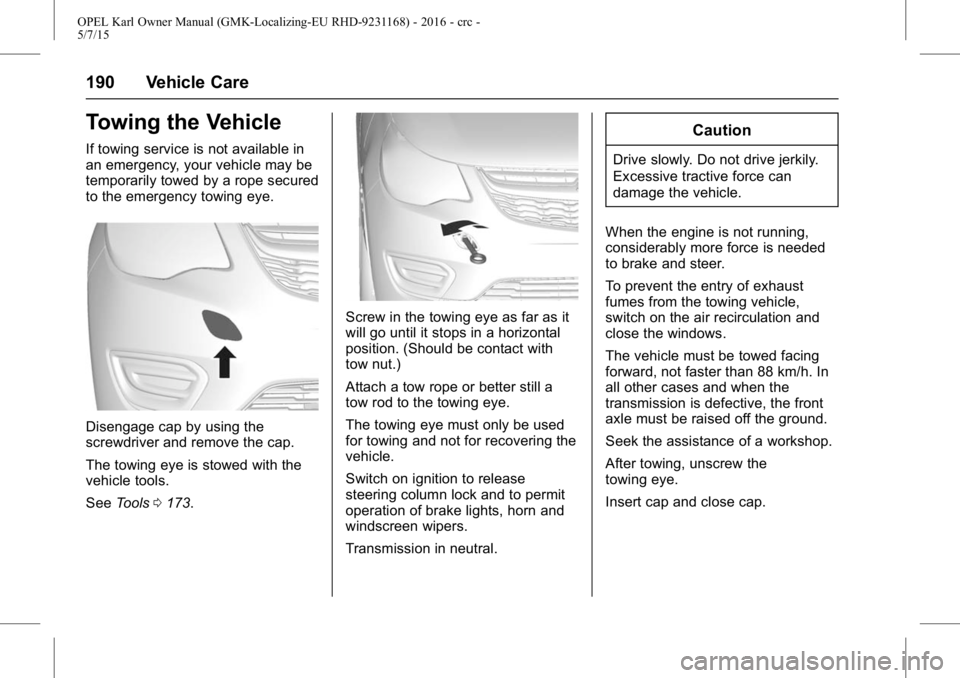
Disengage cap by using the
screwdriver and remove the cap.
The towing eye is stowed with the
vehicle tools.
SeeTools 0173.
Screw in the towing eye as far as it
will go until it stops in a horizontal
position. (Should be contact with
tow nut.)
Attach a tow rope or better still a
tow rod to the towing eye.
The towing eye must only be used
for towing and not for recovering the
vehicle.
Switch on ignition to release
steering column lock and to permit
operation of brake lights, horn and
windscreen wipers.
Transmission in neutral.
Caution
Drive slowly. Do not drive jerkily.
Excessive tractive force can
damage the vehicle.
When the engine is not running,
considerably more force is needed
to brake and steer.
To prevent the entry of exhaust
fumes from the towing vehicle,
switch on the air recirculation and
close the windows.
The vehicle must be towed facing
forward, not faster than 88 km/h. In
all other cases and when the
transmission is defective, the front
axle must be raised off the ground.
Seek the assistance of a workshop.
After towing, unscrew the
towing eye.
Insert cap and close cap.
Page 207 of 217
OPEL Karl Owner Manual (GMK-Localizing-EU RHD-9231168) - 2016 - crc -
5/7/15
206 Customer Information
Vehicle Data
Recording and
Privacy
Event Data Recorders
Data storage modules in the
vehicle
A large number of electronic
components of your vehicle contain
data storage modules temporarily or
permanently storing technical data
about the condition of the vehicle,
events and errors. In general, this
technical information documents the
condition of parts, modules, systems
or the environment:
.Operating conditions of system
components (e.g. filling levels)
. Status messages of the vehicle
and its single components (e.g.
number of wheel revolutions /
rotational speed, deceleration,
lateral acceleration)
. Dysfunctions and defects in
important system components .
Vehicle reactions in particular
driving situations (e.g. inflation of
an airbag, activation of the
stability regulation system)
. Environmental conditions (e.g.
temperature)
This data is exclusively technical
and helps identify and correct errors
as well as optimise vehicle
functions.
Motion profiles indicating travelled
routes cannot be created with
these data.
If services are used (e.g. repair
works, service processes, warranty
cases, quality assurance),
employees of the service network
(manufacturer included) are able to
read out this technical information
from the event and error data
storage modules applying special
diagnostic devices. If required, you
will receive further information at
these workshops. After an error has
been corrected, the data is deleted
from the error storage module or
constantly overwritten. When using the vehicle, situations
may occur in which these technical
data related to other information
(accident report, damages on the
vehicle, witness statements etc.)
may be associated with a specific
person - possibly, with the
assistance of an expert.
Additional functions contractually
agreed upon with the client (e.g.
vehicle location in emergency
cases) allow the transmission of
particular vehicle data from the
vehicle.
Radio Frequency
Identification (RFID)
RFID technology is used in some
vehicles for functions such as tyre
deflation detection and ignition
system security. It is also used in
connection with conveniences such
as radio remote controls for door
locking/unlocking and starting, and
in-vehicle transmitters for garage
door openers. RFID technology in
Opel vehicles does not use or