gear OPEL MANTA 1973 Workshop Manual
[x] Cancel search | Manufacturer: OPEL, Model Year: 1973, Model line: MANTA, Model: OPEL MANTA 1973Pages: 625, PDF Size: 17.22 MB
Page 252 of 625
REAR AXLE48.21FEELER
DIFFERENTIAL
DIAL INDICATOR
SIDE BEARINGS
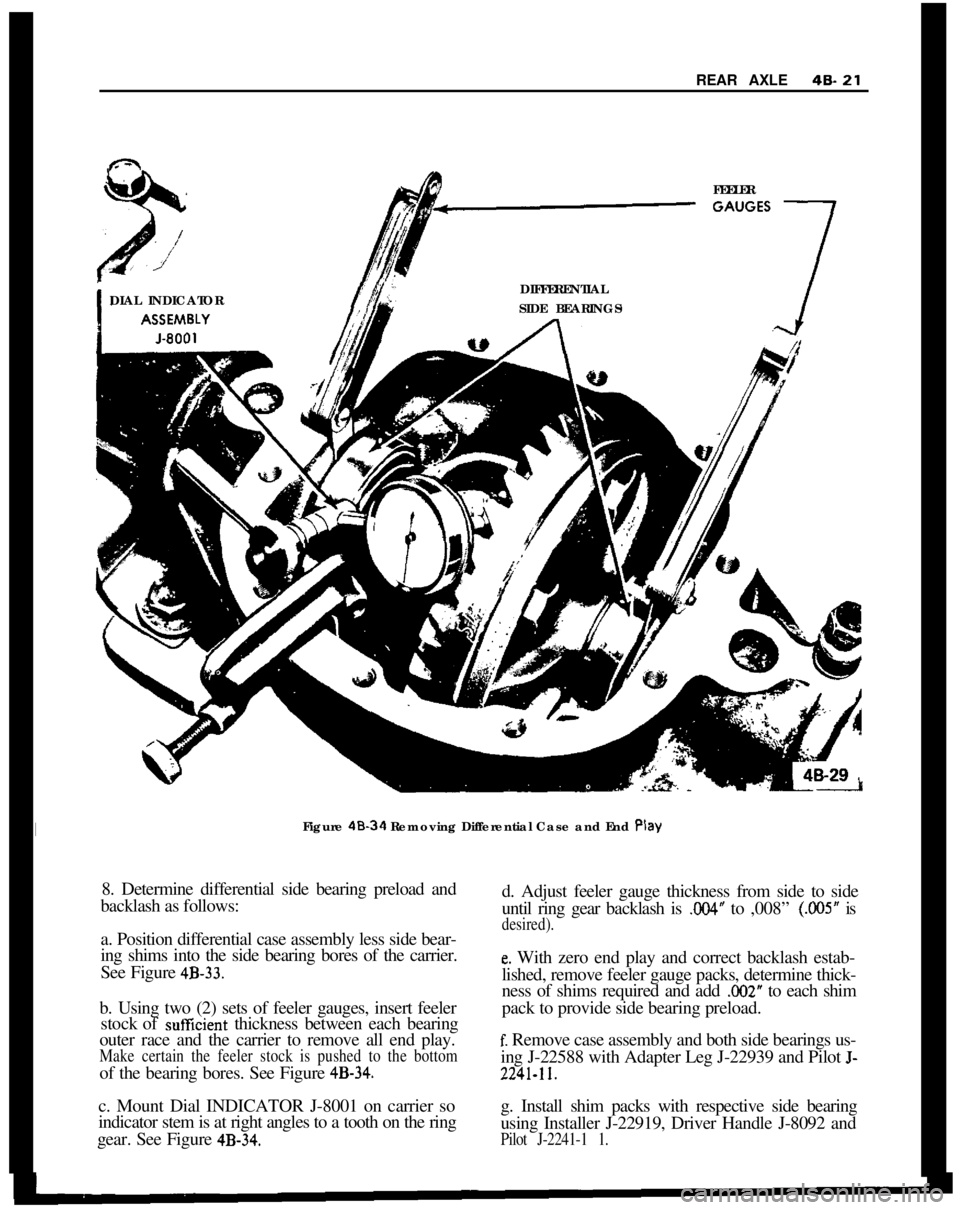
Figure 48.34 Removing Differential Case and End
Play8. Determine differential side bearing preload and
backlash as follows:d. Adjust feeler gauge thickness from side to side
until ring gear backlash is
004” to ,008” (.005” is
desired).a. Position differential case assembly less side bear-
ing shims into the side bearing bores of the carrier.
See Figure
4B-33.b. Using two (2) sets of feeler gauges, insert feeler
stock of sufficient thickness between each bearing
outer race and the carrier to remove all end play.
Make certain the feeler stock is pushed to the bottomof the bearing bores. See Figure
4B-34.
e. With zero end play and correct backlash estab-
lished, remove feeler gauge packs, determine thick-
ness of shims required and add
.002” to each shim
pack to provide side bearing preload.
f. Remove case assembly and both side bearings us-
ing J-22588 with Adapter Leg J-22939 and Pilot
J-
2241-11.c. Mount Dial INDICATOR J-8001 on carrier sog. Install shim packs with respective side bearing
indicator stem is at right angles to a tooth on the ring
using Installer J-22919, Driver Handle J-8092 and
gear. See Figure
4B-34.Pilot J-2241-1 1.
Page 253 of 625
48. 221973 OPEL SERVICE MANUAL
9. Position
case assembly and outer races in the car-
rier. Use a soft-faced hammer to drive the case into
the carrier until the side bearing outer races bottom
in their bores.
10. Install side bearing caps in their original location
and torque the bolts to 33
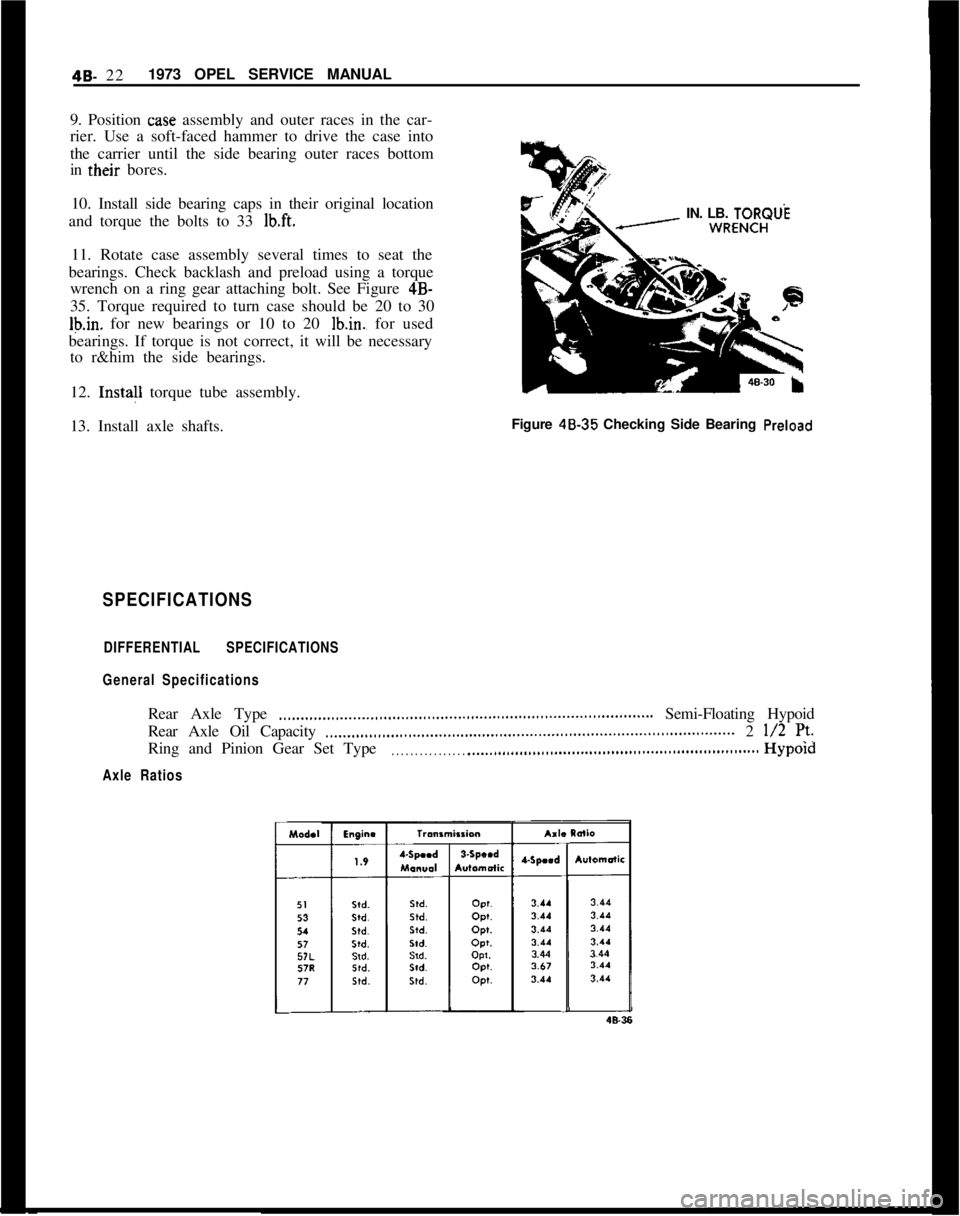
lb.ft.IN. LB. TORQUL
11. Rotate case assembly several times to seat the
bearings. Check backlash and preload using a torque
wrench on a ring gear attaching bolt. See Figure 4B-
35. Torque required to turn case should be 20 to 30
Ib.in. for new bearings or 10 to 20 lb.in., for used
bearings. If torque is not correct, it will be necessary
to r&him the side bearings.
12. Insta!l torque tube assembly.
13. Install axle shafts.Figure 48.35 Checking Side Bearing
Preload
SPECIFICATIONS
DIFFERENTIAL SPECIFICATIONS
General SpecificationsRear Axle Type
.,,...,,,...,,_...._..,,...,,,...,,,....,,.,...,,.,,...,,..,,,........................ Semi-Floating Hypoid
Rear Axle Oil Capacity
..____,,...,,,...,.,..,............,,..,,..,,................................................. 2 l/2 7’.Ring and Pinion Gear Set Type
. . . . . . . . . . . . . . . . . .._................................................................Hypold
Axle Ratios
Page 254 of 625
REAR AXLE49.23
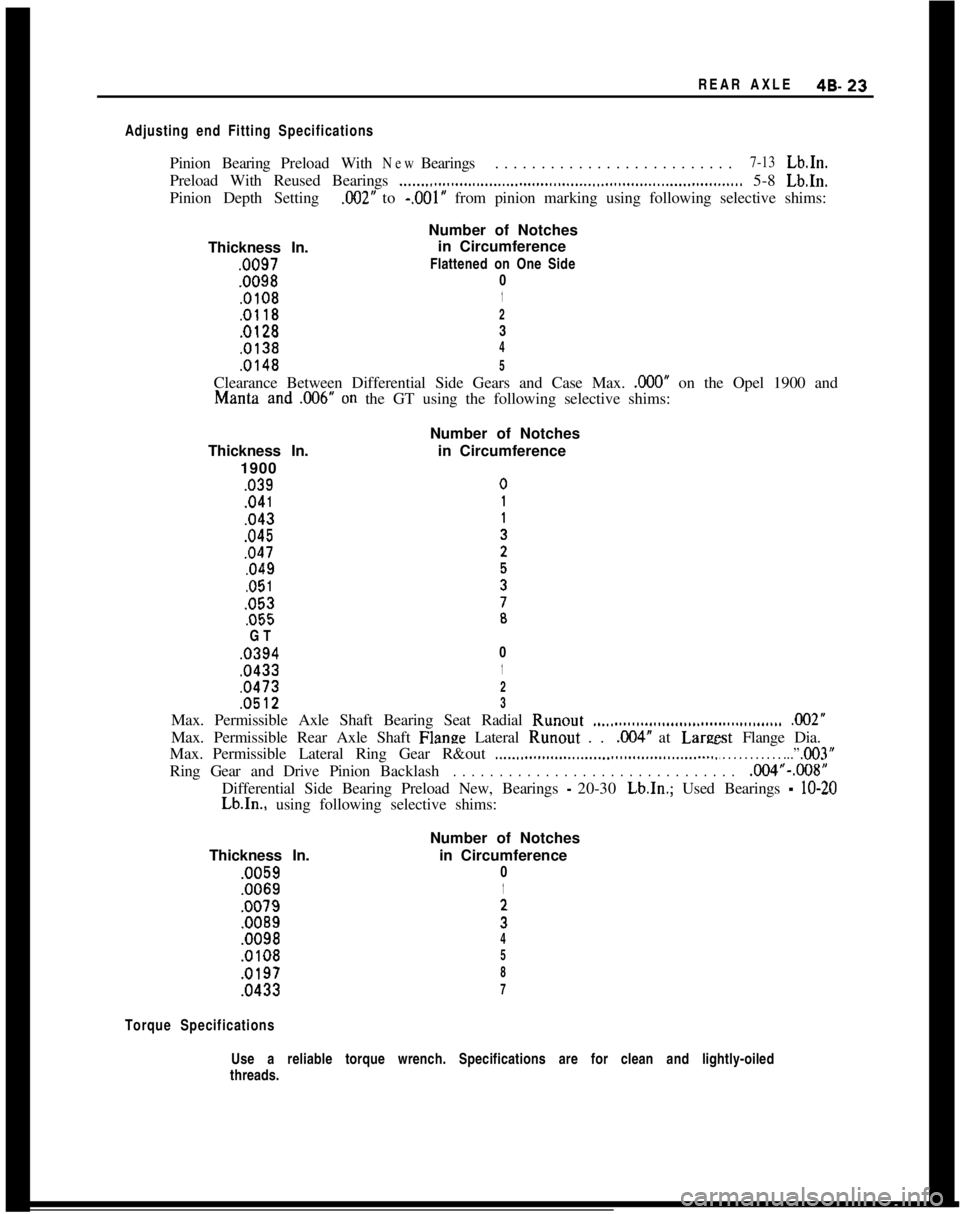
Adjusting end Fitting SpecificationsPinionBearingPreloadWith
NewBearings. . . . . . . . . . . . . . . . . . . . . . . . . .7-13Lb.In.
Preload With Reused Bearings
__.._..I...................,.................,,...................,,............ 5-8 Lb.In.
Pinion Depth Setting
.002” to -.OOl’ from pinion marking using following selective shims:
Number of Notches
Thickness In.in Circumference.0097Flattened on One Side
.00980
.01081
.01182
.01283
.01384
.01485Clearance Between Differential Side Gears and Case Max.
,000” on the Opel 1900 andManta and
,006” on the GT using the following selective shims:
Thickness In.
1900
,039.04
1,043,045,047,049.05
1,053,055
GT
.0394
.0433
.0473Number of Notches
in Circumference
0
1
2
.05123Max. Permissible Axle Shaft Bearing Seat Radial Runout
.._......................................... ,002”Max. Permissible Rear Axle Shaft Flanze Lateral Runout . .
,004” at Lareest Flange Dia.
Max.Permissible Lateral Ring Gear R&out
._.._,,.........._.....,........................... T . . . . . . . . . . . ...” ,003”RingGearandDrivePinionBacklash
. . . . . . . . . . . . . . . . . . . . . . . . . . . . . . .,004”-.008”
Differential Side Bearing Preload New, Bearings
- 20-30 Lb.In.; Used Bearings - lo-20Lb.In., using following selective shims:
Thickness In..0059.0069
.0079
.0089
.0098
.0108
.0197
.0433Number of Notches
in Circumference
0
1
;
4
5
8
7
Torque SpecificationsUse a reliable torque wrench. Specifications are for clean and lightly-oiled
threads.
Page 255 of 625
49- 241973 OPEL SERVICE MANUAL
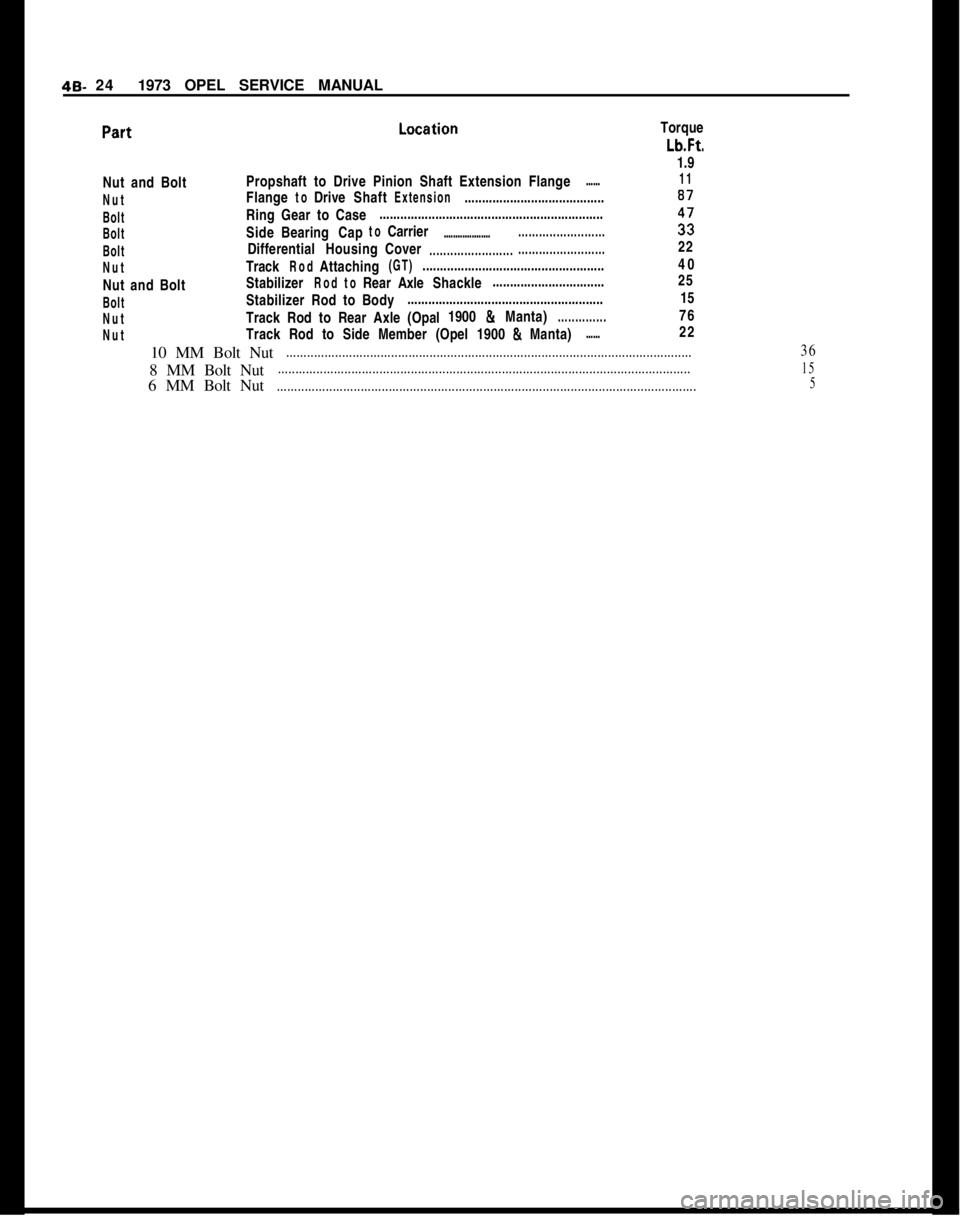
Torque
Lb.Ft.
1.9Nut and BoltPropshaft to Drive Pinion Shaft Extension Flange
......11
NutFlange
toDriveShaftExtension........................................87
BoltRing Gear to Case................................................................
BoltSideBearingCaptoCarrier.............................................i;
BoltDifferentialHousingCover.................................................22
NutTrackRodAttaching(GT)....................................................40
Nut and BoltStabilizer
RodtoRearAxleShackle................................25
BoltStabilizer Rod to Body........................................................15
NutTrack Rod to Rear Axle (Opal1900 & Manta)..............76
NutTrack Rod to Side Member (Opel 1900 & Manta)......22
10 MM Bolt Nut
....................................................................................................................368 MM Bolt Nut
......................................................................................................................156 MM Bolt Nut
........................................................................................................................5
Page 256 of 625
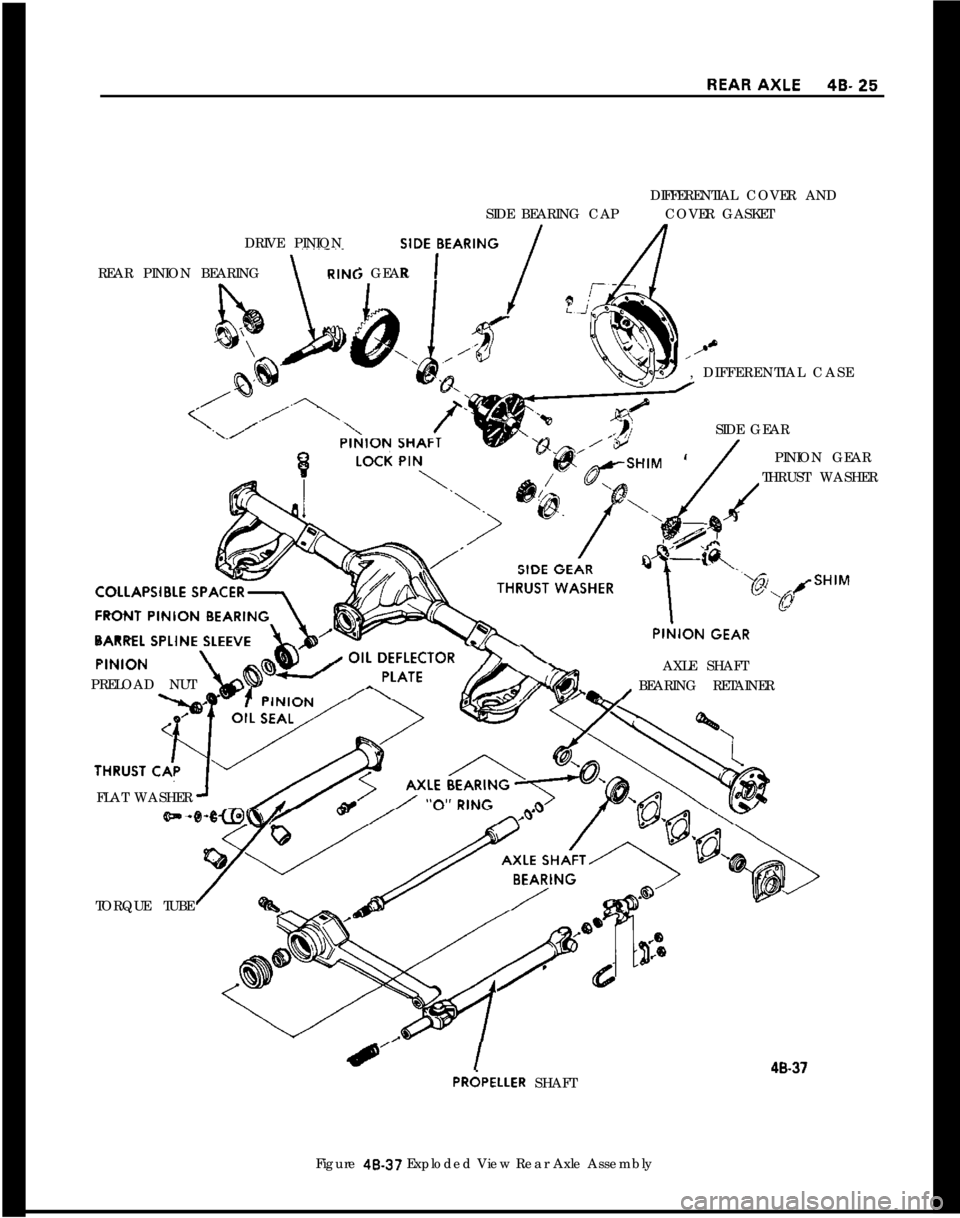
DIFFERENTIAL COVER AND
SIDE BEARING CAPCOVER GASKET
DRIVE PINIONSlDE,BEARlNG /; GEAR REAR PINION BEARINGx
\PRELOAD NUT, DIFFERENTIAL CASE
SIDE GEAR
PINION GEAR
THRUST WASHER
AXLE SHAFT
BEARING RETAINER
FLAT WASHER
TORQUE TUBE40.37PRdPELLER SHAFT
Figure 48-37 Exploded View Rear Axle Assembly
Page 293 of 625

6A- 21973 OPEL SERVICE MANUAL
ENGINE
CONTENTS
Subject
DESCRIPTION AND OPERATION:
EngineConstruction..........................................................
LubricationSystem............................................................
DIAGNOSIS:
Excessive Oil Consumption............................................NoisyValvesandLifters..................................................
MAINTENANCE AND ADJUSTMENTS:
Valve
LifterAdjustment..................................................
MAJOR REPAIR:
Engine Removal and Installation..................................
Engine
OilPanRemoval
andInstallation..................
Manifold, Cylinder Head, Valve Train and
Lifters................................................................................
Connecting Rod Bearings................................................
Crankshaft Bearings and Seals....................................
Piston, Rings and Connecting Rods............................
TimingChainCoverandTimingChain......................
Camshaft..............................................................................
Oil Pump Cover and Gears............................................
SPECIFICATIONS:
BoltTorque.Specifications
..............................................General Specifications......................................................
Engine Dimension and Fits............................................Page No.
6A- 2
6A- 4
6A- 6
6A- 6
6A- 7
6A- 86A-106A-126A-156A-166A-196A-236A-256A-266A-276A-286A-29
DESCRIPTION AND OPERATION
ENGINE CONSTRUCTION
Engine UsageThe 1.9 liter engine is standard equipment on all 1973
Opel
1900, Manta and GT models. This engine has
a compression ratio of
7.6:1 and operates on“regular” low lead grade fuel.
Engine ConstructionThe
cyfinderhead is made of high-grade chromium
grey cast iron. The valve guides are cast intergal with
the head. The overhead camshaft is supported in four
bearings in the cylinder head.Location of the
vzllve seats in combustion chamber
is above the center of cylinder bore. The spark plug
is positioned in the center and near the highest point
of combustion chamber. This arrangement provides
for short flame travel, uniform combustion and good
cold start prop&ties. Exhaust valves have seat in-serts of highly heat and water resisting material. The
head surface is alumetized and so are the seats of the
inlet v&es Alumetizing makes the valve heads
non- scaling and promotes long life. All engines have“rota-caps”.
The forged, five main bearing crankshaft has large-
diameter main and connecting rod bearing journals
with considerable overlap for vibration-free operat-
ion. T&metal bearing shells are used for main and
connecting rod bearings. The crankshaft end play is
controlled by the rear main bearing.
Page 295 of 625
6A. 41973 OPEL SERVICE MANUAL
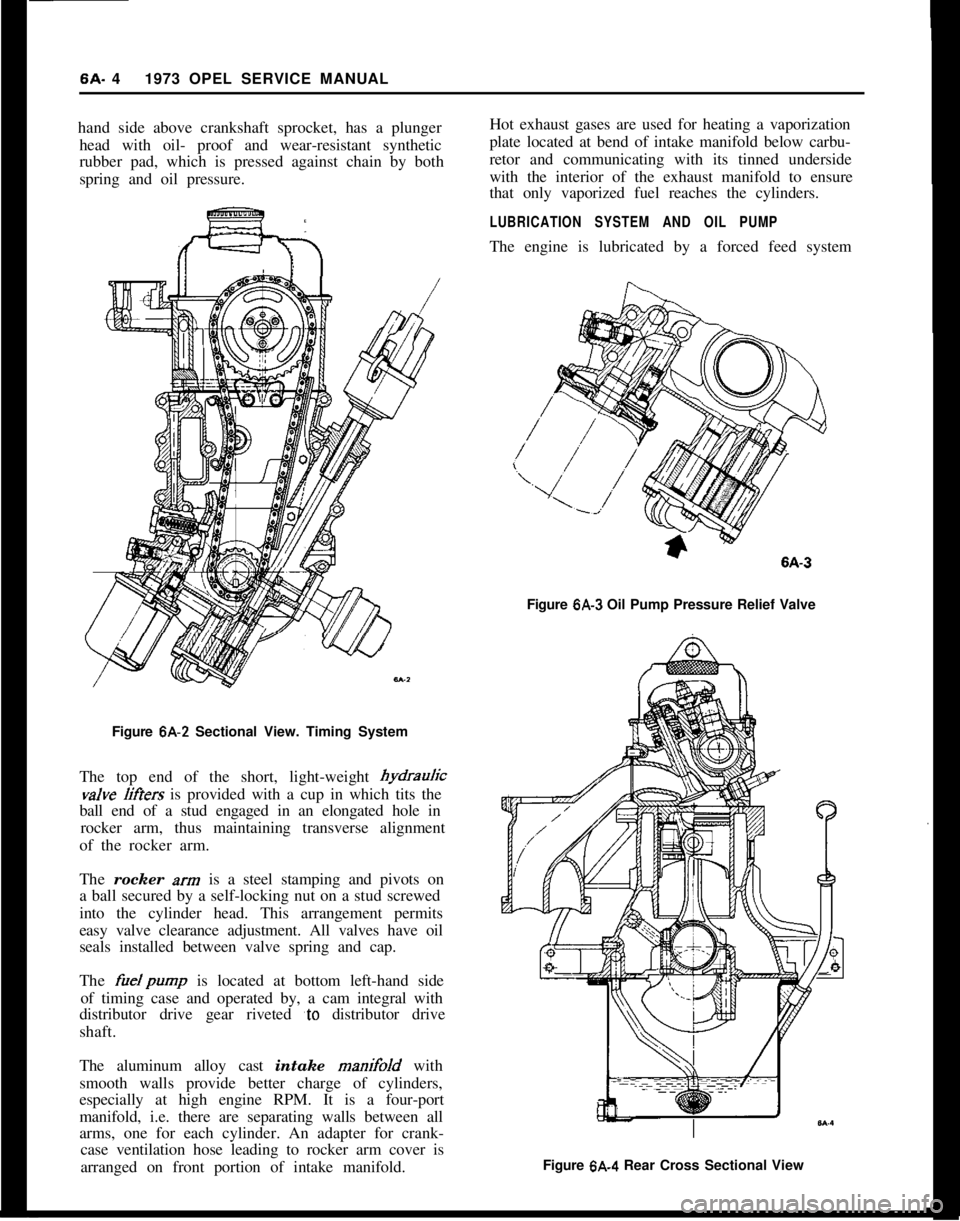
hand side above crankshaft sprocket, has a plunger
head with oil- proof and wear-resistant synthetic
rubber pad, which is pressed against chain by both
spring and oil pressure.
Figure 6A-2 Sectional View. Timing System
The top end of the short, light-weight hydrauricvalve
liffers is provided with a cup in which tits the
ball end of a stud engaged in an elongated hole in
rocker arm, thus maintaining transverse alignment
of the rocker arm.
The rocker
xrn is a steel stamping and pivots on
a ball secured by a self-locking nut on a stud screwed
into the cylinder head. This arrangement permits
easy valve clearance adjustment. All valves have oil
seals installed between valve spring and cap.
The
fuelpump is located at bottom left-hand side
of timing case and operated by, a cam integral with
distributor drive gear riveted
‘to distributor drive
shaft.
The aluminum alloy cast intake manifold with
smooth walls provide better charge of cylinders,
especially at high engine RPM. It is a four-port
manifold, i.e. there are separating walls between all
arms, one for each cylinder. An adapter for crank-
case ventilation hose leading to rocker arm cover is
arranged on front portion of intake manifold.Hot exhaust gases are used for heating a vaporization
plate located at bend of intake manifold below carbu-
retor and communicating with its tinned underside
with the interior of the exhaust manifold to ensure
that only vaporized fuel reaches the cylinders.
LUBRICATION SYSTEM AND OIL PUMPThe engine is lubricated by a forced feed system
Figure
6A-3 Oil Pump Pressure Relief Valve
Figure 6A.4 Rear Cross Sectional View
Page 296 of 625
ENGINE MECHANICAL AND MOUNTS6A- 5
incorporating a gear-type pump driven by the dis-
tributor shaft. The pump body forms part of the
timing case. A passage cast in cylinder block and a
suction pipe connect the pump to the screen cover
assembly in the sump of the oil pan.
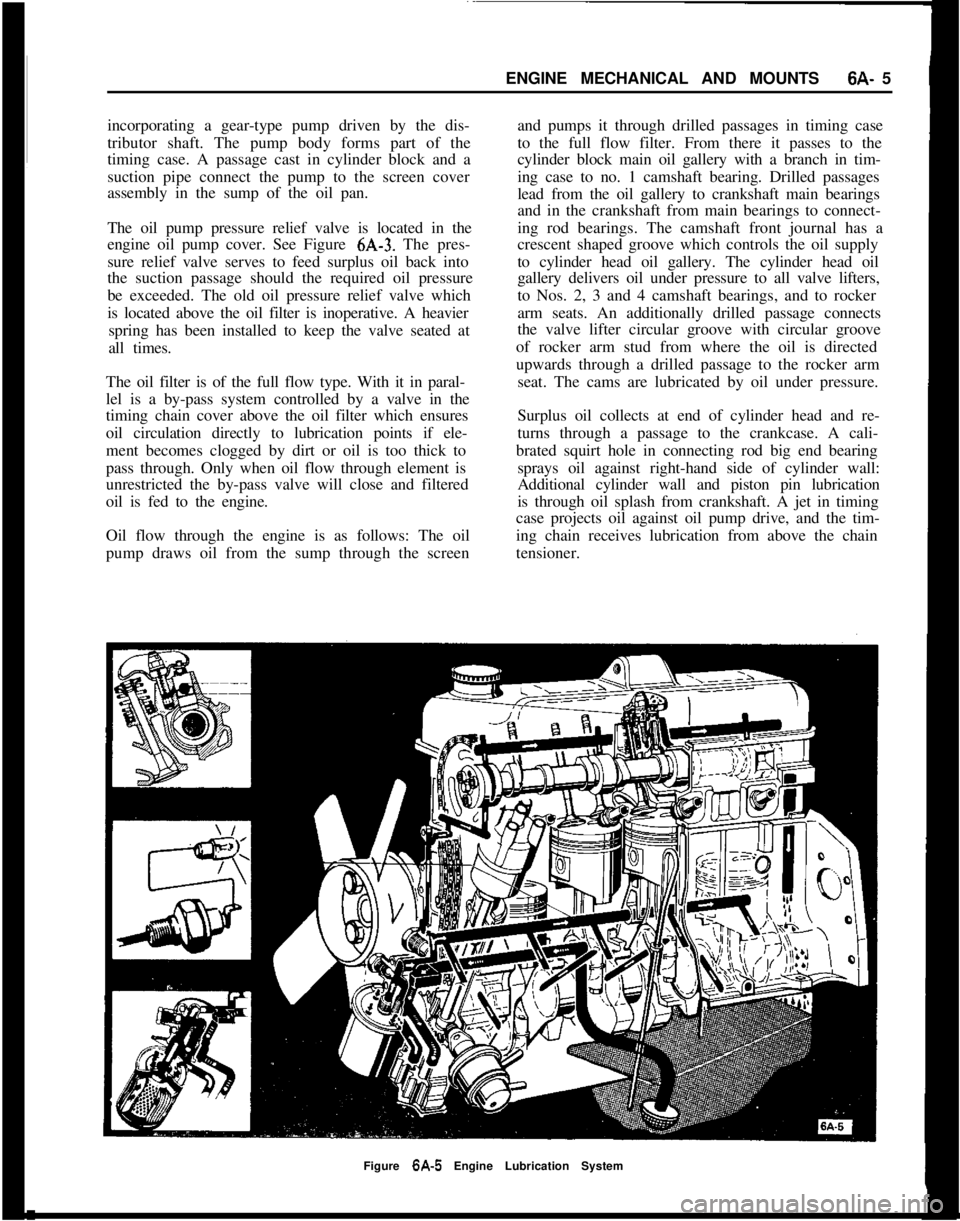
The oil pump pressure relief valve is located in the
engine oil pump cover. See Figure 6A-3. The pres-
sure relief valve serves to feed surplus oil back into
the suction passage should the required oil pressure
be exceeded. The old oil pressure relief valve which
is located above the oil filter is inoperative. A heavier
spring has been installed to keep the valve seated at
all times.
The oil filter is of the full flow type. With it in paral-
lel is a by-pass system controlled by a valve in the
timing chain cover above the oil filter which ensures
oil circulation directly to lubrication points if ele-
ment becomes clogged by dirt or oil is too thick to
pass through. Only when oil flow through element is
unrestricted the by-pass valve will close and filtered
oil is fed to the engine.
Oil flow through the engine is as follows: The oil
pump draws oil from the sump through the screenand pumps it through drilled passages in timing case
to the full flow filter. From there it passes to the
cylinder block main oil gallery with a branch in tim-
ing case to no. 1 camshaft bearing. Drilled passages
lead from the oil gallery to crankshaft main bearings
and in the crankshaft from main bearings to connect-
ing rod bearings. The camshaft front journal has a
crescent shaped groove which controls the oil supply
to cylinder head oil gallery. The cylinder head oil
gallery delivers oil under pressure to all valve lifters,
to Nos. 2, 3 and 4 camshaft bearings, and to rocker
arm seats. An additionally drilled passage connects
the valve lifter circular groove with circular groove
of rocker arm stud from where the oil is directed
upwards through a drilled passage to the rocker arm
seat. The cams are lubricated by oil under pressure.
Surplus oil collects at end of cylinder head and re-
turns through a passage to the crankcase. A cali-
brated squirt hole in connecting rod big end bearing
sprays oil against right-hand side of cylinder wall:
Additional cylinder wall and piston pin lubrication
is through oil splash from crankshaft. A jet in timing
case projects oil against oil pump drive, and the tim-
ing chain receives lubrication from above the chain
tensioner.
Figure 6A-5 Engine Lubrication System
Page 300 of 625
ENGINE MECHANICAL AND MOUNTS6A- 9
The engine does not rest on the front suspension
cross member as in the Opel 1900 and Manta but on
a separate cross member. On removal and installa-
tion of the engine the front suspension cross member
need not be detached.
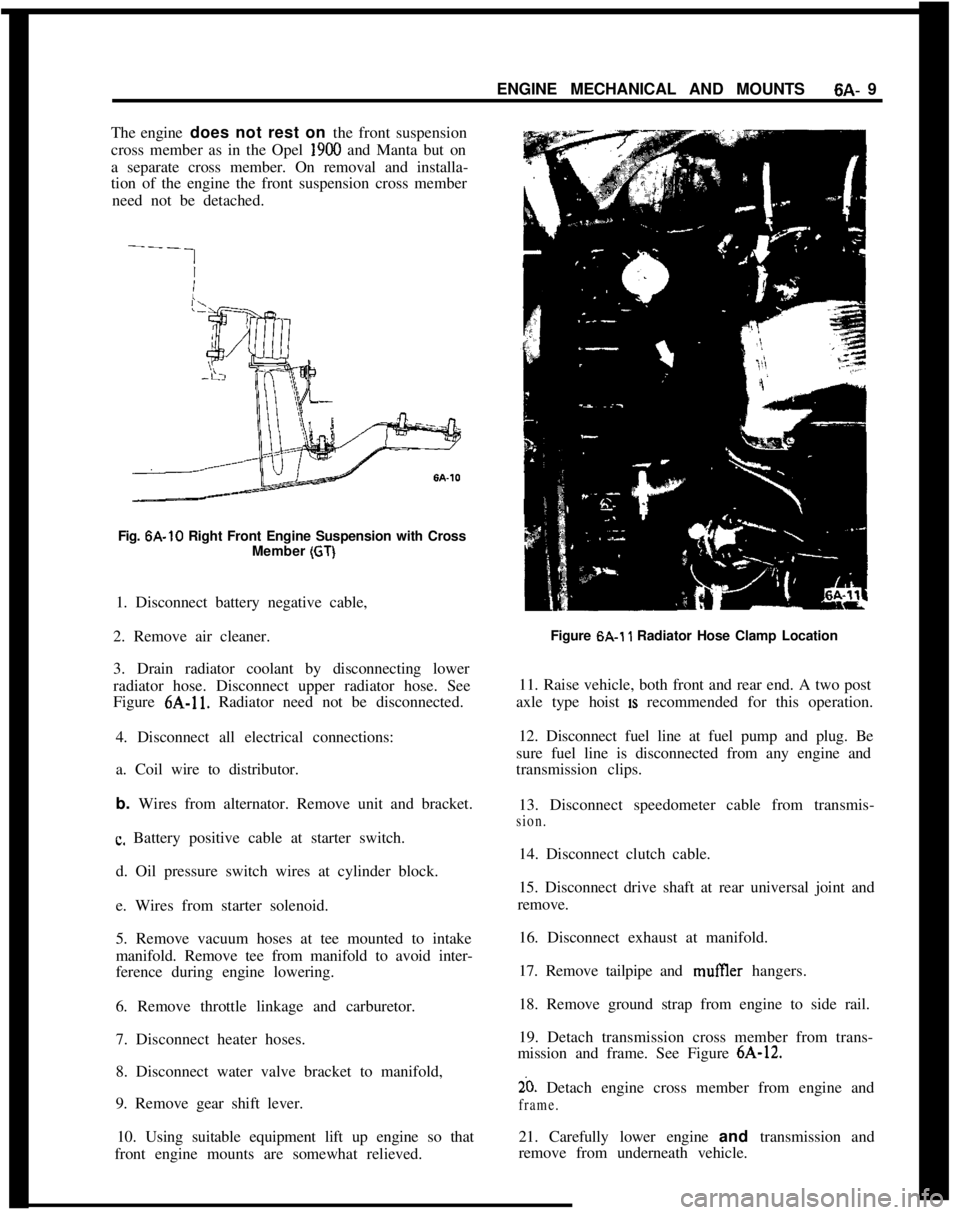
Fig. 6A-10 Right Front Engine Suspension with Cross
Member
(GT)1. Disconnect battery negative cable,
2. Remove air cleaner.
3. Drain radiator coolant by disconnecting lower
radiator hose. Disconnect upper radiator hose. See
Figure 6A-11. Radiator need not be disconnected.
4. Disconnect all electrical connections:
a. Coil wire to distributor.
b. Wires from alternator. Remove unit and bracket.
c. Battery positive cable at starter switch.
d. Oil pressure switch wires at cylinder block.
e. Wires from starter solenoid.
5. Remove vacuum hoses at tee mounted to intake
manifold. Remove tee from manifold to avoid inter-
ference during engine lowering.
6. Remove throttle linkage and carburetor.
7. Disconnect heater hoses.
8. Disconnect water valve bracket to manifold,
9. Remove gear shift lever.
10. Using suitable equipment lift up engine so that
front engine mounts are somewhat relieved.Figure 6A.1
1 Radiator Hose Clamp Location
11. Raise vehicle, both front and rear end. A two post
axle type hoist
IS recommended for this operation.
12. Disconnect fuel line at fuel pump and plug. Be
sure fuel line is disconnected from any engine and
transmission clips.
13. Disconnect speedometer cable from transmis-
sion.14. Disconnect clutch cable.
15. Disconnect drive shaft at rear universal joint and
remove.
16. Disconnect exhaust at manifold.
17. Remove tailpipe and mufIler hangers.
18. Remove ground strap from engine to side rail.
19. Detach transmission cross member from trans-
mission and frame. See Figure 6A-12.
20. Detach engine cross member from engine and
frame.21. Carefully lower engine and transmission and
remove from underneath vehicle.
Page 316 of 625
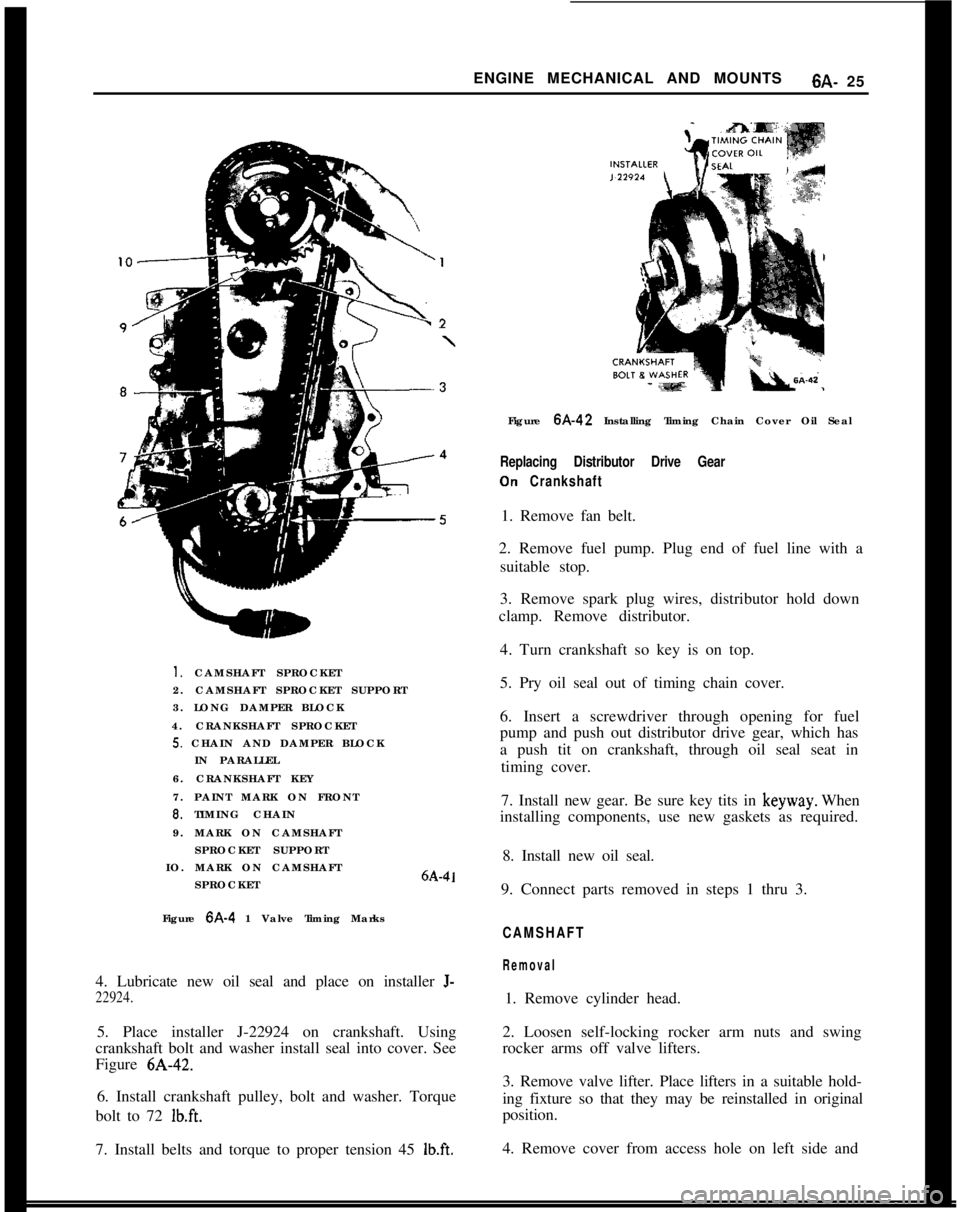
ENGINE MECHANICAL AND MOUNTS6A- 251, CAMSHAFT SPROCKET
2. CAMSHAFT SPROCKET SUPPORT
3. LONG DAMPER BLOCK
4. CRANKSHAFT SPROCKET
5. CHAIN AND DAMPER BLOCK
IN PARALLEL
6. CRANKSHAFT KEY
7. PAINT MARK ON FRONT
8. TIMING CHAIN
9. MARK ON CAMSHAFT
SPROCKET SUPPORT
IO. MARK ON CAMSHAFT
SPROCKET
6A-41Figure 6A-4 1 Valve Timing Marks
Removal4. Lubricate new oil seal and place on installer
J-
22924.1. Remove cylinder head.
5. Place installer J-22924 on crankshaft. Using
crankshaft bolt and washer install seal into cover. See
Figure 6A-42.2. Loosen self-locking rocker arm nuts and swing
rocker arms off valve lifters.
6. Install crankshaft pulley, bolt and washer. Torque
bolt to 72
Ib.ft.3. Remove valve lifter. Place lifters in a suitable hold-
ing fixture so that they may be reinstalled in original
position.
7. Install belts and torque to proper tension 45
lb.ft.4. Remove cover from access hole on left side andFigure 6A-42 Installing Timing Chain Cover Oil Seal
Replacing Distributor Drive Gear
On Crankshaft1. Remove fan belt.
2. Remove fuel pump. Plug end of fuel line with a
suitable stop.
3. Remove spark plug wires, distributor hold down
clamp. Remove distributor.
4. Turn crankshaft so key is on top.
5. Pry oil seal out of timing chain cover.
6. Insert a screwdriver through opening for fuel
pump and push out distributor drive gear, which has
a push tit on crankshaft, through oil seal seat in
timing cover.
7. Install new gear. Be sure key tits in
keyway. When
installing components, use new gaskets as required.
8. Install new oil seal.
9. Connect parts removed in steps 1 thru 3.
CAMSHAFT