tow OPEL MERIVA 2009 Owner's Manual
[x] Cancel search | Manufacturer: OPEL, Model Year: 2009, Model line: MERIVA, Model: OPEL MERIVA 2009Pages: 248, PDF Size: 4.46 MB
Page 127 of 248
121
Climate control
Picture no: 14162s.tif
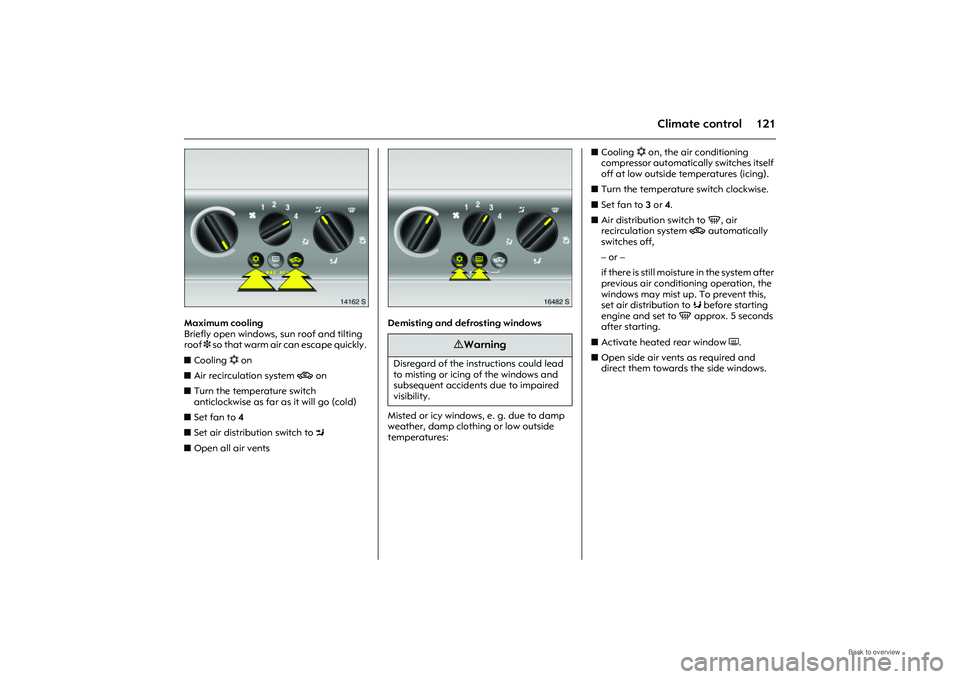
Maximum cooling
Briefly open windows, sun roof and tilting
roof 3 so that warm air can escape quickly.
z Cooling n on
z Air recirculation system 4 on
z Turn the temperature switch
anticlockwise as far as it will go (cold)
z Set fan to 4
z Set air distribution switch to M
z Open all air vents
Picture no: 16482s.tif
Demisting and defrosting windows
Misted or icy windows, e. g. due to damp
weather, damp clothing or low outside
temperatures: z
Cooling n on, the air conditioning
compressor automatically switches itself
off at low outside temperatures (icing).
z Turn the temperature switch clockwise.
z Set fan to 3 or 4 .
z Air distribution switch to V, air
recirculation system 4 automatically
switches off,
– or –
if there is still moisture in the system after
previous air conditioning operation, the
windows may mist up. To prevent this,
set air distribution to K before starting
engine and set to V approx. 5 seconds
after starting.
z Activate heated rear window Ü.
z Open side air vents as required and
direct them towards the side windows.
9 Warning
Disregard of the instructions could lead
to misting or icing of the windows and
subsequent accidents due to impaired
visibility.
Page 131 of 248
125
Climate control
Picture no: 16503s.tif
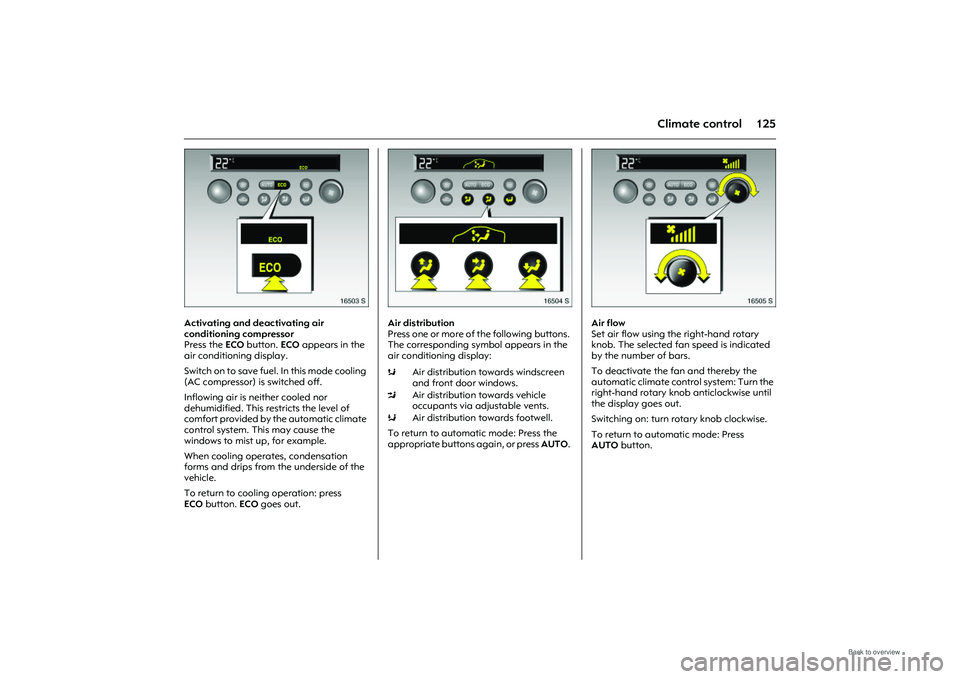
Activating and deactivating air
conditioning compressor
Press the ECO button. ECO appears in the
air conditioning display.
Switch on to sa ve fuel. In this m ode cooling
(AC compressor) is switched off.
Inflowing air is neither cooled nor
dehumidified. This restricts the level of
comfort provided by the automatic climate
control system. This may cause the
windows to mist up, for example.
When cooling operates, condensation
forms and drips from the underside of the
vehicle.
To return to cooling operation: press
ECO button. ECO goes out.
Picture no: 16504s.tif
Air distribution
Press one or more of the following buttons.
The corresponding symbol appears in the
air conditioning display:
To return to automatic mode: Press the
appropriate buttons again, or press AUTO.
Picture no: 16505s.tif
Air flow
Set air flow using the right-hand rotary
knob. The selected fan speed is indicated
by the number of bars.
To deactivate the fan and thereby the
automatic climate control system: Turn the
right-hand rotary knob anticlockwise until
the display goes out.
Switching on: turn rota ry knob clockwise.
To return to automatic mode: Press
AUTO button.
sAir distribution towards windscreen
and front door windows.
M Air distribution towards vehicle
occupants via adjustable vents.
K Air distribution towards footwell.
Page 135 of 248
129
Driving and operation
Driving and operation
Manual transmission
automated
3
The manual transmission automated
transmission 3 permits manual ( manual
mode ) or automatic gear shifting
(automatic mode ), both with automatic
clutch control.
Picture no: 17878s.tif
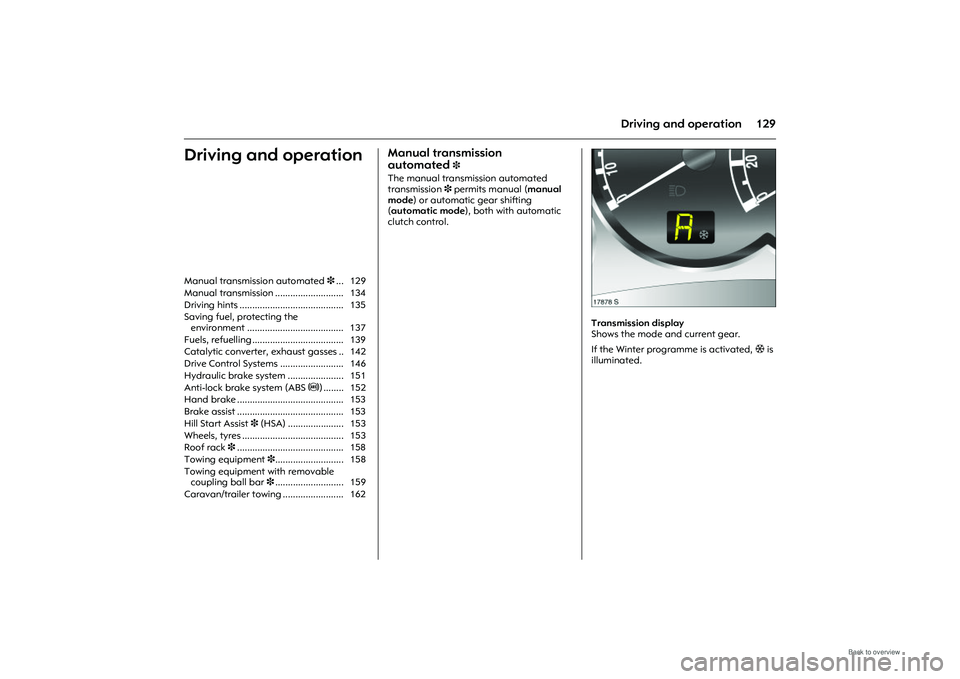
Transmission display
Shows the mode and current gear.
If the Winter programme is activated, T is
illuminated.
Manual transmission automated
3... 129
Manual transmission ........................... 134
Driving hints ......................................... 135
Saving fuel, protecting the environment ...................................... 137
Fuels, refuelling .................................... 139
Catalytic converter, exhaust gasses .. 142
Drive Control Systems ......................... 146
Hydraulic brake system ...................... 151
Anti-lock brake system (ABS u ) ........ 152
Hand brake .......................................... 153
Brake assist .......................................... 153
Hill Start Assist 3 (HSA) ...................... 153
Wheels, tyres ........................................ 153
Roof rack 3.......................................... 158
Towing equipment 3........................... 158
Towing equipment with removable coupling ball bar 3........................... 159
Caravan/trailer towing ........................ 162
Page 136 of 248
130 Driving and operation
Picture no: 18386s.tif
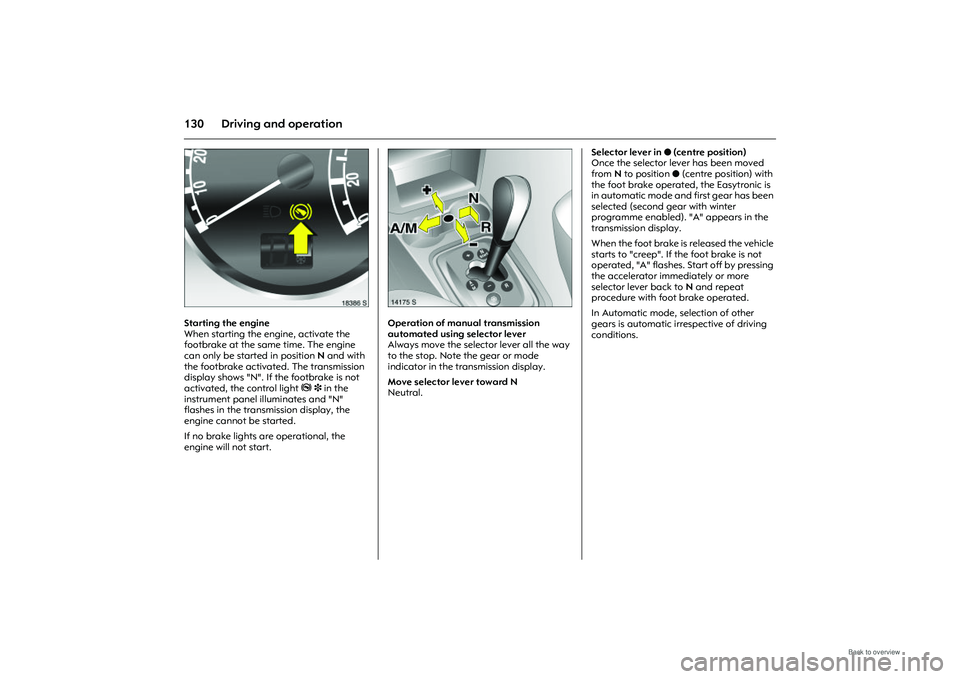
Starting the engine
When starting the engine, activate the
footbrake at the same time. The engine
can only be started in position N and with
the footbrake activated. The transmission
display shows "N". If the footbrake is not
activated, the control light j 3 in the
instrument panel illuminates and "N"
flashes in the transmission display, the
engine cannot be started.
If no brake lights are operational, the
engine will not start.
Picture no: 14175s.tif
Operation of manual transmission
automated using selector lever
Always move the selector lever all the way
to the stop. Note the gear or mode
indicator in the transmission display.
Move selector lever toward N
Neutral. Selector lever in
o (centre position)
Once the selector lever has been moved
from N to position o (centre position) with
the foot brake operated, the Easytronic is
in automatic mode and first gear has been
selected (second gear with winter
programme enabled). "A" appears in the
transmission display.
When the foot brake is released the vehicle
starts to "creep". If the foot brake is not
operated, "A" flashes. Start off by pressing
the accelerator immediately or more
selector lever back to N and repeat
procedure with foot brake operated.
In Automatic mode, selection of other
gears is automatic irrespective of driving
conditions.
Page 140 of 248
134 Driving and operation
Picture no: 14721s.tif
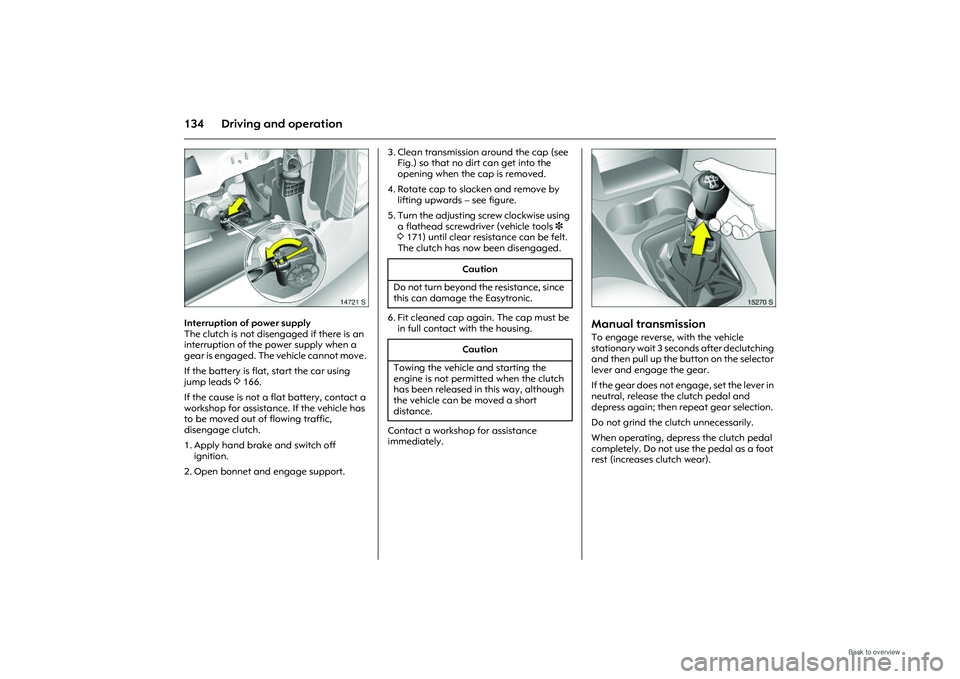
Interruption of power supply
The clutch is not disengaged if there is an
interruption of the power supply when a
gear is engaged. The vehicle cannot move.
If the battery is flat, start the car using
jump leads 3166.
If the cause is not a flat battery, contact a
workshop for assistance. If the vehicle has
to be moved out of flowing traffic,
disengage clutch.
1. Apply hand brake and switch off ignition.
2. Open bonnet and engage support. 3. Clean transmission around the cap (see
Fig.) so that no dirt can get into the
opening when the cap is removed.
4. Rotate cap to slacken and remove by lifting upwards – see figure.
5. Turn the adjusting screw clockwise using a flathead screwdriver (vehicle tools 3
3 171) until clear resistance can be felt.
The clutch has now been disengaged.
6. Fit cleaned cap again. The cap must be in full contact with the housing.
Contact a workshop for assistance
immediately.
Picture no: 15270s.tif
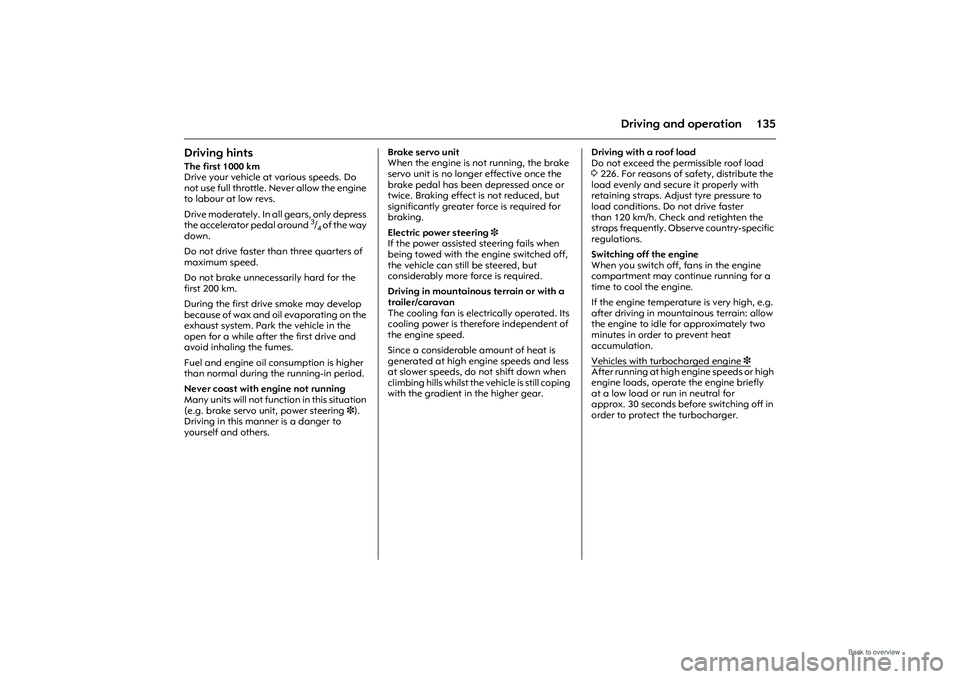
Manual transmissionTo engage reverse, with the vehicle
stationary wait 3 seconds after declutching
and then pull up the bu tton on the selector
lever and engage the gear.
If the gear does not engage, set the lever in
neutral, release the clutch pedal and
depress again; then re peat gear selection.
Do not grind the clutch unnecessarily.
When operating, depress the clutch pedal
completely. Do not use the pedal as a foot
rest (increases clutch wear).
Caution
Do not turn beyond the resistance, since
this can damage the Easytronic.
Caution
Towing the vehicle and starting the
engine is not permitted when the clutch
has been released in this way, although
the vehicle can be moved a short
distance.
Page 141 of 248
135
Driving and operation
Driving hintsThe first 1000 km
Drive your vehicle at various speeds. Do
not use full throttle. Never allow the engine
to labour at low revs.
Drive moderately. In all gears, only depress
the accelerator pedal around
3/4 of the way
down.
Do not drive faster than three quarters of
maximum speed.
Do not brake unnecessarily hard for the
first 200 km.
During the first drive smoke may develop
because of wax and oil evaporating on the
exhaust system. Park the vehicle in the
open for a while after the first drive and
avoid inhaling the fumes.
Fuel and engine oil consumption is higher
than normal during the running-in period.
Never coast with engine not running
Many units will not function in this situation
(e.g. brake servo unit, power steering 3).
Driving in this manner is a danger to
yourself and others. Brake servo unit
When the engine is not running, the brake
servo unit is no longer effective once the
brake pedal has been depressed once or
twice. Braking effect is not reduced, but
significantly greater force is required for
braking.
Electric power steering
3
If the power assisted steering fails when
being towed with the engine switched off,
the vehicle can still be steered, but
considerably more force is required.
Driving in mountainous terrain or with a
trailer/caravan
The cooling fan is elec trically operated. Its
cooling power is therefore independent of
the engine speed.
Since a considerable amount of heat is
generated at high engine speeds and less
at slower speeds, do not shift down when
climbing hills whilst the vehicle is still coping
with the gradient in the higher gear. Driving with a roof load
Do not exceed the permissible roof load
3
226. For reasons of safety, distribute the
load evenly and secure it properly with
retaining straps. Adjust tyre pressure to
load conditions. Do not drive faster
than 120 km/h. Check and retighten the
straps frequently. Observe country-specific
regulations.
Switching off the engine
When you switch off, fans in the engine
compartment may continue running for a
time to cool the engine.
If the engine temperature is very high, e.g.
after driving in mountainous terrain: allow
the engine to idle for approximately two
minutes in order to prevent heat
accumulation.
Vehicles with turbocharged engine
3
After running at high engine speeds or high
engine loads, operate the engine briefly
at a low load or run in neutral for
approx. 30 seconds before switching off in
order to protect the turbocharger.
Page 148 of 248
142 Driving and operation
Picture no: 6448u.tif
Catalytic converter, exhaust
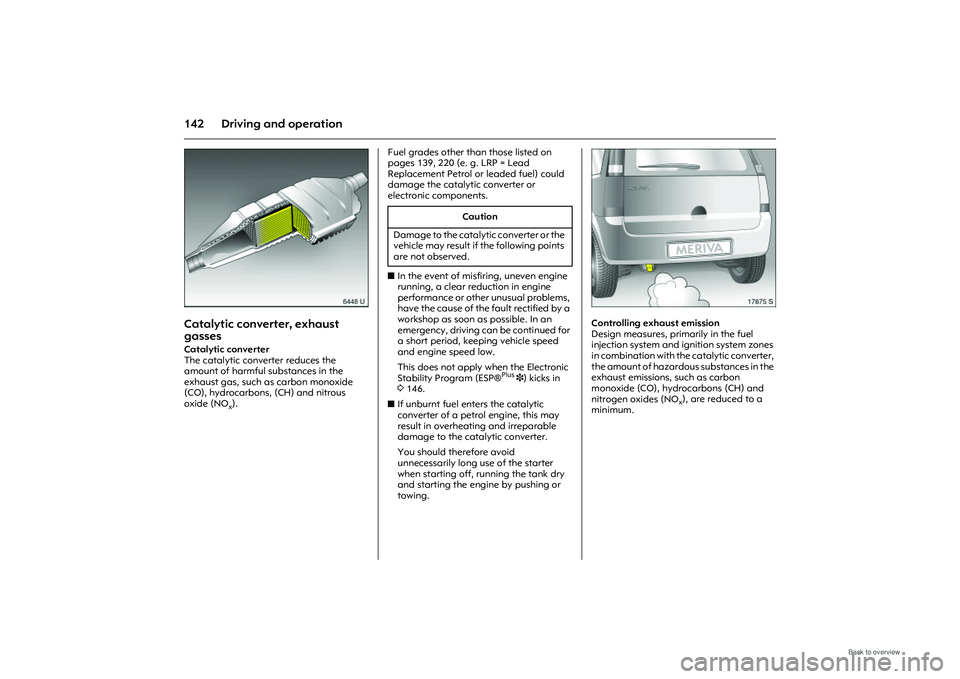
gassesCatalytic converter
The catalytic converter reduces the
amount of harmful substances in the
exhaust gas, such as carbon monoxide
(CO), hydrocarbons, (CH) and nitrous
oxide (NO
x). Fuel grades other than those listed on
pages 139, 220 (e. g. LRP = Lead
Replacement Petrol or leaded fuel) could
damage the catalytic converter or
electronic components.
z
In the event of misfiring, uneven engine
running, a clear reduction in engine
performance or other unusual problems,
have the cause of the fault rectified by a
workshop as soon as possible. In an
emergency, driving can be continued for
a short period, keeping vehicle speed
and engine speed low.
This does not apply when the Electronic
Stability Program (ESP®
Plus
3) kicks in
3 146.
z If unburnt fuel enters the catalytic
converter of a petrol engine, this may
result in overheating and irreparable
damage to the catalytic converter.
You should therefore avoid
unnecessarily long use of the starter
when starting off, running the tank dry
and starting the engine by pushing or
towing.
Picture no: 17875s.tif
Controlling exhaust emission
Design measures, primarily in the fuel
injection system and ignition system zones
in combination with the catalytic converter,
the amount of hazardous substances in the
exhaust emissions, such as carbon
monoxide (CO), hydrocarbons (CH) and
nitrogen oxides (NO
x), are reduced to a
minimum.
Caution
Damage to the catalytic converter or the
vehicle may result if the following points
are not observed.
Page 151 of 248
145
Driving and operation
Picture no: 18535s.tif
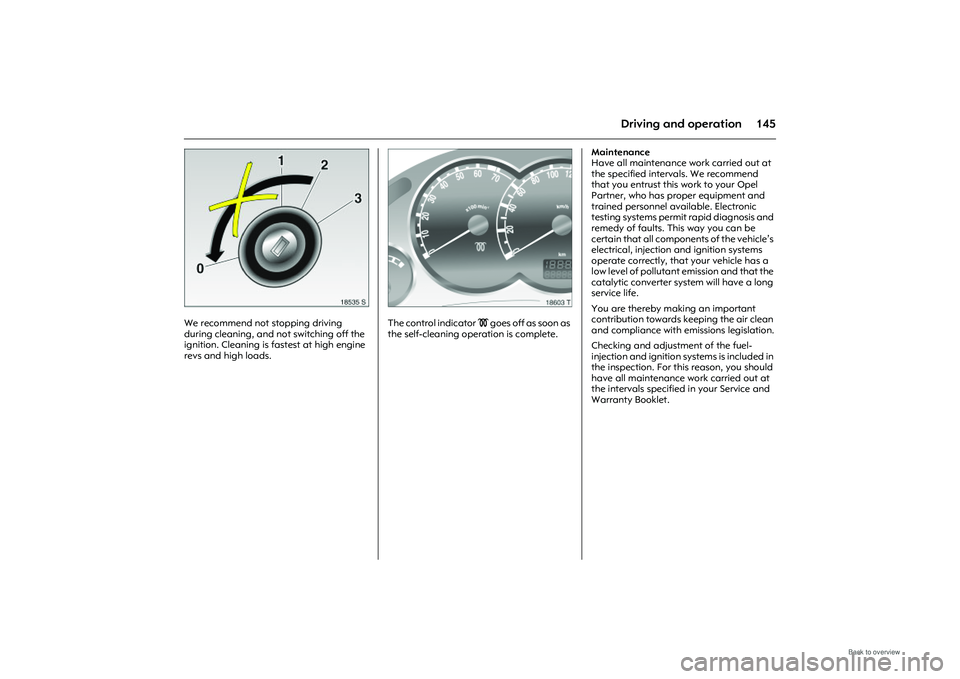
We recommend not stopping driving
during cleaning, and not switching off the
ignition. Cleaning is fa stest at high engine
revs and high loads.
Picture no: 18603s.tif
The control indicator
! goes off as soon as
the self-cleaning operation is complete. Maintenance
Have all maintenance work carried out at
the specified intervals. We recommend
that you entrust this work to your Opel
Partner, who has proper equipment and
trained personnel available. Electronic
testing systems permit rapid diagnosis and
remedy of faults. This way you can be
certain that all components of the vehicle’s
electrical, injection and ignition systems
operate correctly, that your vehicle has a
low level of pollutant emission and that the
catalytic converter system will have a long
service life.
You are thereby making an important
contribution towards keeping the air clean
and compliance with emissions legislation.
Checking and adjustment of the fuel-
injection and ignition systems is included in
the inspection. For this reason, you should
have all maintenance work carried out at
the intervals specified in your Service and
Warranty Booklet.
Page 156 of 248
150 Driving and operationUltrasonic parking sensors 3
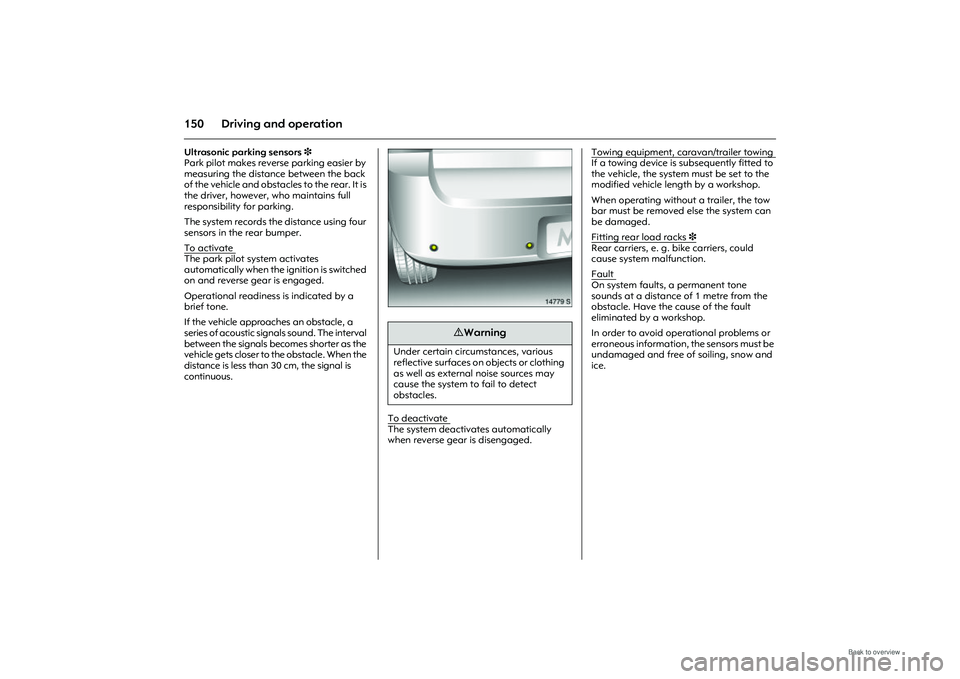
Park pilot makes reverse parking easier by
measuring the distance between the back
of the vehicle and obstacles to the rear. It is
the driver, however, who maintains full
responsibility for parking.
The system records the distance using four
sensors in the rear bumper.
To activate The park pilot system activates
automatically when the ignition is switched
on and reverse gear is engaged.
Operational readiness is indicated by a
brief tone.
If the vehicle approaches an obstacle, a
series of acoustic signals sound. The interval
between the signals be comes shorter as the
vehicle gets closer to the obstacle. When the
distance is less than 30 cm, the signal is
continuous.
Picture no: 14779s.tif
To deactivate The system deactivates automatically
when reverse gear is disengaged. Towing equipment, caravan/trailer towing
If a towing device is subsequently fitted to
the vehicle, the system must be set to the
modified vehicle length by a workshop.
When operating without a trailer, the tow
bar must be removed else the system can
be damaged.
Fitting rear load racks
3
Rear carriers, e. g. bike carriers, could
cause system malfunction.
Fault
On system faults, a permanent tone
sounds at a distance of 1 metre from the
obstacle. Have the cause of the fault
eliminated by a workshop.
In order to avoid operational problems or
erroneous information, the sensors must be
undamaged and free of soiling, snow and
ice.
9 Warning
Under certain circumstances, various
reflective surfaces on objects or clothing
as well as external noise sources may
cause the system to fail to detect
obstacles.
Page 157 of 248
151
Driving and operation
Picture no: 14722s.tif
Hydraulic brake system The brake system comprises two
independent brake circuits.
If a brake circuit fails, the vehicle can still be
braked using the other brake circuit.
However, the brake pedal must be
depressed a considerable way before any
braking effect occurs, and much more
force is required. The braking distance is
longer. Contact a workshop for assistance
before continuing to drive. To ensure that full
pedal travel can be
utilised, especially in case of a fault in one
of the brake circuits, there must be no mats
in the vicinity of the pedals 3136.
When the engine is not running, the
support of the brake servo unit disappears
once the brake pedal has been depressed
once or twice. Braking effect is not
reduced, but braking requires significantly
greater force. This is especially important
to bear in mind when towing.
The brake fluid level should be checked
regularly. If the brake fluid level is too low
and the hand brake is not applied, control
indicator R on the instrument panel
illuminates 385.
Picture no: 17894s.tif
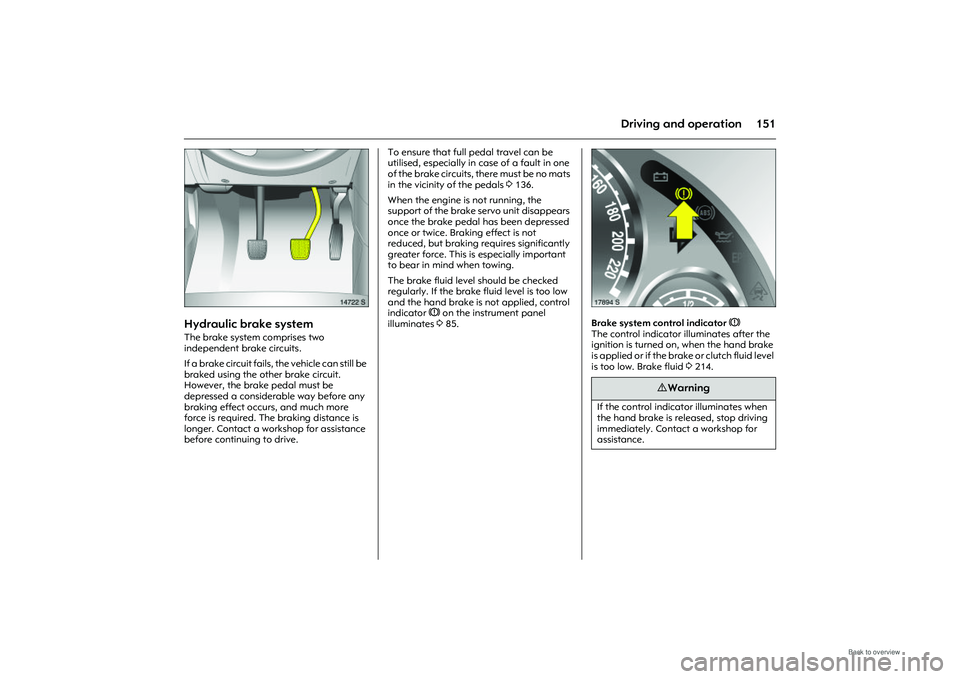
Brake system control indicator R
The control indicator illuminates after the
ignition is turned on, when the hand brake
is applied or if the brake or clutch fluid level
is too low. Brake fluid 3214.
9 Warning
If the control indicator illuminates when
the hand brake is released, stop driving
immediately. Contact a workshop for
assistance.