tow OPEL MERIVA 2009 Service Manual
[x] Cancel search | Manufacturer: OPEL, Model Year: 2009, Model line: MERIVA, Model: OPEL MERIVA 2009Pages: 248, PDF Size: 4.46 MB
Page 176 of 248
170 Self-help, vehicle careIf the automatic clutch has been manually
disengaged in vehicles with manual
automated transmission 3 towing is not
permitted 3134. In this case, contact a
workshop for assistance immediately.
After towing, unscrew towing eye by
rotating clockwise and insert and close the
cap.
Picture no: 14199s.tif
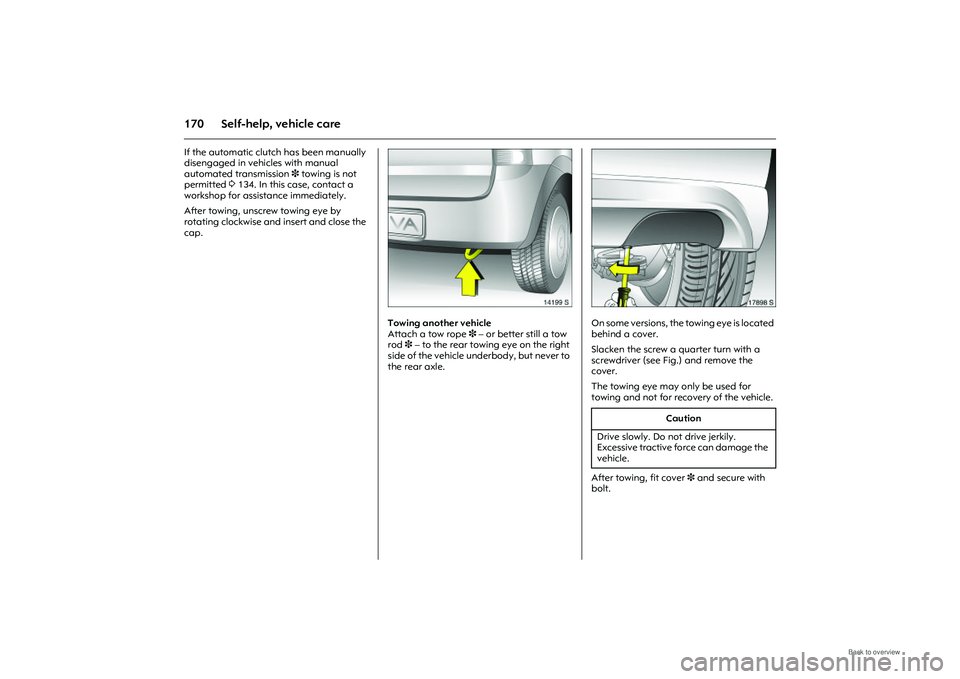
Towing another vehicle
Attach a tow rope 3 – or better still a tow
rod 3 – to the rear towing eye on the right
side of the vehicle underbody, but never to
the rear axle.
Picture no: 17898s.tif
On some versions, the towing eye is located
behind a cover.
Slacken the screw a quarter turn with a
screwdriver (see Fig.) and remove the
cover.
The towing eye may only be used for
towing and not for recovery of the vehicle.
After towing, fit cover 3 and secure with
bolt.
Caution
Drive slowly. Do not drive jerkily.
Excessive tractive force can damage the
vehicle.
Page 177 of 248
171
Self-help, vehicle care
Picture no: 16140s.tif
Warning triangle
¨ 3
,
First-aid kit
+3
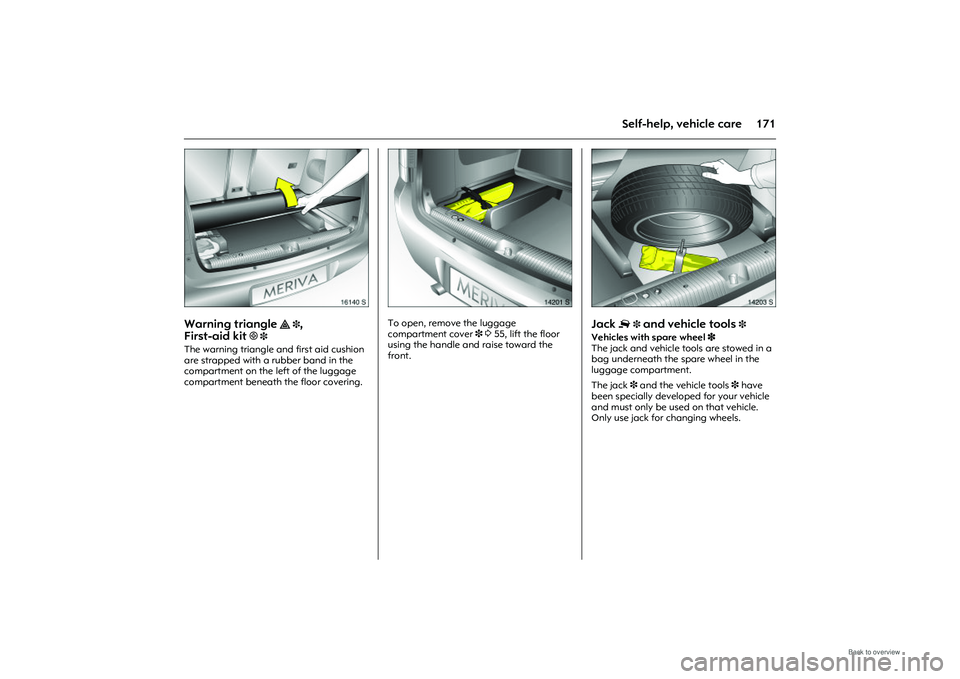
The warning triangle and first aid cushion
are strapped with a rubber band in the
compartment on the le ft of the luggage
compartment beneath the floor covering.
Picture no: 14201s.tif
To open, remove the luggage
compartment cover 3 3 55, lift the floor
using the handle and raise toward the
front.
Picture no: 14203s.tif
Jack
£
3 and vehicle tools
3
Vehicles with spare wheel 3
The jack and vehicle tools are stowed in a
bag underneath the spare wheel in the
luggage compartment.
The jack 3 and the vehicle tools 3 have
been specially developed for your vehicle
and must only be used on that vehicle.
Only use jack for changing wheels.
Page 178 of 248
172 Self-help, vehicle care
Picture no: 17918s.tif
Vehicles with tyre repair kit 3
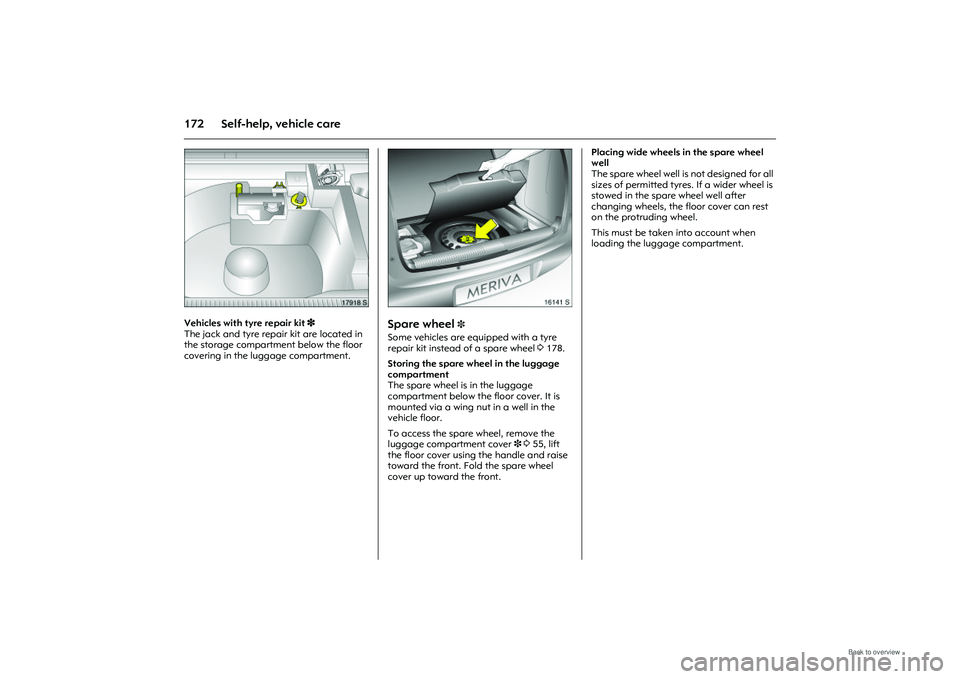
The jack and tyre repair kit are located in
the storage compartment below the floor
covering in the luggage compartment.
Picture no: 16141s.tif
Spare wheel
3
Some vehicles are equipped with a tyre
repair kit instead of a spare wheel 3178.
Storing the spare wheel in the luggage
compartment
The spare wheel is in the luggage
compartment below the floor cover. It is
mounted via a wing nut in a well in the
vehicle floor.
To access the spare wheel, remove the
luggage compartment cover 3 3 55, lift
the floor cover using the handle and raise
toward the front. Fold the spare wheel
cover up toward the front. Placing wide wheels in the spare wheel
well
The spare wheel well is not designed for all
sizes of permitted tyres. If a wider wheel is
stowed in the spare wheel well after
changing wheels, the floor cover can rest
on the protruding wheel.
This must be taken into account when
loading the luggage compartment.
Page 183 of 248
177
Self-help, vehicle care
Picture no: 14763s.tif
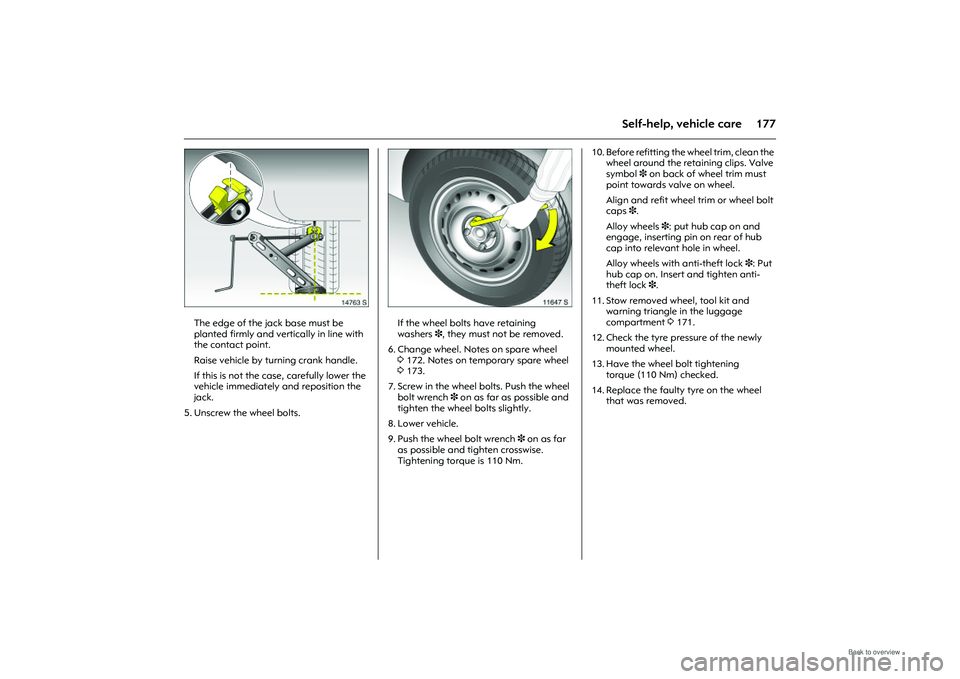
The edge of the jack base must be
planted firmly and vertically in line with
the contact point.
Raise vehicle by turning crank handle.
If this is not the case, carefully lower the
vehicle immediately and reposition the
jack.
5. Unscrew the wheel bolts.
Picture no: 11647s.tif
If the wheel bolt s have retaining
washers 3, they must not be removed.
6. Change wheel. Notes on spare wheel 3172. Notes on temporary spare wheel
3 173.
7. Screw in the wheel bolts. Push the wheel bolt wrench 3 on as far as possible and
tighten the wheel bolts slightly.
8. Lower vehicle.
9. Push the wheel bolt wrench 3 on as far
as possible and tighten crosswise.
Tightening torque is 110 Nm. 10. Before refitting the wheel trim, clean the
wheel around the retaining clips. Valve
symbol 3 on back of wheel trim must
point towards valve on wheel.
Align and refit wheel trim or wheel bolt
caps 3.
Alloy wheels 3: put hub cap on and
engage, inserting pin on rear of hub
cap into relevant hole in wheel.
Alloy wheels with anti-theft lock 3: Put
hub cap on. Insert and tighten anti-
theft lock 3.
11. Stow removed wheel, tool kit and warning triangle in the luggage
compartment 3171.
12. Check the tyre pressure of the newly mounted wheel.
13. Have the wheel bolt tightening torque (110 Nm) checked.
14. Replace the faulty tyre on the wheel that was removed.
Page 184 of 248
178 Self-help, vehicle careTyre repair kit
3
Minor damage to the tyre tread or sidewall
can be repaired with the tyre repair kit.
Do not remove the foreign body from the
tyre.
T y r e d a m a g e e x c e e d i n g 4 m m o r t ha t i s o n
the rim cannot be repaired with the tyre
repair kit.
Important 3181.
In the event of a flat tyre:
z Switch on the hazard warning flashers,
apply the hand brake, engage first gear
or reverse.
z Erect warning triangle as specified.
Warning triangle 3171.
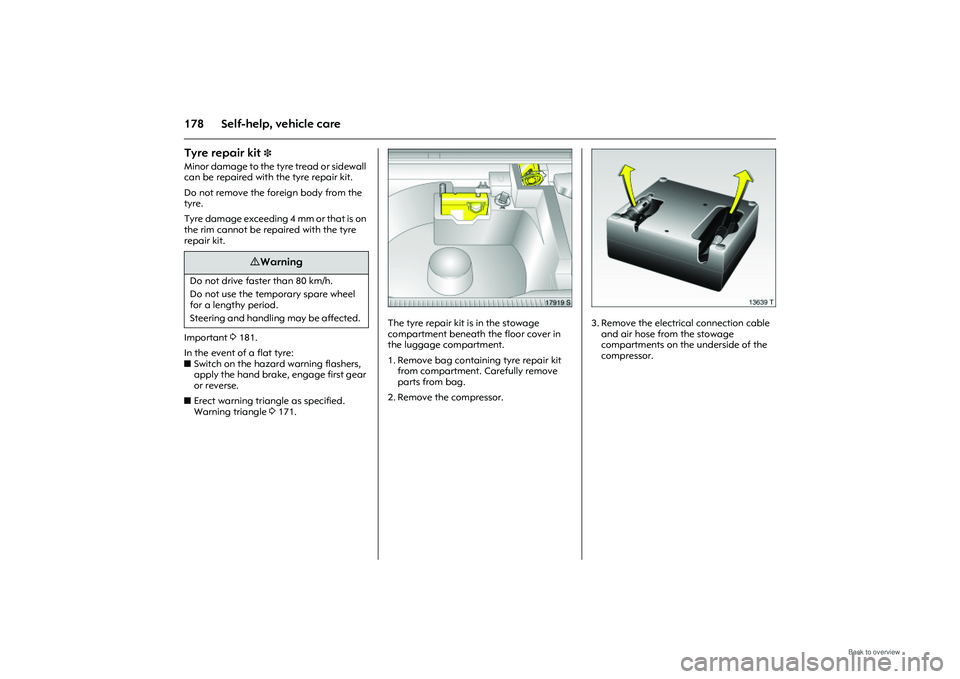
Picture no: 17919S.tif
The tyre repair kit is in the stowage
compartment beneath the floor cover in
the luggage compartment.
1. Remove bag containing tyre repair kit
from compartment. Carefully remove
parts from bag.
2. Remove the compressor.
Picture no: 13639T.tif
3. Remove the electrical connection cable and air hose from the stowage
compartments on the underside of the
compressor.
9 Warning
Do not drive faster than 80 km/h.
Do not use the temporary spare wheel
for a lengthy period.
Steering and handling may be affected.
Page 186 of 248
180 Self-help, vehicle care
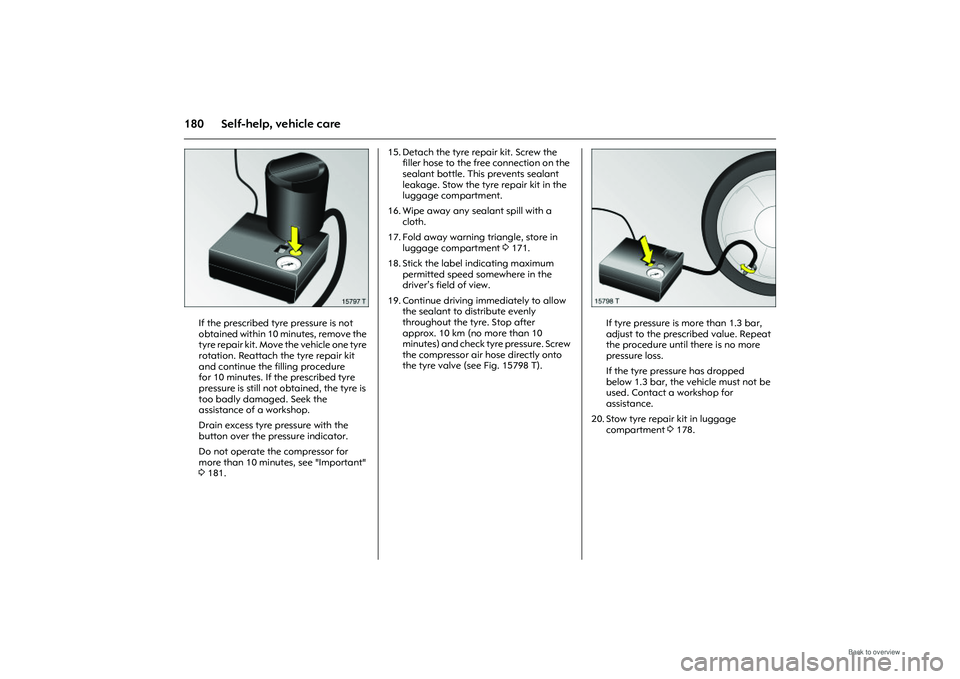
Picture no: 15797t.tif
If the prescribed tyre pressure is not
obtained within 10 minutes, remove the
tyre repair kit. Move the vehicle one tyre
rotation. Reattach the tyre repair kit
and continue the filling procedure
for 10 minutes. If the prescribed tyre
pressure is still not obtained, the tyre is
too badly damaged. Seek the
assistance of a workshop.
Drain excess tyre pressure with the
button over the pressure indicator.
Do not operate the compressor for
more than 10 minutes, see "Important"
3181. 15. Detach the tyre repair kit. Screw the
filler hose to the free connection on the
sealant bottle. This prevents sealant
leakage. Stow the tyre repair kit in the
luggage compartment.
16. Wipe away any sealant spill with a cloth.
17. Fold away warning triangle, store in luggage compartment 3171.
18. Stick the label indicating maximum permitted speed somewhere in the
driver’s field of view.
19. Continue driving immediately to allow the sealant to distribute evenly
throughout the tyre. Stop after
approx. 10 km (no more than 10
minutes) and check tyre pressure. Screw
the compressor air hose directly onto
the tyre valve (see Fig. 15798 T).
Picture no: 15798t.tif
If tyre pressure is more than 1.3 bar,
adjust to the prescribed value. Repeat
the procedure until there is no more
pressure loss.
If the tyre pressure has dropped
below 1.3 bar, the vehicle must not be
used. Contact a workshop for
assistance.
20. Stow tyre repair kit in luggage compartment 3178.
Page 190 of 248
184 Self-help, vehicle care
Picture no: 14436s.tif Picture no:
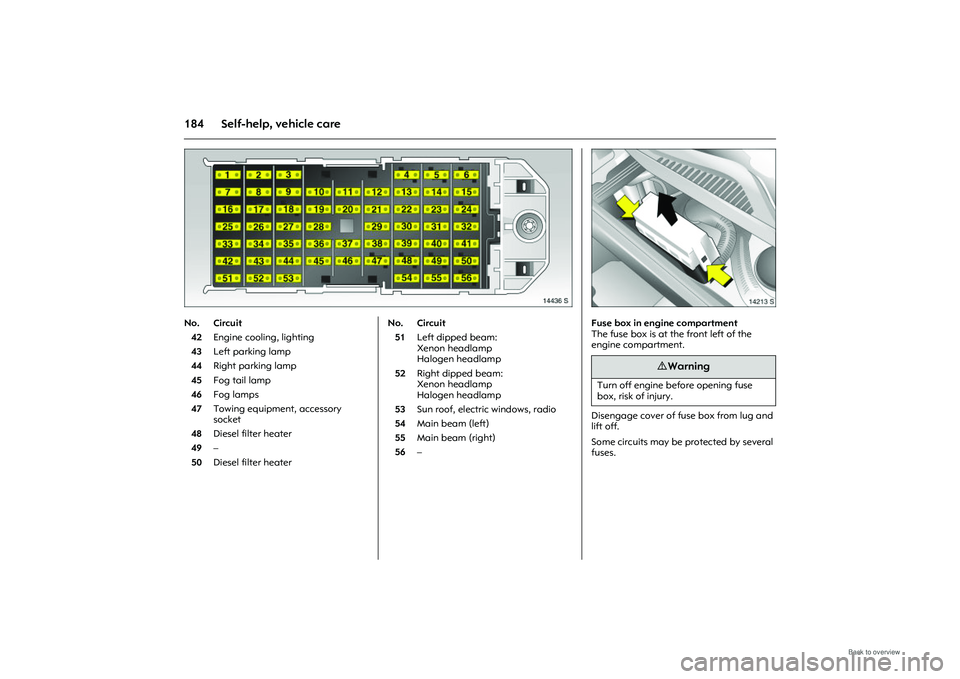
No. Circuit
42 Engine cooling, lighting
43 Left parking lamp
44 Right parking lamp
45 Fog tail lamp
46 Fog lamps
47 Towing equipment, accessory
socket
48 Diesel filter heater
49 –
50 Diesel filter heater
No. Circuit
51 Left dipped beam:
Xenon headlamp
Halogen headlamp
52 Right dipped beam:
Xenon headlamp
Halogen headlamp
53 Sun roof, electric windows, radio
54 Main beam (left)
55 Main beam (right)
56 –
Picture no: 14213s.tif
Fuse box in engine compartment
The fuse box is at the front left of the
engine compartment.
Disengage cover of fuse box from lug and
lift off.
Some circuits may be protected by several
fuses.
9 Warning
Turn off engine before opening fuse
box, risk of injury.
Page 199 of 248
193
Self-help, vehicle care
Picture no: 17957s.tif
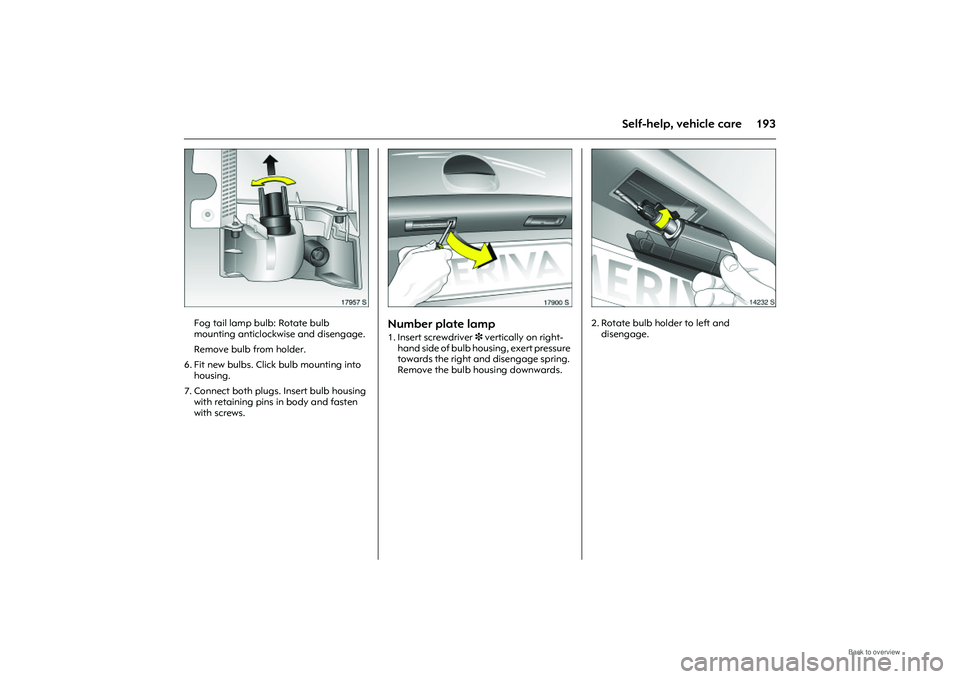
Fog tail lamp bulb: Rotate bulb
mounting anticlockwise and disengage.
Remove bulb from holder.
6. Fit new bulbs. Click bulb mounting into housing.
7. Connect both plugs. Insert bulb housing with retaining pins in body and fasten
with screws.
Picture no: 17900s.tif
Number plate lamp 1. Insert screwdriver 3 vertically on right-
hand side of bulb housing, exert pressure
towards the right and disengage spring.
Remove the bulb housing downwards.
Picture no: 14232s.tif
2. Rotate bulb holder to left and
disengage.
Page 202 of 248
196 Self-help, vehicle care
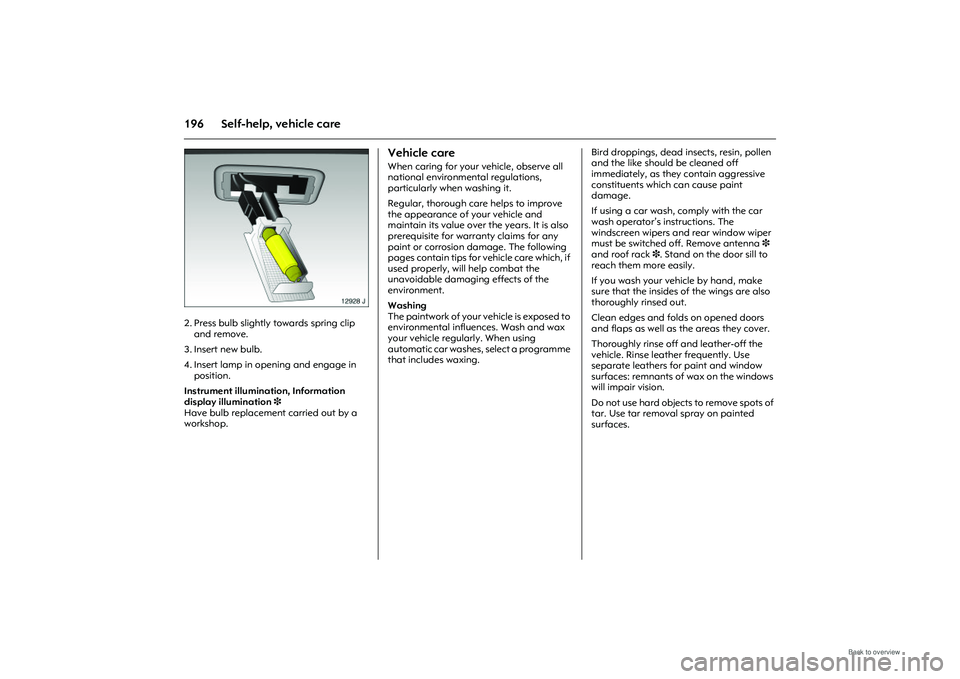
Picture no: 12928j.tif
2. Press bulb slightly towards spring clip and remove.
3. Insert new bulb.
4. Insert lamp in op ening and engage in
position.
Instrument illumination, Information
display illumination 3
Have bulb replacement carried out by a
workshop.
Vehicle careWhen caring for your vehicle, observe all
national environmental regulations,
particularly when washing it.
Regular, thorough care helps to improve
the appearance of your vehicle and
maintain its value over the years. It is also
prerequisite for warranty claims for any
paint or corrosion damage. The following
pages contain tips for vehicle care which, if
used properly, will help combat the
unavoidable damaging effects of the
environment.
Washing
The paintwork of your vehicle is exposed to
environmental influences. Wash and wax
your vehicle regularly. When using
automatic car washes, select a programme
that includes waxing. Bird droppings, dead insects, resin, pollen
and the like should be cleaned off
immediately, as they contain aggressive
constituents which can cause paint
damage.
If using a car wash, comply with the car
wash operator’s instructions. The
windscreen wipers and rear window wiper
must be switched off. Remove antenna
3
and roof rack 3 . Stand on the door sill to
reach them more easily.
If you wash your vehicle by hand, make
sure that the insides of the wings are also
thoroughly rinsed out.
Clean edges and folds on opened doors
and flaps as well as the areas they cover.
Thoroughly rinse off and leather-off the
vehicle. Rinse leather frequently. Use
separate leathers for paint and window
surfaces: remnants of wax on the windows
will impair vision.
Do not use hard objects to remove spots of
tar. Use tar removal spray on painted
surfaces.
Page 204 of 248
198 Self-help, vehicle careWindows and windscreen wiper blades
Use a soft lint-free cloth or chamois leather
together with window cleaner and insect
remover.
When cleaning the rear window, make sure
the heating element inside the window is
not damaged.
For mechanical removal of ice, use a sharp-
edged ice scraper. Pre ss the scraper firmly
against the glass so that no dirt can get
under it and scratch the glass.
Clean smearing wiper blades with a soft
cloth and window cleaner. Locks
The locks are lubricated with a high-quality
locking cylinder grease
in the factory. Only
use de-icer in urgent cases, since it has a
de-greasing effect and affects the
operation of the locks. Have the locks re-
greased in a workshop after using de-icer.
Engine compartment
Look after areas in the engine
compartment that are painted in the same
colour as the vehicle like any other
paintwork.
It is advisable to wash the engine
compartment before and after winter and
preserve it with wax. Cover alternator and
brake fluid reservoir with plastic sheets
before washing the engine.
When washing the engine with a steam-jet
cleaner, do not direct the steam jet at
components of the Anti-lock Braking
System 3, the automatic air conditioning
system 3 or the belt drive and its
components.
After an engine wash, have all engine room
components preserved thoroughly by a
workshop using protective wax.
Do not use high-pressure jet cleaners. Underbody
Some areas of the vehicle underbody have
a PVC undercoating while other critical
areas have a durable protective wax
coating.
After the underbody is washed, check the
underbody and have more protective wax
applied if necessary.
Bitumen/rubber materials could damage
the PVC coating. Have underbody work
carried out by a workshop.
Before and after winter, wash the
underbody and have the protective wax
coating checked.
Towing equipment
Do not clean the coupling ball bar with a
steam-jet or high-pressure jet cleaner.