tow OPEL MERIVA 2009 User Guide
[x] Cancel search | Manufacturer: OPEL, Model Year: 2009, Model line: MERIVA, Model: OPEL MERIVA 2009Pages: 248, PDF Size: 4.46 MB
Page 85 of 248
79
Seats, Interior
Picture no: 14111s.tif
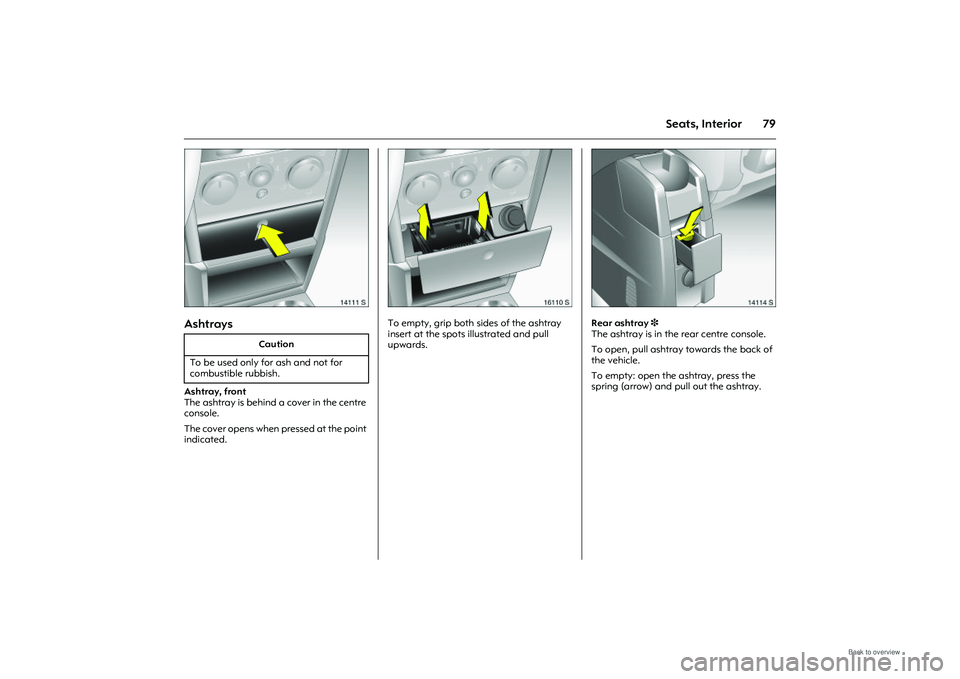
Ashtrays Ashtray, front
The ashtray is behind a cover in the centre
console.
The cover opens when pressed at the point
indicated.
Picture no: 16110s.tif
To empty, grip both sides of the ashtray
insert at the spots illustrated and pull
upwards.
Picture no: 14114s.tif
Rear ashtray 3
The ashtray is in the rear centre console.
To open, pull ashtray towards the back of
the vehicle.
To empty: open the ashtray, press the
spring (arrow) and pull out the ashtray.
Caution
To be used only for ash and not for
combustible rubbish.
Page 86 of 248
80 Seats, Interior
Picture no: 17884s.tif
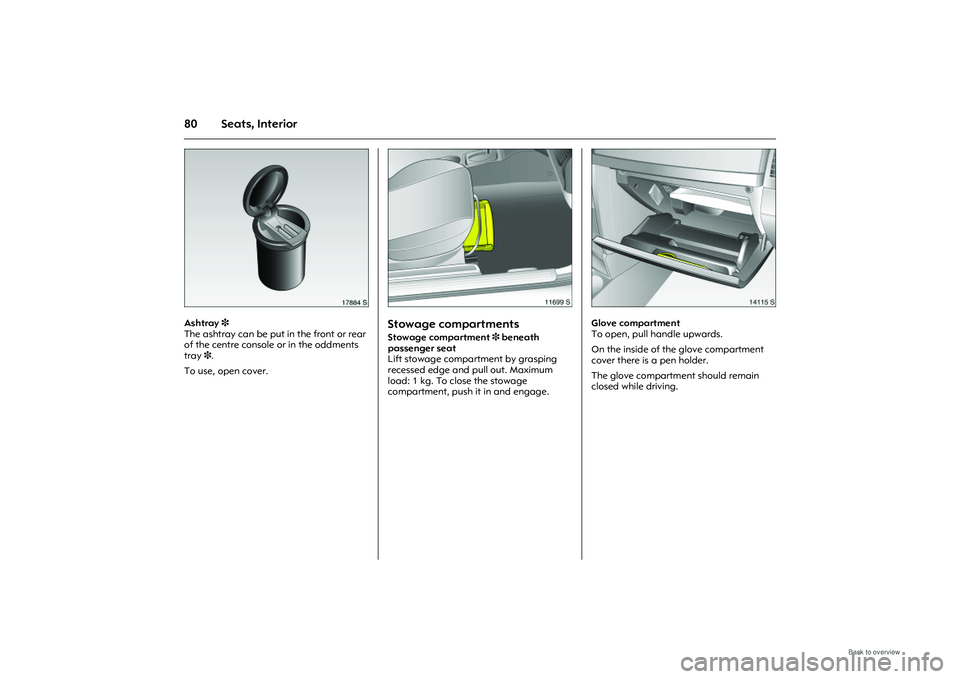
Ashtray 3
The ashtray can be put in the front or rear
of the centre console or in the oddments
tray 3.
To use, open cover.
Picture no: 11699s.tif
Stowage compartments Stowage compartment 3 beneath
passenger seat
Lift stowage compartment by grasping
recessed edge and pull out. Maximum
load: 1 kg. To close the stowage
compartment, push it in and engage.
Picture no: 14115s.tif
Glove compartment
To open, pull handle upwards.
On the inside of the glove compartment
cover there is a pen holder.
The glove compartment should remain
closed while driving.
Page 87 of 248
81
Seats, Interior
Picture no: 11701s.tif
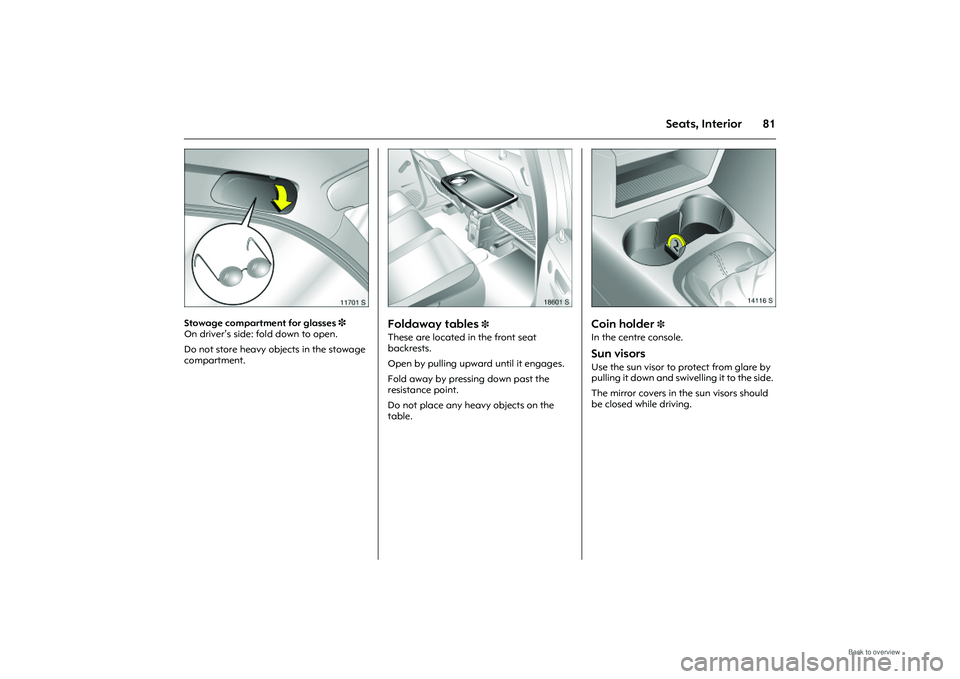
Stowage compartment for glasses 3
On driver’s side: fold down to open.
Do not store heavy objects in the stowage
compartment.
Picture no: 18601s.tif
Foldaway tables
3
These are located in the front seat
backrests.
Open by pulling upward until it engages.
Fold away by pressing down past the
resistance point.
Do not place any heavy objects on the
table.
Picture no: 14116s.tif
Coin holder
3
In the centre console. Sun visors Use the sun visor to protect from glare by
pulling it down and swivelling it to the side.
The mirror covers in the sun visors should
be closed while driving.
Page 107 of 248
101
Instruments, Controls
Picture no: 14056h.tif
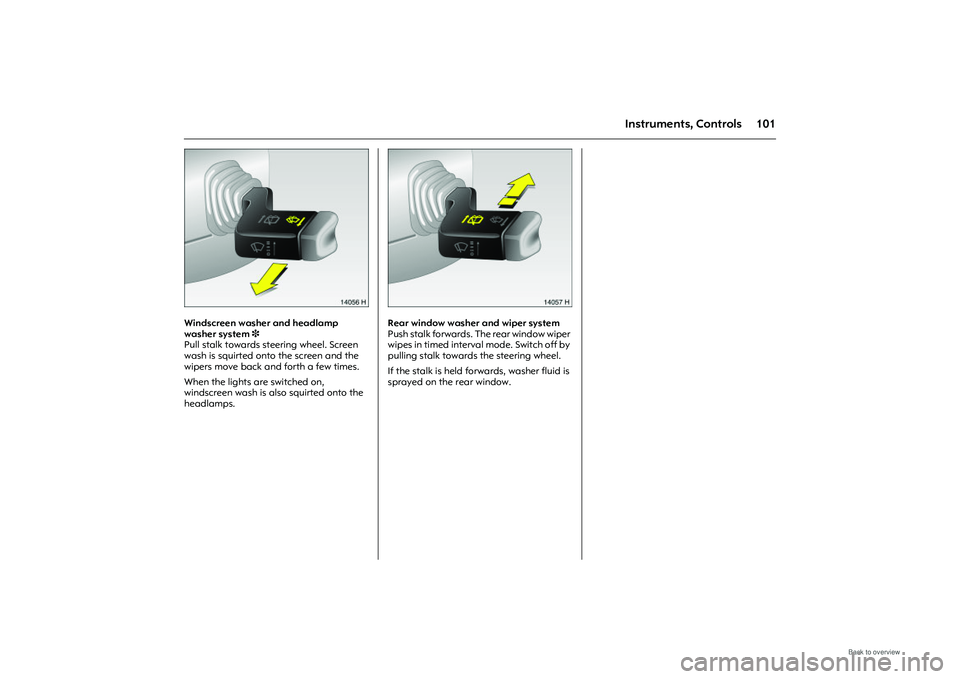
Windscreen washer and headlamp
washer system 3
Pull stalk towards steer ing wheel. Screen
wash is squirted onto the screen and the
wipers move back and forth a few times.
When the lights are switched on,
windscreen wash is al so squirted onto the
headlamps.
Picture no: 14057h.tif
Rear window washer and wiper system
Push stalk forwards. The rear window wiper
wipes in timed interval mode. Switch off by
pulling stalk towards the steering wheel.
If the stalk is held forwards, washer fluid is
sprayed on the rear window.
Page 109 of 248
103
Lighting
Picture no: 18475s.tif
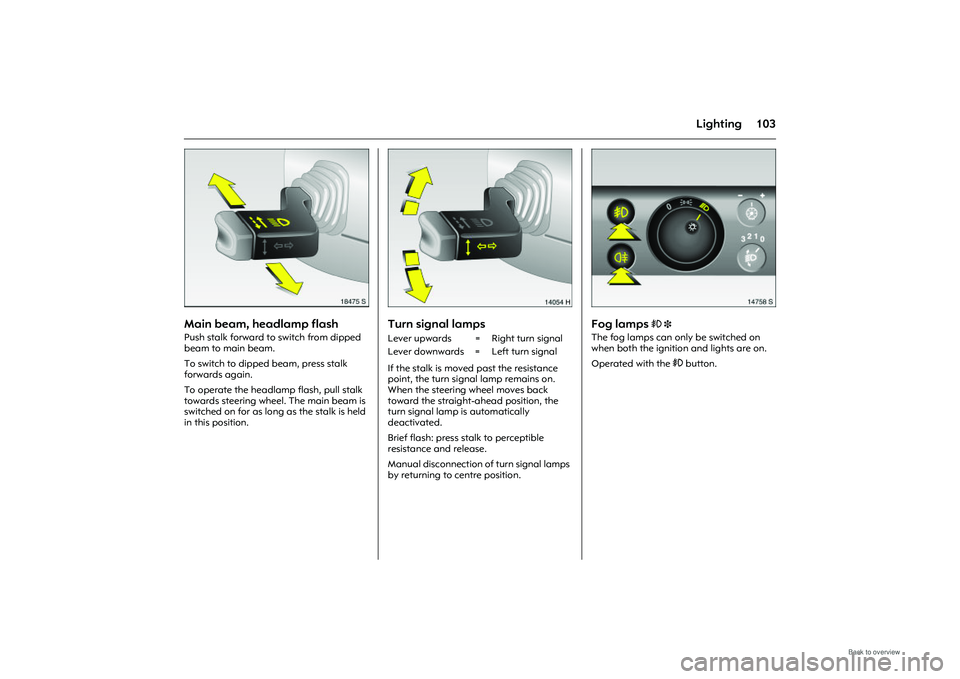
Main beam, headlamp flash Push stalk forward to switch from dipped
beam to main beam.
To switch to dipped beam, press stalk
forwards again.
To operate the headlamp flash, pull stalk
towards steering wheel. The main beam is
switched on for as long as the stalk is held
in this position.
Picture no: 14054h.tif
Turn signal lamps If the stalk is moved past the resistance
point, the turn signal lamp remains on.
When the steering wheel moves back
toward the straight-ahead position, the
turn signal lamp is automatically
deactivated.
Brief flash: press stalk to perceptible
resistance and release.
Manual disconnection of turn signal lamps
by returning to centre position.
Picture no: 14758s.tif
Fog lamps
> 3
The fog lamps can only be switched on
when both the ignition and lights are on.
Operated with the > button.
Lever upwards = Right turn signal
Lever downwards = Left turn signal
Page 110 of 248
104 LightingFog tail lamp
r
The fog tail lamp can only be switched on
both the ignition and dipped
beam/parking lamps are on.
Operated with the r button.
The fog tail lamps on the vehicle are
deactivated when towing a caravan/
trailer.
Reversing lamps The reversing lamps come on when the
ignition is on and reverse gear is engaged.
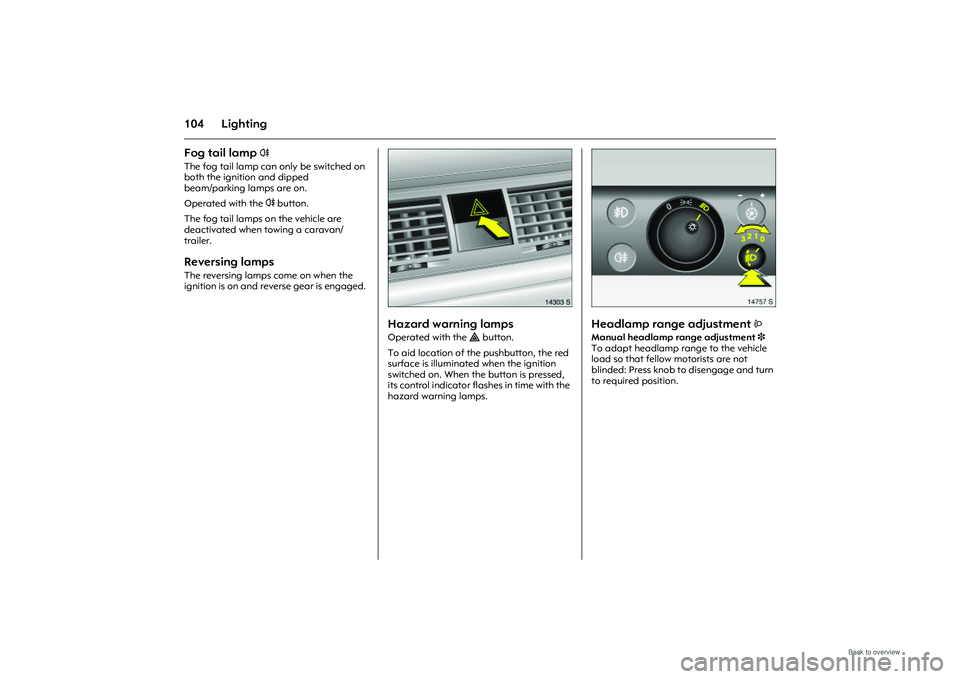
Picture no: 14303s.tif
Hazard warning lamps Operated with the ¨ button.
To aid location of the pushbutton, the red
surface is illuminated when the ignition
switched on. When the button is pressed,
its control indicator flashes in time with the
hazard warning lamps.
Picture no: 14757s.tif
Headlamp range adjustment
?
Manual headlamp range adjustment 3
To adapt headlamp ra nge to the vehicle
load so that fellow motorists are not
blinded: Press knob to disengage and turn
to required position.
Page 113 of 248
107
Lighting
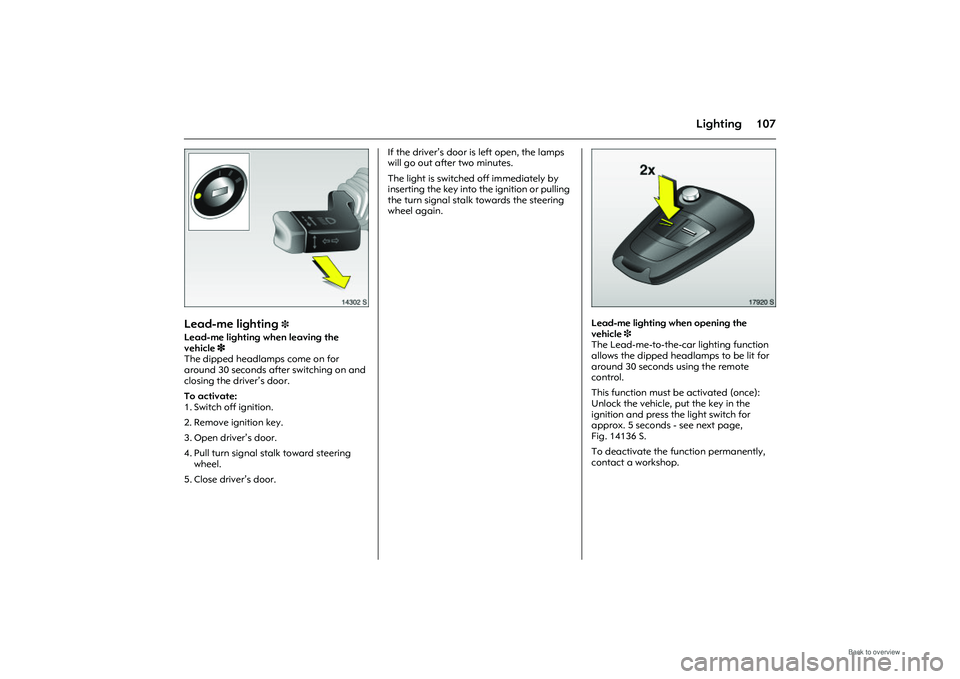
Picture no: 14302s.tif
Lead-me lighting
3
Lead-me lighting when leaving the
vehicle 3
The dipped headlamps come on for
around 30 seconds after switching on and
closing the driver’s door.
To activate:
1. Switch off ignition.
2. Remove ignition key.
3. Open driver’s door.
4. Pull turn signal stalk toward steering
wheel.
5. Close driver’s door. If the driver’s door is left open, the lamps
will go out after two minutes.
The light is switched off immediately by
inserting the key into
the ignition or pulling
the turn signal stalk towards the steering
wheel again.
Picture no: 17920S.tif
Lead-me lighting when opening the
vehicle 3
The Lead-me-to-the-car lighting function
allows the dipped headlamps to be lit for
around 30 seconds using the remote
control.
This function must be activated (once):
Unlock the vehicle, put the key in the
ignition and press the light switch for
approx. 5 seconds - see next page,
Fig. 14136 S.
To deactivate the function permanently,
contact a workshop.
Page 116 of 248
110 LightingBattery discharge protection
3
Some consumers such as the interior
lighting switch themselves off after
approx. 30 minutes if the ignition is off in
order to protect the battery charge. Misted light covers The inside of the light covers may mist up
briefly in poor, wet and cold weather
conditions, in heavy rain or after washing.
The mist disappears quickly by itself; to
help, switch on the lights. Headlamps when driving abroad The asymmetrical dipped beam increases
the field of vision on the passenger side of
the lane.
In countries where traffic drives on the
opposite side of the road, prevent glare as
follows.
Vehicles with halogen headlamp system
or Xenon headlamp system 3
Have headlights conver ted in a workshop.
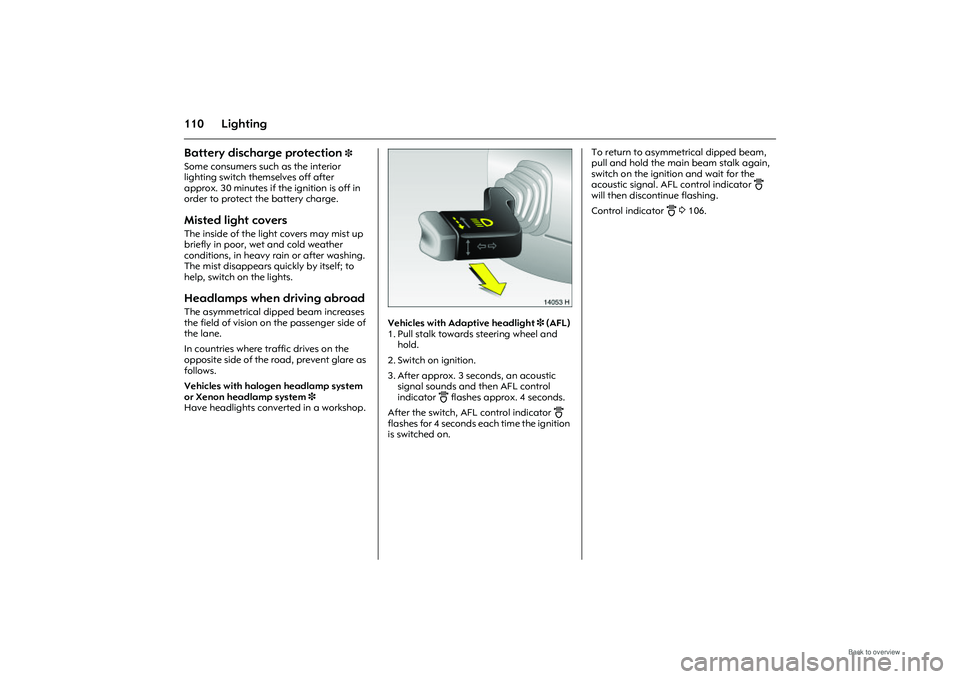
Picture no: 14053h.tif
Vehicles with Adaptive headlight 3 (AFL)
1. Pull stalk towards steering wheel and hold.
2. Switch on ignition.
3. After approx. 3 seconds, an acoustic signal sounds and then AFL control
indicator
B flashes approx. 4 seconds.
After the switch, AFL control indicator
B
flashes for 4 seconds each time the ignition
is switched on. To return to asymmetrical dipped beam,
pull and hold the main beam stalk again,
switch on the ignition and wait for the
acoustic signal. AFL control indicator
B
will then discontinue flashing.
Control indicator
B
3 106.
Page 122 of 248
116 Climate control
Picture no: 14144s.tif
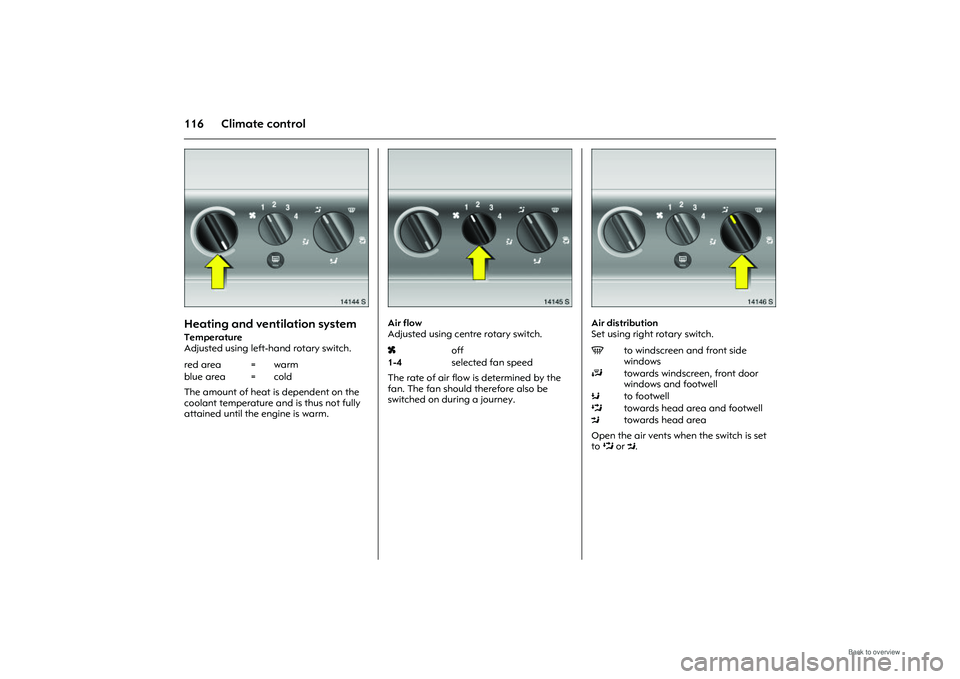
Heating and ventilation system Temperature
Adjusted using left-hand rotary switch.
The amount of heat is dependent on the
coolant temperature and is thus not fully
attained until the engine is warm.
Picture no: 14145s.tif
Air flow
Adjusted using centre rotary switch.
The rate of air flow is determined by the
fan. The fan should therefore also be
switched on during a journey.
Picture no: 14146s.tif
Air distribution
Set using right rotary switch.
Open the air vents when the switch is set
toL or M .
red area = warm
blue area = cold
x
off
1-4 selected fan speed
Vto windscreen and front side
windows
J towards windscreen, front door
windows and footwell
K to footwell
L towards head area and footwell
M towards head area
Page 124 of 248
118 Climate control
Picture no: 14151s.tif
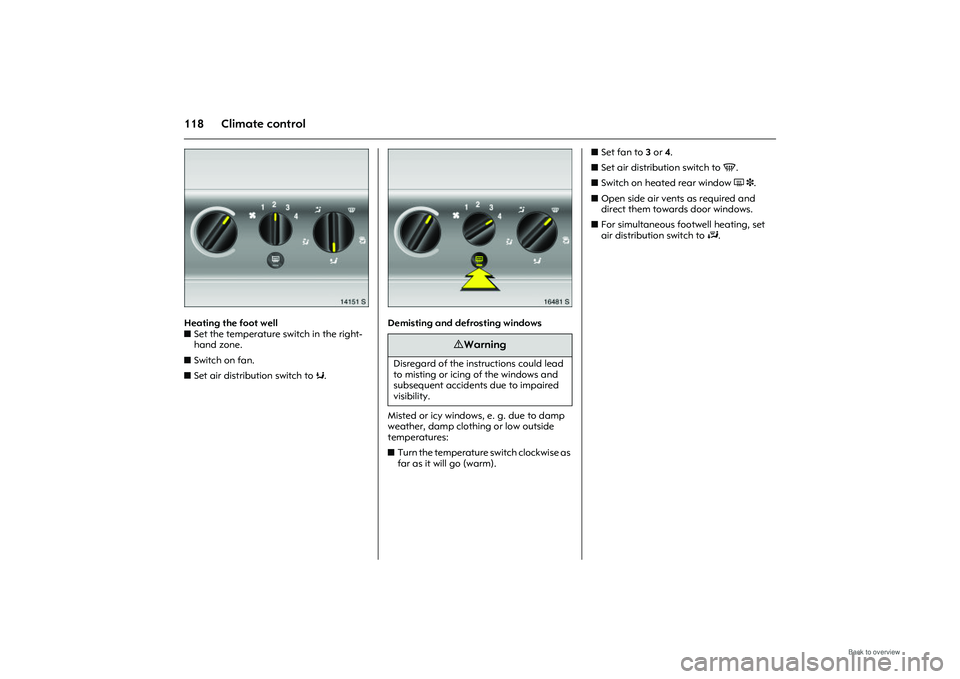
Heating the foot well
zSet the temperature switch in the right-
hand zone.
z Switch on fan.
z Set air distribution switch to K.
Picture no: 16481s.tif
Demisting and defrosting windows
Misted or icy windows, e. g. due to damp
weather, damp clothing or low outside
temperatures:
z Turn the temperature switch clockwise as
far as it will go (warm). z
Set fan to 3 or 4 .
z Set air distribution switch to V.
z Switch on heated rear window Ü 3.
z Open side air vents as required and
direct them towards door windows.
z For simultaneous footwell heating, set
air distribution switch to J.
9 Warning
Disregard of the instructions could lead
to misting or icing of the windows and
subsequent accidents due to impaired
visibility.