ignition OPEL MERIVA 2009 Repair Manual
[x] Cancel search | Manufacturer: OPEL, Model Year: 2009, Model line: MERIVA, Model: OPEL MERIVA 2009Pages: 248, PDF Size: 4.46 MB
Page 171 of 248
165
Self-help, vehicle care
Self-help, vehicle care
Diesel fuel system, bleeding If the tank is allowed to run dry, the diesel
fuel system must be bled. Turn over the
ignition three times for 15 seconds at a
time. Then start the engine for a maximum
of 40 seconds
1). Repeat this process after
no less than 5 seconds. If the engine fails to
start, seek the assistance of a workshop.
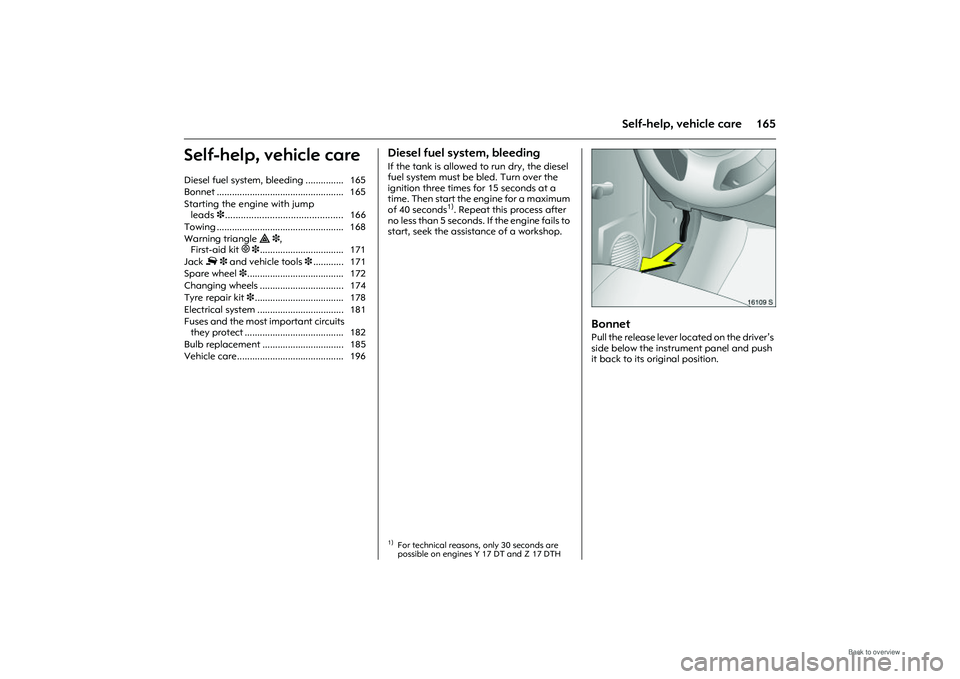
Picture no: 16109s.tif
Bonnet Pull the release lever lo cated on the driver’s
side below the instru ment panel and push
it back to its original position.
Diesel fuel system, bleeding ............... 165
Bonnet .................................................. 165
Starting the engine with jump
leads 3............................................. 166
Towing .................................................. 168
Warning triangle ¨ 3,
First-aid kit +3................................. 171
Jack £ 3 and vehicle tools 3............ 171
Spare wheel 3...................................... 172
Changing wheels ................................. 174
Tyre repair kit 3................................... 178
Electrical system .................................. 181
Fuses and the most important circuits they protect ....................................... 182
Bulb replacement ................................ 185
Vehicle care.......................................... 196
1)For technical reasons, only 30 seconds are
possible on engines Y 17 DT and Z 17 DTH
Page 175 of 248
169
Self-help, vehicle care
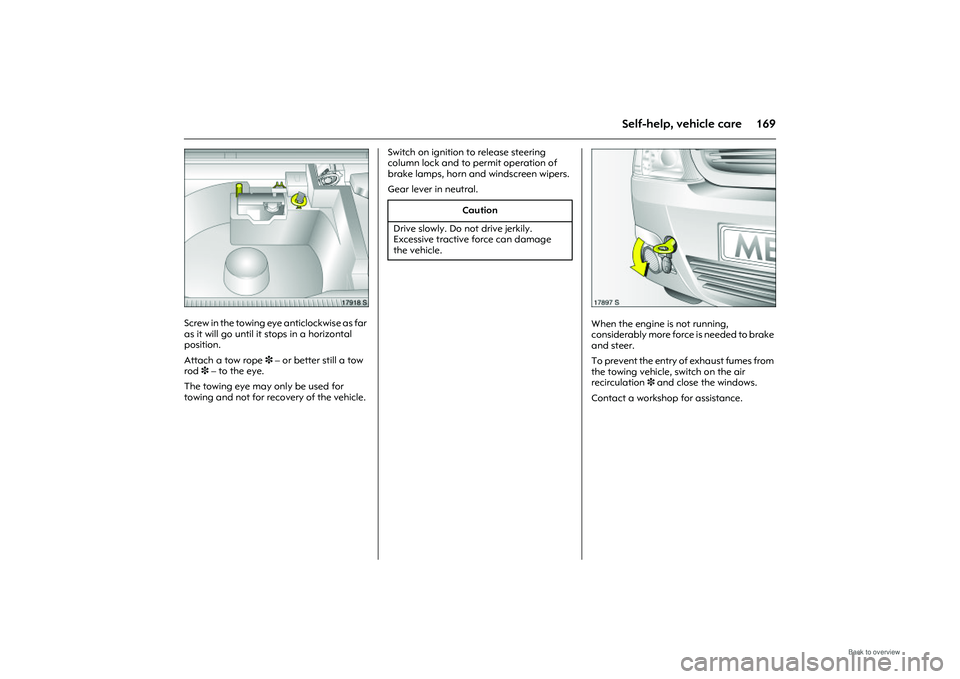
Picture no: 17918s.tif
Screw in the towing eye anticlockwise as far
as it will go until it stops in a horizontal
position.
Attach a tow rope 3 – or better still a tow
rod 3 – to the eye.
The towing eye may only be used for
towing and not for recovery of the vehicle. Switch on ignition to release steering
column lock and to permit operation of
brake lamps, horn an
d windscreen wipers.
Gear lever in neutral.
Picture no: 17897s.tif
When the engine is not running,
considerably more force is needed to brake
and steer.
To prevent the entry of exhaust fumes from
the towing vehicle, switch on the air
recirculation 3 and close the windows.
Contact a workshop for assistance.
Caution
Drive slowly. Do not drive jerkily.
Excessive tractive force can damage
the vehicle.
Page 185 of 248
179
Self-help, vehicle care
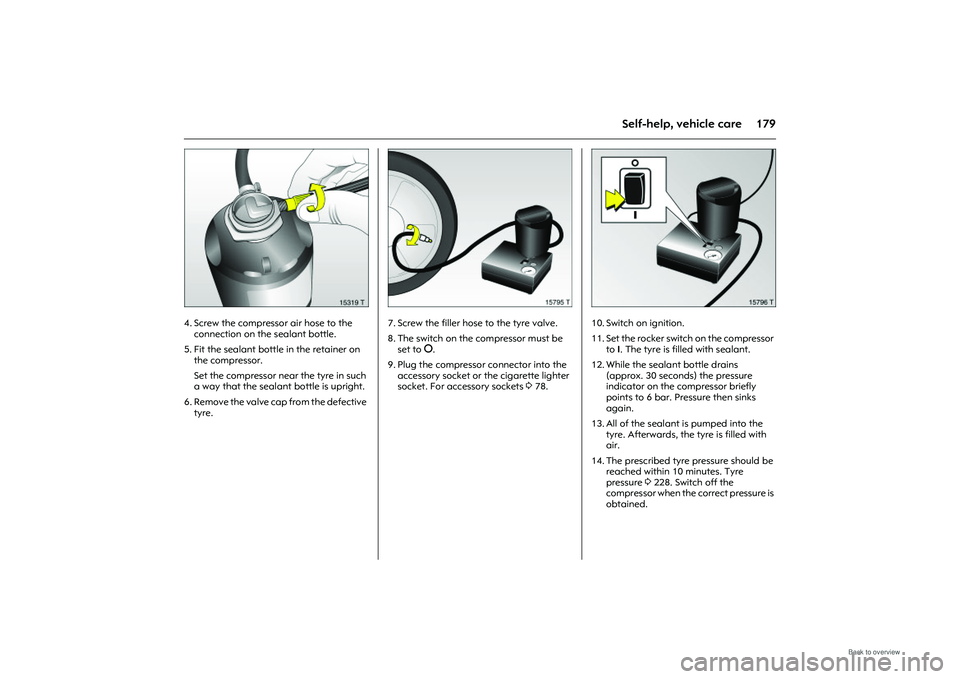
Picture no: 15319t.tif
4. Screw the compressor air hose to the connection on the sealant bottle.
5. Fit the sealant bottle in the retainer on the compressor.
Set the compressor near the tyre in such
a way that the sealant bottle is upright.
6. Remove the valve cap from the defective tyre.
Picture no: 15795t.tif
7. Screw the filler hose to the tyre valve.
8. The switch on the compressor must be set to §.
9. Plug the compressor connector into the accessory socket or the cigarette lighter
socket. For accessory sockets 378.
Picture no: 15796t.tif
10. Switch on ignition.
11. Set the rocker switch on the compressor
to I. The tyre is filled with sealant.
12. While the sealant bottle drains (approx. 30 seconds) the pressure
indicator on the compressor briefly
points to 6 bar. Pressure then sinks
again.
13. All of the sealant is pumped into the tyre. Afterwards, the tyre is filled with
air.
14. The prescribed tyre pressure should be reached within 10 minutes. Tyre
pressure 3228. Switch off the
compressor when the correct pressure is
obtained.
Page 188 of 248
182 Self-help, vehicle care
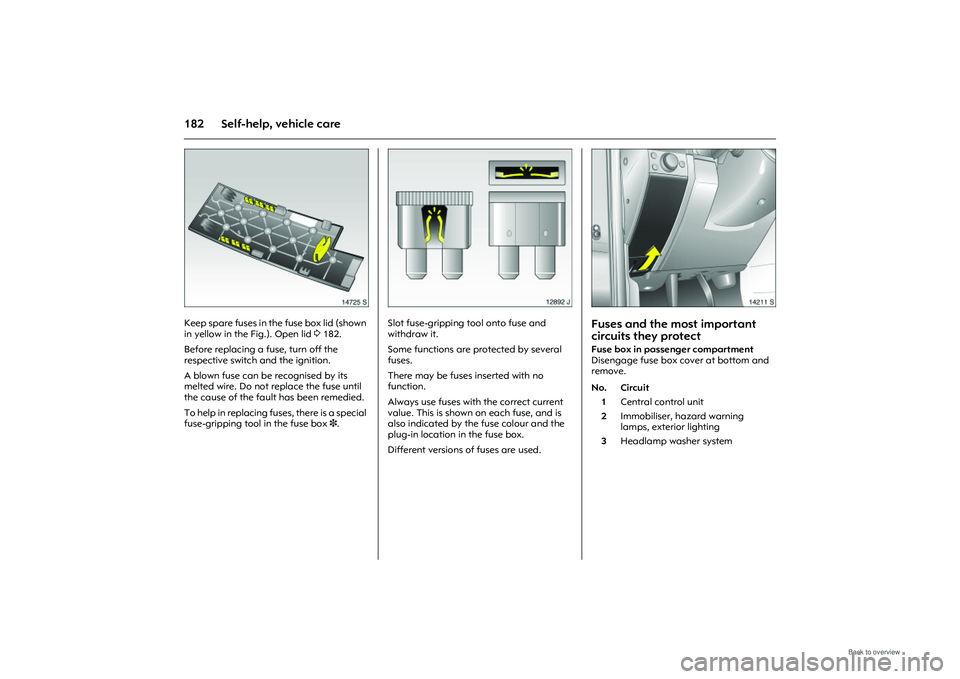
Picture no: 14725s.tif
Keep spare fuses in the fuse box lid (shown
in yellow in the Fig.). Open lid 3182.
Before replacing a fuse, turn off the
respective switch and the ignition.
A blown fuse can be recognised by its
melted wire. Do not replace the fuse until
the cause of the fault has been remedied.
To help in replacing fuses, there is a special
fuse-gripping tool in the fuse box 3.
Picture no: 12892j.tif
Slot fuse-gripping tool onto fuse and
withdraw it.
Some functions are protected by several
fuses.
There may be fuses inserted with no
function.
Always use fuses with the correct current
value. This is shown on each fuse, and is
also indicated by the fuse colour and the
plug-in location in the fuse box.
Different versions of fuses are used.
Picture no: 14211s.tif
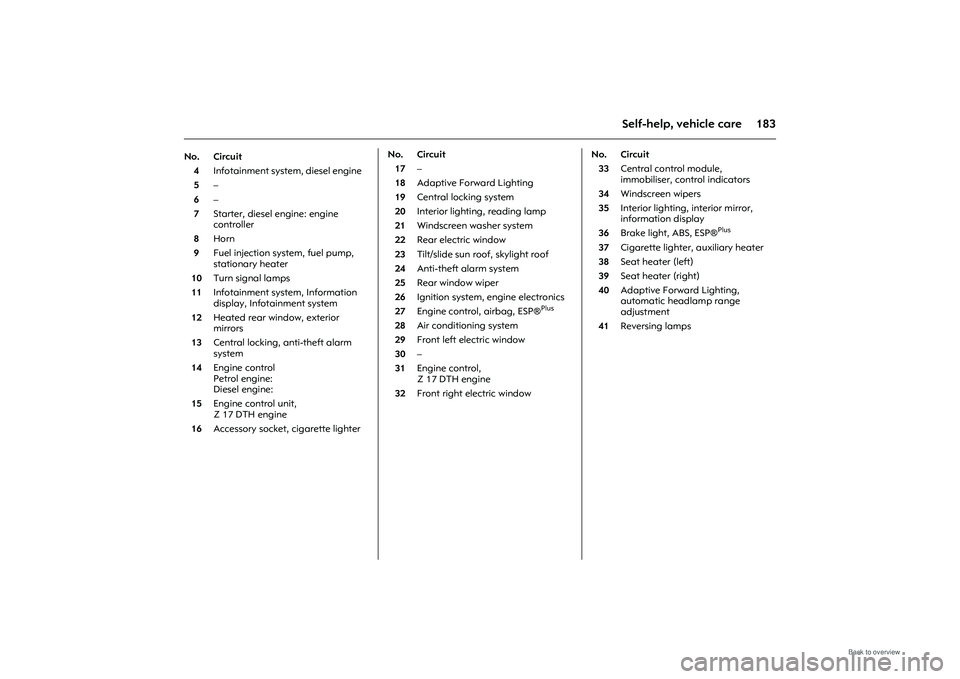
Fuses and the most important
circuits they protect Fuse box in passenger compartment
Disengage fuse box cover at bottom and
remove. No. Circuit
1 Central control unit
2 Immobiliser, hazard warning
lamps, exterior lighting
3 Headlamp washer system
Page 189 of 248
183
Self-help, vehicle care
No. Circuit4 Infotainment system, diesel engine
5 –
6 –
7 Starter, diesel engine: engine
controller
8 Horn
9 Fuel injection system, fuel pump,
stationary heater
10 Turn signal lamps
11 Infotainment system, Information
display, Infotainment system
12 Heated rear window, exterior
mirrors
13 Central locking, anti-theft alarm
system
14 Engine control
Petrol engine:
Diesel engine:
15 Engine control unit,
Z 17 DTH engine
16 Accessory socket, cigarette lighter No. Circuit
17 –
18 Adaptive Forward Lighting
19 Central locking system
20 Interior lighting, reading lamp
21 Windscreen washer system
22 Rear electric window
23 Tilt/slide sun roof, skylight roof
24 Anti-theft alarm system
25 Rear window wiper
26 Ignition system, engine electronics
27 Engine control, airbag, ESP®
Plus
28 Air conditioning system
29 Front left electric window
30 –
31 Engine control,
Z 17 DTH engine
32 Front right electric window No. Circuit
33 Central control module,
immobiliser, control indicators
34 Windscreen wipers
35 Interior lighting, interior mirror,
information display
36 Brake light, ABS, ESP®
Plus
37Cigarette lighter, auxiliary heater
38 Seat heater (left)
39 Seat heater (right)
40 Adaptive Forward Lighting,
automatic headlamp range
adjustment
41 Reversing lamps
Page 191 of 248
185
Self-help, vehicle care
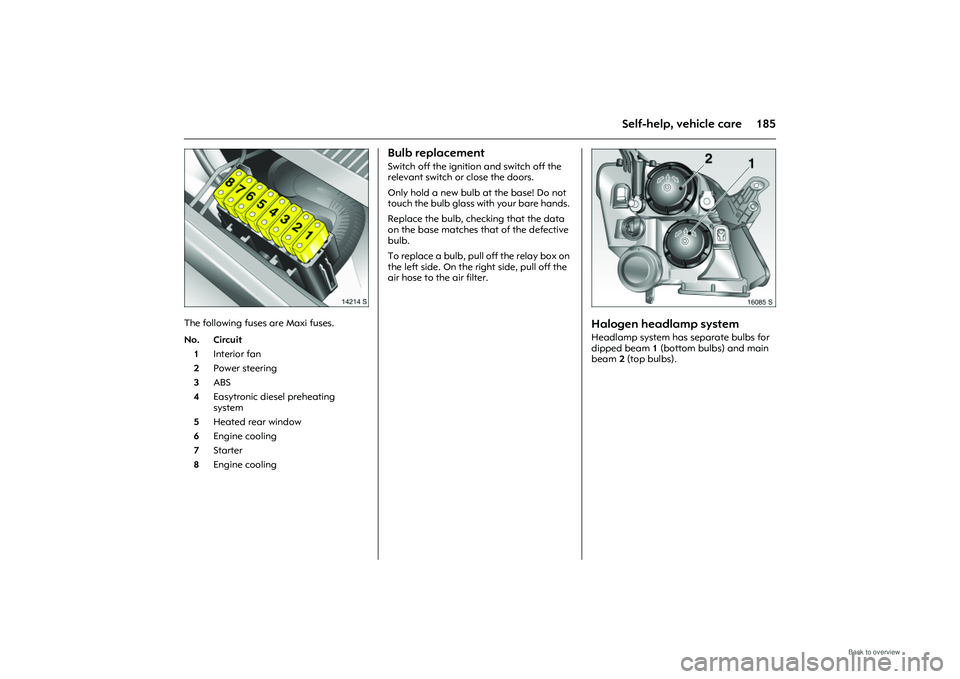
Picture no: 14214s.tif
The following fuses are Maxi fuses.
Bulb replacement Switch off the ignition and switch off the
relevant switch or close the doors.
Only hold a new bulb at the base! Do not
touch the bulb glass with your bare hands.
Replace the bulb, checking that the data
on the base matches that of the defective
bulb.
To replace a bulb, pull off the relay box on
the left side. On the right side, pull off the
air hose to the air filter.
Picture no: 16085s.tif
Halogen headlamp systemHeadlamp system has separate bulbs for
dipped beam 1 (bottom bulbs) and main
beam 2 (top bulbs).
No. Circuit
1 Interior fan
2 Power steering
3 ABS
4 Easytronic diesel preheating
system
5 Heated rear window
6 Engine cooling
7 Starter
8 Engine cooling
Page 206 of 248
200 Service and maintenanceService schedule Europe⊕additional work.
o The intervals are shorter where driving conditions are more arduous or country-specific.
Service work
after year
1)
km (x1000)
1)
1)Depending on what occurs first.
1
30 2
60 3
90 4
120 5
150
Carry out a visual check of all warning lamps, lighting and signalling devices,
check steering and ignition locks xxxxx
Remote control: replace batteries (check spare key) every 2 years
Check windscreen wipers, windscreen washer and headlamp washer systems, adjust if
necessary. xxxxx
Check coolant and antifreeze (bright orange) levels
2), adjust if necessary, note
antifreeze temperature in Service and Warranty Booklet (validation fields).
2)If the loss is too great or there are leaks, carry out remedial work in agr eement with the customer.
xxxxx
Check water-carrying hoses for leaks and make sure that they are secure. xxxxx
Check break fluid level
2), top up if necessary. xxx
Check that the battery terminals and lugs are secure xxxxx
Vehicle system check using TECH 2 xxxxx
Replace pollen filter or active charcoal filter xx
⊕o
If the air is particularly polluted, full of du st or sand or pollen, if the air conditioning
system smells Discussion between customer / Opel Partner
Replace air cleaner element every 4 years/60 000 km
⊕
Replace spark plugsevery 4 years/60 000 km
Make a visual check of the ribbed belt xx
⊕
Replace ribbed belt
Z 13 DT, Z 13 DTJ, Z 17 DTH, Z 17 DT, Z 17 DTR. every 10 years/150 000 km
⊕
Check valve clearance,
adjust if necessary
Z 16 LET, Z 16 XEP, Z 17 DTH, Z 17 DT, Z 17 DTR every 10 years/150 000 km
Page 209 of 248
203
Service and maintenance
International service schedule⊕ additional work.
o The intervals are shorter where driving conditions are more arduous or country-specific.
Service work
after year
1)
km (x 1000)
1)
1)Depending on what occurs first.
1
15 2
30 3
45 4
60 5
75
Carry out a visual check of all warning lamps, lighting and signalling devices,
check steering and ignition locks xxxxx
Remote control: replace batteries (check spare key) every 2 years
Check windscreen wipers, windscreen washer and headlamp washer systems, adjust if
necessary. xxxxx
Check coolant and antifreeze (bright orange) levels
2), adjust if necessary, note
antifreeze temperature in Service and Warranty Booklet (validation fields).
2)If the loss is too great or there are leaks, carry out remedial work in agr eement with the customer.
xxxxx
Check water-carrying hoses for leaks and make sure that they are secure. xxxxx
Check break fluid level
2), top up if necessary. xxx
Check that the battery terminals and lugs are secure xxxxx
Vehicle system check using TECH 2 xxxxx
Replace pollen filter or active charcoal filter xx
⊕o
If the air is particularly polluted, full of du st or sand or pollen, if the air conditioning
system smells Discussion between customer / Opel Partner
Replace air cleaner element every 4 years/60 000 km
⊕
Replace spark plugsevery 4 years/60 000 km
Make a visual check of the ribbed belt xx
⊕
Replace ribbed belt
Z 13 DT, Z 13 DTJ, Z 17 DTH, Z 17 DT, Z 17 DTR. every 10 years/150 000 km
⊕
Check valve clearance,
adjust if necessary
Z16 LET, Z 16 XEP, Z 17 DTH, Z 17 DT, Z 17 DTR every 10 years/150 000 km
Page 214 of 248
208 Service and maintenance
Picture no: 18602s.tif
Inspection system In order to guarantee economical and safe
vehicle operation and to maintain the
value of your vehicle, it is of vital
importance that all maintenance work is
carried out at the proper intervals.
Fixed service interval
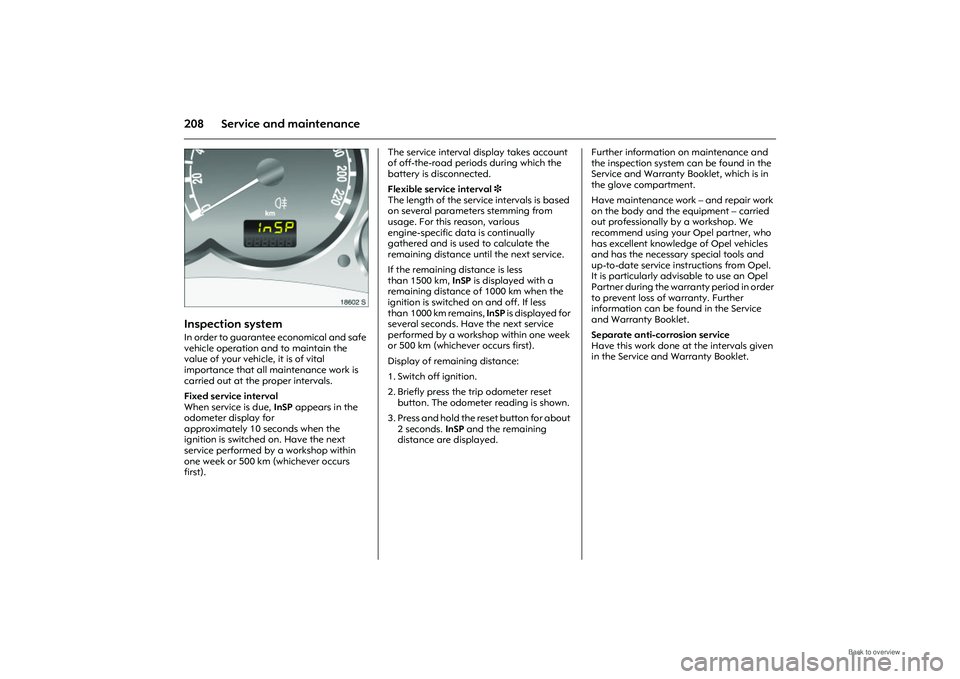
When service is due, InSP appears in the
odometer display for
approximately 10 seconds when the
ignition is switched on. Have the next
service performed by a workshop within
one week or 500 km (whichever occurs
first). The service interval display takes account
of off-the-road periods during which the
battery is disconnected.
Flexible service interval
3
The length of the service intervals is based
on several parameters stemming from
usage. For this reason, various
engine-specific data is continually
gathered and is used to calculate the
remaining distance until the next service.
If the remaining distance is less
than 1500 km, InSP is displayed with a
remaining distance of 1000 km when the
ignition is switched on and off. If less
than 1000 km remains, InSP is displayed for
several seconds. Have the next service
performed by a workshop within one week
or 500 km (whichever occurs first).
Display of remaining distance:
1. Switch off ignition.
2. Briefly press the trip odometer reset button. The odometer reading is shown.
3. Press and hold the reset button for about 2 seconds. InSP and the remaining
distance are displayed. Further information
on maintenance and
the inspection system can be found in the
Service and Warranty Booklet, which is in
the glove compartment.
Have maintenance work – and repair work
on the body and the equipment – carried
out professionally by a workshop. We
recommend using your Opel partner, who
has excellent knowledge of Opel vehicles
and has the necessary special tools and
up-to-date service inst ructions from Opel.
It is particularly advisable to use an Opel
Partner during the warranty period in order
to prevent loss of warranty. Further
information can be found in the Service
and Warranty Booklet.
Separate anti-corrosion service
Have this work done at the intervals given
in the Service and Warranty Booklet.
Page 215 of 248
209
Service and maintenance
Genuine Opel Parts and
Accessories We recommend that you use "Genuine
Opel Parts and Accessories" and
conversion parts released expressly for
your vehicle type. These parts have
undergone special tests to establish their
reliability, safety and specific suitability for
Opel vehicles. Despit e continuous market
monitoring, we cannot assess or guarantee
these attributes for other products, even if
they have been granted approval by the
relevant authorities or in some other form.
"Genuine Opel Parts and Accessories" and
conversion parts approved by Opel can be
obtained from your Op el Partner, who can
provide expert advice on permitted
technical changes and ensure correct
installation.
Picture no: 17922S.tif
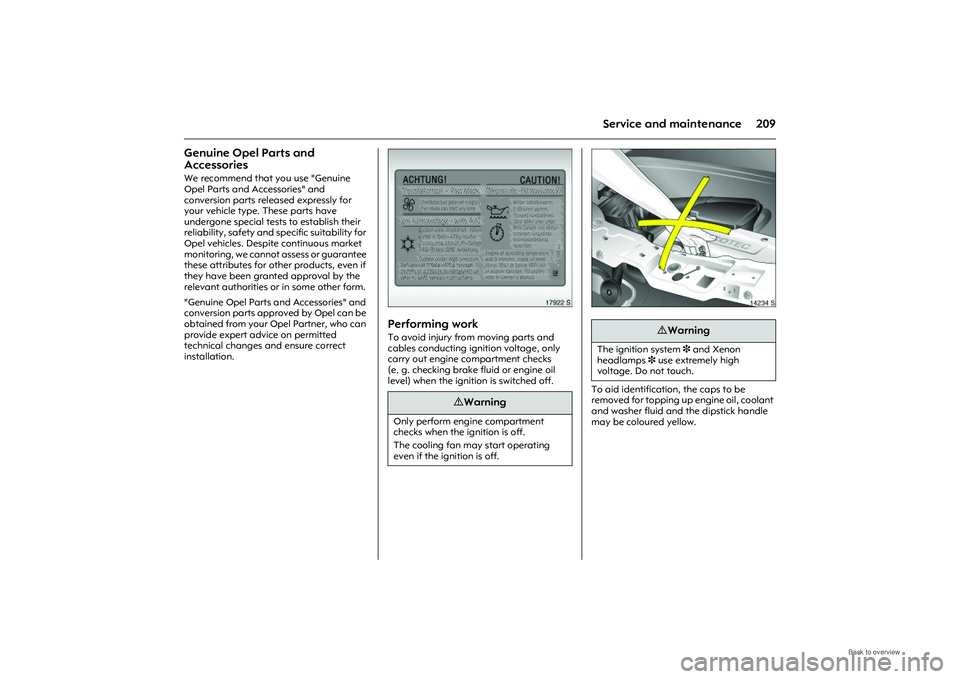
Performing work To avoid injury from moving parts and
cables conducting ignition voltage, only
carry out engine compartment checks
(e. g. checking brake fluid or engine oil
level) when the igniti on is switched off.
Picture no: 14234s.tif
To aid identification, the caps to be
removed for topping up engine oil, coolant
and washer fluid and the dipstick handle
may be coloured yellow.
9 Warning
Only perform engine compartment
checks when the ignition is off.
The cooling fan may start operating
even if the ignition is off.
9 Warning
The ignition system 3 and Xenon
headlamps 3 use extremely high
voltage. Do not touch.