tow OPEL MOVANO_B 2020 Manual user
[x] Cancel search | Manufacturer: OPEL, Model Year: 2020, Model line: MOVANO_B, Model: OPEL MOVANO_B 2020Pages: 353, PDF Size: 9.4 MB
Page 246 of 353

244Driving and operatingIt is possible to use the Laden mode
in both manual and automatic modes. In both cases, the gearshifting
patterns are adapted automatically
for carrying an increased payload.
Activation
Press kg. Control indicator kg is
shown in the transmission display.
The transmission will then select
optimized gearshift patterns.
Deactivation
The Laden mode is switched off by:
● pressing kg again
● turning off the ignition
Kickdown If the accelerator pedal is pressed
past the pressure point, the
transmission shifts to a lower gear
depending on engine speed. Full
engine power is available for
acceleration.
If engine speed is too high the
transmission switches to a higher
gear, even in manual mode. Without
kickdown this automatic shift is not
effected in manual mode.Fault
In the event of a fault, control indicator W is shown in the transmission
display. Continued driving is possible
provided the vehicle is driven with
care and anticipation.
Have the cause of the fault remedied
by a workshop.
Interruption of power supply The clutch is not disengaged if there
is an interruption of the power supply
when a gear is engaged. The vehicle
cannot move.
If the vehicle battery is discharged,
start the vehicle using jump leads
3 304.
If the cause of the fault is not a
discharged vehicle battery, seek the
assistance of a workshop.
If neutral cannot be selected, the
vehicle must only be towed with the
drive wheels raised off the ground
3 306.
Towing the vehicle 3 306.Brakes
The brake system comprises two
independent brake circuits.
If a brake circuit fails, the vehicle can
still be braked using the other brake
circuit. However, braking effect is
achieved only when you depress the
brake pedal firmly. You need to use
considerably more force for this. The
braking distance is extended. Seek
the assistance of a workshop before
continuing your journey.
When the engine is not running, the
support of the brake servo unit
disappears once the brake pedal has been depressed once or twice.
Braking effect is not reduced, but
braking requires significantly greater
force. It is especially important to bear
this in mind when being towed.
Control indicator R 3 100.
Antilock brake system Antilock brake system (ABS)
prevents the wheels from locking.
Page 256 of 353
254Driving and operatingThe indicator light l and the chimes
stop when the system detects that a
collision is not imminent anymore.
Just before the imminent collision, the
system brakes automatically to
reduce the impact speed of the
collision or prohibit a crash.9 Warning
Do not rely on the system to brake
the vehicle. Active emergency
braking will not brake outside of its
operating speed range and only
responds to detected vehicles.
Deactivation and re-activation
Active emergency braking can be
deactivated with the vehicle
stationary and the ignition switched
on:
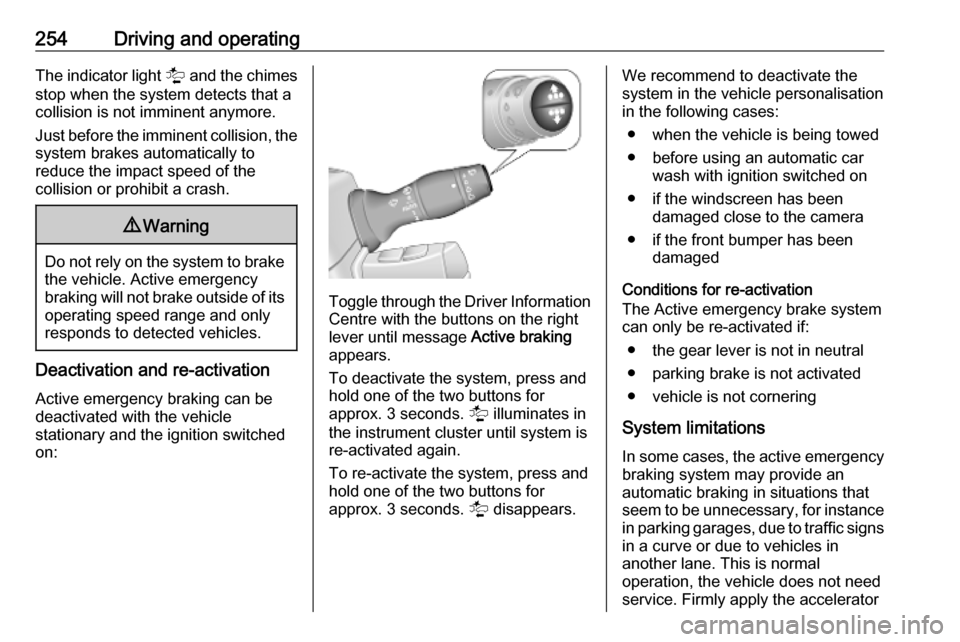
Toggle through the Driver Information
Centre with the buttons on the right
lever until message Active braking
appears.
To deactivate the system, press and
hold one of the two buttons for
approx. 3 seconds. l illuminates in
the instrument cluster until system is
re-activated again.
To re-activate the system, press and hold one of the two buttons for
approx. 3 seconds. l disappears.
We recommend to deactivate the
system in the vehicle personalisation
in the following cases:
● when the vehicle is being towed
● before using an automatic car wash with ignition switched on
● if the windscreen has been damaged close to the camera
● if the front bumper has been damaged
Conditions for re-activation
The Active emergency brake system
can only be re-activated if:
● the gear lever is not in neutral
● parking brake is not activated
● vehicle is not cornering
System limitations In some cases, the active emergency
braking system may provide an
automatic braking in situations that
seem to be unnecessary, for instance in parking garages, due to traffic signs
in a curve or due to vehicles in
another lane. This is normal
operation, the vehicle does not need
service. Firmly apply the accelerator
Page 258 of 353
256Driving and operatingThe ultrasonic parking sensors can
be activated or deactivated in the
settings menu in the Info Display.
Note
Attached parts in the detection area
cause system malfunction.
Activation
The rear parking assist is activated
when reverse gear is engaged. The
front-rear parking assist is activated
when a gear is engaged. Readiness
for operation is indicated by a brief
acoustic signal.
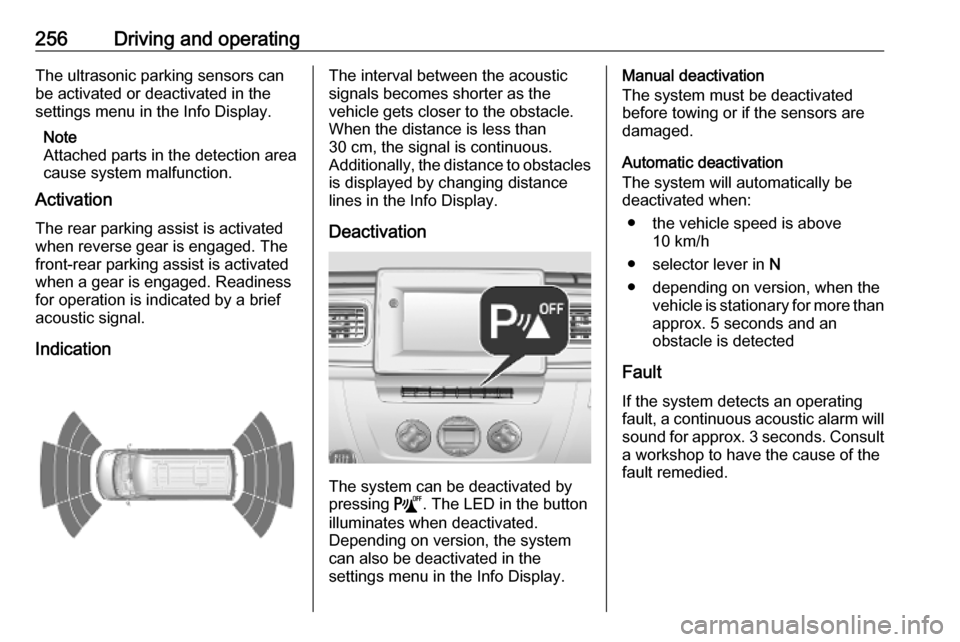
IndicationThe interval between the acoustic
signals becomes shorter as the
vehicle gets closer to the obstacle.
When the distance is less than
30 cm, the signal is continuous.
Additionally, the distance to obstacles is displayed by changing distance
lines in the Info Display.
Deactivation
The system can be deactivated by
pressing =. The LED in the button
illuminates when deactivated.
Depending on version, the system
can also be deactivated in the
settings menu in the Info Display.
Manual deactivation
The system must be deactivated
before towing or if the sensors are
damaged.
Automatic deactivation
The system will automatically be
deactivated when:
● the vehicle speed is above 10 km/h
● selector lever in N
● depending on version, when the vehicle is stationary for more than
approx. 5 seconds and an
obstacle is detected
Fault
If the system detects an operating
fault, a continuous acoustic alarm will sound for approx. 3 seconds. Consult
a workshop to have the cause of the
fault remedied.
Page 267 of 353

Driving and operating265Trailer hitch
General information
Only use towing equipment that has
been approved for your vehicle.
Entrust fitting of towing equipment at
a later date to a workshop. It may be
necessary to make changes that
affect the cooling system, heat
shields or other equipment.
Driving characteristics and towing tips
In the case of trailers with brakes,
attach the breakaway stopping cable.
Before attaching a trailer, lubricate
the coupling ball. However, do not do
so if a stabiliser, which acts on the coupling ball, is being used to reduce
snaking movements. For trailers with
low driving stability the use of a
stabiliser is recommended.
A maximum speed of 80 km/h must
not be exceeded, even in countries
where higher speeds are permitted.If the trailer starts snaking, drive more slowly, do not attempt to correct the
steering and brake sharply if
necessary.
When driving downhill, drive in the
same gear as if driving uphill and
drive at a similar speed.
Adjust tyre pressure to the value
specified for full load 3 317.
Trailer towing
Trailer loads The permissible trailer loads are
vehicle-dependent and engine-
dependent maximum values which
must not be exceeded. The actual
trailer load is the difference between
the actual gross weight of the trailer
and the actual coupling socket load
with the trailer coupled.
The permissible trailer loads are
specified in the vehicle documents. In
general, they are valid for gradients
up to max. 12%.
The permitted trailer load applies up to the specified incline and up to an
altitude of 1000 m above sea level.Since engine power decreases as
altitude increases due to the air
becoming thinner, therefore reducing
climbing ability, the permissible gross
train weight also decreases by 10%
for every 1000 m of additional
altitude. The gross train weight does
not have to be reduced when driving
on roads with slight inclines (less than 8%, e.g. motorways).
The permissible gross train weight
must not be exceeded. This weight is
specified on the identification plate
3 316.
Vertical coupling load
The vertical coupling load is the load
exerted by the trailer on the coupling
ball. It can be varied by changing the
weight distribution when loading the
trailer.
The maximum permissible vertical
coupling load is specified on the
towing equipment identification plate
and in the vehicle documents. Always aim for the maximum load, especially in the case of heavy trailers. The
vertical coupling load should never
fall below 25 kg.
Page 268 of 353
266Driving and operatingIn the case of trailer loads of
1200 kg or more, the vertical coupling load should not be less than 50 kg.
Rear axle load When the trailer is coupled and the
towing vehicle fully loaded (including all occupants), the permissible rear
axle load (see identification plate or
vehicle documents) can be exceeded by 15%. If the permissible rear axle
load is exceeded, a maximum speed
of 80 km/h applies and the tyre
pressure must be increased by 20
kPA / 0.2 bar.
Towing equipment For vehicles fitted with towing
equipment, when connected to a
trailer the pitch of the audible warning
changes upon operation of the turn
lights.
The pitch of the audible warning will
change if a turn light on the trailer or
the towing vehicle fails.Trailer stability assist
If the system detects snaking
movements, engine power is reduced
and the vehicle / trailer combination is
selectively braked until the snaking
ceases. While the system is working,
keep steering wheel as still as
possible.
Trailer stability assist is a function of
the Electronic Stability Control (ESC)
3 248.Auxiliary features
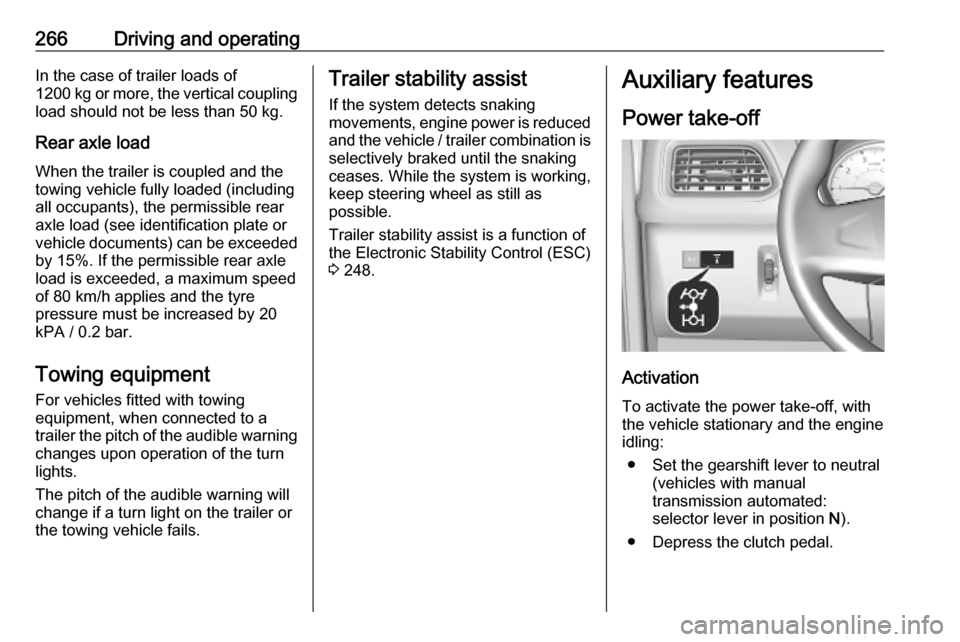
Power take-off
Activation
To activate the power take-off, with
the vehicle stationary and the engine
idling:
● Set the gearshift lever to neutral (vehicles with manual
transmission automated:
selector lever in position N).
● Depress the clutch pedal.
Page 270 of 353

268Vehicle careVehicle careGeneral Information...................269
Accessories and vehicle modifications .......................... 269
Vehicle storage ........................269
End-of-life vehicle recovery .....270
Vehicle checks ........................... 270
Performing work ......................270
Bonnet ..................................... 270
Engine oil ................................. 271
Engine coolant ......................... 272
Power steering fluid .................273
Washer fluid ............................ 273
Brakes ..................................... 274
Brake fluid ............................... 274
Vehicle battery ......................... 274
Diesel fuel system bleeding .....276
Wiper blade replacement ........277
Bulb replacement .......................277
Headlights ............................... 278
Front fog lights ......................... 279
Front turn lights .......................279
Tail lights ................................. 280
Side turn lights ......................... 282
Centre high-mounted brake light ......................................... 282Number plate light...................283
Interior lights ............................ 284
Instrument panel illumination ...285
Electrical system ........................285
Fuses ....................................... 285
Engine compartment fuse box . 286
Instrument panel fuse box .......287
Load compartment fuse box ....288
Vehicle tools .............................. 290
Tools ........................................ 290
Wheels and tyres .......................291
Tyres ....................................... 291
Winter tyres ............................. 291
Tyre designations ....................291
Tyre pressure .......................... 291
Tyre pressure monitoring system .................................... 292
Tread depth ............................. 294
Changing tyre and wheel size . 295
Wheel covers ........................... 295
Tyre chains .............................. 295
Tyre repair kit .......................... 296
Wheel changing .......................299
Spare wheel ............................ 301
Jump starting ............................. 304
Towing ....................................... 306
Towing the vehicle ...................306
Towing another vehicle ...........307Appearance care .......................308
Exterior care ............................ 308
Interior care ............................. 310
Page 279 of 353
Vehicle care277If the engine cannot be started after
several attempts to bleed the diesel
fuel system, seek the assistance of a
workshop.
Wiper blade replacement Wiper blades on the windscreen
If required, use the step located below
the headlights to reach the
windscreen wiper.
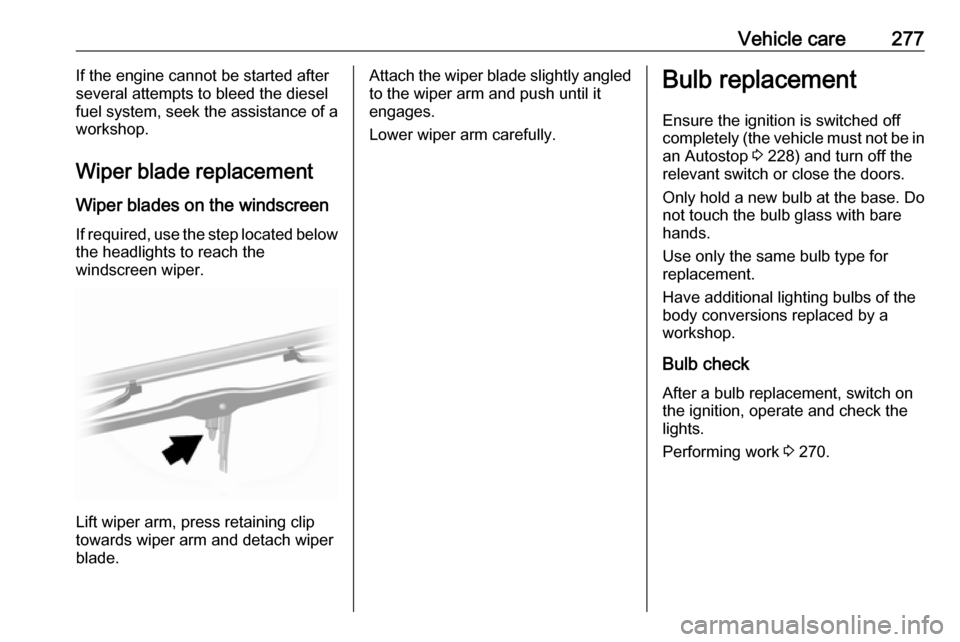
Lift wiper arm, press retaining clip
towards wiper arm and detach wiper
blade.
Attach the wiper blade slightly angled
to the wiper arm and push until it
engages.
Lower wiper arm carefully.Bulb replacement
Ensure the ignition is switched off
completely (the vehicle must not be in
an Autostop 3 228) and turn off the
relevant switch or close the doors.
Only hold a new bulb at the base. Do not touch the bulb glass with bare
hands.
Use only the same bulb type for
replacement.
Have additional lighting bulbs of the
body conversions replaced by a
workshop.
Bulb check
After a bulb replacement, switch on
the ignition, operate and check the
lights.
Performing work 3 270.
Page 280 of 353
278Vehicle careHeadlights
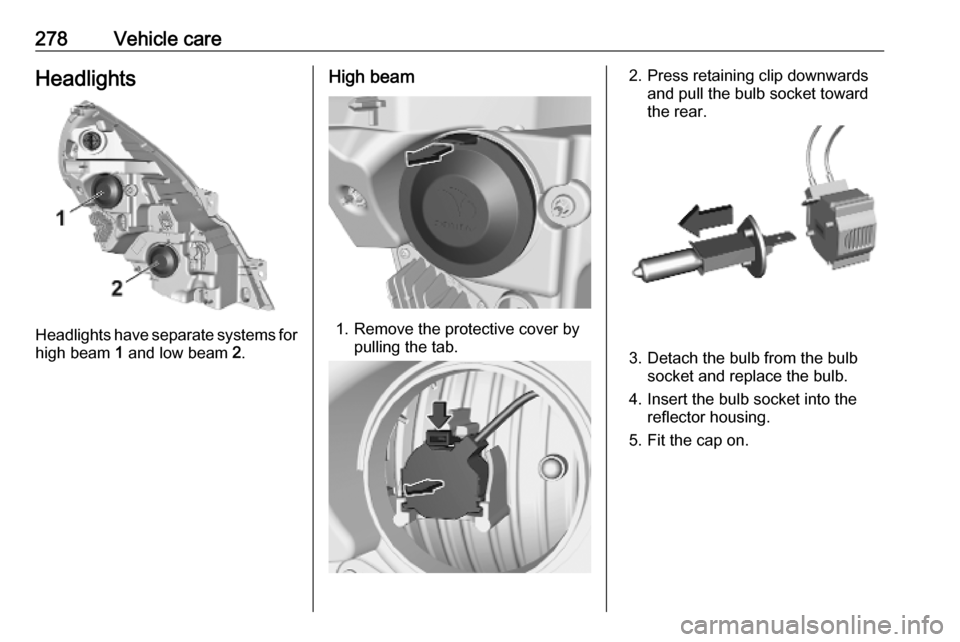
Headlights have separate systems forhigh beam 1 and low beam 2.
High beam
1. Remove the protective cover by
pulling the tab.
2. Press retaining clip downwardsand pull the bulb socket toward
the rear.
3. Detach the bulb from the bulb socket and replace the bulb.
4. Insert the bulb socket into the reflector housing.
5. Fit the cap on.
Page 281 of 353
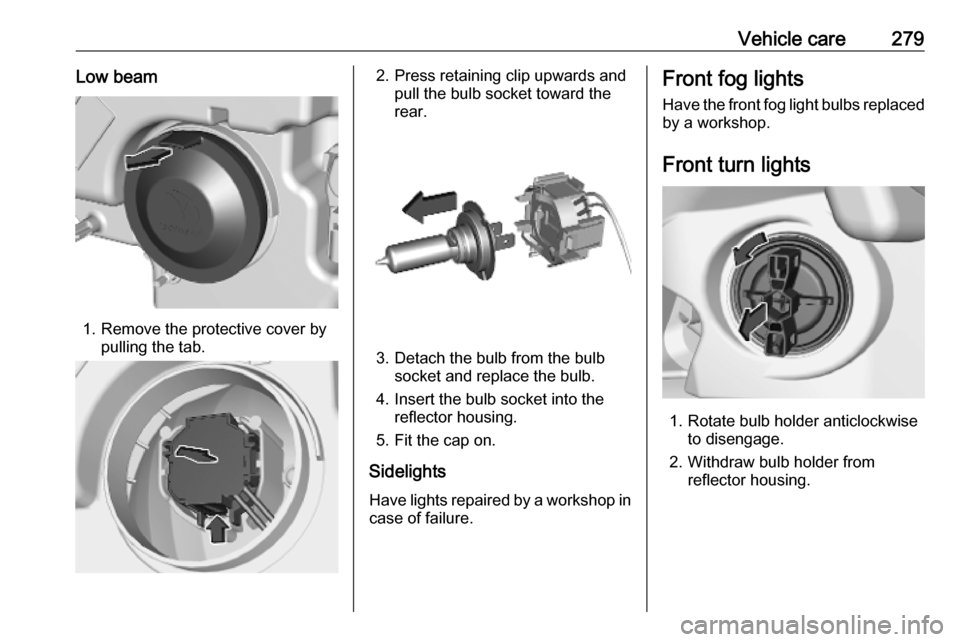
Vehicle care279Low beam
1. Remove the protective cover bypulling the tab.
2. Press retaining clip upwards and pull the bulb socket toward the
rear.
3. Detach the bulb from the bulb socket and replace the bulb.
4. Insert the bulb socket into the reflector housing.
5. Fit the cap on.
Sidelights Have lights repaired by a workshop in
case of failure.
Front fog lights
Have the front fog light bulbs replaced by a workshop.
Front turn lights
1. Rotate bulb holder anticlockwise to disengage.
2. Withdraw bulb holder from reflector housing.
Page 292 of 353
290Vehicle careVehicle tools
Tools
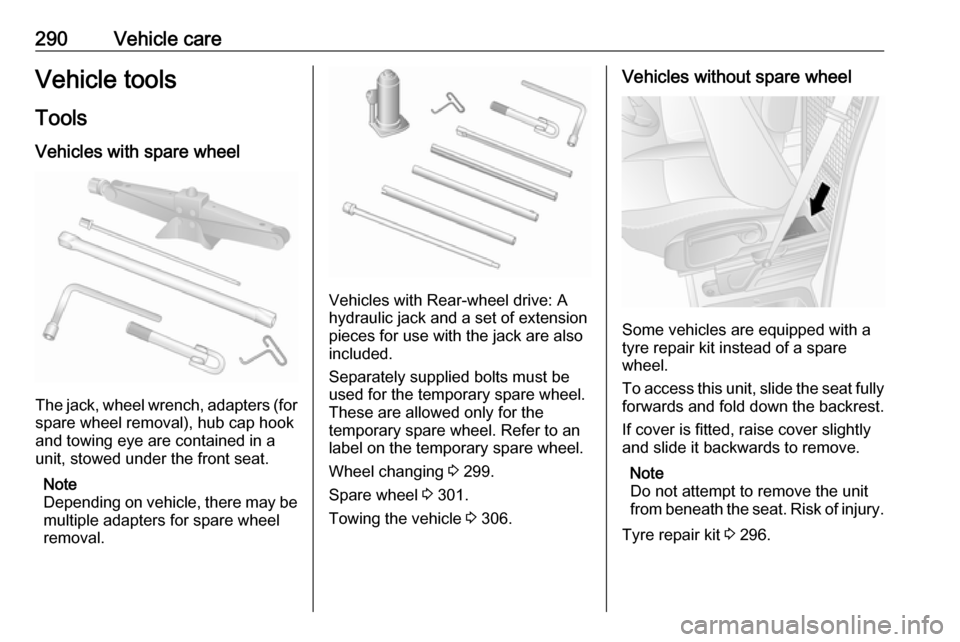
Vehicles with spare wheel
The jack, wheel wrench, adapters (for
spare wheel removal), hub cap hook
and towing eye are contained in a
unit, stowed under the front seat.
Note
Depending on vehicle, there may be
multiple adapters for spare wheel
removal.
Vehicles with Rear-wheel drive: A hydraulic jack and a set of extension
pieces for use with the jack are also
included.
Separately supplied bolts must be
used for the temporary spare wheel.
These are allowed only for the
temporary spare wheel. Refer to an label on the temporary spare wheel.
Wheel changing 3 299.
Spare wheel 3 301.
Towing the vehicle 3 306.
Vehicles without spare wheel
Some vehicles are equipped with a
tyre repair kit instead of a spare
wheel.
To access this unit, slide the seat fully forwards and fold down the backrest.
If cover is fitted, raise cover slightly
and slide it backwards to remove.
Note
Do not attempt to remove the unit
from beneath the seat. Risk of injury.
Tyre repair kit 3 296.