AUX OPEL VECTRA 1988 Service Service Manual
[x] Cancel search | Manufacturer: OPEL, Model Year: 1988, Model line: VECTRA, Model: OPEL VECTRA 1988Pages: 525, PDF Size: 58.26 MB
Page 183 of 525
14Brake fluid renewal
3
Renew the brake and bleed the system.
Refer to Chapter 9 for full details.
15Brake pad check
2
With the front or rear (as applicable) of the
vehicle raised, remove the wheels and check
brake pads for wear. Renew the pads if the
lining is below that specified. See Chapter 9,
for specifications and full details.
16Handbrake linkage check
2
With the vehicle raised, check the operation
of the handbrake and lubricate the linkages.
Refer to Chapter 9, for further details.
17Power steering fluid check
2
1With the engine off, remove the cap from
the power steering reservoir. It is fitted with a
dipstick.
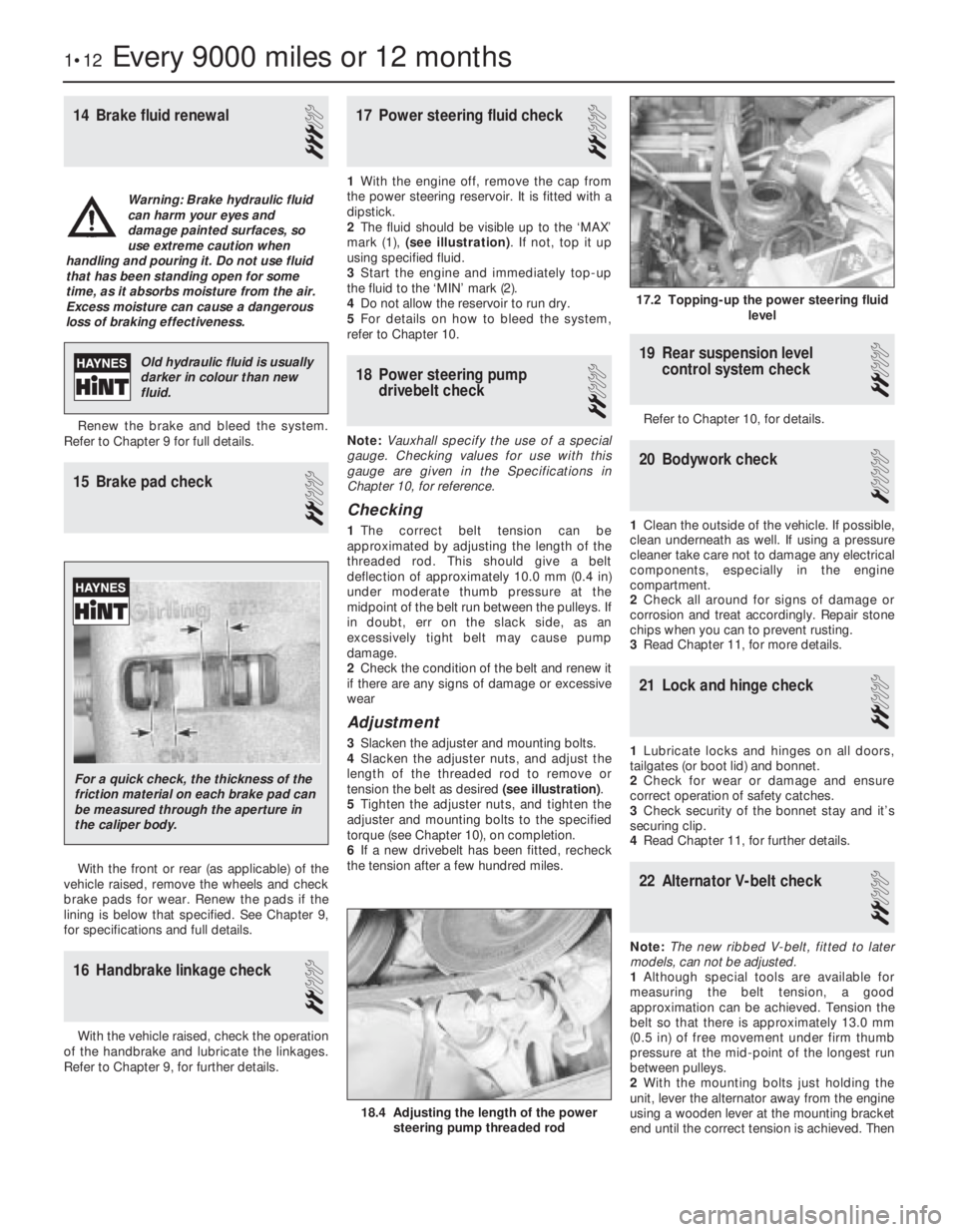
2The fluid should be visible up to the ‘MAX’
mark (1), (see illustration). If not, top it up
using specified fluid.
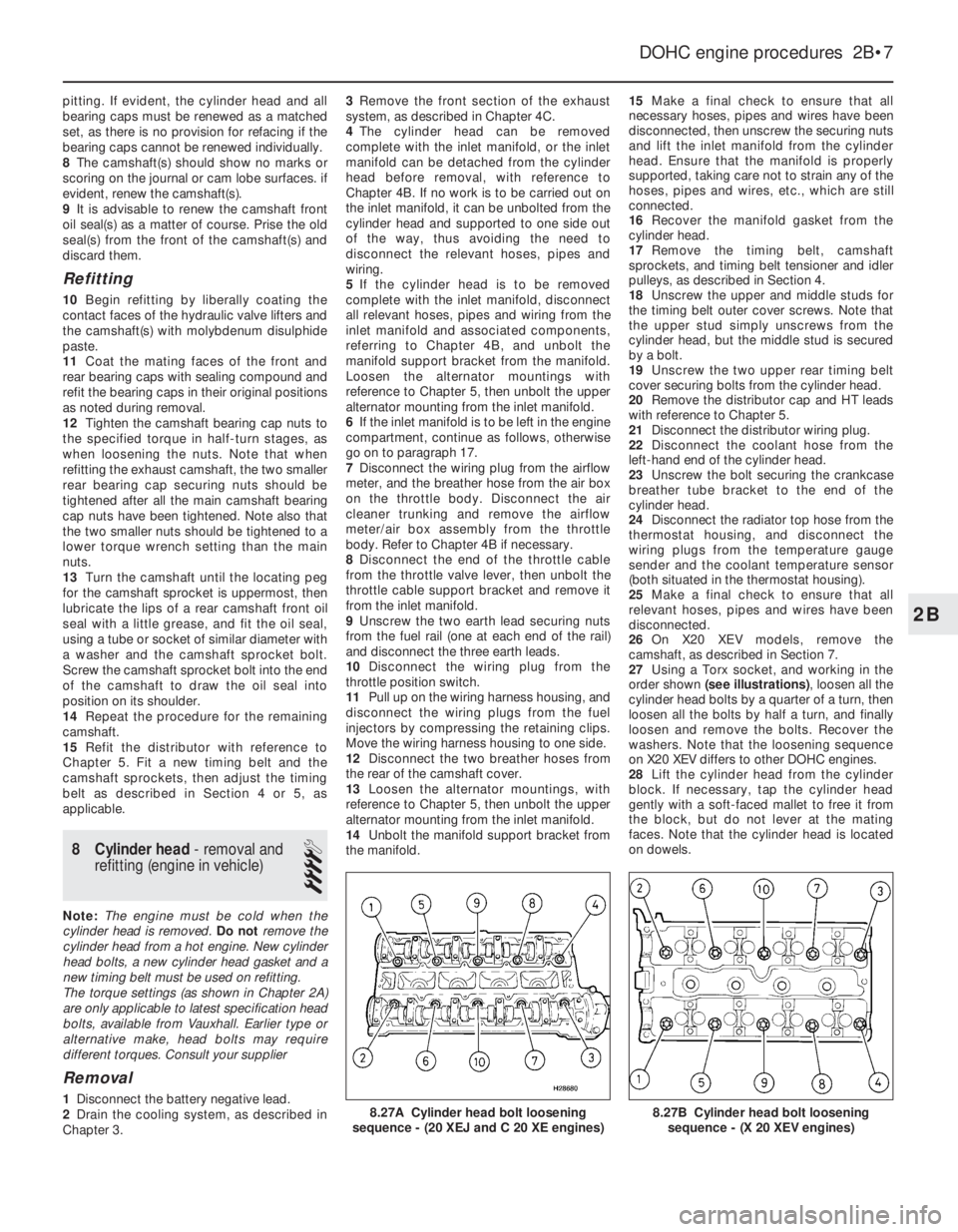
3Start the engine and immediately top-up
the fluid to the ‘MIN’ mark (2).
4Do not allow the reservoir to run dry.
5For details on how to bleed the system,
refer to Chapter 10.
18Power steering pump
drivebelt check
2
Note:Vauxhall specify the use of a special
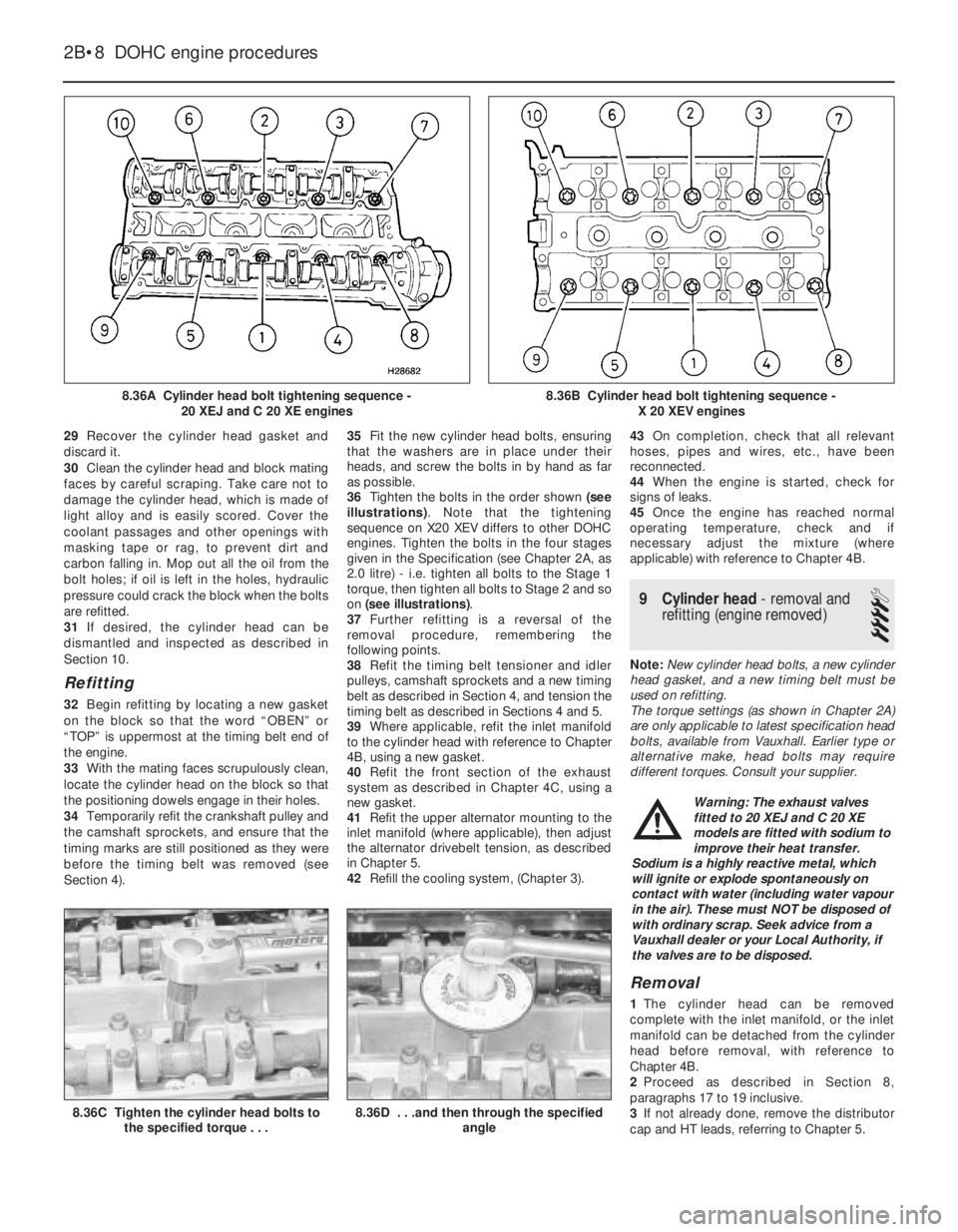
gauge. Checking values for use with this
gauge are given in the Specifications in
Chapter 10, for reference.
Checking
1The correct belt tension can be
approximated by adjusting the length of the
threaded rod. This should give a belt
deflection of approximately 10.0 mm (0.4 in)
under moderate thumb pressure at the
midpoint of the belt run between the pulleys. If
in doubt, err on the slack side, as an
excessively tight belt may cause pump
damage.
2Check the condition of the belt and renew it
if there are any signs of damage or excessive
wear
Adjustment
3Slacken the adjuster and mounting bolts.
4Slacken the adjuster nuts, and adjust the
length of the threaded rod to remove or
tension the belt as desired (see illustration).
5Tighten the adjuster nuts, and tighten the
adjuster and mounting bolts to the specified
torque (see Chapter 10), on completion.
6If a new drivebelt has been fitted, recheck
the tension after a few hundred miles.
19Rear suspension level
control system check
2
Refer to Chapter 10, for details.
20Bodywork check
1
1Clean the outside of the vehicle. If possible,
clean underneath as well. If using a pressure
cleaner take care not to damage any electrical
components, especially in the engine
compartment.
2Check all around for signs of damage or
corrosion and treat accordingly. Repair stone
chips when you can to prevent rusting.
3Read Chapter 11, for more details.
21Lock and hinge check
2
1Lubricate locks and hinges on all doors,
tailgates (or boot lid) and bonnet.
2Check for wear or damage and ensure
correct operation of safety catches.
3Check security of the bonnet stay and it’s
securing clip.
4Read Chapter 11, for further details.
22Alternator V-belt check
2
Note:The new ribbed V-belt, fitted to later
models, can not be adjusted.
1Although special tools are available for
measuring the belt tension, a good
approximation can be achieved. Tension the
belt so that there is approximately 13.0 mm
(0.5 in) of free movement under firm thumb
pressure at the mid-point of the longest run
between pulleys.
2With the mounting bolts just holding the
unit, lever the alternator away from the engine
using a wooden lever at the mounting bracket
end until the correct tension is achieved. Then
1•12Every 9000 miles or 12 months
17.2 Topping-up the power steering fluid
level
18.4 Adjusting the length of the power
steering pump threaded rod
Warning: Brake hydraulic fluid
can harm your eyes and
damage painted surfaces, so
use extreme caution when
handling and pouring it. Do not use fluid
that has been standing open for some
time, as it absorbs moisture from the air.
Excess moisture can cause a dangerous
loss of braking effectiveness.
Old hydraulic fluid is usually
darker in colour than new
fluid.
For a quick check, the thickness of the
friction material on each brake pad can
be measured through the aperture in
the caliper body.
Page 186 of 525
3When refitting the distributor cap, check
that the ends of the HT leads are fitted
securely to the cap, plugs and coil. Also make
sure that the spring-tensioned carbon brush
in the centre of the distributor cap moves
freely, and that the HT segments are not worn
excessively.
4Inspect the electrical and vacuum
connections of the ignition/engine
management systems, and make sure that
they are clean and secure.
32Clutch cable check
2
Check the clutch cable adjustment, as
described in Chapter 6.
Check also, the condition of the cable.
Inspect the cable strands for fraying, and
ensure that the cable is correctly routed, to
avoid chafing against surrounding
components. Renew the cable, as described
in Chapter 6, if excessive wear or damage is
evident.
33Manual transmission fluid
check
2
Note:Models built after 1994 it is no longer
necessary to check levels.
1Ensure that the vehicle is on level ground.
2Unscrew the transmission oil level plug,
which is located in the rear left of the
differential housing on F10 and F13
transmissions, and in the rear right of the
differential housing on F16 and F20
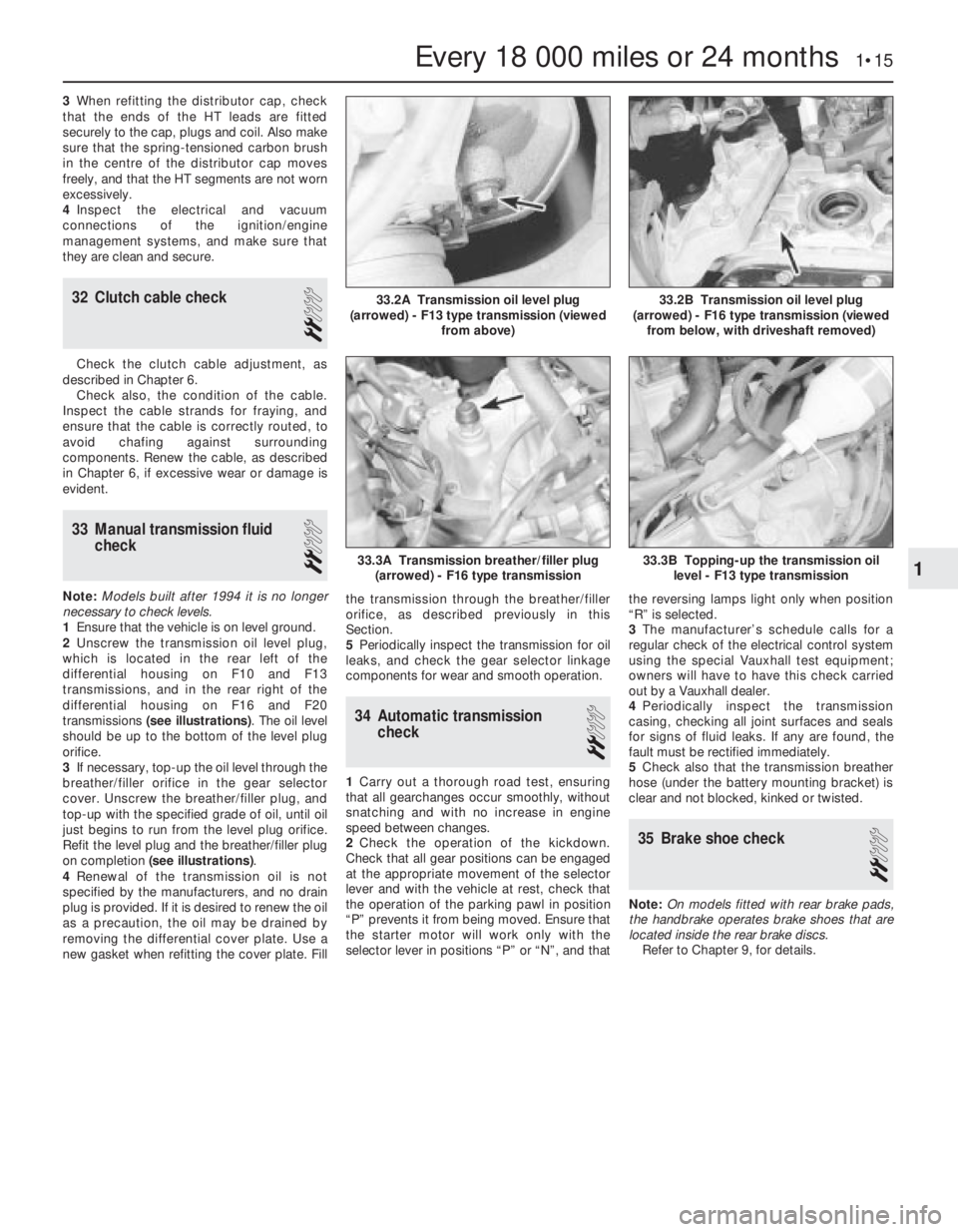
transmissions (see illustrations). The oil level
should be up to the bottom of the level plug
orifice.
3If necessary, top-up the oil level through the
breather/filler orifice in the gear selector
cover. Unscrew the breather/filler plug, and
top-up with the specified grade of oil, until oil
just begins to run from the level plug orifice.
Refit the level plug and the breather/filler plug
on completion (see illustrations).
4Renewal of the transmission oil is not
specified by the manufacturers, and no drain
plug is provided. If it is desired to renew the oil
as a precaution, the oil may be drained by
removing the differential cover plate. Use a
new gasket when refitting the cover plate. Fillthe transmission through the breather/filler
orifice, as described previously in this
Section.
5Periodically inspect the transmission for oil
leaks, and check the gear selector linkage
components for wear and smooth operation.
34Automatic transmission
check
2
1Carry out a thorough road test, ensuring
that all gearchanges occur smoothly, without
snatching and with no increase in engine
speed between changes.
2Check the operation of the kickdown.
Check that all gear positions can be engaged
at the appropriate movement of the selector
lever and with the vehicle at rest, check that
the operation of the parking pawl in position
“P” prevents it from being moved. Ensure that
the starter motor will work only with the
selector lever in positions “P” or “N”, and thatthe reversing lamps light only when position
“R” is selected.
3The manufacturer’s schedule calls for a
regular check of the electrical control system
using the special Vauxhall test equipment;
owners will have to have this check carried
out by a Vauxhall dealer.
4Periodically inspect the transmission
casing, checking all joint surfaces and seals
for signs of fluid leaks. If any are found, the
fault must be rectified immediately.
5Check also that the transmission breather
hose (under the battery mounting bracket) is
clear and not blocked, kinked or twisted.
35Brake shoe check
2
Note:On models fitted with rear brake pads,
the handbrake operates brake shoes that are
located inside the rear brake discs.
Refer to Chapter 9, for details.
Every 18 000 miles or 24 months 1•15
33.3A Transmission breather/filler plug
(arrowed) - F16 type transmission33.3B Topping-up the transmission oil
level - F13 type transmission
33.2B Transmission oil level plug
(arrowed) - F16 type transmission (viewed
from below, with driveshaft removed)33.2A Transmission oil level plug
(arrowed) - F13 type transmission (viewed
from above)
1
Page 187 of 525
36Timing belt renewal
3
1To minimise risk of major damage to the
engine the timing belt (or cambelt, as it is
sometimes called), needs replacing at least,
on every major service.
2It is good practise however, not only to
renew the belt whenever major engine work is
carried out, but also if you buy a used car with
unclear service history.
3Some models are fitted with an inspection
cover to view the condition of the belt. Whilst
others involve a lot more work.
4Full details on checking and replacement
are shown in Chapters 2A or 2B, as
appropriate.
37Spark plug renewal (DOHC)
2
1This procedure is basically the same shown
in Section 30. However on these models, a
spark plug cover needs to be removed from
the camshaft cover before the plugs can be
removed.
2Take great care when removing and
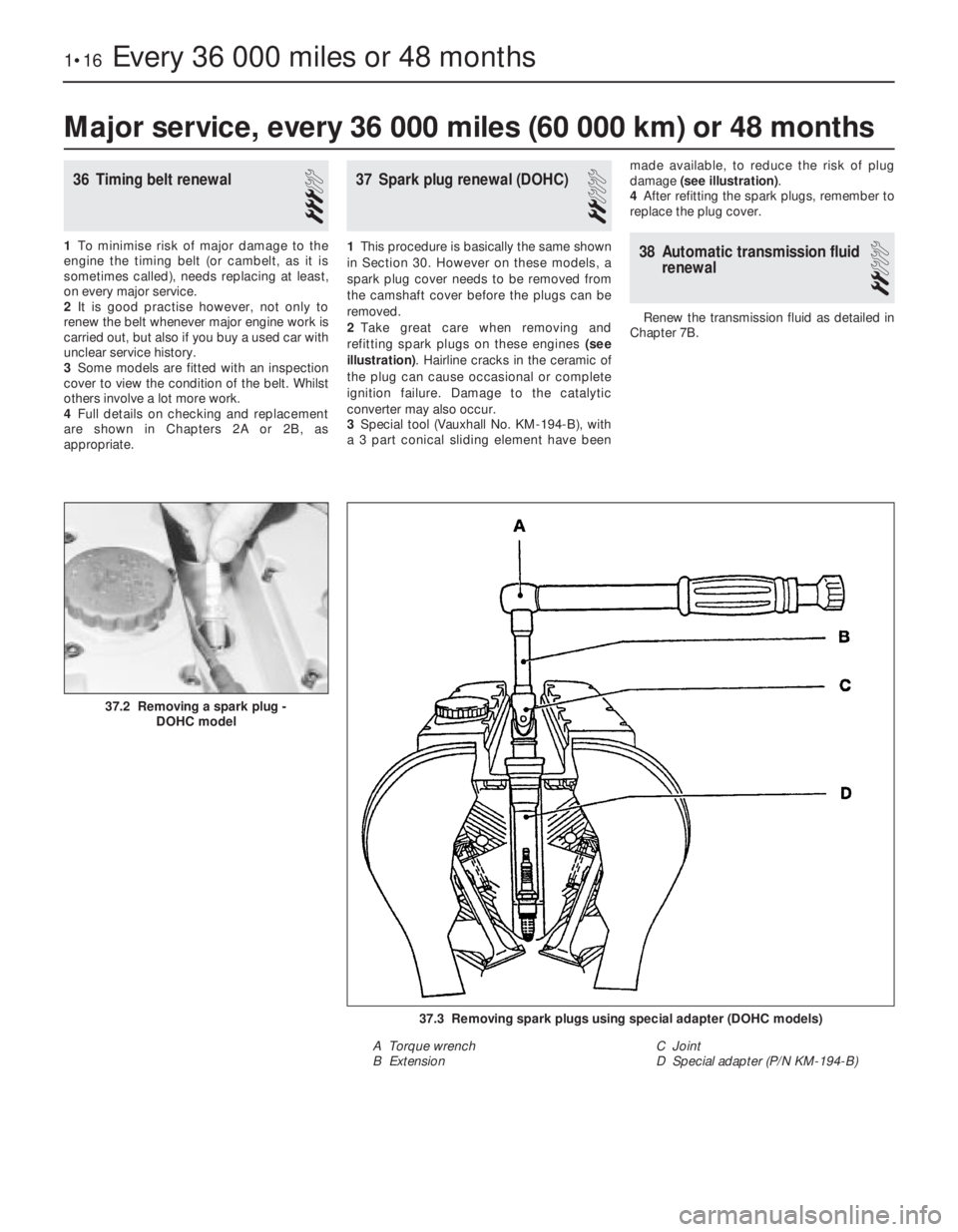
refitting spark plugs on these engines (see
illustration). Hairline cracks in the ceramic of
the plug can cause occasional or complete
ignition failure. Damage to the catalytic
converter may also occur.
3Special tool (Vauxhall No. KM-194-B), with
a 3 part conical sliding element have beenmade available, to reduce the risk of plug
damage (see illustration).
4After refitting the spark plugs, remember to
replace the plug cover.38Automatic transmission fluid
renewal
2
Renew the transmission fluid as detailed in
Chapter 7B.
1•16Every 36 000 miles or 48 months
37.3 Removing spark plugs using special adapter (DOHC models)
A Torque wrench
B ExtensionC Joint
D Special adapter (P/N KM-194-B)
37.2 Removing a spark plug -
DOHC model
Major service, every 36 000 miles (60 000 km) or 48 months
Page 192 of 525
Apply a little grease to the threads of the
securing bolt, and tighten it to the specified
torque in the two stages given in the Specifi-
cations. Ensure that the thrustwasher is in
place under the bolt head, and prevent the
crankshaft from turning as during removal.
23Refit the camshaft sprockets. Ensure that
the locating pins on the ends of the camshafts
engage with the holes in the sprockets and
with the sprocket timing marks facing
forwards. Then tighten the securing bolts to
the specified torque in the two stages given in
the Specifications. Prevent the camshafts
from turning as during removal.
24Check the condition of the camshaft
cover rubber gasket and renew if necessary,
then refit the camshaft cover and tighten the
securing bolts (see illustration).
25Refit the HT leads to the spark plugs
(ensuring that they are refitted to their correct
cylinders), then clip the leads to the end of the
camshaft cover. Refit the spark plug cover
and tighten the securing bolts.
26Reconnect the breather hose to the
camshaft cover.
27Temporarily refit the crankshaft pulley,
and ensure that the crankshaft pulley and
camshaft sprocket timing marks are still
aligned as described in paragraph 6. Then fit a
new timing belt around the sprockets and
pulleys, starting at the crankshaft sprocket.
28Refit the crankshaft pulley, and tighten the
securing bolts to the specified torque. If
necessary, prevent the crankshaft from
turning as during removal. 29Adjust the timing belt tension, as
described from paragraph 35 onwards.
30Refit the outer timing belt cover, ensuring
that the rubber grommets are in place in the
screw holes, and tighten the securing screws.
31Refit the alternator drivebelt and adjust
the drivebelt tension, as described in Chapter
5.
32Refit the power steering pump drivebelt
and adjust the drivebelt tension, as described
in Chapter 10.
33Refit the air cleaner components as
applicable, referring to Chapter 4B, if
necessary.
34Reconnect the battery negative lead.
Adjustment
Note: The manufacturers specify the use of
special adjustment wrench Vauxhall tool No
KM-666 for adjusting the timing belt tension. If
access to this tool cannot be obtained an
approximate adjustment can be achieved
using the method described in this Section.
However it is emphasised that the vehicle
should be taken to a dealer at the earliest
possible opportunity to have the tension
adjusted using the special tool. Do not drive
the vehicle over any long distance until the
belt tension has been adjusted by a dealer
Approximate adjustment
35No checking of timing belt adjustment is
specified, and the following adjustment
procedure applies to a newly fitted belt. The
adjustment must be carried out with the
engine cold.36With the timing belt cover removed and
the tensioner pulley bolt slackened, ensure
that the TDC marks on the camshaft
sprockets and the crankshaft pulley are
aligned as described in paragraph 6. If
necessary, turn the crankshaft to achieve
alignment.
37Have an assistant press the tensioner
pulley against the belt until the belt can just be
twisted through 45°, using moderate pressure
with the thumb and forefinger, on the longest
belt run between the exhaust camshaft
sprocket and the belt idler pulley.
38Have the assistant hold the tensioner
pulley in position, and tighten the tensioner
pulley bolt to the specified torque in the two
stages given in the Specifications.
39Turn the crankshaft clockwise through
two complete revolutions, and check that,
with the crankshaft pulley TDC mark aligned
with the pointer on the rear timing belt cover,
the TDC marks on the camshaft sprockets are
still aligned with the notches in the camshaft
cover.
40Proceed as described in paragraphs 30 to
34, inclusive.
41Have the belt tension adjusted by a
Vauxhall dealer using the manufacturer’s
special tool at the earliest opportunity.Adjustment using Vauxhall special
tool (KM-666)
42Proceed as described in paragraphs 35
and 36.
43Fit the special tool KM-666 to the belt
tensioner pulley mounting plate, in
accordance with the tool manufacturer’s
instructions.
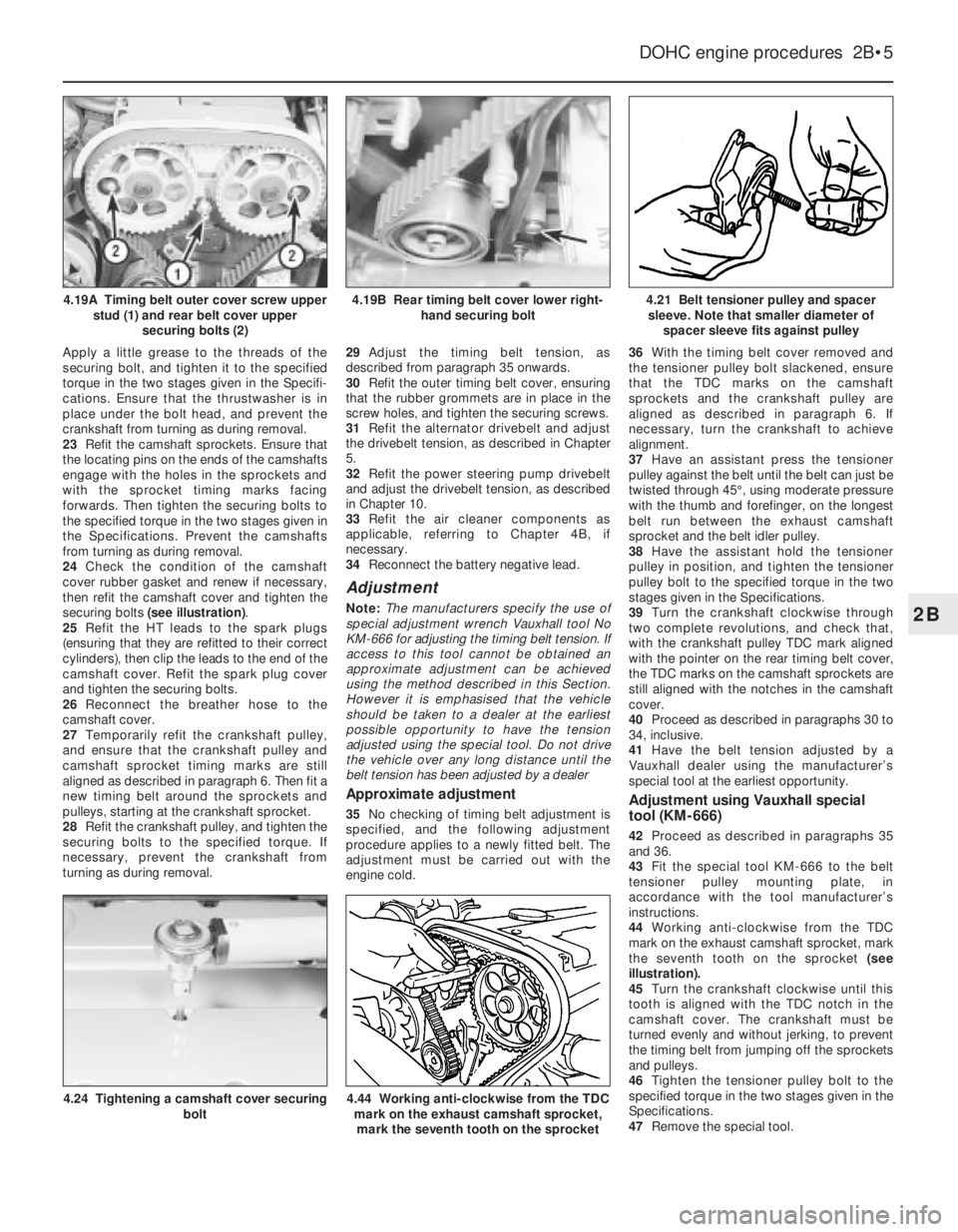
44Working anti-clockwise from the TDC
mark on the exhaust camshaft sprocket, mark
the seventh tooth on the sprocket (see
illustration).
45Turn the crankshaft clockwise until this
tooth is aligned with the TDC notch in the
camshaft cover. The crankshaft must be
turned evenly and without jerking, to prevent
the timing belt from jumping off the sprockets
and pulleys.
46Tighten the tensioner pulley bolt to the
specified torque in the two stages given in the
Specifications.
47Remove the special tool.
DOHC engine procedures 2B•5
4.21 Belt tensioner pulley and spacer
sleeve. Note that smaller diameter of
spacer sleeve fits against pulley
4.44 Working anti-clockwise from the TDC
mark on the exhaust camshaft sprocket,
mark the seventh tooth on the sprocket4.24 Tightening a camshaft cover securing
bolt
4.19B Rear timing belt cover lower right-
hand securing bolt4.19A Timing belt outer cover screw upper
stud (1) and rear belt cover upper
securing bolts (2)
2B
Page 194 of 525
pitting. If evident, the cylinder head and all
bearing caps must be renewed as a matched
set, as there is no provision for refacing if the
bearing caps cannot be renewed individually.
8The camshaft(s) should show no marks or
scoring on the journal or cam lobe surfaces. if
evident, renew the camshaft(s).
9It is advisable to renew the camshaft front
oil seal(s) as a matter of course. Prise the old
seal(s) from the front of the camshaft(s) and
discard them.
Refitting
10Begin refitting by liberally coating the
contact faces of the hydraulic valve lifters and
the camshaft(s) with molybdenum disulphide
paste.
11Coat the mating faces of the front and
rear bearing caps with sealing compound and
refit the bearing caps in their original positions
as noted during removal.
12Tighten the camshaft bearing cap nuts to
the specified torque in half-turn stages, as
when loosening the nuts. Note that when
refitting the exhaust camshaft, the two smaller
rear bearing cap securing nuts should be
tightened after all the main camshaft bearing
cap nuts have been tightened. Note also that
the two smaller nuts should be tightened to a
lower torque wrench setting than the main
nuts.
13Turn the camshaft until the locating peg
for the camshaft sprocket is uppermost, then
lubricate the lips of a rear camshaft front oil
seal with a little grease, and fit the oil seal,
using a tube or socket of similar diameter with
a washer and the camshaft sprocket bolt.
Screw the camshaft sprocket bolt into the end
of the camshaft to draw the oil seal into
position on its shoulder.
14Repeat the procedure for the remaining
camshaft.
15Refit the distributor with reference to
Chapter 5. Fit a new timing belt and the
camshaft sprockets, then adjust the timing
belt as described in Section 4 or 5, as
applicable.
8Cylinder head -removal and
refitting (engine in vehicle)
4
Note: The engine must be cold when the
cylinder head is removed. Do not remove the
cylinder head from a hot engine. New cylinder
head bolts, a new cylinder head gasket and a
new timing belt must be used on refitting.
The torque settings (as shown in Chapter 2A)
are only applicable to latest specification head
bolts, available from Vauxhall. Earlier type or
alternative make, head bolts may require
different torques. Consult your supplier
Removal
1Disconnect the battery negative lead.
2Drain the cooling system, as described in
Chapter 3.3Remove the front section of the exhaust
system, as described in Chapter 4C.
4The cylinder head can be removed
complete with the inlet manifold, or the inlet
manifold can be detached from the cylinder
head before removal, with reference to
Chapter 4B. If no work is to be carried out on
the inlet manifold, it can be unbolted from the
cylinder head and supported to one side out
of the way, thus avoiding the need to
disconnect the relevant hoses, pipes and
wiring.
5If the cylinder head is to be removed
complete with the inlet manifold, disconnect
all relevant hoses, pipes and wiring from the
inlet manifold and associated components,
referring to Chapter 4B, and unbolt the
manifold support bracket from the manifold.
Loosen the alternator mountings with
reference to Chapter 5, then unbolt the upper
alternator mounting from the inlet manifold.
6If the inlet manifold is to be left in the engine
compartment, continue as follows, otherwise
go on to paragraph 17.
7Disconnect the wiring plug from the airflow
meter, and the breather hose from the air box
on the throttle body. Disconnect the air
cleaner trunking and remove the airflow
meter/air box assembly from the throttle
body. Refer to Chapter 4B if necessary.
8Disconnect the end of the throttle cable
from the throttle valve lever, then unbolt the
throttle cable support bracket and remove it
from the inlet manifold.
9Unscrew the two earth lead securing nuts
from the fuel rail (one at each end of the rail)
and disconnect the three earth leads.
10Disconnect the wiring plug from the
throttle position switch.
11Pull up on the wiring harness housing, and
disconnect the wiring plugs from the fuel
injectors by compressing the retaining clips.
Move the wiring harness housing to one side.
12Disconnect the two breather hoses from
the rear of the camshaft cover.
13Loosen the alternator mountings, with
reference to Chapter 5, then unbolt the upper
alternator mounting from the inlet manifold.
14Unbolt the manifold support bracket from
the manifold.15Make a final check to ensure that all
necessary hoses, pipes and wires have been
disconnected, then unscrew the securing nuts
and lift the inlet manifold from the cylinder
head. Ensure that the manifold is properly
supported, taking care not to strain any of the
hoses, pipes and wires, etc., which are still
connected.
16Recover the manifold gasket from the
cylinder head.
17Remove the timing belt, camshaft
sprockets, and timing belt tensioner and idler
pulleys, as described in Section 4.
18Unscrew the upper and middle studs for
the timing belt outer cover screws. Note that
the upper stud simply unscrews from the
cylinder head, but the middle stud is secured
by a bolt.
19Unscrew the two upper rear timing belt
cover securing bolts from the cylinder head.
20Remove the distributor cap and HT leads
with reference to Chapter 5.
21Disconnect the distributor wiring plug.
22Disconnect the coolant hose from the
left-hand end of the cylinder head.
23Unscrew the bolt securing the crankcase
breather tube bracket to the end of the
cylinder head.
24Disconnect the radiator top hose from the
thermostat housing, and disconnect the
wiring plugs from the temperature gauge
sender and the coolant temperature sensor
(both situated in the thermostat housing).
25Make a final check to ensure that all
relevant hoses, pipes and wires have been
disconnected.
26On X20 XEV models, remove the
camshaft, as described in Section 7.
27Using a Torx socket, and working in the
order shown (see illustrations), loosen all the
cylinder head bolts by a quarter of a turn, then
loosen all the bolts by half a turn, and finally
loosen and remove the bolts. Recover the
washers. Note that the loosening sequence
on X20 XEV differs to other DOHC engines.
28Lift the cylinder head from the cylinder
block. If necessary, tap the cylinder head
gently with a soft-faced mallet to free it from
the block, but do not lever at the mating
faces. Note that the cylinder head is located
on dowels.
DOHC engine procedures 2B•7
8.27B Cylinder head bolt loosening
sequence - (X 20 XEV engines)8.27A Cylinder head bolt loosening
sequence - (20 XEJ and C 20 XE engines)
2B
Page 195 of 525
29Recover the cylinder head gasket and
discard it.
30Clean the cylinder head and block mating
faces by careful scraping. Take care not to
damage the cylinder head, which is made of
light alloy and is easily scored. Cover the
coolant passages and other openings with
masking tape or rag, to prevent dirt and
carbon falling in. Mop out all the oil from the
bolt holes; if oil is left in the holes, hydraulic
pressure could crack the block when the bolts
are refitted.
31If desired, the cylinder head can be
dismantled and inspected as described in
Section 10.
Refitting
32Begin refitting by locating a new gasket
on the block so that the word “OBEN” or
“TOP” is uppermost at the timing belt end of
the engine.
33With the mating faces scrupulously clean,
locate the cylinder head on the block so that
the positioning dowels engage in their holes.
34Temporarily refit the crankshaft pulley and
the camshaft sprockets, and ensure that the
timing marks are still positioned as they were
before the timing belt was removed (see
Section 4).35Fit the new cylinder head bolts, ensuring
that the washers are in place under their
heads, and screw the bolts in by hand as far
as possible.
36Tighten the bolts in the order shown (see
illustrations). Note that the tightening
sequence on X20 XEV differs to other DOHC
engines. Tighten the bolts in the four stages
given in the Specification (see Chapter 2A, as
2.0 litre) - i.e. tighten all bolts to the Stage 1
torque, then tighten all bolts to Stage 2 and so
on (see illustrations).
37Further refitting is a reversal of the
removal procedure, remembering the
following points.
38Refit the timing belt tensioner and idler
pulleys, camshaft sprockets and a new timing
belt as described in Section 4, and tension the
timing belt as described in Sections 4 and 5.
39Where applicable, refit the inlet manifold
to the cylinder head with reference to Chapter
4B, using a new gasket.
40Refit the front section of the exhaust
system as described in Chapter 4C, using a
new gasket.
41Refit the upper alternator mounting to the
inlet manifold (where applicable), then adjust
the alternator drivebelt tension, as described
in Chapter 5.
42Refill the cooling system, (Chapter 3).43On completion, check that all relevant
hoses, pipes and wires, etc., have been
reconnected.
44When the engine is started, check for
signs of leaks.
45Once the engine has reached normal
operating temperature, check and if
necessary adjust the mixture (where
applicable) with reference to Chapter 4B.
9Cylinder head -removal and
refitting (engine removed)
4
Note: New cylinder head bolts, a new cylinder
head gasket, and a new timing belt must be
used on refitting.
The torque settings (as shown in Chapter 2A)
are only applicable to latest specification head
bolts, available from Vauxhall. Earlier type or
alternative make, head bolts may require
different torques. Consult your supplier.
Removal
1The cylinder head can be removed
complete with the inlet manifold, or the inlet
manifold can be detached from the cylinder
head before removal, with reference to
Chapter 4B.
2Proceed as described in Section 8,
paragraphs 17 to 19 inclusive.
3If not already done, remove the distributor
cap and HT leads, referring to Chapter 5.
2B•8DOHC engine procedures
8.36A Cylinder head bolt tightening sequence -
20 XEJ and C 20 XE engines
8.36C Tighten the cylinder head bolts to
the specified torque . . .8.36D . . .and then through the specified
angle
8.36B Cylinder head bolt tightening sequence -
X 20 XEV engines
Warning: The exhaust valves
fitted to 20 XEJ and C 20 XE
models are fitted with sodium to
improve their heat transfer.
Sodium is a highly reactive metal, which
will ignite or explode spontaneously on
contact with water (including water vapour
in the air). These must NOT be disposed of
with ordinary scrap. Seek advice from a
Vauxhall dealer or your Local Authority, if
the valves are to be disposed.
Page 201 of 525
Piston rings
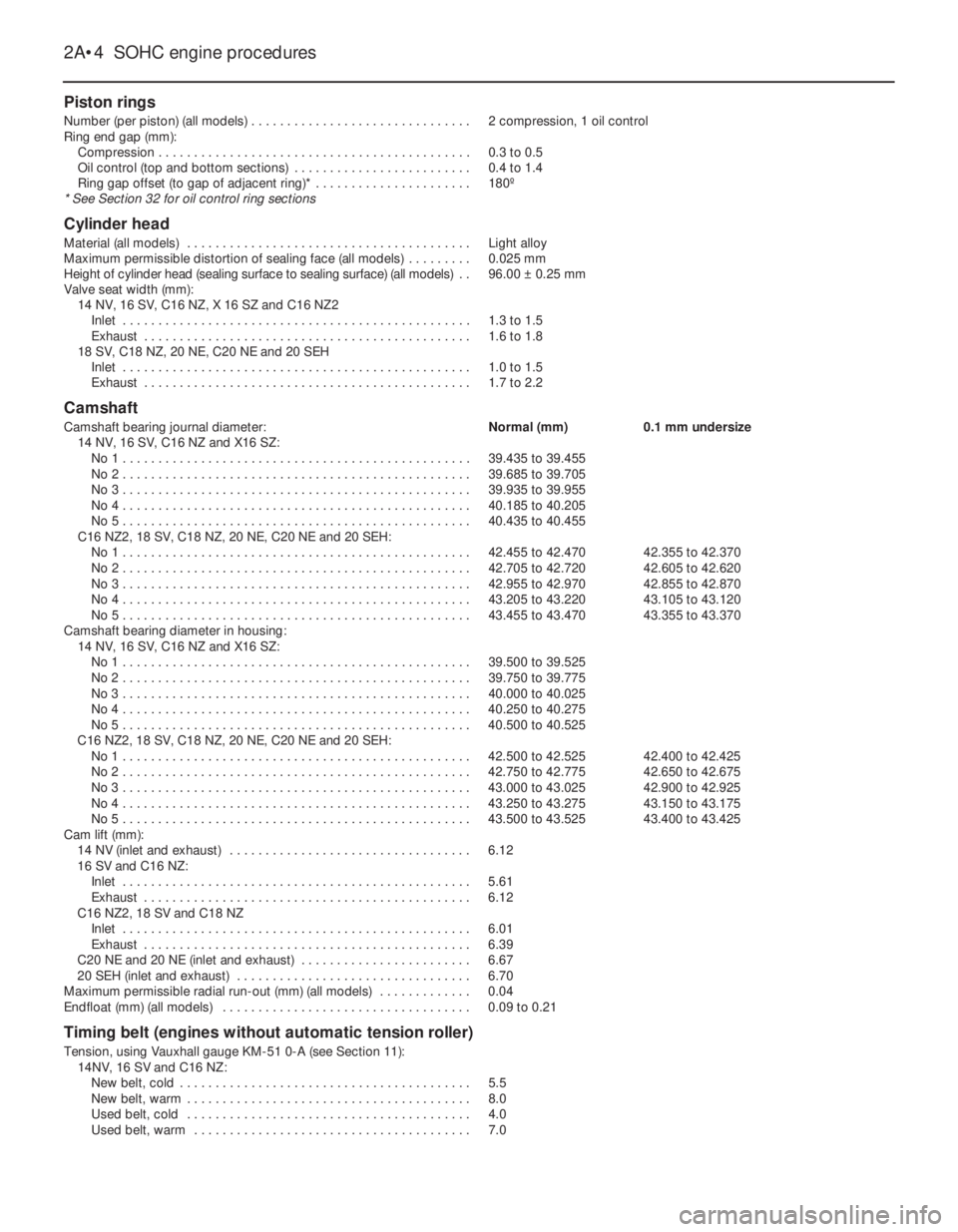
Number (per piston) (all models) . . . . . . . . . . . . . . . . . . . . . . . . . . . . . . .2 compression, 1 oil control
Ring end gap (mm):
Compression . . . . . . . . . . . . . . . . . . . . . . . . . . . . . . . . . . . . . . . . . . . .0.3 to 0.5
Oil control (top and bottom sections) . . . . . . . . . . . . . . . . . . . . . . . . .0.4 to 1.4
Ring gap offset (to gap of adjacent ring)* . . . . . . . . . . . . . . . . . . . . . .180º
* See Section 32 for oil control ring sections
Cylinder head
Material (all models) . . . . . . . . . . . . . . . . . . . . . . . . . . . . . . . . . . . . . . . .Light alloy
Maximum permissible distortion of sealing face (all models) . . . . . . . . .0.025 mm
Height of cylinder head (sealing surface to sealing surface) (all models) . .96.00 ±0.25 mm
Valve seat width (mm):
14 NV, 16 SV, C16 NZ, X 16 SZ and C16 NZ2
Inlet . . . . . . . . . . . . . . . . . . . . . . . . . . . . . . . . . . . . . . . . . . . . . . . . .1.3 to 1.5
Exhaust . . . . . . . . . . . . . . . . . . . . . . . . . . . . . . . . . . . . . . . . . . . . . .1.6 to 1.8
18 SV, C18 NZ, 20 NE, C20 NE and 20 SEH
Inlet . . . . . . . . . . . . . . . . . . . . . . . . . . . . . . . . . . . . . . . . . . . . . . . . .1.0 to 1.5
Exhaust . . . . . . . . . . . . . . . . . . . . . . . . . . . . . . . . . . . . . . . . . . . . . .1.7 to 2.2
Camshaft
Camshaft bearing journal diameter:Normal (mm)0.1 mm undersize
14 NV, 16 SV, C16 NZ and X16 SZ:
No 1 . . . . . . . . . . . . . . . . . . . . . . . . . . . . . . . . . . . . . . . . . . . . . . . . .39.435 to 39.455
No 2 . . . . . . . . . . . . . . . . . . . . . . . . . . . . . . . . . . . . . . . . . . . . . . . . .39.685 to 39.705
No 3 . . . . . . . . . . . . . . . . . . . . . . . . . . . . . . . . . . . . . . . . . . . . . . . . .39.935 to 39.955
No 4 . . . . . . . . . . . . . . . . . . . . . . . . . . . . . . . . . . . . . . . . . . . . . . . . .40.185 to 40.205
No 5 . . . . . . . . . . . . . . . . . . . . . . . . . . . . . . . . . . . . . . . . . . . . . . . . .40.435 to 40.455
C16 NZ2, 18 SV, C18 NZ, 20 NE, C20 NE and 20 SEH:
No 1 . . . . . . . . . . . . . . . . . . . . . . . . . . . . . . . . . . . . . . . . . . . . . . . . .42.455 to 42.47042.355 to 42.370
No 2 . . . . . . . . . . . . . . . . . . . . . . . . . . . . . . . . . . . . . . . . . . . . . . . . .42.705 to 42.72042.605 to 42.620
No 3 . . . . . . . . . . . . . . . . . . . . . . . . . . . . . . . . . . . . . . . . . . . . . . . . .42.955 to 42.97042.855 to 42.870
No 4 . . . . . . . . . . . . . . . . . . . . . . . . . . . . . . . . . . . . . . . . . . . . . . . . .43.205 to 43.22043.105 to 43.120
No 5 . . . . . . . . . . . . . . . . . . . . . . . . . . . . . . . . . . . . . . . . . . . . . . . . .43.455 to 43.47043.355 to 43.370
Camshaft bearing diameter in housing:
14 NV, 16 SV, C16 NZ and X16 SZ:
No 1 . . . . . . . . . . . . . . . . . . . . . . . . . . . . . . . . . . . . . . . . . . . . . . . . .39.500 to 39.525
No 2 . . . . . . . . . . . . . . . . . . . . . . . . . . . . . . . . . . . . . . . . . . . . . . . . .39.750 to 39.775
No 3 . . . . . . . . . . . . . . . . . . . . . . . . . . . . . . . . . . . . . . . . . . . . . . . . .40.000 to 40.025
No 4 . . . . . . . . . . . . . . . . . . . . . . . . . . . . . . . . . . . . . . . . . . . . . . . . .40.250 to 40.275
No 5 . . . . . . . . . . . . . . . . . . . . . . . . . . . . . . . . . . . . . . . . . . . . . . . . .40.500 to 40.525
C16 NZ2, 18 SV, C18 NZ, 20 NE, C20 NE and 20 SEH:
No 1 . . . . . . . . . . . . . . . . . . . . . . . . . . . . . . . . . . . . . . . . . . . . . . . . .42.500 to 42.52542.400 to 42.425
No 2 . . . . . . . . . . . . . . . . . . . . . . . . . . . . . . . . . . . . . . . . . . . . . . . . .42.750 to 42.77542.650 to 42.675
No 3 . . . . . . . . . . . . . . . . . . . . . . . . . . . . . . . . . . . . . . . . . . . . . . . . .43.000 to 43.02542.900 to 42.925
No 4 . . . . . . . . . . . . . . . . . . . . . . . . . . . . . . . . . . . . . . . . . . . . . . . . .43.250 to 43.27543.150 to 43.175
No 5 . . . . . . . . . . . . . . . . . . . . . . . . . . . . . . . . . . . . . . . . . . . . . . . . .43.500 to 43.52543.400 to 43.425
Cam lift (mm):
14 NV (inlet and exhaust) . . . . . . . . . . . . . . . . . . . . . . . . . . . . . . . . . .6.12
16 SV and C16 NZ:
Inlet . . . . . . . . . . . . . . . . . . . . . . . . . . . . . . . . . . . . . . . . . . . . . . . . .5.61
Exhaust . . . . . . . . . . . . . . . . . . . . . . . . . . . . . . . . . . . . . . . . . . . . . .6.12
C16 NZ2, 18 SV and C18 NZ
Inlet . . . . . . . . . . . . . . . . . . . . . . . . . . . . . . . . . . . . . . . . . . . . . . . . .6.01
Exhaust . . . . . . . . . . . . . . . . . . . . . . . . . . . . . . . . . . . . . . . . . . . . . .6.39
C20 NE and 20 NE (inlet and exhaust) . . . . . . . . . . . . . . . . . . . . . . . .6.67
20 SEH (inlet and exhaust) . . . . . . . . . . . . . . . . . . . . . . . . . . . . . . . . .6.70
Maximum permissible radial run-out (mm) (all models) . . . . . . . . . . . . .0.04
Endfloat (mm) (all models) . . . . . . . . . . . . . . . . . . . . . . . . . . . . . . . . . . .0.09 to 0.21
Timing belt (engines without automatic tension roller)
Tension, using Vauxhall gauge KM-51 0-A (see Section 11):
14NV, 16 SV and C16 NZ:
New belt, cold . . . . . . . . . . . . . . . . . . . . . . . . . . . . . . . . . . . . . . . . .5.5
New belt, warm . . . . . . . . . . . . . . . . . . . . . . . . . . . . . . . . . . . . . . . .8.0
Used belt, cold . . . . . . . . . . . . . . . . . . . . . . . . . . . . . . . . . . . . . . . .4.0
Used belt, warm . . . . . . . . . . . . . . . . . . . . . . . . . . . . . . . . . . . . . . .7.0
2A•4SOHC engine procedures
Page 202 of 525
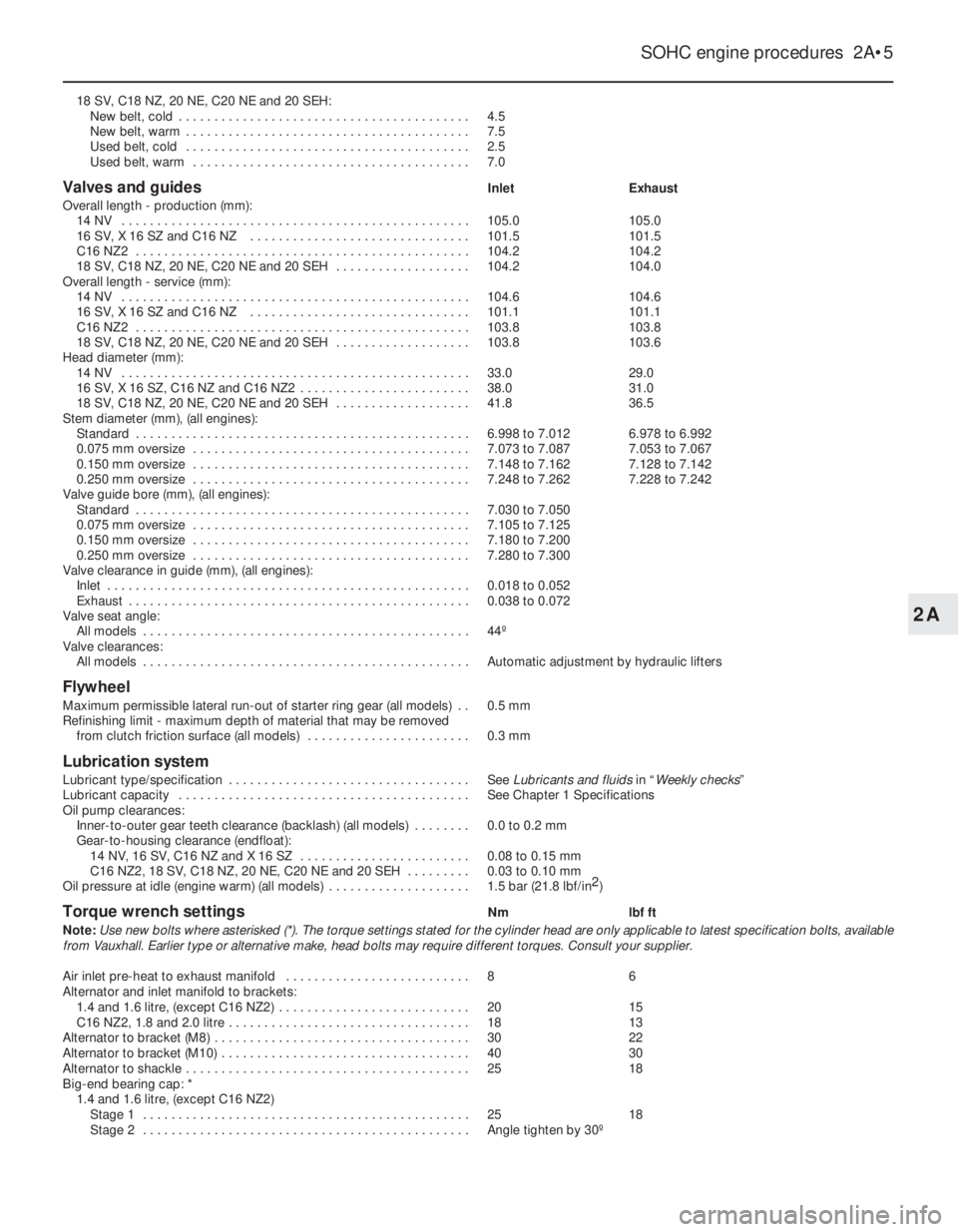
18 SV, C18 NZ, 20 NE, C20 NE and 20 SEH:
New belt, cold . . . . . . . . . . . . . . . . . . . . . . . . . . . . . . . . . . . . . . . . .4.5
New belt, warm . . . . . . . . . . . . . . . . . . . . . . . . . . . . . . . . . . . . . . . .7.5
Used belt, cold . . . . . . . . . . . . . . . . . . . . . . . . . . . . . . . . . . . . . . . .2.5
Used belt, warm . . . . . . . . . . . . . . . . . . . . . . . . . . . . . . . . . . . . . . .7.0
Valves and guidesInletExhaust
Overall length - production (mm):
14 NV . . . . . . . . . . . . . . . . . . . . . . . . . . . . . . . . . . . . . . . . . . . . . . . . .105.0105.0
16 SV, X 16 SZ and C16 NZ . . . . . . . . . . . . . . . . . . . . . . . . . . . . . . .101.5101.5
C16 NZ2 . . . . . . . . . . . . . . . . . . . . . . . . . . . . . . . . . . . . . . . . . . . . . . .104.2104.2
18 SV, C18 NZ, 20 NE, C20 NE and 20 SEH . . . . . . . . . . . . . . . . . . .104.2104.0
Overall length - service (mm):
14 NV . . . . . . . . . . . . . . . . . . . . . . . . . . . . . . . . . . . . . . . . . . . . . . . . .104.6104.6
16 SV, X 16 SZ and C16 NZ . . . . . . . . . . . . . . . . . . . . . . . . . . . . . . .101.1101.1
C16 NZ2 . . . . . . . . . . . . . . . . . . . . . . . . . . . . . . . . . . . . . . . . . . . . . . .103.8103.8
18 SV, C18 NZ, 20 NE, C20 NE and 20 SEH . . . . . . . . . . . . . . . . . . .103.8103.6
Head diameter (mm):
14 NV . . . . . . . . . . . . . . . . . . . . . . . . . . . . . . . . . . . . . . . . . . . . . . . . .33.029.0
16 SV, X 16 SZ, C16 NZ and C16 NZ2 . . . . . . . . . . . . . . . . . . . . . . . .38.031.0
18 SV, C18 NZ, 20 NE, C20 NE and 20 SEH . . . . . . . . . . . . . . . . . . .41.836.5
Stem diameter (mm), (all engines):
Standard . . . . . . . . . . . . . . . . . . . . . . . . . . . . . . . . . . . . . . . . . . . . . . .6.998 to 7.0126.978 to 6.992
0.075 mm oversize . . . . . . . . . . . . . . . . . . . . . . . . . . . . . . . . . . . . . . .7.073 to 7.0877.053 to 7.067
0.150 mm oversize . . . . . . . . . . . . . . . . . . . . . . . . . . . . . . . . . . . . . . .7.148 to 7.1627.128 to 7.142
0.250 mm oversize . . . . . . . . . . . . . . . . . . . . . . . . . . . . . . . . . . . . . . .7.248 to 7.2627.228 to 7.242
Valve guide bore (mm), (all engines):
Standard . . . . . . . . . . . . . . . . . . . . . . . . . . . . . . . . . . . . . . . . . . . . . . .7.030 to 7.050
0.075 mm oversize . . . . . . . . . . . . . . . . . . . . . . . . . . . . . . . . . . . . . . .7.105 to 7.125
0.150 mm oversize . . . . . . . . . . . . . . . . . . . . . . . . . . . . . . . . . . . . . . .7.180 to 7.200
0.250 mm oversize . . . . . . . . . . . . . . . . . . . . . . . . . . . . . . . . . . . . . . .7.280 to 7.300
Valve clearance in guide (mm), (all engines):
Inlet . . . . . . . . . . . . . . . . . . . . . . . . . . . . . . . . . . . . . . . . . . . . . . . . . . .0.018 to 0.052
Exhaust . . . . . . . . . . . . . . . . . . . . . . . . . . . . . . . . . . . . . . . . . . . . . . . .0.038 to 0.072
Valve seat angle:
All models . . . . . . . . . . . . . . . . . . . . . . . . . . . . . . . . . . . . . . . . . . . . . .44º
Valve clearances:
All models . . . . . . . . . . . . . . . . . . . . . . . . . . . . . . . . . . . . . . . . . . . . . .Automatic adjustment by hydraulic lifters
Flywheel
Maximum permissible lateral run-out of starter ring gear (all models) . .0.5 mm
Refinishing limit -maximum depth of material that may be removed
from clutch friction surface (all models) . . . . . . . . . . . . . . . . . . . . . . .0.3 mm
Lubrication system
Lubricant type/specification . . . . . . . . . . . . . . . . . . . . . . . . . . . . . . . . . .See Lubricants and fluids in “Weekly checks”
Lubricant capacity . . . . . . . . . . . . . . . . . . . . . . . . . . . . . . . . . . . . . . . . .See Chapter 1 Specifications
Oil pump clearances:
Inner-to-outer gear teeth clearance (backlash) (all models) . . . . . . . .0.0 to 0.2 mm
Gear-to-housing clearance (endfloat):
14 NV, 16 SV, C16 NZ and X 16 SZ . . . . . . . . . . . . . . . . . . . . . . . .0.08 to 0.15 mm
C16 NZ2, 18 SV, C18 NZ, 20 NE, C20 NE and 20 SEH . . . . . . . . .0.03 to 0.10 mm
Oil pressure at idle (engine warm) (all models) . . . . . . . . . . . . . . . . . . . .1.5 bar (21.8 lbf/in2
)
Torque wrench settingsNmlbf ft
Note:Use new bolts where asterisked (*). The torque settings stated for the cylinder head are only applicable to latest specification bolts, available
from Vauxhall. Earlier type or alternative make, head bolts may require different torques. Consult your supplier.
Air inlet pre-heat to exhaust manifold . . . . . . . . . . . . . . . . . . . . . . . . . .86
Alternator and inlet manifold to brackets:
1.4 and 1.6 litre, (except C16 NZ2) . . . . . . . . . . . . . . . . . . . . . . . . . . .2015
C16 NZ2, 1.8 and 2.0 litre . . . . . . . . . . . . . . . . . . . . . . . . . . . . . . . . . .1813
Alternator to bracket (M8) . . . . . . . . . . . . . . . . . . . . . . . . . . . . . . . . . . . .3022
Alternator to bracket (M10) . . . . . . . . . . . . . . . . . . . . . . . . . . . . . . . . . . .4030
Alternator to shackle . . . . . . . . . . . . . . . . . . . . . . . . . . . . . . . . . . . . . . . .2518
Big-end bearing cap: *
1.4 and 1.6 litre, (except C16 NZ2)
Stage 1 . . . . . . . . . . . . . . . . . . . . . . . . . . . . . . . . . . . . . . . . . . . . . .2518
Stage 2 . . . . . . . . . . . . . . . . . . . . . . . . . . . . . . . . . . . . . . . . . . . . . .Angle tighten by 30º
SOHC engine procedures 2A•5
2A
Page 208 of 525
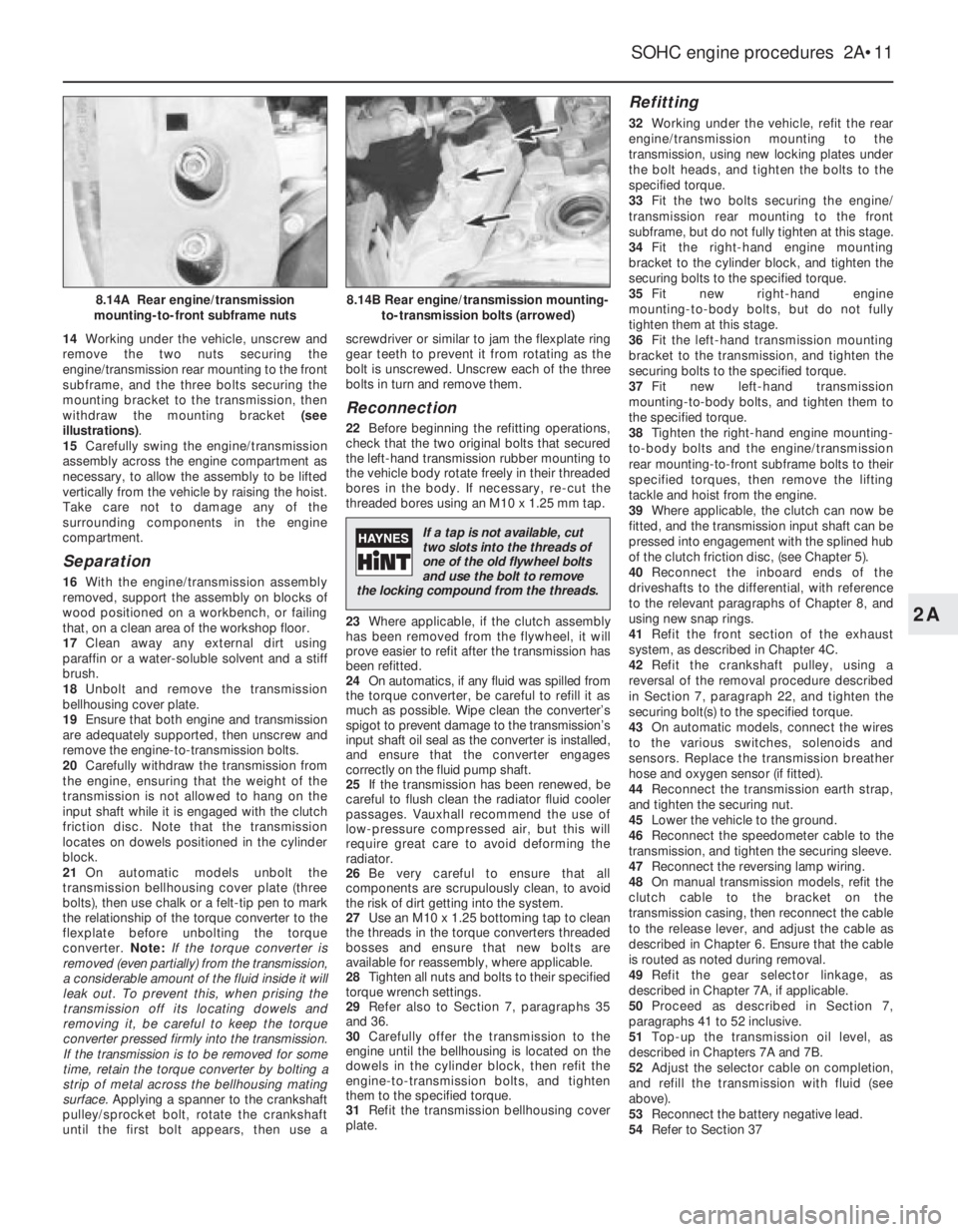
14Working under the vehicle, unscrew and
remove the two nuts securing the
engine/transmission rear mounting to the front
subframe, and the three bolts securing the
mounting bracket to the transmission, then
withdraw the mounting bracket (see
illustrations).
15Carefully swing the engine/transmission
assembly across the engine compartment as
necessary, to allow the assembly to be lifted
vertically from the vehicle by raising the hoist.
Take care not to damage any of the
surrounding components in the engine
compartment.
Separation
16With the engine/transmission assembly
removed, support the assembly on blocks of
wood positioned on a workbench, or failing
that, on a clean area of the workshop floor.
17Clean away any external dirt using
paraffin or a water-soluble solvent and a stiff
brush.
18Unbolt and remove the transmission
bellhousing cover plate.
19Ensure that both engine and transmission
are adequately supported, then unscrew and
remove the engine-to-transmission bolts.
20Carefully withdraw the transmission from
the engine, ensuring that the weight of the
transmission is not allowed to hang on the
input shaft while it is engaged with the clutch
friction disc. Note that the transmission
locates on dowels positioned in the cylinder
block.
21On automatic models unbolt the
transmission bellhousing cover plate (three
bolts), then use chalk or a felt-tip pen to mark
the relationship of the torque converter to the
flexplate before unbolting the torque
converter. Note:If the torque converter is
removed (even partially) from the transmission,
a considerable amount of the fluid inside it will
leak out. To prevent this, when prising the
transmission off its locating dowels and
removing it, be careful to keep the torque
converter pressed firmly into the transmission.
If the transmission is to be removed for some
time, retain the torque converter by bolting a
strip of metal across the bellhousing mating
surface. Applying a spanner to the crankshaft
pulley/sprocket bolt, rotate the crankshaft
until the first bolt appears, then use ascrewdriver or similar to jam the flexplate ring
gear teeth to prevent it from rotating as the
bolt is unscrewed. Unscrew each of the three
bolts in turn and remove them.
Reconnection
22Before beginning the refitting operations,
check that the two original bolts that secured
the left-hand transmission rubber mounting to
the vehicle body rotate freely in their threaded
bores in the body. If necessary, re-cut the
threaded bores using an M10 x 1.25 mm tap.
23Where applicable, if the clutch assembly
has been removed from the flywheel, it will
prove easier to refit after the transmission has
been refitted.
24On automatics, if any fluid was spilled from
the torque converter, be careful to refill it as
much as possible. Wipe clean the converter’s
spigot to prevent damage to the transmission’s
input shaft oil seal as the converter is installed,
and ensure that the converter engages
correctly on the fluid pump shaft.
25If the transmission has been renewed, be
careful to flush clean the radiator fluid cooler
passages. Vauxhall recommend the use of
low-pressure compressed air, but this will
require great care to avoid deforming the
radiator.
26Be very careful to ensure that all
components are scrupulously clean, to avoid
the risk of dirt getting into the system.
27Use an M10 x 1.25 bottoming tap to clean
the threads in the torque converters threaded
bosses and ensure that new bolts are
available for reassembly, where applicable.
28Tighten all nuts and bolts to their specified
torque wrench settings.
29Refer also to Section 7, paragraphs 35
and 36.
30Carefully offer the transmission to the
engine until the bellhousing is located on the
dowels in the cylinder block, then refit the
engine-to-transmission bolts, and tighten
them to the specified torque.
31Refit the transmission bellhousing cover
plate.
Refitting
32Working under the vehicle, refit the rear
engine/transmission mounting to the
transmission, using new locking plates under
the bolt heads, and tighten the bolts to the
specified torque.
33Fit the two bolts securing the engine/
transmission rear mounting to the front
subframe, but do not fully tighten at this stage.
34Fit the right-hand engine mounting
bracket to the cylinder block, and tighten the
securing bolts to the specified torque.
35Fit new right-hand engine
mounting-to-body bolts, but do not fully
tighten them at this stage.
36Fit the left-hand transmission mounting
bracket to the transmission, and tighten the
securing bolts to the specified torque.
37Fit new left-hand transmission
mounting-to-body bolts, and tighten them to
the specified torque.
38Tighten the right-hand engine mounting-
to-body bolts and the engine/transmission
rear mounting-to-front subframe bolts to their
specified torques, then remove the lifting
tackle and hoist from the engine.
39Where applicable, the clutch can now be
fitted, and the transmission input shaft can be
pressed into engagement with the splined hub
of the clutch friction disc, (see Chapter 5).
40Reconnect the inboard ends of the
driveshafts to the differential, with reference
to the relevant paragraphs of Chapter 8, and
using new snap rings.
41Refit the front section of the exhaust
system, as described in Chapter 4C.
42Refit the crankshaft pulley, using a
reversal of the removal procedure described
in Section 7, paragraph 22, and tighten the
securing bolt(s) to the specified torque.
43On automatic models, connect the wires
to the various switches, solenoids and
sensors. Replace the transmission breather
hose and oxygen sensor (if fitted).
44Reconnect the transmission earth strap,
and tighten the securing nut.
45Lower the vehicle to the ground.
46Reconnect the speedometer cable to the
transmission, and tighten the securing sleeve.
47Reconnect the reversing lamp wiring.
48On manual transmission models, refit the
clutch cable to the bracket on the
transmission casing, then reconnect the cable
to the release lever, and adjust the cable as
described in Chapter 6. Ensure that the cable
is routed as noted during removal.
49Refit the gear selector linkage, as
described in Chapter 7A, if applicable.
50Proceed as described in Section 7,
paragraphs 41 to 52 inclusive.
51Top-up the transmission oil level, as
described in Chapters 7A and 7B.
52Adjust the selector cable on completion,
and refill the transmission with fluid (see
above).
53Reconnect the battery negative lead.
54Refer to Section 37
SOHC engine procedures 2A•11
8.14B Rear engine/transmission mounting-
to-transmission bolts (arrowed)8.14A Rear engine/transmission
mounting-to-front subframe nuts
2A
If a tap is not available, cut
two slots into the threads of
one of the old flywheel bolts
and use the bolt to remove
the locking compound from the threads.
Page 212 of 525
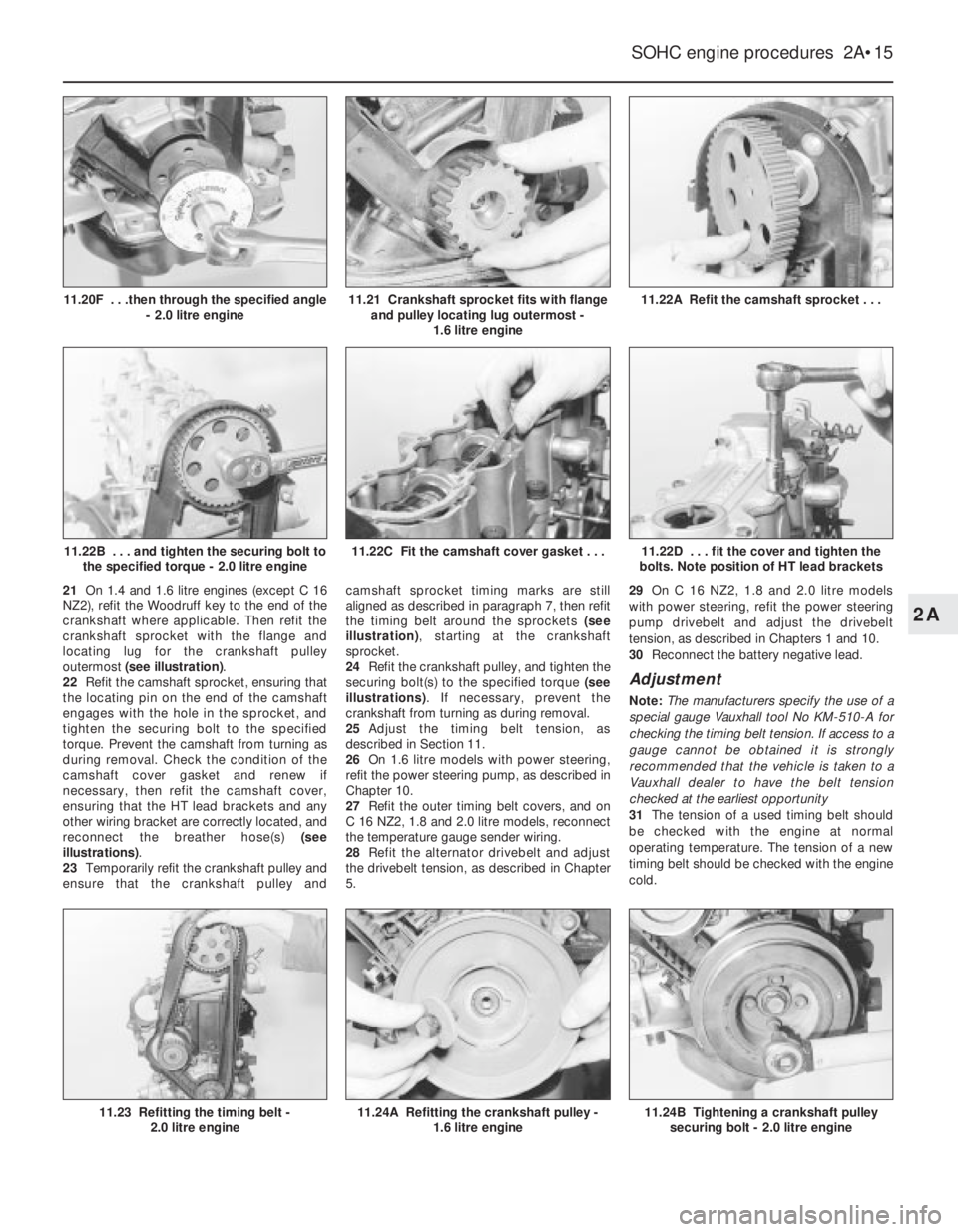
21On 1.4 and 1.6 litre engines (except C 16
NZ2), refit the Woodruff key to the end of the
crankshaft where applicable. Then refit the
crankshaft sprocket with the flange and
locating lug for the crankshaft pulley
outermost (see illustration).
22Refit the camshaft sprocket, ensuring that
the locating pin on the end of the camshaft
engages with the hole in the sprocket, and
tighten the securing bolt to the specified
torque. Prevent the camshaft from turning as
during removal. Check the condition of the
camshaft cover gasket and renew if
necessary, then refit the camshaft cover,
ensuring that the HT lead brackets and any
other wiring bracket are correctly located, and
reconnect the breather hose(s) (see
illustrations).
23Temporarily refit the crankshaft pulley and
ensure that the crankshaft pulley andcamshaft sprocket timing marks are still
aligned as described in paragraph 7, then refit
the timing belt around the sprockets (see
illustration), starting at the crankshaft
sprocket.
24Refit the crankshaft pulley, and tighten the
securing bolt(s) to the specified torque (see
illustrations). If necessary, prevent the
crankshaft from turning as during removal.
25Adjust the timing belt tension, as
described in Section 11.
26On 1.6 litre models with power steering,
refit the power steering pump, as described in
Chapter 10.
27Refit the outer timing belt covers, and on
C 16 NZ2, 1.8 and 2.0 litre models, reconnect
the temperature gauge sender wiring.
28Refit the alternator drivebelt and adjust
the drivebelt tension, as described in Chapter
5.29On C 16 NZ2, 1.8 and 2.0 litre models
with power steering, refit the power steering
pump drivebelt and adjust the drivebelt
tension, as described in Chapters 1 and 10.
30Reconnect the battery negative lead.
Adjustment
Note: The manufacturers specify the use of a
special gauge Vauxhall tool No KM-510-A for
checking the timing belt tension. If access to a
gauge cannot be obtained it is strongly
recommended that the vehicle is taken to a
Vauxhall dealer to have the belt tension
checked at the earliest opportunity
31The tension of a used timing belt should
be checked with the engine at normal
operating temperature. The tension of a new
timing belt should be checked with the engine
cold.
SOHC engine procedures 2A•15
11.22A Refit the camshaft sprocket . . .
11.24B Tightening a crankshaft pulley
securing bolt - 2.0 litre engine11.24A Refitting the crankshaft pulley -
1.6 litre engine11.23 Refitting the timing belt -
2.0 litre engine
11.22D . . . fit the cover and tighten the
bolts. Note position of HT lead brackets11.22C Fit the camshaft cover gasket . . .11.22B . . . and tighten the securing bolt to
the specified torque - 2.0 litre engine
11.21 Crankshaft sprocket fits with flange
and pulley locating lug outermost -
1.6 litre engine11.20F . . .then through the specified angle
- 2.0 litre engine
2A