AUX OPEL VECTRA 1988 Service Workshop Manual
[x] Cancel search | Manufacturer: OPEL, Model Year: 1988, Model line: VECTRA, Model: OPEL VECTRA 1988Pages: 525, PDF Size: 58.26 MB
Page 213 of 525
32Release the securing clips and remove the
main outer timing belt cover, then unclip the
smaller outer timing belt cover from the
coolant pump.
33Turn the crankshaft through at least
quarter of a turn clockwise using a socket or
spanner on the crankshaft sprocket bolt.
34If the special gauge is available, place the
locked gauge at the centre of the belt run
between the coolant pump and the camshaft
sprocket. The gauge should locate on the
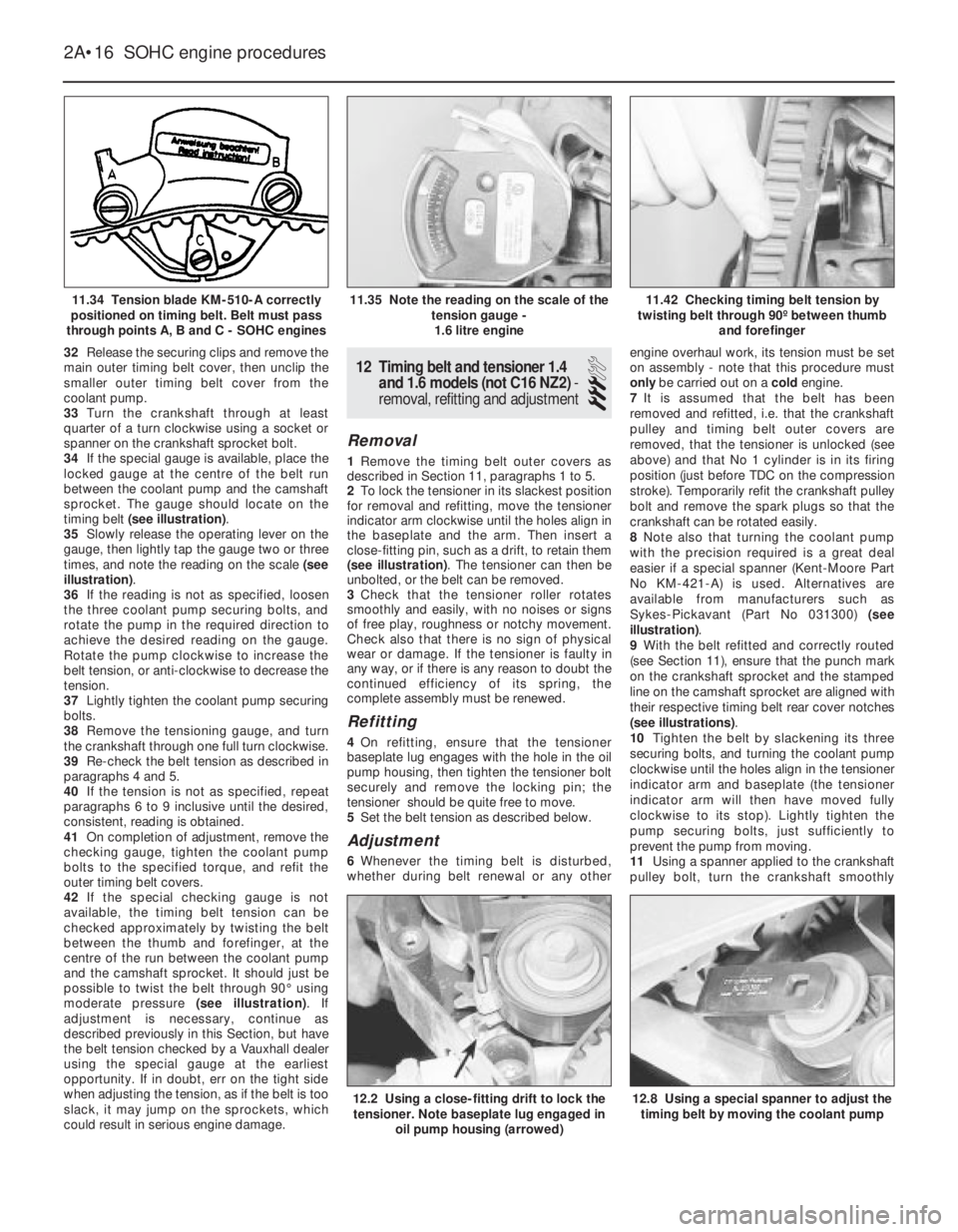
timing belt (see illustration).
35Slowly release the operating lever on the
gauge, then lightly tap the gauge two or three
times, and note the reading on the scale (see
illustration).
36If the reading is not as specified, loosen
the three coolant pump securing bolts, and
rotate the pump in the required direction to
achieve the desired reading on the gauge.
Rotate the pump clockwise to increase the
belt tension, or anti-clockwise to decrease the
tension.
37Lightly tighten the coolant pump securing
bolts.
38Remove the tensioning gauge, and turn
the crankshaft through one full turn clockwise.
39Re-check the belt tension as described in
paragraphs 4 and 5.
40If the tension is not as specified, repeat
paragraphs 6 to 9 inclusive until the desired,
consistent, reading is obtained.
41On completion of adjustment, remove the
checking gauge, tighten the coolant pump
bolts to the specified torque, and refit the
outer timing belt covers.
42If the special checking gauge is not
available, the timing belt tension can be
checked approximately by twisting the belt
between the thumb and forefinger, at the
centre of the run between the coolant pump
and the camshaft sprocket. It should just be
possible to twist the belt through 90°using
moderate pressure (see illustration). If
adjustment is necessary, continue as
described previously in this Section, but have
the belt tension checked by a Vauxhall dealer
using the special gauge at the earliest
opportunity. If in doubt, err on the tight side
when adjusting the tension, as if the belt is too
slack, it may jump on the sprockets, which
could result in serious engine damage.12Timing belt and tensioner 1.4
and 1.6 models (not C16 NZ2) -
removal, refitting and adjustment
3
Removal
1Remove the timing belt outer covers as
described in Section 11, paragraphs 1 to 5.
2To lock the tensioner in its slackest position
for removal and refitting, move the tensioner
indicator arm clockwise until the holes align in
the baseplate and the arm. Then insert a
close-fitting pin, such as a drift, to retain them
(see illustration). The tensioner can then be
unbolted, or the belt can be removed.
3Check that the tensioner roller rotates
smoothly and easily, with no noises or signs
of free play, roughness or notchy movement.
Check also that there is no sign of physical
wear or damage. If the tensioner is faulty in
any way, or if there is any reason to doubt the
continued efficiency of its spring, the
complete assembly must be renewed.
Refitting
4On refitting, ensure that the tensioner
baseplate lug engages with the hole in the oil
pump housing, then tighten the tensioner bolt
securely and remove the locking pin; the
tensioner should be quite free to move.
5Set the belt tension as described below.
Adjustment
6Whenever the timing belt is disturbed,
whether during belt renewal or any otherengine overhaul work, its tension must be set
on assembly - note that this procedure must
only be carried out on a cold engine.
7It is assumed that the belt has been
removed and refitted, i.e. that the crankshaft
pulley and timing belt outer covers are
removed, that the tensioner is unlocked (see
above) and that No 1 cylinder is in its firing
position (just before TDC on the compression
stroke). Temporarily refit the crankshaft pulley
bolt and remove the spark plugs so that the
crankshaft can be rotated easily.
8Note also that turning the coolant pump
with the precision required is a great deal
easier if a special spanner (Kent-Moore Part
No KM-421-A) is used. Alternatives are
available from manufacturers such as
Sykes-Pickavant (Part No 031300) (see
illustration).
9With the belt refitted and correctly routed
(see Section 11), ensure that the punch mark
on the crankshaft sprocket and the stamped
line on the camshaft sprocket are aligned with
their respective timing belt rear cover notches
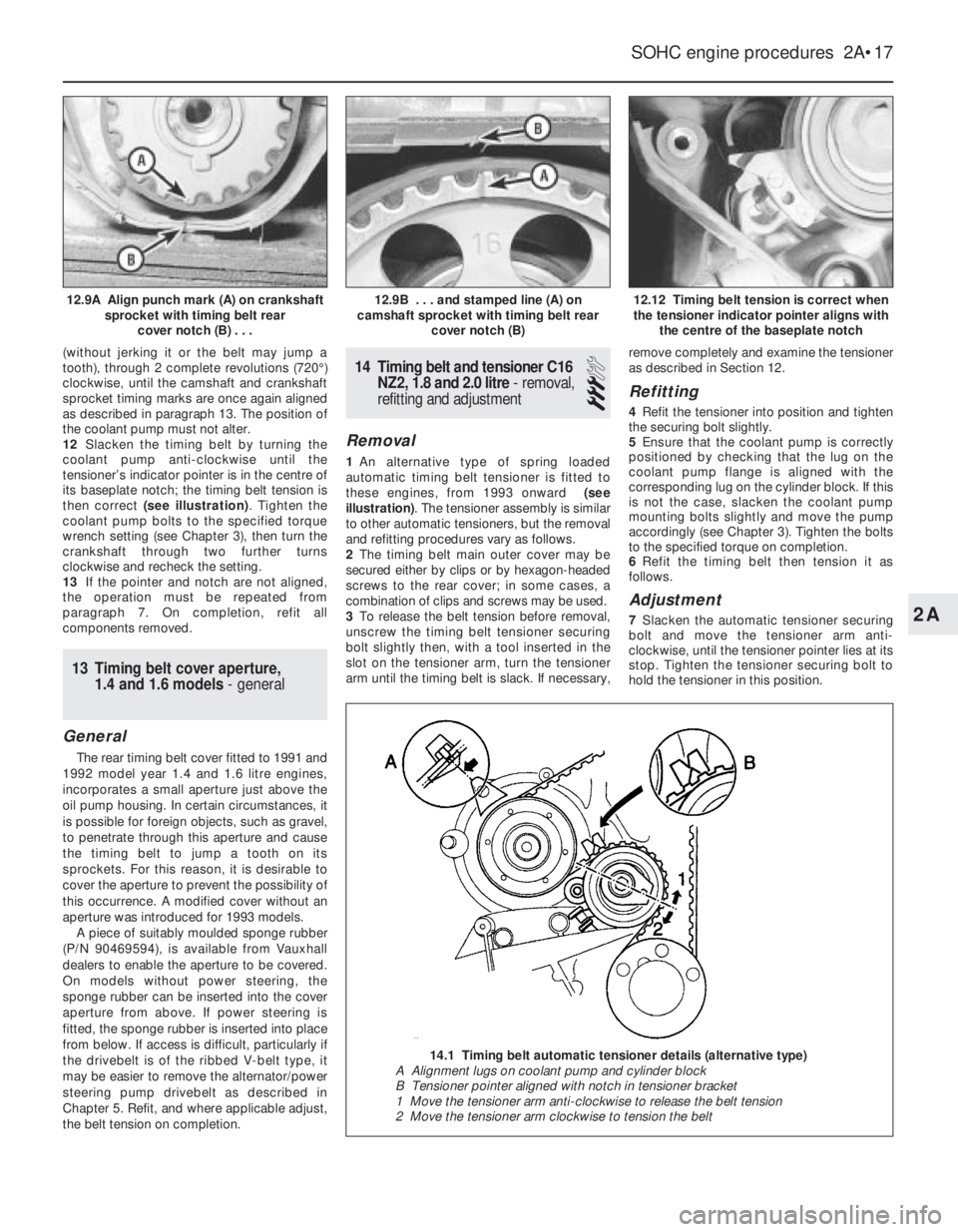
(see illustrations).
10Tighten the belt by slackening its three
securing bolts, and turning the coolant pump
clockwise until the holes align in the tensioner
indicator arm and baseplate (the tensioner
indicator arm will then have moved fully
clockwise to its stop). Lightly tighten the
pump securing bolts, just sufficiently to
prevent the pump from moving.
11Using a spanner applied to the crankshaft
pulley bolt, turn the crankshaft smoothly
2A•16SOHC engine procedures
11.34 Tension blade KM-510-A correctly
positioned on timing belt. Belt must pass
through points A, B and C - SOHC engines11.42 Checking timing belt tension by
twisting belt through 90º between thumb
and forefinger
12.8 Using a special spanner to adjust the
timing belt by moving the coolant pump12.2 Using a close-fitting drift to lock the
tensioner. Note baseplate lug engaged in
oil pump housing (arrowed)
11.35 Note the reading on the scale of the
tension gauge -
1.6 litre engine
Page 214 of 525
(without jerking it or the belt may jump a
tooth), through 2 complete revolutions (720°)
clockwise, until the camshaft and crankshaft
sprocket timing marks are once again aligned
as described in paragraph 13. The position of
the coolant pump must not alter.
12Slacken the timing belt by turning the
coolant pump anti-clockwise until the
tensioner’s indicator pointer is in the centre of
its baseplate notch; the timing belt tension is
then correct (see illustration). Tighten the
coolant pump bolts to the specified torque
wrench setting (see Chapter 3), then turn the
crankshaft through two further turns
clockwise and recheck the setting.
13If the pointer and notch are not aligned,
the operation must be repeated from
paragraph 7. On completion, refit all
components removed.
13Timing belt cover aperture,
1.4 and 1.6 models - general
General
The rear timing belt cover fitted to 1991 and
1992 model year 1.4 and 1.6 litre engines,
incorporates a small aperture just above the
oil pump housing. In certain circumstances, it
is possible for foreign objects, such as gravel,
to penetrate through this aperture and cause
the timing belt to jump a tooth on its
sprockets. For this reason, it is desirable to
cover the aperture to prevent the possibility of
this occurrence. A modified cover without an
aperture was introduced for 1993 models.
A piece of suitably moulded sponge rubber
(P/N 90469594), is available from Vauxhall
dealers to enable the aperture to be covered.
On models without power steering, the
sponge rubber can be inserted into the cover
aperture from above. If power steering is
fitted, the sponge rubber is inserted into place
from below. If access is difficult, particularly if
the drivebelt is of the ribbed V-belt type, it
may be easier to remove the alternator/power
steering pump drivebelt as described in
Chapter 5. Refit, and where applicable adjust,
the belt tension on completion.
14Timing belt and tensioner C16
NZ2, 1.8 and 2.0 litre - removal,
refitting and adjustment
3
Removal
1An alternative type of spring loaded
automatic timing belt tensioner is fitted to
these engines, from 1993 onward (see
illustration). The tensioner assembly is similar
to other automatic tensioners, but the removal
and refitting procedures vary as follows.
2The timing belt main outer cover may be
secured either by clips or by hexagon-headed
screws to the rear cover; in some cases, a
combination of clips and screws may be used.
3To release the belt tension before removal,
unscrew the timing belt tensioner securing
bolt slightly then, with a tool inserted in the
slot on the tensioner arm, turn the tensioner
arm until the timing belt is slack. If necessary,remove completely and examine the tensioner
as described in Section 12.
Refitting
4Refit the tensioner into position and tighten
the securing bolt slightly.
5Ensure that the coolant pump is correctly
positioned by checking that the lug on the
coolant pump flange is aligned with the
corresponding lug on the cylinder block. If this
is not the case, slacken the coolant pump
mounting bolts slightly and move the pump
accordingly (see Chapter 3). Tighten the bolts
to the specified torque on completion.
6Refit the timing belt then tension it as
follows.
Adjustment
7Slacken the automatic tensioner securing
bolt and move the tensioner arm anti-
clockwise, until the tensioner pointer lies at its
stop. Tighten the tensioner securing bolt to
hold the tensioner in this position.
SOHC engine procedures 2A•17
12.12 Timing belt tension is correct when
the tensioner indicator pointer aligns with
the centre of the baseplate notch12.9B . . . and stamped line (A) on
camshaft sprocket with timing belt rear
cover notch (B)12.9A Align punch mark (A) on crankshaft
sprocket with timing belt rear
cover notch (B) . . .
2A
14.1 Timing belt automatic tensioner details (alternative type)
A Alignment lugs on coolant pump and cylinder block
B Tensioner pointer aligned with notch in tensioner bracket
1 Move the tensioner arm anti-clockwise to release the belt tension
2 Move the tensioner arm clockwise to tension the belt
Page 216 of 525
Inspection
7With the camshaft removed, examine the
bearings in the camshaft housing for signs of
obvious wear or pitting. If evident, a new
camshaft housing will probably be required.
8The camshaft itself should show no marks
or scoring on the journal or cam lobe
surfaces. If evident, renew the camshaft. Note
that if the camshaft is renewed, all the rocker
arms should also be renewed.
9Check the camshaft thrustplate for signs of
wear or grooves, and renew if evident.
10It is advisable to renew the camshaft front
oil seal as a matter of course if the camshaft
has been removed. Prise out the old seal
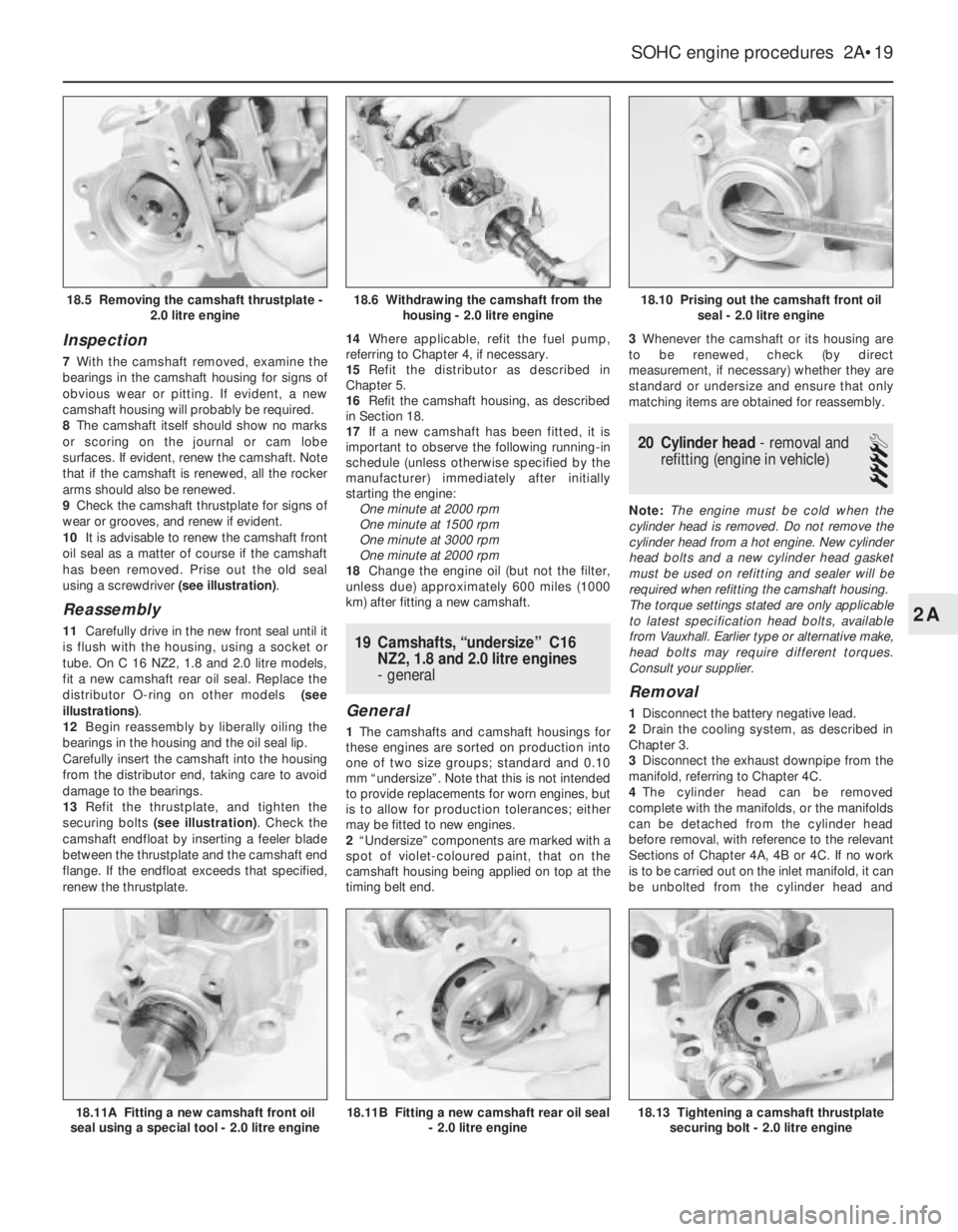
using a screwdriver (see illustration).
Reassembly
11Carefully drive in the new front seal until it
is flush with the housing, using a socket or
tube. On C 16 NZ2, 1.8 and 2.0 litre models,
fit a new camshaft rear oil seal. Replace the
distributor O-ring on other models (see
illustrations).
12Begin reassembly by liberally oiling the
bearings in the housing and the oil seal lip.
Carefully insert the camshaft into the housing
from the distributor end, taking care to avoid
damage to the bearings.
13Refit the thrustplate, and tighten the
securing bolts (see illustration). Check the
camshaft endfloat by inserting a feeler blade
between the thrustplate and the camshaft end
flange. If the endfloat exceeds that specified,
renew the thrustplate.14Where applicable, refit the fuel pump,
referring to Chapter 4, if necessary.
15Refit the distributor as described in
Chapter 5.
16Refit the camshaft housing, as described
in Section 18.
17If a new camshaft has been fitted, it is
important to observe the following running-in
schedule (unless otherwise specified by the
manufacturer) immediately after initially
starting the engine:
One minute at 2000 rpm
One minute at 1500 rpm
One minute at 3000 rpm
One minute at 2000 rpm
18Change the engine oil (but not the filter,
unless due) approximately 600 miles (1000
km) after fitting a new camshaft.19Camshafts, “undersize” C16
NZ2, 1.8 and 2.0 litre engines
- general
General
1The camshafts and camshaft housings for
these engines are sorted on production into
one of two size groups; standard and 0.10
mm “undersize”. Note that this is not intended
to provide replacements for worn engines, but
is to allow for production tolerances; either
may be fitted to new engines.
2“Undersize” components are marked with a
spot of violet-coloured paint, that on the
camshaft housing being applied on top at the
timing belt end.3Whenever the camshaft or its housing are
to be renewed, check (by direct
measurement, if necessary) whether they are
standard or undersize and ensure that only
matching items are obtained for reassembly.
20Cylinder head - removal and
refitting (engine in vehicle)
4
Note: The engine must be cold when the
cylinder head is removed. Do not remove the
cylinder head from a hot engine. New cylinder
head bolts and a new cylinder head gasket
must be used on refitting and sealer will be
required when refitting the camshaft housing.
The torque settings stated are only applicable
to latest specification head bolts, available
from Vauxhall. Earlier type or alternative make,
head bolts may require different torques.
Consult your supplier.
Removal
1Disconnect the battery negative lead.
2Drain the cooling system, as described in
Chapter 3.
3Disconnect the exhaust downpipe from the
manifold, referring to Chapter 4C.
4The cylinder head can be removed
complete with the manifolds, or the manifolds
can be detached from the cylinder head
before removal, with reference to the relevant
Sections of Chapter 4A, 4B or 4C. If no work
is to be carried out on the inlet manifold, it can
be unbolted from the cylinder head and
SOHC engine procedures 2A•19
18.10 Prising out the camshaft front oil
seal - 2.0 litre engine
18.13 Tightening a camshaft thrustplate
securing bolt - 2.0 litre engine18.11B Fitting a new camshaft rear oil seal
- 2.0 litre engine18.11A Fitting a new camshaft front oil
seal using a special tool - 2.0 litre engine
18.6 Withdrawing the camshaft from the
housing - 2.0 litre engine18.5 Removing the camshaft thrustplate -
2.0 litre engine
2A
Page 218 of 525
28Recover the cylinder head gasket and
discard it.
Refitting
29Clean the cylinder head and block mating
faces, and the camshaft housing and cylinder
head mating faces by careful scraping. Take
care not to damage the cylinder head and
camshaft housing, which are made of light
alloy and are easily scored. Cover the coolant
passages and other openings with masking
tape or rag to prevent dirt and carbon falling
in. Mop out all the oil from the bolt holes; if oil
is left in the holes, hydraulic pressure could
crack the block when the bolts are refitted.
30If desired, the cylinder head can be
dismantled and inspected as described in
Sections 22 and 23, and the camshaft
housing can be dismantled as described in
Section 18.31Begin refitting by locating a new gasket
on the block so that the word “OBEN” or
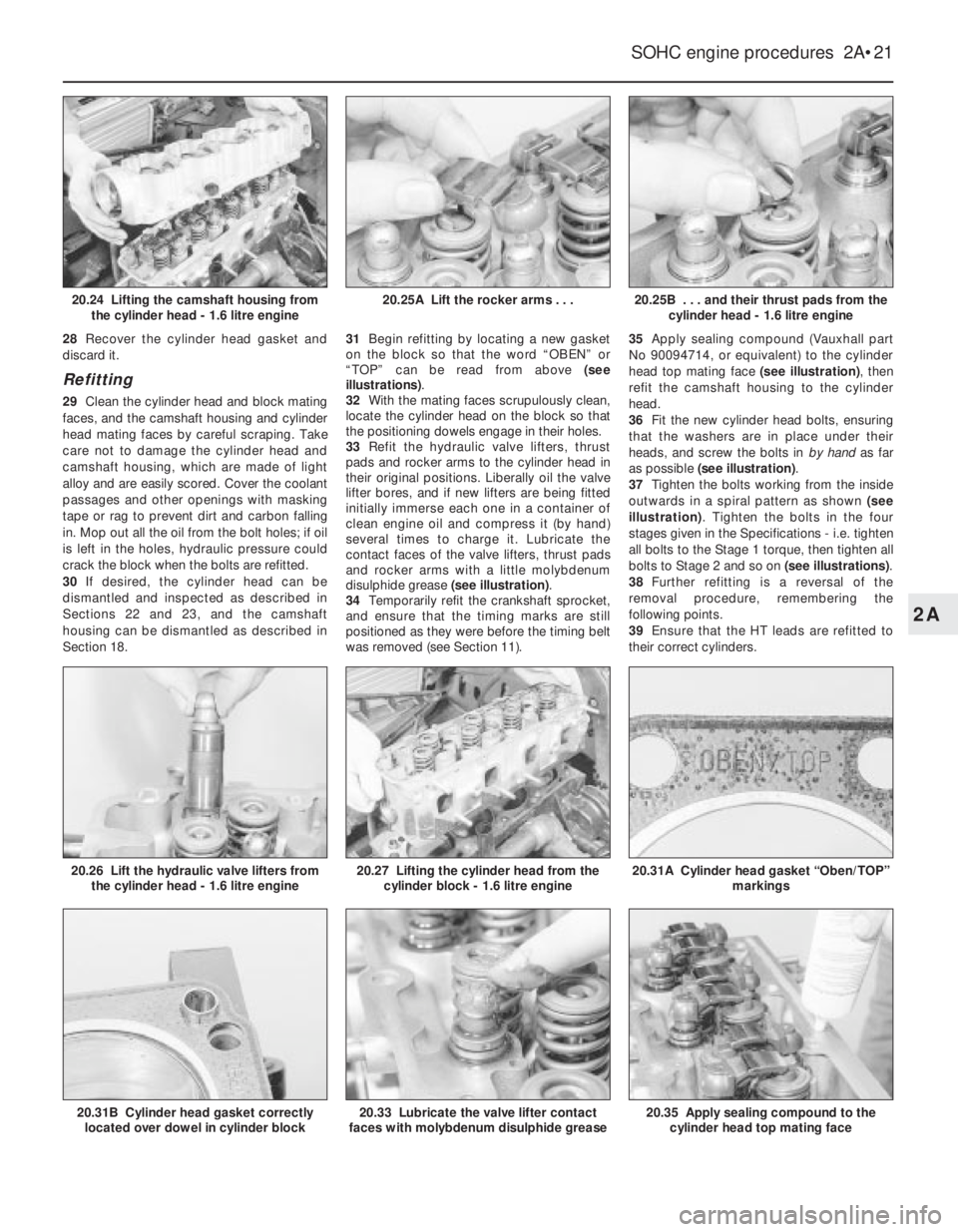
“TOP” can be read from above (see
illustrations).
32With the mating faces scrupulously clean,
locate the cylinder head on the block so that
the positioning dowels engage in their holes.
33Refit the hydraulic valve lifters, thrust
pads and rocker arms to the cylinder head in
their original positions. Liberally oil the valve
lifter bores, and if new lifters are being fitted
initially immerse each one in a container of
clean engine oil and compress it (by hand)
several times to charge it. Lubricate the
contact faces of the valve lifters, thrust pads
and rocker arms with a little molybdenum
disulphide grease (see illustration).
34Temporarily refit the crankshaft sprocket,
and ensure that the timing marks are still
positioned as they were before the timing belt
was removed (see Section 11).35Apply sealing compound (Vauxhall part
No 90094714, or equivalent) to the cylinder
head top mating face (see illustration), then
refit the camshaft housing to the cylinder
head.
36Fit the new cylinder head bolts, ensuring
that the washers are in place under their
heads, and screw the bolts in by hand as far
as possible (see illustration).
37Tighten the bolts working from the inside
outwards in a spiral pattern as shown (see
illustration). Tighten the bolts in the four
stages given in the Specifications -i.e. tighten
all bolts to the Stage 1 torque, then tighten all
bolts to Stage 2 and so on (see illustrations).
38Further refitting is a reversal of the
removal procedure, remembering the
following points.
39Ensure that the HT leads are refitted to
their correct cylinders.
SOHC engine procedures 2A•21
20.25B . . . and their thrust pads from the
cylinder head - 1.6 litre engine
20.35 Apply sealing compound to the
cylinder head top mating face20.33 Lubricate the valve lifter contact
faces with molybdenum disulphide grease20.31B Cylinder head gasket correctly
located over dowel in cylinder block
20.31A Cylinder head gasket “Oben/TOP”
markings20.27 Lifting the cylinder head from the
cylinder block - 1.6 litre engine20.26 Lift the hydraulic valve lifters from
the cylinder head - 1.6 litre engine
20.25A Lift the rocker arms . . .20.24 Lifting the camshaft housing from
the cylinder head - 1.6 litre engine
2A
Page 219 of 525
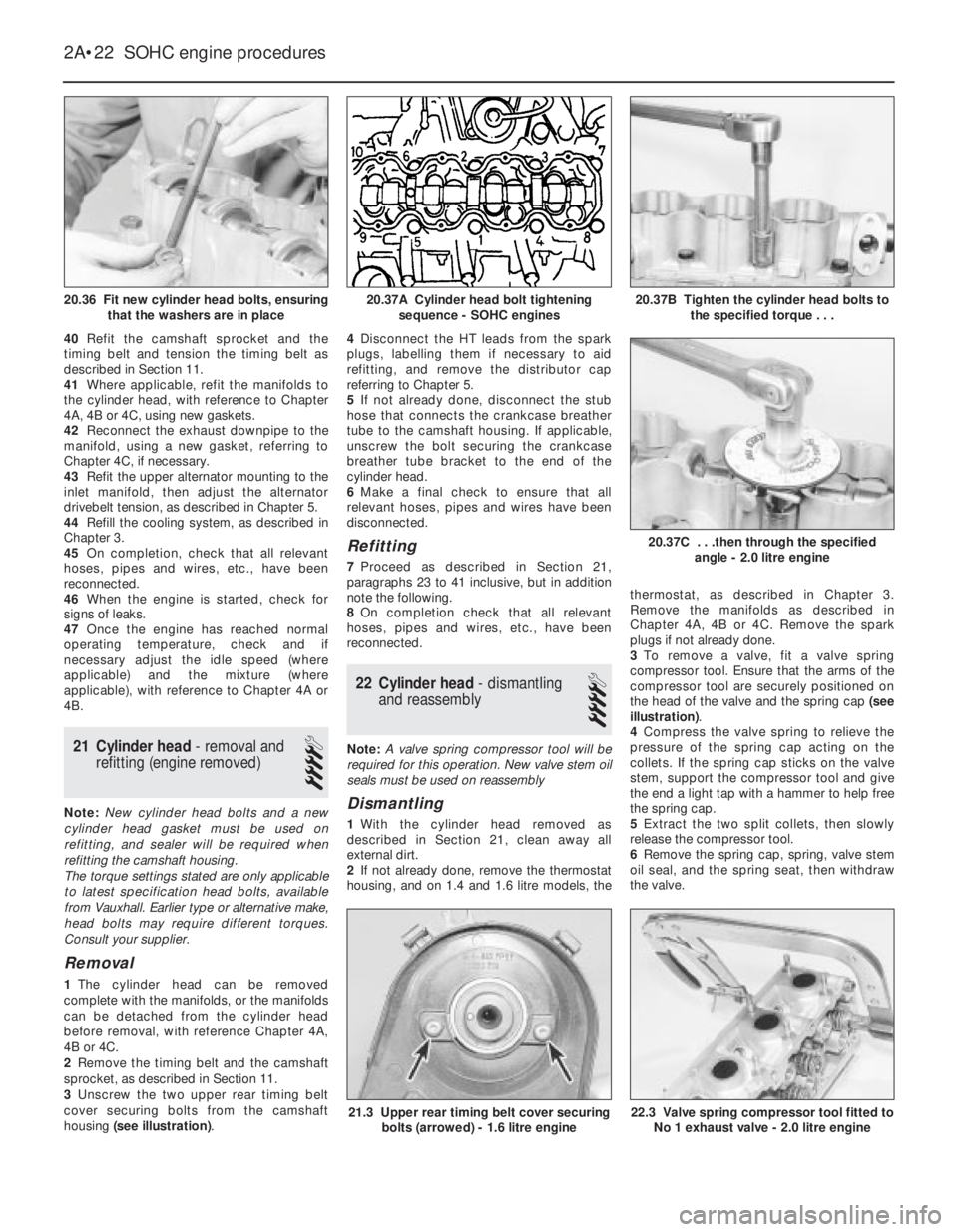
40Refit the camshaft sprocket and the
timing belt and tension the timing belt as
described in Section 11.
41Where applicable, refit the manifolds to
the cylinder head, with reference to Chapter
4A, 4B or 4C, using new gaskets.
42Reconnect the exhaust downpipe to the
manifold, using a new gasket, referring to
Chapter 4C, if necessary.
43Refit the upper alternator mounting to the
inlet manifold, then adjust the alternator
drivebelt tension, as described in Chapter 5.
44Refill the cooling system, as described in
Chapter 3.
45On completion, check that all relevant
hoses, pipes and wires, etc., have been
reconnected.
46When the engine is started, check for
signs of leaks.
47Once the engine has reached normal
operating temperature, check and if
necessary adjust the idle speed (where
applicable) and the mixture (where
applicable), with reference to Chapter 4A or
4B.
21Cylinder head - removal and
refitting (engine removed)
4
Note: New cylinder head bolts and a new
cylinder head gasket must be used on
refitting, and sealer will be required when
refitting the camshaft housing.
The torque settings stated are only applicable
to latest specification head bolts, available
from Vauxhall. Earlier type or alternative make,
head bolts may require different torques.
Consult your supplier.
Removal
1The cylinder head can be removed
complete with the manifolds, or the manifolds
can be detached from the cylinder head
before removal, with reference Chapter 4A,
4B or 4C.
2Remove the timing belt and the camshaft
sprocket, as described in Section 11.
3Unscrew the two upper rear timing belt
cover securing bolts from the camshaft
housing (see illustration).4Disconnect the HT leads from the spark
plugs, labelling them if necessary to aid
refitting, and remove the distributor cap
referring to Chapter 5.
5If not already done, disconnect the stub
hose that connects the crankcase breather
tube to the camshaft housing. If applicable,
unscrew the bolt securing the crankcase
breather tube bracket to the end of the
cylinder head.
6Make a final check to ensure that all
relevant hoses, pipes and wires have been
disconnected.
Refitting
7Proceed as described in Section 21,
paragraphs 23 to 41 inclusive, but in addition
note the following.
8On completion check that all relevant
hoses, pipes and wires, etc., have been
reconnected.
22Cylinder head -dismantling
and reassembly
4
Note: A valve spring compressor tool will be
required for this operation. New valve stem oil
seals must be used on reassembly
Dismantling
1With the cylinder head removed as
described in Section 21, clean away all
external dirt.
2If not already done, remove the thermostat
housing, and on 1.4 and 1.6 litre models, thethermostat, as described in Chapter 3.
Remove the manifolds as described in
Chapter 4A, 4B or 4C. Remove the spark
plugs if not already done.
3To remove a valve, fit a valve spring
compressor tool. Ensure that the arms of the
compressor tool are securely positioned on
the head of the valve and the spring cap (see
illustration).
4Compress the valve spring to relieve the
pressure of the spring cap acting on the
collets. If the spring cap sticks on the valve
stem, support the compressor tool and give
the end a light tap with a hammer to help free
the spring cap.
5Extract the two split collets, then slowly
release the compressor tool.
6Remove the spring cap, spring, valve stem
oil seal, and the spring seat, then withdraw
the valve.
2A•22SOHC engine procedures
20.36 Fit new cylinder head bolts, ensuring
that the washers are in place20.37B Tighten the cylinder head bolts to
the specified torque . . .
22.3 Valve spring compressor tool fitted to
No 1 exhaust valve - 2.0 litre engine21.3 Upper rear timing belt cover securing
bolts (arrowed) - 1.6 litre engine
20.37C . . .then through the specified
angle - 2.0 litre engine
20.37A Cylinder head bolt tightening
sequence - SOHC engines
Page 221 of 525
23Cylinder head - inspection
and renovation
4
Note: Refer to a dealer for advice before
attempting to carry out valve grinding or valve
seat reciting operations, as these operations
may not be possible for the DIY mechanic.
This is due to the fitment of hardened valve
seats for use with unleaded petrol
Inspection
1Remember that the cylinder head is of light
alloy construction and is easily damaged, use
a blunt scraper or rotary wire brush to clean all
traces of carbon deposits from the
combustion spaces and the ports. The valve
stems and valve guides should also be freed
from any carbon deposits. Wash the
combustion spaces and ports down with
paraffin and scrape the cylinder head surface
free of any foreign matter with the side of a
steel rule, or a similar article.
2If the engine is installed in the car, clean the
pistons and the top of the cylinder bores. If
the pistons are still in the block, it is essential
that great care is taken to ensure that no
carbon gets into the cylinder bores. This could
scratch the cylinder walls or cause damage to
the pistons and rings. To ensure this does not
happen, first turn the crankshaft so that two of
the pistons are at the top of their bores. Insert
rag into the other two bores or seal them off
with paper and masking tape. The waterways
should also be covered with small pieces of
masking tape, to prevent particles of carbon
entering the cooling system and damaging the
coolant pump.
3Press a little grease into the gap between
the cylinder walls and the two pistons that are
to be worked on. With a blunt scraper,
carefully scrape away the carbon from the
piston crown, taking great care not to scratch
the aluminium. Also scrape away the carbon
from the surrounding lip of the cylinder wall.
When all carbon has been removed, scrape
away the grease that will now be
contaminated with carbon particles, taking
care not to press any into the bores. To assist
prevention of carbon build-up, the piston
crown can be polished with a metal polish.
Remove the rags or masking tape from the
other two cylinders, and turn the crankshaft
so that the two pistons that were at thebottom are now at the top. Place rag or
masking tape in the cylinders that have been
decarbonised, and continue as just described.
4Examine the heads of the valves for pitting
and burning, especially the heads of the
exhaust valves. The valve seatings should be
examined at the same time. If the pitting on
the valve and seat is very slight, the marks
can be removed by grinding the seats and
valves together with coarse, and then fine,
valve grinding paste.
5Where bad pitting has occurred to the valve
seats, it will be necessary to recut them and fit
new valves. This latter job should be entrusted
to the local dealer or engineering works. In
practice it is very seldom that the seats are so
badly worn. Normally it is the valve that is too
badly worn for refitting, and the owner can
easily buy a new set of valves and match
them to the seats by valve grinding.
Renovation
6Valve grinding is carried out as follows.
Smear a trace of coarse carborundum paste
on the seat face and apply a suction grinder
tool to the valve head. With a semi-rotary
motion, grind the valve head to its seat, lifting
the valve occasionally to redistribute the
grinding paste. When a dull matt even surface
is produced on both the valve seat and the
valve, wipe off the paste and repeat the
process with fine carborundum paste, lifting
and turning the valve to redistribute the paste
as before. A light spring placed under the
valve head will greatly ease this operation.
When a smooth unbroken ring of light grey
matt finish is produced, on both valve and
valve seat faces, the grinding operation is
complete. Carefully clean away every trace of
grinding compound, taking great care to leave
none in the ports or in the valve guides. Clean
the valves and valve seats with a
paraffin-soaked rag, then with a clean rag,
and finally, if an air line is available, blow the
valves, valve guides and valve ports clean.
7Check that all valve springs are intact. If any
one is broken, all should be renewed. Check
the free height of the springs against new
ones. If some springs are not long enough,
replace them all. Springs suffer from fatigue
and it is a good idea to renew them even if
they look serviceable. 8The cylinder head can be checked for
warping either by placing it on a piece of plate
glass or using a straight-edge and feeler
blades. If there is any doubt or if its block face
is corroded, have it re-faced by your dealer or
motor engineering works.
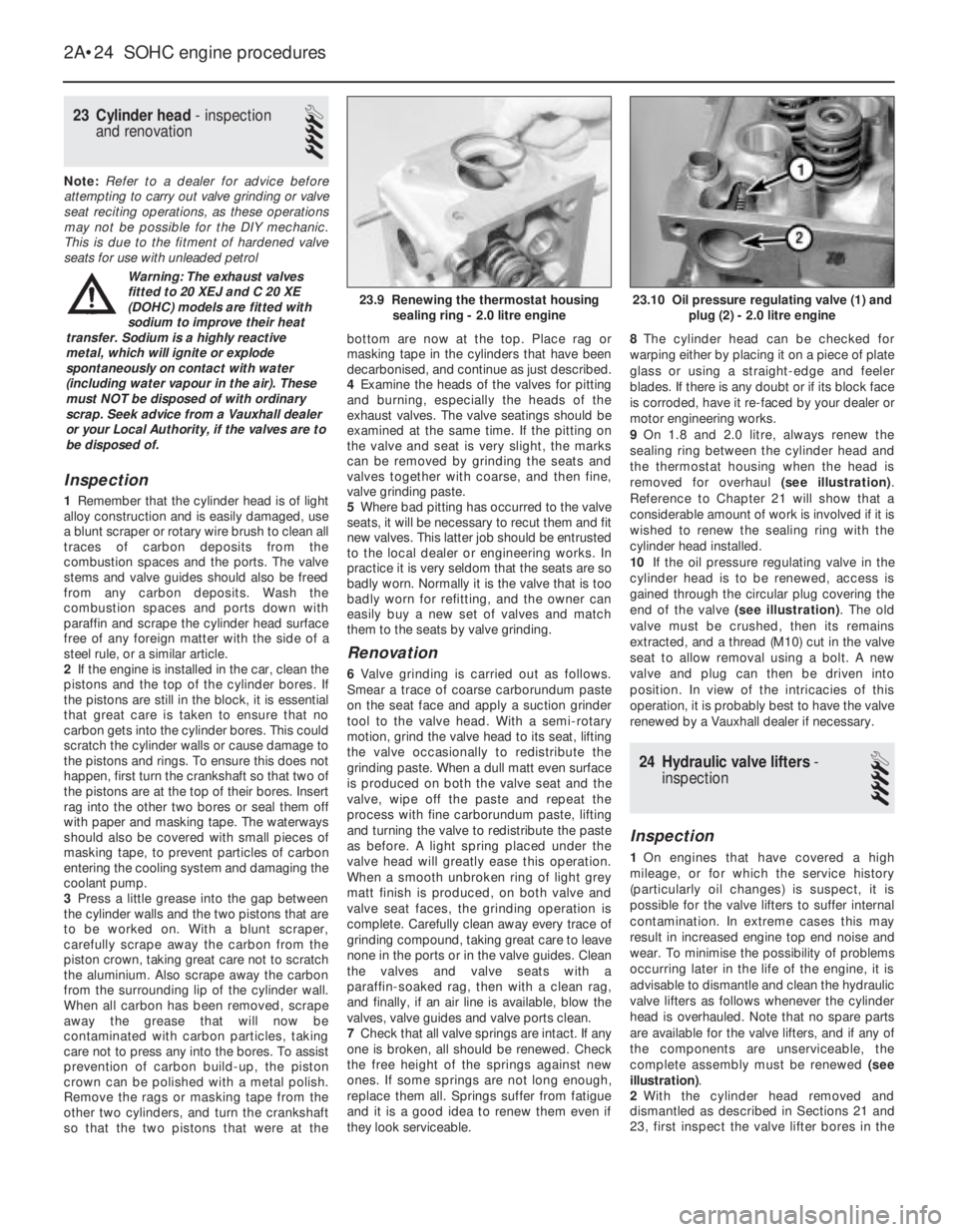
9On 1.8 and 2.0 litre, always renew the
sealing ring between the cylinder head and
the thermostat housing when the head is
removed for overhaul (see illustration).
Reference to Chapter 21 will show that a
considerable amount of work is involved if it is
wished to renew the sealing ring with the
cylinder head installed.
10If the oil pressure regulating valve in the
cylinder head is to be renewed, access is
gained through the circular plug covering the
end of the valve (see illustration). The old
valve must be crushed, then its remains
extracted, and a thread (M10) cut in the valve
seat to allow removal using a bolt. A new
valve and plug can then be driven into
position. In view of the intricacies of this
operation, it is probably best to have the valve
renewed by a Vauxhall dealer if necessary.
24Hydraulic valve lifters -
inspection
4
Inspection
1On engines that have covered a high
mileage, or for which the service history
(particularly oil changes) is suspect, it is
possible for the valve lifters to suffer internal
contamination. In extreme cases this may
result in increased engine top end noise and
wear. To minimise the possibility of problems
occurring later in the life of the engine, it is
advisable to dismantle and clean the hydraulic
valve lifters as follows whenever the cylinder
head is overhauled. Note that no spare parts
are available for the valve lifters, and if any of
the components are unserviceable, the
complete assembly must be renewed (see
illustration).
2With the cylinder head removed and
dismantled as described in Sections 21 and
23, first inspect the valve lifter bores in the
2A•24SOHC engine procedures
23.10 Oil pressure regulating valve (1) and
plug (2) - 2.0 litre engine23.9 Renewing the thermostat housing
sealing ring - 2.0 litre engine
Warning: The exhaust valves
fitted to 20 XEJ and C 20 XE
(DOHC) models are fitted with
sodium to improve their heat
transfer. Sodium is a highly reactive
metal, which will ignite or explode
spontaneously on contact with water
(including water vapour in the air). These
must NOT be disposed of with ordinary
scrap. Seek advice from a Vauxhall dealer
or your Local Authority, if the valves are to
be disposed of.
Page 223 of 525
25Flywheel -removal, inspection
and refitting
4
Note: New flywheel securing bolts must he
used on refitting. Certain models are fitted
with a ‘Pot type’ flywheel. Although, it has a
deeply recessed surface for the clutch disc,
the operations below are the same.
Removal
1If not already done, remove the clutch,
(Chapter 6), and the starter motor, (Chapter 5).
2If the engine is in the vehicle, remove the
clutch release bearing and its guide sleeve, as
described in Chapter 6.
3Although the flywheel bolt holes are offset
so that the flywheel can only be fitted in one
position, it will make refitting easier if
alignment marks are made between the
flywheel and the end of the crankshaft.
4Prevent the flywheel from turning by
jamming the ring gear teeth using a large
screwdriver or similar tool. Access is most
easily obtained through the starter motor
aperture if the engine is in the vehicle.
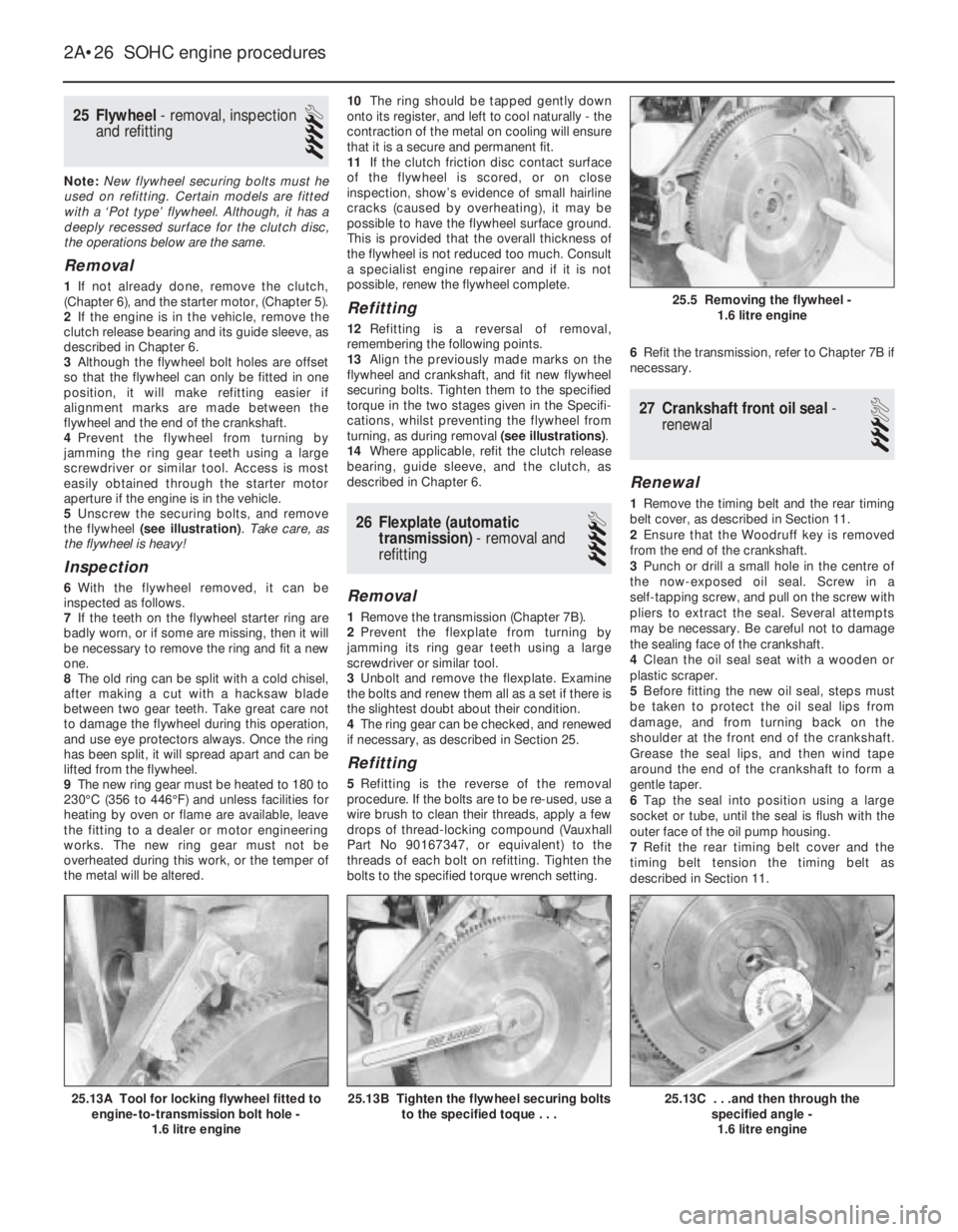
5Unscrew the securing bolts, and remove
the flywheel (see illustration). Take care, as
the flywheel is heavy!
Inspection
6With the flywheel removed, it can be
inspected as follows.
7If the teeth on the flywheel starter ring are
badly worn, or if some are missing, then it will
be necessary to remove the ring and fit a new
one.
8The old ring can be split with a cold chisel,
after making a cut with a hacksaw blade
between two gear teeth. Take great care not
to damage the flywheel during this operation,
and use eye protectors always. Once the ring
has been split, it will spread apart and can be
lifted from the flywheel.
9The new ring gear must be heated to 180 to
230°C (356 to 446°F) and unless facilities for
heating by oven or flame are available, leave
the fitting to a dealer or motor engineering
works. The new ring gear must not be
overheated during this work, or the temper of
the metal will be altered.10The ring should be tapped gently down
onto its register, and left to cool naturally -the
contraction of the metal on cooling will ensure
that it is a secure and permanent fit.
11If the clutch friction disc contact surface
of the flywheel is scored, or on close
inspection, show’s evidence of small hairline
cracks (caused by overheating), it may be
possible to have the flywheel surface ground.
This is provided that the overall thickness of
the flywheel is not reduced too much. Consult
a specialist engine repairer and if it is not
possible, renew the flywheel complete.
Refitting
12Refitting is a reversal of removal,
remembering the following points.
13Align the previously made marks on the
flywheel and crankshaft, and fit new flywheel
securing bolts. Tighten them to the specified
torque in the two stages given in the Specifi-
cations, whilst preventing the flywheel from
turning, as during removal (see illustrations).
14Where applicable, refit the clutch release
bearing, guide sleeve, and the clutch, as
described in Chapter 6.
26Flexplate (automatic
transmission) -removal and
refitting
4
Removal
1Remove the transmission (Chapter 7B).
2Prevent the flexplate from turning by
jamming its ring gear teeth using a large
screwdriver or similar tool.
3Unbolt and remove the flexplate. Examine
the bolts and renew them all as a set if there is
the slightest doubt about their condition.
4The ring gear can be checked, and renewed
if necessary, as described in Section 25.
Refitting
5Refitting is the reverse of the removal
procedure. If the bolts are to be re-used, use a
wire brush to clean their threads, apply a few
drops of thread-locking compound (Vauxhall
Part No 90167347, or equivalent) to the
threads of each bolt on refitting. Tighten the
bolts to the specified torque wrench setting.6Refit the transmission, refer to Chapter 7B if
necessary.
27Crankshaft front oil seal -
renewal
3
Renewal
1Remove the timing belt and the rear timing
belt cover, as described in Section 11.
2Ensure that the Woodruff key is removed
from the end of the crankshaft.
3Punch or drill a small hole in the centre of
the now-exposed oil seal. Screw in a
self-tapping screw, and pull on the screw with
pliers to extract the seal. Several attempts
may be necessary. Be careful not to damage
the sealing face of the crankshaft.
4Clean the oil seal seat with a wooden or
plastic scraper.
5Before fitting the new oil seal, steps must
be taken to protect the oil seal lips from
damage, and from turning back on the
shoulder at the front end of the crankshaft.
Grease the seal lips, and then wind tape
around the end of the crankshaft to form a
gentle taper.
6Tap the seal into position using a large
socket or tube, until the seal is flush with the
outer face of the oil pump housing.
7Refit the rear timing belt cover and the
timing belt tension the timing belt as
described in Section 11.
2A•26SOHC engine procedures
25.13C . . .and then through the
specified angle -
1.6 litre engine25.13B Tighten the flywheel securing bolts
to the specified toque . . .25.13A Tool for locking flywheel fitted to
engine-to-transmission bolt hole -
1.6 litre engine
25.5 Removing the flywheel -
1.6 litre engine
Page 224 of 525
28Crankshaft rear oil seal -
renewal
4
Renewal
1With the engine removed from the vehicle,
remove the flywheel, or flexplate (as
applicable) as described in Sections 25 and
26.
2Punch or drill a small hole in the centre of
the now-exposed oil seal. Screw in a
self-tapping screw, and pull on the screw with
pliers to extract the seal. Several attempts
may be necessary. Be careful not to damage
the sealing face of the crankshaft.
3Clean the oil seal seat with a wooden or
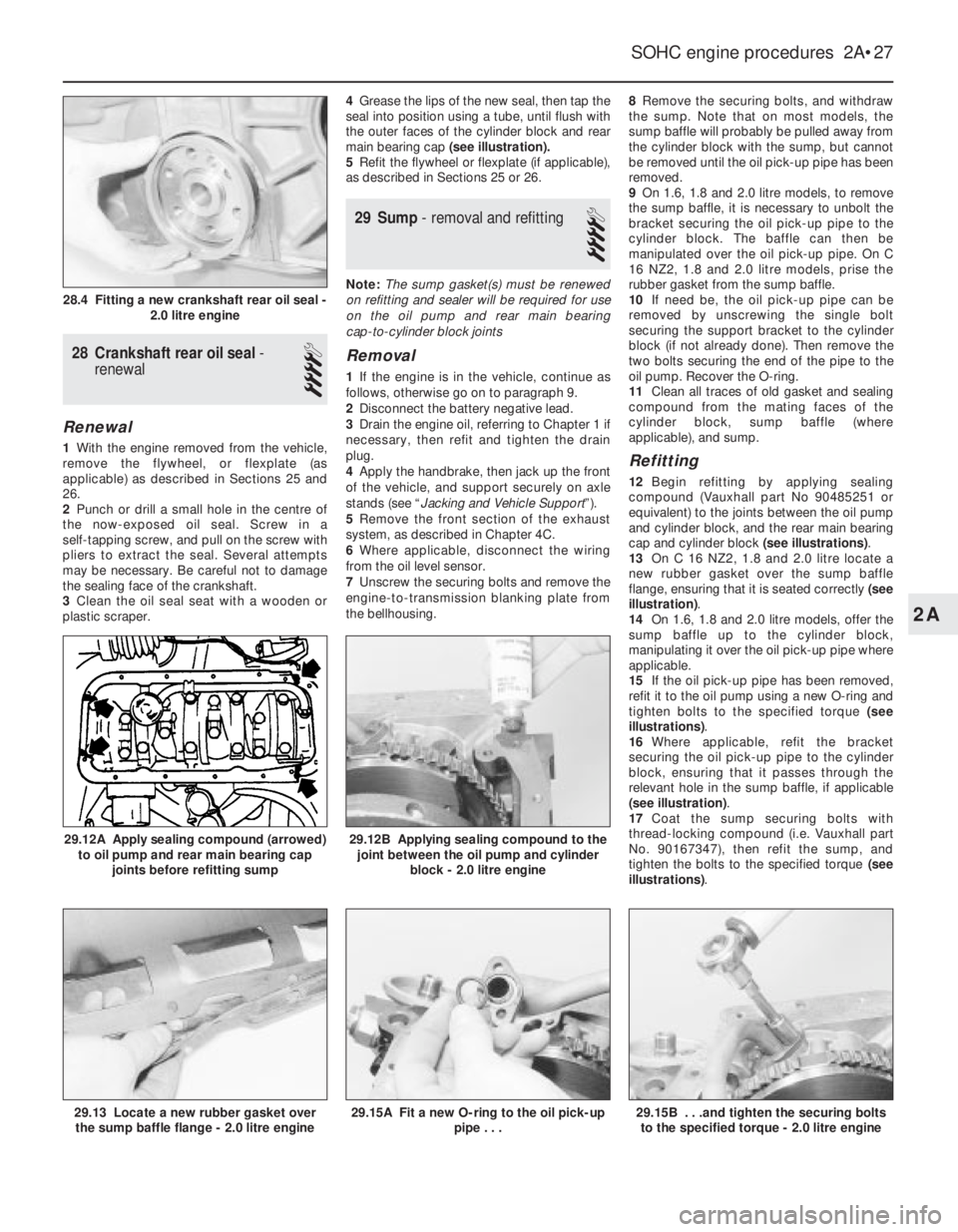
plastic scraper.4Grease the lips of the new seal, then tap the
seal into position using a tube, until flush with
the outer faces of the cylinder block and rear
main bearing cap (see illustration).
5Refit the flywheel or flexplate (if applicable),
as described in Sections 25 or 26.
29Sump - removal and refitting
4
Note: The sump gasket(s) must be renewed
on refitting and sealer will be required for use
on the oil pump and rear main bearing
cap-to-cylinder block joints
Removal
1If the engine is in the vehicle, continue as
follows, otherwise go on to paragraph 9.
2Disconnect the battery negative lead.
3Drain the engine oil, referring to Chapter 1 if
necessary, then refit and tighten the drain
plug.
4Apply the handbrake, then jack up the front
of the vehicle, and support securely on axle
stands (see “Jacking and Vehicle Support”).
5Remove the front section of the exhaust
system, as described in Chapter 4C.
6Where applicable, disconnect the wiring
from the oil level sensor.
7Unscrew the securing bolts and remove the
engine-to-transmission blanking plate from
the bellhousing.8Remove the securing bolts, and withdraw
the sump. Note that on most models, the
sump baffle will probably be pulled away from
the cylinder block with the sump, but cannot
be removed until the oil pick-up pipe has been
removed.
9On 1.6, 1.8 and 2.0 litre models, to remove
the sump baffle, it is necessary to unbolt the
bracket securing the oil pick-up pipe to the
cylinder block. The baffle can then be
manipulated over the oil pick-up pipe. On C
16 NZ2, 1.8 and 2.0 litre models, prise the
rubber gasket from the sump baffle.
10If need be, the oil pick-up pipe can be
removed by unscrewing the single bolt
securing the support bracket to the cylinder
block (if not already done). Then remove the
two bolts securing the end of the pipe to the
oil pump. Recover the O-ring.
11Clean all traces of old gasket and sealing
compound from the mating faces of the
cylinder block, sump baffle (where
applicable), and sump.
Refitting
12Begin refitting by applying sealing
compound (Vauxhall part No 90485251 or
equivalent) to the joints between the oil pump
and cylinder block, and the rear main bearing
cap and cylinder block (see illustrations).
13On C 16 NZ2, 1.8 and 2.0 litre locate a
new rubber gasket over the sump baffle
flange, ensuring that it is seated correctly (see
illustration).
14On 1.6, 1.8 and 2.0 litre models, offer the
sump baffle up to the cylinder block,
manipulating it over the oil pick-up pipe where
applicable.
15If the oil pick-up pipe has been removed,
refit it to the oil pump using a new O-ring and
tighten bolts to the specified torque (see
illustrations).
16Where applicable, refit the bracket
securing the oil pick-up pipe to the cylinder
block, ensuring that it passes through the
relevant hole in the sump baffle, if applicable
(see illustration).
17Coat the sump securing bolts with
thread-locking compound (i.e. Vauxhall part
No. 90167347), then refit the sump, and
tighten the bolts to the specified torque (see
illustrations).
SOHC engine procedures 2A•27
29.12B Applying sealing compound to the
joint between the oil pump and cylinder
block - 2.0 litre engine
29.15B . . .and tighten the securing bolts
to the specified torque - 2.0 litre engine29.15A Fit a new O-ring to the oil pick-up
pipe . . .29.13 Locate a new rubber gasket over
the sump baffle flange - 2.0 litre engine
29.12A Apply sealing compound (arrowed)
to oil pump and rear main bearing cap
joints before refitting sump
28.4 Fitting a new crankshaft rear oil seal -
2.0 litre engine
2A
Page 226 of 525
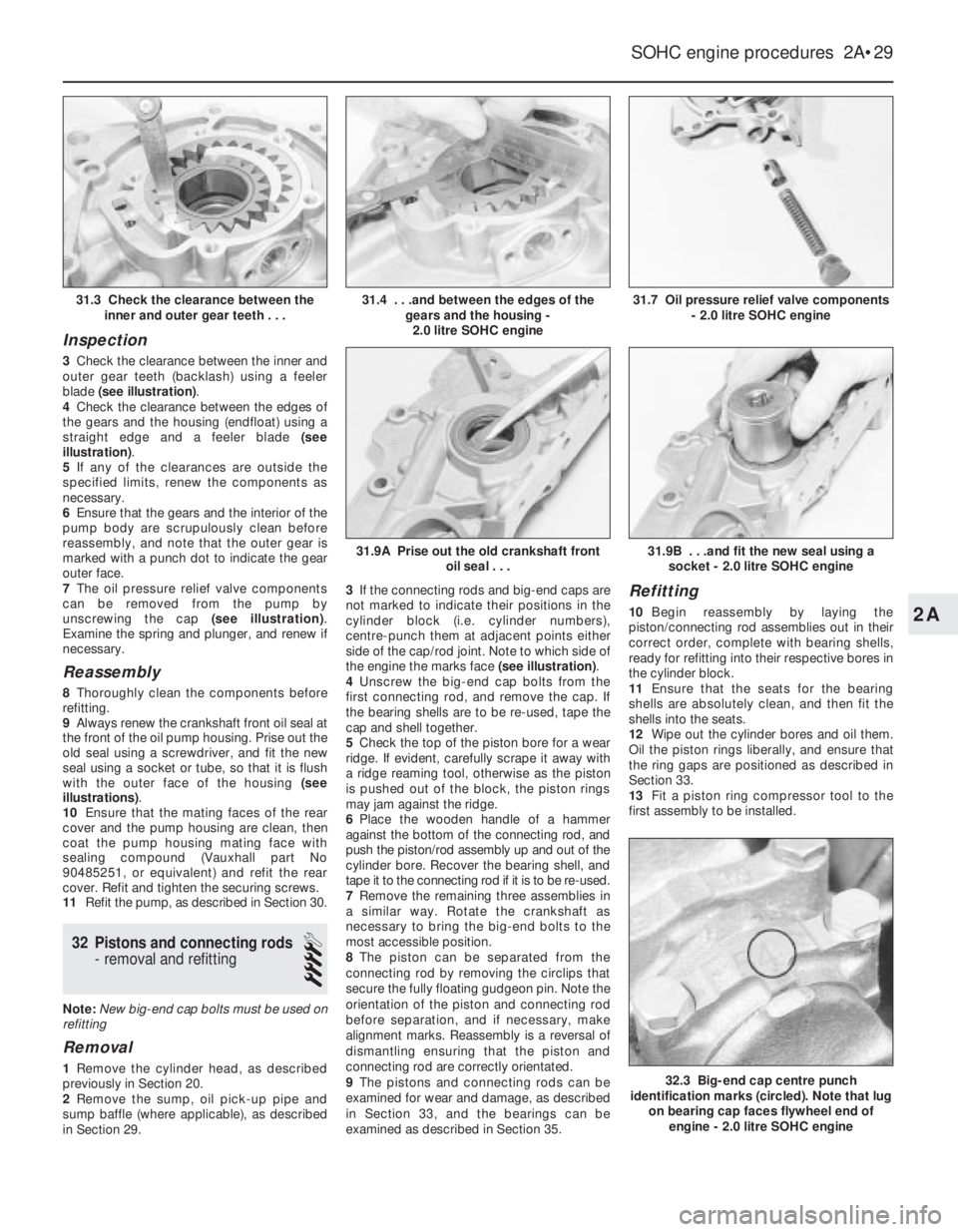
Inspection
3Check the clearance between the inner and
outer gear teeth (backlash) using a feeler
blade (see illustration).
4Check the clearance between the edges of
the gears and the housing (endfloat) using a
straight edge and a feeler blade (see
illustration).
5If any of the clearances are outside the
specified limits, renew the components as
necessary.
6Ensure that the gears and the interior of the
pump body are scrupulously clean before
reassembly, and note that the outer gear is
marked with a punch dot to indicate the gear
outer face.
7The oil pressure relief valve components
can be removed from the pump by
unscrewing the cap (see illustration).
Examine the spring and plunger, and renew if
necessary.
Reassembly
8Thoroughly clean the components before
refitting.
9Always renew the crankshaft front oil seal at
the front of the oil pump housing. Prise out the
old seal using a screwdriver, and fit the new
seal using a socket or tube, so that it is flush
with the outer face of the housing (see
illustrations).
10Ensure that the mating faces of the rear
cover and the pump housing are clean, then
coat the pump housing mating face with
sealing compound (Vauxhall part No
90485251, or equivalent) and refit the rear
cover. Refit and tighten the securing screws.
11Refit the pump, as described in Section 30.
32Pistons and connecting rods
- removal and refitting
4
Note: New big-end cap bolts must be used on
refitting
Removal
1Remove the cylinder head, as described
previously in Section 20.
2Remove the sump, oil pick-up pipe and
sump baffle (where applicable), as described
in Section 29.3If the connecting rods and big-end caps are
not marked to indicate their positions in the
cylinder block (i.e. cylinder numbers),
centre-punch them at adjacent points either
side of the cap/rod joint. Note to which side of
the engine the marks face (see illustration).
4Unscrew the big-end cap bolts from the
first connecting rod, and remove the cap. If
the bearing shells are to be re-used, tape the
cap and shell together.
5Check the top of the piston bore for a wear
ridge. If evident, carefully scrape it away with
a ridge reaming tool, otherwise as the piston
is pushed out of the block, the piston rings
may jam against the ridge.
6Place the wooden handle of a hammer
against the bottom of the connecting rod, and
push the piston/rod assembly up and out of the
cylinder bore. Recover the bearing shell, and
tape it to the connecting rod if it is to be re-used.
7Remove the remaining three assemblies in
a similar way. Rotate the crankshaft as
necessary to bring the big-end bolts to the
most accessible position.
8The piston can be separated from the
connecting rod by removing the circlips that
secure the fully floating gudgeon pin. Note the
orientation of the piston and connecting rod
before separation, and if necessary, make
alignment marks. Reassembly is a reversal of
dismantling ensuring that the piston and
connecting rod are correctly orientated.
9The pistons and connecting rods can be
examined for wear and damage, as described
in Section 33, and the bearings can be
examined as described in Section 35.
Refitting
10Begin reassembly by laying the
piston/connecting rod assemblies out in their
correct order, complete with bearing shells,
ready for refitting into their respective bores in
the cylinder block.
11Ensure that the seats for the bearing
shells are absolutely clean, and then fit the
shells into the seats.
12Wipe out the cylinder bores and oil them.
Oil the piston rings liberally, and ensure that
the ring gaps are positioned as described in
Section 33.
13Fit a piston ring compressor tool to the
first assembly to be installed.
SOHC engine procedures 2A•29
31.7 Oil pressure relief valve components
- 2.0 litre SOHC engine
32.3 Big-end cap centre punch
identification marks (circled). Note that lug
on bearing cap faces flywheel end of
engine - 2.0 litre SOHC engine
31.9B . . .and fit the new seal using a
socket - 2.0 litre SOHC engine31.9A Prise out the old crankshaft front
oil seal . . .
31.4 . . .and between the edges of the
gears and the housing -
2.0 litre SOHC engine31.3 Check the clearance between the
inner and outer gear teeth . . .
2A
Page 227 of 525
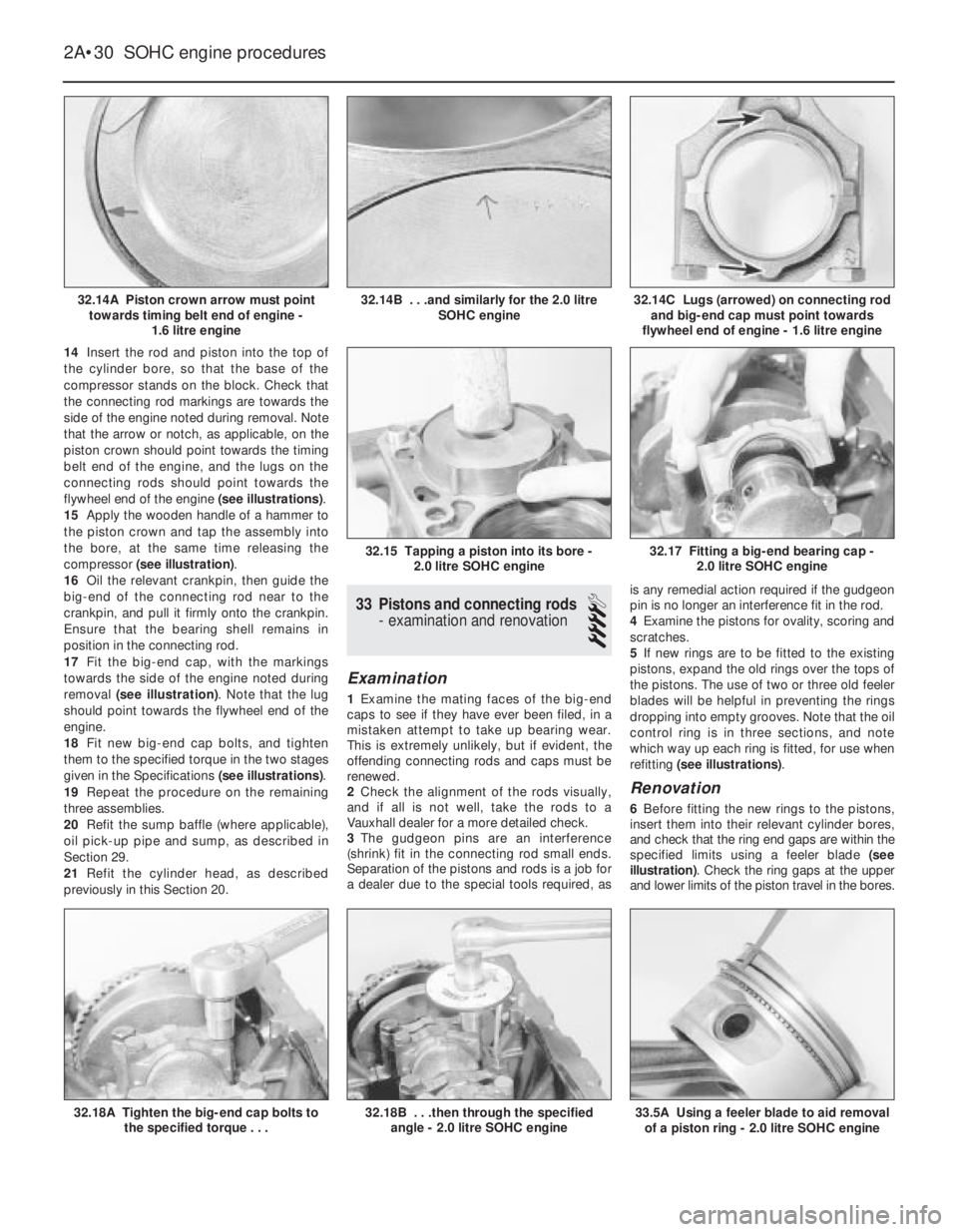
14Insert the rod and piston into the top of
the cylinder bore, so that the base of the
compressor stands on the block. Check that
the connecting rod markings are towards the
side of the engine noted during removal. Note
that the arrow or notch, as applicable, on the
piston crown should point towards the timing
belt end of the engine, and the lugs on the
connecting rods should point towards the
flywheel end of the engine (see illustrations).
15Apply the wooden handle of a hammer to
the piston crown and tap the assembly into
the bore, at the same time releasing the
compressor (see illustration).
16Oil the relevant crankpin, then guide the
big-end of the connecting rod near to the
crankpin, and pull it firmly onto the crankpin.
Ensure that the bearing shell remains in
position in the connecting rod.
17Fit the big-end cap, with the markings
towards the side of the engine noted during
removal (see illustration). Note that the lug
should point towards the flywheel end of the
engine.
18Fit new big-end cap bolts, and tighten
them to the specified torque in the two stages
given in the Specifications (see illustrations).
19Repeat the procedure on the remaining
three assemblies.
20Refit the sump baffle (where applicable),
oil pick-up pipe and sump, as described in
Section 29.
21Refit the cylinder head, as described
previously in this Section 20.
33Pistons and connecting rods
-examination and renovation
4
Examination
1Examine the mating faces of the big-end
caps to see if they have ever been filed, in a
mistaken attempt to take up bearing wear.
This is extremely unlikely, but if evident, the
offending connecting rods and caps must be
renewed.
2Check the alignment of the rods visually,
and if all is not well, take the rods to a
Vauxhall dealer for a more detailed check.
3The gudgeon pins are an interference
(shrink) fit in the connecting rod small ends.
Separation of the pistons and rods is a job for
a dealer due to the special tools required, asis any remedial action required if the gudgeon
pin is no longer an interference fit in the rod.
4Examine the pistons for ovality, scoring and
scratches.
5If new rings are to be fitted to the existing
pistons, expand the old rings over the tops of
the pistons. The use of two or three old feeler
blades will be helpful in preventing the rings
dropping into empty grooves. Note that the oil
control ring is in three sections, and note
which way up each ring is fitted, for use when
refitting (see illustrations).
Renovation
6Before fitting the new rings to the pistons,
insert them into their relevant cylinder bores,
and check that the ring end gaps are within the
specified limits using a feeler blade (see
illustration). Check the ring gaps at the upper
and lower limits of the piston travel in the bores.
2A•30SOHC engine procedures
32.14A Piston crown arrow must point
towards timing belt end of engine -
1.6 litre engine32.14C Lugs (arrowed) on connecting rod
and big-end cap must point towards
flywheel end of engine - 1.6 litre engine
33.5A Using a feeler blade to aid removal
of a piston ring - 2.0 litre SOHC engine32.18B . . .then through the specified
angle - 2.0 litre SOHC engine32.18A Tighten the big-end cap bolts to
the specified torque . . .
32.17 Fitting a big-end bearing cap -
2.0 litre SOHC engine32.15 Tapping a piston into its bore -
2.0 litre SOHC engine
32.14B . . .and similarly for the 2.0 litre
SOHC engine