fuel OPEL VIVARO B 2018 Manual user
[x] Cancel search | Manufacturer: OPEL, Model Year: 2018, Model line: VIVARO B, Model: OPEL VIVARO B 2018Pages: 237, PDF Size: 5.57 MB
Page 146 of 237

144Driving and operatingWarning chimes 3 104.
Refilling AdBlueCaution
Only use AdBlue that complies
with European standards
DIN 70 070 and ISO 22241-1.
Do not use additives.
Do not dilute AdBlue.
Otherwise the selective catalytic
reduction system could be
damaged.
Note
If AdBlue must be refilled at very low temperatures, the refilling of AdBlue
may not be detected by the system.
In this case, park the vehicle in a
space with a higher ambient
temperature until AdBlue is
liquefied.
Note
If engine starting is prohibited due to low AdBlue level, we recommend
refilling the tank completely or with a volume of at least ten litres of AdBlue(depending on AdBlue
consumption).
Avoid minor top-ups (e.g. less than ten litres), otherwise the system may
not detect a refill.
Note
When unscrewing the protective cap from the filler neck, ammonia fumes
may emerge. Do not inhale as the fumes have a pungent smell. The
fumes are not harmful by inhalation.
The vehicle must be parked on a level
surface.The filler neck for AdBlue is located
behind the fuel filler flap, located on
the left-hand side of the vehicle.
The fuel filler flap can only be opened if the vehicle is unlocked and the left-
hand door is opened.9 Danger
Vehicles with stop-start system:
The engine must be switched off
and the ignition key removed, to
avoid risk of engine being
restarted automatically by the
system.
Capacities 3 219.
Filling station
9 Danger
Follow the operating and safety
instructions of the filling station
when refilling AdBlue.
1. Switch off engine and remove key
from ignition switch.
Page 147 of 237

Driving and operating1452. Open left-hand door and pull fuelfiller flap to open.
3. Unscrew protective capanticlockwise from the filler neck.
Caution
The AdBlue protective cap is the
blue lower cap (arrowed in
illustration), and the fuel filler cap
is the black upper cap 3 160.
In case of incorrect refilling, do not switch on ignition. Seek the
assistance of a workshop
immediately.
4. Fully insert the pump nozzle into the filler neck and switch it on.
5. When refilling is complete, mount the protective cap and turn
clockwise until it engages.
6. Close fuel filler flap and left-hand door.
AdBlue canister Note
Only use the designated AdBlue
canisters for refilling, to prevent a
topping-up of too much AdBlue.
Additionally, the fumes in the tank
are captured in the canister and do
not emerge.
Note
Since AdBlue has a limited
durability, check the date of expiry
before refilling.
1. Switch off engine and remove key
from ignition switch.
2. Open left-hand door and pull fuel filler flap to open.
3. Unscrew protective capanticlockwise from the filler neck.
Caution
The AdBlue protective cap is the
blue lower cap (arrowed in
illustration), and the fuel filler cap
is the black upper cap 3 160.
In case of incorrect refilling, do not switch on ignition. Seek the
assistance of a workshop
immediately.
4. Open AdBlue canister.
Page 148 of 237
146Driving and operating5.Mount one end of the hose on the
canister and screw the other end
on the filler neck.
6. Lift the canister until it is empty, or
until the flow from the canister has stopped. This can take up to five
minutes.
7. Place the canister on the ground to empty the hose, wait 15
seconds.
8. Unscrew the hose from the filler neck.
9. Mount the protective cap and turn
clockwise until it engages.
10. Close fuel filler flap and left-hand door.
Note
Dispose of AdBlue canister
according to environmental
requirements. Hose can be reused
after flushing with clear water before
AdBlue dries out.Note
Allow the vehicle to idle for at least
ten seconds to allow the system to
detect the AdBlue refill.
Failure to observe this procedure will
result in the system only recognising the AdBlue refill after approx.
20 minutes of driving.
If the AdBlue refill is detected
successfully, AdBlue level warnings
will disappear.
If the AdBlue refill is not detected
some time after running the engine,
seek the assistance of a workshop.
Filler cap
Only use genuine filler caps. AdBlue
tank has a special filler cap.
Fault
If the system detects an operating
fault, control indicator Y illuminates
together with F and a warning chime.
Seek the assistance of a workshop
immediately.
A corresponding message appears in the Driver Information Centre 3 102.Manual transmission
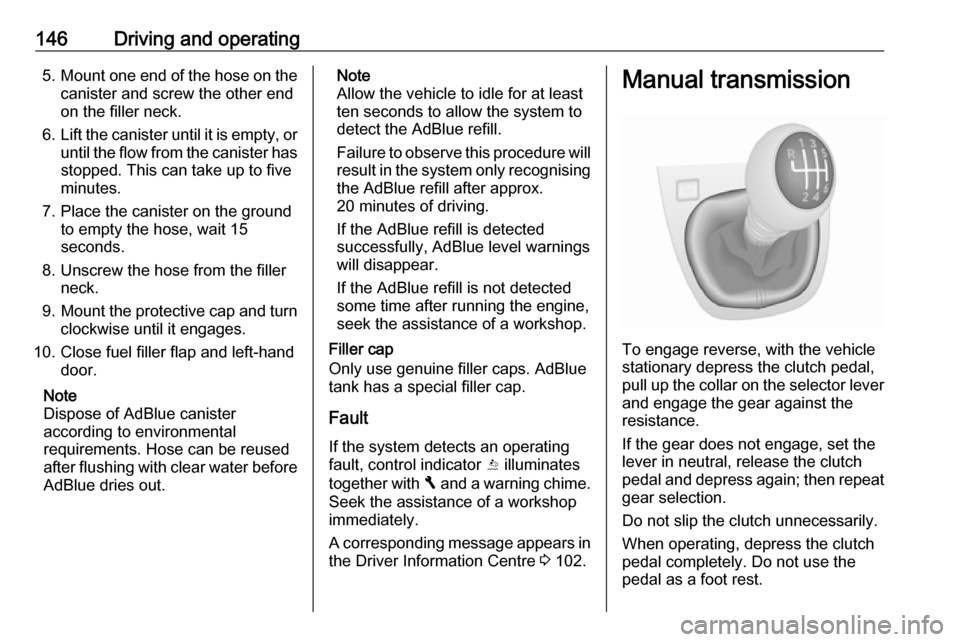
To engage reverse, with the vehicle
stationary depress the clutch pedal, pull up the collar on the selector lever
and engage the gear against the
resistance.
If the gear does not engage, set the
lever in neutral, release the clutch
pedal and depress again; then repeat
gear selection.
Do not slip the clutch unnecessarily.
When operating, depress the clutch pedal completely. Do not use the
pedal as a foot rest.
Page 161 of 237

Driving and operating159The guide line intervals are as
follows:3 (red):30 cm4 (yellow):70 cm5 (green):150 cmSettings
Settings, e.g. brightness, contrast and colours can be changed via the
Infotainment system. The feature
may also be switched off
permanently. Refer to Infotainment
manual for further information.
Deactivation
The camera is deactivated after a
delay if reverse gear is not engaged
for approx. five seconds.
Fault
The rear view camera may not
operate properly when:
● the surrounding is dark
● the sun or the beam of headlights
is shining directly into the camera
lens
● ice, snow, mud, or anything else covers the camera lens. Clean
the lens, rinse it with water, and
wipe it with a soft cloth
● the rear doors / tailgate are not closed correctly
● the vehicle had a rear-end accident
● there are extreme temperature changesFuel
Fuel for diesel engines Only use diesel fuel that complies
with EN 590. The fuel must have low
sulphur content (max. 10 ppm).
Equivalent standardised fuels with a
biodiesel (= FAME according to
EN14214) content of max. 7% by
volume (like DIN 51628 or equivalent
standards) may be used.
In countries outside the European
Union, use Euro-Diesel fuel with a
sulphur concentration below 50 ppm.Caution
Use of fuel that does not comply to EN 590 or similar can lead to
engine powerloss, increased wear
or engine damage and loss of
warranty.
Do not use marine diesel oils, heating
oils, Aquazole and similar diesel-
water emulsions. Diesel fuels must
not be diluted with fuels for petrol
engines.
Page 162 of 237

160Driving and operatingThe flow and filterability of diesel fuelsare temperature-dependent. When
temperatures are low, refuel with
diesel fuel with guaranteed winter
properties.
Diesel fuel filter 3 173.
Diesel fuel system bleeding 3 173.
Low temperature operation At temperatures below 0 °C, somediesel products with biodiesel blends
may clog, freeze or gel, which may
affect the fuel supply system. Starting
and engine operation may not work
properly. Make sure to fill winter
grade diesel fuel at ambient
temperatures below 0 °C.
Arctic grade diesel fuel can be used
in extreme cold temperatures below
-20 °C. Using this fuel grade in warm
or hot climates is not recommended
and may cause engine stalling, poor starting or damage on the fuel
injection system.Refuelling9 Danger
Before refuelling, switch off engine
and any external heaters with
combustion chambers.
Vehicles with stop-start system:
The engine must be switched off
and the ignition key removed, to avoid risk of engine being
restarted automatically by the
system.
Switch off any mobile phones.
Follow the operating and safety
instructions of the filling station
when refuelling.
9 Danger
Fuel is flammable and explosive.
No smoking. No naked flames or
sparks.
If you can smell fuel in your
vehicle, have the cause of this
remedied immediately by a
workshop.
Caution
In case of misfuelling, do not
switch on ignition.
Note
To ensure the fuel level is displayed
correctly, the ignition must be
switched off before refuelling. Avoid
minor fuel top-ups (e.g. less than
five litres) to ensure accurate
readings.
The fuel filler flap is located on the left-
hand side of the vehicle.
The fuel filler flap can only be opened
if the vehicle is unlocked and the left- hand door is opened.
Note
Do not open the left-hand sliding
side door during refuelling.
Pull flap to open.
Page 163 of 237

Driving and operating161Caution
In vehicles with AdBlue, the
AdBlue protective cap is the blue
lower cap 3 141 , and the fuel filler
cap is the black upper cap
(arrowed in illustration).
In case of misfuelling, do not
switch on ignition. Seek the
assistance of a workshop
immediately.
To open the fuel filler cap, turn
anticlockwise.
The fuel filler cap can be retained in
the bracket on the fuel filler flap.
For refuelling, fully insert the pump
nozzle and switch it on.
After automatic cut-off, it can be
topped up by operating the pump
nozzle a maximum of two more times.Caution
Wipe off any overflowing fuel
immediately.
When refuelling is complete, replace
the fuel filler cap and turn clockwise
as far as it will go.
Close the fuel filler flap.
Fuel filler cap Only use genuine fuel filler caps.Diesel-engined vehicles have special
fuel filler caps.
Fuel consumption - CO 2-
Emissions
The values for fuel consumption
(combined) of the model Opel Vivaro
is within a range of 7.4 to
5.7 l/100 km.
Depending on country, the fuel
consumption is displayed in km/l. In
this case, the fuel consumption
(combined) of the model Opel Vivaro
is within a range of approx. 13.5 to
17.5 km/l.
The CO 2 emission (combined) is
within a range of 195 to 149 g/km.
For the values specific to your
vehicle, refer to the EEC Certificate of Conformity provided with your vehicle
or other national registration
documents.
General information
The official fuel consumption and
specific CO 2 emission figures quoted
relate to the EU base model with
standard equipment.
Fuel consumption data and CO 2
emission data are determined
according to regulation
R (EC) No. 715/2007 (in the latest
applicable version), taking into
consideration the vehicle weight in
running order, as specified by the
regulation.
Page 164 of 237

162Driving and operatingThe figures are provided only for the
purpose of comparison between different vehicle variants and mustnot be taken as a guarantee for the
actual fuel consumption of a
particular vehicle.
Additional equipment may result in
slightly higher results than the stated
fuel consumption and CO 2 figures.
Furthermore, fuel consumption is dependent on personal driving style
as well as road and traffic conditions.Trailer hitch
General information
Entrust retrofitting of towing
equipment to a workshop. It may be
necessary to make changes that
affect the cooling system, heat
shields or other equipment. Only use
towing equipment that has been
approved for your vehicle.
Driving characteristics and towing tips
In the case of trailers with brakes,
attach the breakaway stopping cable.
Before attaching a trailer, lubricate
the coupling ball. However, do not do so if a stabiliser, which acts on thecoupling ball, is being used to reduce
snaking movements. For trailers with
low driving stability the use of a
stabiliser is recommended.
A maximum speed of 80 km/h must
not be exceeded, even in countries
where higher speeds are permitted.If the trailer starts snaking, drive more slowly, do not attempt to correct the
steering and brake sharply if
necessary.
When driving downhill, drive in the
same gear as if driving uphill and
drive at a similar speed.
Adjust tyre pressure to the value
specified for full load 3 220.
Trailer towing
Trailer loads The permissible trailer loads are
vehicle and engine-dependent
maximum values which must not be
exceeded. The actual trailer load is the difference between the actual
gross weight of the trailer and the
actual coupling socket load with the
trailer coupled.
The permissible trailer loads are
specified in the vehicle documents. In
general, they are valid for gradients
up to max. 12%.
The permitted trailer load applies up
to the specified incline and up to an
altitude of 1000 metres above sea
Page 166 of 237

164Vehicle careVehicle careGeneral Information...................165
Accessories and vehicle modifications .......................... 165
Vehicle storage ........................165
End-of-life vehicle recovery .....166
Vehicle checks ........................... 166
Performing work ......................166
Bonnet ..................................... 166
Engine oil ................................. 167
Engine air filter ........................ 168
Engine coolant ......................... 169
Power steering fluid .................169
Washer fluid ............................ 170
Brakes ..................................... 170
Brake fluid ............................... 170
Vehicle battery ......................... 171
Diesel fuel filter ........................173
Diesel fuel system bleeding .....173
Wiper blade replacement ........174
Bulb replacement .......................175
Headlights ............................... 175
Fog lights ................................. 176
Front turn signal lights .............176
Tail lights ................................. 176
Side turn signal lights ..............177Centre high-mounted brake
light ......................................... 177
Reversing light ......................... 178
Number plate light ...................179
Fog tail light ............................. 179
Interior lights ............................ 180
Instrument panel illumination ...180
Electrical system ........................181
Fuses ....................................... 181
Instrument panel fuse box .......182
Vehicle tools .............................. 185
Tools ........................................ 185
Wheels and tyres .......................186
Tyres ....................................... 186
Winter tyres ............................. 186
Tyre designations ....................186
Tyre pressure .......................... 186
Tyre pressure monitoring system .................................... 188
Tread depth ............................. 190
Changing tyre and wheel size . 190
Wheel covers ........................... 190
Tyre chains .............................. 191
Tyre repair kit .......................... 191
Wheel changing .......................194
Spare wheel ............................ 195
Jump starting ............................. 197Towing....................................... 198
Towing the vehicle ...................198
Towing another vehicle ...........199
Appearance care .......................200
Exterior care ............................ 200
Interior care ............................. 202
Page 167 of 237

Vehicle care165General Information
Accessories and vehicle modifications
We recommend the use of genuine
parts and accessories and factory
approved parts specific for your
vehicle type. We cannot assess or guarantee reliability of other products
- even if they have a regulatory or
otherwise granted approval.
Any modification, conversion or other changes made to standard vehicle
specifications (including, without
limitation, software modifications,
modifications of the electronic control
units) may invalidate the warranty
offered by Opel. Furthermore, such
changes may impact fuel
consumption, CO 2 emissions and
other emissions of the vehicle and
cause the vehicle to no longer
conform to the operating permit,
impacting the validity of your vehicle
registration.Caution
When transporting the vehicle on
a train or on a recovery vehicle, the
mud flaps might be damaged.
Vehicle storage
Storage for a long period of time
If the vehicle is to be stored for several months:
● Wash the vehicle. Wax painted parts of the vehicle.
Exterior care 3 200.
● Have the wax in the engine compartment and underbody
checked.
● Clean and preserve rubber seals.
● Fill up fuel tank completely.
● Change the engine oil.
● Drain the washer fluid reservoir. ● Check the coolant antifreeze and
corrosion protection.
● Adjust tyre pressure to the value specified for full load.
● Park vehicle in a dry, wellventilated place. Engage first or
reverse gear. Prevent the vehicle from rolling.
● Do not apply the parking brake.
● Open the bonnet, close all doors and lock the vehicle.
Putting back into operation
When the vehicle is to be put back into
operation:
● Check tyre pressure.
● Fill up the washer fluid reservoir. ● Check the engine oil level.
● Check the coolant level.
● Since the durability of AdBlue is limited to two years, fluid should
be exchanged if it is too old. Seek the assistance of a workshop.
● Fit the number plate, if necessary.
Page 175 of 237
Vehicle care173disconnecting the main vehicle
battery or before jump starting the vehicle.
The terminals are designed for
additional electrical consumers up to
a maximum of 50 A.
Jump starting 3 197.
Diesel fuel filter The diesel fuel filter is accessible from the underside of the vehicle.
Drain filter of residual water at every
engine oil change.
Place a container underneath the
filter housing. Loosen the knurled
screw on the lower part of the filter by approx. one turn, to drain off the
water.
The filter is drained as soon as water-
free diesel fuel emerges. Retighten
the screw.
Check diesel fuel filter at shorter
intervals if the vehicle is subjected to
extreme operating conditions.
Diesel fuel system bleeding
If the fuel tank has been run dry, it will be necessary to air vent or bleed the
diesel fuel system.
Refuel then proceed as follows:With ignition key
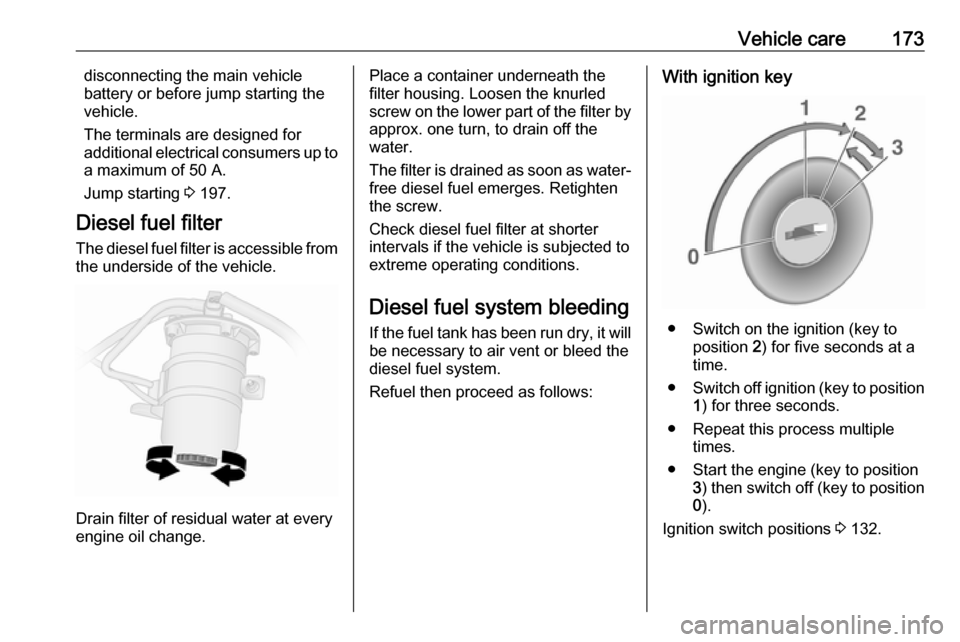
● Switch on the ignition (key to position 2) for five seconds at a
time.
● Switch off ignition (key to position
1 ) for three seconds.
● Repeat this process multiple times.
● Start the engine (key to position 3) then switch off (key to position
0 ).
Ignition switch positions 3 132.