Pressure OPEL ZAFIRA 2009 User Guide
[x] Cancel search | Manufacturer: OPEL, Model Year: 2009, Model line: ZAFIRA, Model: OPEL ZAFIRA 2009Pages: 228, PDF Size: 7.3 MB
Page 90 of 228
90
Instruments and controls
It illuminates for a few seconds when
the ignition is switched on.
Flashing during driving
The system has kicked in. Engine
output may be reduced and the
vehicle may be braked automatically
to a small degree 3 142.
Illuminates while driving
The system is switched off or a fault
is present. Continued driving is
possible. Driving stability, however,
may deteriorate depending on road
surface conditions.
Have the cause of the fault remedied
by a workshop.
ESP® Plus
3 142.
Engine coolant
temperature
W illuminates red.
Illuminates when the engine is
running
Stop, switch off engine. Caution
Coolant temperature too high.
Check coolant level immediately
3 157.
If there is sufficient coolant, consult
a workshop.
Preheating and diesel
particle filter
!
illuminates or flashes yellow.
Illuminated
Preheating activated. Only activates
when outside temperature is low.
Flashes
( in
vehicles fitted with a diesel particle
filter).
Control indicator ! flashes if the filter
requires cleaning and previous
driving conditions did not permit
automatic cleaning. Continue driving
and if possible do not allow engine
speed to drop below 2000 rpm. The control indicator
! goes off as
soon
as the self-cleaning operation is
complete.
Diesel particle filter 3 129.
Deflation detection system
and tyre pressure
monitoring system
w illuminates or flashes red or yellow.
Control indicator lights red
Tyre pressure loss. Stop immediately
and check tyre pressure. A maximum
speed of 80 km/h is permitted for run-
flat tyres 3 174.
Control indicator lights yellow
Fault in system or tyre without
pressure sensor mounted (e. g. spare
wheel). Consult a workshop.
Flashes
Flashes three times to indicate
system initialisation.
Deflation detection system 3 177,
tyre pressure monitoring system
3 176.
Page 91 of 228
Instruments and controls
91
Interactive Driving System,
Continuous Damping
Control, SPORT-mode
IDS+ illuminates yellow.
Illuminates for approximately 10
seconds after the driver's door is
opened. Illumination whilst driving
indicates a fault in the system. The
system
switches to the harder chassis
setting for reasons of safety. Have the
cause of the fault remedied by
a workshop.
IDS Plus
3 143, CDC 3 143, SPORT
mode 3 143.
Engine oil pressure
I illuminates red.
It illuminates when the ignition is
switched on and goes out shortly after
the engine starts. Illuminates when the engine is
running
Caution
Engine lubrication may be
interrupted. This may result in
damage to the engine and/or
locking of the drive wheels.
1. Depress clutch.
2.
Select neutral gear, set selectorlever to N .
3. Move out of the flow of traffic as quickly as possible without
impeding other vehicles.
4. Switch off ignition. 9
Warning When the engine is off,
considerably
more force is needed
to brake and steer.
Do not remove key until vehicle
has come to a standstill, otherwise
the steering column lock could
engage unexpectedly. Seek the assistance of a workshop.
Low engine oil level
S
illuminates yellow.
Engine oil level is checked
automatically.
Illuminates when the engine is
running
Low
engine oil level. Check engine oil
level and top up as necessary
3 156.
Low fuel
Y illuminates or flashes yellow.
Illuminated
Level in fuel tank too low.
Flashes
Fuel used up. Refuel immediately.
Never run the tank dry.
Catalytic converter 3 130.
Bleeding the diesel fuel system
3 159.
Page 101 of 228
Instruments and controls
101
Brake light switch
Brake light does not come on during
braking. Have the cause of the fault
remedied immediately by
a workshop.
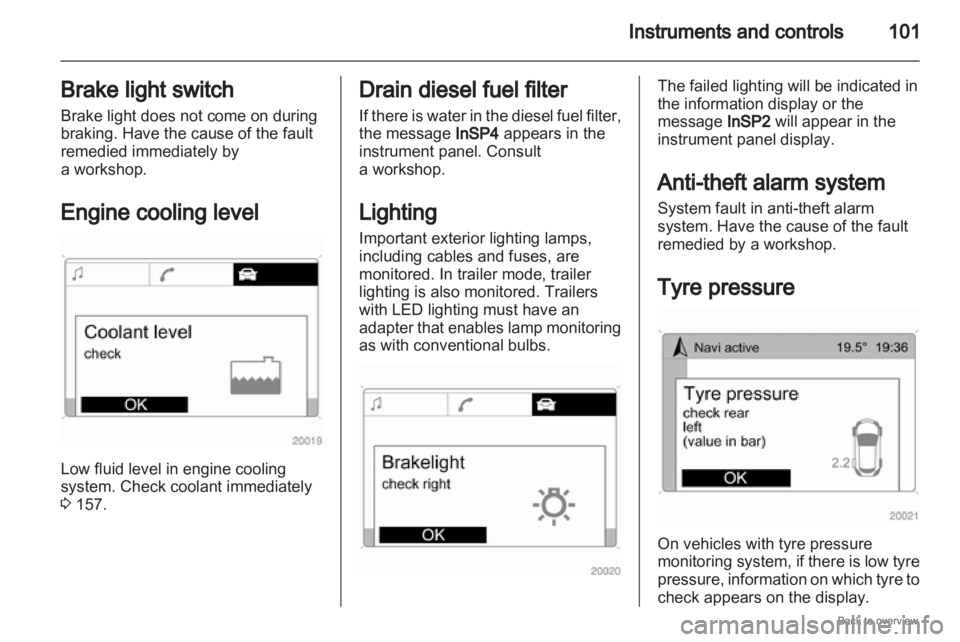
Engine cooling level Low fluid level in engine cooling
system. Check coolant immediately
3 157. Drain diesel fuel filter
If
there is water in the diesel fuel filter,
the message InSP4 appears in the
instrument panel. Consult
a workshop.
Lighting
Important exterior lighting lamps,
including cables and fuses, are
monitored. In trailer mode, trailer
lighting is also monitored. Trailers
with LED lighting must have an
adapter that enables lamp monitoring
as with conventional bulbs. The failed lighting will be indicated in
the information display or the
message InSP2 will appear in the
instrument panel display.
Anti-theft alarm system
System fault in anti-theft alarm
system. Have the cause of the fault
remedied by a workshop.
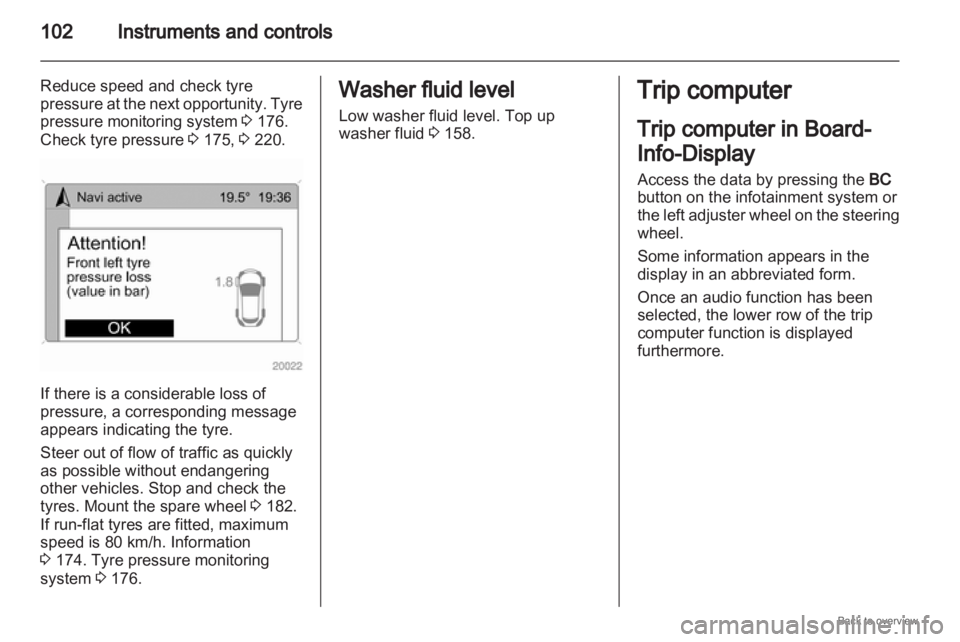
Tyre pressure On vehicles with tyre pressure
monitoring
system, if there is low tyre
pressure, information on which tyre to
check appears on the display.
Page 102 of 228
102
Instruments and controls
Reduce speed and check tyre
pressure at the next opportunity. Tyre
pressure monitoring system 3 176.
Check tyre pressure 3 175, 3 220.If there is a considerable loss of
pressure, a corresponding message
appears indicating the tyre.
Steer out of flow of traffic as quickly
as possible without endangering
other vehicles. Stop and check the
tyres. Mount the spare wheel
3 182.
If run-flat tyres are fitted, maximum
speed is 80 km/h. Information
3 174. Tyre pressure monitoring
system 3 176. Washer fluid level
Low washer fluid level. Top up
washer fluid
3 158. Trip computer
Trip computer in Board-
Info-Display
Access the data by pressing the
BC
button on the infotainment system or
the
left adjuster wheel on the steering
wheel.
Some information appears in the
display in an abbreviated form.
Once an audio function has been
selected, the lower row of the trip
computer function is displayed
furthermore.
Page 107 of 228
Instruments and controls
107
Driving Time incl Stops
The time the vehicle is in motion is
recorded. The time the vehicle is
stationary with the ignition switched
on is included.
Travel Time
Measurement of the time from
manual
activation via Start to manual
deactivation via Reset.
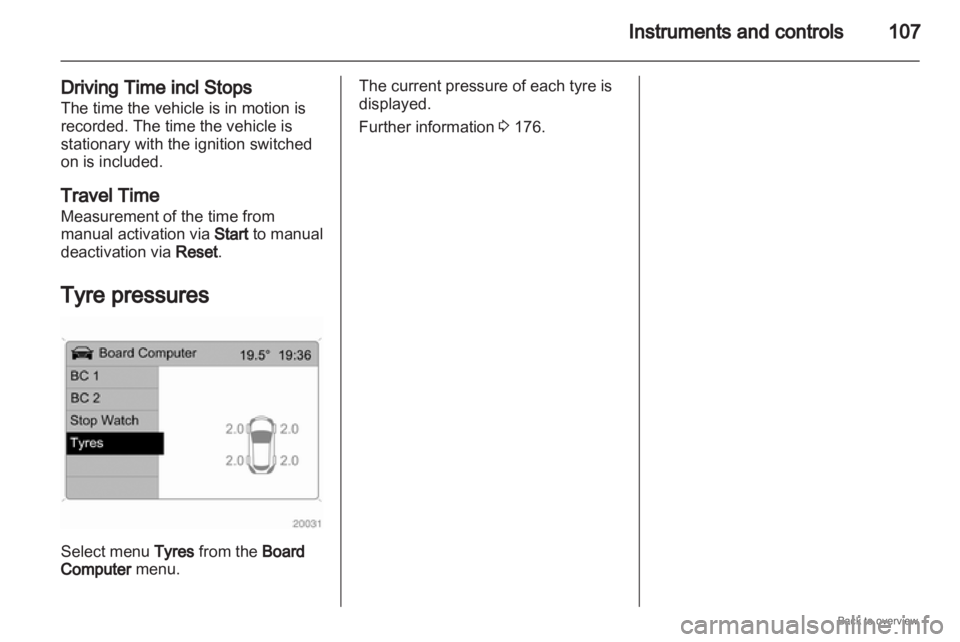
Tyre pressures Select menu Tyres from the Board
Computer menu. The current pressure of each tyre is
displayed.
Further information
3 176.
Page 126 of 228
126
Climate control
Air conditioning regular
operation
In order to ensure continuously
efficient performance, cooling must
be operated for a few minutes once
a month, irrespective of the weather
and time of year. Operation with
cooling is not possible when outside
temperature is low.
Service
For
optimal cooling performance, it is
recommended that the climate control
system be checked annually, starting
three years after initial vehicle
registration.
■ Functionality and pressure test
■ Heating functionality
■ Leakage check
■ Check of drive belts
■ Cleaning of condenser and evaporator drainage
■ Performance check
Page 135 of 228
Driving and operating
135
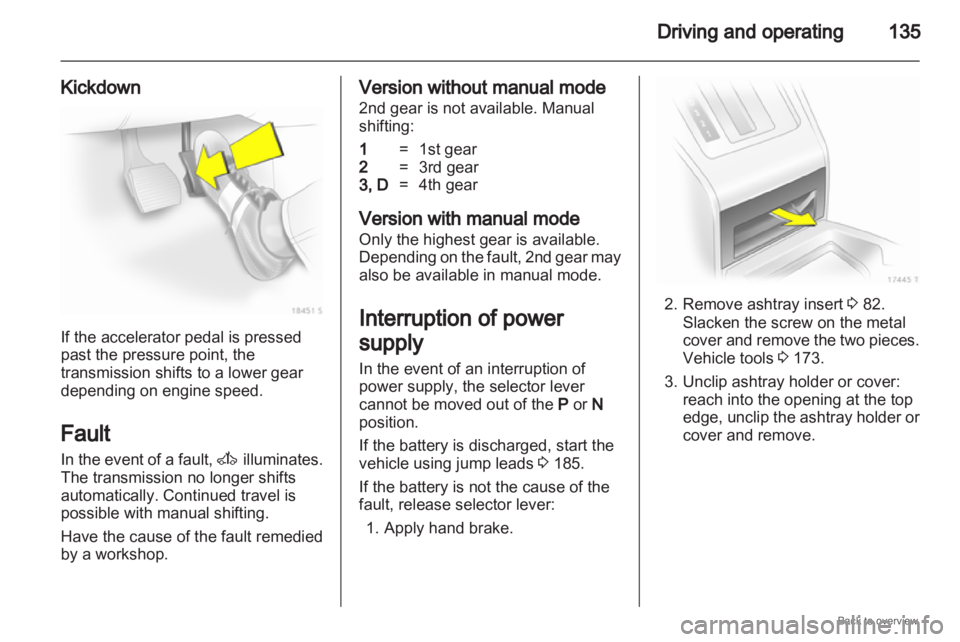
Kickdown If the accelerator pedal is pressed
past the pressure point, the
transmission shifts to a lower gear
depending on engine speed.
Fault
In
the event of a fault, A illuminates.
The transmission no longer shifts
automatically. Continued travel is
possible with manual shifting.
Have the cause of the fault remedied
by a workshop. Version without manual mode
2nd gear is not available. Manual
shifting:
1
= 1st gear
2 = 3rd gear
3, D =4th gear
Version with manual mode
Only the highest gear is available.
Depending
on the fault, 2nd gear may
also be available in manual mode.
Interruption of power
supply
In the event of an interruption of
power supply, the selector lever
cannot be moved out of the P or N
position.
If the battery is discharged, start the
vehicle using jump leads 3 185.
If the battery is not the cause of the
fault, release selector lever: 1. Apply hand brake. 2. Remove ashtray insert
3 82.
Slacken the screw on the metal
cover
and remove the two pieces.
Vehicle tools 3 173.
3. Unclip ashtray holder or cover: reach into the opening at the top
edge, unclip the ashtray holder or
cover and remove.
Page 139 of 228

Driving and operating
139
Activation
Press the T button. The transmission
switches to automatic mode. The
vehicle starts off in 2nd gear. Sport
mode is deactivated.
Deactivation
The Winter programme is switched off
by:
■ pressing the T button again
■ turning off the ignition,
■ switching to manual mode (when switched back to automatic mode,
the Winter programme is again
active)
■ when clutch temperature is too high Kickdown
If the accelerator pedal is pressed
past the pressure point, the
transmission shifts to a lower gear
depending on engine speed.
Fault
To prevent damage to the manual
transmission
automated, the clutch is
engaged automatically at high clutch
temperatures.
A illuminates in the event of a fault.
Continued driving is possible. Manual
mode cannot be used for shifting. If F appears in the transmission
display, continued driving is not
possible.
Have the cause of the fault remedied
by a workshop.
Interruption of power
supply
The clutch is not disengaged if there
is an interruption of the power supply
when a gear is engaged. The vehicle
cannot move.
If the battery is discharged, start the
vehicle using jump leads 3 185.
If the cause of the fault is not
a discharged battery, seek the
assistance of a workshop.
Page 141 of 228
Driving and operating
141
ABS starts to regulate brake pressure
as soon as a wheel shows a tendency
to lock. The vehicle remains
steerable, even during hard braking.
ABS control is made apparent though
a pulse in the brake pedal and the
noise of the regulation process.
For optimum braking, keep the brake
pedal fully depressed throughout the
braking process, despite the fact that
the pedal is pulsating. Do not reduce
the pressure on the pedal.
Control indicator u 3 89.
Adaptive brake lamp
During full braking, all three brake
lamps flash for the duration of ABS
control. Fault
9
Warning If there is a fault in the ABS, the
wheels may be liable to lock due
to braking that is heavier than
normal. The advantages of ABS
are no longer available. During
hard braking, the vehicle can no
longer be steered and may
swerve.
Have the cause of the fault remedied
by a workshop. Parking brake
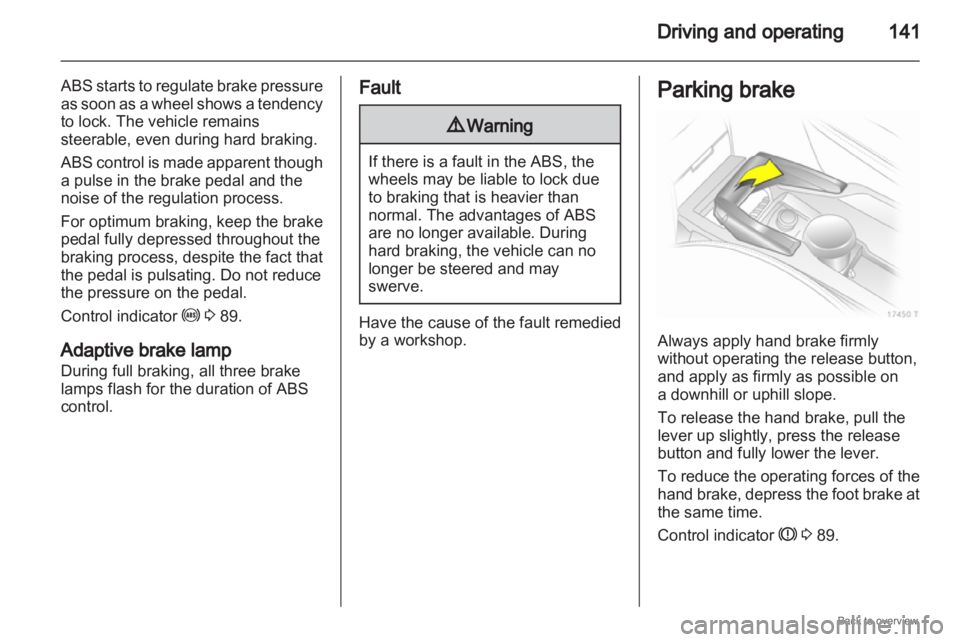
Always apply hand brake firmly
without operating the release button,
and apply as firmly as possible on
a downhill or uphill slope.
To release the hand brake, pull the
lever up slightly, press the release
button and fully lower the lever.
To
reduce the operating forces of the
hand brake, depress the foot brake at
the same time.
Control indicator R 3 89.
Page 142 of 228

142
Driving and operating
Brake assist
If the brake pedal is depressed
quickly and forcefully, maximum
brake force is automatically applied
(full braking).
Maintain steady pressure on the
brake
pedal for as long as full braking
is required. Maximum brake force is
automatically reduced when the
brake pedal is released.
Hill start assist
The system helps pull away on
inclines. After releasing the brake
pedal, if the hand brake is not applied
the brakes are released after a 2-
second delay. Ride control systems
Electronic stability
program
Electronic stability program
(ESP®
Plus
) improves driving stability
when necessary, regardless of the
type
of road surface or tyre grip. It also
prevents the drive wheels from
spinning.
As soon as the vehicle starts to
swerve (understeer/oversteer),
engine output is reduced and the
wheels are braked individually. This
considerably improves the driving
stability of the vehicle on slippery road
surfaces.
ESP® Plus
is operational as soon as
control indicator v extinguishes.
When ESP® Plus
comes into action v
flashes. 9
Warning Do not let this special safety
feature tempt you into taking risks
when driving.
Adapt speed to the road
conditions.
Control indicator
v 3 89.
Deactivation ESP®
Plus
can be deactivated when
Sport mode is engaged for high-
performance driving: