Pressure OPEL ZAFIRA 2009 Owner's Manual
[x] Cancel search | Manufacturer: OPEL, Model Year: 2009, Model line: ZAFIRA, Model: OPEL ZAFIRA 2009Pages: 228, PDF Size: 7.3 MB
Page 143 of 228

Driving and operating
143
Hold the SPORT button depressed
for about 4 seconds. Control indicator
v illuminates. ESPoff also appears in
the service display. 9
Warning Do not deactivate ESP®
Plus
if
a
run-flat tyre 3 has lost pressure.ESP®
Plus
is reactivated by pressing
the SPORT
button. ESPon appears in
the service display. ESP® Plus
is also
reactivated the next time the ignition
is switched on.
Sport mode 3 143.
Interactive driving system
Interactive driving system (IDS Plus
)
combines the electronic stability
program (ESP® Plus
) with the antilock
brake system (ABS) and continuous
damping control (CDC) to improve
driving dynamics and vehicle safety. Sport mode
Suspension and steering become
more direct and provide better
contact with the road surface. The
engine reacts more quickly to
accelerator pedal movements.
Automatic
gear changing is also more
responsive.
Control indicator IDSPlus
3 91.
Activation Press SPORT button.
Control indicator
1 3 89. Winter programme activation not
possible.
Deactivation
Briefly press the SPORT button.
Sport mode is deactivated the next
time the ignition is switched on or if
the Winter programme is activated.
Continuous damping
control
Continuous damping control (CDC)
changes suspension with damping
adaptation
of each shock absorber to
the current driving situation and road
conditions.
When Sport mode is engaged, the
damping control is adapted to
a sportier driving style.
Control indicator IDS+ 3 91.
Page 148 of 228
148
Driving and operating
The fuel filler cap can be retained in
the bracket on the fuel filler flap. Caution
Wipe off any overflowing fuel
immediately.
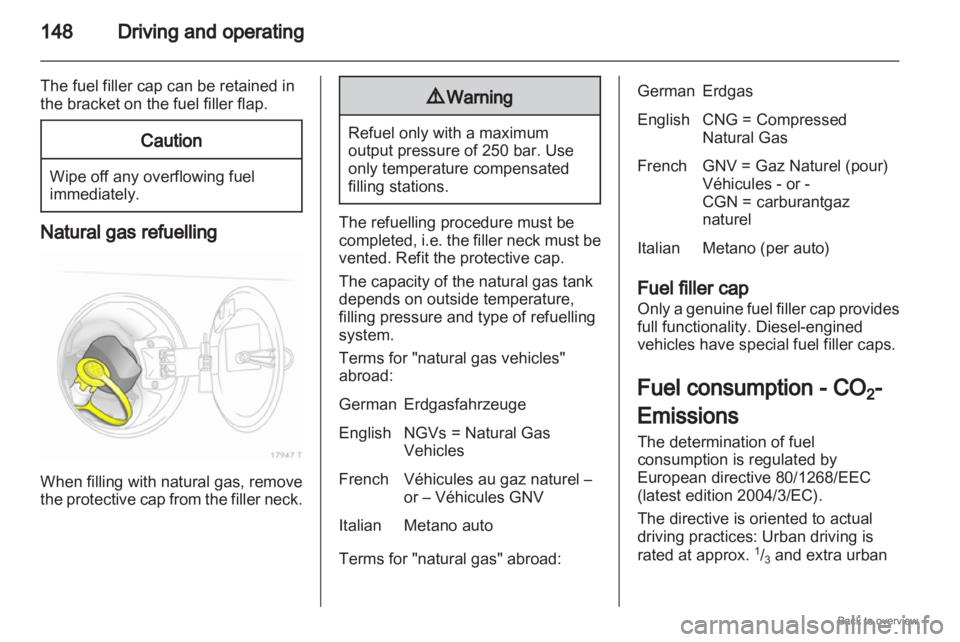
Natural gas refuelling
When filling with natural gas, remove
the
protective cap from the filler neck. 9
Warning Refuel only with a maximum
output pressure of 250 bar. Use
only temperature compensated
filling stations.
The refuelling procedure must be
completed,
i.e. the filler neck must be
vented. Refit the protective cap.
The capacity of the natural gas tank
depends on outside temperature,
filling pressure and type of refuelling
system.
Terms for "natural gas vehicles"
abroad:
German Erdgasfahrzeuge
English NGVs = Natural Gas Vehicles
French Véhicules au gaz naturel – or – Véhicules GNV
Italian Metano auto
Terms for "natural gas" abroad: German Erdgas
English CNG = Compressed
Natural Gas
French GNV = Gaz Naturel (pour) Véhicules - or -
CGN = carburantgaz
naturel
Italian Metano (per auto)
Fuel filler cap
Only
a genuine fuel filler cap provides
full functionality. Diesel-engined
vehicles have special fuel filler caps.
Fuel consumption - CO 2-
Emissions
The determination of fuel
consumption is regulated by
European directive 80/1268/EEC
(latest edition 2004/3/EC).
The directive is oriented to actual
driving practices: Urban driving is
rated at approx. 1
/3 and extra urban
Page 150 of 228
150
Driving and operating
If the trailer starts snaking, drive more
slowly, do not attempt to correct the
steering and brake sharply if
necessary.
When driving downhill, drive in the
same gear as if driving uphill and
drive at a similar speed.
Adjust tyre pressure to the value
specified for full load 3 220.
Trailer towing
Trailer loads
The permissible trailer loads are
vehicle and engine-dependent
maximum values which must not be
exceeded. The actual trailer load is
the difference between the actual
gross weight of the trailer and the
actual coupling socket load with the
trailer coupled.
The permissible trailer loads are
specified
in the vehicle documents. In
general, they are valid for gradients
up to max. 12 % The permitted trailer load applies up
to the specified incline and up to an
altitude of 1000 metres above sea
level. Since engine power decreases
as altitude increases because of the
air becoming thinner, therefore
reducing climbing ability, the
permissible gross train weight also
decreases by 10 % for every 1000
metres of additional altitude. The
gross
train weight does not have to be
reduced when driving on roads with
slight inclines (less than 8 %, e. g.
motorways).
The permissible gross train weight
must not be exceeded. This weight is
specified on the identification plate
3 208.
Vertical coupling load
The vertical coupling load is the load
exerted by the trailer on the coupling
ball. It can be varied by changing the
weight distribution when loading the
trailer.
The maximum permissible vertical
coupling load (75 kg) is specified on
the towing equipment identification
plate and in the vehicle documents. Always aim for the maximum load,
especially in the case of heavy
trailers. The vertical coupling load
should never fall below 25 kg.
Rear axle load
When the trailer is coupled and the
towing vehicle fully loaded, the
permissible rear axle load (see
identification plate or vehicle
documents) may be exceeded by 90
kg
and the gross vehicle weight rating
by 75 kg. If the permissible rear axle
load is exceeded, a maximum speed
of 100 km/h applies.
Towing equipment Caution
When operating without a trailer,
remove the coupling ball bar.
Page 154 of 228
154
Vehicle care
Vehicle care
General Information ...................154
Vehicle checks ........................... 155
Bulb replacement .......................160
Electrical system ........................167
Vehicle tools .............................. 173
Wheels and tyres .......................174
Jump starting ............................. 185
Towing ....................................... 187
Appearance care .......................189 General Information
Accessories and vehicle
modifications
We
recommend to use Genuine Parts
and Accessories and factory
approved parts specific for your
vehicle type. We cannot assess or
guarantee for other products - even if
they have a regulatory or otherwise
granted approval.
Do not make any modifications to the
electrical system, e. g. changes of
electronic control units (chip tuning).
Vehicle storage
Storage for a long period of time
Following must be done if the vehicle
should be stored for several months:
■ Wash and wax the vehicle.
■ Have the wax in the engine compartment and underbody
checked.
■ Clean and preserve rubber seals.
■ Change engine oil. ■ Drain washer fluid reservoir.
■
Check coolant anti-freeze andcorrosion protection.
■ Adjust tyre pressure to the value specified for full load.
■ Park vehicle in dry, well ventilated place. Engage first or reverse gear
or set selector lever to P. Prevent
the vehicle from rolling.
■ Do not apply hand brake.
■ Open bonnet, close all doors and lock the vehicle.
■ Disconnect the clamp from the negative terminal of the vehicle
battery. Beware that all systems are
not functional, e.g. anti-theft alarm
system.
Putting back into operation
Following must be done if the vehicle
is putting back into operation: ■ Connect the clamp to the negative terminal of the vehicle battery.
Activate the electronic of the power
windows.
■ Check tyre pressure.
■ Fill up the washer fluid reservoir.
Page 157 of 228
Vehicle care
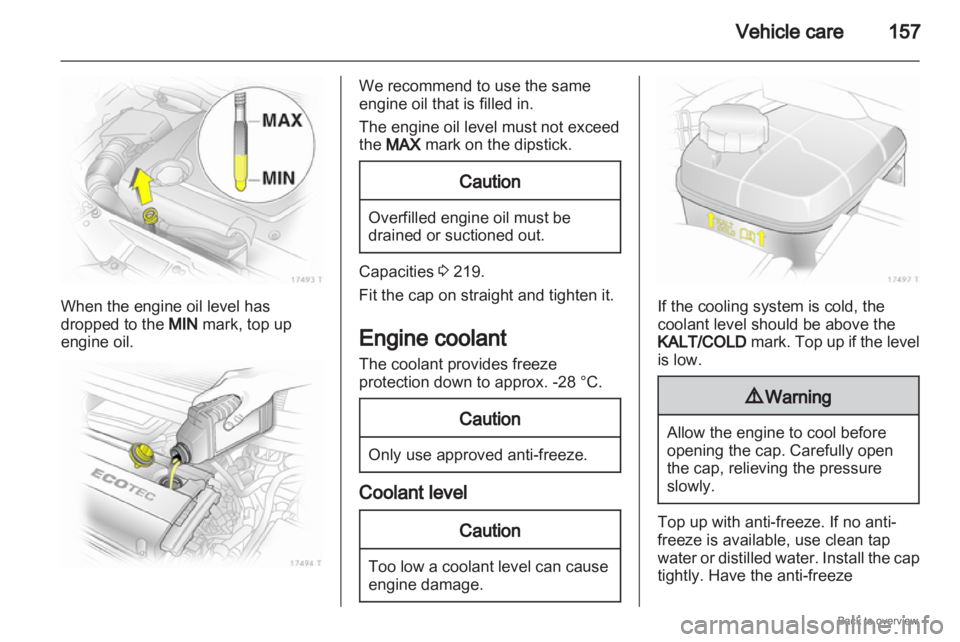
157When the engine oil level has
dropped to the
MIN mark, top up
engine oil. We recommend to use the same
engine oil that is filled in.
The engine oil level must not exceed
the MAX mark on the dipstick.
Caution
Overfilled engine oil must be
drained or suctioned out.
Capacities
3 219.
Fit the cap on straight and tighten it.
Engine coolant
The coolant provides freeze
protection down to approx. -28 °C. Caution
Only use approved anti-freeze.
Coolant level
Caution
Too low a coolant level can cause
engine damage. If the cooling system is cold, the
coolant level should be above the
KALT/COLD
mark. Top up if the level
is low. 9
Warning Allow the engine to cool before
opening the cap. Carefully open
the cap, relieving the pressure
slowly.
Top up with anti-freeze. If no anti-
freeze is available, use clean tap
water
or distilled water. Install the cap
tightly. Have the anti-freeze
Page 172 of 228
172
Vehicle care
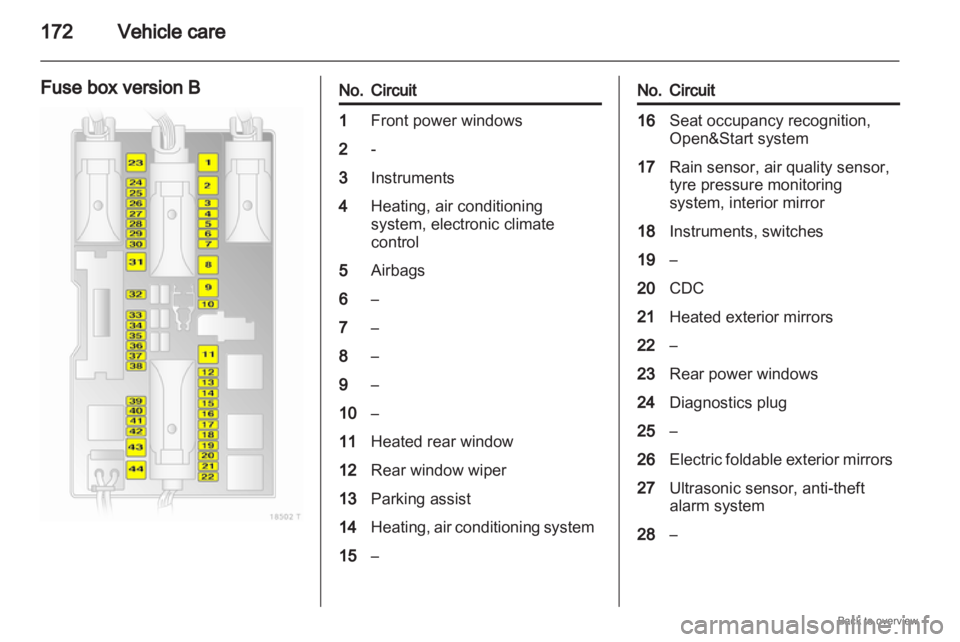
Fuse box version B No. Circuit
1
Front power windows
2 -
3 Instruments
4 Heating, air conditioning
system, electronic climate
control
5 Airbags
6 –
7 –
8 –
9 –
10 –
11 Heated rear window
12 Rear window wiper
13 Parking assist
14 Heating, air conditioning system
15 – No. Circuit
16
Seat occupancy recognition,
Open&Start system
17 Rain sensor, air quality sensor,
tyre pressure monitoring
system, interior mirror
18 Instruments, switches
19 –
20 CDC
21 Heated exterior mirrors
22 –
23 Rear power windows
24 Diagnostics plug
25 –
26 Electric foldable exterior mirrors
27 Ultrasonic sensor, anti-theft
alarm system
28 –
Page 174 of 228
174
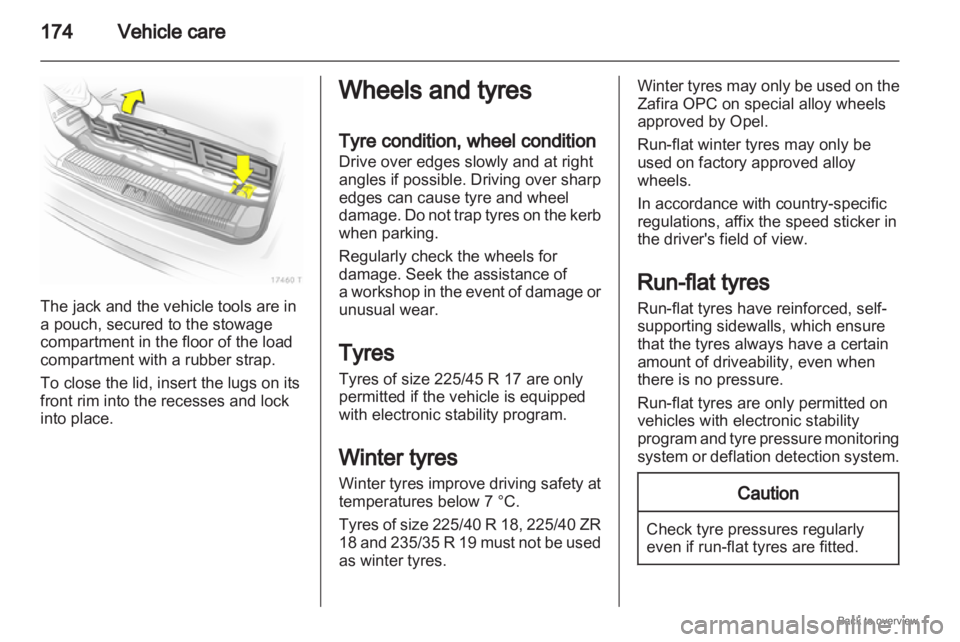
Vehicle careThe jack and the vehicle tools are in
a pouch, secured to the stowage
compartment in the floor of the load
compartment with a rubber strap.
To close the lid, insert the lugs on its
front rim into the recesses and lock
into place. Wheels and tyres
Tyre condition, wheel condition
Drive over edges slowly and at right
angles if possible. Driving over sharp
edges can cause tyre and wheel
damage.
Do not trap tyres on the kerb
when parking.
Regularly check the wheels for
damage. Seek the assistance of
a workshop in the event of damage or
unusual wear.
Tyres
Tyres of size 225/45 R 17 are only
permitted if the vehicle is equipped
with electronic stability program.
Winter tyres
Winter tyres improve driving safety at
temperatures below 7 °C.
Tyres of size 225/40 R 18, 225/40 ZR
18 and 235/35 R 19 must not be used
as winter tyres. Winter tyres may only be used on the
Zafira OPC on special alloy wheels
approved by Opel.
Run-flat winter tyres may only be
used on factory approved alloy
wheels.
In accordance with country-specific
regulations, affix the speed sticker in
the driver's field of view.
Run-flat tyres
Run-flat tyres have reinforced, self-
supporting sidewalls, which ensure
that the tyres always have a certain
amount of driveability, even when
there is no pressure.
Run-flat tyres are only permitted on
vehicles with electronic stability
program
and tyre pressure monitoring
system or deflation detection system. Caution
Check tyre pressures regularly
even if run-flat tyres are fitted.
Page 175 of 228
Vehicle care
175
Depending on tyre manufacturer, run-
flat tyres can be identified from
a marking on the tyre wall. E.g. ROF
= RunonFlat for Goodyear or SSR
= Self Supporting Runflat Tyre for
Continental.
Use of run-flat tyres is only permitted
in combination with factory approved
alloy wheels.
Do not use a tyre repair kit.
The ECO tyre pressure must not be
used.
Run-flat tyres must not be combined
with standard tyres.
If converting to standard tyres, note
that the vehicle is not equipped with
a spare wheel or tyre repair kit.
Driving with a damaged tyre
A
loss in tyre pressure is indicated by
the tyre pressure monitoring system
or the deflation detection system.
If a tyre has no pressure, continued
driving is possible
■ at a speed of max. 80 km/h
■ up to a distance of 80 km 9
Warning The vehicle will be more difficult to
steer and handle. Braking
distance will be longer.
Adapt driving style and speed to
the changed conditions.
Tyre designations
E.g. 195/65 R 15 91 H
195
=Tyre width, mm
65 =Cross-section ratio (tyre
height to tyre width), %
R = Belt type: Radial
RF =Type: RunFlat
15 =Wheel diameter, inches
91 =Load index e.g. 91 is
equivalent to 618 kg
H = Speed code letter
Speed code letter:
Q = up to 160 km/h
S = up to 180 km/h
T = up to 190 km/h
H = up to 210 km/h
V = up to 240 km/h
W = up to 270 km/h Tyre pressure
Check the pressure of cold tyres at
least every 14 days and before any
long journey. Do not forget the spare
wheel. This also applies to vehicles
with tyre pressure monitoring.
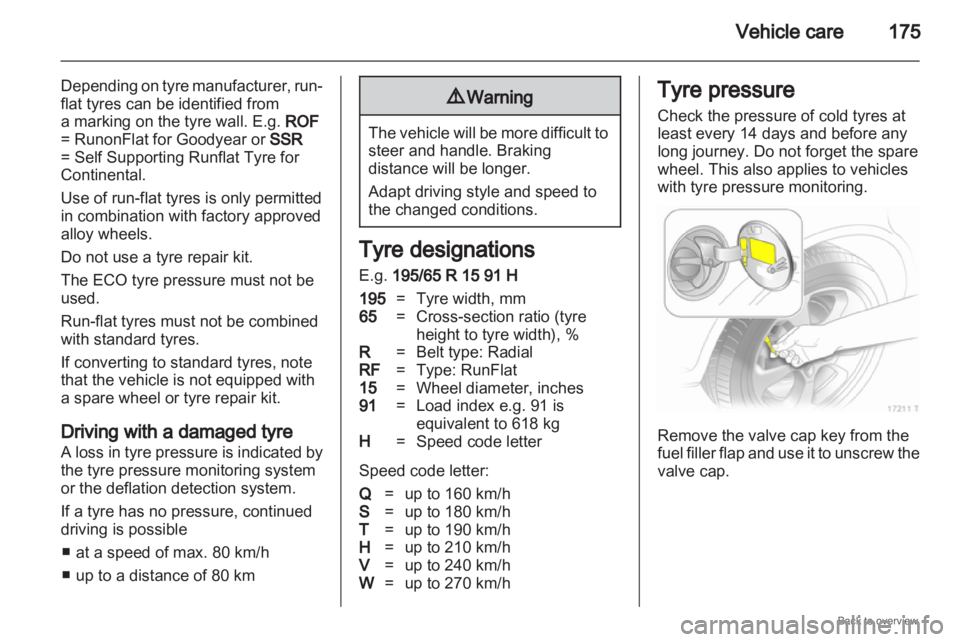
Remove the valve cap key from the
fuel
filler flap and use it to unscrew the
valve cap.
Page 176 of 228
176
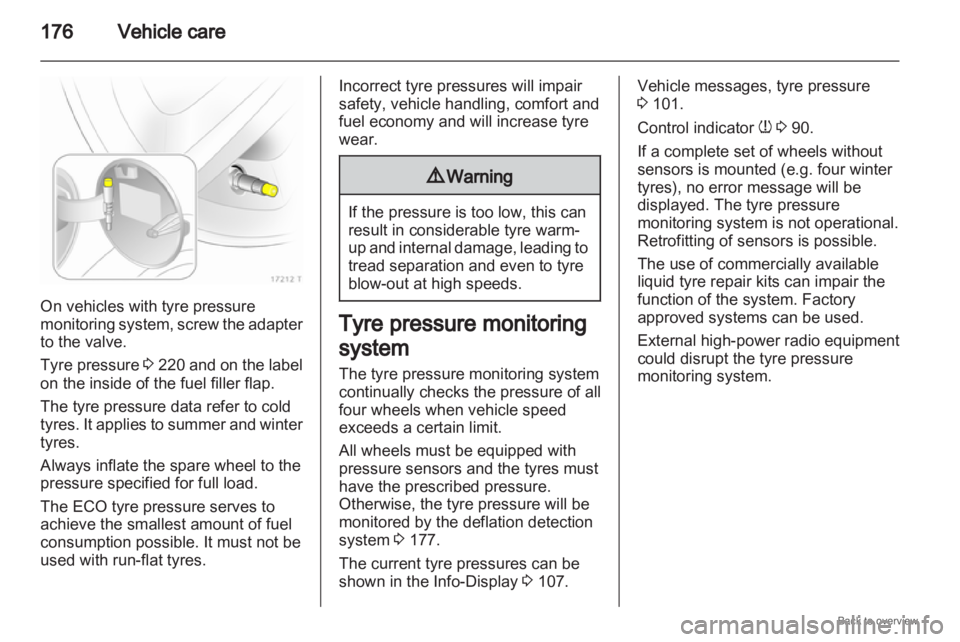
Vehicle careOn vehicles with tyre pressure
monitoring
system, screw the adapter
to the valve.
Tyre pressure 3 220 and on the label
on the inside of the fuel filler flap.
The tyre pressure data refer to cold
tyres. It applies to summer and winter
tyres.
Always inflate the spare wheel to the
pressure specified for full load.
The ECO tyre pressure serves to
achieve the smallest amount of fuel
consumption possible. It must not be
used with run-flat tyres. Incorrect tyre pressures will impair
safety, vehicle handling, comfort and
fuel economy and will increase tyre
wear.
9
Warning If the pressure is too low, this can
result in considerable tyre warm-
up
and internal damage, leading to
tread separation and even to tyre
blow-out at high speeds. Tyre pressure monitoring
system
The tyre pressure monitoring system
continually checks the pressure of all
four wheels when vehicle speed
exceeds a certain limit.
All wheels must be equipped with
pressure sensors and the tyres must
have the prescribed pressure.
Otherwise, the tyre pressure will be
monitored by the deflation detection
system 3 177.
The current tyre pressures can be
shown in the Info-Display
3 107. Vehicle messages, tyre pressure
3 101.
Control indicator
w 3 90.
If a complete set of wheels without
sensors is mounted (e.g. four winter
tyres), no error message will be
displayed. The tyre pressure
monitoring system is not operational.
Retrofitting of sensors is possible.
The use of commercially available
liquid tyre repair kits can impair the
function of the system. Factory
approved systems can be used.
External high-power radio equipment
could disrupt the tyre pressure
monitoring system.
Page 177 of 228
Vehicle care
177
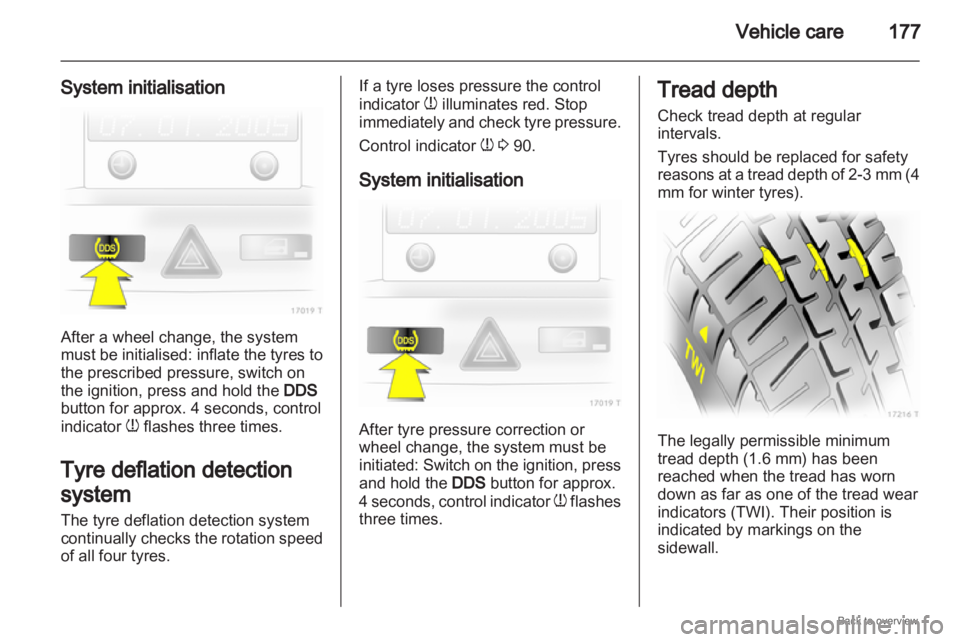
System initialisation After a wheel change, the system
must
be initialised: inflate the tyres to
the prescribed pressure, switch on
the ignition, press and hold the DDS
button for approx. 4 seconds, control
indicator w flashes three times.
Tyre deflation detection
system
The tyre deflation detection system
continually checks the rotation speed
of all four tyres. If a tyre loses pressure the control
indicator
w illuminates red. Stop
immediately
and check tyre pressure.
Control indicator w 3 90.
System initialisation After tyre pressure correction or
wheel change, the system must be
initiated:
Switch on the ignition, press
and hold the DDS button for approx.
4 seconds, control indicator w flashes
three times. Tread depth
Check tread depth at regular
intervals.
Tyres should be replaced for safety
reasons
at a tread depth of 2-3 mm (4
mm for winter tyres). The legally permissible minimum
tread depth (1.6 mm) has been
reached when the tread has worn
down as far as one of the tread wear
indicators (TWI). Their position is
indicated by markings on the
sidewall.