instrument panel PEUGEOT 108 2016 User Guide
[x] Cancel search | Manufacturer: PEUGEOT, Model Year: 2016, Model line: 108, Model: PEUGEOT 108 2016Pages: 268, PDF Size: 6.17 MB
Page 53 of 268
51
108_en_Chap03_ergonomie-confort_ed01-2016
Steering wheel adjustment
(with power steering)
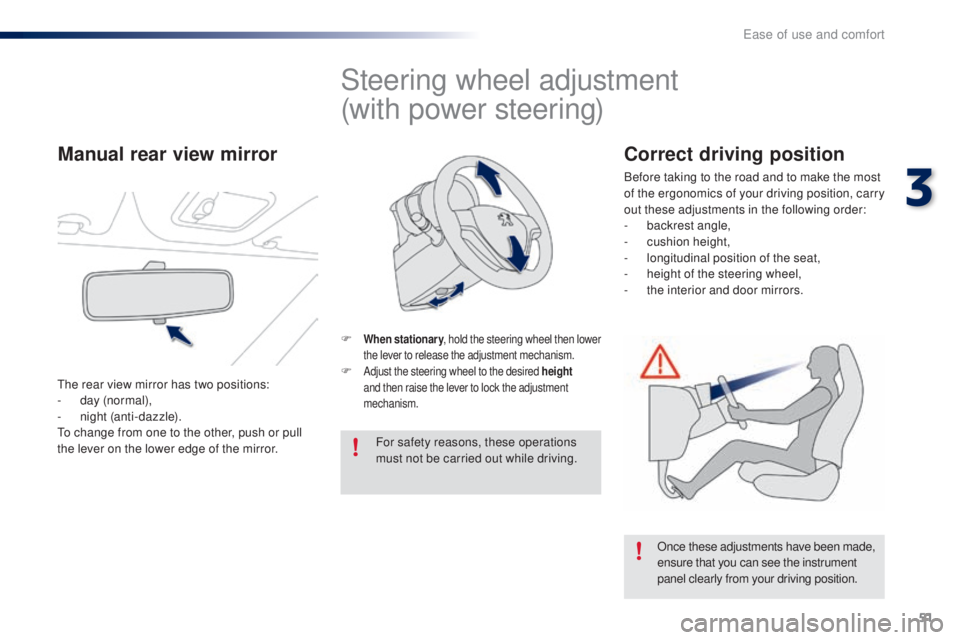
F When stationary, hold the steering wheel then lower
the lever to release the adjustment mechanism.
F Adjust the steering wheel to the desired height
and then raise the lever to lock the adjustment
mechanism.
For safety reasons, these operations
must not be carried out while driving.
Once these adjustments have been made,
ensure that you can see the instrument
panel clearly from your driving position.
Manual rear view mirror
the rear view mirror has two positions:
- d ay (normal),
-
n
ight (anti-dazzle).
to c
hange from one to the other, push or pull
the lever on the lower edge of the mirror.
Correct driving position
Before taking to the road and to make the most
of the ergonomics of your driving position, carry
out these adjustments in the following order:
-
b
ackrest angle,
-
c
ushion height,
-
l
ongitudinal position of the seat,
-
hei
ght of the steering wheel,
-
t
he interior and door mirrors.
3
ease of use and comfort
Page 75 of 268
73
108_en_Chap04_conduite_ed01-2016
Starting using the
electronic key
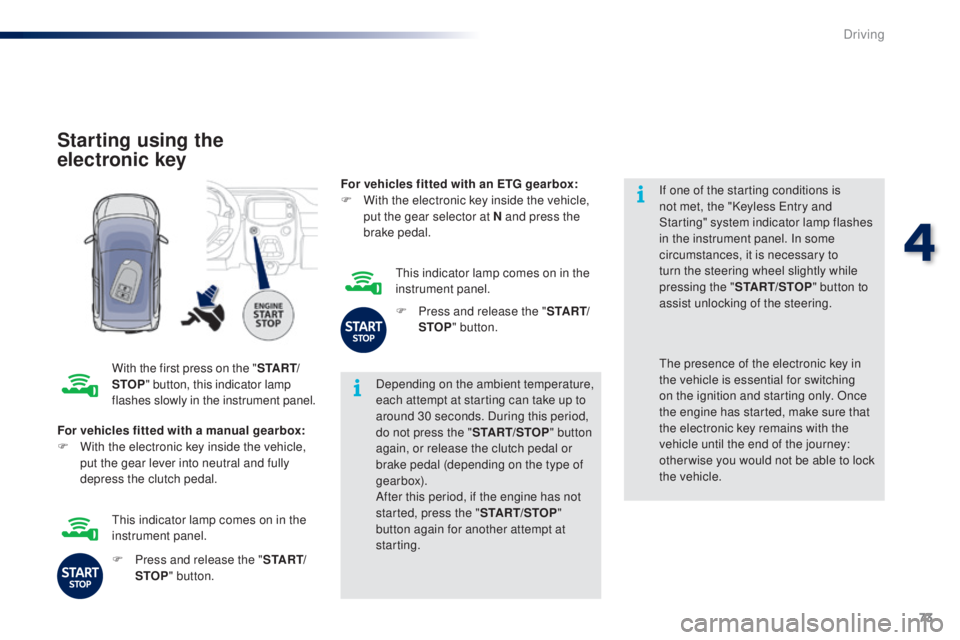
With the first press on the "St A Rt/
StoP " b
utton, this indicator lamp
flashes slowly in the instrument panel. Depending on the ambient temperature,
each attempt at starting can take up to
around 30 seconds. During this period,
do not press the "
S
t
A
R
t/
S to
P" b
utton
again, or release the clutch pedal or
brake pedal (depending on the type of
gearbox).
After this period, if the engine has not
started, press the " S
t
A
R
t/
S to
P"
b
utton again for another attempt at
starting. If one of the starting conditions is
not met, the "Keyless
e
n
try and
Starting" system indicator lamp flashes
in the instrument panel. In some
circumstances, it is necessary to
turn the steering wheel slightly while
pressing the " S t
A
R
t/
S to
P
" b
utton to
assist unlocking of the steering.
For vehicles fitted with a manual gearbox:
F
W
ith the electronic key inside the vehicle,
put the gear lever into neutral and fully
depress the clutch pedal.th e presence of the electronic key in
the vehicle is essential for switching
on the ignition and starting only. Once
the engine has started, make sure that
the electronic key remains with the
vehicle until the end of the journey:
other wise you would not be able to lock
the
vehicle.
F
P
ress and release the " S
t
A R
t/
StoP " b
utton.
th
is indicator lamp comes on in the
instrument panel. For vehicles fitted with an
etg gearbox:
F
W
ith the electronic key inside the vehicle,
put the gear selector at N and press the
brake pedal.
th
is indicator lamp comes on in the
instrument panel.
F
P
ress and release the "
S
t
A R
t/
StoP " b
utton.
4
Driving
Page 76 of 268
74
108_en_Chap04_conduite_ed01-2016
there is an audible signal when the driver's door
is opened and the vehicle is in "ACC" mode.
If the vehicle is not immobilised, the
engine will not stop.
Switching off using the
electronic key
F Immobilise the vehicle.
F
W ith a manual gearbox: put the gear lever
into neutral.
F
W
ith an etg gearbox: place the gear
selector at N .
F
W
ith the electronic key inside
the vehicle, press the " S
t
A R
t/
StoP " b
utton.
the
engine stops.
th
e steering locks when a door is opened or on
locking the vehicle.
F
P
ress the "S
t
A
R
t/
S to
P" b
utton
again to change to "
oFF " m
ode.
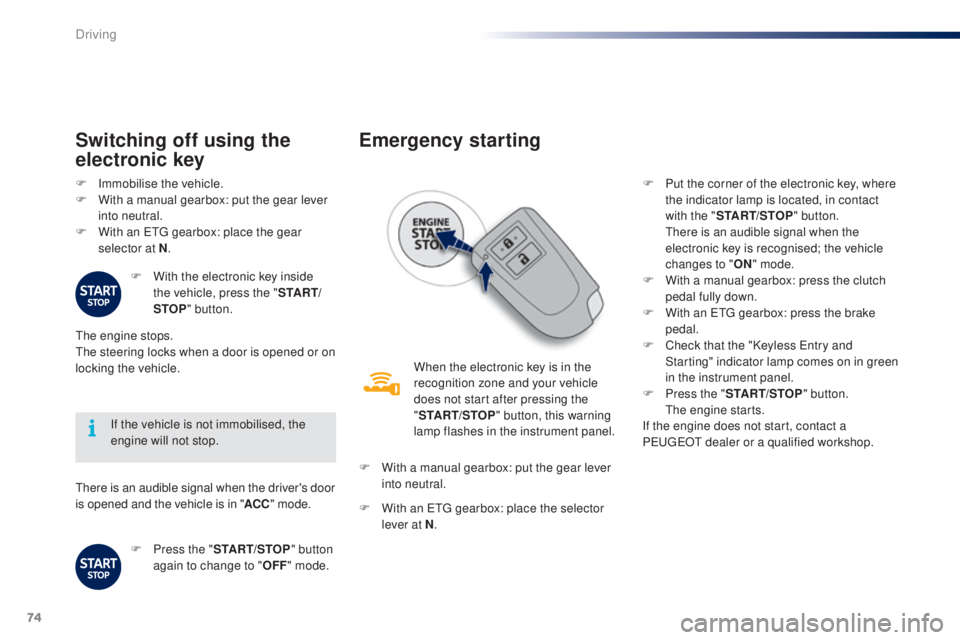
emergency starting
When the electronic key is in the
recognition zone and your vehicle
does not start after pressing the
"S
t
A
R
t/
S to
P" b
utton, this warning
lamp flashes in the instrument panel.
F
W
ith a manual gearbox: put the gear lever
into neutral.
F
W
ith an etg gearbox: place the selector
lever at N . F
P
ut the corner of the electronic key, where
the indicator lamp is located, in contact
with the " S t
A
R
t/
S to
P
" b
utton.
t
h
ere is an audible signal when the
electronic key is recognised; the vehicle
changes to "
oN " m
ode.
F
W
ith a manual gearbox: press the clutch
pedal fully down.
F
W
ith an etg gearbox: press the brake
pedal.
F
C
heck that the "Keyless e
n
try and
Starting" indicator lamp comes on in green
in the instrument panel.
F
P
ress the "S
t
A
R
t/
S to
P" b
utton.
t
h
e engine starts.
If the engine does not start, contact a
P
e
uge
Ot
dealer or a qualified workshop.
Driving
Page 79 of 268
77
108_en_Chap04_conduite_ed01-2016
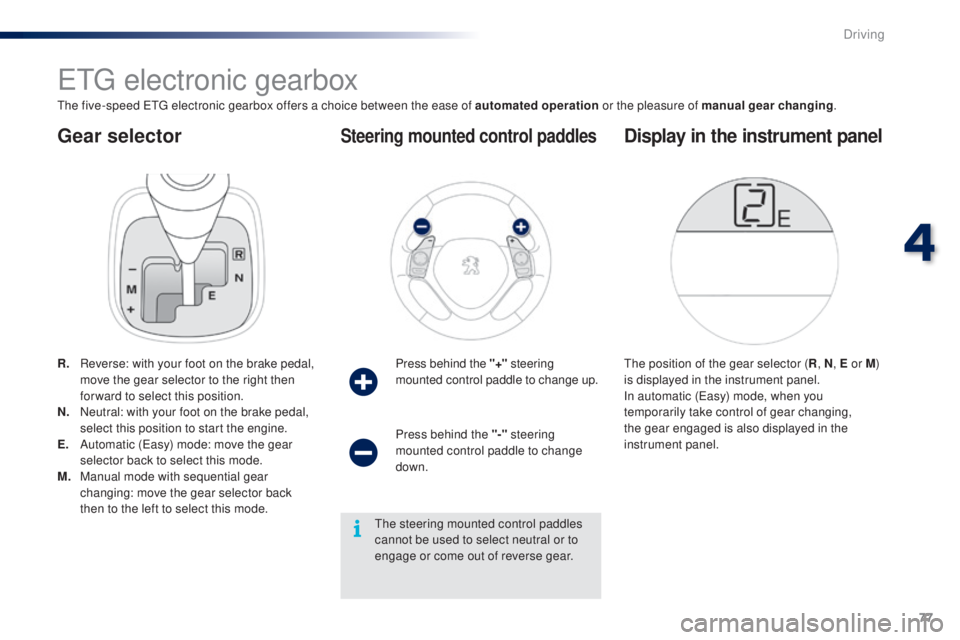
gear selector
etg electronic gearbox
the five-speed etg electronic gearbox offers a choice between the ease of automated operation or the pleasure of manual gear changing.
R.
R
everse: with your foot on the brake pedal,
move the gear selector to the right then
for ward to select this position.
N.
N
eutral: with your foot on the brake pedal,
select this position to start the engine.
e.
A
utomatic (
ea
sy) mode: move the gear
selector back to select this mode.
M.
M
anual mode with sequential gear
changing: move the gear selector back
then to the left to select this mode. Press behind the "+"
steering
mounted control paddle to change up.
Steering mounted control paddles
the position of the gear selector ( R, N , e or M)
is displayed in the instrument panel.
In automatic (
ea
sy) mode, when you
temporarily take control of gear changing,
the gear engaged is also displayed in the
instrument panel.
Display in the instrument panel
Press behind the "-" steering
mounted control paddle to change
down.
th
e steering mounted control paddles
cannot be used to select neutral or to
engage or come out of reverse gear.
4
Driving
Page 81 of 268
79
108_en_Chap04_conduite_ed01-2016
temporarily taking control of
gear changes
You can temporarily take control of gear
changes using the "+" and "-"
steering
mounted control paddles.
ge
ar change commands are only acted on if
the engine speed allows.
t
h
ere is an audible
signal if a command is not accepted.
th
e gear engaged is displayed in the
instrument panel.
th
is function allows you to anticipate certain
situations such as overtaking a vehicle or
approaching a corner.
After a few moments with no action on the
controls, the gearbox returns to automatic
control of the gears. It is possible to change mode at any time, by
moving the gear selector from position
e to
position M and the other way round.
Never select neutral N when the vehicle
is moving.
F
P
lace the gear selector in position M
.
F
C
hange up or down using:
- t he gear selector, pushing:
- back, "+" to change up,
-
for ward, "-" to change down.
-
o
r the "+" or "-" steering mounted
control paddle.
the
gear engaged is displayed.
ge
ar change commands are only acted on if
the engine speed allows.
It is not necessary to release the accelerator
peal during gear changes.
t
h
ere is an audible
signal if a command is not accepted.
When braking or slowing down, the gearbox
automatically changes down so that pick-up is
in the right gear.
Manual mode
under sharp acceleration, the gearbox will
not change up without action by the driver on
the gear selector or steering mounted control
paddles (unless the engine speed is close to
maximum).
to e
ngage reverse, the vehicle must be
stationary with your foot on the brake pedal.
F
Sel
ect position R .
Reverse
there is an audible signal on engaging reverse.
4
Driving
Page 82 of 268
80
108_en_Chap04_conduite_ed01-2016
the vehicle can be stopped whatever the
position of the gear selector (N,
e or R).
However, there is an audible signal on opening
the driver's door if the gear selector is not at
position N .
Switching off
When the vehicle is stopped with the
engine running, always put the gear
selector to neutral N .
th
ere is a continuous audible signal
if you turn the ignition switch to "
oFF "
w
ith the vehicle in 2
nd, 3rd, 4th or 5th g e a r.
In this case return the ignition switch
to "
oN "
, move the gear selector to
position
N , then to position
e
,
M or R ,
then turn the ignition switch to "
oFF ".
O
n a slope, use the brakes to
immobilise the vehicle and place the
gear selector in position N ,
e
or R . With the ignition on, illumination
of this warning lamp indicates a
gearbox fault.
Contact a P
e
uge
Ot
dealer or a
qualified workshop.
operating faults
In all cases, it is essential that you
apply the parking brake to immobilise
the vehicle.
Before doing anything under the
bonnet, check that the gear selector is
in neutral N and the parking brake is
applied.
Limits of operation
On a gradient, or when hill start assist is
activated, never hold the vehicle using the
accelerator : you could damage the clutch.
In these situations there is an audible signal.
F
M
ove the gear selector to position N .
F
W
ait 15 minutes to allow the clutch to cool
down before setting off. -
c
heck that the ignition switch is at the "
oN
"
p
osition,
-
p
lace the gear selector at N
, then move it
to e
,
M or R
.
If 1 is flashing in the instrument panel:
- p lace the gear selector at e or M
, then
move it to N .
If R is flashing in the instrument panel:
-
p
lace the gear selector at R, then move it
to N .
If
N
is flashing in the instrument panel
accompanied by an audible signal for a long time:
Driving
Page 83 of 268
81
108_en_Chap04_conduite_ed01-2016
System which reduces fuel consumption by recommending the most appropriate gear.
gear shift indicator
operation
example:
- Y ou are in third gear.
-
Y
ou press the accelerator pedal.
-
t
h
e system may suggest that you engage
a higher gear.
Depending on the driving situation and your
vehicle's equipment, the system may advise
you to change gear.
the
gear engagement recommendations must
not be considered compulsory. In fact, the
configuration of the road, the amount of traffic
and safety remain determining factors when
choosing the best gear. t
her
efore, the driver
remains responsible for deciding whether or not
to follow the advice given by the system.
th
is function cannot be deactivated.
th
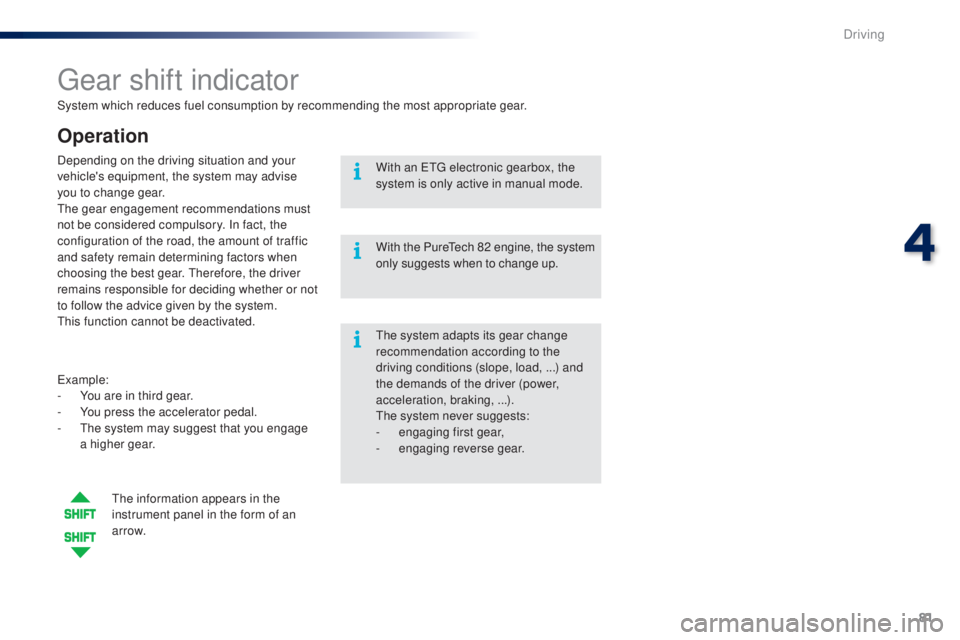
e information appears in the
instrument panel in the form of an
ar row.
th
e system adapts its gear change
recommendation according to the
driving conditions (slope, load, ...) and
the demands of the driver (power,
acceleration, braking,
...).
th
e system never suggests:
-
e
ngaging first gear,
-
enga
ging reverse gear.
With an
etg electronic gearbox, the
system is only active in manual mode.
With the Pure
te
ch 82 engine, the system
only suggests when to change up.
4
Driving
Page 85 of 268
83
108_en_Chap04_conduite_ed01-2016
Stop & Start (Vti 68 S&S engine)
operation
going into engine St oP
mode
this indicator lamp comes on in the
instrument panel and the engine
goes into standby automatically:
-
w
hen stationary, in neutral, and you
release the clutch pedal.
Never refuel with the engine in
S
tO
P mode; you must switch off the
ignition with the button. For smoother operation, during
parking manoeuvres StO P mode is
not available for a few seconds after
coming out of reverse gear.
th
e Stop & Start does not affect the
vehicle's systems, such as for example,
braking, power steering...
th
e Stop & Start
system puts the engine
temporarily into standby - S
tO
P mode - during
stops in the traffic (red lights, traffic jams, or
other...).
th
e engine restarts automatically -
StA
Rt
mode - as soon as you want to move
off.
t
h
e restart takes place instantly, quickly
and silently.
Per fect for urban use, the Stop & Start system
reduces fuel consumption and exhaust
emissions as well as the noise level when
stationary.
Stop & Start time counters
A partial time counter counts the periods in
StO P mode during a journey.
It is displayed in the trip computer once the
Stop & Start is operating.
Press one of the " DISP" buttons to return to the
previous display.
A global time counter counts the periods in
S
tO
P mode since the last reset.
When it is displayed, press one of the
" DISP "
buttons to reset the counter.
4
Driving
Page 86 of 268
84
108_en_Chap04_conduite_ed01-2016
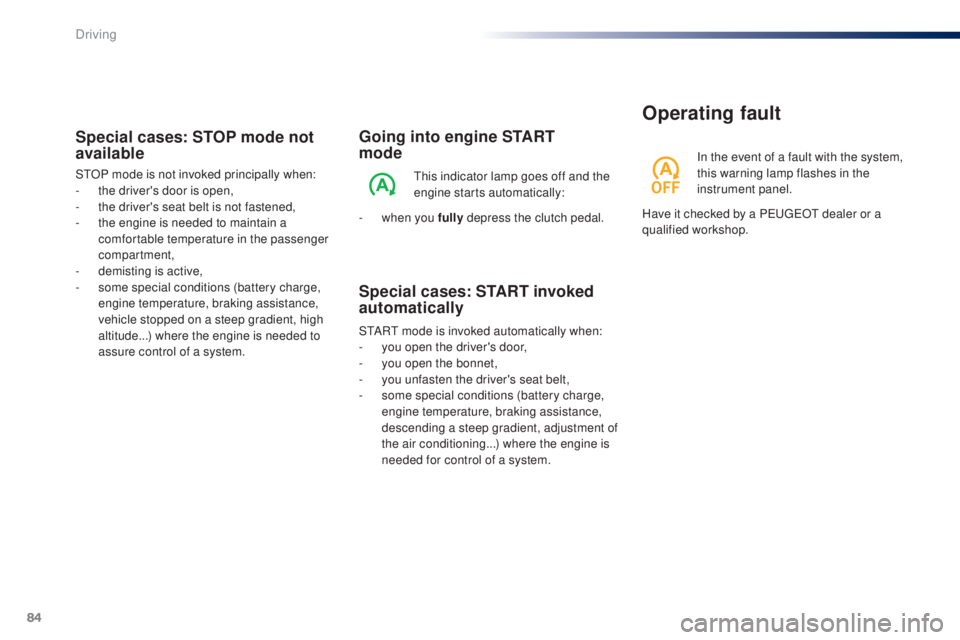
going into engine StARt
mode
this indicator lamp goes off and the
engine starts automatically:
-
w
hen you fully depress the clutch pedal.
S
tA
R
t
mode is invoked automatically when:
-
y
ou open the driver's door,
-
y
ou open the bonnet,
-
y
ou unfasten the driver's seat belt,
-
s
ome special conditions (battery charge,
engine temperature, braking assistance,
descending a steep gradient, adjustment of
the air conditioning...) where the engine is
needed for control of a system.
Special cases: StA Rt invoked
automatically
In the event of a fault with the system,
this warning lamp flashes in the
instrument panel.
operating fault
Have it checked by a Pe ugeOt dealer or a
qualified workshop.
Special cases: St oP m ode not
available
StOP mode is not invoked principally when:
- t
he driver's door is open,
-
t
he driver's seat belt is not fastened,
-
t
he engine is needed to maintain a
comfortable temperature in the passenger
compartment,
-
d
emisting is active,
-
s
ome special conditions (battery charge,
engine temperature, braking assistance,
vehicle stopped on a steep gradient, high
altitude...) where the engine is needed to
assure control of a system.
Driving
Page 87 of 268
85
108_en_Chap04_conduite_ed01-2016
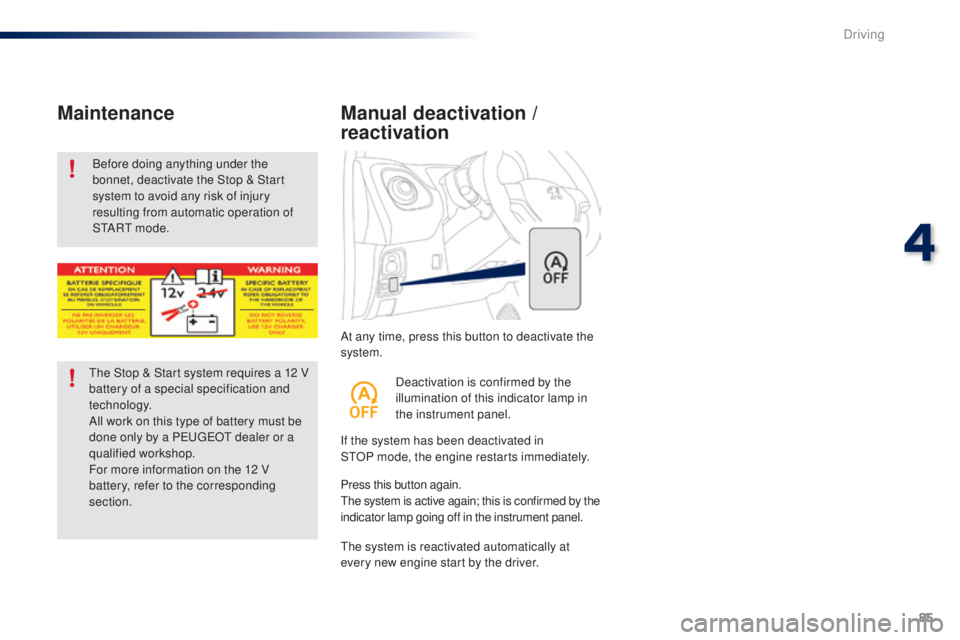
At any time, press this button to deactivate the
system.
Manual deactivation /
reactivation
If the system has been deactivated in
StOP mode, the engine restarts immediately.
th
e system is reactivated automatically at
every new engine start by the driver. Press this button again.
th
e system is active again; this is confirmed by the
indicator lamp going off in the instrument panel. Deactivation is confirmed by the
illumination of this indicator lamp in
the instrument panel.
Before doing anything under the
bonnet, deactivate the Stop & Start
system to avoid any risk of injury
resulting from automatic operation of
S
t
A R
t m
o d e .
Maintenance
the Stop & Start system requires a 12
V
battery of a special specification and
technology.
All work on this type of battery must be
done only by a P
e
uge
Ot
dealer or a
qualified workshop.
For more information on the 12 V
battery, refer to the corresponding
section.
4
Driving