roof PEUGEOT 108 2016 Owners Manual
[x] Cancel search | Manufacturer: PEUGEOT, Model Year: 2016, Model line: 108, Model: PEUGEOT 108 2016Pages: 268, PDF Size: 6.17 MB
Page 4 of 268
.
.
108_en_Chap00a_sommaire_ed01-2016
Instrument panels 11
Display screens
1
3
Indicator and warning lamps
1
5
Indicators
26
tr
ip computer
2
7
Setting the time
2
9
InstrumentsOver view
Keys
31
Keyless e
n
try and Starting system
3
4
Doors
38
Boot
39
Front electric windows
4
1
Rear quarter windows
4
1
ele
ctric fabric roof
4
2
Access
Front seats 4 6
Rear seats
4
8
Mirrors
50
Steering wheel adjustment
5
1
Ventilation
52
Heating
54
Manual air conditioning
5
5
Automatic air conditioning
5
7
Front demist - defrost
6
0
Rear screen demist - defrost
6
1
Courtesy lamp
6
2
Boot lamp
6
2
Interior fittings
6
3
Rear parcel shelf
6
7
Boot fittings
6
8
ease of use and comfort
Driving recommendations 70
Starting - switching off the engine
with the key
7
1
Starting - switching off the engine with
the
Keyless e
n
try and Starting system
7
2
Manual parking brake
7
6
5-speed manual gearbox
7
6
e
tg
el
ectronic gearbox
7
7
ge
ar shift indicator
8
1
Hill start assist
8
2
Stop & Start
8
3
Speed limiter
8
6
Reversing camera
9
2
Lane departure warning system
9
3
Under-inflation detection
9
5
Driving
e
co-driving
Contents
Page 5 of 268
.
108_en_Chap00a_sommaire_ed01-2016
exterior lighting control stalk 98
Automatic illumination of headlamps
1
01
Direction indicators
1
03
Headlamp beam height adjustment
1
03
Wiper control stalk
1
04
Lighting and visibility
Horn 10 6
Hazard warning lamps
1
06
e
SC system
1
07
Active City Brake
1
10
Seat belts
1
15
Airbags
118
Child seats
1
23
Deactivating the passenger's front airbag
1
26
ISOFIX child seats
1
32
Child lock
1
37
SafetyIn the event of a breakdown
Fuel tank 1 38
Snow chains
1
40
el
ectrical energy economy mode
1
41
Accessories
142
Changing a wiper blade
1
44
Fitting roof bars
1
44
Bonnet
14
6
Petrol engines
1
47
Checking levels
1
48
C h e c ks
151
Practical informationte chnical data
7-inch touch screen 185
Radio
2
35
Audio equipment and telematics
Alphabetical index
temporary puncture repair kit 1 53
Spare wheel
1
58
Changing a bulb
1
63
Changing a fuse
1
68
12 V battery
1
77
to
wing the vehicle
1
80
en
gines
181
Weights
182
Dimensions
183
Identification markings
1
84
Contents
Page 6 of 268
4
108_en_Chap00b_vue-ensemble_ed01-2016
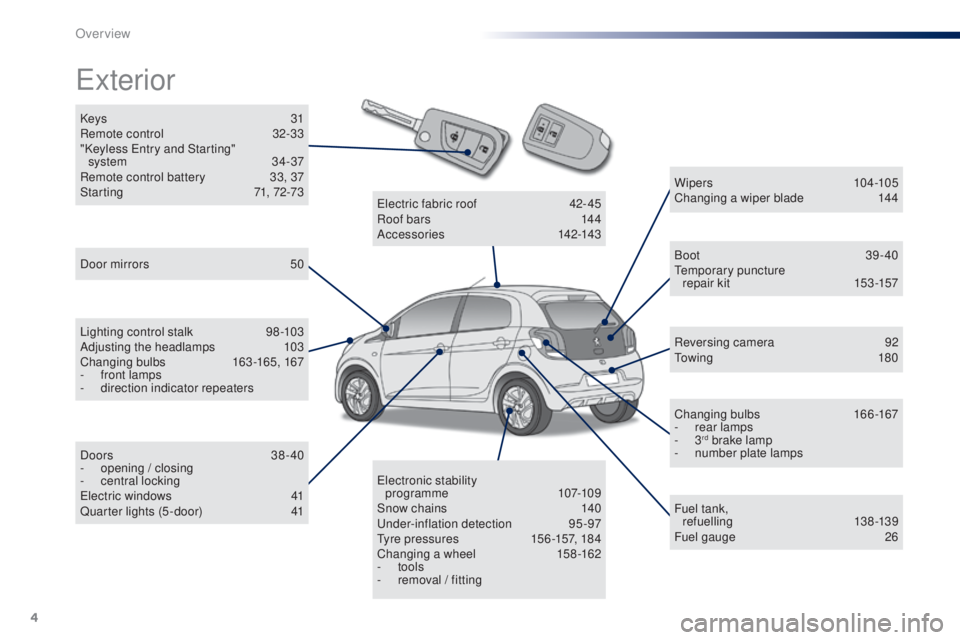
Keys 31
Remote control 3 2-33
"Keyless
e
n
try and Starting"
system
34-37
Remote control battery
3
3, 37
Starting
7
1, 72-73
exterior
Door mirrors 5 0
Lighting control stalk
9
8 -103
Adjusting the headlamps
1
03
Changing bulbs
1
63-165, 167
-
f
ront lamps
-
d
irection indicator repeaters
Doors
38-40
-
ope
ning / closing
-
c
entral locking
el
ectric windows
4
1
Quarter lights (5 -door)
4
1 Wipers
10
4 -105
Changing a wiper blade
1
44
Boot 39-40te
mporary puncture
repair kit
1
53-157
Reversing camera
9
2
to
w i n g
18 0
Changing bulbs
1
66-167
-
r
ear lamps
-
3
rd brake lamp
-
n
umber plate lamps
Fuel tank, ref uelling
13 8 -13 9
Fuel gauge
26
ele
ctronic stability
programme
107-109
Snow chains
1
40
un
der-inflation detection
9
5-97
ty
re pressures
1
56 -157, 184
Changing a wheel
1
58-162
-
tools
-
r
emoval / fitting
ele
ctric fabric roof
4
2-45
Roof bars
1
44
Accessories
1
42-143
Over view
Page 8 of 268
6
108_en_Chap00b_vue-ensemble_ed01-2016
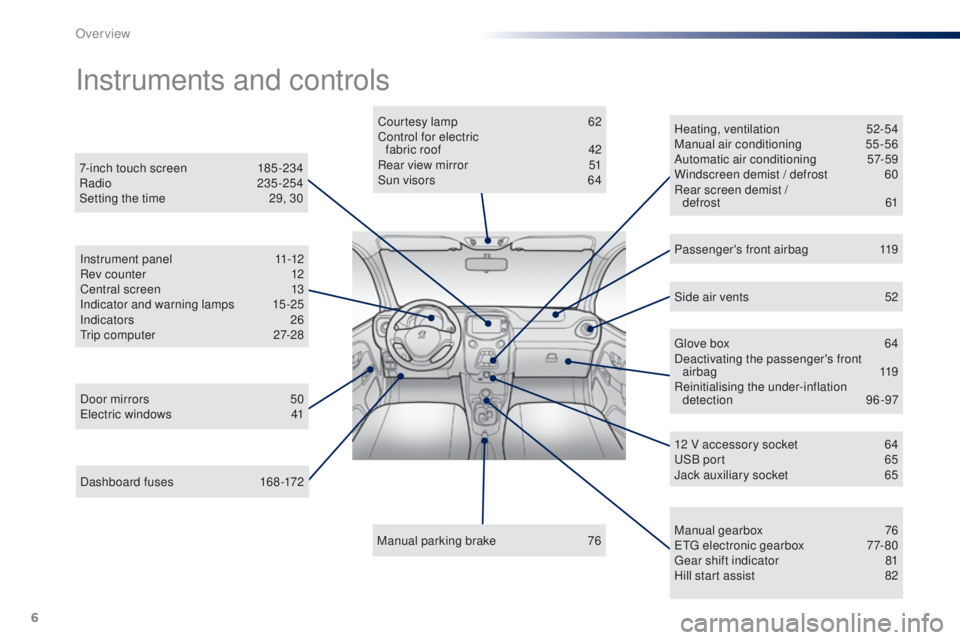
Dashboard fuses 168-172
Instruments and controls
Door mirrors 5 0el
ectric windows 4 1Courtesy lamp
6
2
Control for electric fabric roof
4
2
Rear view mirror
5
1
Sun visors
6
4
Manual parking brake
7
6Heating, ventilation
5
2-54
Manual air conditioning
5
5-56
Automatic air conditioning
5
7-59
Windscreen demist / defrost
6
0
Rear screen demist / defrost
61
7-inch touch screen
1
85 -234
Radio
235-254
Setting the time
2
9, 30
Manual gearbox
7
6
e
tg
el
ectronic gearbox
7
7-80
ge
ar shift indicator
8
1
Hill start assist
8
2
12 V accessory socket
6
4
uS
B port
6
5
Jack auxiliary socket
6
5
Instrument panel
1
1-12
Rev counter
1
2
Central screen
1
3
Indicator and warning lamps
1
5-25
Indicators 26
tr
ip computer
2
7-28
Side air vents
5
2
Passenger's front airbag
1
19
gl
ove box
6
4
Deactivating the passenger's front airbag
119
Reinitialising the under-inflation detection 96-97
Over view
Page 11 of 268
9
108_en_Chap00c_eco-conduite_ed01-2016
optimise the use of your gearbox
With a manual gearbox, move off gently and change up without waiting.
During acceleration change up early.
With an etg electronic gearbox, give preference to automatic (
ea
sy)
mode and avoid pressing the accelerator pedal heavily or suddenly.
Control the use of your electrical
equipment
Before moving off, if the passenger compartment is too warm, ventilate it
by opening the windows and air vents before using the air conditioning.
Above 30 mph (50 km/h), close the windows and leave the air vents
open.
Remember to make use of equipment that can help keep the
temperature in the passenger compartment down (sunroof and window
blinds...).
Switch off the air conditioning, unless it has automatic regulation, as
soon as the desired temperature is attained.
Switch off the demisting and defrosting controls, if not automatic.
Switch off the heated seat as soon as possible.
Switch off the headlamps and front foglamps when the level of light
does not require their use.
Avoid running the engine before moving off, particularly in winter; your
vehicle will warm up much faster while driving.
As a passenger, if you avoid connecting your multimedia devices
(film, music, video game...), you will contribute towards limiting the
consumption of electrical energy, and so of fuel.
Disconnect your portable devices before leaving the vehicle.
eco-driving
eco-driving is a range of everyday practices that allow the motorist to optimise their fuel consumption and CO2 emissions.
th
e gear shift indicator invites you to engage the most suitable gear:
as soon as the indication is displayed in the instrument panel, follow it
straight away.
For vehicles fitted with an
etg
electronic gearbox, this indicator
appears only in manual mode.
Drive smoothly
Maintain a safe distance between vehicles, use engine braking rather
than the brake pedal, and press the accelerator progressively. th ese
practices contribute towards a reduction in fuel consumption and
CO
2 emissions and also helps reduce the background traffic noise.
.
eco-driving
Page 12 of 268
10
108_en_Chap00c_eco-conduite_ed01-2016
Limit the causes of excess consumption
Spread loads throughout the vehicle; place the heaviest items in the
bottom of the boot, as close as possible to the rear seats.
Limit the loads carried in the vehicle and reduce wind resistance
(roof bars, roof rack...). u
s
e a roof box in preference.
Remove roof bars and roof racks after use.
At the end of winter, remove snow tyres and refit your summer tyres.
observe the recommendations on
maintenance
Check the tyre pressures regularly, when cold, referring to the label in
the door aperture, driver's side.
Carry out this check in particular:
-
b
efore a long journey,
-
a
t each change of season,
-
a
fter a long period out of use.
Don't forget the spare wheel and the tyres on any trailer or caravan.
Have your vehicle serviced regularly (engine oil, oil filter, air filter,
passenger compartment filter...) and observe the schedule of
operations recommended in the warranty and maintenance record.
When refuelling, do not continue after the third cut-off of the nozzle to
avoid any over flow.
At the wheel of your new vehicle, it is only after the first 1 800 miles
(3
000 kilometres) that you will see the fuel consumption settle down to
a consistent average.
eco-driving
Page 44 of 268
42
108_en_Chap02_ouvertures_ed01-2016
* Depending on version. Your vehicle may be fitted with an electrically operated fabric roof.
electric fabric roof*
electric opening and closing
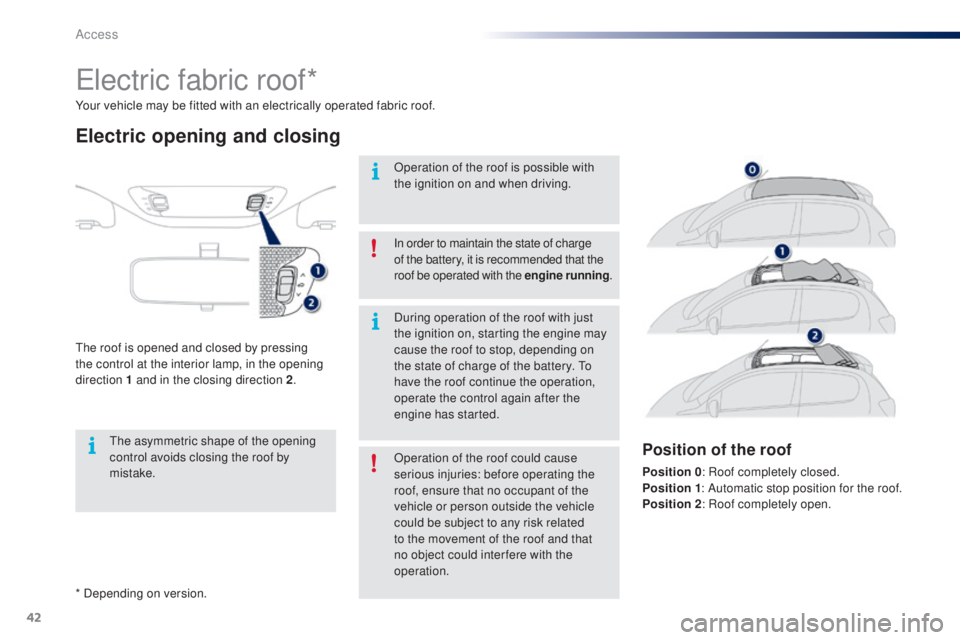
the roof is opened and closed by pressing
the control at the interior lamp, in the opening
direction 1 and in the closing direction 2.In order to maintain the state of charge
of the battery, it is recommended that the
roof be operated with the engine running
.
Operation of the roof is possible with
the ignition on and when driving.
Operation of the roof could cause
serious injuries: before operating the
roof, ensure that no occupant of the
vehicle or person outside the vehicle
could be subject to any risk related
to the movement of the roof and that
no object could inter fere with the
operation. During operation of the roof with just
the ignition on, starting the engine may
cause the roof to stop, depending on
the state of charge of the battery.
t
o
h
ave the roof continue the operation,
operate the control again after the
engine has started.
th
e asymmetric shape of the opening
control avoids closing the roof by
mistake.
Position of the roof
Position 0 : Roof completely closed.
Position 1 : Automatic stop position for the roof.
Position 2 : Roof completely open.
Access
Page 45 of 268
43
108_en_Chap02_ouvertures_ed01-2016
opening
F Briefly press the control in the opening direction to open the the roof in stages.
or
F
P
ress and hold the control in the opening
direction, until the manoeuvre is complete,
to open the roof completely.
P
ressing again stops the movement of
the
roof.
Closing
F Briefly press the control in the closing direction to open the the roof in stages.
or
F
P
ress and hold the control in the closing
direction, until the manoeuvre is complete,
to close the roof to position 1 .
P
ressing again stops the movement of the
roof.
F
t
o c
lose the roof completely, press and
hold the control (between positions 1
and
0) until the roof locks closed.
th
e closing manoeuvre of the roof
could cause serious injuries: take
particular care with children.
If the roof does not close correctly:
-
c
heck that nothing is blocking the roof
(ignition off),
-
r
epeat the closing command (with the
engine running).
If the problem persists, contact a P
e
uge
Ot
dealer or a qualified workshop.
operating fault
In the event of an electrical fault,
contact a Pe ugeOt dealer or a
qualified workshop.
Protection of the electric motors
used for opening and closing the
roof
Following repeated opening and closing of the
roof, the electric motors may become too warm
and no longer allow the roof to be opened or
closed. Allow the motors to cool down with no
operation of the roof for 10 minutes.
2
Access
Page 46 of 268
44
108_en_Chap02_ouvertures_ed01-2016
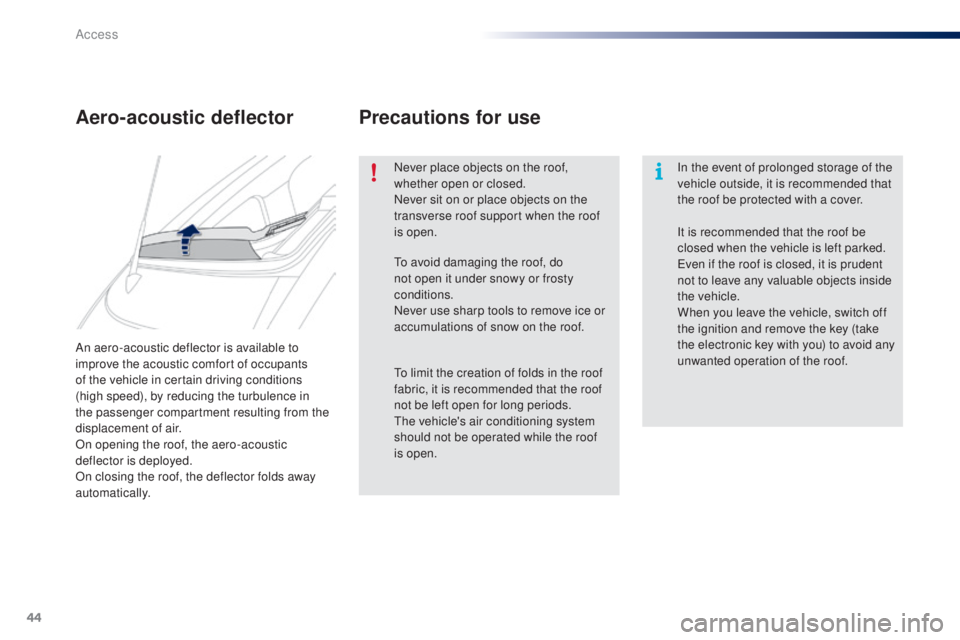
An aero-acoustic deflector is available to
improve the acoustic comfort of occupants
of the vehicle in certain driving conditions
(high speed), by reducing the turbulence in
the passenger compartment resulting from the
displacement of air.
On opening the roof, the aero-acoustic
deflector is deployed.
On closing the roof, the deflector folds away
automatically.
Aero-acoustic deflector Precautions for use
Never place objects on the roof,
whether open or closed.
Never sit on or place objects on the
transverse roof support when the roof
is open. In the event of prolonged storage of the
vehicle outside, it is recommended that
the roof be protected with a cover.
to a
void damaging the roof, do
not open it under snowy or frosty
conditions.
Never use sharp tools to remove ice or
accumulations of snow on the roof.
to l
imit the creation of folds in the roof
fabric, it is recommended that the roof
not be left open for long periods.
th
e vehicle's air conditioning system
should not be operated while the roof
is open. It is recommended that the roof be
closed when the vehicle is left parked.
ev
en if the roof is closed, it is prudent
not to leave any valuable objects inside
the vehicle.
When you leave the vehicle, switch off
the ignition and remove the key (take
the electronic key with you) to avoid any
unwanted operation of the roof.
Access
Page 47 of 268
45
108_en_Chap02_ouvertures_ed01-2016
Recommendations on care of your vehicle
the general recommendations on the care of your vehicle are given in the warranty and maintenance record.
Fabric roof
to avoid damaging the roof.
- n ever use a high pressure jet wash,
-
n
ever wash your vehicle in an
automatic roller-brush car wash. Remove bird droppings or tree resins as
their acidity may damage the roof. Never use chemical products,
detergents, stain removers, solvents,
alcohol, petrol,
wdt. to clean the roof.
We recommend that you clean the
aero-acoustic defector with care using
a soft brush.
Before washing the fabric roof, first
remove as much dirt as possible from
the sur face using a soft brush or a
vacuum cleaner.to w
aterproof the roof, use only special
waterproofing products for fabric roofs.
to r
emove marks, sponge them (but
never rub them) using soapy water, then
immediately rinse with clean water.
Allow the vehicle to dry in a shaded
area and avoid direct exposure to
the
sun. For the regular maintenance of the
fabric roof and to conserve its original
appearance, we recommend an
ecological "Fly remover - Fabric roof
cleaner" from the "
t
e
C
HNA
t
u
Re"
r
ange. t
o o
btain this product go to a
P
e
uge
Ot d
ealer.
Aero-acoustic deflector
2
Access