brake PEUGEOT 108 2016 Owner's Manual
[x] Cancel search | Manufacturer: PEUGEOT, Model Year: 2016, Model line: 108, Model: PEUGEOT 108 2016Pages: 268, PDF Size: 6.17 MB
Page 84 of 268
82
108_en_Chap04_conduite_ed01-2016
Hill start assist
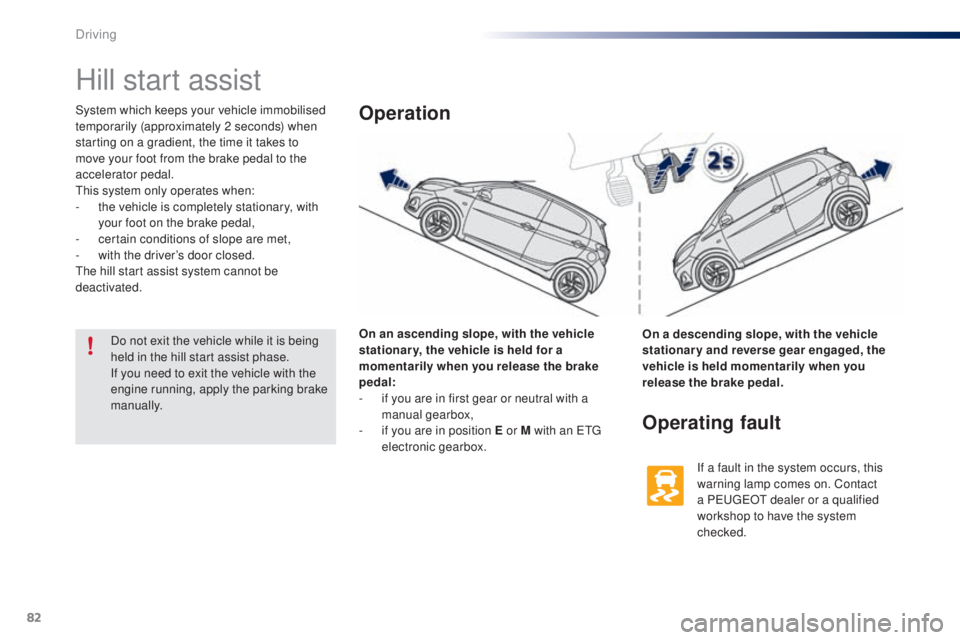
System which keeps your vehicle immobilised
temporarily (approximately 2 seconds) when
starting on a gradient, the time it takes to
move your foot from the brake pedal to the
accelerator pedal.
th
is system only operates when:
-
t
he vehicle is completely stationary, with
your foot on the brake pedal,
-
c
ertain conditions of slope are met,
-
w
ith the driver’s door closed.
th
e hill start assist system cannot be
deactivated.
on a
n ascending slope, with the vehicle
stationar y, the vehicle is held for a
momentarily when you release the brake
pedal:
-
i
f you are in first gear or neutral with a
manual gearbox,
-
i
f you are in position e or M with an etg
electronic gearbox.operation
on a descending slope, with the vehicle
stationary and reverse gear engaged, the
vehicle is held momentarily when you
release the brake pedal.
operating fault
If a fault in the system occurs, this
warning lamp comes on. Contact
a P
e
uge
Ot
dealer or a qualified
workshop to have the system
checked.
Do not exit the vehicle while it is being
held in the hill start assist phase.
If you need to exit the vehicle with the
engine running, apply the parking brake
manually.
Driving
Page 109 of 268
107
108_en_Chap06_securite_ed01-2016
electronic Stability Control (eSC) incorporating
the following systems:
-
a
nti-lock braking system (ABS) and the
electronic brake force distribution (
eB
FD),
-
em
ergency braking assistance,
-
t
raction control (
tR
C),
-
d
ynamic stability control (DSC).
electronic stability control (eS C)
Definitions
Anti-lock braking system (ABS)
and electronic brake force
distribution (
e
BFD)
these systems improve the stability and
manoeuvrability of your vehicle when braking
and contribute towards better control in
corners, in particular on poor or slippery road
surfaces.
th
e ABS prevents wheel lock in the event of
emergency braking.
th
e electronic brake force distribution system
manages the braking pressure wheel by wheel.
emergency braking assistance
In an emergency, this system enables you to
reach the optimum braking pressure more
quickly and therefore reduce the stopping
distance.
It is triggered according to the speed at which
the brake pedal is pressed.
t
h
is is felt by a
reduction in the resistance of the pedal and an
increase in the effectiveness of the braking.
traction control (tR C)
this system optimises traction in order to limit
wheel slip by acting on the brakes of the driving
wheels and on the engine. It also improves
the directional stability of the vehicle on
acceleration.
Dynamic stability control (DSC)
If there is a difference between the path
followed by the vehicle and that required by the
driver, this system monitors each wheel and
automatically acts on the brake of one or more
wheels and on the engine to return the vehicle
to the required path, within the limits of the laws
of physics.
6
Safety
Page 110 of 268
108
108_en_Chap06_securite_ed01-2016
Illumination of this warning lamp,
accompanied by an audible signal,
indicates that there is a fault with the
electronic brake force distribution
(
eB
FD), which could cause loss of
control of the vehicle when braking.
operation
Illimination of this warning lamp,
accompanied by an audible signal,
indicates that there is a fault with
the ABS system, which could cause
loss of control of the vehicle when
braking.
Anti-lock braking system (ABS)
and electronic brake force
distribution (
e
BFD)When changing wheels (tyres and rims),
make sure that these are approved for
your vehicle.
Normal operation of the ABS may make
itself felt by slight vibration of the brake
pedal.
In emergency braking, press
very firmly without releasing the
pressure.
Yo u must stop as soon as it is safe to do so .
Contact a P
e
uge
Ot
dealer or a qualified
workshop as soon as possible.
Dynamic stability control (DSC)
and traction control (tR C)
Activation
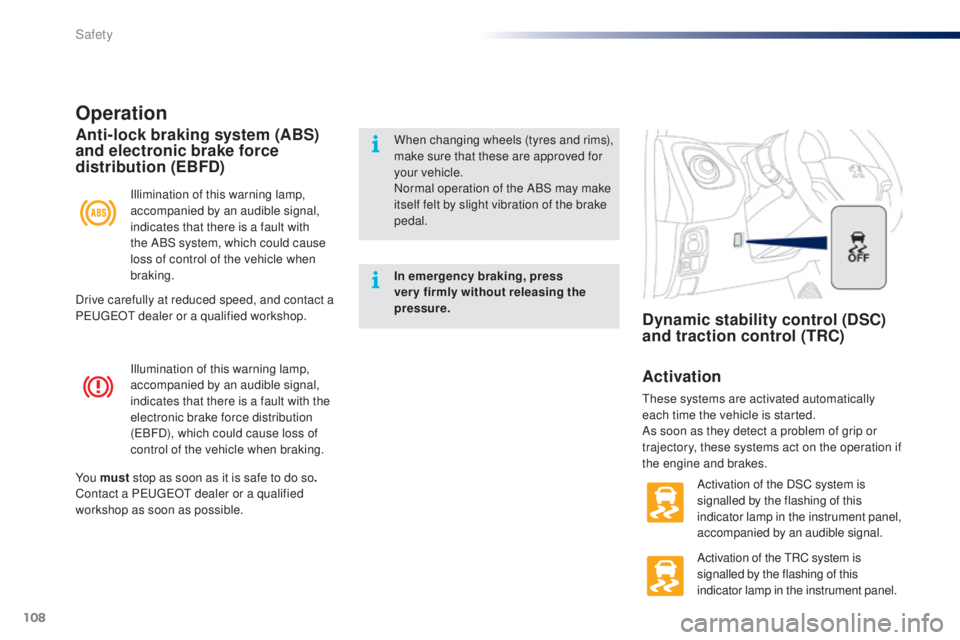
these systems are activated automatically
each time the vehicle is started.
As soon as they detect a problem of grip or
trajectory, these systems act on the operation if
the engine and brakes. Activation of the DSC system is
signalled by the flashing of this
indicator lamp in the instrument panel,
accompanied by an audible signal.
Activation of the
t
R
C system is
signalled by the flashing of this
indicator lamp in the instrument panel.
Drive carefully at reduced speed, and contact a
P
e
uge
Ot
dealer or a qualified workshop.
Safety
Page 112 of 268
110
108_en_Chap06_securite_ed01-2016
Active City Brake
Active City Brake is a driving assistance system
that aims to avoid a frontal collision or reduce
the speed of an impact if the driver does not
react or reacts too late (brake application too
late).
th
is system is designed to improve
driving safety.
It remains the driver's responsibility to
continuously monitor the state of the
traffic and to assess the distances and
relative speeds of other vehicles.
Active City Brake can in no
circumstances replace the need for
vigilance on the part of the driver.
Never look at the laser sensor through
an optical instrument (magnifying glass,
microscope...) at a distance of less than
10 centimetres: risk of eye injury.
Automatic braking occurs later than if
done by the driver, so as to intervene
only when there is a high risk of
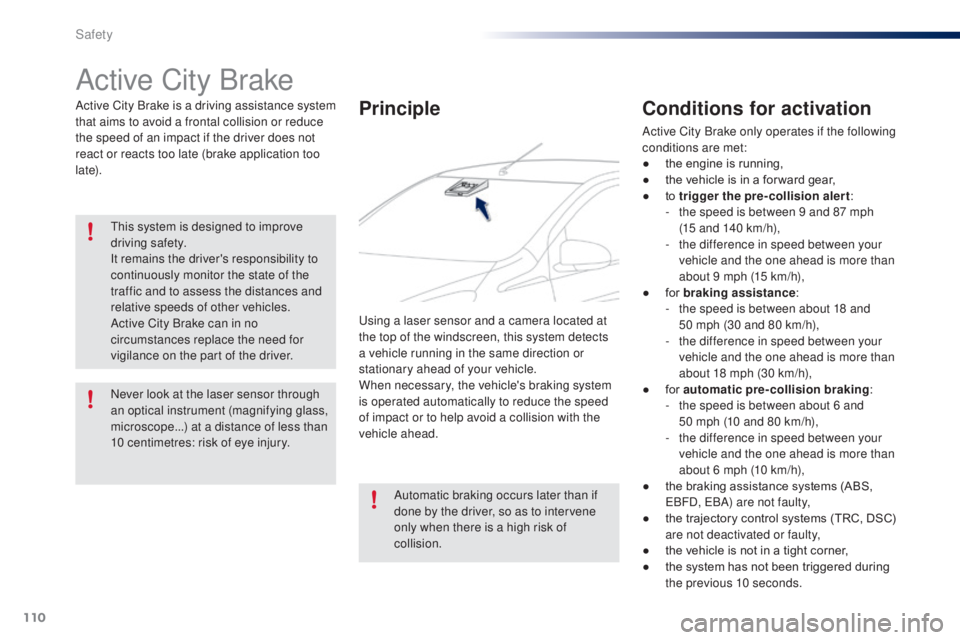
collision.Principle
using a laser sensor and a camera located at
the top of the windscreen, this system detects
a vehicle running in the same direction or
stationary ahead of your vehicle.
When necessary, the vehicle's braking system
is operated automatically to reduce the speed
of impact or to help avoid a collision with the
vehicle ahead.
Conditions for activation
Active City Brake only operates if the following
conditions are met:
●
t
he engine is running,
●
t
he vehicle is in a for ward gear,
●
t
o trigger the pre-collision alert :
-
t
he speed is between 9 and 87 mph
(15 and 140 km/h),
-
t
he difference in speed between your
vehicle and the one ahead is more than
about 9 mph (15 km/h),
●
f
or braking assistance :
-
t
he speed is between about 18 and
50
mph (30 and 80 km/h),
-
t
he difference in speed between your
vehicle and the one ahead is more than
about 18 mph (30 km/h),
●
f
or automatic pre-collision braking:
-
t
he speed is between about 6 and
50
mph (10 and 80 km/h),
-
t
he difference in speed between your
vehicle and the one ahead is more than
about 6 mph (10 km/h),
●
t
he braking assistance systems (ABS,
eB
FD, e
B
A) are not faulty,
●
t
he trajectory control systems (TRC, DSC)
are not deactivated or faulty,
●
t
he vehicle is not in a tight corner,
●
t
he system has not been triggered during
the previous 10 seconds.
Safety
Page 113 of 268
111
108_en_Chap06_securite_ed01-2016
operation
three levels of operation are possible:
● P re-collision alert : if a risk of collision
with a vehicle is detected, a warning lamp
comes on in the instrument panel together
with an audible signal to encourage the
driver to make an avoiding manoeuvre.
t
h
e
thresholds for triggering the alert can be
set.
●
Br
aking assistance : increases the
braking started by the driver, only if a risk
of collision is detected.
●
A
utomatic pre-collision braking: when
your vehicle is too close to or closing
too quickly on the vehicle ahead of you,
the system automatically operates the
brakes to reduce the speed of impact. A
collision can be avoided automatically if the
difference in speed between your vehicle
and the one ahead is not more than 18 mph
(30 km/h).
You are then alerted by the display of
this warning lamp, accompanied by
an audible signal.th e automatic braking may bring the vehicle to
a complete stop if the situation requires it.
th
e brake lamps on your vehicle come on to
warn other road users.
th
e triggering of the system may cause
the engine to stall, unless the driver
depresses the clutch pedal quickly
enough during automatic braking.
6
Safety
Page 142 of 268
140
108_en_Chap07_info-pratiques_ed01-2016
Snow chains
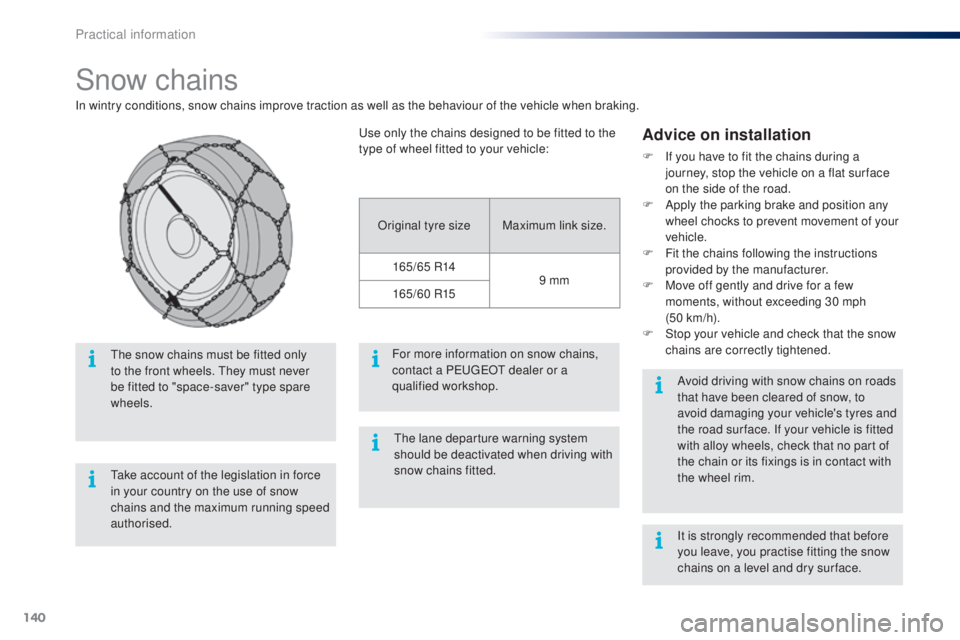
In wintry conditions, snow chains improve traction as well as the behaviour of the vehicle when braking.
Advice on installation
F If you have to fit the chains during a journey, stop the vehicle on a flat sur face
on the side of the road.
F
A
pply the parking brake and position any
wheel chocks to prevent movement of your
vehicle.
F
F
it the chains following the instructions
provided by the manufacturer.
F
M
ove off gently and drive for a few
moments, without exceeding 30 mph
(50
km/h).
F
S
top your vehicle and check that the snow
chains are correctly tightened.
ta
ke account of the legislation in force
in your country on the use of snow
chains and the maximum running speed
authorised.
th
e snow chains must be fitted only
to the front wheels.
t
h
ey must never
be fitted to "space-saver" type spare
wheels. Avoid driving with snow chains on roads
that have been cleared of snow, to
avoid damaging your vehicle's tyres and
the road sur face. If your vehicle is fitted
with alloy wheels, check that no part of
the chain or its fixings is in contact with
the wheel rim.
us
e only the chains designed to be fitted to the
type of wheel fitted to your vehicle:
Original tyre size Maximum link size.
165/65 R14 9 mm
165/60 R15
For more information on snow chains,
contact a P
e
uge
Ot
dealer or a
qualified workshop.
It is strongly recommended that before
you leave, you practise fitting the snow
chains on a level and dry sur face.
th
e lane departure warning system
should be deactivated when driving with
snow chains fitted.
Practical information
Page 149 of 268
147
108_en_Chap07_info-pratiques_ed01-2016
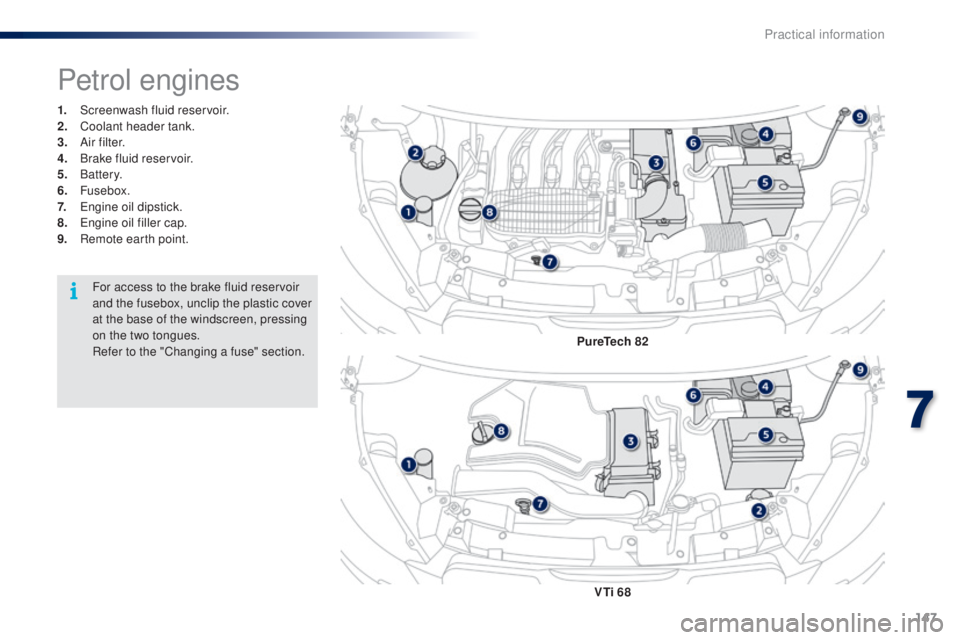
1. Screenwash fluid reservoir.
2. Coolant header tank.
3.
A
i r f i l t e r.
4.
B
rake fluid reservoir.
5.
Battery.
6.
Fusebox.
7.
e
n
gine oil dipstick.
8.
e
n
gine oil filler cap.
9.
R
emote earth point.
Petrol engines
Puretech 82
V
ti 6
8
For access to the brake fluid reservoir
and the fusebox, unclip the plastic cover
at the base of the windscreen, pressing
on the two tongues.
Refer to the "Changing a fuse" section.
7
Practical information
Page 151 of 268
149
108_en_Chap07_info-pratiques_ed01-2016
the brake fluid level should be close
to the "MA X" mark. If it is not, check
the brake pad wear.
Brake fluid level
Changing the fluid
Refer to the manufacturer's service schedule
for details of the interval for this operation.
Fluid specification
the brake fluid must conform to the
manufacturer's recommendations.
topping-up the engine oil
oil gradethe oil must be the correct grade for your
engine and conform to the manufacturer's
recommendations.
Refer to the under-bonnet view for the location
of the oil filler cap on your vehicle.
F
u
n
screw the filler cap for access to the
filler orifice.
F
P
our in the oil in small quantities, avoiding
spills onto the engine (risk of fire).
F
W
ait a few minutes before checking the
level again using the dipstick.
F
t
o
p-up again if necessary.
F
A
fter checking and topping up, carefully
refit the oil filler cap and the dipstick to its
housing.
engine oil change
Refer to the manufacturer's service schedule
for details of the interval for this operation.
In order to maintain the reliability of the engine
and emissions control system, never use
additives in the engine oil.
7
Practical information
Page 154 of 268
152
108_en_Chap07_info-pratiques_ed01-2016
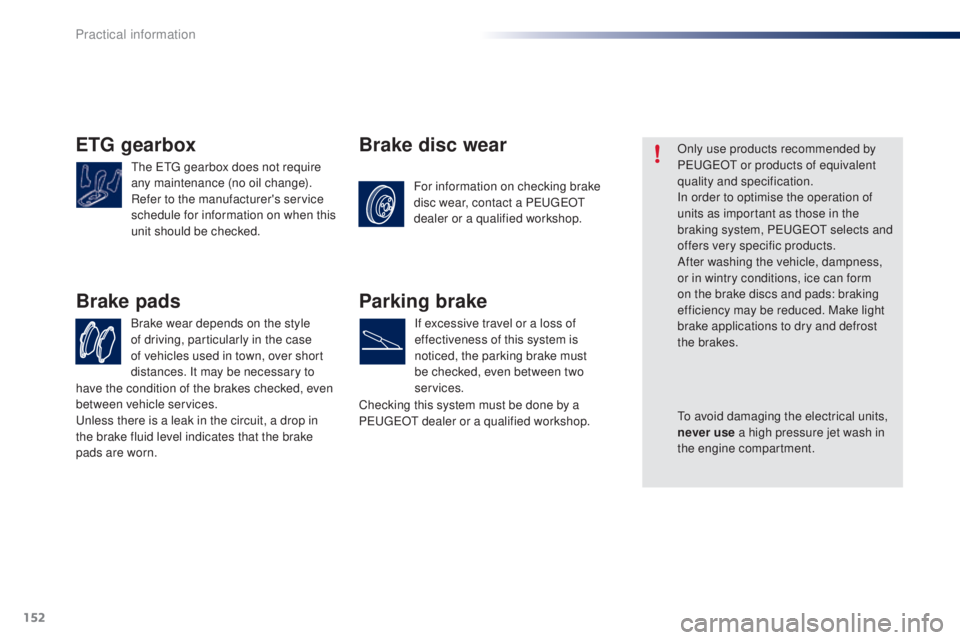
etg gearbox
the etg gearbox does not require
any maintenance (no oil change).
Refer to the manufacturer's service
schedule for information on when this
unit should be checked.
Brake wear depends on the style
of driving, particularly in the case
of vehicles used in town, over short
distances. It may be necessary to
Brake pads
For information on checking brake
disc wear, contact a Pe ugeOt
dealer or a qualified workshop.
Brake disc wearOnly use products recommended by
Pe ugeOt or products of equivalent
quality and specification.
In order to optimise the operation of
units as important as those in the
braking system, P
e
uge
Ot
selects and
offers very specific products.
After washing the vehicle, dampness,
or in wintry conditions, ice can form
on the brake discs and pads: braking
efficiency may be reduced. Make light
brake applications to dry and defrost
the brakes.
Parking brake
If excessive travel or a loss of
effectiveness of this system is
noticed, the parking brake must
be checked, even between two
services.
Checking this system must be done by a
P
e
uge
Ot
dealer or a qualified workshop.
have the condition of the brakes checked, even
between vehicle services.
un
less there is a leak in the circuit, a drop in
the brake fluid level indicates that the brake
pads are worn.
to a
void damaging the electrical units,
never use a high pressure jet wash in
the engine compartment.
Practical information
Page 160 of 268
158
108_en_Chap08_en-cas-pannes_ed01-2016
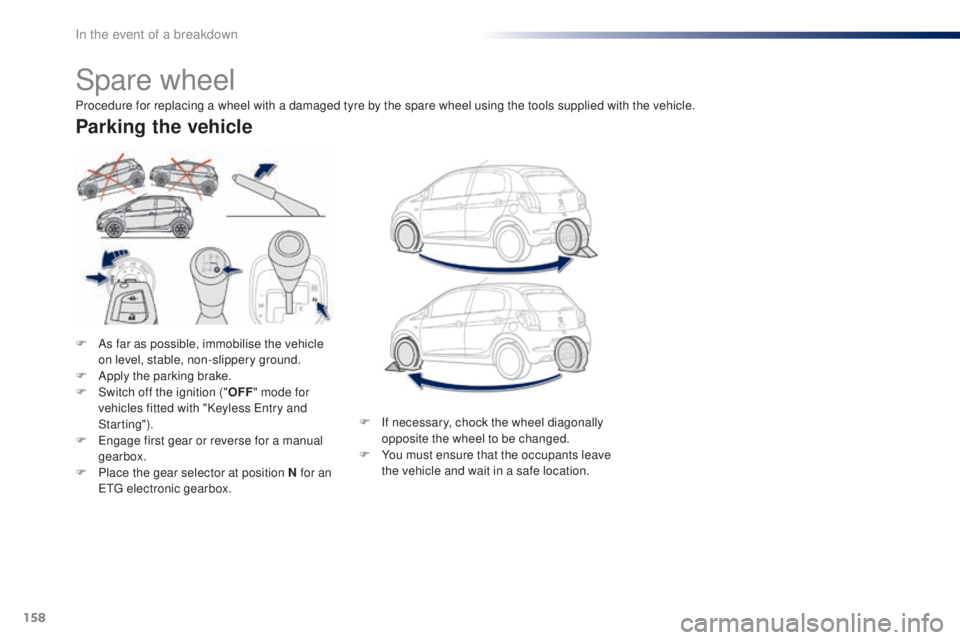
Spare wheel
F As far as possible, immobilise the vehicle on level, stable, non-slippery ground.
F
A
pply the parking brake.
F
S
witch off the ignition ("
oFF" m
ode for
vehicles fitted with "Keyless
e
n
try and
Starting").
F
e
n
gage first gear or reverse for a manual
gearbox.
F
P
lace the gear selector at position N for an
e
tg
el
ectronic gearbox.
Parking the vehicle
Procedure for replacing a wheel with a damaged tyre by the spare wheel using the tools supplied with the vehicle.
F
I
f necessary, chock the wheel diagonally
opposite the wheel to be changed.
F
Y
ou must ensure that the occupants leave
the vehicle and wait in a safe location.
In the event of a breakdown