bonnet PEUGEOT 108 2016 Owners Manual
[x] Cancel search | Manufacturer: PEUGEOT, Model Year: 2016, Model line: 108, Model: PEUGEOT 108 2016Pages: 268, PDF Size: 6.17 MB
Page 5 of 268
.
108_en_Chap00a_sommaire_ed01-2016
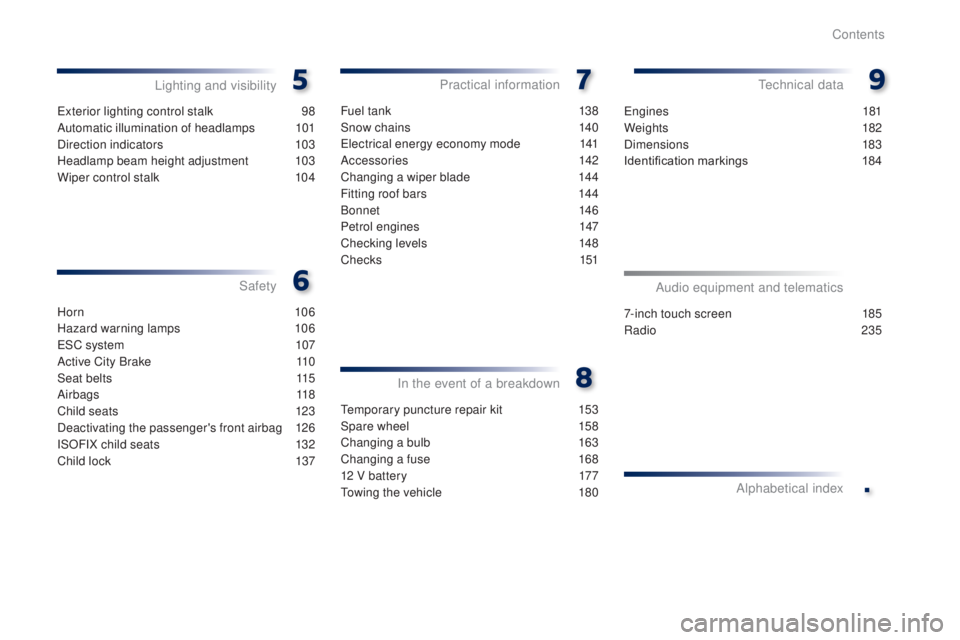
exterior lighting control stalk 98
Automatic illumination of headlamps
1
01
Direction indicators
1
03
Headlamp beam height adjustment
1
03
Wiper control stalk
1
04
Lighting and visibility
Horn 10 6
Hazard warning lamps
1
06
e
SC system
1
07
Active City Brake
1
10
Seat belts
1
15
Airbags
118
Child seats
1
23
Deactivating the passenger's front airbag
1
26
ISOFIX child seats
1
32
Child lock
1
37
SafetyIn the event of a breakdown
Fuel tank 1 38
Snow chains
1
40
el
ectrical energy economy mode
1
41
Accessories
142
Changing a wiper blade
1
44
Fitting roof bars
1
44
Bonnet
14
6
Petrol engines
1
47
Checking levels
1
48
C h e c ks
151
Practical informationte chnical data
7-inch touch screen 185
Radio
2
35
Audio equipment and telematics
Alphabetical index
temporary puncture repair kit 1 53
Spare wheel
1
58
Changing a bulb
1
63
Changing a fuse
1
68
12 V battery
1
77
to
wing the vehicle
1
80
en
gines
181
Weights
182
Dimensions
183
Identification markings
1
84
Contents
Page 9 of 268
7
108_en_Chap00b_vue-ensemble_ed01-2016
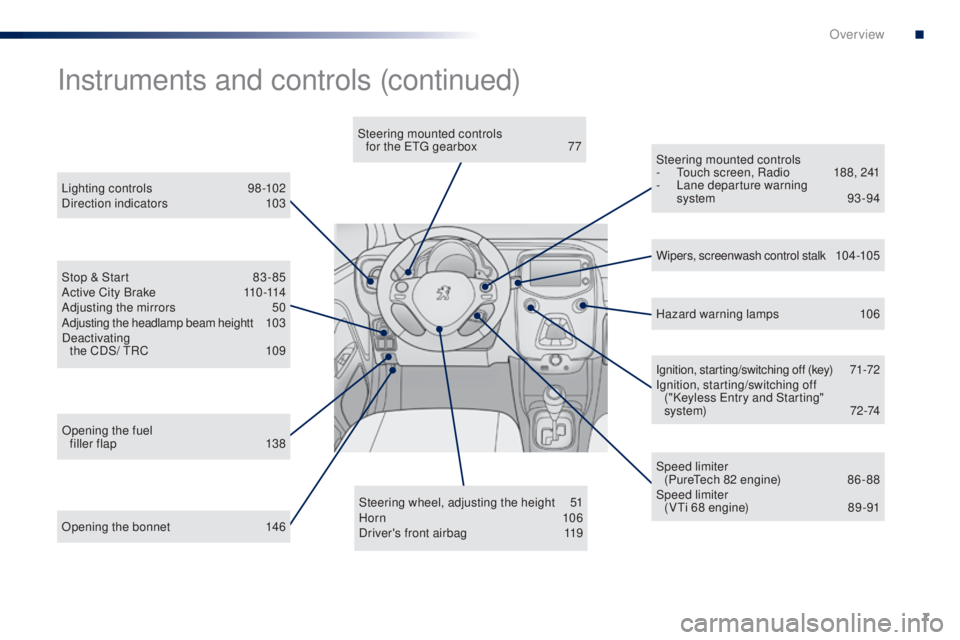
Opening the bonnet 146Steering wheel, adjusting the height
5
1
Horn 10 6
Driver's front airbag 1 19Ignition, starting/switching off (key)
7
1-72
Ignition, starting/switching off ("Keyless e
n
try and Starting"
system)
7
2-74
Steering mounted controls
- t
o
uch screen, Radio
1
88, 241
-
L
ane departure warning
system 93 -94
Instruments and controls (continued)
Lighting controls 9
8-102
Direction indicators 1 03
Stop & Start
8
3 - 85
Active City Brake
1
10 -114
Adjusting the mirrors
5
0
Adjusting the headlamp beam heightt
1
03
Deactivating the CDS/
t
R
C
1
09 Wipers, screenwash control stalk
1
0 4 -10 5
Speed limiter (Pure
te
ch 82 engine)
8
6 - 88
Speed limiter (V
ti 6
8 engine)
8
9 -91
Opening the fuel
filler flap
1
38 Hazard warning lamps
1
06
Steering mounted controls
for the etg gearbox
7
7
.
Over view
Page 10 of 268
8
108_en_Chap00b_vue-ensemble_ed01-2016
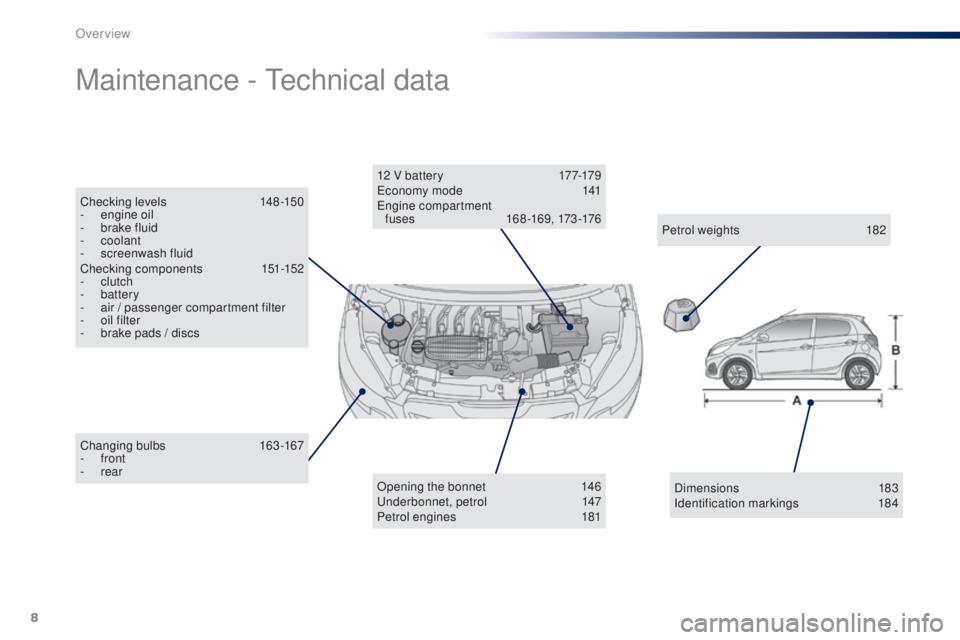
Changing bulbs 163-167
- front
-
rear
Maintenance - te chnical data
Opening the bonnet 1 46un
derbonnet, petrol 1 47
Petrol engines
1
81
12 V battery
1
77-179
ec
onomy mode
1
41
en
gine compartment
f u s e s
1
6 8 -16 9, 173 -176
Petrol weights
1
82
Checking levels
1
48 -150
-
e
ngine oil
-
b
rake fluid
-
coolant
-
s
creenwash fluid
Checking components
1
51-152
-
clutch
-
battery
-
a
ir / passenger compartment filter
-
o
il filter
-
b
rake pads / discs
Dimensions 183
Identification markings
1
84
Over view
Page 82 of 268
80
108_en_Chap04_conduite_ed01-2016
the vehicle can be stopped whatever the
position of the gear selector (N,
e or R).
However, there is an audible signal on opening
the driver's door if the gear selector is not at
position N .
Switching off
When the vehicle is stopped with the
engine running, always put the gear
selector to neutral N .
th
ere is a continuous audible signal
if you turn the ignition switch to "
oFF "
w
ith the vehicle in 2
nd, 3rd, 4th or 5th g e a r.
In this case return the ignition switch
to "
oN "
, move the gear selector to
position
N , then to position
e
,
M or R ,
then turn the ignition switch to "
oFF ".
O
n a slope, use the brakes to
immobilise the vehicle and place the
gear selector in position N ,
e
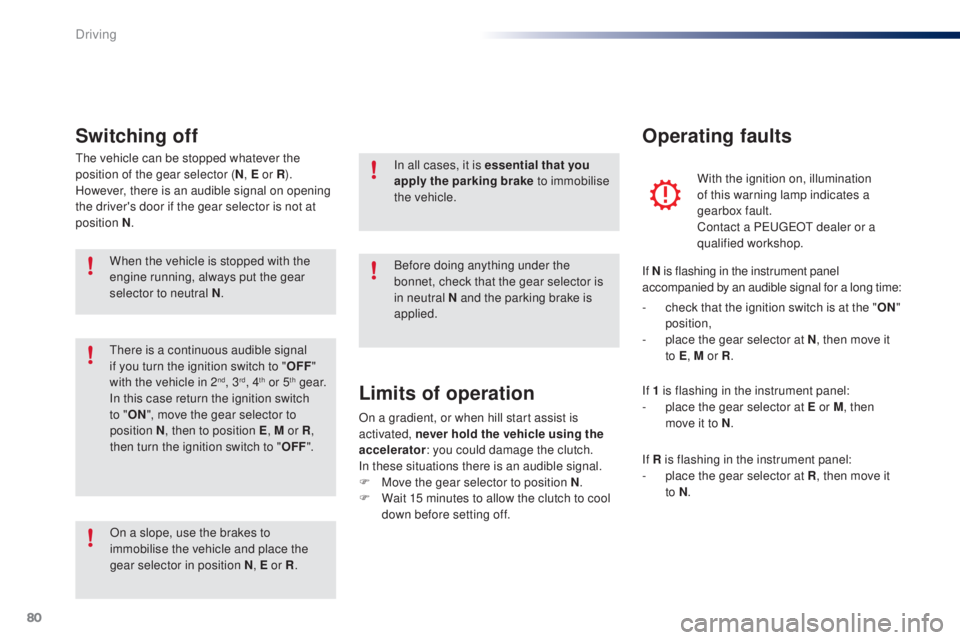
or R . With the ignition on, illumination
of this warning lamp indicates a
gearbox fault.
Contact a P
e
uge
Ot
dealer or a
qualified workshop.
operating faults
In all cases, it is essential that you
apply the parking brake to immobilise
the vehicle.
Before doing anything under the
bonnet, check that the gear selector is
in neutral N and the parking brake is
applied.
Limits of operation
On a gradient, or when hill start assist is
activated, never hold the vehicle using the
accelerator : you could damage the clutch.
In these situations there is an audible signal.
F
M
ove the gear selector to position N .
F
W
ait 15 minutes to allow the clutch to cool
down before setting off. -
c
heck that the ignition switch is at the "
oN
"
p
osition,
-
p
lace the gear selector at N
, then move it
to e
,
M or R
.
If 1 is flashing in the instrument panel:
- p lace the gear selector at e or M
, then
move it to N .
If R is flashing in the instrument panel:
-
p
lace the gear selector at R, then move it
to N .
If
N
is flashing in the instrument panel
accompanied by an audible signal for a long time:
Driving
Page 86 of 268
84
108_en_Chap04_conduite_ed01-2016
going into engine StARt
mode
this indicator lamp goes off and the
engine starts automatically:
-
w
hen you fully depress the clutch pedal.
S
tA
R
t
mode is invoked automatically when:
-
y
ou open the driver's door,
-
y
ou open the bonnet,
-
y
ou unfasten the driver's seat belt,
-
s
ome special conditions (battery charge,
engine temperature, braking assistance,
descending a steep gradient, adjustment of
the air conditioning...) where the engine is
needed for control of a system.
Special cases: StA Rt invoked
automatically
In the event of a fault with the system,
this warning lamp flashes in the
instrument panel.
operating fault
Have it checked by a Pe ugeOt dealer or a
qualified workshop.
Special cases: St oP m ode not
available
StOP mode is not invoked principally when:
- t
he driver's door is open,
-
t
he driver's seat belt is not fastened,
-
t
he engine is needed to maintain a
comfortable temperature in the passenger
compartment,
-
d
emisting is active,
-
s
ome special conditions (battery charge,
engine temperature, braking assistance,
vehicle stopped on a steep gradient, high
altitude...) where the engine is needed to
assure control of a system.
Driving
Page 87 of 268
85
108_en_Chap04_conduite_ed01-2016
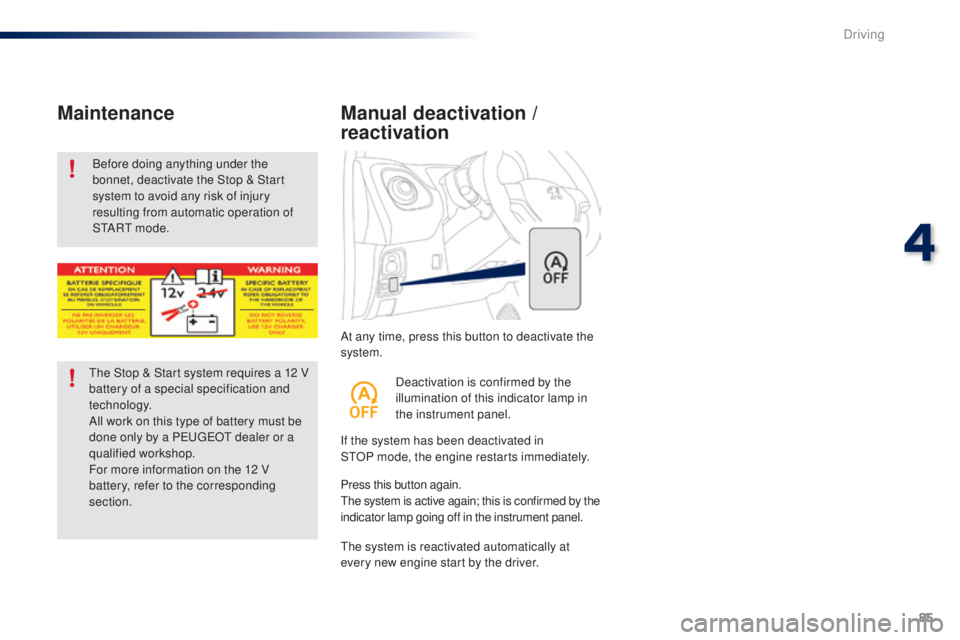
At any time, press this button to deactivate the
system.
Manual deactivation /
reactivation
If the system has been deactivated in
StOP mode, the engine restarts immediately.
th
e system is reactivated automatically at
every new engine start by the driver. Press this button again.
th
e system is active again; this is confirmed by the
indicator lamp going off in the instrument panel. Deactivation is confirmed by the
illumination of this indicator lamp in
the instrument panel.
Before doing anything under the
bonnet, deactivate the Stop & Start
system to avoid any risk of injury
resulting from automatic operation of
S
t
A R
t m
o d e .
Maintenance
the Stop & Start system requires a 12
V
battery of a special specification and
technology.
All work on this type of battery must be
done only by a P
e
uge
Ot
dealer or a
qualified workshop.
For more information on the 12 V
battery, refer to the corresponding
section.
4
Driving
Page 115 of 268
113
108_en_Chap06_securite_ed01-2016
Never leave accumulations of snow or
any object projecting above the bonnet
or in front of the roof: this might fall into
the field of vision of the sensor and
generate a detection.
operating limits
the system only detects vehicles (cars, lorries)
that are stationary or moving in the same
direction as your vehicle. In difficult weather conditions (very
heavy rain, snow, fog, hail...), braking
distances increase, which can reduce
the ability of the system to avoid a
collision.
the
driver must therefore remain
particularly vigilant.
th
e system is not triggered or is interrupted if
the driver:
-
a
ccelerates strongly (even if the speed
limiter is on),
-
o
r turns the steering wheel suddenly
(avoiding manoeuvre).
Detection capability is less effective if:
-
y
ou are driving on roads with pronounced
bends and/or on roads in poor condition,
-
y
our vehicle is excessively loaded, as
this changes the horizontal attitude of the
vehicle.
-
y
our vehicle skids.It does not detect small vehicles
(bicycles, motorcycles), pedestrians or
animals, nor non-reflective stationary
objects.unwanted triggering of the system
It is possible for the system to detect a risk of
imminent collision and start working, in the
following conditions in particular:
-
d
etection of an object located close to the
edge of the road entering a corner (safety
barrier, lamp post or road sign),
-
d
etection of a structure located at the top
or bottom of a steep slope (advertising
hoarding, steet lighting),
-
d
etection of reflective objects (central
reservation...) in the road,
-
d
etection of the upper bar of a bridge or a
traffic light gantry,
-
p
assing a vehicle travelling in the other
direction in a corner,
-
p
assing a vehicle traveling in the other
direction, at a crossroads, when your
vehicle is turning left or right,
-
i
f the vehicle ahead of you sends up water
or snow,
-
i
f your vehicle stops very close to an
overhanging wall or other vehicles,
-
w
hen your vehicle closes rapidly on the
vehicle ahead,
-
i
f the vehicle is raised or lowered,
-
i
f the vehicle passes through a plastic curtain,
-
i
f driving through mist or smoke,
-
i
f the sensor is misaligned (following
replacement after a collision).
6
Safety
Page 116 of 268
114
108_en_Chap06_securite_ed01-2016
operating faults
Sensor fault
the operation of the laser sensor may suffer
inter ference from accumulations of dirt or
misting of the windscreen or the presence of
an object causing an obstruction (e.g.: bonnet
open).In this case you are warned by the
display of this flashing warning lamp
in the instrument panel.
use
the windscreen demisting and regularly
clean the area of the windscreen in front of the
sensor.
Do not stick or other wise fix any object
on the windscreen in front of the sensor.
System fault
In the event of a malfunction of
the system, you are warned by the
display of this flashing warning lamp
in the instrument panel.
Have the system checked by a P
e
uge
Ot
dealer or a qualified workshop.
In the event of an impact to the
windscreen at the sensor, deactivate
the system and contact a P
e
uge
Ot
dealer or a qualified workshop
to have
your windscreen replaced.
Never try to remove, adjust or test the
sensor.
Only a P
e
uge
Ot
dealer or a qualified
workshop is able to work on the system.
Safety
Page 148 of 268
146
108_en_Chap07_info-pratiques_ed01-2016
Bonnet
Do not open the bonnet when there is a
very strong wind.
When the engine is hot, handle the
exterior safety catch and the stay with
care (risk of burns).
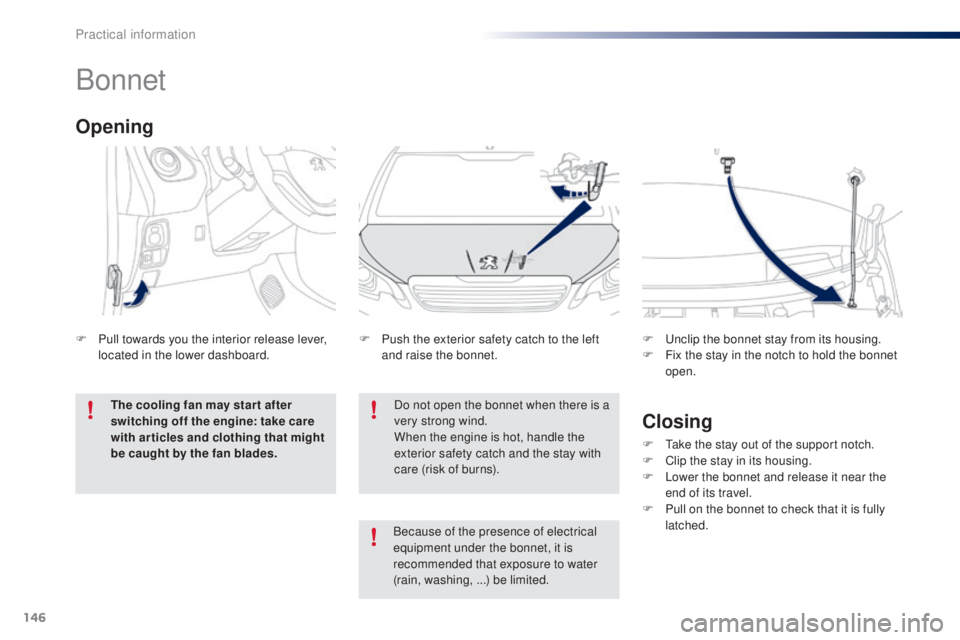
F
P
ush the exterior safety catch to the left
and raise the bonnet. F u
n
clip the bonnet stay from its housing.
F
F
ix the stay in the notch to hold the bonnet
open.
opening
F Pull towards you the interior release lever, located in the lower dashboard.
th
e cooling fan may star t after
switching off the engine: take care
with articles and clothing that might
be caught by the fan blades.
Closing
F take the stay out of the support notch.
F C lip the stay in its housing.
F
L
ower the bonnet and release it near the
end of its travel.
F
P
ull on the bonnet to check that it is fully
latched.
Because of the presence of electrical
equipment under the bonnet, it is
recommended that exposure to water
(rain, washing, ...) be limited.
Practical information
Page 150 of 268
148
108_en_Chap07_info-pratiques_ed01-2016
Checking levels
take care when working under the
bonnet, as certain areas of the engine
may be extremely hot (risk of burns) and
the cooling fan could start at any time
(even with the ignition off).
engine oil level
the check of the oil level is carried
out with the dipstick, located under
the bonnet. For the position of the
dipstick, refer to the under-bonnet
view on a previous page.
Checking with dipstick
Check all of these levels regularly, in line with the manufacturer's service schedule. top them up if necessary, unless other wise indicated.
If a level drops significantly, have the corresponding system checked by a Pe ugeOt dealer or a qualified workshop.
to e
nsure the accuracy of the reading,
your vehicle must be on a level
sur face, with the engine off for at least
30
minutes.
It is normal to top up the oil level between
two services (or oil changes). P
e
uge
Ot
recommends that you check the level, and top
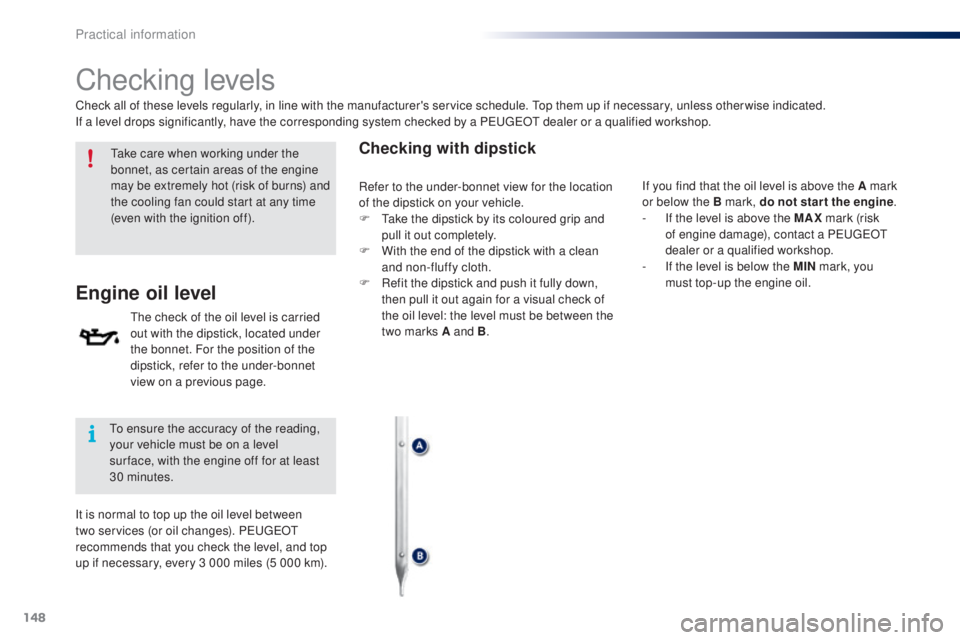
up if necessary, every 3 000 miles (5 000 km). If you find that the oil level is above the A mark
or below the B mark, do not star t the engine
.
-
I
f the level is above the MAX mark (risk
of engine damage), contact a P
e
uge
Ot
dealer or a qualified workshop.
-
I
f the level is below the MIN mark, you
must top-up the engine oil.
Refer to the under-bonnet view for the location
of the dipstick on your vehicle.
F
t
a
ke the dipstick by its coloured grip and
pull it out completely.
F
W
ith the end of the dipstick with a clean
and non-fluffy cloth.
F
R
efit the dipstick and push it fully down,
then pull it out again for a visual check of
the oil level: the level must be between the
two marks A and B .
Practical information