remove seats PEUGEOT 108 2018 Owners Manual
[x] Cancel search | Manufacturer: PEUGEOT, Model Year: 2018, Model line: 108, Model: PEUGEOT 108 2018Pages: 180, PDF Size: 7.14 MB
Page 9 of 180
7
Limit the causes of excess
consumption
Spread loads throughout the vehicle; place
the heaviest items in the bottom of the boot,
as close as possible to the rear seats.
Limit the loads carried in the vehicle and
reduce wind resistance (roof bars, roof rack,
…). Use a roof box in preference.
Remove roof bars and the roof rack after use.
At the end of winter, remove winter tyres and
refit your summer tyres.
Observe the recommendations
on maintenance
Check the tyre pressures regularly, when cold,
referring to the label in the door aperture,
driver's side.
Carry out this check in particular:
-
b
efore a long journey,
-
a
t each change of season,
-
a
fter a long period out of use. Have your vehicle ser viced regularly (engine
oil, oil filter, air filter, passenger compartment
filter…) and obser ve the schedule of
operations recommended in the warranty and
maintenance record. Do not forget the spare wheel and the tyres on
any trailer or caravan.
.
Eco-driving
Page 46 of 180
44
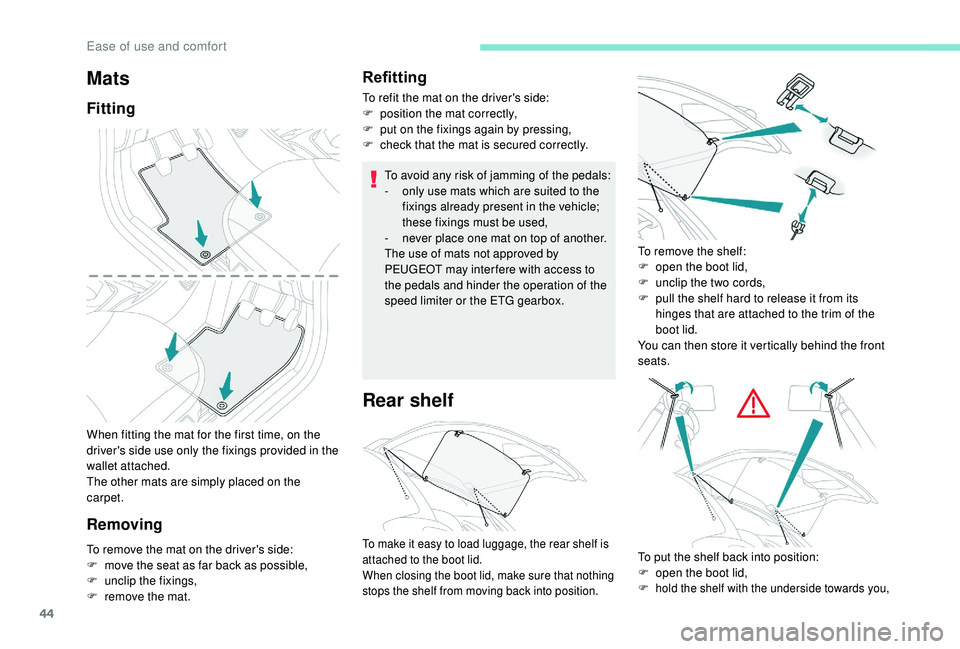
When fitting the mat for the first time, on the
driver's side use only the fixings provided in the
wallet attached.
The other mats are simply placed on the
carpet.
RemovingRefitting
To refit the mat on the driver's side:
F
p osition the mat correctly,
F
p
ut on the fixings again by pressing,
F
c
heck that the mat is secured correctly.
To avoid any risk of jamming of the pedals:
-
o
nly use mats which are suited to the
fixings already present in the vehicle;
these fixings must be used,
-
n
ever place one mat on top of another.
The use of mats not approved by
PEUGEOT may inter fere with access to
the pedals and hinder the operation of the
speed limiter or the ETG gearbox.
Rear shelf
Mats
Fitting
To remove the mat on the driver's side:
F
m ove the seat as far back as possible,
F
un
clip the fixings,
F
r
emove the mat. To remove the shelf:
F
o
pen the boot lid,
F
u
nclip the two cords,
F
p
ull the shelf hard to release it from its
hinges that are attached to the trim of the
boot lid.
You can then store it vertically behind the front
seats.To make it easy to load luggage, the rear shelf is
attached to the boot lid.
When closing the boot lid, make sure that nothing
stops the shelf from moving back into position.To put the shelf back into position:
F o pen the boot lid,
F
hold the shelf with the underside towards you,
Ease of use and comfort
Page 61 of 180
59
Front airbags
Do not drive holding the steering wheel
by its spokes or resting your hands on the
centre part of the wheel.
Passengers must not place their feet on
the dashboard.
Do not smoke as deployment of the
airbags can cause burns or the risk of
injury from a cigarette or pipe.
Never remove or pierce the steering wheel
or hit it violently.
Do not fit or attach anything to the steering
wheel or dashboard, this could cause
injuries with deployment of the airbags.
Curtain airbags
Do not attach anything or hang anything to
the roof, as this could cause head injuries
when the curtain airbag is deployed.
If fitted to your vehicle, do not remove the
grab handles installed on the roof, they
play a
part in securing the curtain airbags. Lateral airbags
Use only approved covers on the seats,
compatible with the deployment of the
lateral airbags. For information on the
product range of seat covers suitable for
your vehicle, contact a
PEUGEOT dealer.
Do not attach anything to or hang anything
from the seat backrests (clothes, etc.) as
this could cause injuries to the thorax or
arm when the lateral airbag is deployed.
Do not sit with the upper part of the body
any nearer to the door than necessary.
General points relating to
child seats
The regulations on carrying children are
specific to each country. Refer to the
legislation in force in your country. -
S
tatistically, the safest seats in your
vehicle for carr ying children are the rear
seats.
-
A c
hild weighing less than 9 kg must
travel in the rear ward-facing position
both in the front and in the rear.
It is recommended that children travel on
the rear seats of your vehicle:
- "
rearward facing " up to the age of 3,
- "
forward facing " over the age of 3.
Ensure that the seat belt is positioned and
tightened correctly.
For child seats with a support leg, ensure
that the latter is in firm and steady contact
with the floor.
In the front: if necessary, adjust the
passenger seat.
At the rear: if necessary, adjust the
relevant front seat.
For maximum safety, please obser ve the
following recommendations:
-
I
n accordance with European regulations,
all children under the age of 12
or less
than one and a
half metres tall must
travel in approved child seats suited to
their weight , on seats fitted with a
seat belt
or ISOFIX mountings.
5
Safety
Page 68 of 180
66
U:Seat suitable for the installation of
a
child seat secured using a seat belt
and universally approved, rearward
and/or for ward facing, with the front
seat adjusted in the middle longitudinal
position.
U (R): same as U , with the vehicle seat which
must be adjusted in the rearmost
longitudinal position, backrest
straightened.
ISOFIX mountings
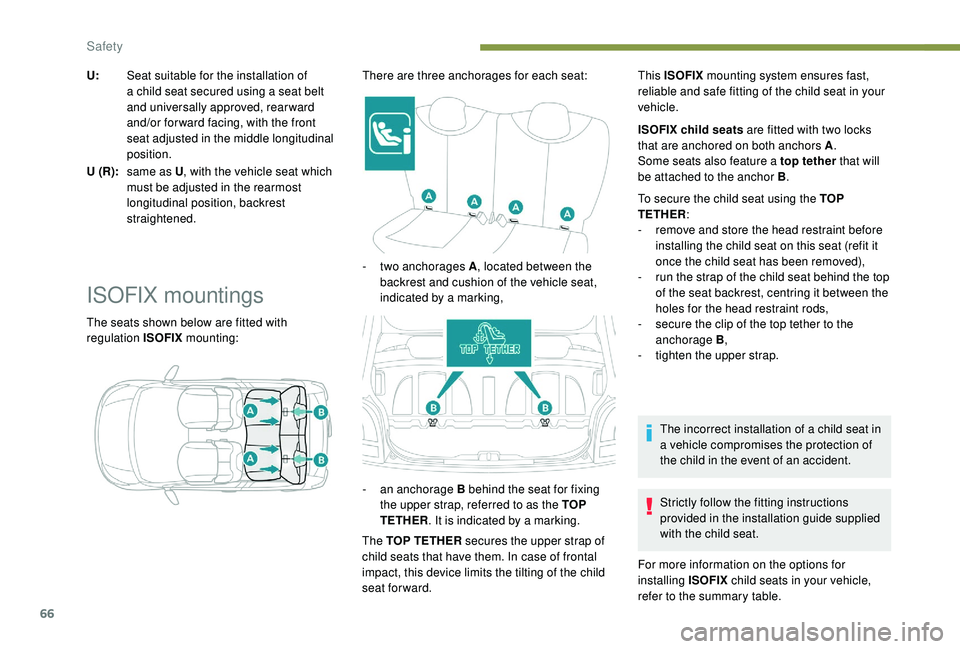
The seats shown below are fitted with
regulation ISOFIX mounting: There are three anchorages for each seat:
-
t
wo anchorages A
, located between the
backrest and cushion of the vehicle seat,
indicated by a marking,
-
an
anchorage B behind the seat for fixing
the upper strap, referred to as the TOP
TETHER . It is indicated by a
marking.
The TOP TETHER secures the upper strap of
child seats that have them. In case of frontal
impact, this device limits the tilting of the child
seat forward. This ISOFIX
mounting system ensures fast,
reliable and safe fitting of the child seat in your
vehicle.
ISOFIX child seats are fitted with two locks
that are anchored on both anchors A .
Some seats also feature a top tether
that will
be attached to the anchor B .
To secure the child seat using the TOP
TETHER :
-
r
emove and store the head restraint before
installing the child seat on this seat (refit it
once the child seat has been removed),
-
r
un the strap of the child seat behind the top
of the seat backrest, centring it between the
holes for the head restraint rods,
- s ecure the clip of the top tether to the
anchorage B ,
-
t
ighten the upper strap.
The incorrect installation of a
child seat in
a
vehicle compromises the protection of
the child in the event of an accident.
Strictly follow the fitting instructions
provided in the installation guide supplied
with the child seat.
For more information on the options for
installing ISOFIX child seats in your vehicle,
refer to the summary table.
Safety
Page 69 of 180
67
Recommended ISOFIX
child seats
Also consult the user guides from the child
seat's manufacturer to find out how to
install and remove the seat.
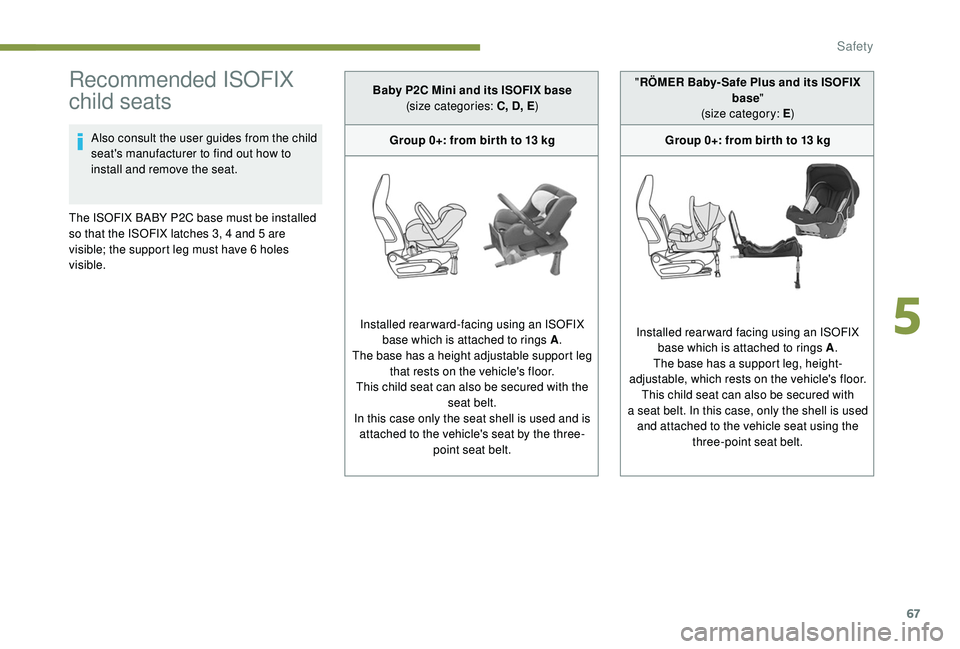
The ISOFIX BABY P2C base must be installed
so that the ISOFIX latches 3, 4
and 5 are
visible; the support leg must have 6
holes
visible. Baby P2C Mini and its ISOFIX base
(size categories: C, D, E )
Group 0+: from bir th to 13 kg
Installed rearward-facing using an ISOFIX base which is attached to rings A .
The base has a
height adjustable support leg
that rests on the vehicle's floor.
This child seat can also be secured with the seat belt.
In this case only the seat shell is used and is attached to the vehicle's seat by the three- point seat belt. "
RÖMER Baby- Safe Plus and its ISOFIX
base"
(size category: E )
Group 0+: from bir th to 13 kg
Installed rearward facing using an ISOFIX base which is attached to rings A .
The base has a
support leg, height-
adjustable, which rests on the vehicle's floor. This child seat can also be secured with
a
seat belt. In this case, only the shell is used
and attached to the vehicle seat using the three-point seat belt.
5
Safety
Page 72 of 180
70
Locations for i-Size child
seats
i-Size child seats have two latches that engage
on the two rings A.
i-Size child seats also have:
-
e
ither an upper strap which is attached to
the ring B
-
o
r a support leg resting on the vehicle floor,
compatible with the approved i-Size seat,
the role of which is to prevent the child
seat from tipping for ward in the event of
a
collision.
In accordance with the new European
Regulations, this table indicates the options
for installing i-Size child seats on seats in
the vehicle fitted with ISOFIX mountings and
approved for i-Size.
For more information on ISOFIX child seats ,
particularly the mountings and the rings, refer
to the corresponding section. i-Size child
seat
1st row Front
passenger seat Not i-Size
2nd row Outer rear
seats ( a) i-U
i- U: suitable for i-Size restraints of the
"universal" category, forward facing or
rearward facing.
(a) To install a
rearward or forward facing
child seat at the rear, move the front seat
for ward, then straighten the backrest to
allow enough room for the child seat and
the child's legs.
Advice
The incorrect installation of a child seat in
a vehicle compromises the protection of
the child in the event of an accident.
Ensure that there is no seat belt or seat
belt buckle under the child seat, as this
could destabilise it.
Remember to fasten the seat belts or the
child seat harnesses keeping the slack
relative to the child's body to a
minimum,
even for short journeys.
When installing a
child seat using the seat
belt, ensure that the seat belt is tightened
correctly on the child seat and that it
secures the child seat firmly on the seat
of your vehicle. If your passenger seat is
adjustable, move it forwards if necessary.
The head restraint must be removed
before installing a
child seat with
a
backrest on a passenger seat.
Ensure that the head restraint is stored or
attached securely to prevent it from being
thrown around the vehicle in the event
of sharp braking. Refit the head restraint
when the child seat is removed.
Safety