wheel PEUGEOT 2008 2013 Owner's Manual
[x] Cancel search | Manufacturer: PEUGEOT, Model Year: 2013, Model line: 2008, Model: PEUGEOT 2008 2013Pages: 324, PDF Size: 8.39 MB
Page 126 of 324
124
Safety
Electronic Stability Programme incorporatingthe following systems:
- the anti-lock braking system (ABS) and the
electronic brake force distribution (EBFD),
- the emergency braking assistance,
- the anti-slip regulation (ASR) or traction control,
- the d
ynamic stability control (DSC).
Electronic stability programme (ESP)
Definitions
Anti-lock braking system (ABS)
and electronic brake force
distribution
(EBFD)
This system improves the stability and
manoeuvrability of your vehicle when braking
and provides improved control in corners, in
par ticular on poor or slippery road surfaces.
The ABS prevents wheel lock in the event of emergency braking.
The electronic brake force distribution system
manages the braking pressure wheel by wheel.
Emergency braking assistance
In an emergency, this system enables you to reach the optimum braking pressure more
quickly and therefore reduce the stoppingdistance.
It is triggered in relation to the speed at which
the brake pedal is pressed. This is felt by areduction in the resistance of the pedal and an
increase in the effectiveness of the braking.
Anti-slip regulation (ASR)
The ASR system (also known as Traction Control) optimises traction in order to avoid
wheel slip by acting on the brakes of the drivingwheels and on the engine. It also improves
the directional stability of the vehicle onacceleration.
Dynamic stability control (DSC)
If there is a difference between the path
followed by the vehicle and that required by
the driver, the DSC monitors each wheel and
automatically acts on the brake of one or more
wheels and on the engine to return the vehicle
to the required path, within the limits of the laws
of physics.
Page 127 of 324
125
6
Safety
Operation
Anti-lock braking system (ABS) and electronic brake force distribution (EBFD)
In emergency braking, pressvery firmly without releasing thepressure.
When changing wheels (tyres and rims), make sure that these are approved for your vehicle. Normal operation of the ABS may makeitself felt by slight vibrations of the brakepedal. When this warnin
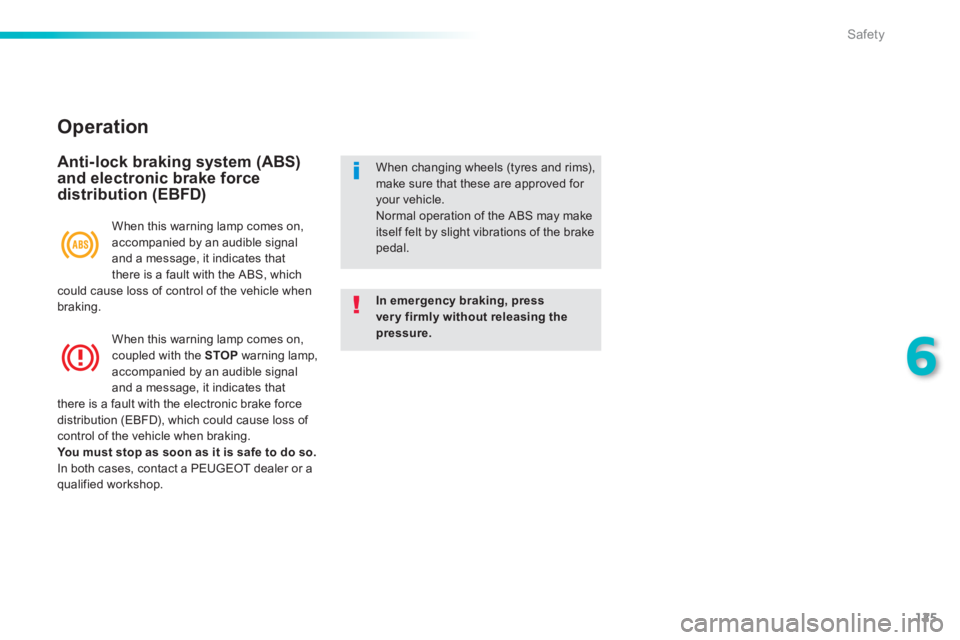
g lamp comes on, accompanied by an audible signal and a message, it indicates that
there is a fault with the ABS, whichcould cause loss of control of the vehicle when braking.
When this warnin
g lamp comes on, coupled with the STOP
warning lamp, accompanied by an audible signal and a message, it indicates that
there is a fault with the electronic brake force
distribution (EBFD), which could cause loss of control of the vehicle when braking.You must stop as soon as it is safe to do so. In both cases, contact a PEUGEOT dealer or aqualified workshop.
Page 128 of 324
126
Safety
Dynamic stability control(DSC)
Activation
This system is activated automatically each
time the vehicle is started.
It comes into operation in the event of a grip or
trajectory problem.
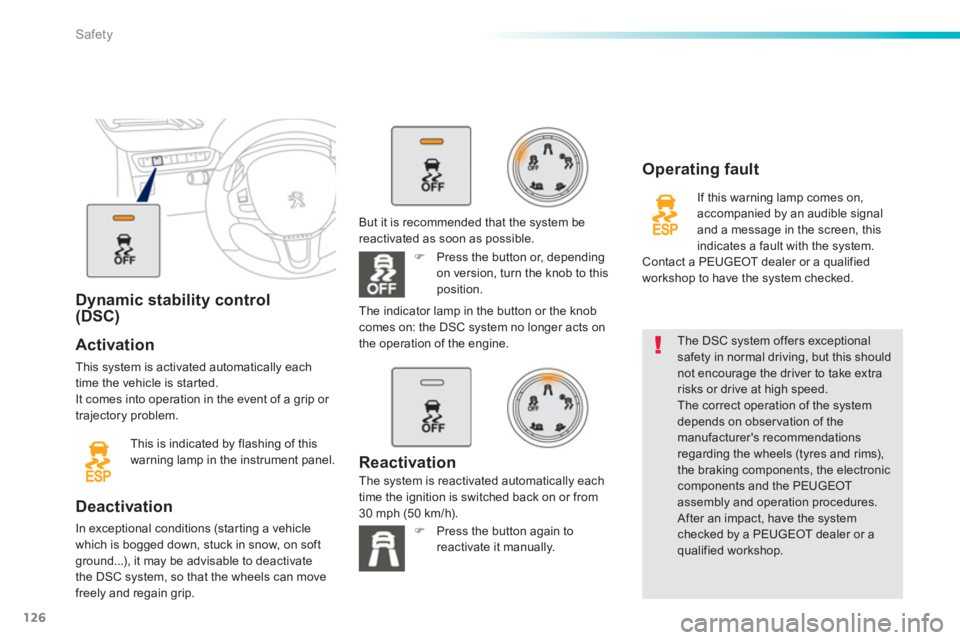
This is indicated b
y flashing of this
warning lamp in the instrument panel.
Deactivation
In exceptional conditions (starting a vehicle
which is bogged down, stuck in snow, on softground...), it may be advisable to deactivate
the DSC system, so that the wheels can move
freely and regain grip.
The DSC system offers exceptional safety in normal driving, but this should not encourage the driver to take extra risks or drive at high speed.
The correct operation of the system depends on obser vation of the manufacturer's recommendationsregarding the wheels (tyres and rims),the braking components, the electronic components and the PEUGEOTassembly and operation procedures.
After an impact, have the system
checked by a PEUGEOT dealer or aqualified workshop.
Operating fault
If this warning lamp comes on,
accompanied by an audible signal
and a messa
ge in the screen, this
indicates a fault with the system.
Contact a PEUGEOT dealer or a qualified
workshop to have the system checked.
Reactivation
But it is recommended that the system bereactivated as soon as possible.
)Press the button or, depending
on version, turn the knob to this position.
The s
ystem is reactivated automatically each
time the ignition is switched back on or from
30 mph (50 km/h). The indicator lamp in the button or the knob
comes on: the DSC system no longer acts on
the operation of the engine.
)Press the button again toreactivate it manually.
Page 129 of 324
127
6
i
Safety
Grip control
Special patented traction control system which
improves traction on snow, mud and sand.
This s
ystem is combined with all-season M+S (Mud and Snow: 215/60 R16) tyres which offer
an excellent compromise between safety, gripand traction.
This system, the operation of which has been
optimised for each situation, allows you to manoeuvre in most conditions of poor grip(encountered during touring use).
The accelerator pedal should be pressed
sufficiently to allow the system to use thepower of the engine. The electronics will ensure optimum management of the variousparameters. Operation at high engine speeds iscompletely normal.
Each time the ignition is switched off, the system returns to standard mode (DSC).
Normal mode
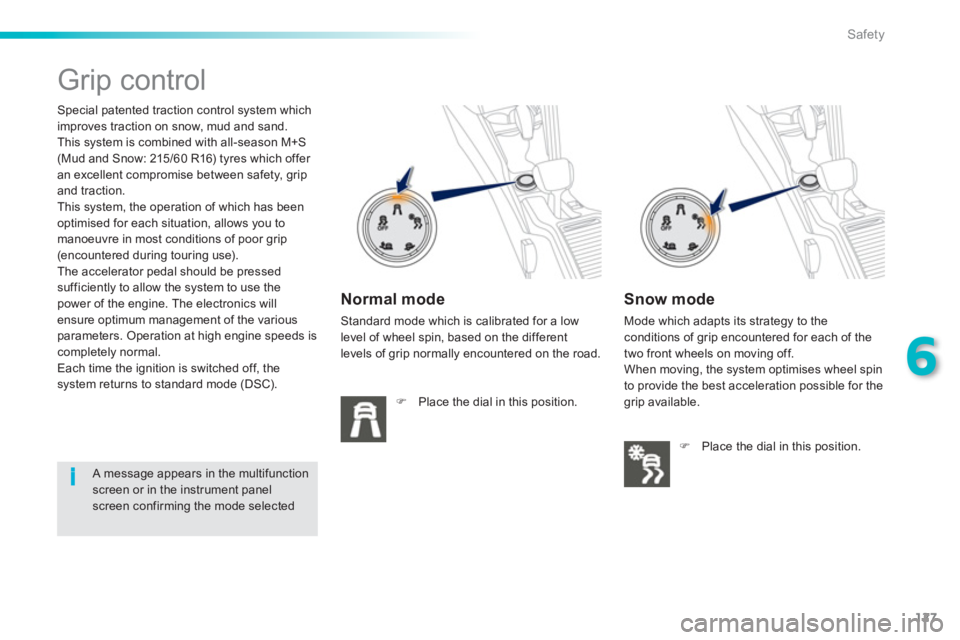
Standard mode which is calibrated for a lowlevel of wheel spin, based on the differentlevels of grip normally encountered on the road.
)
Place the dial in this position.
A message appears in the multifunctionscreen or in the instrument panelscreen confirming the mode selected
Snow mode
Mode which adapts its strategy to theconditions of grip encountered for each of the
two front wheels on moving off.
When moving, the system optimises wheel spin
to provide the best acceleration possible for the
grip available.
)Place the dial in this position.
Page 130 of 324
128
i
Safety
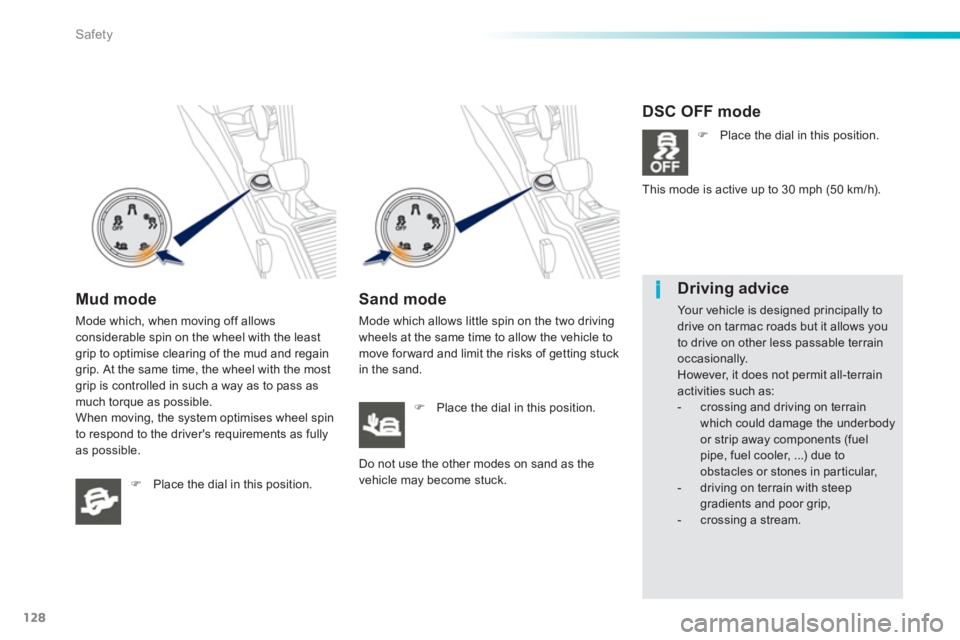
Mud mode
Mode which, when moving off allowsconsiderable spin on the wheel with the leastgrip to optimise clearing of the mud and regain grip. At the same time, the wheel with the mostgrip is controlled in such a way as to pass as much torque as possible.
When moving, the system optimises wheel spin
to respond to the driver's requirements as
fullyas possible.
) Place the dial in this position.
Sand mode
Mode which allows little spin on the two drivingwheels at the same time to allow the vehicle tomove for ward and limit the risks of getting stuck
in the sand.
)Place the dial in this position.
D
o not use the other modes on sand as thevehicle may become stuck.
DSC OFF mode
)
Place the dial in this position.
This mode is active up to 30 mph
(50 km/h).
Driving advice
Your vehicle is designed principally to drive on tarmac roads but it allows you to drive on other less passable terrainoccasionally.
However, it does not permit all-terrain activities such as:
- crossing and driving on terrainwhich could damage the underbody
or strip away components (fuel pipe, fuel cooler, ...) due toobstacles or stones in particular,
- driving on terrain with steepgradients and poor grip,
- crossing a stream.
Page 134 of 324
132
Safety
Airbags
System designed to maximise the safety of the
occupants (with the exception of the rear centrepassenger) in the event of violent collisions.
The airbags supplement the action of the force-
limiting seat belts (with the exception of the centre rear passenger).
If a collision occurs, the electronic detectors record and analyse the front and side impacts sustained in the impact detection zones:
- in the case of a serious impact, the airbagsare deployed instantly and contribute
towards better protection of the occupants
of the vehicle
(with the exception of the rear centre passenger); immediately after theimpact, the airbags deflate rapidly so that
they do not hinder visibility or the exit of the
occupants,
- in the case of a minor or rear impact
or in cer tain roll-over conditions, the
airbags will not be deployed; the seat belt
alone contributes towards ensuring your protection in these situations.
The airbags do not operate whenthe ignition is switched off.
This equipment will only deploy once.
If a second impact occurs (during thesame or a subsequent accident), theairbag will not be deployed again.
Deployment of the airbag(s) is accompanied by a slight emission of smoke and a noise, due to theactivation of the pyrotechnic cartridgeincorporated in the system.This smoke is not harmful, but sensitiveindividuals may experience slight irritation.
The noise of the detonation may result in a slight loss of hearing for a shorttime.
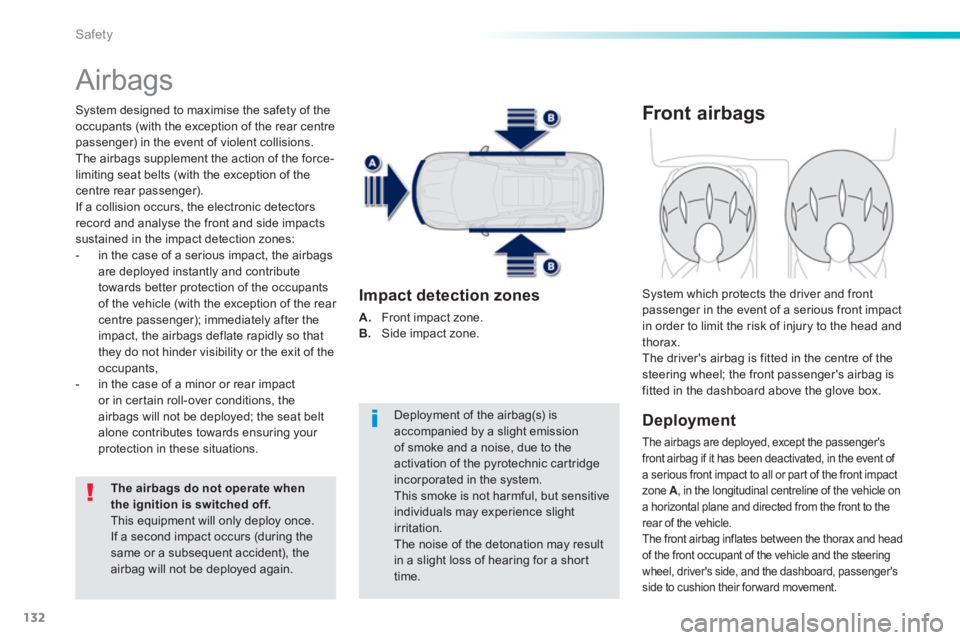
Impact detection zones
A.
Front impact zone.
B. Side impact zone.
Front airbags
Deployment
The airbags are deployed, except the passenger's
front airbag if it has been deactivated, in the event of
a serious front impact to all or par t of the front impact
z
one A , in the longitudinal centreline of the vehicle on
a horizontal plane and directed from the front to the
rear of the vehicle.
The front airbag inflates between the thorax and head
of the front occupant of the vehicle and the steeringwheel, driver's side, and the dashboard, passenger's
side to cushion their forward movement.
System which protects the driver and frontpassenger in the event of a serious front impact
in order to limit the risk of injury to the head and
thorax.
The driver's airbag is fitted in the centre of the steering wheel; the front passenger's airbag isfitted in the dashboard above the glove box.
Page 137 of 324
135
6
Safety
Sit in a normal upright position.
Wear a correctly adjusted seat belt.
Do not leave anything between theoccupants and the airbags (a child, pet, object...). This could hamper the operation of the airbags or injure the occupants. After an accident or if the vehicle has beenstolen or broken into, have the airbagsystems checked. All work on the airbag system must be carried out by a PEUGEOT dealer or a qualified workshop.
Even if all of the precautions mentionedare obser ved, a risk of injury or of minor burns to the head, chest or arms when an airbag is deployed cannot be ruled out. Thebag inflates almost instantly (within a fewmilliseconds) then deflates within the same
time discharging the hot gas via openings provided for this purpose.
Lateral airbags
Use only approved covers on the seats, compatible with the deployment the lateralairbags. For information on the range of seatcovers suitable for your vehicle, you can contact a PEUGEOT dealer. Refer to the "Accessories" section.Do not fix or attach anything to the seatbacks (clothing...). This could cause injuryto the chest or arms if the lateral airbag isdeployed.Do not sit with the upper par t of the body anynearer to the door than necessary.
Front airbags
Do not drive holding the steering wheel by itsspokes or resting your hands on the centre part of the wheel.
Passengers must not place their feet on thedashboard.
If possible, do not smoke as deployment of the airbags can cause burns or the risk of injury from a cigarette or pipe.
Never remove or pierce the steering wheel or hit it violently.
For the airbags to be fully effective, observe the following safety rules:
Curtain airbags
Do not fix or attach anything to the roof. This could cause injury to the head if the cur tain airbag is deployed. If fitted on your vehicle, do not remove thegrab handles installed on the roof, they play a part in securing the cur tain airbags.
Page 148 of 324
146
Practical information
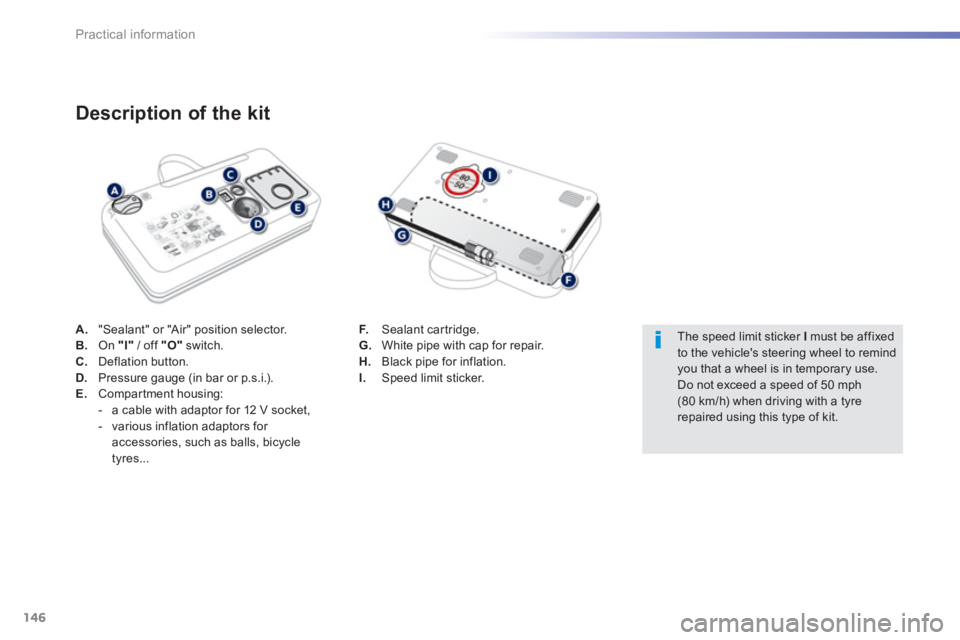
A. "Sealant" or "Air" position selector.B.On "I"/ off "O"
switch. C.Deflation button.D.
Pressure gauge (in bar or p.s.i.).E.
Compartment housing:
- a cable with adaptor for 12 V socket,
- various inflation adaptors for accessories, such as balls, bicycle
tyres...
Description of the kit
F.
Sealant car tridge.
G.White pipe with cap for repair. H.Black pipe for inflation. I. Speed limit sticker.
The speed limit sticker Imust be affixed to the vehicle's steering wheel to remind you that a wheel is in temporary use.
Do not exceed a speed of 50 mph (80 km/h) when driving with a tyre repaired using this type of kit.
Page 151 of 324
149
7
Practical information
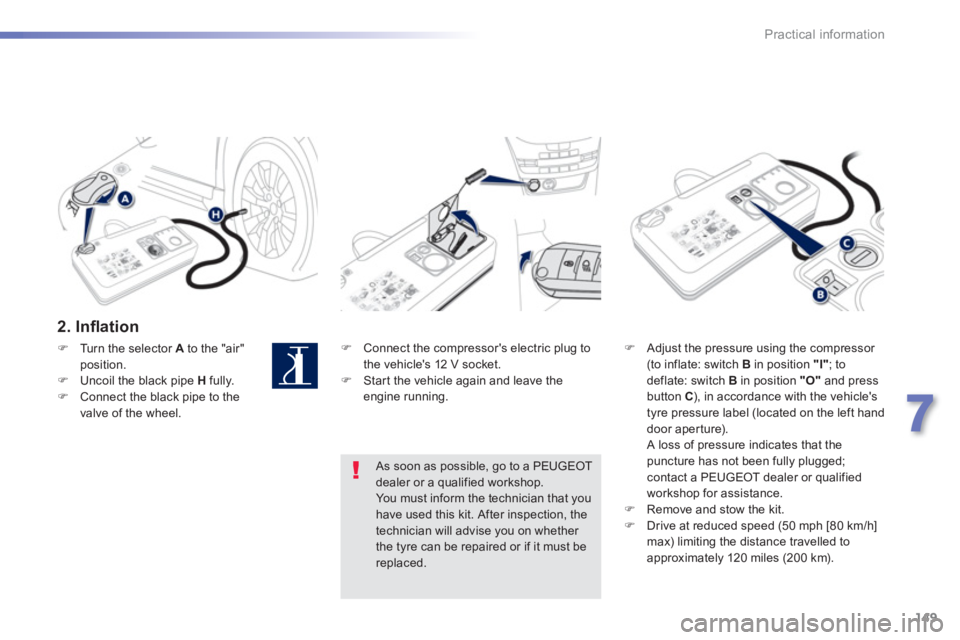
2. Infl ation
)
Connect the compressor's electric plug to
the vehicle's 12 V socket.) Star t the vehicle again and leave theengine running.
)
Adjust the pressure using the compressor (to inflate: switch B
in position "I"
; to deflate: switch B
in position "O"and press button C), in accordance with the vehicle's
tyre pressure label (located on the left hand
door aperture).
A loss of pressure indicates that thepuncture has not been fully plugged; contact a PEUGEOT dealer or qualified
workshop for assistance. ) Remove and stow the kit. )
Drive at reduced speed (50 mph [80 km/h]max) limiting the distance travelled to
approximately 120 miles (200 km).
As soon as possible, go to a PEUGEOTdealer or a qualified workshop.Yo u m u s t i nform the technician that you have used this kit. After inspection, the technician will advise you on whether the tyre can be repaired or if it must be replaced.
)Turn the selector A
to the "air" position.)Uncoil the black pipe Hfully. )Connect the black pipe to the
valve of the wheel.
Page 152 of 324
150
Practical information
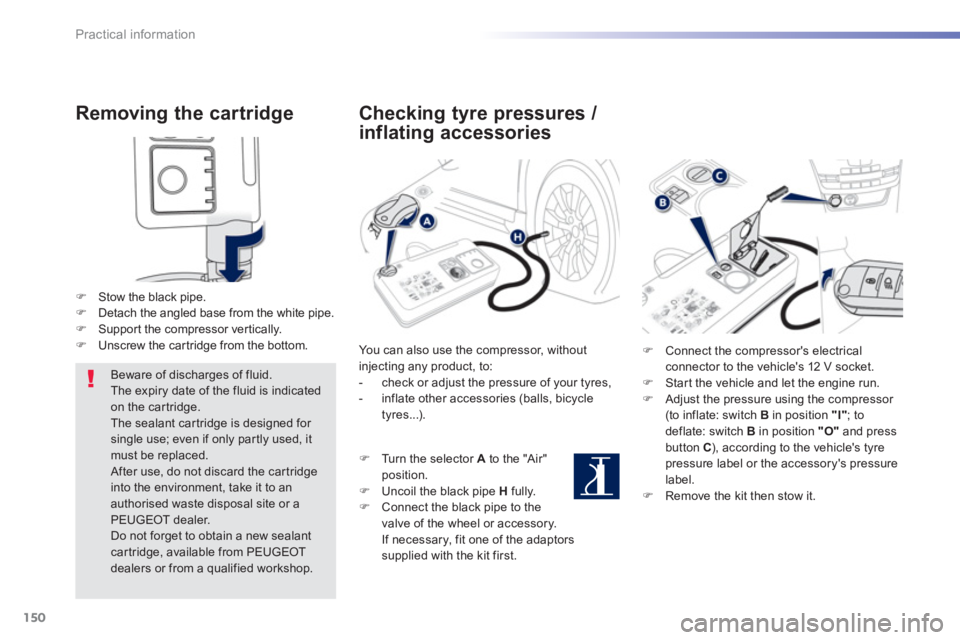
Removing the cartridge
) Stow the black pipe.)
Detach the angled base from the white pipe. )
Suppor t the compressor ver tically.)
Unscrew the car tridge from the bottom.
Beware of discharges of fluid.
The expiry date of the fluid is indicated on the car tridge.
The sealant car tridge is designed for
single use; even if only partly used, itmust be replaced. After use, do not discard the car tridge into the environment, take it to anauthorised waste disposal site or aPEUGEOT dealer.
Do not forget to obtain a new sealantcartridge, available from PEUGEOT dealers or from a qualified workshop.
Checking tyre pressures /
inflatin
g accessories
You can also use the compressor, without injecting any product, to:
- check or adjust the pressure of your tyres,
- inflate other accessories (balls, bicycle
tyres...).
)
Turn the selector A
to the "Air"
position.
) Uncoil the black pipe H
fully.)
Connect the black pipe to the
valve of the wheel or accessory.
If necessary, fit one of the adaptorssupplied with the kit first.
)Connect the compressor's electrical connector to the vehicle's 12 V socket.)Star t the vehicle and let the engine run.)Adjust the pressure using the compressor (to inflate: switch B in position "I"
; to deflate: switch B
in position "O"and press button C), according to the vehicle's tyrepressure label or the accessory's pressure
label. )Remove the kit then stow it.