engine PEUGEOT 2008 2016 Owner's Manual
[x] Cancel search | Manufacturer: PEUGEOT, Model Year: 2016, Model line: 2008, Model: PEUGEOT 2008 2016Pages: 450, PDF Size: 14.16 MB
Page 33 of 450
31
2008_en_Chap01_controle-de-marche_ed01-2016
Oil level
Low oil level
F Identify the engine oil filler cap.
F O pen the filler cap.
F
A
dd engine oil with exceeding mark A .
F
F
it the filler cap.
Dipstick
For more information on the underbonnet
and the engine oil dipstick, refer to the
corresponding section.
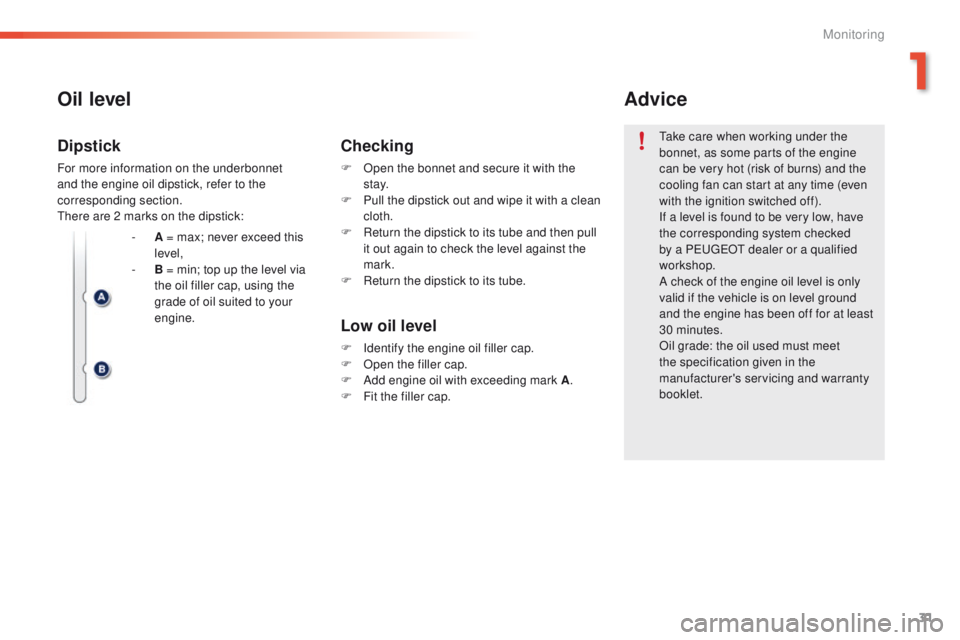
There are 2 marks on the dipstick: -
A
= max; never exceed this
level,
-
B
= min; top up the level via
the oil filler cap, using the
grade of oil suited to your
engine.
Checking
F Open the bonnet and secure it with the st ay.
F
P
ull the dipstick out and wipe it with a clean
cloth.
F
R
eturn the dipstick to its tube and then pull
it out again to check the level against the
mark.
F
R
eturn the dipstick to its tube.
Advice
Take care when working under the
bonnet, as some parts of the engine
can be very hot (risk of burns) and the
cooling fan can start at any time (even
with the ignition switched off).
If a level is found to be very low, have
the corresponding system checked
by a PEUGEOT dealer or a qualified
workshop.
A check of the engine oil level is only
valid if the vehicle is on level ground
and the engine has been off for at least
30 minutes.
Oil grade: the oil used must meet
the specification given in the
manufacturer's servicing and warranty
booklet.
1
Monitoring
Page 34 of 450
32
Electronic oil level indicator
The check is done for a few seconds after
switching on the ignition, with a message in the
display or screen (depending on version).
It is only valid if the vehicle is on level ground
and the engine has been off for at least
30
minutes.
It is normal to top-up the engine oil
level between services (or oil changes).
PEUGEOT recommends that you check
the oil level and top-up if necessary,
every 3 000 miles (5 000 km).
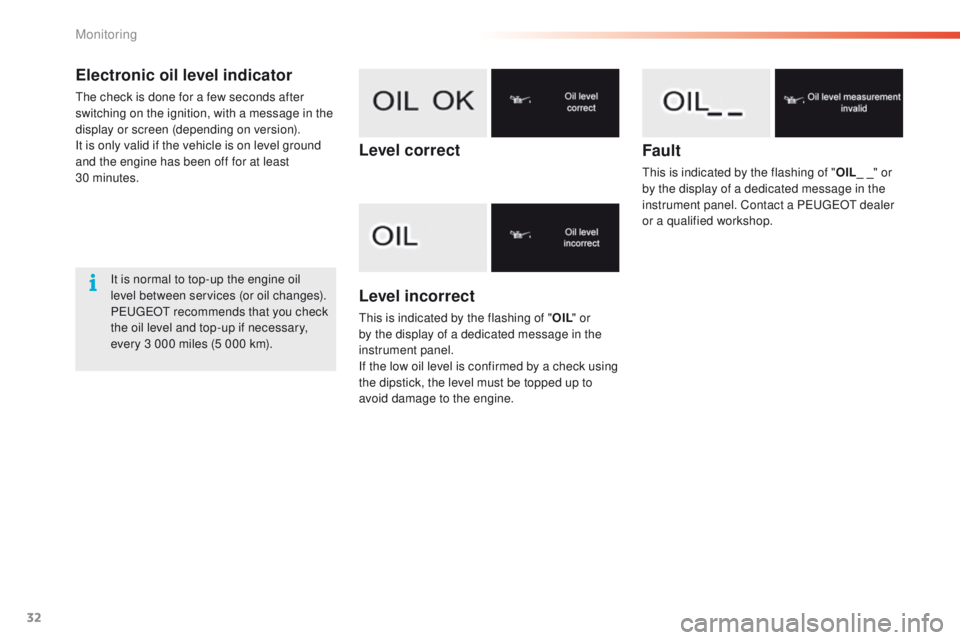
Fault
This is indicated by the flashing of " OIL_ _" or
by the display of a dedicated message in the
instrument panel. Contact a PEUGEOT dealer
or a qualified workshop.
Level correct
Level incorrect
This is indicated by the flashing of " OIL" or
by the display of a dedicated message in the
instrument panel.
If the low oil level is confirmed by a check using
the dipstick, the level must be topped up to
avoid damage to the engine.
Monitoring
Page 35 of 450
33
2008_en_Chap01_controle-de-marche_ed01-2016
Coolant temperature
gauge
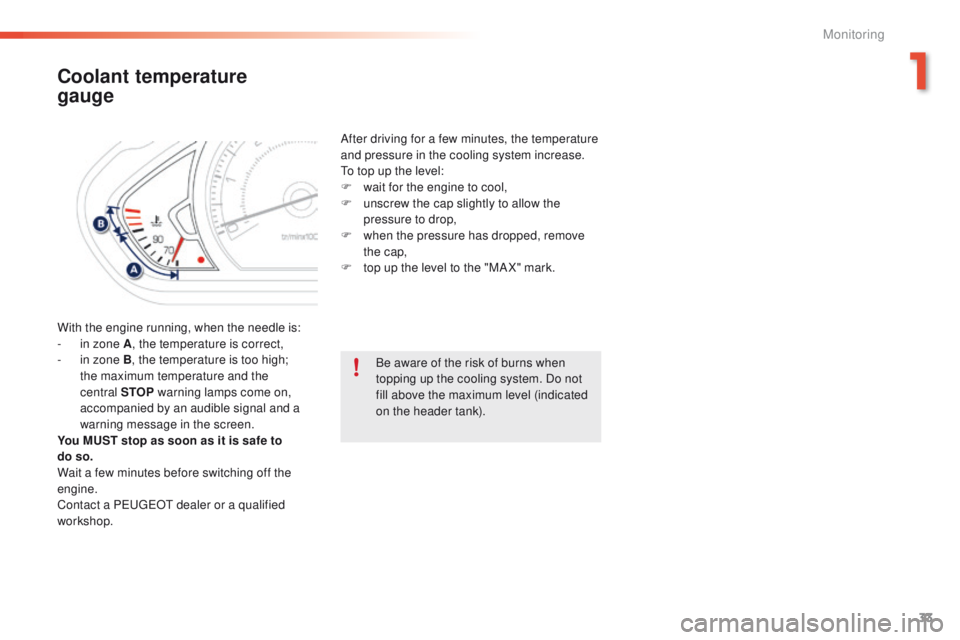
With the engine running, when the needle is:
- i n zone A , the temperature is correct,
-
i
n zone B, the temperature is too high;
the maximum temperature and the
central STOP warning lamps come on,
accompanied by an audible signal and a
warning message in the screen.
You MUST stop as soon as it is safe to
do
so.
Wait a few minutes before switching off the
engine.
Contact a PEUGEOT dealer or a qualified
workshop. After driving for a few minutes, the temperature
and pressure in the cooling system increase.
To top up the level:
F
w
ait for the engine to cool,
F
u
nscrew the cap slightly to allow the
pressure to drop,
F
w
hen the pressure has dropped, remove
the cap,
F
t
op up the level to the "MA X" mark.
Be aware of the risk of burns when
topping up the cooling system. Do not
fill above the maximum level (indicated
on the header tank).
1
Monitoring
Page 47 of 450
45
2008_en_Chap02_ouvertures_ed01-2016
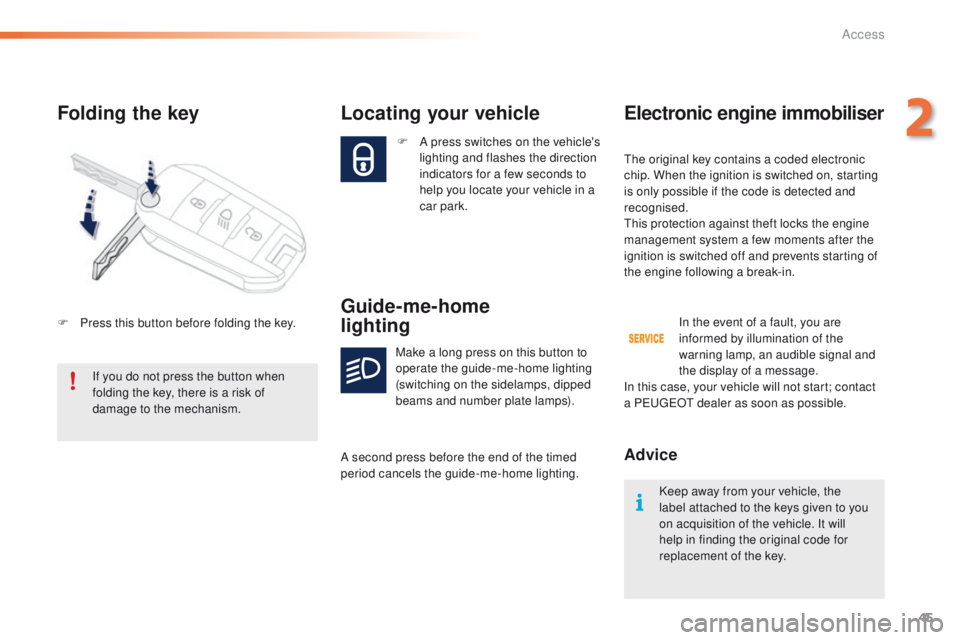
Folding the key
F A press switches on the vehicle's lighting and flashes the direction
indicators for a few seconds to
help you locate your vehicle in a
car park.
Locating your vehicle
If you do not press the button when
folding the key, there is a risk of
damage to the mechanism. The original key contains a coded electronic
chip. When the ignition is switched on, starting
is only possible if the code is detected and
recognised.
This protection against theft locks the engine
management system a few moments after the
ignition is switched off and prevents starting of
the engine following a break-in.
Guide-me-home
lighting
Make a long press on this button to
operate the guide-me-home lighting
(switching on the sidelamps, dipped
beams and number plate lamps).
A second press before the end of the timed
period cancels the guide-me-home lighting.
Electronic engine immobiliser
In the event of a fault, you are
informed by illumination of the
warning lamp, an audible signal and
the display of a message.
In this case, your vehicle will not start; contact
a PEUGEOT dealer as soon as possible.
Keep away from your vehicle, the
label attached to the keys given to you
on acquisition of the vehicle. It will
help in finding the original code for
replacement of the key.
F
P
ress this button before folding the key.
Advice
2
Access
Page 49 of 450
47
2008_en_Chap02_ouvertures_ed01-2016
Lost keys
Go to a PEUGEOT dealer with the vehicle's registration document, your personal identification documents and if possible the key code label.
The PEUGEOT dealer will be able to look up the key code and the transponder code required to order a new key.
Remote control
The high frequency remote control is a sensitive system; do not operate it while it is in your pocket as there is a possibility that it may unlock the
vehicle, without you being aware of it.
Do not repeatedly press the buttons of your remote control out of range and out of sight of your vehicle. You run the risk of stopping it from
working and the remote control would have to be reinitialised.
No remote control can operate when the key is in the ignition switch, even when the ignition is switched off, except for reinitialisation.
Anti-theft protection
Do not make any modifications to the electronic engine immobiliser system; this could cause malfunctions.
Locked vehicle
Driving with the doors locked may make access to the passenger compartment by the emergency services more difficult in an emergency.
As a safety precaution, never leave children alone in the vehicle, except for a very short period.
In all cases, it is essential to remove the key from the ignition switch when leaving the vehicle.
Second-hand vehicle
Have the pairing of all of the keys in your possession checked by a PEUGEOT dealer, to ensure that only your keys can be used to open and
start the vehicle.
2
Access
Page 50 of 450
48
2008_en_Chap02_ouvertures_ed01-2016
Doors
Opening
From outside
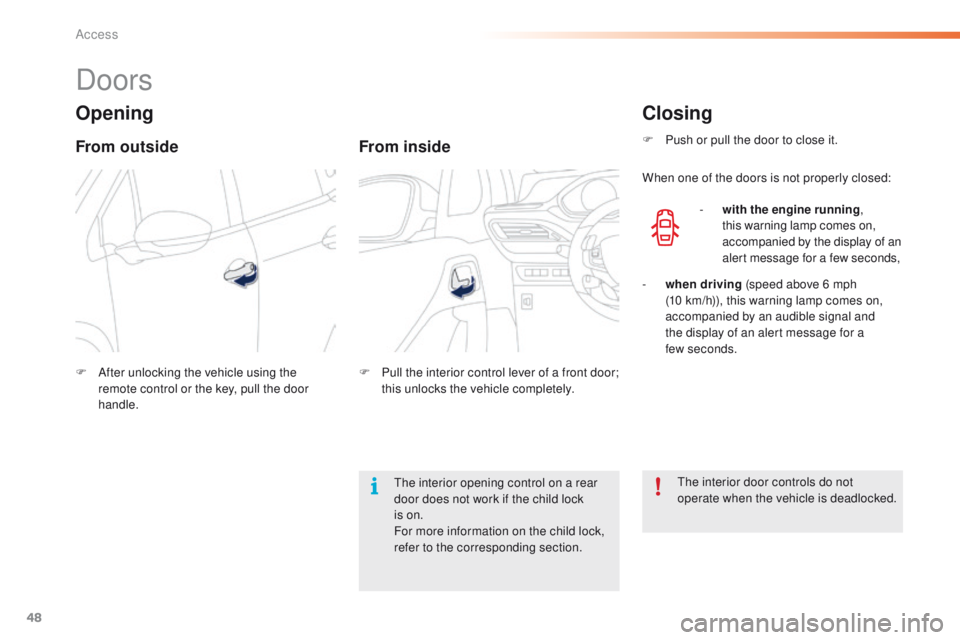
F After unlocking the vehicle using the remote control or the key, pull the door
handle.
From inside
F Pull the interior control lever of a front door; this unlocks the vehicle completely.
Closing
F Push or pull the door to close it.
When one of the doors is not properly closed:
-
w
ith the engine running ,
this warning lamp comes on,
accompanied by the display of an
alert message for a few seconds,
-
wh
en driving (speed above 6 mph
(10
km/h)), this warning lamp comes on,
accompanied by an audible signal and
the display of an alert message for a
few
seconds.
The interior door controls do not
operate when the vehicle is deadlocked.
The interior opening control on a rear
door does not work if the child lock
is
on.
For more information on the child lock,
refer to the corresponding section.
Access
Page 52 of 450
50
2008_en_Chap02_ouvertures_ed01-2016
Boot
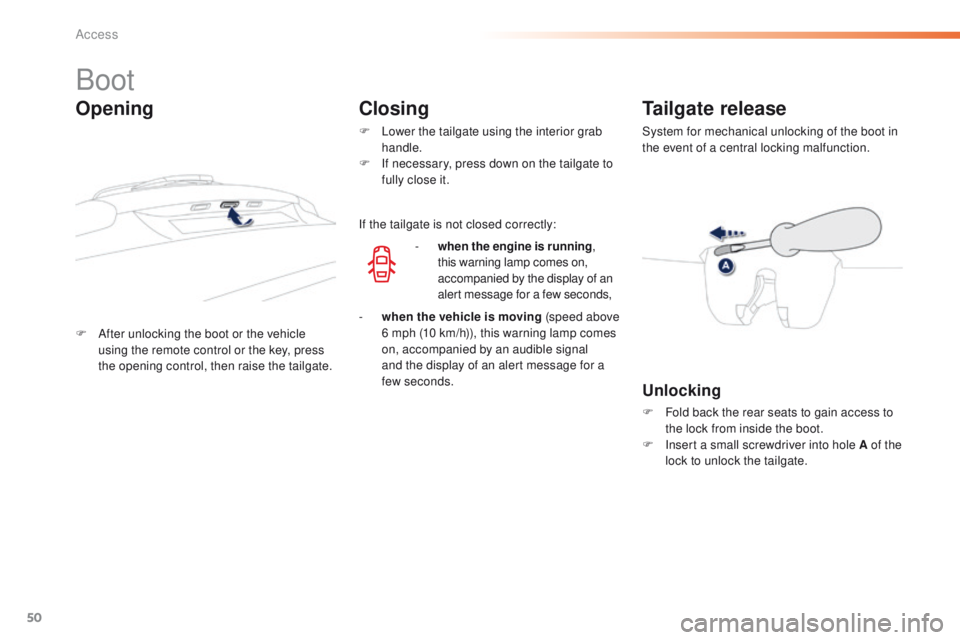
F After unlocking the boot or the vehicle using the remote control or the key, press
the opening control, then raise the tailgate.
Tailgate release
System for mechanical unlocking of the boot in
the event of a central locking malfunction.
Opening Closing
F Lower the tailgate using the interior grab
handle.
F
I
f necessary, press down on the tailgate to
fully close it.
-
w
hen the engine is running ,
this warning lamp comes on,
accompanied by the display of an
alert message for a few seconds,
-
w
hen the vehicle is moving (speed above
6 mph (10 km/h)), this warning lamp comes
on, accompanied by an audible signal
and the display of an alert message for a
few
seconds.
Unlocking
F Fold back the rear seats to gain access to the lock from inside the boot.
F
I
nsert a small screwdriver into hole A of the
lock to unlock the tailgate.
If the tailgate is not closed correctly:
Access
Page 53 of 450
51
2008_en_Chap02_ouvertures_ed01-2016
Locking / unlocking from the inside
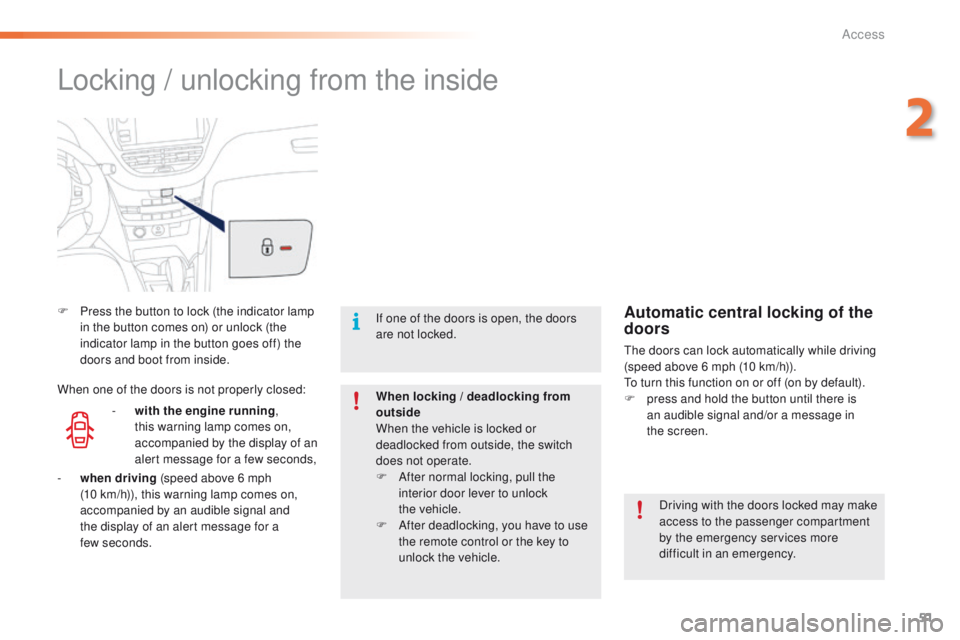
F Press the button to lock (the indicator lamp in the button comes on) or unlock (the
indicator lamp in the button goes off) the
doors and boot from inside.
Driving with the doors locked may make
access to the passenger compartment
by the emergency services more
difficult in an emergency.
If one of the doors is open, the doors
are not locked.
When locking / deadlocking from
outside
When the vehicle is locked or
deadlocked from outside, the switch
does not operate.
F
A
fter normal locking, pull the
interior door lever to unlock
the
vehicle.
F
A
fter deadlocking, you have to use
the remote control or the key to
unlock the vehicle.Automatic central locking of the
doors
The doors can lock automatically while driving
(speed above 6 mph (10 km/h)).
To turn this function on or off (on by default).
F
p
ress and hold the button until there is
an audible signal and/or a message in
the
screen.
-
w
ith the engine running ,
this warning lamp comes on,
accompanied by the display of an
alert message for a few seconds,
When one of the doors is not properly closed:
-
wh
en driving (speed above 6 mph
(10
km/h)), this warning lamp comes on,
accompanied by an audible signal and
the display of an alert message for a
few
seconds.
2
Access
Page 59 of 450

57
2008_en_Chap03_confort_ed01-2016
With the engine running, the front seats can be
heated separately.
F
U
se the adjustment dial, placed on the side
of each front seat, to switch on and select
the level of heating required:
0 : Of f.
1 : Low.
2 : Medium.
3 : High.
F
T
o raise the head restraint, pull it upwards.
F
T
o remove the head restraint, press the
lug
A and pull the head restraint upwards.
F
T
o put the head restraint back in place,
engage the head restraint stems in the
openings, keeping them in line with the
seat back.
F
T
o lower the head restraint, press the lug A
and the head restraint at the same time. The head restraint has a frame with
notches which prevent it from lowering;
this is a safety device in case of impact.
The adjustment is correct when the
upper edge of the head restraint is
level with the top of the head.
Never drive with the head restraints
removed; they must be in place and
adjusted correctly.
Head restraintsHeated seats
3
Comfort
Page 62 of 450
60
2008_en_Chap03_confort_ed01-2016
Mirrors
Each fitted with an adjustable mirror glass
providing the lateral rear ward vision necessary
for overtaking or parking. They can also be
folded for parking in confined spaces.
Door mirrors
The objects observed are, in reality,
closer than they appear.
Take this into account when assessing
the distance of vehicles approaching
from behind.
Demisting - DefrostingAdjustment
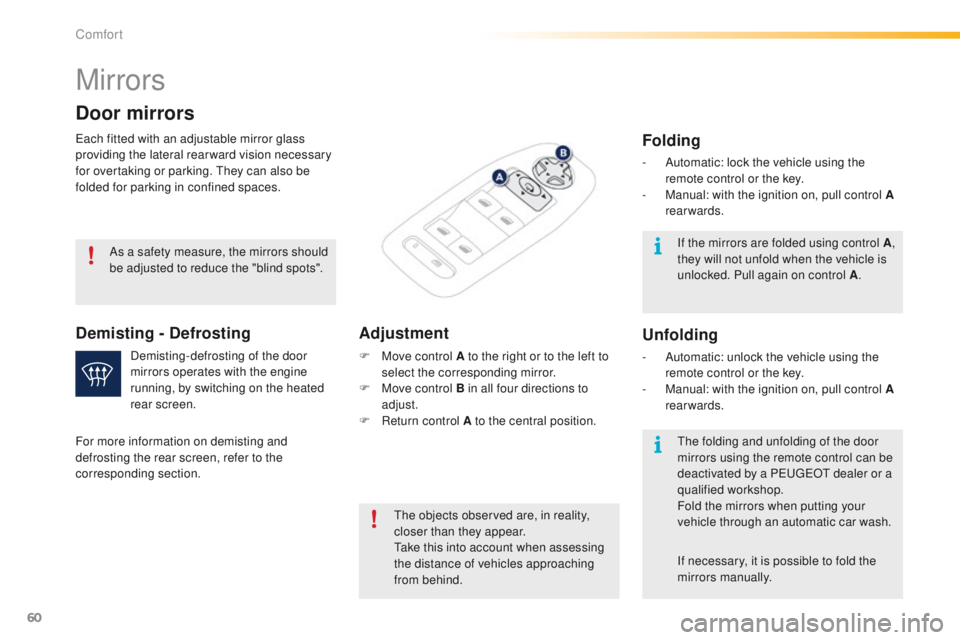
F Move control A to the right or to the left to
select the corresponding mirror.
F
M
ove control B in all four directions to
adjust.
F
R
eturn control A to the central position.
Demisting-defrosting of the door
mirrors operates with the engine
running, by switching on the heated
rear screen.
As a safety measure, the mirrors should
be adjusted to reduce the "blind spots".
For more information on demisting and
defrosting the rear screen, refer to the
corresponding section. If the mirrors are folded using control A
,
they will not unfold when the vehicle is
unlocked. Pull again on control A .
The folding and unfolding of the door
mirrors using the remote control can be
deactivated by a PEUGEOT dealer or a
qualified workshop.
Fold the mirrors when putting your
vehicle through an automatic car wash.
Folding
- Automatic: lock the vehicle using the remote control or the key.
-
M
anual: with the ignition on, pull control A
rearwards.
Unfolding
- Automatic: unlock the vehicle using the remote control or the key.
-
M
anual: with the ignition on, pull control A
rearwards.
If necessary, it is possible to fold the
mirrors manually.
Comfort