ignition PEUGEOT 2008 2016 Workshop Manual
[x] Cancel search | Manufacturer: PEUGEOT, Model Year: 2016, Model line: 2008, Model: PEUGEOT 2008 2016Pages: 450, PDF Size: 14.16 MB
Page 151 of 450
149
2008_en_Chap07_securite_ed01-2016
Seat belts
Front seat belts
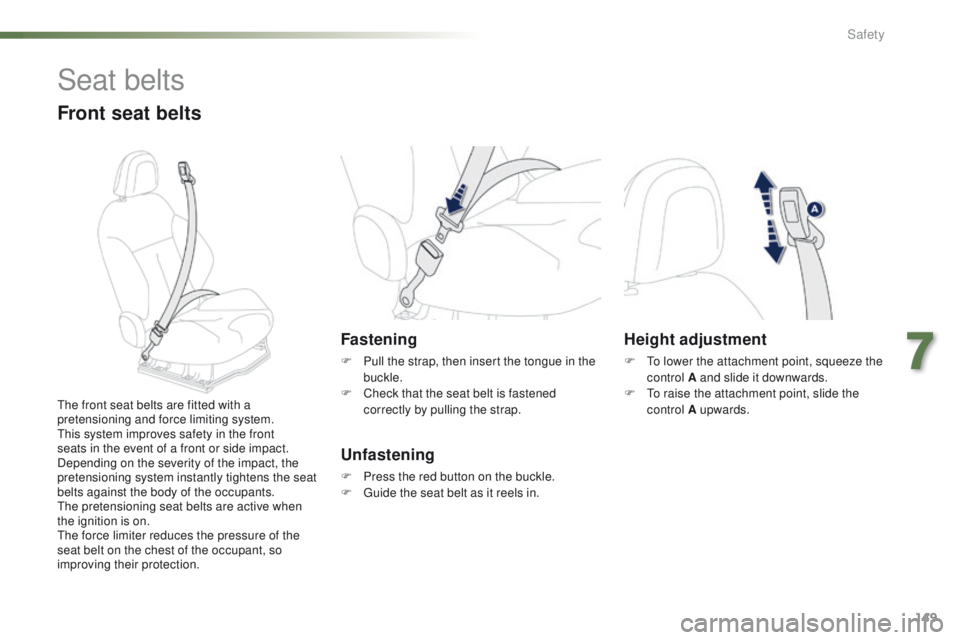
Fastening
F Pull the strap, then insert the tongue in the buckle.
F
C
heck that the seat belt is fastened
correctly by pulling the strap.
Unfastening
F Press the red button on the buckle.
F G uide the seat belt as it reels in.
The front seat belts are fitted with a
pretensioning and force limiting system.
This system improves safety in the front
seats in the event of a front or side impact.
Depending on the severity of the impact, the
pretensioning system instantly tightens the seat
belts against the body of the occupants.
The pretensioning seat belts are active when
the ignition is on.
The force limiter reduces the pressure of the
seat belt on the chest of the occupant, so
improving their protection.
Height adjustment
F To lower the attachment point, squeeze the
control A and slide it downwards.
F
T
o raise the attachment point, slide the
control A upwards.
7
Safety
Page 152 of 450
150
2008_en_Chap07_securite_ed01-2016
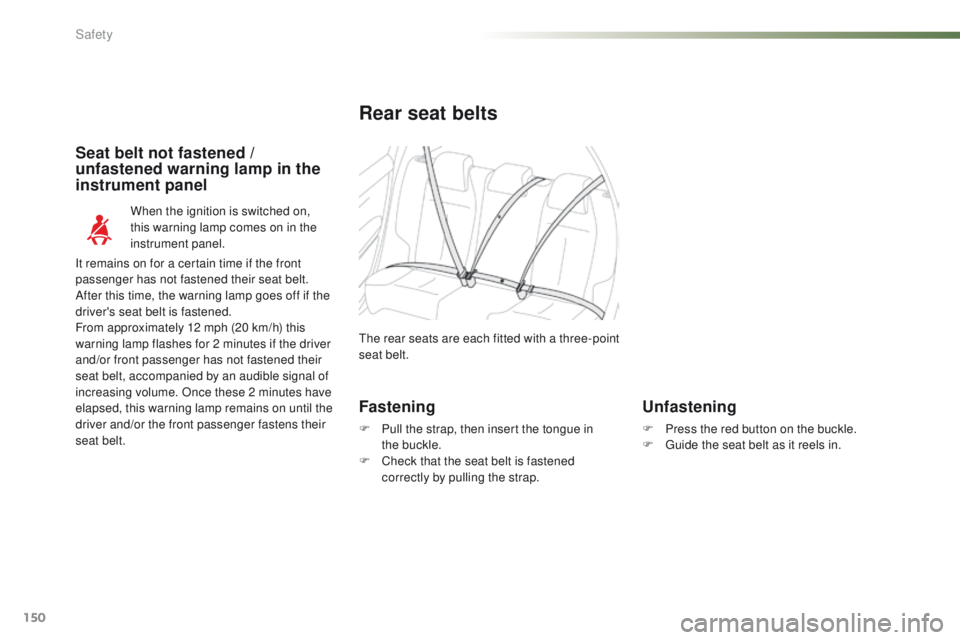
Rear seat belts
The rear seats are each fitted with a three-point
seat belt.
When the ignition is switched on,
this warning lamp comes on in the
instrument panel.
Seat belt not fastened /
unfastened warning lamp in the
instrument panel
Fastening
F Pull the strap, then insert the tongue in the buckle.
F
C
heck that the seat belt is fastened
correctly by pulling the strap.
Unfastening
F Press the red button on the buckle.
F G uide the seat belt as it reels in.
It remains on for a certain time if the front
passenger has not fastened their seat belt.
After this time, the warning lamp goes off if the
driver's seat belt is fastened.
From approximately 12 mph (20 km/h) this
warning lamp flashes for 2 minutes if the driver
and/or front passenger has not fastened their
seat belt, accompanied by an audible signal of
increasing volume. Once these 2 minutes have
elapsed, this warning lamp remains on until the
driver and/or the front passenger fastens their
seat belt.
Safety
Page 154 of 450
152
2008_en_Chap07_securite_ed01-2016
Airbags
General information
System designed to contribute towards
improving the safety of the occupants (with
the exception of the rear centre passenger)
in the event of violent collisions. The airbags
supplement the action of the seat belts fitted
with force limiters (all except the centre rear
passenger belt).
If a collision occurs, the electronic detectors
record and analyse the front and side impacts
sustained in the impact detection zones:
-
i
n the case of a serious impact, the airbags
are deployed instantly and contribute
towards better protection of the occupants
of the vehicle (with the exception of the
rear centre passenger); immediately after
the impact, the airbags deflate rapidly so
that they do not hinder visibility or the exit
of the occupants,
-
i
n the case of a minor or rear impact or in
certain roll-over conditions, the airbags
may not be deployed; the seat belt
alone contributes towards ensuring your
protection in these situations.
The airbags do not operate when the
ignition is switched off. Deployment of one or more of the
airbags is accompanied by a slight
emission of smoke and a noise, due
to the activation of the pyrotechnic
cartridge incorporated in the system.
This smoke is not harmful, but sensitive
individuals may experience slight
irritation.
The noise of detonation associated with
the deployment of one or more airbags
may result in a slight loss of hearing for
a short time.
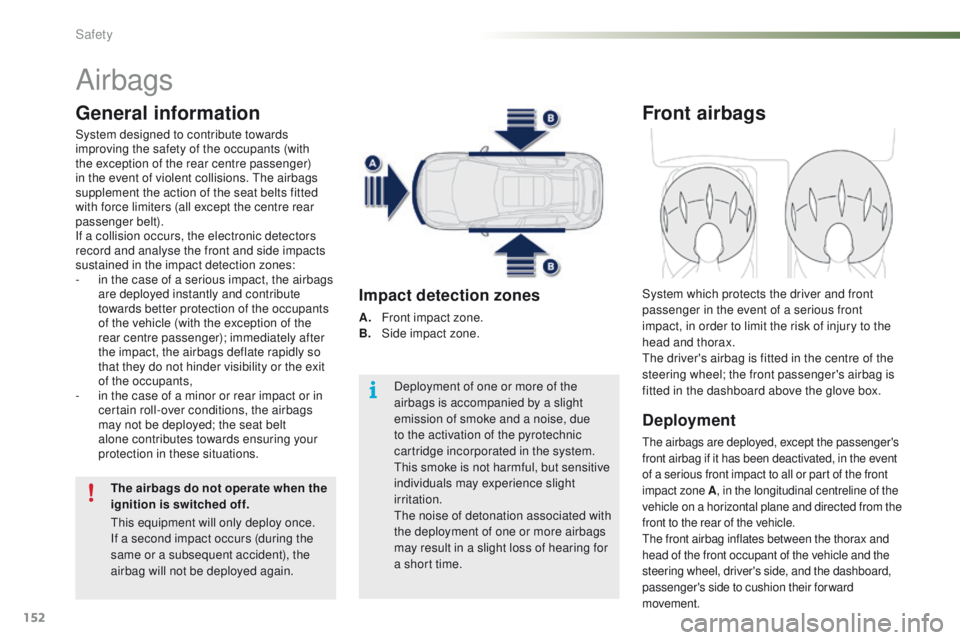
Impact detection zones
A. Front impact zone.
B. S
ide impact zone.
Front airbags
Deployment
The airbags are deployed, except the passenger's
front airbag if it has been deactivated, in the event
of a serious front impact to all or part of the front
impact zone A , in the longitudinal centreline of the
vehicle on a horizontal plane and directed from the
front to the rear of the vehicle.
The front airbag inflates between the thorax and
head of the front occupant of the vehicle and the
steering wheel, driver's side, and the dashboard,
passenger's side to cushion their forward
movement.
System which protects the driver and front
passenger in the event of a serious front
impact, in order to limit the risk of injury to the
head and thorax.
The driver's airbag is fitted in the centre of the
steering wheel; the front passenger's airbag is
fitted in the dashboard above the glove box.
This equipment will only deploy once.
If a second impact occurs (during the
same or a subsequent accident), the
airbag will not be deployed again.
Safety
Page 155 of 450
153
2008_en_Chap07_securite_ed01-2016
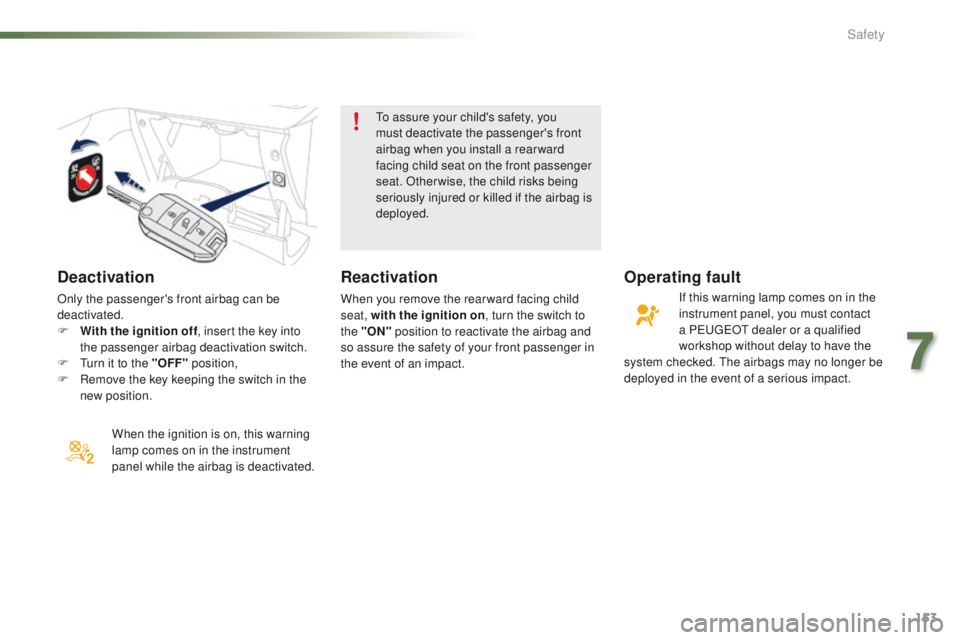
Deactivation
When the ignition is on, this warning
lamp comes on in the instrument
panel while the airbag is deactivated.To assure your child's safety, you
must deactivate the passenger's front
airbag when you install a rear ward
facing child seat on the front passenger
seat. Otherwise, the child risks being
seriously injured or killed if the airbag is
deployed.
Reactivation
When you remove the rear ward facing child
seat, with the ignition on
, turn the switch to
the "ON" position to reactivate the airbag and
so assure the safety of your front passenger in
the event of an impact.
Operating fault
If this warning lamp comes on in the
instrument panel, you must contact
a PEUGEOT dealer or a qualified
workshop without delay to have the
system checked. The airbags may no longer be
deployed in the event of a serious impact.
Only the passenger's front airbag can be
deactivated.
F
W
ith the ignition off , insert the key into
the passenger airbag deactivation switch.
F
T
urn it to the "OFF" position,
F
R
emove the key keeping the switch in the
new position.
7
Safety
Page 160 of 450
158
2008_en_Chap08_securite-enfants_ed01-2016
Deactivating the passenger's
front airbag
Never install a rear ward facing child
restraint system on a seat protected by
an active front airbag. This could cause
the death of the child or serious injury.Passenger airbag OFF
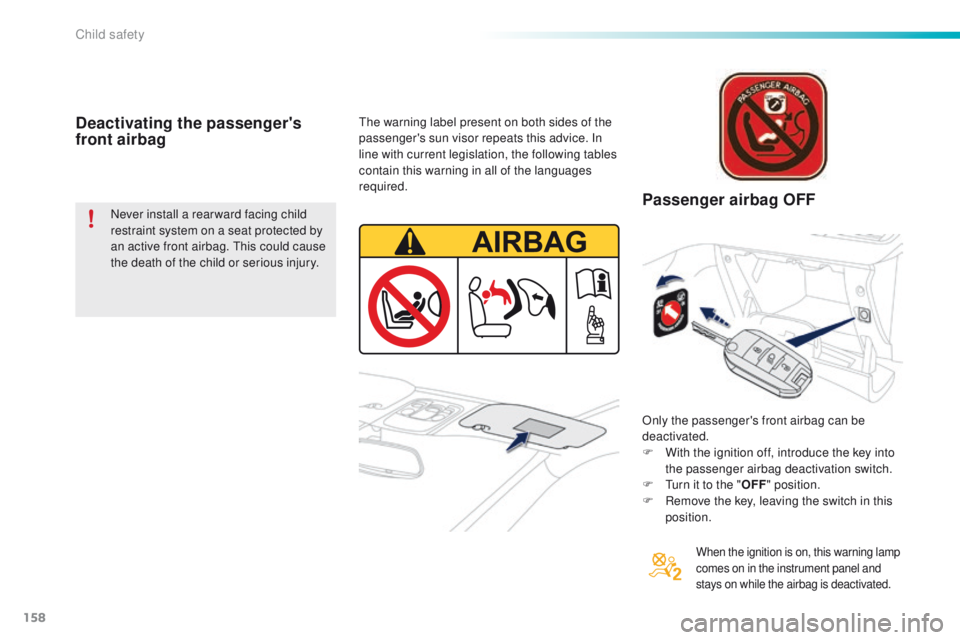
The warning label present on both sides of the
passenger's sun visor repeats this advice. In
line with current legislation, the following tables
contain this warning in all of the languages
required.Only the passenger's front airbag can be
deactivated.
F
W
ith the ignition off, introduce the key into
the passenger airbag deactivation switch.
F
T
urn it to the "OFF" position.
F
R
emove the key, leaving the switch in this
position.
When the ignition is on, this warning lamp
comes on in the instrument panel and
stays on while the airbag is deactivated.
Child safety
Page 171 of 450
169
2008_en_Chap08_securite-enfants_ed01-2016
Electric operation
Electric system, with the control located at the front, for locking the rear doors so that they cannot
be opened using their interior controls.
Switching on
F With the ignition on, press this button.
The indicator lamp in the button comes on,
accompanied by a message to confirm that the
child lock is on.
This indicator lamp remains on until the child
lock is switched off.
It is still possible to open the doors from the
outside and operate the rear electric windows
from the driver's control panel.
Switching off
F With the ignition on, press this button again.
The indicator lamp in the button goes off,
accompanied by a message to confirm that the
child lock is off.
This indicator lamp remains off while the child
lock is switched off.
Any other status of the indicator lamp
indicates a fault with the electric child
lock.
Have it checked by a PEUGEOT dealer
or a qualified workshop.
This system is independent and in no
circumstances does it take the place of
the central locking control.
Check the state of the child lock every
time you switch on the ignition.
Always remove the key from the ignition
when leaving the vehicle, even for a
short time.
Child lock
Locking
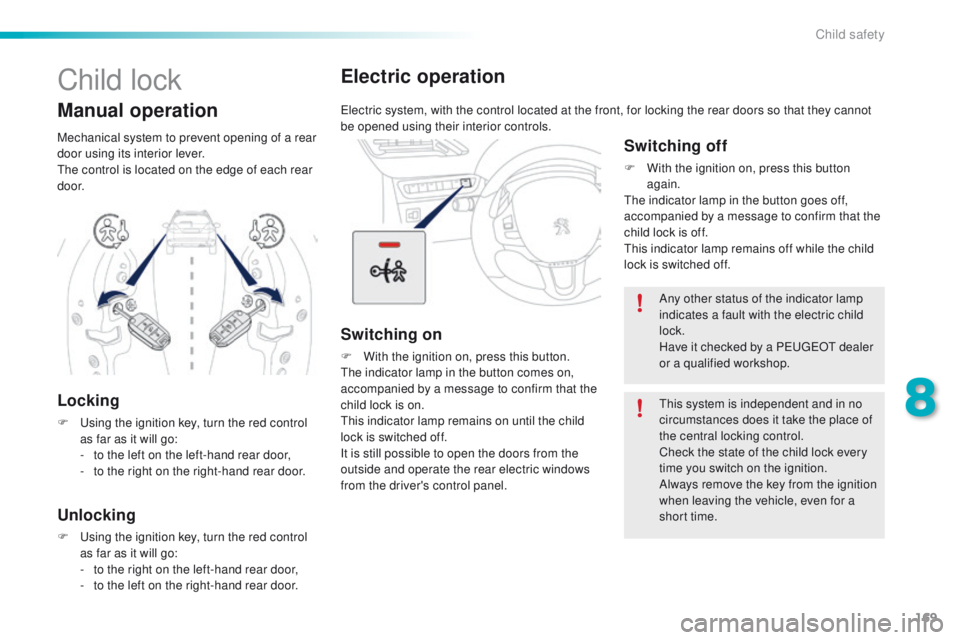
F Using the ignition key, turn the red control as far as it will go:
-
t
o the left on the left-hand rear door,
-
t
o the right on the right-hand rear door.
Unlocking
F Using the ignition key, turn the red control as far as it will go:
-
t
o the right on the left-hand rear door,
-
t
o the left on the right-hand rear door.
Mechanical system to prevent opening of a rear
door using its interior lever.
The control is located on the edge of each rear
d o o r.
Manual operation
8
Child safety
Page 172 of 450
170
2008_en_Chap09_info-pratiques_ed01-2016
Low fuel level
When the fuel tank minimum level is
reached this warning lamp comes on
in the instrument panel. There remains
approximately 5 litres of fuel in the tank.
When the warning lamp flashes there is
ver y little fuel remaining in the tank.
The key cannot be removed from the
lock until the cap is refitted.
Removing the filler cap may cause an
inrush of air. This vacuum is per fectly
normal and results from the sealing of
the system.
Fuel tank
Fuel tank capacity: approximately 50 litres.
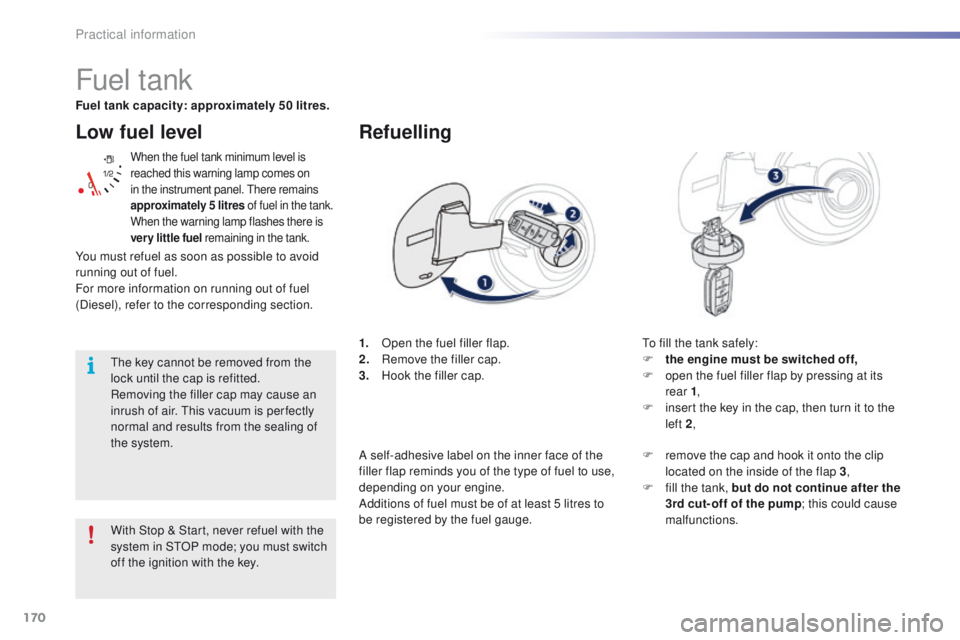
1.
O
pen the fuel filler flap.
2.
R
emove the filler cap.
3.
H
ook the filler cap.
Refuelling
To fill the tank safely:
F t he engine must be switched off,
F
o
pen the fuel filler flap by pressing at its
rear 1 ,
F
i
nsert the key in the cap, then turn it to the
left 2 ,
With Stop & Start, never refuel with the
system in STOP mode; you must switch
off the ignition with the key. F
r
emove the cap and hook it onto the clip
located on the inside of the flap 3 ,
F
f
ill the tank, but do not continue after the
3rd cut- off of the pump ; this could cause
malfunctions.
You must refuel as soon as possible to avoid
running out of fuel.
For more information on running out of fuel
(Diesel), refer to the corresponding section.
A self-adhesive label on the inner face of the
filler flap reminds you of the type of fuel to use,
depending on your engine.
Additions of fuel must be of at least 5 litres to
be registered by the fuel gauge.
Practical information
Page 176 of 450
174
2008_en_Chap09_info-pratiques_ed01-2016
On vehicle fitted with HDi engines, the fuel
system must be primed if you run out of fuel.
For versions with a manual priming pump,
refer to the drawing of the corresponding
underbonnet view.
If the tank on your vehicle is fitted with
a misfuel prevention device, refer to the
corresponding section.
Running out of fuel (Diesel)
If the engine does not start first time,
don't keep trying. Start the procedure
again from the beginning.F
A
dd at least 5 litres of Diesel fuel to the
tank.
F
S
witch the ignition on (without starting the
engine).
F
W
ait around 6 seconds and switch off the
ignition.
F
R
epeat the operation 10 times.
F
O
perate the starter motor to start the
engine.
1.6 litre BlueHDi engines
F Add at least 5 litres of Diesel fuel to the tank.
F
O
pen the bonnet.
F
I
f necessary, unclip the styling cover for
access to the priming pump.
F
S
queeze and release the priming pump
repeatedly until resistance is felt (there
may be resistance at the first press).
F
O
perate the starter to start the engine
(if the engine does not start at the first
attempt, wait around 15 seconds before
trying again).
F
I
f the engine does not start after a
few
attempts, operate the priming pump
again then start the engine.
F
R
efit the styling cover and clip it in place.
F
C
lose the bonnet.
1.6 litre e-HDi 92 engine
Practical information
Page 178 of 450
176
2008_en_Chap09_info-pratiques_ed01-2016
Range indicators
Once the AdBlue® tank is on reserve or after
detection of a fault with the SCR emissions
control system, when the ignition is switched
on, an indicator displays an estimate of the
distance that can be covered, the range, before
engine starting is prevented.
In the event of simultaneous system fault and
low AdBlue
® level, the shortest range figure is
the one displayed.
In the event of the risk of non-starting related to a lack of AdBlue®
The engine start prevention system
required by regulations is activated
automatically once the AdBlue
® tank is
e m pt y. Range greater than 1 500 miles (2 400 km)
When the ignition is switched on, no
information on range is displayed automatically
in the instrument panel.
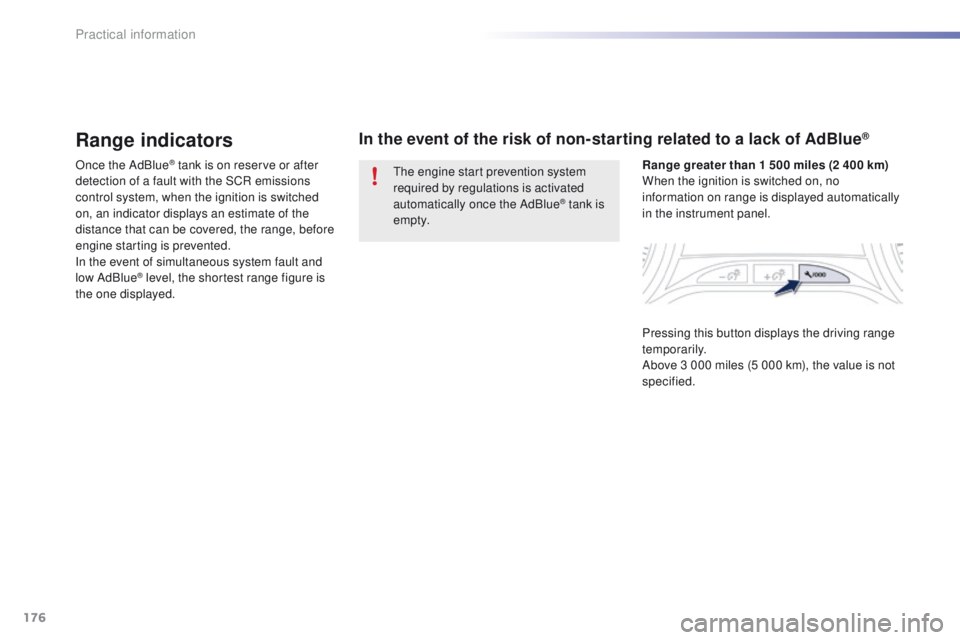
Pressing this button displays the driving range
temporarily.
Above 3 000 miles (5 000 km), the value is not
specified.
Practical information
Page 179 of 450
177
2008_en_Chap09_info-pratiques_ed01-2016
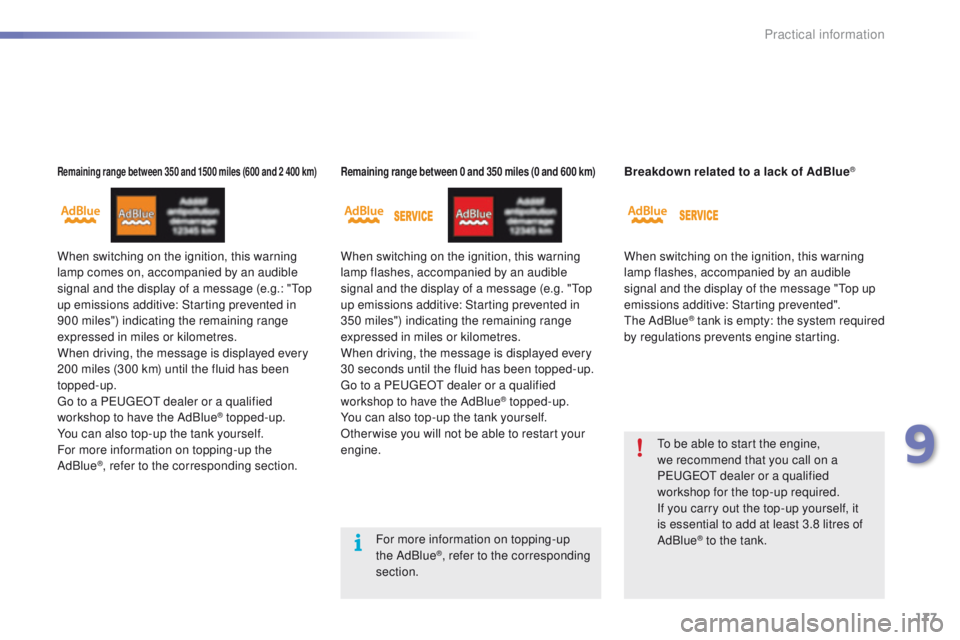
When switching on the ignition, this warning
l amp comes on, accompanied by an audible
signal and the display of a message (e.g.: "Top
up emissions additive: Starting prevented in
900 miles") indicating the remaining range
expressed in miles or kilometres.
When driving, the message is displayed every
200 miles (300 km) until the fluid has been
topped-up.
Go to a PEUGEOT dealer or a qualified
workshop to have the AdBlue
® topped-up.
You can also top-up the tank yourself.
For more information on topping-up the
AdBlue
®, refer to the corresponding section.
Remaining range between 350 and 1500 miles (600 and 2 400 km)Remaining range between 0 and 350 miles (0 and 600 km)Breakdown related to a lack of AdBlue®
When switching on the ignition, this warning
lamp flashes, accompanied by an audible
signal and the display of a message (e.g. "Top
up emissions additive: Starting prevented in
350 miles") indicating the remaining range
expressed in miles or kilometres.
When driving, the message is displayed every
30 seconds until the fluid has been topped-up.
Go to a PEUGEOT dealer or a qualified
workshop to have the AdBlue
® topped-up.
You can also top-up the tank yourself.
Other wise you will not be able to restart your
engine. To be able to start the engine,
we recommend that you call on a
PEUGEOT dealer or a qualified
workshop for the top-up required.
If you carry out the top-up yourself, it
is essential to add at least 3.8 litres of
AdBlue
® to the tank.
When switching on the ignition, this warning
lamp flashes, accompanied by an audible
signal and the display of the message "Top up
emissions additive: Starting prevented".
The AdBlue
® tank is empty: the system required
by regulations prevents engine starting.
For more information on topping-up
the AdBlue
®, refer to the corresponding
section.
9
Practical information