tow PEUGEOT 2008 2016 Owners Manual
[x] Cancel search | Manufacturer: PEUGEOT, Model Year: 2016, Model line: 2008, Model: PEUGEOT 2008 2016Pages: 450, PDF Size: 14.16 MB
Page 5 of 450
.
2008_en_Chap00a_sommaire_ed01-2016
General safety recommendations 134
Direction indicators
1
35
Hazard warning lamps
1
35
H or n
13
6
Emergency or assistance call
1
36
Under-inflation detection
1
37
ESC system
1
40
Grip control
1
43
Active City Brake
1
45
Front seat belts
1
49
Airbags
152
Safety
Fuel tank 1 70
Misfuel prevention (Diesel) 1 72
Running out of fuel (Diesel)
1
74
AdBlue
® and SCR system
(BlueHDi Diesel) 1 75
Temporary puncture repair kit
1
83
Changing a wheel
1
94
Snow chains
2
01
Changing a bulb
2
02
Changing a fuse
2
08
12 V battery
2
14
Changing a wiper blade
2
20
To w i n g
2 2 1
Towing a trailer
2
23
Towbar with quickly detachable towball
2
25
Fitting roof bars
2
30
Advice on care and maintenance
2
30
Accessories
2
31
Practical information
Bonnet 234
Petrol engines 2 35
Diesel engines
2
36
Checking levels
2
37
Checks
240
Checks
General information 2 42
Petrol engines 2 43
Petrol weights
2
45
Diesel engines
2
47
Diesel weights
2
49
Dimensions
252
Identification markings
2
53
Technical data
Emergency call 254
Assistance call 2 55
7-inch touch screen
2
57
Audio system / Bluetooth
3
27
Audio system
3
47
Audio equipment and telematics
Alphabetical index
Carrying children 1 56
Deactivating the passenger's front airbag 1 58
ISOFIX child seats
1
65
Child lock
1
69
Child safety
Lighting 1 17
Headlamp adjustment 1 24
Cornering lighting
1
25
Wiper controls
1
26
Lighting dimmer
1
30
Courtesy lamps
1
31
Interior mood lighting
1
32
Panoramic glazed sunroof
1
33
Visibility
Contents
Page 6 of 450
4
2008_en_Chap00b_vue-ensemble_ed01-2016
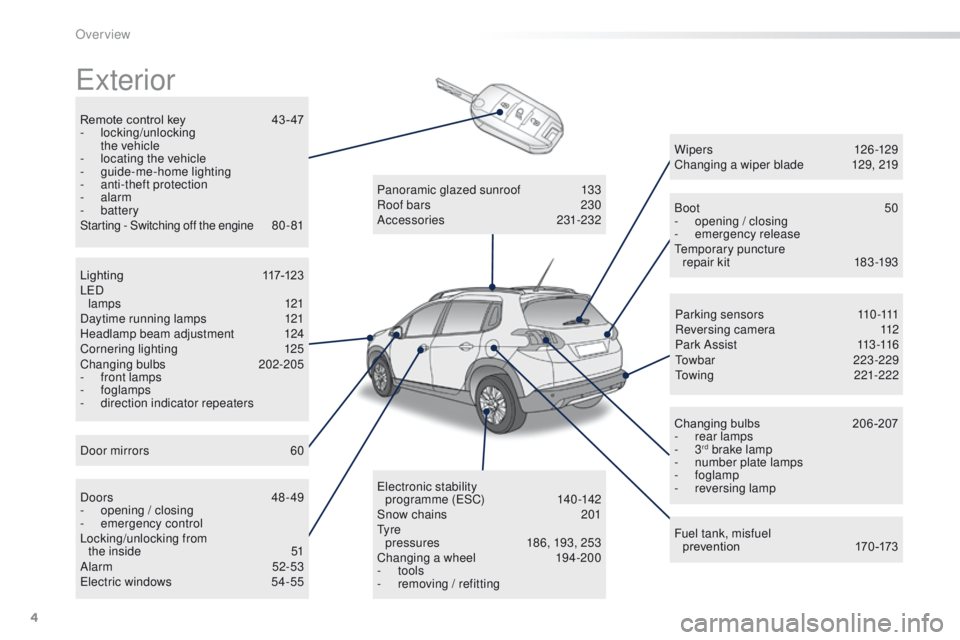
Exterior
Remote control key 43 - 47
- locking/unlocking
the vehicle
-
l
ocating the vehicle
-
gu
ide-me-home lighting
-
a
nti-theft protection
-
alarm
-
battery
Starting - Switching off the engine
8
0 - 81 Boot
50
-
ope
ning / closing
-
em
ergency release
Temporary puncture repair kit
1
83-193
W iper s
126 -129
Changing a wiper blade
1
29, 219
Changing bulbs
2
06-207
-
r
ear lamps
-
3
rd brake lamp
-
n
umber plate lamps
-
foglamp
-
r
eversing lamp
Fuel tank, misfuel p r eve nt i o n
17
0 -173
Panoramic glazed sunroof
1
33
Roof bars
2
30
Accessories
231-232
Electronic stability programme (ESC)
1
40 -142
Snow chains
2
01
Ty r e pressures
1
86, 193, 253
Changing a wheel
1
94-200
-
tools
-
r
emoving / refitting
Lighting
1
17-123
LED lamps
121
Daytime running lamps
1
21
Headlamp beam adjustment
1
24
Cornering lighting
1
25
Changing bulbs
2
02-205
-
f
ront lamps
-
foglamps
-
d
irection indicator repeaters
Door mirrors
6
0
Doors
48 - 49
-
ope
ning / closing
-
em
ergency control
Locking/unlocking from the inside
5
1
Alarm
52-53
Electric windows
5
4-55 P a r k i n g s e n s o r s
11
0 -111
Reversing camera
1
12
P a r k A s s i s t
11
3 -11 6
Towbar
223-229
Towing
221-222
Over view
Page 14 of 450
12
2008_en_Chap00c_eco-conduite_ed01-2016
Eco-driving
Eco-driving is a range of everyday practices that allow the motorist to optimise their fuel consumption and CO2 emissions.
Optimise the use of your gearbox
With a manual gearbox, move off gently and change up without waiting.
During acceleration change up early.
With an automatic or electronic gearbox, give preference to automatic
mode and avoid pressing the accelerator pedal heavily or suddenly.
The gear shift indicator invites you to engage the most suitable gear:
as soon as the indication is displayed in the instrument panel, follow it
straight away.
For vehicles fitted with an electronic or automatic gearbox, this
indicator appears only in manual mode.
Drive smoothly
Maintain a safe distance between vehicles, use engine braking rather
than the brake pedal, and press the accelerator progressively. These
practices contribute towards a reduction in fuel consumption and
CO
2 emissions and also help to reduce the background traffic noise.
If your vehicle has cruise control, make use of the system at speeds
above 25 mph (40 km/h) when the traffic is flowing well.
Control the use of your electrical
equipment
Before moving off, if the passenger compartment is too warm, ventilate it
by opening the windows and air vents before using the air conditioning.
Above 30 mph (50 km/h), close the windows and leave the air vents
open.
Remember to make use of equipment that can help keep the
temperature in the passenger compartment down (sunroof and window
blinds...).
Switch off the air conditioning, unless it has automatic regulation, as
soon as the desired temperature is attained.
Switch off the demisting and defrosting controls, if not automatic.
Switch off the heated seat as soon as possible.
Switch off the headlamps and front foglamps when the level of light
does not require their use.
Avoid running the engine before moving off, particularly in winter; your
vehicle will warm up much faster while driving.
As a passenger, if you avoid connecting your multimedia devices
(film, music, video game...), you will contribute towards limiting the
consumption of electrical energy, and so of fuel.
Disconnect your portable devices before leaving the vehicle.
Eco-driving
Page 19 of 450
17
2008_en_Chap01_controle-de-marche_ed01-2016
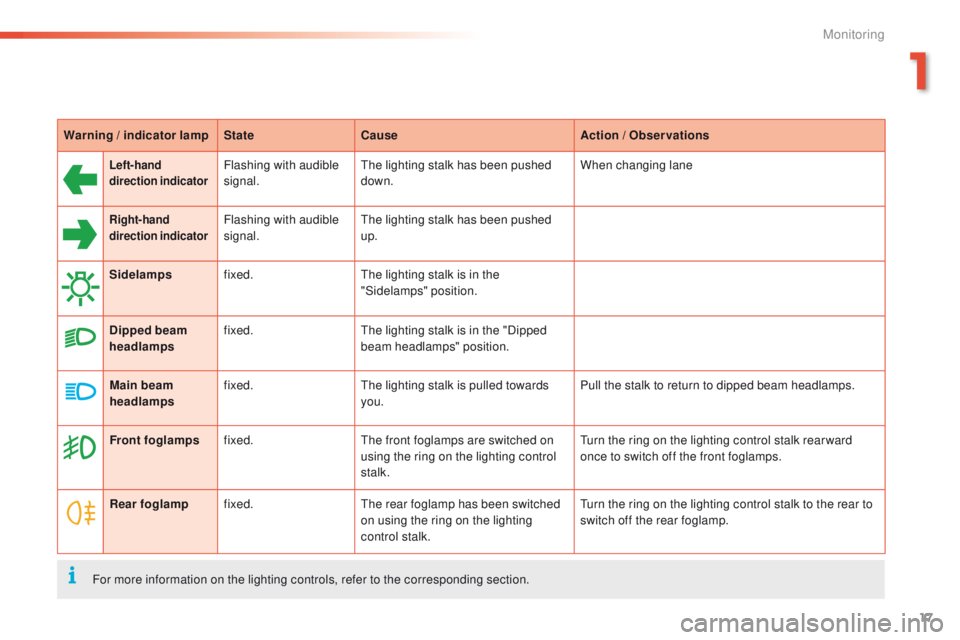
Warning / indicator lampStateCause Action / Observations
Left-hand
direction indicatorFlashing with audible
signal.The lighting stalk has been pushed
down. When changing lane
Right-hand
direction indicatorFlashing with audible
signal.The lighting stalk has been pushed
up.
Sidelamps fixed. The lighting stalk is in the
"Sidelamps" position.
Dipped beam
headlamps fixed.
The lighting stalk is in the "Dipped
beam headlamps" position.
Main beam
headlamps fixed.
The lighting stalk is pulled towards
you. Pull the stalk to return to dipped beam headlamps.
Front foglamps fixed. The front foglamps are switched on
using the ring on the lighting control
stalk. Turn the ring on the lighting control stalk rear ward
once to switch off the front foglamps.
Rear foglamp fixed. The rear foglamp has been switched
on using the ring on the lighting
control stalk. Turn the ring on the lighting control stalk to the rear to
switch off the rear foglamp.
For more information on the lighting controls, refer to the corresponding section.
1
Monitoring
Page 45 of 450
43
2008_en_Chap02_ouvertures_ed01-2016
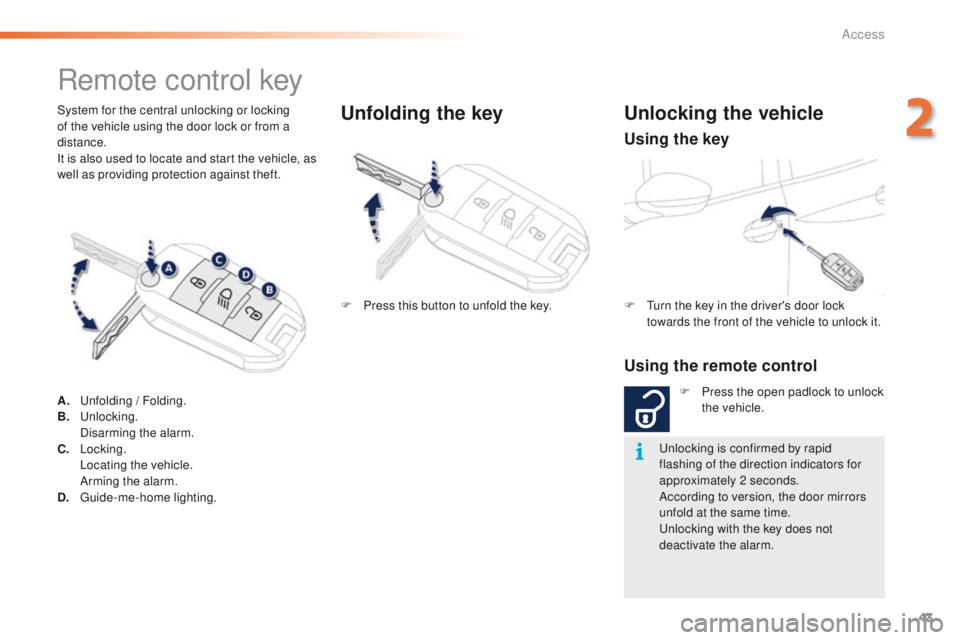
System for the central unlocking or locking
of the vehicle using the door lock or from a
distance.
It is also used to locate and start the vehicle, as
well as providing protection against theft.
Remote control key
Unlocking the vehicle
F Turn the key in the driver's door lock towards the front of the vehicle to unlock it.
Using the remote control
F Press the open padlock to unlock the vehicle.
Unlocking is confirmed by rapid
flashing of the direction indicators for
approximately 2 seconds.
According to version, the door mirrors
unfold at the same time.
Unlocking with the key does not
deactivate the alarm.
F
P
ress this button to unfold the key.
A. U
nfolding / Folding.
B.
Unlocking.
D
isarming the alarm.
C.
Locking.
L
ocating the vehicle.
A
rming the alarm.
D.
G
uide-me-home lighting.
Unfolding the key
Using the key
2
Access
Page 46 of 450
44
2008_en_Chap02_ouvertures_ed01-2016
Locking is confirmed by fixed
lighting of the direction indicators for
approximately 2 seconds.
According to version, the door mirrors
fold at the same time.
As a safety measure (children on
board), never leave the vehicle without
taking your key, even for a short period.
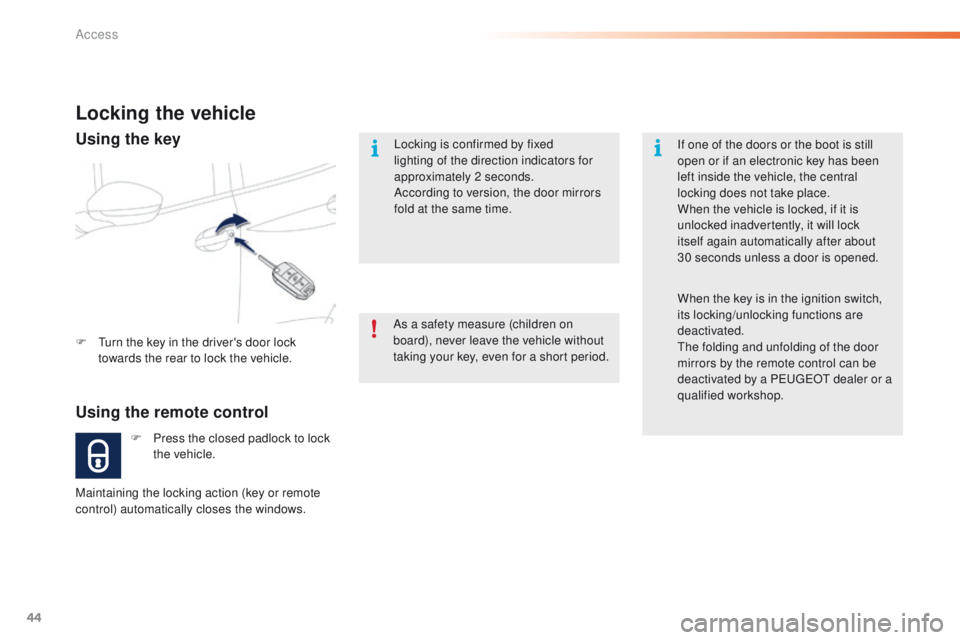
Locking the vehicle
Using the remote control
F Press the closed padlock to lock the vehicle.
F
T
urn the key in the driver's door lock
towards the rear to lock the vehicle.
Maintaining the locking action (key or remote
control) automatically closes the windows. If one of the doors or the boot is still
open or if an electronic key has been
left inside the vehicle, the central
locking does not take place.
When the vehicle is locked, if it is
unlocked inadvertently, it will lock
itself again automatically after about
30
seconds unless a door is opened.
When the key is in the ignition switch,
its locking/unlocking functions are
deactivated.
The folding and unfolding of the door
mirrors by the remote control can be
deactivated by a PEUGEOT dealer or a
qualified workshop.
Using the key
Access
Page 51 of 450

49
2008_en_Chap02_ouvertures_ed01-2016
Back-up control
For mechanically locking and unlocking the
doors in the event of a fault with the central
locking system or a battery failure.Driver's door
Insert the key in the lock to lock or unlock
the door.
Passenger doors
Locking
F On the rear doors, check that the child lock is not on.
F
R
emove the black cap located on the edge
of the door, using the key.
F
I
nsert the key into the aperture without
forcing, then without turning, move the
latch sideways towards the inside of the
d o o r.
F
R
emove the key and refit the cap.
Unlocking
F Pull the interior door lever.
In the event of a fault with the central
locking, it is essential to disconnect the
battery to lock the boot and so assure
the complete locking of the vehicle.
2
Access
Page 61 of 450
59
2008_en_Chap03_confort_ed01-2016
Steering wheel adjustment
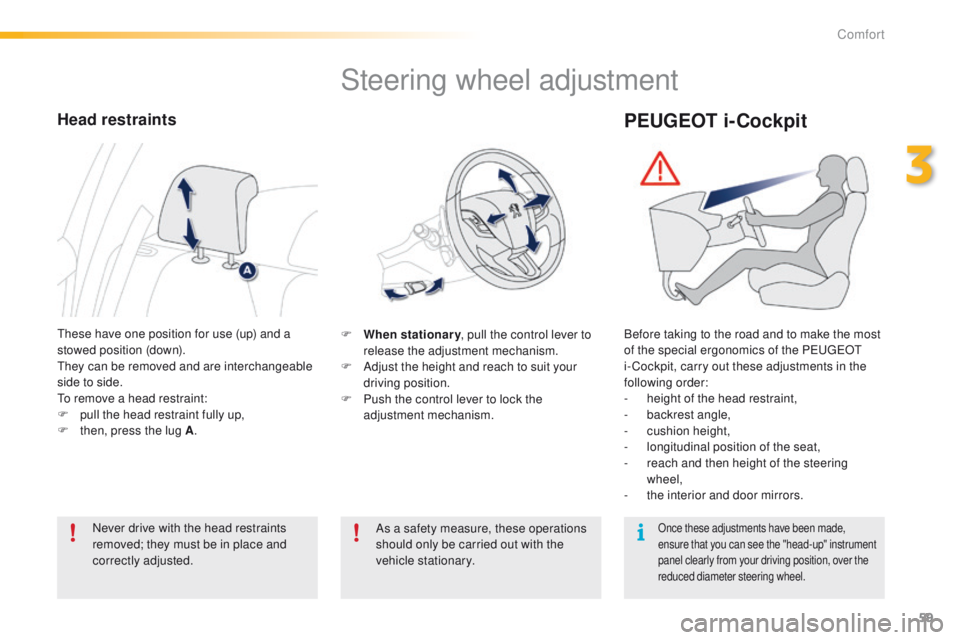
F When stationary, pull the control lever to
release the adjustment mechanism.
F
A
djust the height and reach to suit your
driving position.
F
P
ush the control lever to lock the
adjustment mechanism.
As a safety measure, these operations
should only be carried out with the
vehicle stationary.
Never drive with the head restraints
removed; they must be in place and
correctly adjusted.
These have one position for use (up) and a
stowed position (down).
They can be removed and are interchangeable
side to side.
To remove a head restraint:
F
p
ull the head restraint fully up,
F
t
hen, press the lug A .
Head restraintsPEUGEOT i-Cockpit
Before taking to the road and to make the most
of the special ergonomics of the PEUGEOT
i- Cockpit, carry out these adjustments in the
following order:
-
h
eight of the head restraint,
-
b
ackrest angle,
-
c
ushion height,
-
l
ongitudinal position of the seat,
-
r
each and then height of the steering
wheel,
-
t
he interior and door mirrors.
Once these adjustments have been made,
ensure that you can see the "head-up" instrument
panel clearly from your driving position, over the
reduced diameter steering wheel.
3
Comfort
Page 65 of 450
63
2008_en_Chap03_confort_ed01-2016
In order for these systems to be fully effective, follow the operation and maintenance
guidelines below:
F
T
o obtain an even air distribution, take care not to obstruct the exterior air intake grilles
located at the base of the windscreen, the nozzles, the vents and the air outlets, as well
as the air extractor located in the boot.
F
D
o not cover the sunshine sensor, located on the dashboard; this is used for regulation
of the air conditioning system.
F
O
perate the air conditioning system for at least 5 to 10 minutes, once or twice a month
to keep it in per fect working order.
F
E
nsure that the passenger compartment filter is in good condition and have the filter
elements replaced regularly.
W
e recommend the use of a combined passenger compartment filter. Thanks to its
special active additive, it contributes to the purification of the air breathed by the
occupants and the cleanliness of the passenger compartment (reduction of allergic
symptoms, bad odours and greasy deposits).
F
T
o ensure correct operation of the air conditioning system, you are also advised to have
it checked regularly as recommended in the warranty and maintenance record.
F
I
f the system does not produce cold air, switch it off and contact a PEUGEOT dealer or
a qualified workshop.
When towing the maximum load on a steep gradient in high temperatures, switching off the
air conditioning increases the available engine power and so improves the towing ability.
Recommendations for ventilation and air conditioning
If after an extended stop in sunshine,
the interior temperature is very high, first
ventilate the passenger compartment for
a few moments.
Put the air flow control at a setting high
enough to quickly change the air in the
passenger compartment.
The air conditioning system does not
contain chlorine and does not present
any danger to the ozone layer.
The condensation created by the air
conditioning results in a discharge
of water under the vehicle which is
perfectly normal.
Stop & Start
The heating and air conditioning systems only work when the engine is running.
To maintain a comfortable temperature in the passenger compartment, you can temporarily
deactivate the Stop & Start system.
For more information on Stop & Start, refer to the corresponding section.
3
Comfort
Page 71 of 450
69
2008_en_Chap03_confort_ed01-2016
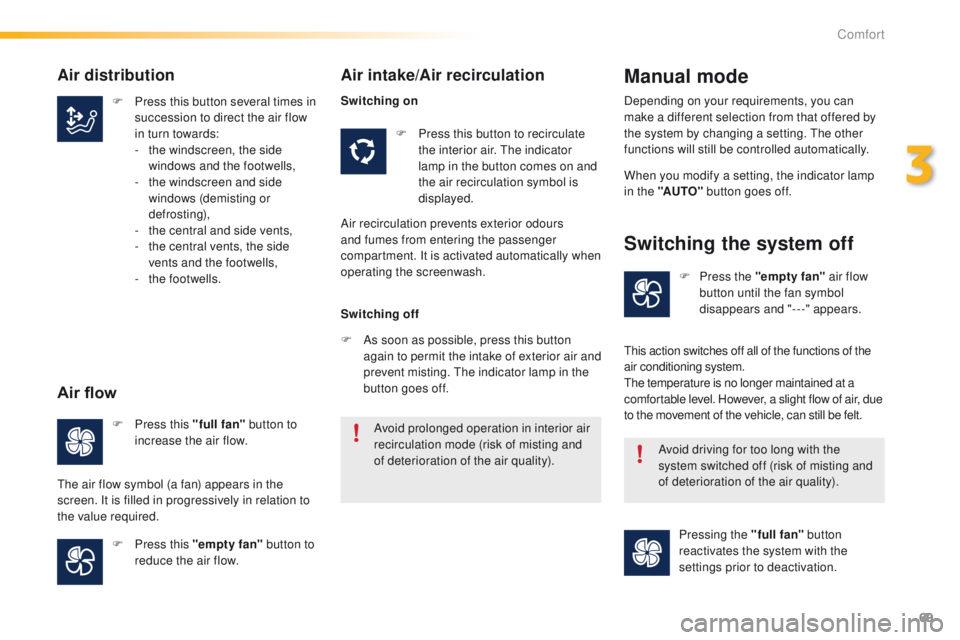
F Press this button several times in succession to direct the air flow
in turn towards:
-
t
he windscreen, the side
windows and the footwells,
-
t
he windscreen and side
windows (demisting or
def r o st ing),
-
t
he central and side vents,
-
t
he central vents, the side
vents and the footwells,
-
t
he footwells. F
P
ress this button to recirculate
the interior air. The indicator
lamp in the button comes on and
the air recirculation symbol is
displayed. When you modify a setting, the indicator lamp
in the "AUTO"
button goes off.
F
P
ress this "full fan" button to
increase the air flow.
F
P
ress this "empty fan" button to
reduce the air flow. Avoid prolonged operation in interior air
recirculation mode (risk of misting and
of deterioration of the air quality).
Avoid driving for too long with the
system switched off (risk of misting and
of deterioration of the air quality).
Air distribution
Air flow
The air flow symbol (a fan) appears in the
screen. It is filled in progressively in relation to
the value required.
Air intake/Air recirculation
Air recirculation prevents exterior odours
and fumes from entering the passenger
compartment. It is activated automatically when
operating the screenwash.
Manual mode
Switching the system off
Switching on
Switching off
F
A
s soon as possible, press this button
again to permit the intake of exterior air and
prevent misting. The indicator lamp in the
button goes off. Depending on your requirements, you can
make a different selection from that offered by
the system by changing a setting. The other
functions will still be controlled automatically.
F
P
ress the "empty fan" air flow
button until the fan symbol
disappears and "---" appears.
This action switches off all of the functions of the
air conditioning system.
The temperature is no longer maintained at a
comfortable level. However, a slight flow of air, due
to the movement of the vehicle, can still be felt.
Pressing the "full fan" button
reactivates the system with the
settings prior to deactivation.
3
Comfort