brake PEUGEOT 207 2011 User Guide
[x] Cancel search | Manufacturer: PEUGEOT, Model Year: 2011, Model line: 207, Model: PEUGEOT 207 2011Pages: 248, PDF Size: 8.61 MB
Page 118 of 248
7
i!
DRIVING
116
Stopping the vehicle
Before switching off the engine, you
can engage position P
or N
to place the
gearbox in neutral.
In both cases, apply the parking brake
to immobilise the vehicle.
Operating fault
When the ignition is on, the
lighting of this warning lamp,
accompanied by an audible
signal and a message in the
multifunction screen, indicates a gear-
box fault.
In this case, the gearbox switches to
back-up mode and is locked in 3rd gear.
You may feel a substantial knock when
changing from P
to R
and from N
to R
.
This will not cause any damage to the
gearbox.
Do not exceed 60 mph (100 km/h), local
speed restrictions permitting.
Contact a PEUGEOT dealer or a quali-
fi ed workshop as soon as possible.
There is a risk of damage to the
gearbox:
- if you press the accelerator and
brake pedals at the same time,
- if you force the movement of
the gear lever from the P
po-
sition to another position when
the battery is fl at.
To reduce fuel consumption when
at a prolonged standstill with the
engine running (traffi c jam...), put
the gear lever in the N
position and
apply the parking brake.
Manual operation
)
Select position M
for sequential
changing of the four gears.
)
Push the lever towards the +
sign to
change up a gear.
)
Pull the lever towards the -
sign to
change down a gear.
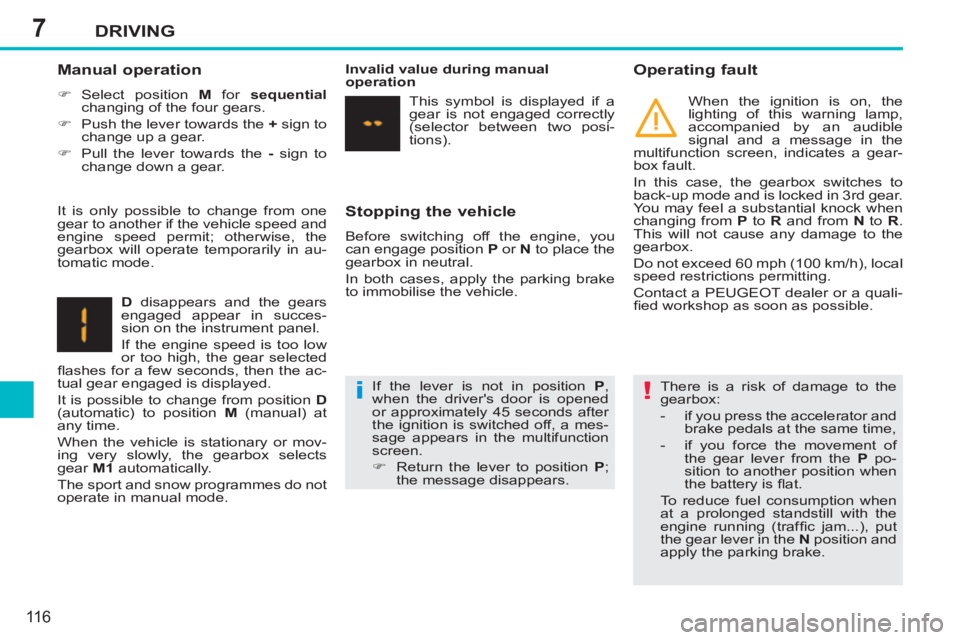
D
disappears and the gears
engaged appear in succes-
sion on the instrument panel.
If the engine speed is too low
or too high, the gear selected
fl ashes for a few seconds, then the ac-
tual gear engaged is displayed.
It is possible to change from position D
(automatic) to position M
(manual) at
any time.
When the vehicle is stationary or mov-
ing very slowly, the gearbox selects
gear M1
automatically.
The sport and snow programmes do not
operate in manual mode. If the lever is not in position P
,
when the driver's door is opened
or approximately 45 seconds after
the ignition is switched off, a mes-
sage appears in the multifunction
screen.
)
Return the lever to position P
;
the message disappears.
It is only possible to change from one
gear to another if the vehicle speed and
engine speed permit; otherwise, the
gearbox will operate temporarily in au-
tomatic mode.
Invalid value during manual
operation
This symbol is displayed if a
gear is not engaged correctly
(selector between two posi-
tions).
Page 121 of 248
7
i
DRIVING
119
CRUISE CONTROL
System which automatically maintains
the speed of the vehicle at the value
programmed by the driver, without any
action on the accelerator pedal.
The cruise control is switched on
manually: it requires a minimum vehicle
speed of 25 mph (40 km/h), as well as
the engaging of:
- fourth gear on a manual gearbox,
- second gear on an automatic gear-
box in sequential mode,
- position D
on an automatic gear-
box.
The cruise control is switched off
man-
ually or by pressing the brake or clutch
pedal or on triggering of the ESP sys-
tem for safety reasons.
It is possible to exceed the programmed
speed temporarily by pressing the ac-
celerator pedal.
To return to the programmed speed,
simply release the accelerator pedal.
Switching off the ignition cancels any
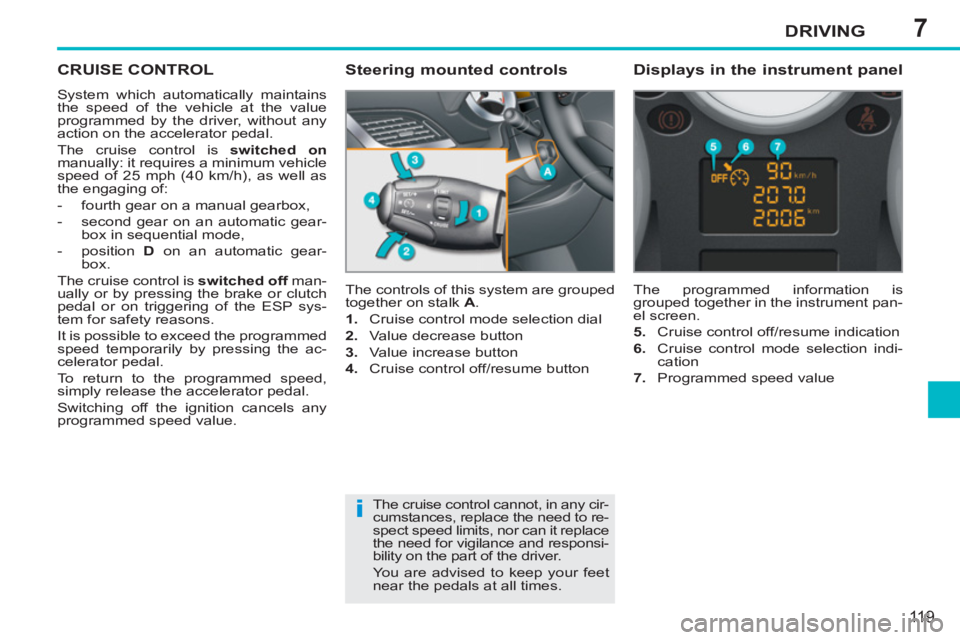
programmed speed value. The controls of this system are grouped
together on stalk A
.
1.
Cruise control mode selection dial
2.
Value decrease button
3.
Value increase button
4.
Cruise control off/resume button
The programmed information is
grouped together in the instrument pan-
el screen.
5.
Cruise control off/resume indication
6.
Cruise control mode selection indi-
cation
7.
Programmed speed value
Steering mounted controls
Displays in the instrument panel
The cruise control cannot, in any cir-
cumstances, replace the need to re-
spect speed limits, nor can it replace
the need for vigilance and responsi-
bility on the part of the driver.
You are advised to keep your feet
near the pedals at all times.
Page 128 of 248
8CHECKS
126
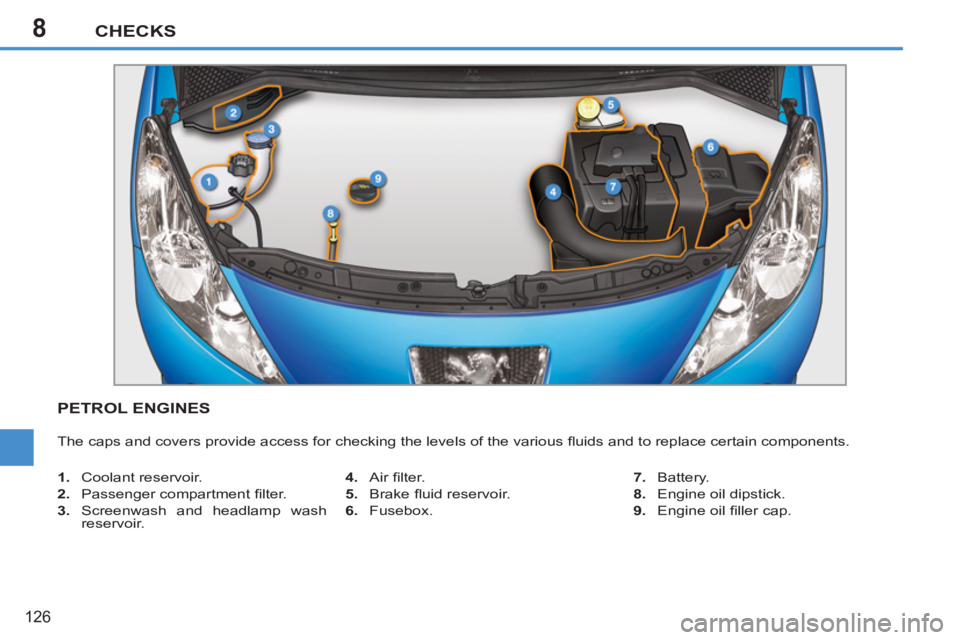
PETROL ENGINES
The caps and covers provide access for checking the levels of the various fl uids and to replace certain components.
1.
Coolant reservoir.
2.
Passenger compartment fi lter.
3.
Screenwash and headlamp wash
reservoir.
4.
Air fi lter.
5.
Brake fl uid reservoir.
6.
Fusebox.
7.
Battery.
8.
Engine oil dipstick.
9.
Engine oil fi ller cap.
Page 129 of 248
8CHECKS
127
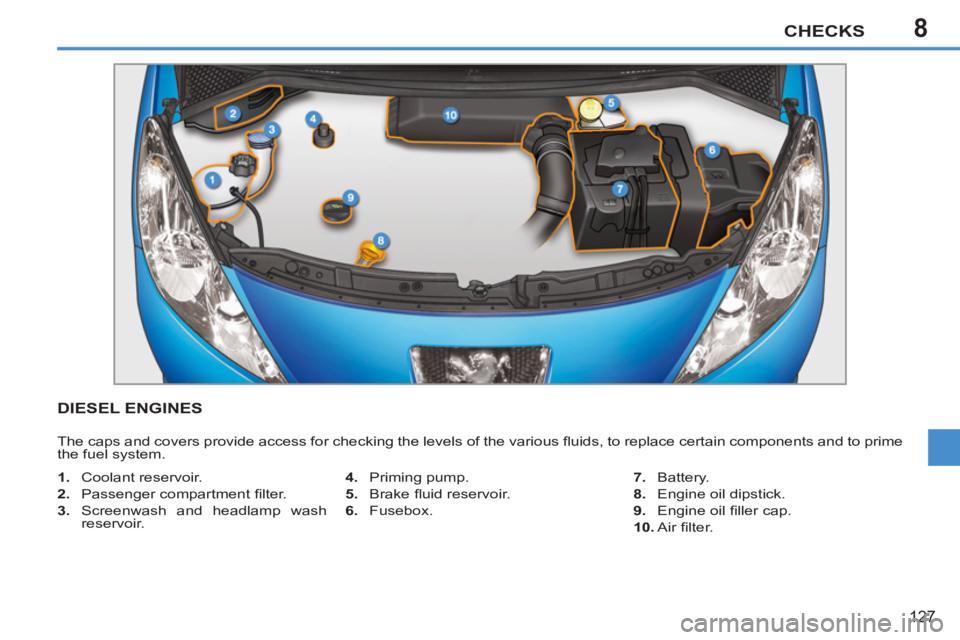
DIESEL ENGINES
The caps and covers provide access for checking the levels of the various fl uids, to replace certain components and to prime
the fuel system.
1.
Coolant reservoir.
2.
Passenger compartment fi lter.
3.
Screenwash and headlamp wash
reservoir.
4.
Priming pump.
5.
Brake fl uid reservoir.
6.
Fusebox.
7.
Battery.
8.
Engine oil dipstick.
9.
Engine oil fi ller cap.
10.
Air fi lter.
Page 130 of 248
8CHECKS
128
CHECKING LEVELS
Check all of these levels regularly and
top them up if necessary, unless other-
wise indicated.
If a level drops signifi cantly, have the
corresponding system checked by a
PEUGEOT dealer or a qualifi ed work-
shop.
Take care when working under the bon-
net, as some parts of the engine can be
extremely hot (risk of burns).
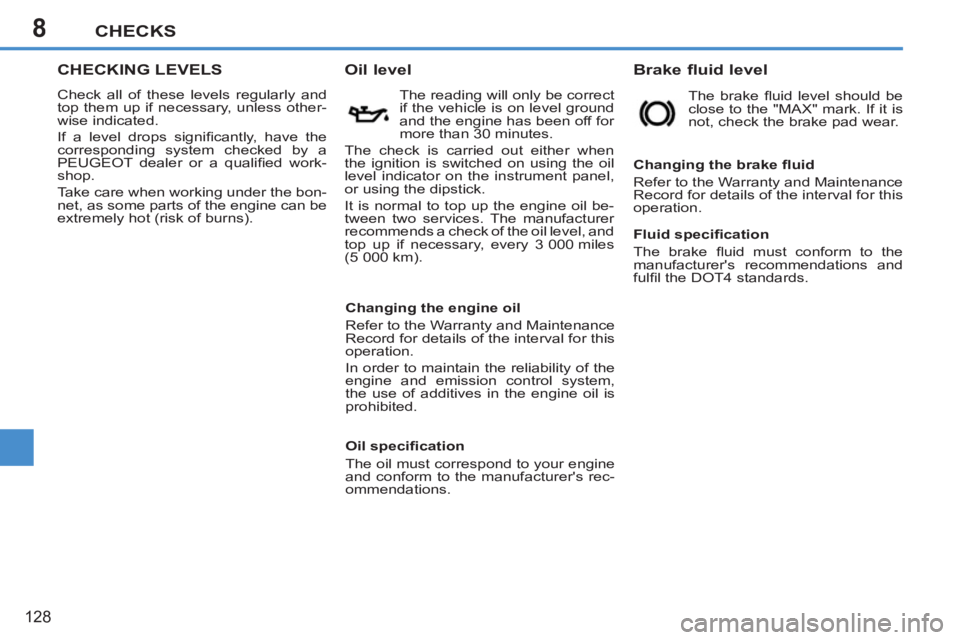
Brake fluid level
Oil level
The reading will only be correct
if the vehicle is on level ground
and the engine has been off for
more than 30 minutes.
The check is carried out either when
the ignition is switched on using the oil
level indicator on the instrument panel,
or using the dipstick.
It is normal to top up the engine oil be-
tween two services. The manufacturer
recommends a check of the oil level, and
top up if necessary, every 3 000 miles
(5 000 km). The brake fl uid level should be
close to the "MAX" mark. If it is
not, check the brake pad wear.
Changing the brake fl uid
Refer to the Warranty and Maintenance
Record for details of the interval for this
operation.
Changing the engine oil
Refer to the Warranty and Maintenance
Record for details of the interval for this
operation.
In order to maintain the reliability of the
engine and emission control system,
the use of additives in the engine oil is
prohibited.
Oil specifi cation
The oil must correspond to your engine
and conform to the manufacturer's rec-
ommendations.
Fluid specifi cation
The brake fl uid must conform to the
manufacturer's recommendations and
fulfi l the DOT4 standards.
Page 133 of 248
8
!
CHECKS
131
Automatic gearbox
The gearbox does not re-
quire any maintenance (no oil
change).
Refer to the Warranty and
Maintenance Record for de-
tails of the checking intervals
for this component.
Parking brake
If the parking brake travel is too
long or if you notice a loss of effec-
tiveness of this system, the parking
brake must be adjusted, even be-
tween two services.
This system must be checked by a PEUGEOT
dealer or a qualifi ed workshop.
Manual gearbox
The gearbox does not re-
quire any maintenance (no oil
change).
Refer to the Warranty and
Maintenance Record for de-
tails of the level checking in-
tervals for this component.
Brake disc and drum wear
For any information relating
to checking of the brake disc
and/or drum wear, contact a
PEUGEOT dealer or a quali-
fi ed workshop. Only use products recommend-
ed by PEUGEOT or products of
equivalent quality and specifi ca-
tions.
In order to optimise the operation
of units as important as the brak-
ing system, PEUGEOT selects
and offers very specifi c products.
To avoid damaging the electrical
units, the use of a high pressure
washer in the engine compart-
ment is strictly prohibited
.
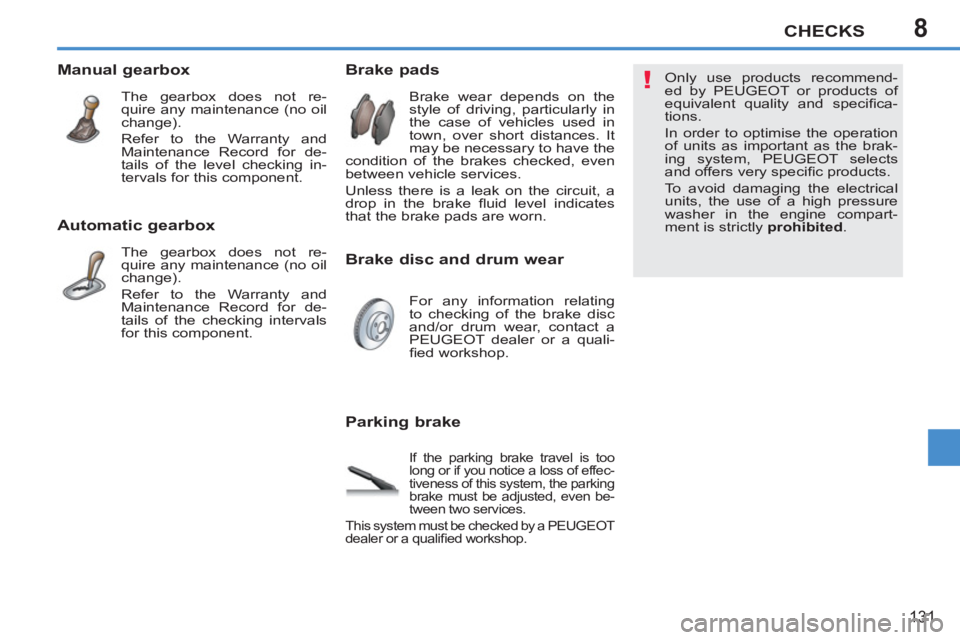
Brake pads
Brake wear depends on the
style of driving, particularly in
the case of vehicles used in
town, over short distances. It
may be necessary to have the
condition of the brakes checked, even
between vehicle services.
Unless there is a leak on the circuit, a
drop in the brake fl uid level indicates
that the brake pads are worn.
Page 142 of 248
9
i
PRACTICAL INFORMATION
140
Parking the vehicle
Immobilise the vehicle where it
does not block traffi c: the ground
must be level, stable and non-
slippery.
Apply the parking brake, switch off
the ignition and engage fi rst gear *
to lock the wheels.
If necessary, place a chock under
the wheel diagonally opposite the
wheel to be changed.
You should ensure that the occu-
pants get out of the vehicle and
wait where they are safe.
Never go underneath a vehicle
raised using a jack; use an axle
stand.
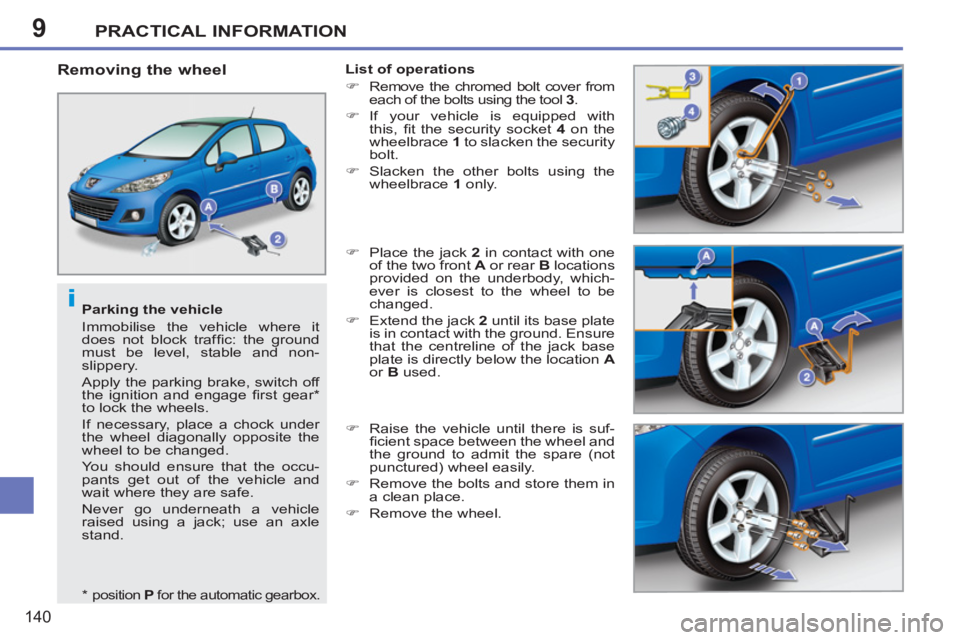
Removing the wheel
List of operations
)
Remove the chromed bolt cover from
each of the bolts using the tool 3
.
)
If your vehicle is equipped with
this, fi t the security socket 4
on the
wheelbrace 1
to slacken the security
bolt.
)
Slacken the other bolts using the
wheelbrace 1
only.
)
Place the jack 2
in contact with one
of the two front A
or rear B
locations
provided on the underbody, which-
ever is closest to the wheel to be
changed.
)
Extend the jack 2
until its base plate
is in contact with the ground. Ensure
that the centreline of the jack base
plate is directly below the location A
or B
used.
)
Raise the vehicle until there is suf-
fi cient space between the wheel and
the ground to admit the spare (not
punctured) wheel easily.
)
Remove the bolts and store them in
a clean place.
)
Remove the wheel.
*
position P
for the automatic gearbox.
Page 146 of 248
9
i
PRACTICAL INFORMATION
144
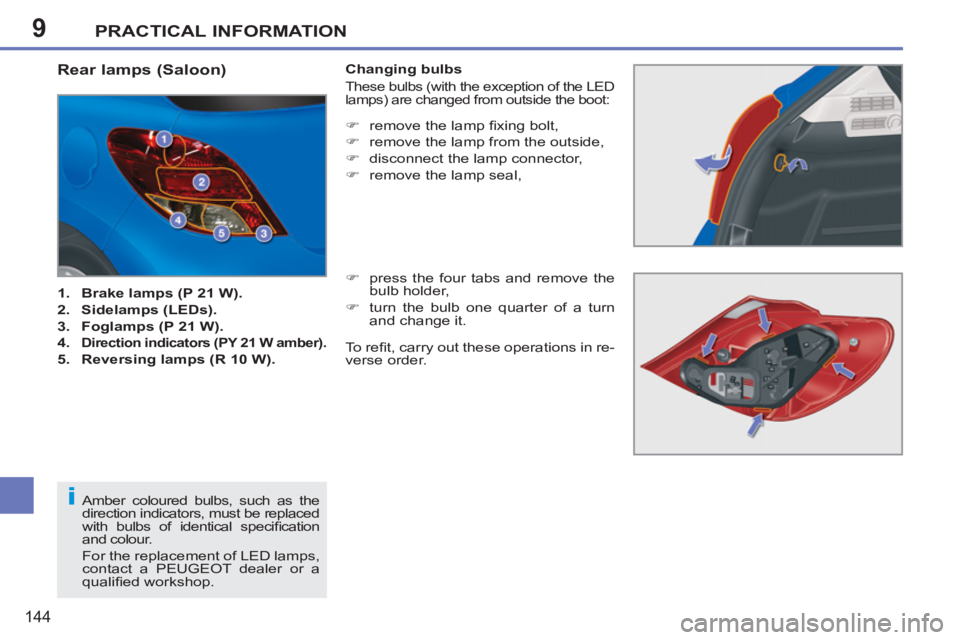
Rear lamps (Saloon)
1.
Brake lamps (P 21 W).
2.
Sidelamps (LEDs).
3.
Foglamps (P 21 W).
4.
Direction indicators (PY 21 W amber).
5.
Reversing lamps (R 10 W).
Changing bulbs
These bulbs (with the exception of the LED
lamps) are changed from outside the boot:
)
remove the lamp fi xing bolt,
)
remove the lamp from the outside,
)
disconnect the lamp connector,
)
remove the lamp seal,
)
press the four tabs and remove the
bulb holder,
)
turn the bulb one quarter of a turn
and change it.
Amber coloured bulbs, such as the
direction indicators, must be replaced
with bulbs of identical specifi cation
and colour.
For the replacement of LED lamps,
contact a PEUGEOT dealer or a
qualifi ed workshop.
To r efi t, carry out these operations in re-
verse order.
Page 147 of 248
9
!
PRACTICAL INFORMATION
145
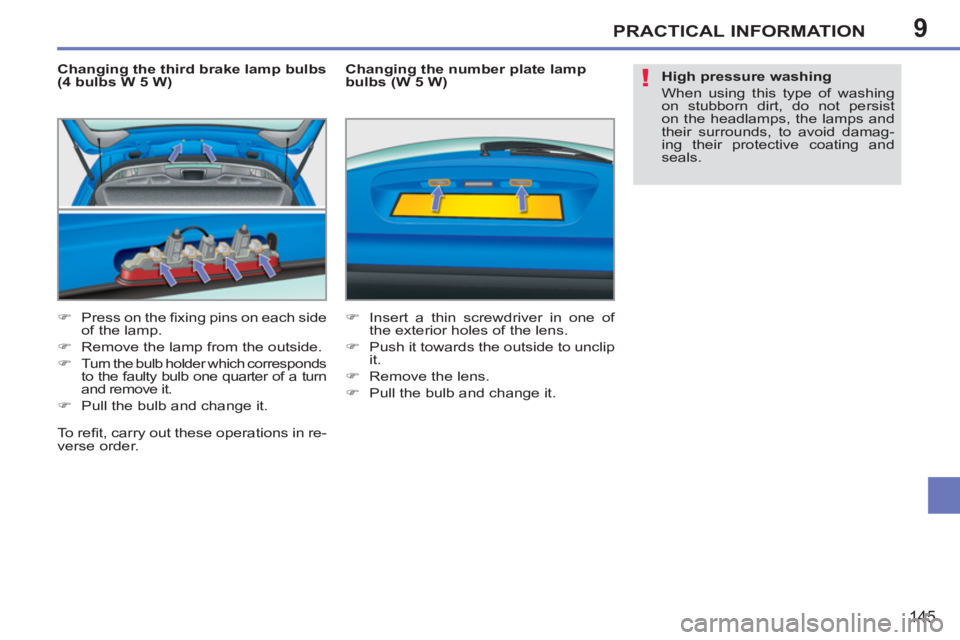
Changing the third brake lamp bulbs
(4 bulbs W 5 W)
)
Press on the fi xing pins on each side
of the lamp.
)
Remove the lamp from the outside.
)
Turn the bulb holder which corresponds
to the faulty bulb one quarter of a turn
and remove it.
)
Pull the bulb and change it.
Changing the number plate lamp
bulbs (W 5 W)
)
Insert a thin screwdriver in one of
the exterior holes of the lens.
)
Push it towards the outside to unclip
it.
)
Remove the lens.
)
Pull the bulb and change it.
To r efi t, carry out these operations in re-
verse order.
High pressure washing
When using this type of washing
on stubborn dirt, do not persist
on the headlamps, the lamps and
their surrounds, to avoid damag-
ing their protective coating and
seals.
Page 148 of 248
9
i
PRACTICAL INFORMATION
146
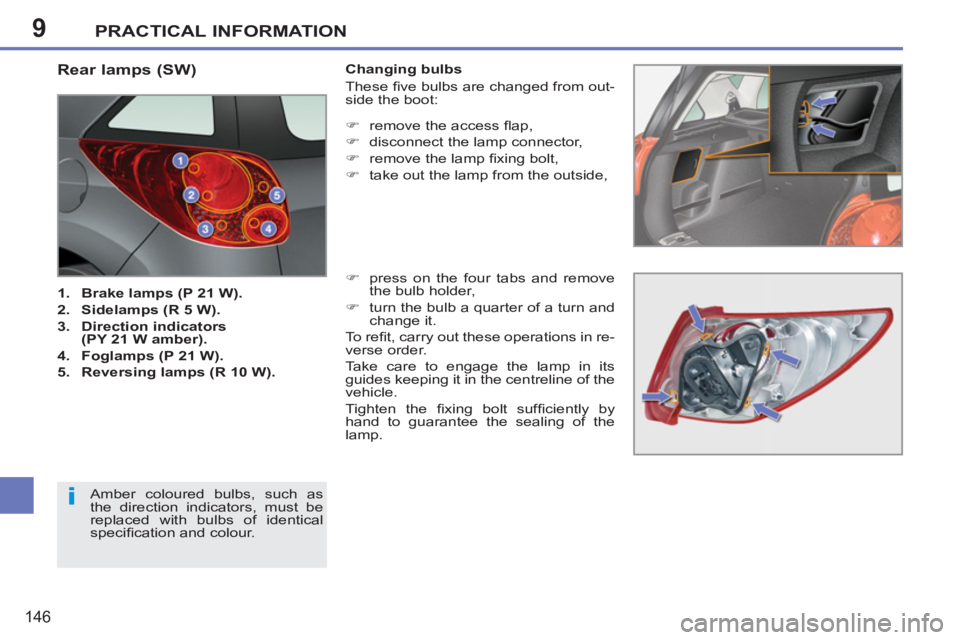
Rear lamps (SW)
1.
Brake
lamps
(P 21 W).
2.
Sidelamps
(R 5 W).
3.
Direction indicators
(PY 21 W amber).
4.
Foglamps
(P 21 W).
5.
Reversing
lamps
(R 10 W).
Changing bulbs
These fi ve bulbs are changed from out-
side the boot:
)
remove the access fl ap,
)
disconnect the lamp connector,
)
remove the lamp fi xing bolt,
)
take out the lamp from the outside,
)
press on the four tabs and remove
the bulb holder,
)
turn the bulb a quarter of a turn and
change it.
To r efi t, carry out these operations in re-
verse order.
Take care to engage the lamp in its
guides keeping it in the centreline of the
vehicle.
Tighten the fi xing bolt suffi ciently by
hand to guarantee the sealing of the
lamp.
Amber coloured bulbs, such as
the direction indicators, must be
replaced with bulbs of identical
specifi cation and colour.