ABS PEUGEOT 207 2011 Owners Manual
[x] Cancel search | Manufacturer: PEUGEOT, Model Year: 2011, Model line: 207, Model: PEUGEOT 207 2011Pages: 248, PDF Size: 8.61 MB
Page 26 of 248
1INSTRUMENTS and CONTROLS
24
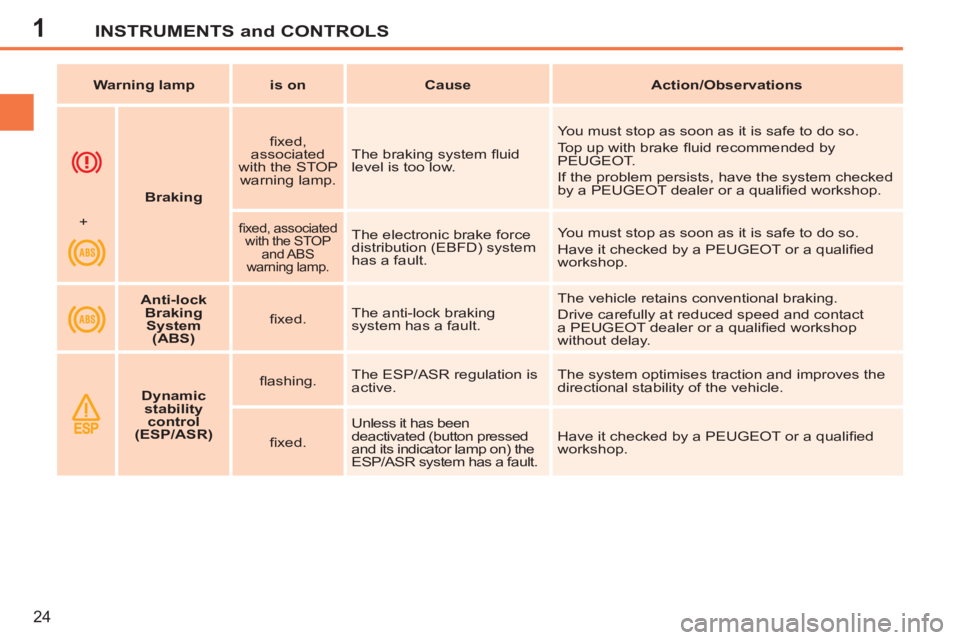
Braking
fi xed,
associated
with the STOP
warning lamp. The braking system fl uid
level is too low. You must stop as soon as it is safe to do so.
Top up with brake fl uid recommended by
PEUGEOT.
If the problem persists, have the system checked
by a PEUGEOT dealer or a qualifi ed workshop.
+
fi xed, associated
with the STOP
and ABS
warning lamp.
The electronic brake force
distribution (EBFD) system
has a fault. You must stop as soon as it is safe to do so.
Have it checked by a PEUGEOT or a qualifi ed
workshop.
Warning lamp
is on
Cause
Action/Observations
Anti-lock
Braking
System
(ABS)
fi xed. The anti-lock braking
system has a fault. The vehicle retains conventional braking.
Drive carefully at reduced speed and contact
a PEUGEOT dealer or a qualifi ed workshop
without delay.
Dynamic
stability
control
(ESP/ASR)
fl ashing. The ESP/ASR regulation is
active. The system optimises traction and improves the
directional stability of the vehicle.
fi xed. Unless it has been
deactivated (button pressed
and its indicator lamp on) the
ESP/ASR system has a fault. Have it checked by a PEUGEOT or a qualifi ed
workshop.
Page 45 of 248
1INSTRUMENTS and CONTROLS
43
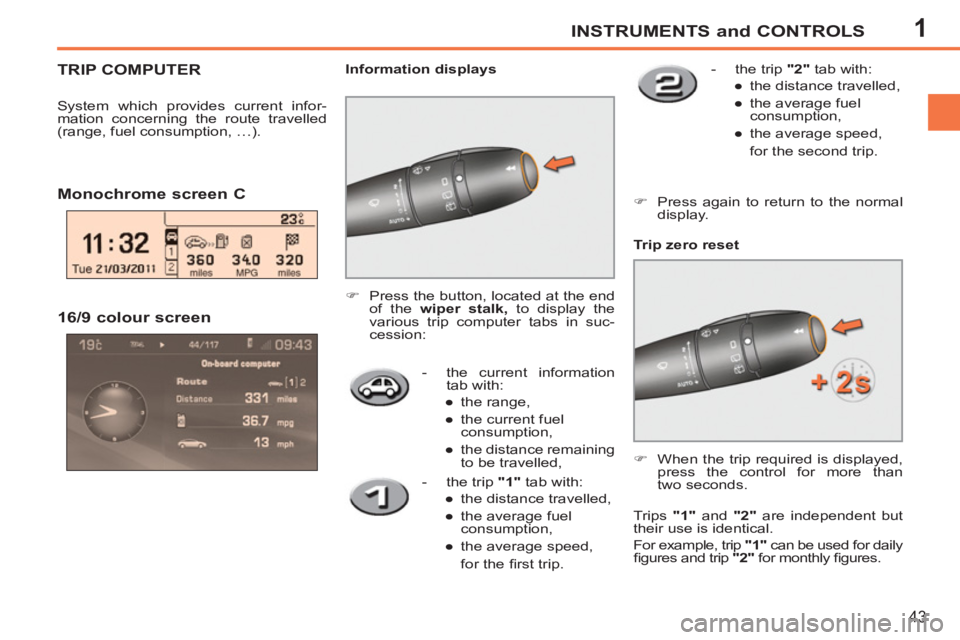
16/9 colour screen
- the current information
tab with:
●
the range,
●
the current fuel
consumption,
●
the distance remaining
to be travelled,
Trip zero reset
Monochrome screen C
)
Press the button, located at the end
of the wiper stalk,
to display the
various trip computer tabs in suc-
cession:
Information displays
)
When the trip required is displayed,
press the control for more than
two seconds.
- the trip "1"
tab with:
●
the distance travelled,
●
the average fuel
consumption,
●
the average speed,
for the fi rst trip.
- the trip "2"
tab with:
●
the distance travelled,
●
the average fuel
consumption,
●
the average speed,
for the second trip.
TRIP COMPUTER
System which provides current infor-
mation concerning the route travelled
(range, fuel consumption, …).
Trips "1"
and "2"
are independent but
their use is identical.
For example, trip "1"
can be used for daily
fi gures and trip "2"
for monthly fi gures.
)
Press again to return to the normal
display.
Page 97 of 248
5
!
CHILD SAFETY
95
ADVICE ON CHILD SEATS
Installing a booster seat
The chest part of the seat belt must
be positioned on the child's shoulder
without touching the neck.
Ensure that the lap part of the
seat belt passes correctly over the
child's thighs.
PEUGEOT recommends the use of
a booster seat which has a back, fi t-
ted with a seat belt guide at shoulder
level. The incorrect installation of a child
seat in a vehicle compromises the
child's protection in the event of an
accident.
Remember to fasten the seat belts
or the child seat harnesses keep-
ing the slack relative to the child's
body to a minimum, even for short
journeys.
When installing a child seat using
the seat belt, ensure that the seat
belt is tightened correctly on the
child seat and that it secures the
child seat fi rmly on the seat of your
vehicle. Move the seat forwards if
necessary.
For optimum installation of the "for-
wards-facing" child seat, ensure that
the back of the child seat is in contact
with the back of the vehicle's seat
and that the head restraint does not
cause any discomfort.
If the head restraint has to be re-
moved, ensure that it is stored or
attached securely to prevent it from
being thrown around the vehicle in
the event of sharp braking. As a safety precaution, do not leave:
- a child or children alone and un-
supervised in a vehicle,
- a child or an animal in a vehicle
which is exposed to the sun,
with the windows closed,
- the keys within reach of children
inside the vehicle.
To prevent accidental opening of
the doors and rear windows, use
the "Child lock".
Take care not to open the rear windows
by more than one third.
To protect young children from the
rays of the sun, fi t side blinds on
the rear windows.
Children under the age of 10 must
not travel in the "forwards-facing"
position on the front passenger seat,
unless the rear seats are already
occupied by other children, cannot
be used or are absent.
Deactivate the passenger airbag
when a "rearwards-facing" child
seat is installed on the front seat.
Otherwise, the child would risk being
seriously injured or killed if the airbag
were to infl ate.
Page 105 of 248
6
i
!
!
SAFETY
103
BRAKING ASSISTANCE
SYSTEMS *
Group of supplementary systems which
help you to obtain optimum braking in
complete safety in emergency situations:
- anti-lock braking system (ABS),
- electronic brake force distribution
(EBFD),
- emergency braking assistance (EBA).
Anti-lock braking system
and electronic brake force
distribution
Linked systems which improve the sta-
bility and manoeuvrability of your vehi-
cle when braking, in particular on poor
or slippery surfaces.
When braking in an emergency,
press very fi rmly without releasing
the pressure.
Emergency braking assistance
System which, in an emergency, en-
ables you to obtain the optimum braking
pressure more quickly, thus reducing
the stopping distance.
Activation
The anti-lock braking system comes
into operation automatically when there
is a risk of wheel lock.
Normal operation of the ABS may make
itself felt by slight vibration of the brake
pedal.
Activation
It is triggered by the speed at which the
brake pedal is pressed.
The effect of this is a reduction in the
resistance of the pedal and an increase
in braking effi ciency.
*
According to country. When braking in an emergency,
press fi rmly without releasing the
pressure.
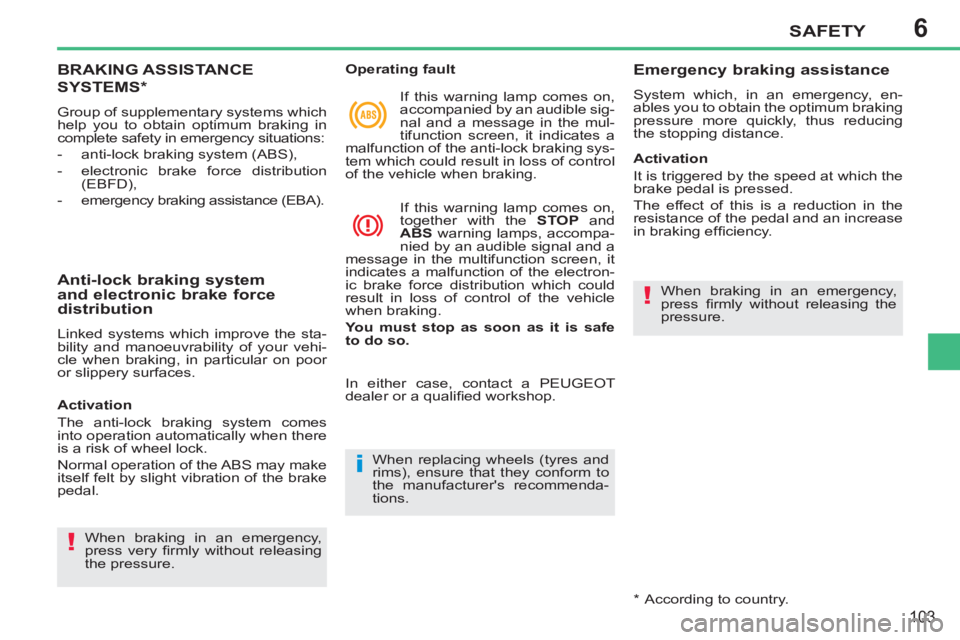
Operating fault
If this warning lamp comes on,
accompanied by an audible sig-
nal and a message in the mul-
tifunction screen, it indicates a
malfunction of the anti-lock braking sys-
tem which could result in loss of control
of the vehicle when braking.
If this warning lamp comes on,
together with the STOP
and
ABS
warning lamps, accompa-
nied by an audible signal and a
message in the multifunction screen, it
indicates a malfunction of the electron-
ic brake force distribution which could
result in loss of control of the vehicle
when braking.
You must stop as soon as it is safe
to do so.
In either case, contact a PEUGEOT
dealer or a qualifi ed workshop.
When replacing wheels (tyres and
rims), ensure that they conform to
the manufacturer's recommenda-
tions.
Page 146 of 248
9
i
PRACTICAL INFORMATION
144
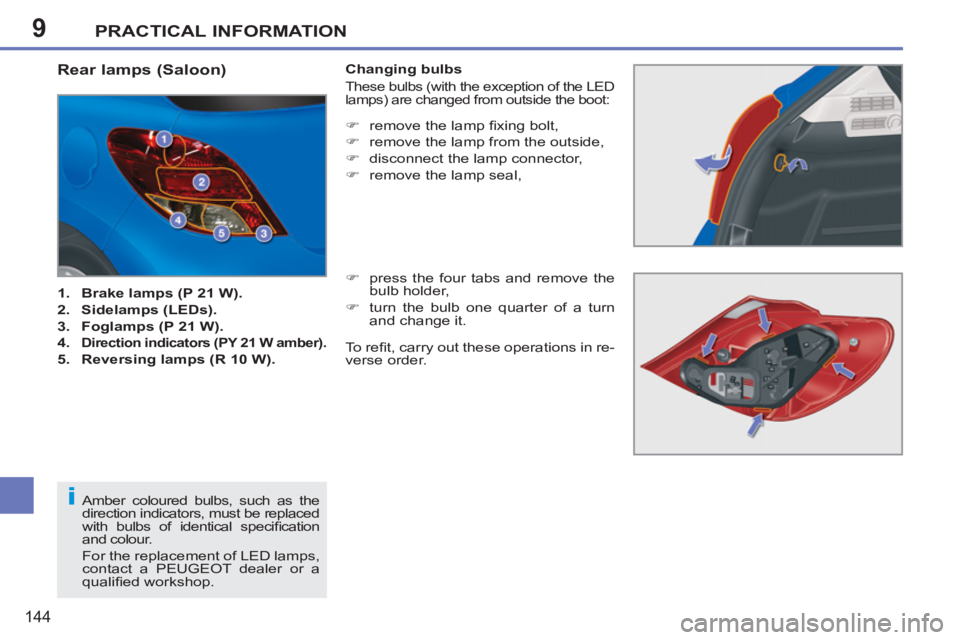
Rear lamps (Saloon)
1.
Brake lamps (P 21 W).
2.
Sidelamps (LEDs).
3.
Foglamps (P 21 W).
4.
Direction indicators (PY 21 W amber).
5.
Reversing lamps (R 10 W).
Changing bulbs
These bulbs (with the exception of the LED
lamps) are changed from outside the boot:
)
remove the lamp fi xing bolt,
)
remove the lamp from the outside,
)
disconnect the lamp connector,
)
remove the lamp seal,
)
press the four tabs and remove the
bulb holder,
)
turn the bulb one quarter of a turn
and change it.
Amber coloured bulbs, such as the
direction indicators, must be replaced
with bulbs of identical specifi cation
and colour.
For the replacement of LED lamps,
contact a PEUGEOT dealer or a
qualifi ed workshop.
To r efi t, carry out these operations in re-
verse order.
Page 148 of 248
9
i
PRACTICAL INFORMATION
146
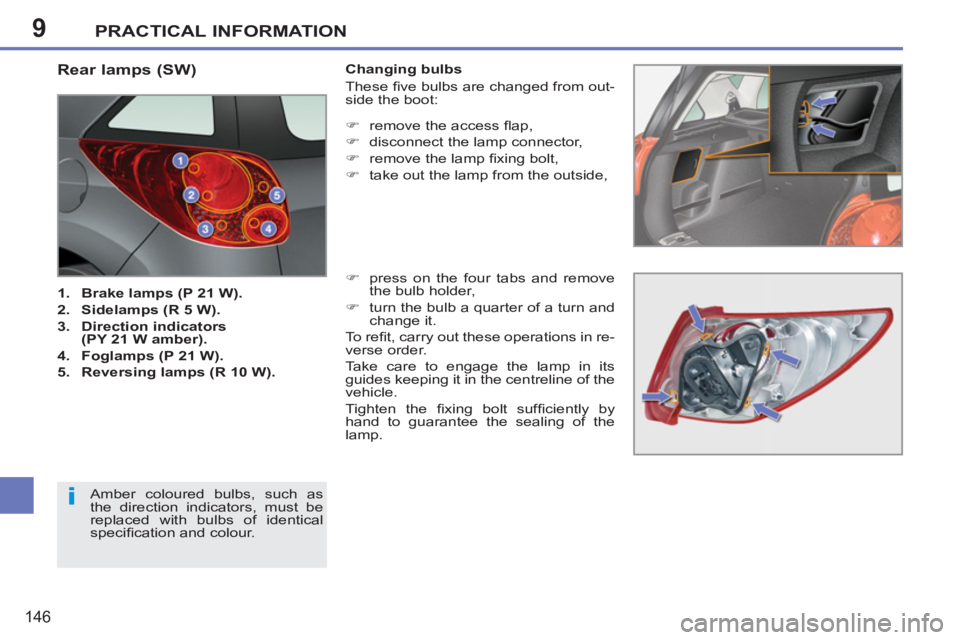
Rear lamps (SW)
1.
Brake
lamps
(P 21 W).
2.
Sidelamps
(R 5 W).
3.
Direction indicators
(PY 21 W amber).
4.
Foglamps
(P 21 W).
5.
Reversing
lamps
(R 10 W).
Changing bulbs
These fi ve bulbs are changed from out-
side the boot:
)
remove the access fl ap,
)
disconnect the lamp connector,
)
remove the lamp fi xing bolt,
)
take out the lamp from the outside,
)
press on the four tabs and remove
the bulb holder,
)
turn the bulb a quarter of a turn and
change it.
To r efi t, carry out these operations in re-
verse order.
Take care to engage the lamp in its
guides keeping it in the centreline of the
vehicle.
Tighten the fi xing bolt suffi ciently by
hand to guarantee the sealing of the
lamp.
Amber coloured bulbs, such as
the direction indicators, must be
replaced with bulbs of identical
specifi cation and colour.
Page 149 of 248
9
!
PRACTICAL INFORMATION
147
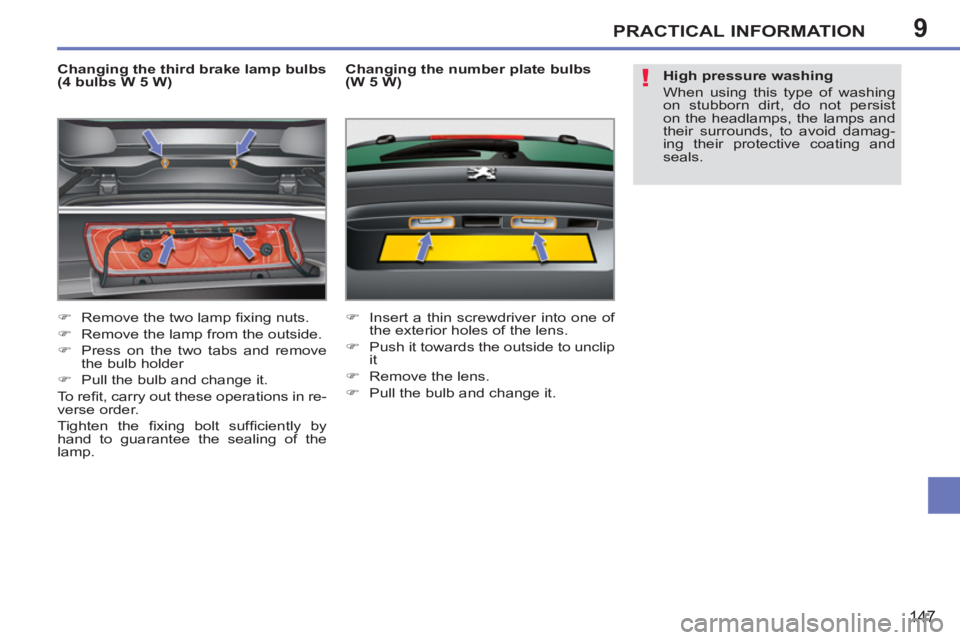
Changing the third brake lamp bulbs
(4 bulbs W 5 W)
)
Remove the two lamp fi xing nuts.
)
Remove the lamp from the outside.
)
Press on the two tabs and remove
the bulb holder
)
Pull the bulb and change it.
To r efi t, carry out these operations in re-
verse order.
Tighten the fi xing bolt suffi ciently by
hand to guarantee the sealing of the
lamp.
Changing the number plate bulbs
(W 5 W)
)
Insert a thin screwdriver into one of
the exterior holes of the lens.
)
Push it towards the outside to unclip
it
)
Remove the lens.
)
Pull the bulb and change it.
High pressure washing
When using this type of washing
on stubborn dirt, do not persist
on the headlamps, the lamps and
their surrounds, to avoid damag-
ing their protective coating and
seals.
Page 152 of 248
9PRACTICAL INFORMATION
150
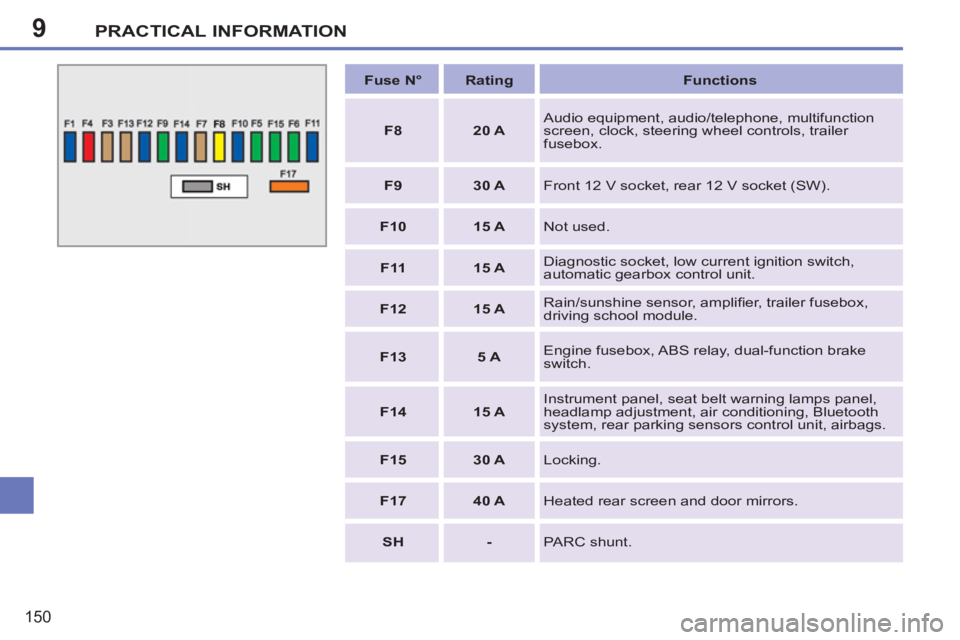
Fuse N°
Rating
Functions
F8
20 A
Audio equipment, audio/telephone, multifunction
screen, clock, steering wheel controls, trailer
fusebox.
F9
30 A
Front 12 V socket, rear 12 V socket (SW).
F10
15 A
Not used.
F11
15 A
Diagnostic socket, low current ignition switch,
automatic gearbox control unit.
F12
15 A
Rain/sunshine sensor, amplifi er, trailer fusebox,
driving school module.
F13
5 A
Engine fusebox, ABS relay, dual-function brake
switch.
F14
15 A
Instrument panel, seat belt warning lamps panel,
headlamp adjustment, air conditioning, Bluetooth
system, rear parking sensors control unit, airbags.
F15
30 A
Locking.
F17
40 A
Heated rear screen and door mirrors.
SH
-
PARC shunt.
Page 153 of 248
9PRACTICAL INFORMATION
151
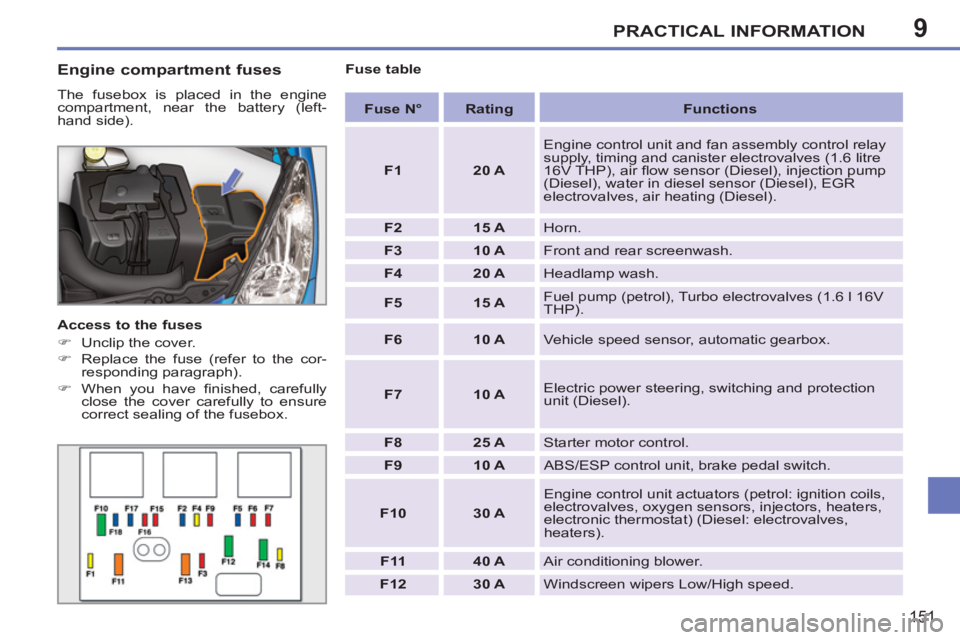
Engine compartment fuses
The fusebox is placed in the engine
compartment, near the battery (left-
hand side).
Access to the fuses
)
Unclip the cover.
)
Replace the fuse (refer to the cor-
responding paragraph).
)
When you have fi nished, carefully
close the cover carefully to ensure
correct sealing of the fusebox.
Fuse table
Fuse N°
Rating
Functions
F1
20 A
Engine control unit and fan assembly control relay
supply, timing and canister electrovalves (1.6 litre
16V THP), air fl ow sensor (Diesel), injection pump
(Diesel), water in diesel sensor (Diesel), EGR
electrovalves, air heating (Diesel).
F2
15 A
Horn.
F3
10 A
Front and rear screenwash.
F4
20 A
Headlamp wash.
F5
15 A
Fuel pump (petrol), Turbo electrovalves (1.6 l 16V
THP).
F6
10 A
Vehicle speed sensor, automatic gearbox.
F7
10 A
Electric power steering, switching and protection
unit (Diesel).
F8
25 A
Starter motor control.
F9
10 A
ABS/ESP control unit, brake pedal switch.
F10
30 A
Engine control unit actuators (petrol: ignition coils,
electrovalves, oxygen sensors, injectors, heaters,
electronic thermostat) (Diesel: electrovalves,
heaters).
F11
40 A
Air conditioning blower.
F12
30 A
Windscreen wipers Low/High speed.
Page 154 of 248
9PRACTICAL INFORMATION
152
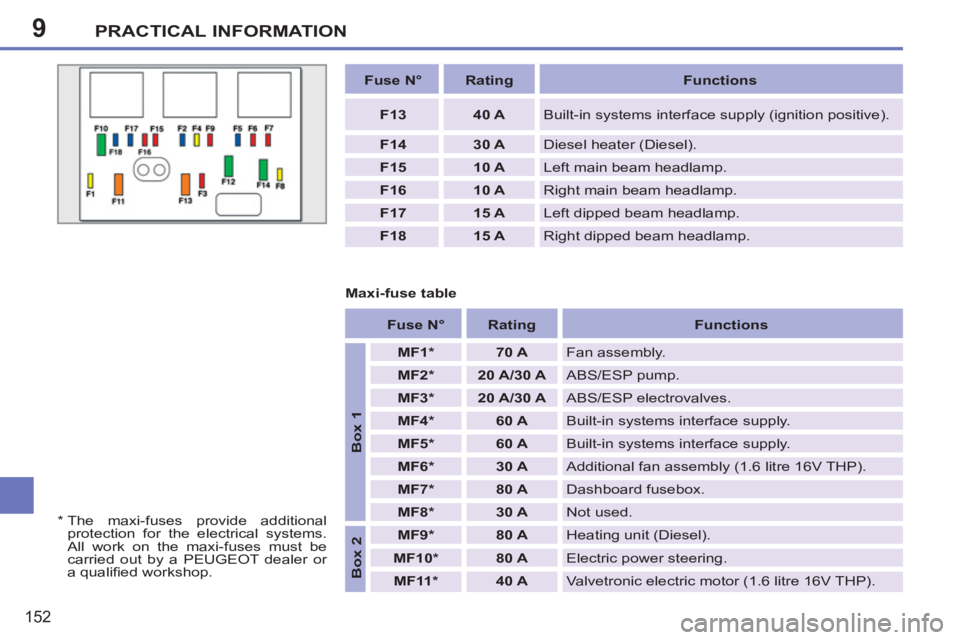
Fuse N°
Rating
Functions
F13
40 A
Built-in systems interface supply (ignition positive).
F14
30 A
Diesel heater (Diesel).
F15
10 A
Left main beam headlamp.
F16
10 A
Right main beam headlamp.
F17
15 A
Left dipped beam headlamp.
F18
15 A
Right dipped beam headlamp.
*
The maxi-fuses provide additional
protection for the electrical systems.
All work on the maxi-fuses must be
carried out by a PEUGEOT dealer or
a qualifi ed workshop.
Maxi-fuse table
Fuse N°
Rating
Functions
Box 1
MF1 *
70 A
Fan assembly.
MF2 *
20 A/30 A
ABS/ESP pump.
MF3 *
20 A/30 A
ABS/ESP electrovalves.
MF4 *
60 A
Built-in systems interface supply.
MF5 *
60 A
Built-in systems interface supply.
MF6 *
30 A
Additional fan assembly (1.6 litre 16V THP).
MF7 *
80 A
Dashboard fusebox.
MF8 *
30 A
Not used.
Box 2
MF9 *
80 A
Heating unit (Diesel).
MF10 *
80 A
Electric power steering.
MF11 *
40 A
Valvetronic electric motor (1.6 litre 16V THP).