belt Peugeot 207 CC 2014 User Guide
[x] Cancel search | Manufacturer: PEUGEOT, Model Year: 2014, Model line: 207 CC, Model: Peugeot 207 CC 2014Pages: 232, PDF Size: 11.11 MB
Page 93 of 232
5CHILD SAFETY
91
207CC_EN_CHAP05_SECURITE ENFANTS_ED01-2014
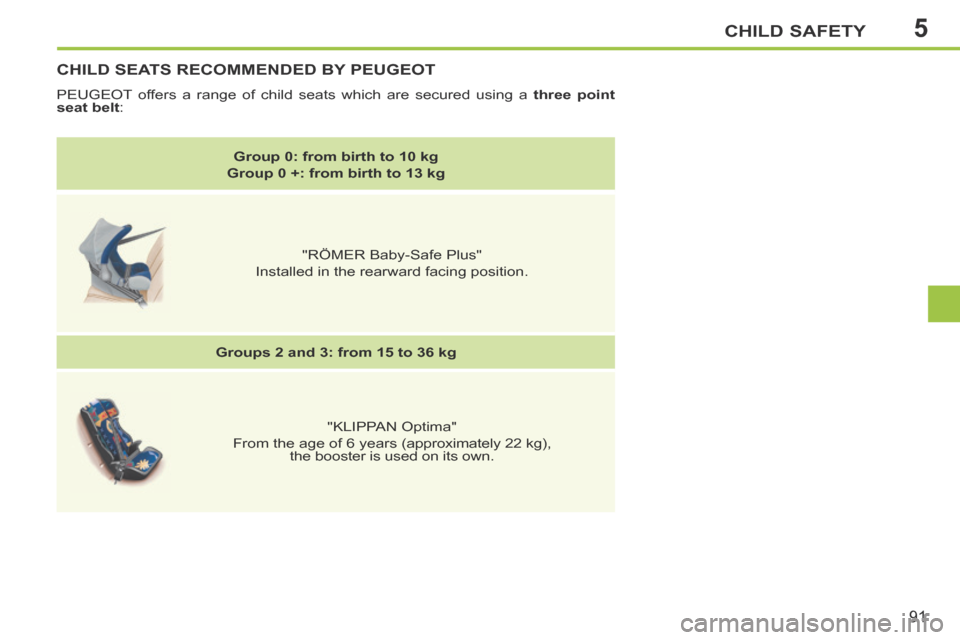
CHILD SEATS RECOMMENDED BY PEUGEOT
PEUGEOT offers a range of child seats which are secured using a three point
seat belt :
Group 0: from birth to 10 kg
Group 0 +: from birth to 13 kg
"RÖMER Baby-Safe Plus"
Installed in the rearward facing position.
Groups 2 and 3: from 15 to 36 kg "KLIPPAN Optima"
From the age of 6 years (approximately 22 kg), the booster is used on its own.
Page 94 of 232

5
i
CHILD SAFETY
92
207CC_EN_CHAP05_SECURITE ENFANTS_ED01-2014
LOCATIONS FOR CHILD SEATS SECURED WITH A SEAT BELT
In accordance with European regulations, this table indicates the option\
s for the installation of child seats secured using the
seat belt and universally approved (a) in relation to the weight of th\
e child and the seat in the vehicle.
(a) Universal child seat: child seat which can be installed in all vehicles using the seat belt.
(b) Group 0: from birth to 10 kg. Infant car seats and "car cots" cannot be \
installed on the front passenger seat.
(c) Consult the legislation in force in your country before installing your child on this seat.
(d) To install a child seat, move the front seat forward, then put the seat b\
ack in the upright position to leave enough space for the child seat and the child'\
s legs.
The front seat can be moved further forward than the intermediate longit\
udinal
position.
U : seat suitable for the installation of a child seat secured using the sea\
t belt and universally approved "rearward facing" and/or "forward facing".
U(R) : identical to U , with the vehicle's seat adjusted to its highest position.
Seat
Weight of the child /indicative age
Less than 13 kg
(groups 0 (b) and 0+) Up to 1 year approx From 9 to 18 kg
(group 1)
From 1 to 3 years approx From 15 to 25 kg
(group 2)
From 3 to 6 years approx From 22 to 36 kg
(group 3)
From 6 to 10 years approx
Front passenger seat (c)
- fi x e d
U U U U
- height adjustable
U(R) U(R) U(R) U(R)
Outer rear
seats (d)
U U U U
Remove and stow the head re-
straint before installing a child
seat with a backrest on a passen-
ger seat. Refi t the head restraint
once the child seat has been re-
moved.
Page 95 of 232
5
!
CHILD SAFETY
93
207CC_EN_CHAP05_SECURITE ENFANTS_ED01-2014
ADVICE ON CHILD SEATS
Children at the front Installing a booster seat
You mst remove the head restraint be-
fore installing a child seat with backrest
to a passenger seat.
Ensure that the head restraint is stored
or attached securely to prevent it from
being thrown around the vehicle in the
event of sharp braking. Refi t the head
restraint when the child seat is removed.
The incorrect installation of a child
seat in a vehicle compromises the
child's protection in the event of an ac-
cident.
Ensure that there is no seat belt or
seat belt buckle under the child seat,
as this could destabilise it.
Remember to fasten the seat belts or
the child seat harnesses keeping the
slack relative to the child's body to a
minimum, even for short journeys.
When installing a child seat using the
seat belt, ensure that the seat belt is
tightened correctly on the child seat
and that it secures the child seat fi rm-
ly on the seat of your vehicle. If your
passenger seat is adjustable, move it
forwards if necessary.
At rear seating positions, always leave
suffi cient space between the front
seat and:
- a "rearward facing" child seat,
- the child's feet for a child seat fi tted
"forward facing".
To do this, move the front seat for-
wards and, if necessary, move its
backrest into the upright position.
For optimum installation of the "for-
ward facing" child seat, ensure that
the back of the child seat is as close
as possible to the backrest of the ve-
hicle's seat, in contact if possible. The legislation on carrying children on
the front passenger seat is specifi c to
each country. Refer to the legislation in
force in your country.
Children of under 10 years should not
be carried in the "forward facing" posi-
tion on the front passenger seat, unless
the rear seats are already occupied by
children or of the rear seats are unus-
able or not present.
Deactivate the passenger's airbag
when a "rearward facing" child seat is
installed on the front seat. Otherwise
the child would risk being seriously
injured or killed if the airbag were de-
ployed. The chest part of the seat belt must
be positioned on the child's shoulder
without touching the neck.
Ensure that the lap part of the seat
belt passes correctly over the child's
thighs.
PEUGEOT recommends the use of
a booster seat which has a back, fi t-
ted with a seat belt guide at shoulder
level.
As a safety precaution, do not leave:
- a child or children alone and unsu-
pervised in a vehicle,
- a child or an animal in a vehicle which is exposed to the sun, with
the windows closed,
- the keys within reach of children inside the vehicle.
Page 97 of 232
5
i
CHILD SAFETY
95
207CC_EN_CHAP05_SECURITE ENFANTS_ED01-2014
ISOFIX CHILD SEAT
This child seat can also be used on seats which are not fi tted with ISOFIX mountings.
In this case, it must be attached to the vehicle seat using the three po\
int seat belt.
Adjust the front seat of the vehicle so that the child's feet do not tou\
ch the backrest.
Follow the instructions for fi tting the child seat given in the seat manufacturer's installation guide.
Recommended by PEUGEOT and approved for your vehicle
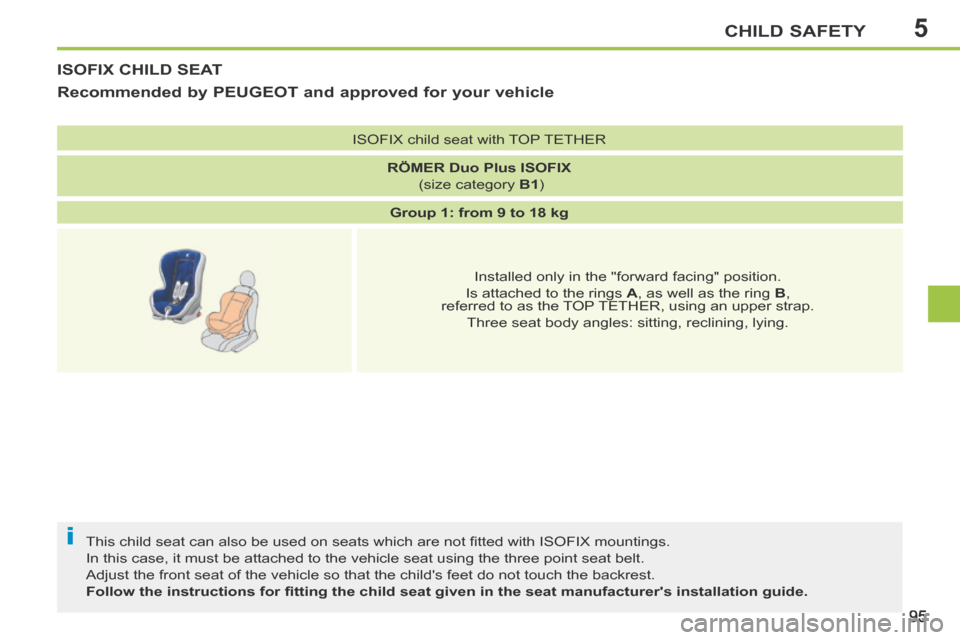
ISOFIX child seat with TOP TETHER RÖMER Duo Plus ISOFIX (size category B1 )
Group 1: from 9 to 18 kg
Installed only in the "forward facing" position.
Is attached to the rings A , as well as the ring B ,
referred to as the TOP TETHER, using an upper strap.
Three seat body angles: sitting, reclining, lying.
Page 104 of 232
6
!
SAFETY
102
207CC_EN_CHAP06_SECURITE_ED01-2014
SEAT BELTS ROLL-OVER BARS
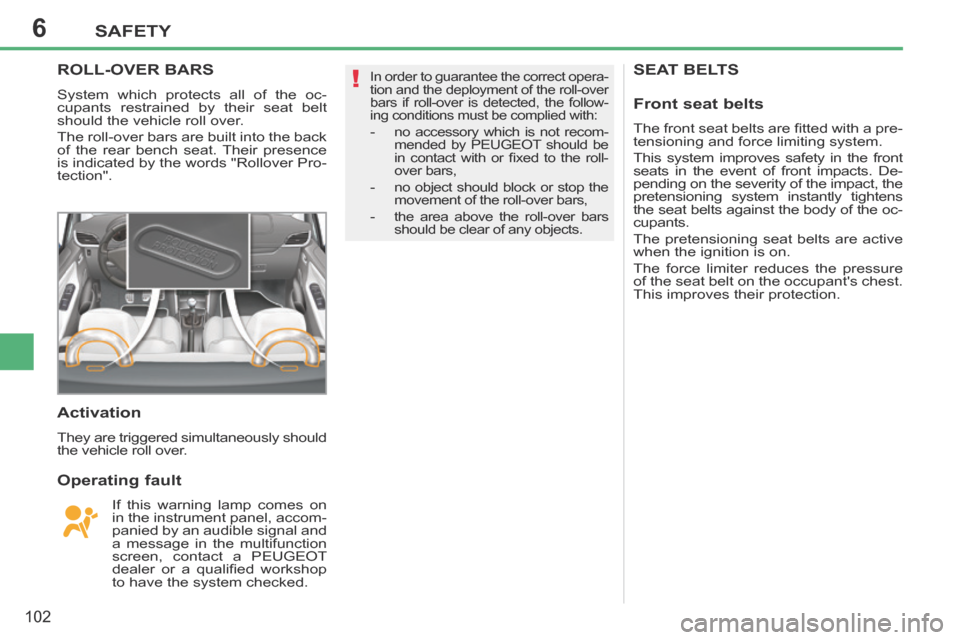
System which protects all of the oc-
cupants restrained by their seat belt
should the vehicle roll over.
The roll-over bars are built into the back
of the rear bench seat. Their presence
is indicated by the words "Rollover Pro-
tection".
Activation
They are triggered simultaneously should
the vehicle roll over.
Operating fault
If this warning lamp comes on
in the instrument panel, accom-
panied by an audible signal and
a message in the multifunction
screen, contact a PEUGEOT
dealer or a qualifi ed workshop
to have the system checked.
In order to guarantee the correct opera-
tion and the deployment of the roll-over
bars if roll-over is detected, the follow-
ing conditions must be complied with:
- no accessory which is not recom-mended by PEUGEOT should be
in contact with or fi xed to the roll-
over bars,
- no object should block or stop the movement of the roll-over bars,
- the area above the roll-over bars should be clear of any objects.
Front seat belts
The front seat belts are fi tted with a pre-
tensioning and force limiting system.
This system improves safety in the front
seats in the event of front impacts. De-
pending on the severity of the impact, the
pretensioning system instantly tightens
the seat belts against the body of the oc-
cupants.
The pretensioning seat belts are active
when the ignition is on.
The force limiter reduces the pressure
of the seat belt on the occupant's chest.
This improves their protection.
Page 105 of 232
6SAFETY
103
207CC_EN_CHAP06_SECURITE_ED01-2014
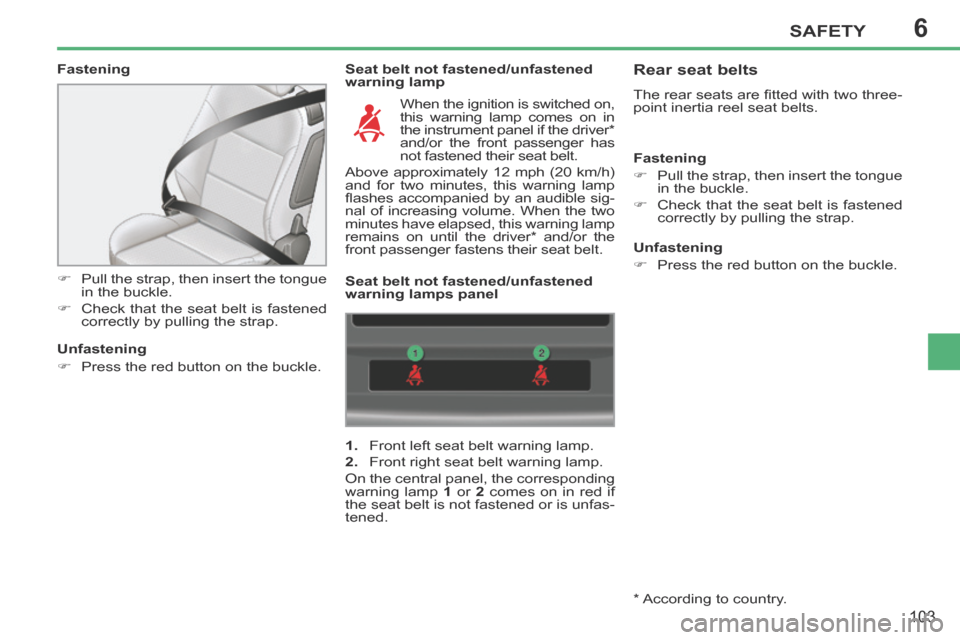
Fastening Seat belt not fastened/unfastened
warning lamp
Pull the strap, then insert the tongue in the buckle.
Check that the seat belt is fastened correctly by pulling the strap. When the ignition is switched on,
this warning lamp comes on in
the instrument panel if the driver *
and/or the front passenger has
not fastened their seat belt.
Above approximately 12 mph (20 km/h)
and for two minutes, this warning lamp
fl ashes accompanied by an audible sig-
nal of increasing volume. When the two
minutes have elapsed, this warning lamp
remains on until the driver * and/or the
front passenger fastens their seat belt.
Unfastening
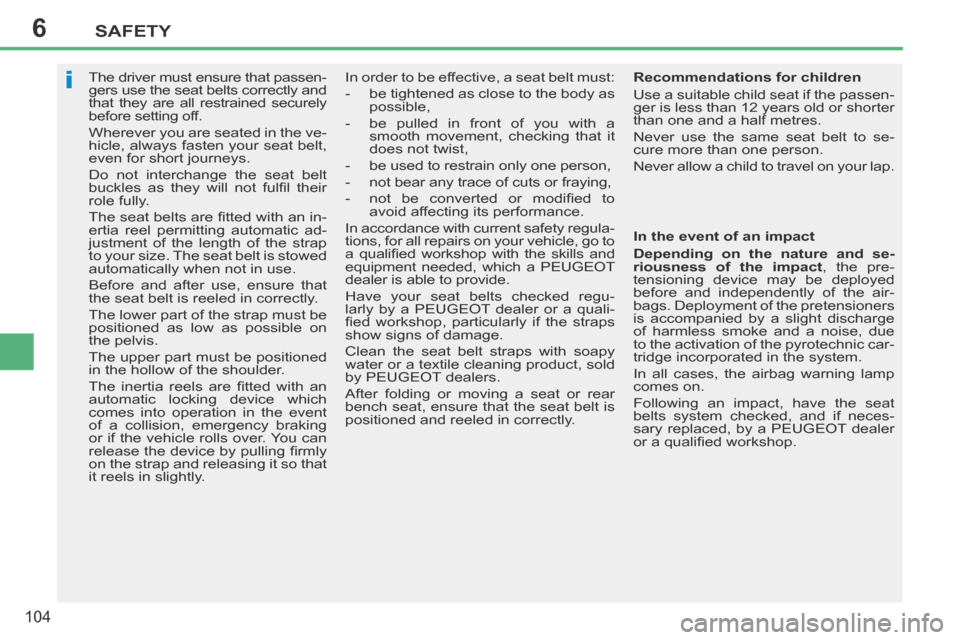
Press the red button on the buckle. 1. Front left seat belt warning lamp.
2. Front right seat belt warning lamp.
On the central panel, the corresponding
warning lamp 1 or 2 comes on in red if
the seat belt is not fastened or is unfas-
tened . Seat belt not fastened/unfastened
warning lamps panel Rear seat belts
The rear seats are fi tted with two three-
point inertia reel seat belts.
Fastening
Pull the strap, then insert the tongue in the buckle.
Check that the seat belt is fastened correctly by pulling the strap.
Unfastening
Press the red button on the buckle.
* According to country.
Page 106 of 232
6
i
SAFETY
104
207CC_EN_CHAP06_SECURITE_ED01-2014
The driver must ensure that passen-
gers use the seat belts correctly and
that they are all restrained securely
before setting off.
Wherever you are seated in the ve-
hicle, always fasten your seat belt,
even for short journeys.
Do not interchange the seat belt
buckles as they will not fulfi l their
role fully.
The seat belts are fi tted with an in-
ertia reel permitting automatic ad-
justment of the length of the strap
to your size. The seat belt is stowed
automatically when not in use.
Before and after use, ensure that
the seat belt is reeled in correctly.
The lower part of the strap must be
positioned as low as possible on
the pelvis.
The upper part must be positioned
in the hollow of the shoulder.
The inertia reels are fi tted with an
automatic locking device which
comes into operation in the event
of a collision, emergency braking
or if the vehicle rolls over. You can
release the device by pulling fi rmly
on the strap and releasing it so that
it reels in slightly. In order to be effective, a seat belt must:
- be tightened as close to the body as
possible,
- be pulled in front of you with a smooth movement, checking that it
does not twist,
- be used to restrain only one person,
- not bear any trace of cuts or fraying,
- not be converted or modifi ed to avoid affecting its performance.
In accordance with current safety regula-
tions, for all repairs on your vehicle, go to
a qualifi ed workshop with the skills and
equipment needed, which a PEUGEOT
dealer is able to provide.
Have your seat belts checked regu-
larly by a PEUGEOT dealer or a quali-
fi ed workshop, particularly if the straps
show signs of damage.
Clean the seat belt straps with soapy
water or a textile cleaning product, sold
by PEUGEOT dealers.
After folding or moving a seat or rear
bench seat, ensure that the seat belt is
positioned and reeled in correctly. Recommendations for children
Use a suitable child seat if the passen-
ger is less than 12 years old or shorter
than one and a half metres.
Never use the same seat belt to se-
cure more than one person.
Never allow a child to travel on your lap.
In the event of an impact
Depending on the nature and se-
riousness of the impact , the pre-
tensioning device may be deployed
before and independently of the air-
bags. Deployment of the pretensioners
is accompanied by a slight discharge
of harmless smoke and a noise, due
to the activation of the pyrotechnic car-
tridge incorporated in the system.
In all cases, the airbag warning lamp
comes on.
Following an impact, have the seat
belts system checked, and if neces-
sary replaced, by a PEUGEOT dealer
or a qualifi ed workshop.
Page 107 of 232
6
!
i
SAFETY
105
207CC_EN_CHAP06_SECURITE_ED01-2014
AIRBAGS
The airbags have been designed to
maximise the safety of the occupants in
the event of violent collisions. They sup-
plement the action of the force-limiting
seat belts.
In this case, the electronic detectors
record and analyse the front and side
impacts suffered in the impact detection
zones:
- in the event of a serious impact, the airbags are deployed instanta-
neously and contribute towards pro-
tecting the occupants of the vehicle;
immediately after the impact, the
airbags defl ate rapidly so that they
do not hinder the visibility of the oc-
cupants or their possible exit from
the vehicle,
- in the event of a minor impact or rear impact and in certain roll-over
conditions, the airbags will not be
deployed; the seat belt alone con-
tributes towards providing your pro-
tection in these situations.
The airbags do not operate when
the ignition is off.
This equipment only operates once.
If a second impact occurs (during
the same or a subsequent acci-
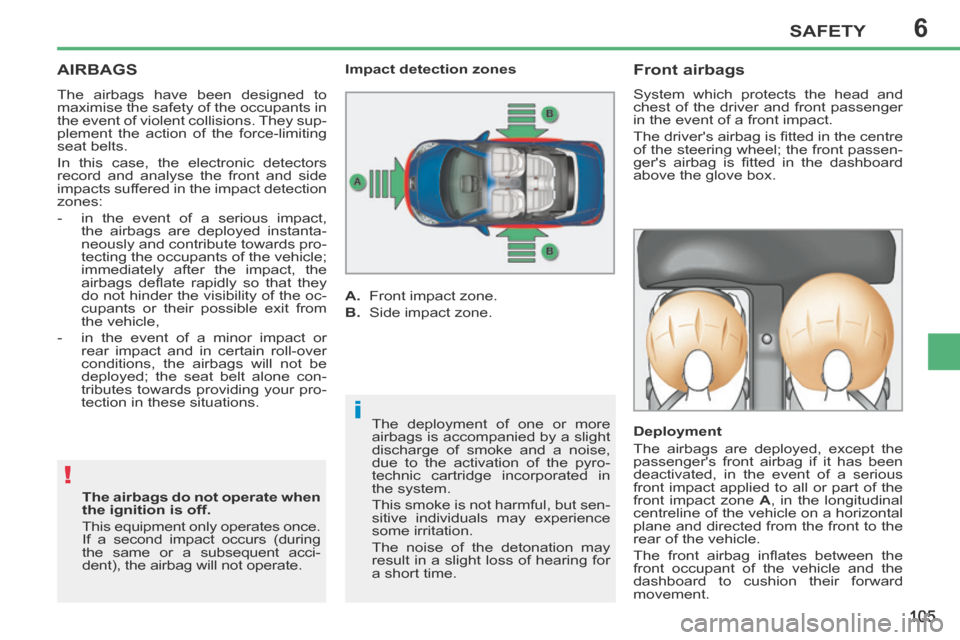
dent), the airbag will not operate. Impact detection zones
A. Front impact zone.
B. Side impact zone.
Front airbags
Deployment
The airbags are deployed, except the
passenger's front airbag if it has been
deactivated, in the event of a serious
front impact applied to all or part of the
front impact zone
A , in the longitudinal
centreline of the vehicle on a horizontal
plane and directed from the front to the
rear of the vehicle.
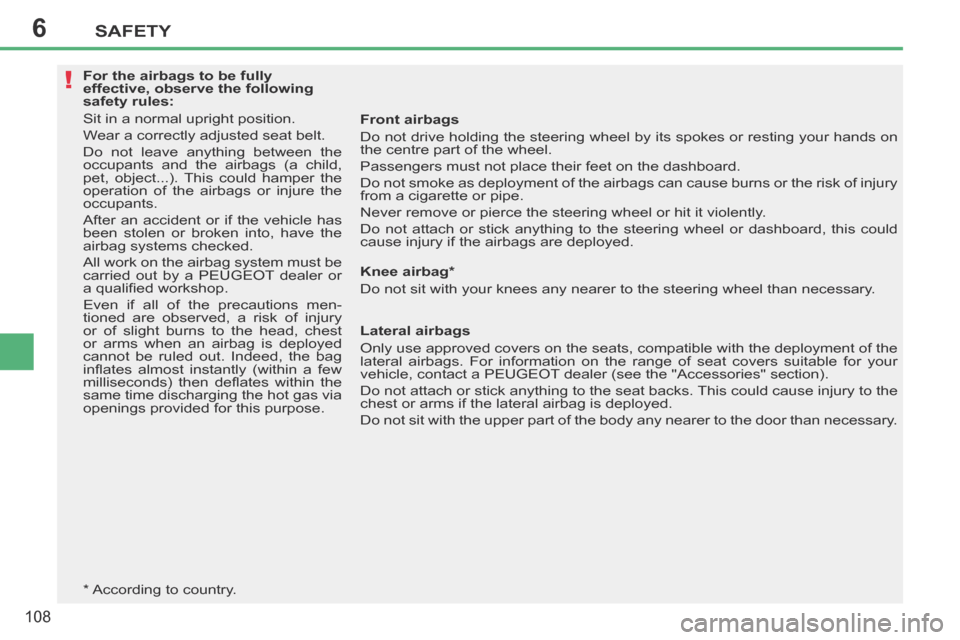
The front airbag infl ates between the
front occupant of the vehicle and the
dashboard to cushion their forward
movement.
The deployment of one or more
airbags is accompanied by a slight
discharge of smoke and a noise,
due to the activation of the pyro-
technic cartridge incorporated in
the system.
This smoke is not harmful, but sen-
sitive individuals may experience
some irritation.
The noise of the detonation may
result in a slight loss of hearing for
a short time. System which protects the head and
chest of the driver and front passenger
in the event of a front impact.
The driver's airbag is fi tted in the centre
of the steering wheel; the front passen-
ger's airbag is fi tted in the dashboard
above the glove box.
Page 110 of 232
6
!
SAFETY
108
207CC_EN_CHAP06_SECURITE_ED01-2014
For the airbags to be fully
effective, observe the following
safety rules:
Sit in a normal upright position.
Wear a correctly adjusted seat belt.
Do not leave anything between the
occupants and the airbags (a child,
pet, object...). This could hamper the
operation of the airbags or injure the
occupants.
After an accident or if the vehicle has
been stolen or broken into, have the
airbag systems checked.
All work on the airbag system must be
carried out by a PEUGEOT dealer or
a qualifi ed workshop.
Even if all of the precautions men-
tioned are observed, a risk of injury
or of slight burns to the head, chest
or arms when an airbag is deployed
cannot be ruled out. Indeed, the bag
infl ates almost instantly (within a few
milliseconds) then defl ates within the
same time discharging the hot gas via
openings provided for this purpose.
* According to country. Front airbags
Do not drive holding the steering wheel by its spokes or resting your ha\
nds on
the centre part of the wheel.
Passengers must not place their feet on the dashboard.
Do not smoke as deployment of the airbags can cause burns or the risk of injury
from a cigarette or pipe.
Never remove or pierce the steering wheel or hit it violently.
Do not attach or stick anything to the steering wheel or dashboard, this\
could
cause injury if the airbags are deployed.
Knee airbag *
Do not sit with your knees any nearer to the steering wheel than necessa\
ry.
Lateral airbags
Only use approved covers on the seats, compatible with the deployment of\
the
lateral airbags. For information on the range of seat covers suitable for your
vehicle, contact a PEUGEOT dealer (see the "Accessories" section) .
Do not attach or stick anything to the seat backs. This could cause injury to the
chest or arms if the lateral airbag is deployed.
Do not sit with the upper part of the body any nearer to the door than necessary.
Page 146 of 232
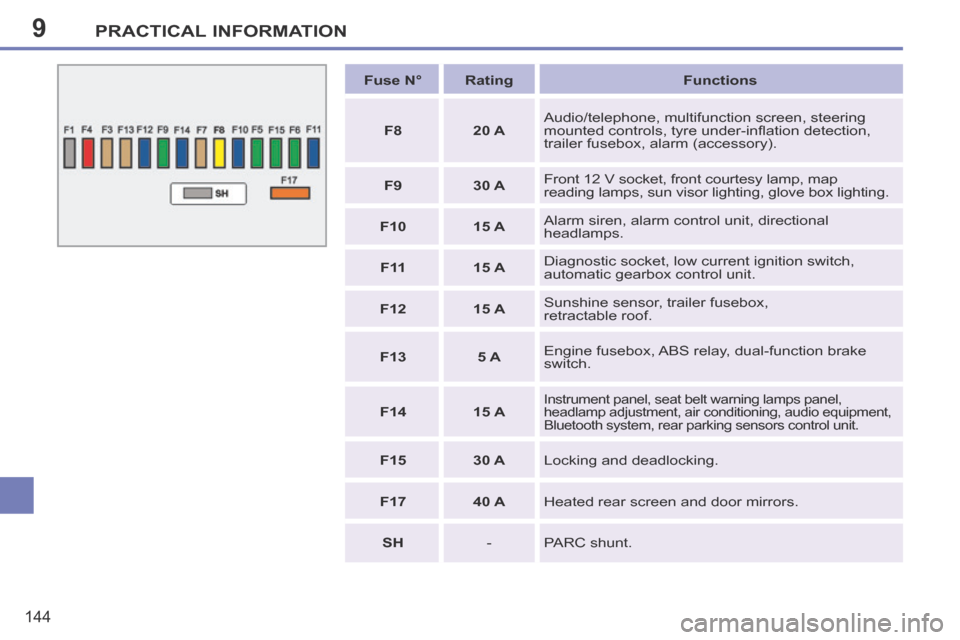
9PRACTICAL INFORMATION
144
207CC_EN_CHAP09_INFO PRATIQUES_ED01-2014
Fuse N° Rating Functions
F8 20 A Audio/telephone, multifunction screen, steering
mounted controls, tyre under-infl ation detection,
trailer fusebox, alarm (accessory).
F9 30 A Front 12 V socket, front courtesy lamp, map
reading lamps, sun visor lighting, glove box lighting.
F10 15 A Alarm siren, alarm control unit, directional
headlamps.
F 11 15 A Diagnostic socket, low current ignition switch,
automatic gearbox control unit.
F12 15 A Sunshine sensor, trailer fusebox,
retractable roof.
F13 5 A Engine fusebox, ABS relay, dual-function brake
switch.
F14 15 A
Instrument panel, seat belt warning lamps panel,
headlamp adjustment, air conditioning, audio equipment,
Bluetooth system, rear parking sensors control unit.
F15 30 A Locking and deadlocking.
F17 40 A Heated rear screen and door mirrors.
SH - PARC shunt.