steering Peugeot 207 CC 2014 User Guide
[x] Cancel search | Manufacturer: PEUGEOT, Model Year: 2014, Model line: 207 CC, Model: Peugeot 207 CC 2014Pages: 232, PDF Size: 11.11 MB
Page 107 of 232
6
!
i
SAFETY
105
207CC_EN_CHAP06_SECURITE_ED01-2014
AIRBAGS
The airbags have been designed to
maximise the safety of the occupants in
the event of violent collisions. They sup-
plement the action of the force-limiting
seat belts.
In this case, the electronic detectors
record and analyse the front and side
impacts suffered in the impact detection
zones:
- in the event of a serious impact, the airbags are deployed instanta-
neously and contribute towards pro-
tecting the occupants of the vehicle;
immediately after the impact, the
airbags defl ate rapidly so that they
do not hinder the visibility of the oc-
cupants or their possible exit from
the vehicle,
- in the event of a minor impact or rear impact and in certain roll-over
conditions, the airbags will not be
deployed; the seat belt alone con-
tributes towards providing your pro-
tection in these situations.
The airbags do not operate when
the ignition is off.
This equipment only operates once.
If a second impact occurs (during
the same or a subsequent acci-
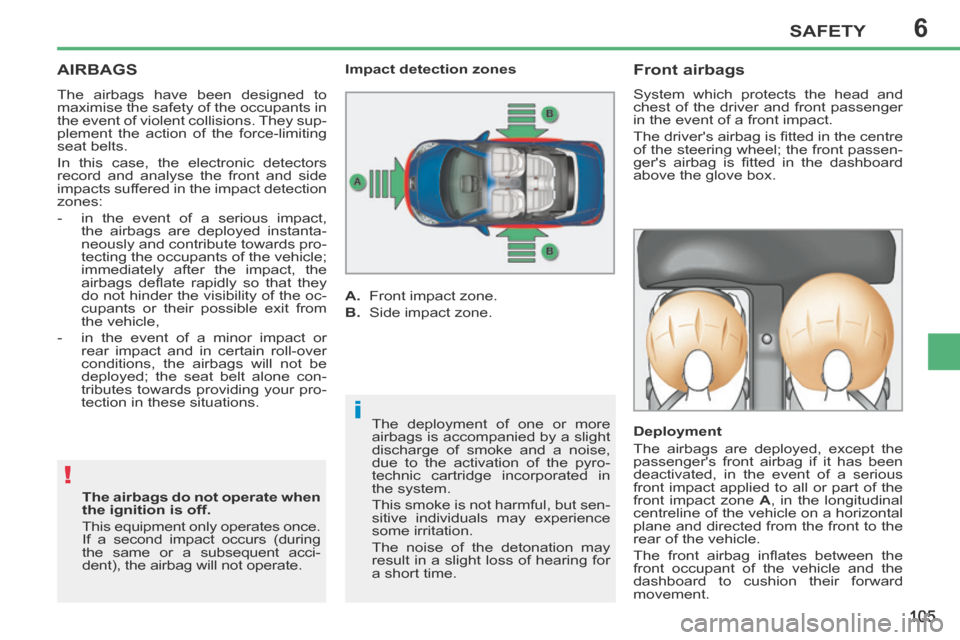
dent), the airbag will not operate. Impact detection zones
A. Front impact zone.
B. Side impact zone.
Front airbags
Deployment
The airbags are deployed, except the
passenger's front airbag if it has been
deactivated, in the event of a serious
front impact applied to all or part of the
front impact zone
A , in the longitudinal
centreline of the vehicle on a horizontal
plane and directed from the front to the
rear of the vehicle.
The front airbag infl ates between the
front occupant of the vehicle and the
dashboard to cushion their forward
movement.
The deployment of one or more
airbags is accompanied by a slight
discharge of smoke and a noise,
due to the activation of the pyro-
technic cartridge incorporated in
the system.
This smoke is not harmful, but sen-
sitive individuals may experience
some irritation.
The noise of the detonation may
result in a slight loss of hearing for
a short time. System which protects the head and
chest of the driver and front passenger
in the event of a front impact.
The driver's airbag is fi tted in the centre
of the steering wheel; the front passen-
ger's airbag is fi tted in the dashboard
above the glove box.
Page 109 of 232
6
!
SAFETY
107
207CC_EN_CHAP06_SECURITE_ED01-2014
* According to country.
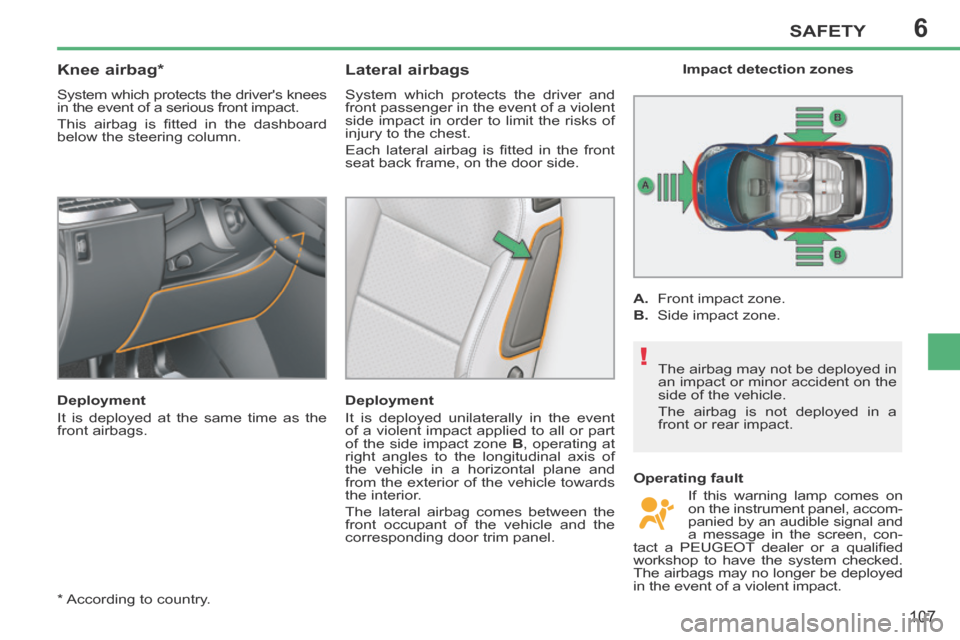
Knee airbag *
System which protects the driver's knees
in the event of a serious front impact.
This airbag is fi tted in the dashboard
below the steering column.
Deployment
It is deployed at the same time as the
front airbags.
Lateral airbags
System which protects the driver and
front passenger in the event of a violent
side impact in order to limit the risks of
injury to the chest.
Each lateral airbag is fi tted in the front
seat back frame, on the door side.
Deployment
It is deployed unilaterally in the event
of a violent impact applied to all or part
of the side impact zone B , operating at
right angles to the longitudinal axis of
the vehicle in a horizontal plane and
from the exterior of the vehicle towards
the interior.
The lateral airbag comes between the
front occupant of the vehicle and the
corresponding door trim panel. Impact detection zones
A. Front impact zone.
B. Side impact zone. The airbag may not be deployed in
an impact or minor accident on the
side of the vehicle.
The airbag is not deployed in a
front or rear impact.
Operating fault If this warning lamp comes on
on the instrument panel, accom-
panied by an audible signal and
a message in the screen, con-
tact a PEUGEOT dealer or a qualifi ed
workshop to have the system checked.
The airbags may no longer be deployed
in the event of a violent impact.
Page 110 of 232
6
!
SAFETY
108
207CC_EN_CHAP06_SECURITE_ED01-2014
For the airbags to be fully
effective, observe the following
safety rules:
Sit in a normal upright position.
Wear a correctly adjusted seat belt.
Do not leave anything between the
occupants and the airbags (a child,
pet, object...). This could hamper the
operation of the airbags or injure the
occupants.
After an accident or if the vehicle has
been stolen or broken into, have the
airbag systems checked.
All work on the airbag system must be
carried out by a PEUGEOT dealer or
a qualifi ed workshop.
Even if all of the precautions men-
tioned are observed, a risk of injury
or of slight burns to the head, chest
or arms when an airbag is deployed
cannot be ruled out. Indeed, the bag
infl ates almost instantly (within a few
milliseconds) then defl ates within the
same time discharging the hot gas via
openings provided for this purpose.
* According to country. Front airbags
Do not drive holding the steering wheel by its spokes or resting your ha\
nds on
the centre part of the wheel.
Passengers must not place their feet on the dashboard.
Do not smoke as deployment of the airbags can cause burns or the risk of injury
from a cigarette or pipe.
Never remove or pierce the steering wheel or hit it violently.
Do not attach or stick anything to the steering wheel or dashboard, this\
could
cause injury if the airbags are deployed.
Knee airbag *
Do not sit with your knees any nearer to the steering wheel than necessa\
ry.
Lateral airbags
Only use approved covers on the seats, compatible with the deployment of\
the
lateral airbags. For information on the range of seat covers suitable for your
vehicle, contact a PEUGEOT dealer (see the "Accessories" section) .
Do not attach or stick anything to the seat backs. This could cause injury to the
chest or arms if the lateral airbag is deployed.
Do not sit with the upper part of the body any nearer to the door than necessary.
Page 116 of 232
7
i
DRIVING
11 4
207CC_EN_CHAP07_CONDUITE_ED01-2014
SPEED LIMITER
System which prevents the vehicle from
exceeding the speed programmed by the
driver.
When the programmed speed limit is
reached, pressing the accelerator pedal
no longer has any effect.
The speed limiter is switched on manu-
ally: it requires a programmed speed of at
least 20 mph (30 km/h).
The speed limiter is switched off by
manual operation of the control.
The programmed speed can be exceed-
ed temporarily by pressing the accelera-
tor fi rmly.
To return to the programmed speed, sim-
ply slow down to a speed below the pro-
grammed speed.
The programmed speed remains in the
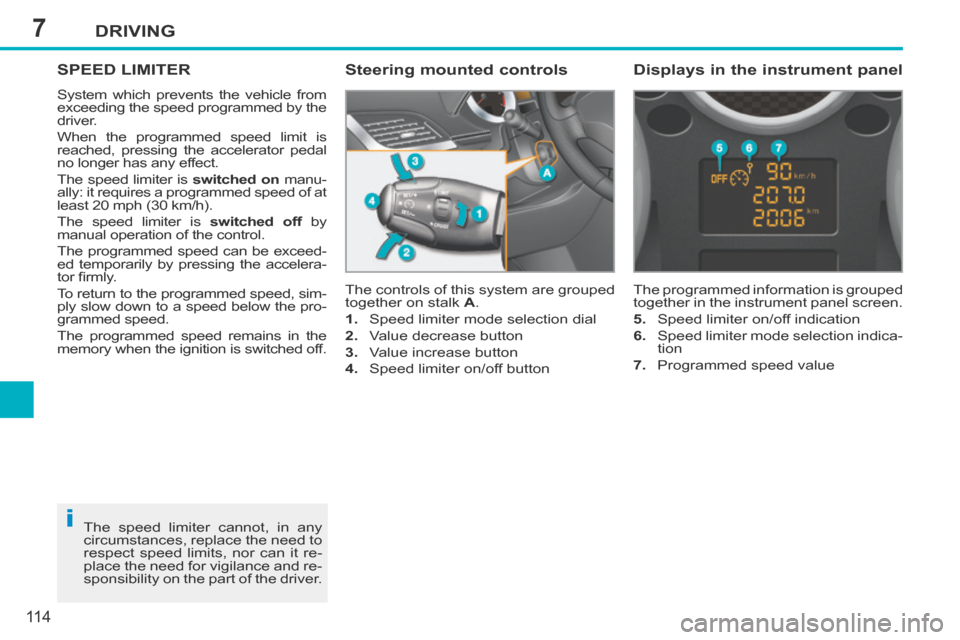
memory when the ignition is switched off. The controls of this system are grouped
together on stalk
A .
1. Speed limiter mode selection dial
2. Value decrease button
3. Value increase button
4. Speed limiter on/off button The programmed information is grouped
together in the instrument panel screen.
5. Speed limiter on/off indication
6. Speed limiter mode selection indica-
tion
7. Programmed speed value
Steering mounted controls Displays in the instrument panel
The speed limiter cannot, in any
circumstances, replace the need to
respect speed limits, nor can it re-
place the need for vigilance and re-
sponsibility on the part of the driver.
Page 118 of 232
7
i
DRIVING
11 6
207CC_EN_CHAP07_CONDUITE_ED01-2014
CRUISE CONTROL
System which automatically maintains
the speed of the vehicle at the value
programmed by the driver, without any
action on the accelerator pedal.
The cruise control is switched on
manually: it requires a minimum vehicle
speed of 25 mph (40 km/h), as well as
the engaging of:
- fourth gear on a manual gearbox,
- second gear on an automatic gear- box in sequential mode,
- position D on an automatic gearbox.
The cruise control is switched off man-
ually or by pressing the brake or clutch
pedal or on triggering of the ESP sys-
tem for safety reasons.
It is possible to exceed the programmed
speed temporarily by pressing the ac-
celerator pedal.
To return to the programmed speed,
simply release the accelerator pedal.
Switching off the ignition cancels any
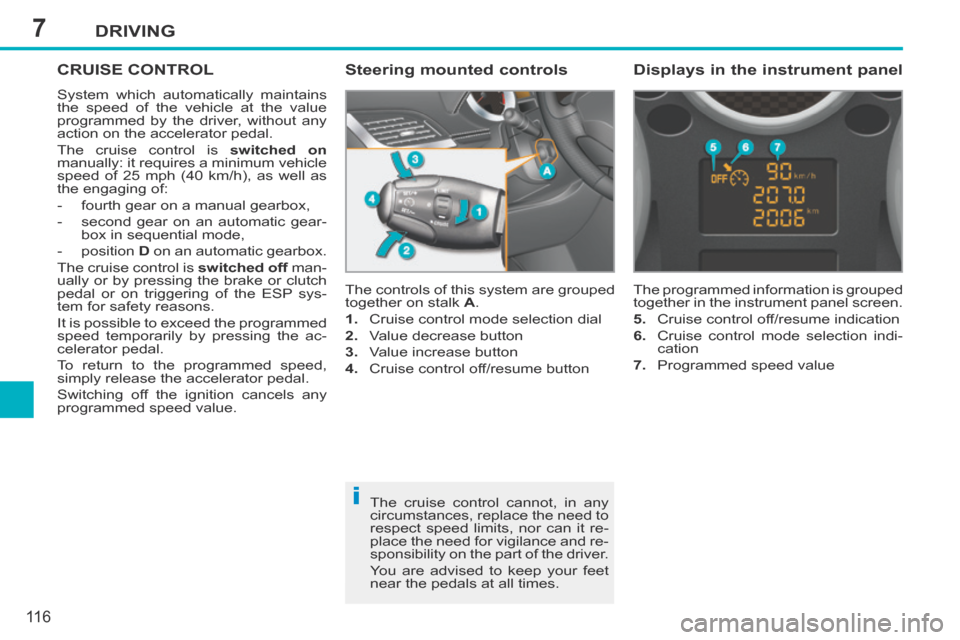
programmed speed value. The controls of this system are grouped
together on stalk
A .
1. Cruise control mode selection dial
2. Value decrease button
3. Value increase button
4. Cruise control off/resume button The programmed information is grouped
together in the instrument panel screen.
5. Cruise control off/resume indication
6. Cruise control mode selection indi-
cation
7. Programmed speed value
Steering mounted controls Displays in the instrument panel
The cruise control cannot, in any
circumstances, replace the need to
respect speed limits, nor can it re-
place the need for vigilance and re-
sponsibility on the part of the driver.
You are advised to keep your feet
near the pedals at all times.
Page 130 of 232
9
i
i
PRACTICAL INFORMATION
128
207CC_EN_CHAP09_INFO PRATIQUES_ED01-2014
TEMPORARY PUNCTURE
REPAIR KIT
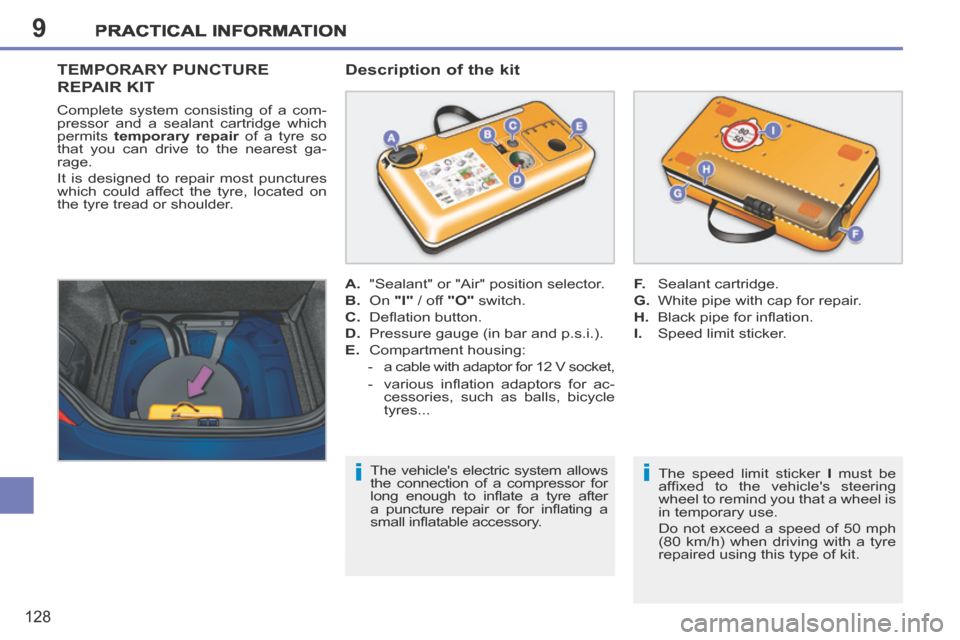
Description of the kit
The speed limit sticker
I must be
affi xed to the vehicle's steering
wheel to remind you that a wheel is
in temporary use.
Do not exceed a speed of 50 mph
(80 km/h) when driving with a tyre
repaired using this type of kit.
A. "Sealant" or "Air" position selector.
B. On "I" / off
"O" switch.
C. Defl ation button.
D. Pressure gauge (in bar and p.s.i.).
E. Compartment housing: - a cable with adaptor for 12 V socket,
- various infl ation adaptors for ac-cessories, such as balls, bicycle
tyres... F.
Sealant cartridge.
G. White pipe with cap for repair.
H. Black pipe for infl ation.
I. Speed limit sticker.
Complete system consisting of a com-
pressor and a sealant cartridge which
permits
temporary repair of a tyre so
that you can drive to the nearest ga-
rage.
It is designed to repair most punctures
which could affect the tyre, located on
the tyre tread or shoulder.
The vehicle's electric system allows
the connection of a compressor for
long enough to infl ate a tyre after
a puncture repair or for infl ating a
small infl atable accessory.
Page 145 of 232
9PRACTICAL INFORMATION
143
207CC_EN_CHAP09_INFO PRATIQUES_ED01-2014
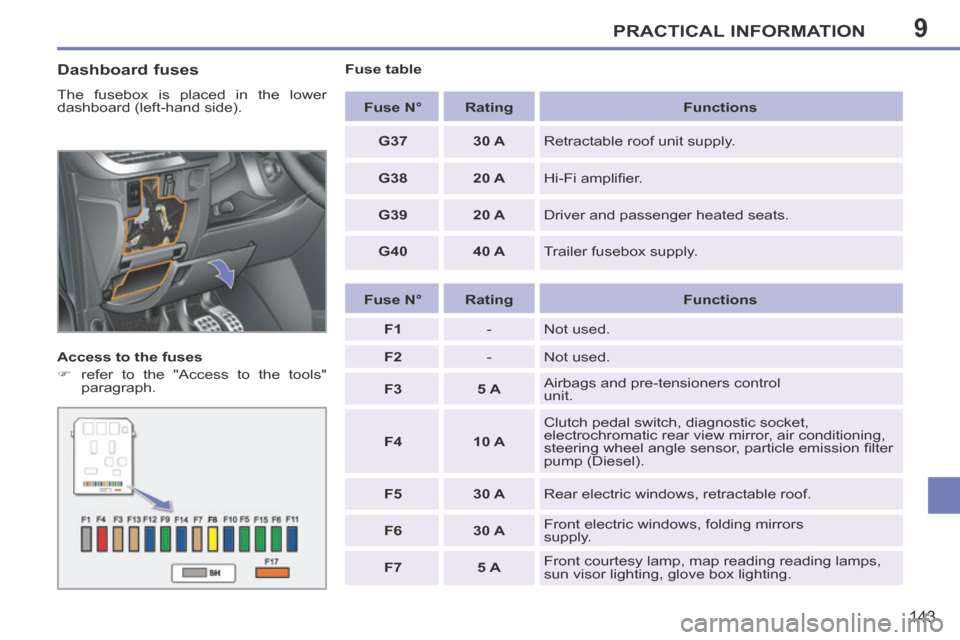
Dashboard fuses
The fusebox is placed in the lower
dashboard (left-hand side).
Access to the fuses
refer to the "Access to the tools" paragraph. Fuse table
Fuse N° Rating Functions
G37 30 A Retractable roof unit supply.
G38 20 A Hi-Fi amplifi er.
G39 20 A Driver and passenger heated seats.
G40 40 A Trailer fusebox supply.
Fuse N° Rating Functions
F1 - Not used.
F2 - Not used.
F3 5 A Airbags and pre-tensioners control
unit.
F4 10 A Clutch pedal switch, diagnostic socket,
electrochromatic rear view mirror, air conditioning,
steering wheel angle sensor, particle emission fi lter
pump (Diesel).
F5 30 A Rear electric windows, retractable roof.
F6 30 A Front electric windows, folding mirrors
supply.
F7 5 A Front courtesy lamp, map reading reading lamps,
sun visor lighting, glove box lighting.
Page 146 of 232
9PRACTICAL INFORMATION
144
207CC_EN_CHAP09_INFO PRATIQUES_ED01-2014
Fuse N° Rating Functions
F8 20 A Audio/telephone, multifunction screen, steering
mounted controls, tyre under-infl ation detection,
trailer fusebox, alarm (accessory).
F9 30 A Front 12 V socket, front courtesy lamp, map
reading lamps, sun visor lighting, glove box lighting.
F10 15 A Alarm siren, alarm control unit, directional
headlamps.
F 11 15 A Diagnostic socket, low current ignition switch,
automatic gearbox control unit.
F12 15 A Sunshine sensor, trailer fusebox,
retractable roof.
F13 5 A Engine fusebox, ABS relay, dual-function brake
switch.
F14 15 A
Instrument panel, seat belt warning lamps panel,
headlamp adjustment, air conditioning, audio equipment,
Bluetooth system, rear parking sensors control unit.
F15 30 A Locking and deadlocking.
F17 40 A Heated rear screen and door mirrors.
SH - PARC shunt.
Page 147 of 232
9PRACTICAL INFORMATION
145
207CC_EN_CHAP09_INFO PRATIQUES_ED01-2014
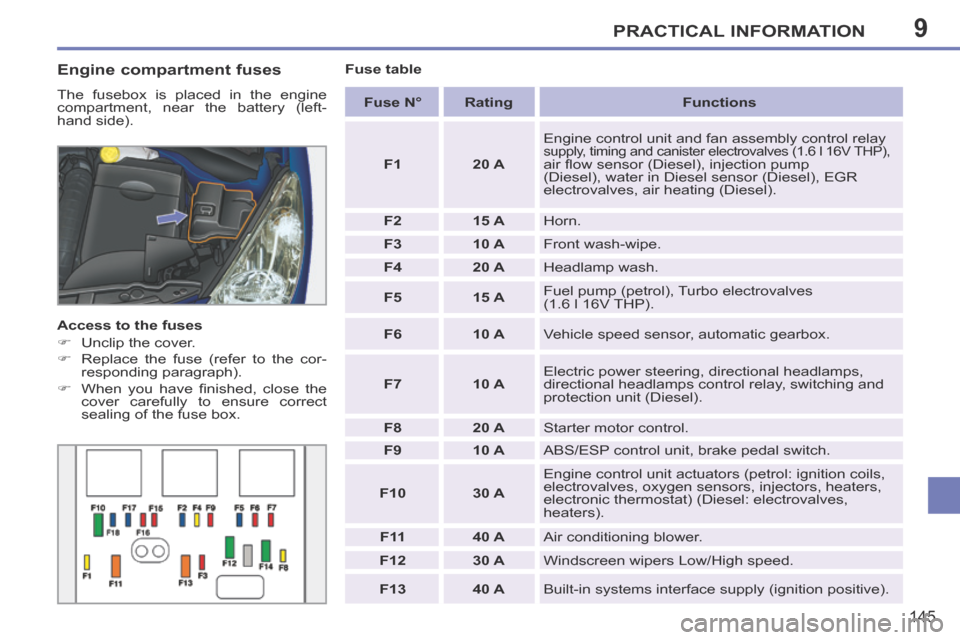
Engine compartment fuses
The fusebox is placed in the engine
compartment, near the battery (left-
hand side).
Access to the fuses
Unclip the cover.
Replace the fuse (refer to the cor-responding paragraph).
When you have fi nished, close the cover carefully to ensure correct
sealing of the fuse box. Fuse table
Fuse N° Rating Functions
F1 20 A Engine control unit and fan assembly control relay
supply, timing and canister electrovalves (1.6 l 16V THP),
air fl ow sensor (Diesel), injection pump
(Diesel), water in Diesel sensor (Diesel), EGR
electrovalves, air heating (Diesel).
F2 15 A Horn.
F3 10 A Front wash-wipe.
F4 20 A Headlamp wash.
F5 15 A Fuel pump (petrol), Turbo electrovalves
(1.6 l 16V THP).
F6 10 A Vehicle speed sensor, automatic gearbox.
F7 10 A Electric power steering, directional headlamps,
directional headlamps control relay, switching and
protection unit (Diesel).
F8 20 A Starter motor control.
F9 10 A ABS/ESP control unit, brake pedal switch.
F10 30 A Engine control unit actuators (petrol: ignition coils,
electrovalves, oxygen sensors, injectors, heaters,
electronic thermostat) (Diesel: electrovalves,
heaters).
F 11 40 A Air conditioning blower.
F12 30 A Windscreen wipers Low/High speed.
F13 40 A Built-in systems interface supply (ignition positive).
Page 148 of 232
9PRACTICAL INFORMATION
146
207CC_EN_CHAP09_INFO PRATIQUES_ED01-2014
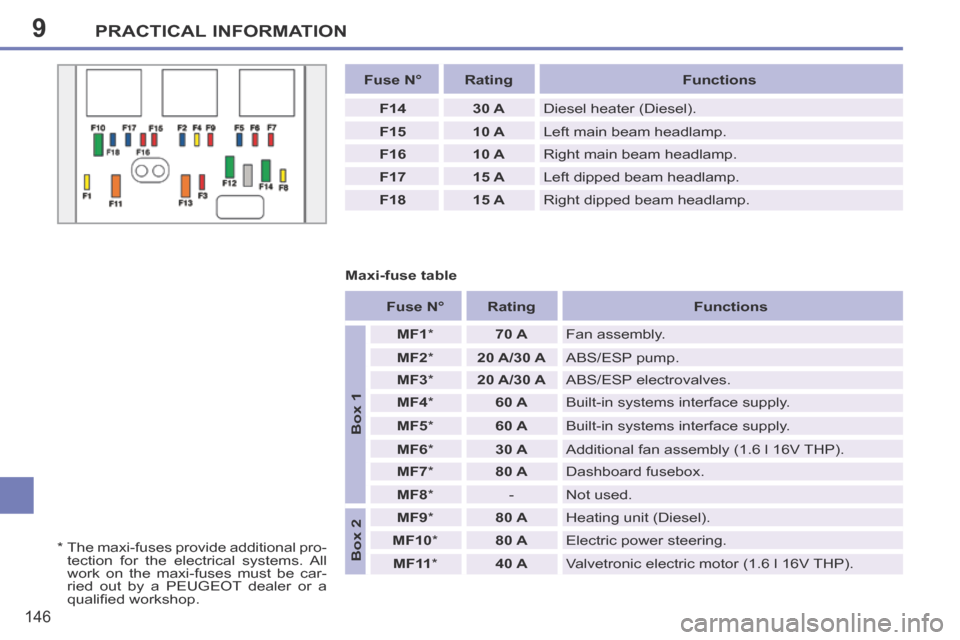
Fuse N° Rating Functions
F14 30 A Diesel heater (Diesel).
F15 10 A Left main beam headlamp.
F16 10 A Right main beam headlamp.
F17 15 A Left dipped beam headlamp.
F18 15 A Right dipped beam headlamp.
Maxi-fuse table
* The maxi-fuses provide additional pro- tection for the electrical systems. All
work on the maxi-fuses must be car-
ried out by a PEUGEOT dealer or a
qualifi ed workshop.
Fuse N° Rating Functions
Box 1
MF1 * 70 A Fan assembly.
MF2 * 20 A/30 A ABS/ESP pump.
MF3 * 20 A/30 A ABS/ESP electrovalves.
MF4 * 60 A Built-in systems interface supply.
MF5 * 60 A Built-in systems interface supply.
MF6 * 30 A Additional fan assembly (1.6 l 16V THP).
MF7 * 80 A Dashboard fusebox.
MF8 * - Not used.
Box 2
MF9 * 80 A Heating unit (Diesel).
MF10 * 80 A Electric power steering.
MF11 * 40 A Valvetronic electric motor (1.6 l 16V THP).