lock Peugeot 207 CC 2014 Owner's Guide
[x] Cancel search | Manufacturer: PEUGEOT, Model Year: 2014, Model line: 207 CC, Model: Peugeot 207 CC 2014Pages: 232, PDF Size: 11.11 MB
Page 76 of 232
3
i
i
ACCESS
74
207CC_EN_CHAP03_OUVERTURES_ED01-2014
If the vehicle is locked or dead-
locked from the outside, the red
indicator lamp fl ashes and button A
is inactive.
In this case, use the remote control or the key to unlock the
vehicle.
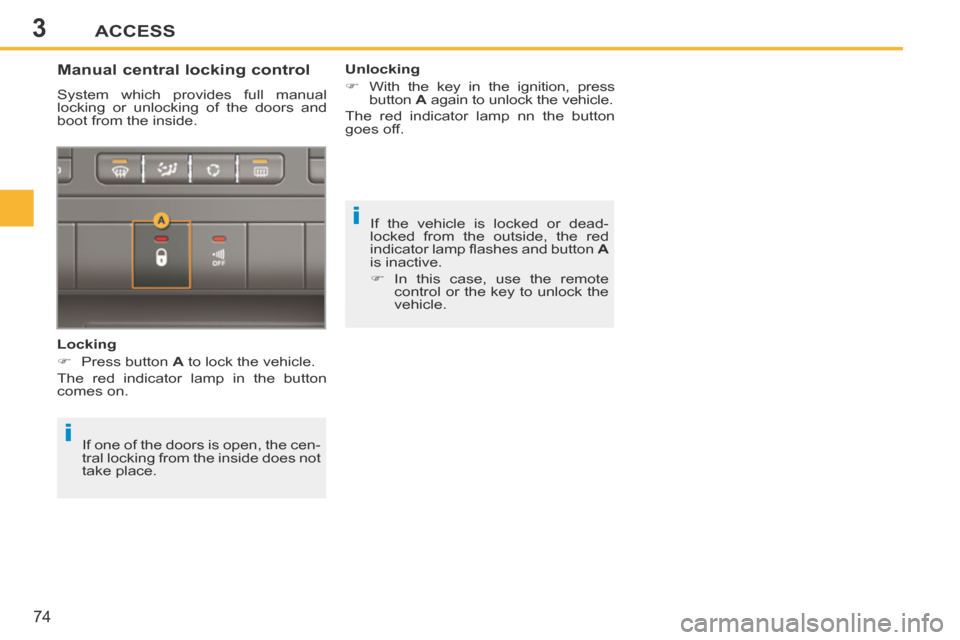
Manual central locking control
System which provides full manual
locking or unlocking of the doors and
boot from the inside.
Locking
Press button A to lock the vehicle.
The red indicator lamp in the button
comes on.
If one of the doors is open, the cen-
tral locking from the inside does not
take place. Unlocking
With the key in the ignition, press
button A again to unlock the vehicle.
The red indicator lamp nn the button
goes off.
Page 77 of 232
3
!
ACCESS
75
207CC_EN_CHAP03_OUVERTURES_ED01-2014
Emergency control
System which locks or unlocks the
doors mechanically in the event of a
malfunction of the central locking.
Insert the key in the lock, located on the edge of the door, then turn it one
eighth of a turn .
Locking the driver's door
Insert the key in the lock, then turn it
to the right.
Unlocking the driver's door
Insert the key in the lock, then turn it to the left.
Locking the passenger door
Unlocking the passenger door
Pull the interior door opening control.
If one of the doors is open, the auto-
matic central locking does not take
place.
If the boot is open, the automatic
central locking of the doors is active.
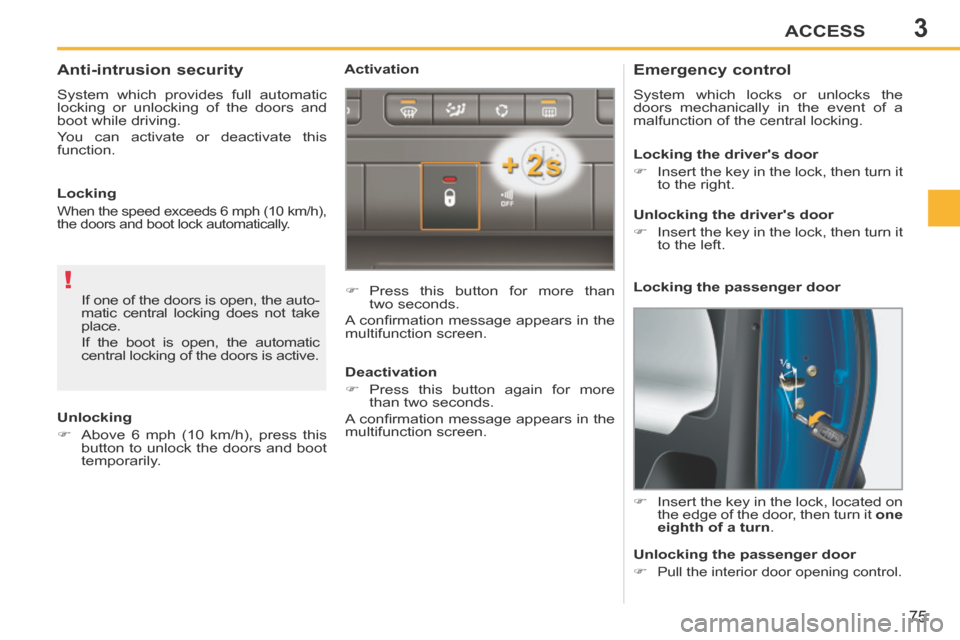
Anti-intrusion security
System which provides full automatic
locking or unlocking of the doors and
boot while driving.
You can activate or deactivate this
function. Activation
Press this button for more than two seconds.
A confi rmation message appears in the
multifunction screen.
Unlocking
Above 6 mph (10 km/h), press this button to unlock the doors and boot
temporarily.
Locking
When the speed exceeds 6 mph (10 km/h),
the doors and boot lock automatically.
Deactivation
Press this button again for more
than two seconds.
A confi rmation message appears in the
multifunction screen.
Page 78 of 232
3
i
i
ACCESS
76
207CC_EN_CHAP03_OUVERTURES_ED01-2014
BOOT
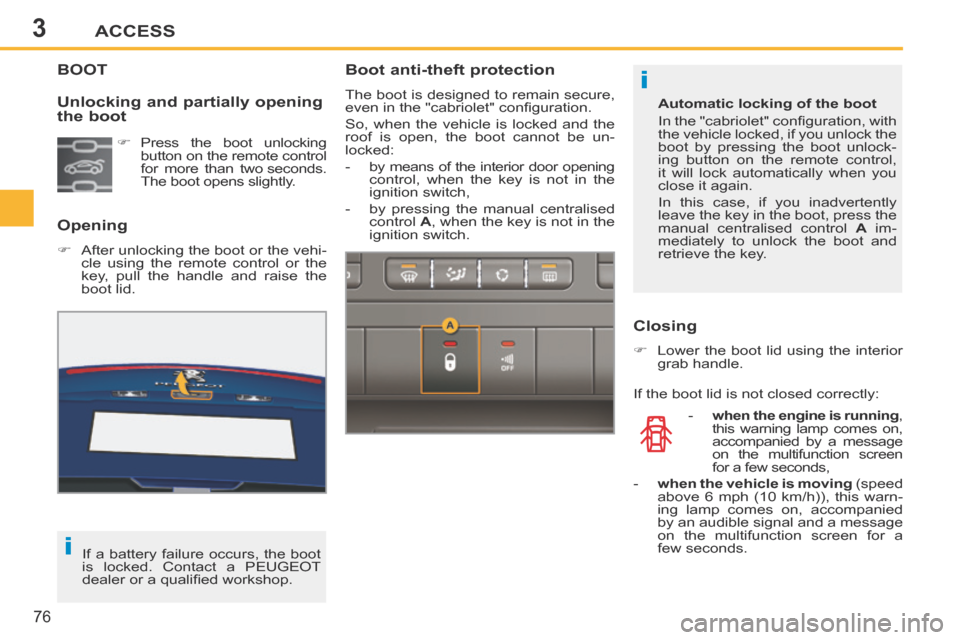
Opening
After unlocking the boot or the vehi-cle using the remote control or the
key, pull the handle and raise the
boot lid.
Unlocking and partially opening
the boot
Press the boot unlocking button on the remote control
for more than two seconds.
The boot opens slightly.
If a battery failure occurs, the boot
is locked. Contact a PEUGEOT
dealer or a qualifi ed workshop.
Boot anti-theft protection
The boot is designed to remain secure,
even in the "cabriolet" confi guration.
So, when the vehicle is locked and the
roof is open, the boot cannot be un-
locked:
- by means of the interior door opening control, when the key is not in the
ignition switch,
- by pressing the manual centralised control A , when the key is not in the
ignition switch.
- when the engine is running , this warning lamp comes on,
accompanied by a message
on the multifunction screen
for a few seconds,
- when the vehicle is moving (speed above 6 mph (10 km/h)), this warn-
ing lamp comes on, accompanied
by an audible signal and a message
on the multifunction screen for a
few seconds.
Closing
Lower the boot lid using the interior grab handle.
If the boot lid is not closed correctly: Automatic locking of the boot
In the "cabriolet" confi guration, with
the vehicle locked, if you unlock the
boot by pressing the boot unlock-
ing button on the remote control,
it will lock automatically when you
close it again.
In this case, if you inadvertently
leave the key in the boot, press the
manual centralised control
A im-
mediately to unlock the boot and
retrieve the key.
Page 79 of 232
3
i
ACCESS
77
207CC_EN_CHAP03_OUVERTURES_ED01-2014
The key cannot be removed from
the lock until the cap is refi tted.
FUEL TANK
Fuel tank capacity: approximately
50 litres (petrol) or 48 litres (Diesel). Opening the fi ller cap may create a
noise caused by an inrush of air. This
vacuum is entirely normal, resulting
from the sealing of the fuel system.
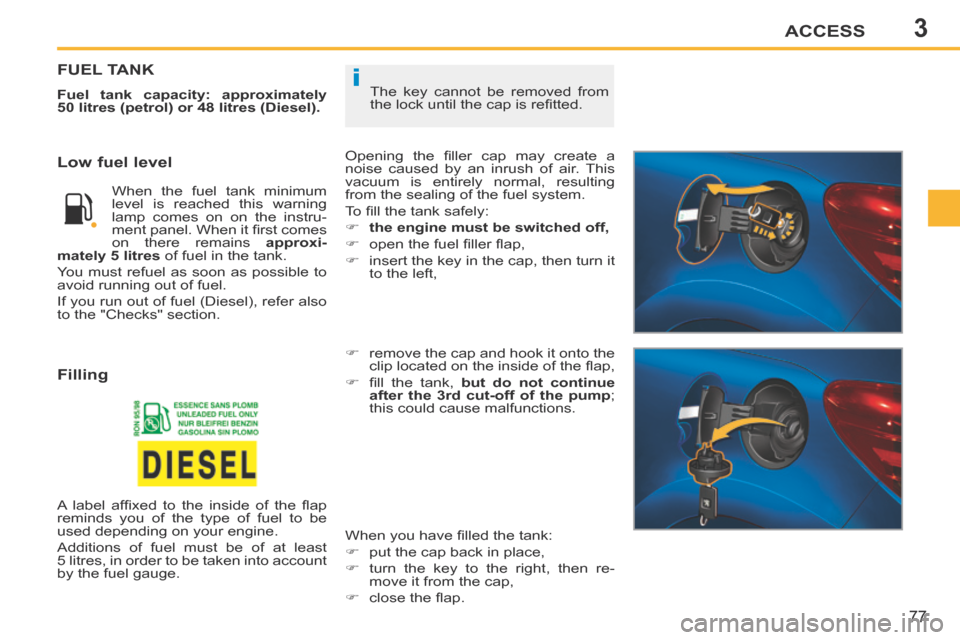
To fi ll the tank safely:
the engine must be switched off,
open the fuel fi ller fl ap,
insert the key in the cap, then turn it to the left,
When you have fi lled the tank:
put the cap back in place,
turn the key to the right, then re- move it from the cap,
close the fl ap. remove the cap and hook it onto the clip located on the inside of the fl ap,
fi ll the tank, but do not continue
after the 3rd cut-off of the pump ;
this could cause malfunctions.
Low fuel level
When the fuel tank minimum
level is reached this warning
lamp comes on on the instru-
ment panel. When it fi rst comes
on there remains approxi-
mately 5 litres of fuel in the tank.
You must refuel as soon as possible to
avoid running out of fuel.
If you run out of fuel (Diesel), refer also
to the "Checks" section.
Filling
A label affi xed to the inside of the fl ap
reminds you of the type of fuel to be
used depending on your engine.
Additions of fuel must be of at least
5 litres, in order to be taken into account
by the fuel gauge.
Page 84 of 232
4
!
82
VISIBILITY
207CC_EN_CHAP04_VISIBILITE_ED01-2014
In fog or snow, the sunshine sensor
may detect suffi cient light. There-
fore, the lighting will not come on
automatically.
Do not cover the sunshine sensor,
coupled with the rain sensor and
located in the centre of the wind-
screen behind the rear view mirror;
the associated functions would no
longer be controlled.
Operating fault
In the event of a fault with the
sunshine sensor, the lighting
comes on accompanied by the
service warning lamp, an audi-
ble signal and a message in the screen.
Have it checked by a PEUGEOT dealer
or a qualifi ed workshop.
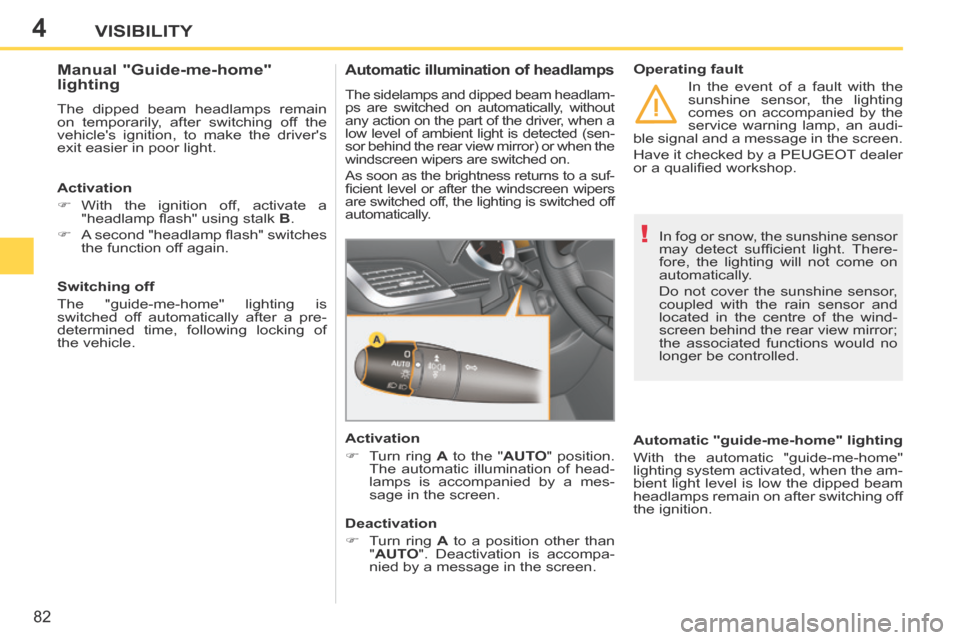
Automatic illumination of headlamps
The sidelamps and dipped beam headlam-
ps are switched on automatically, without
any action on the part of the driver, when a
low level of ambient light is detected (sen-
sor behind the rear view mirror) or when the
windscreen wipers are switched on.
As soon as the brightness returns to a suf-
fi cient level or after the windscreen wipers
are switched off, the lighting is switched off
automatically.
Manual "Guide-me-home"
lighting
The dipped beam headlamps remain
on temporarily, after switching off the
vehicle's ignition, to make the driver's
exit easier in poor light.
Activation
With the ignition off, activate a "headlamp fl ash" using stalk B .
A second "headlamp fl ash" switches the function off again.
Switching off
The "guide-me-home" lighting is
switched off automatically after a pre-
determined time, following locking of
the vehicle.
Activation
Turn ring A to the " AUTO " position.
The automatic illumination of head-
lamps is accompanied by a mes-
sage in the screen.
Deactivation
Turn ring A to a position other than
" AUTO ". Deactivation is accompa-
nied by a message in the screen. Automatic "guide-me-home" lighting
With the automatic "guide-me-home"
lighting system activated, when the am-
bient light level is low the dipped beam
headlamps remain on after switching off
the ignition.
Page 87 of 232
4
i
85
VISIBILITY
207CC_EN_CHAP04_VISIBILITE_ED01-2014
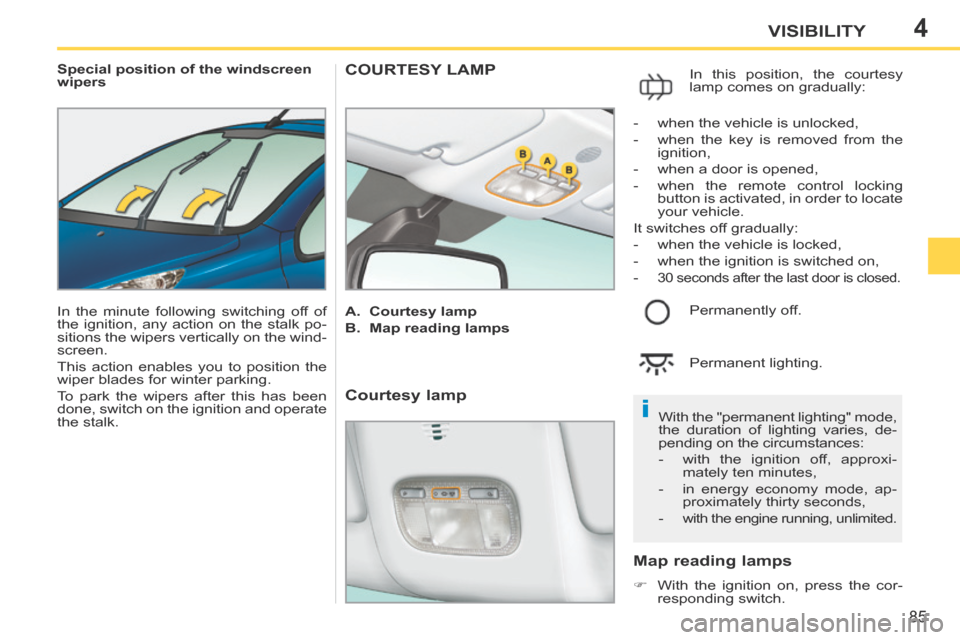
Special position of the windscreen
wipers
In the minute following switching off of
the ignition, any action on the stalk po-
sitions the wipers vertically on the wind-
screen.
This action enables you to position the
wiper blades for winter parking.
To park the wipers after this has been
done, switch on the ignition and operate
the stalk. COURTESY LAMP
A. Courtesy lamp
B. Map reading lamps In this position, the courtesy
lamp comes on gradually:
Map reading lamps
With the ignition on, press the cor-
responding switch. With the "permanent lighting" mode,
the duration of lighting varies, de-
pending on the circumstances:
- with the ignition off, approxi-
mately ten minutes,
- in energy economy mode, ap- proximately thirty seconds,
- with the engine running, unlimited.
- when the vehicle is unlocked,
- when the key is removed from the ignition,
- when a door is opened,
- when the remote control locking button is activated, in order to locate
your vehicle.
It switches off gradually:
- when the vehicle is locked,
- when the ignition is switched on,
-
30 seconds after the last door is closed.
Permanently off.
Permanent lighting.
Courtesy lamp
Page 102 of 232
6
!
i
!
SAFETY
100
207CC_EN_CHAP06_SECURITE_ED01-2014
BRAKING ASSISTANCE
SYSTEMS *
Group of supplementary systems which
help you to obtain optimum braking in
complete safety in emergency situations:
- anti-lock braking system (ABS),
- electronic brake force distribution (EBFD),
-
emergency braking assistance (EBA).
Anti-lock braking system
and electronic brake force
distribution
Linked systems which improve the sta-
bility and manoeuvrability of your vehicle
when braking, in particular on poor or
slippery surfaces.
When braking in an emergency,
press very fi rmly without releasing
the pressure. When replacing wheels (tyres and
rims), ensure that they conform to the
manufacturer's recommendations.
Operating fault
If this warning lamp comes on,
accompanied by an audible
signal and a message in the
screen, it indicates a malfunc-
tion of the anti-lock braking system
which could result in loss of control of
the vehicle when braking.
If this warning lamp comes on,
together with the STOP and
ABS warning lamps, accompa-
nied by an audible signal and
a message in the screen, it indicates a
malfunction of the electronic brake force
distribution which could result in loss of
control of the vehicle when braking.
You must stop as soon as it is safe
to do so.
In either case, contact a PEUGEOT
dealer or a qualifi ed workshop.
Emergency braking assistance
System which, in an emergency, en-
ables you to obtain the optimum braking
pressure more quickly, thus reducing
the stopping distance.
* According to country.
Activation
The anti-lock braking system comes
into operation automatically when there
is a risk of wheel lock.
Normal operation of the ABS may make
itself felt by slight vibration of the brake
pedal. Activation
It is triggered by the speed at which the
brake pedal is pressed.
The effect of this is a reduction in the
resistance of the pedal and an increase
in braking effi ciency.
When braking in an emergency,
press fi rmly without releasing the
pressure.
Page 104 of 232
6
!
SAFETY
102
207CC_EN_CHAP06_SECURITE_ED01-2014
SEAT BELTS ROLL-OVER BARS
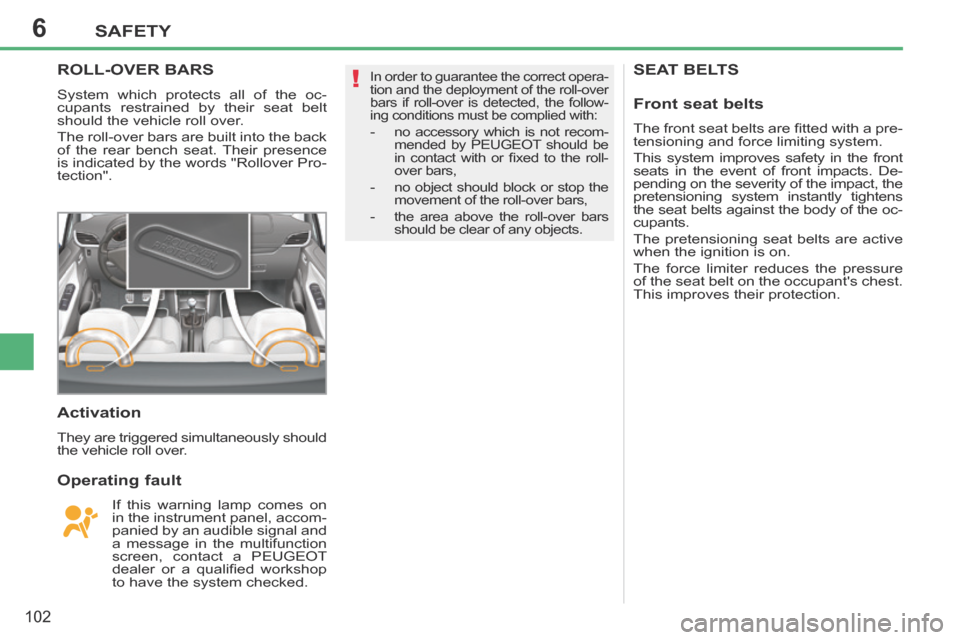
System which protects all of the oc-
cupants restrained by their seat belt
should the vehicle roll over.
The roll-over bars are built into the back
of the rear bench seat. Their presence
is indicated by the words "Rollover Pro-
tection".
Activation
They are triggered simultaneously should
the vehicle roll over.
Operating fault
If this warning lamp comes on
in the instrument panel, accom-
panied by an audible signal and
a message in the multifunction
screen, contact a PEUGEOT
dealer or a qualifi ed workshop
to have the system checked.
In order to guarantee the correct opera-
tion and the deployment of the roll-over
bars if roll-over is detected, the follow-
ing conditions must be complied with:
- no accessory which is not recom-mended by PEUGEOT should be
in contact with or fi xed to the roll-
over bars,
- no object should block or stop the movement of the roll-over bars,
- the area above the roll-over bars should be clear of any objects.
Front seat belts
The front seat belts are fi tted with a pre-
tensioning and force limiting system.
This system improves safety in the front
seats in the event of front impacts. De-
pending on the severity of the impact, the
pretensioning system instantly tightens
the seat belts against the body of the oc-
cupants.
The pretensioning seat belts are active
when the ignition is on.
The force limiter reduces the pressure
of the seat belt on the occupant's chest.
This improves their protection.
Page 106 of 232
6
i
SAFETY
104
207CC_EN_CHAP06_SECURITE_ED01-2014
The driver must ensure that passen-
gers use the seat belts correctly and
that they are all restrained securely
before setting off.
Wherever you are seated in the ve-
hicle, always fasten your seat belt,
even for short journeys.
Do not interchange the seat belt
buckles as they will not fulfi l their
role fully.
The seat belts are fi tted with an in-
ertia reel permitting automatic ad-
justment of the length of the strap
to your size. The seat belt is stowed
automatically when not in use.
Before and after use, ensure that
the seat belt is reeled in correctly.
The lower part of the strap must be
positioned as low as possible on
the pelvis.
The upper part must be positioned
in the hollow of the shoulder.
The inertia reels are fi tted with an
automatic locking device which
comes into operation in the event
of a collision, emergency braking
or if the vehicle rolls over. You can
release the device by pulling fi rmly
on the strap and releasing it so that
it reels in slightly. In order to be effective, a seat belt must:
- be tightened as close to the body as
possible,
- be pulled in front of you with a smooth movement, checking that it
does not twist,
- be used to restrain only one person,
- not bear any trace of cuts or fraying,
- not be converted or modifi ed to avoid affecting its performance.
In accordance with current safety regula-
tions, for all repairs on your vehicle, go to
a qualifi ed workshop with the skills and
equipment needed, which a PEUGEOT
dealer is able to provide.
Have your seat belts checked regu-
larly by a PEUGEOT dealer or a quali-
fi ed workshop, particularly if the straps
show signs of damage.
Clean the seat belt straps with soapy
water or a textile cleaning product, sold
by PEUGEOT dealers.
After folding or moving a seat or rear
bench seat, ensure that the seat belt is
positioned and reeled in correctly. Recommendations for children
Use a suitable child seat if the passen-
ger is less than 12 years old or shorter
than one and a half metres.
Never use the same seat belt to se-
cure more than one person.
Never allow a child to travel on your lap.
In the event of an impact
Depending on the nature and se-
riousness of the impact , the pre-
tensioning device may be deployed
before and independently of the air-
bags. Deployment of the pretensioners
is accompanied by a slight discharge
of harmless smoke and a noise, due
to the activation of the pyrotechnic car-
tridge incorporated in the system.
In all cases, the airbag warning lamp
comes on.
Following an impact, have the seat
belts system checked, and if neces-
sary replaced, by a PEUGEOT dealer
or a qualifi ed workshop.
Page 115 of 232
7
!i
i
DRIVING
11 3
207CC_EN_CHAP07_CONDUITE_ED01-2014
Stopping the vehicle
Before switching off the engine, you
can engage position P or N to place the
gearbox in neutral.
In both cases, apply the parking brake
to immobilise the vehicle.
Operating fault
There is a risk of damage to the
gearbox:
- if you press the accelerator and brake pedals at the same time,
- if you force the movement of the gear lever from the P posi-
tion to another position when
the battery is fl at.
To reduce fuel consumption when
at a prolonged standstill with the
engine running (traffi c jam...), put
the gear lever in the N position and
apply the parking brake.
Manual operation
Select position M for sequential
changing of the four gears.
Push the lever towards the + sign to
change up a gear.
Pull the lever towards the - sign to
change down a gear.
D disappears and the gears
engaged appear in succes-
sion in the instrument panel.
If the engine speed is too low
or too high, the gear selected
fl ashes for a few seconds, then the ac-
tual gear engaged is displayed.
It is possible to change from position D
(automatic) to position M (manual) at
any time.
When the vehicle is stationary or mov-
ing very slowly, the gearbox selects
gear M1 automatically.
The sport and snow programmes do not
operate in manual mode. If the lever is not in position
P ,
when the driver's door is opened or
approximately 45 seconds after the
ignition is switched off, a warning
message appears in the screen.
Return the lever to position P ;
the message disappears.
It is only possible to change from one
gear to another if the vehicle speed and
engine speed permit; otherwise, the
gearbox will operate temporarily in au-
tomatic mode.
Invalid value during manual
operation
This symbol is displayed if a
gear is not engaged correctly
(selector between two posi-
tions). When the ignition is on, the
lighting of this warning lamp,
accompanied by an audible
signal and a message in the
multifunction screen, indicates a gear-
box fault.
In this case, the gearbox switches to
back-up mode and is locked in 3rd gear.
You may feel a substantial knock when
changing from P to R and from N to R .
This will not cause any damage to the
gearbox.
Do not exceed 60 mph (100 km/h), local
speed restrictions permitting.
Contact a PEUGEOT dealer or a quali-
fi ed workshop as soon as possible.
When driving on fl ooded roads or
when crossing a ford, proceed at
walking pace.