maintenance Peugeot 207 CC 2014 Owner's Manual
[x] Cancel search | Manufacturer: PEUGEOT, Model Year: 2014, Model line: 207 CC, Model: Peugeot 207 CC 2014Pages: 232, PDF Size: 11.11 MB
Page 8 of 232
!
!
i
6
FAMILIARISATION
207CC_EN_CHAP00B_PRISE EN MAIN_ED01-2014
OPENING
Retractable roof
When washing your vehicle:
- lock the vehicle,
- avoid spraying the upper part
of the windows,
- keep the end of the high-pres- sure nozzle at least 1 metre
from the windows and door
seals.
After washing the vehicle or fol-
lowing rain, wait until the roof has
dried before opening it.
The roof is operated under the
sole responsibility of the driver.
During operation of the roof, to
avoid the risk of injury, ensure that
no one is in the vicinity of the mov-
ing parts.
You are strongly advised not to op-
erate the roof in strong winds. It is preferable to operate the roof
with the engine running.
The roof can be operated at
speeds below 6 mph (10 km/h).
It is only possible to carry out the
operation twice with the engine off,
to avoid discharging the battery.
Preliminary conditions
Switch on the ignition.
Ensure that:
- the vehicle is not in energy econo-my mode (refer to the correspond-
ing section),
- the battery voltage is suffi cient indicator lamp on in the roof con-
trol),
- the roof fuse is in good condition (refer to the corresponding section),
- the electric windows are initialised (refer to the corresponding section),
- the ambient temperature is above -15 °C.
Precautions to be taken before
operating the roof
Park the vehicle on level ground.
Check that no object could hinder
the operation of the roof:
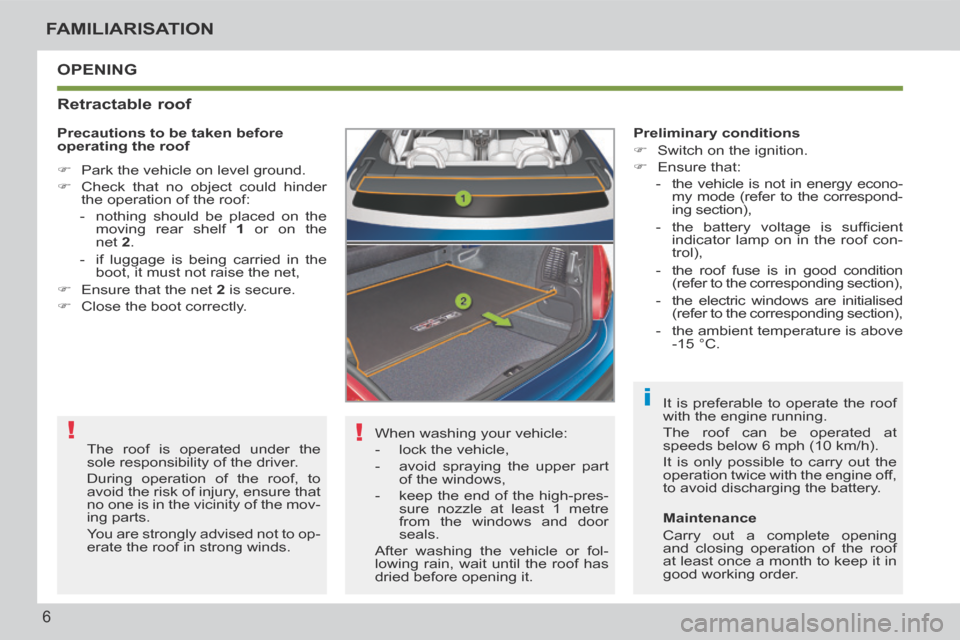
- nothing should be placed on the moving rear shelf 1 or on the
net 2 .
- if luggage is being carried in the boot, it must not raise the net,
Ensure that the net 2 is secure.
Close the boot correctly.
Maintenance
Carry out a complete opening
and closing operation of the roof
at least once a month to keep it in
good working order.
Page 21 of 232
19
207CC_EN_CHAP00B_PRISE EN MAIN_ED01-2014
Limit the causes of excess consumption
Spread loads throughout the vehicle; place the heaviest
items in the bottom of the boot, as close as possible to the
rear seats.
Limit the loads carried in the vehicle and reduce wind resis-
tance (roof bars, roof rack, bicycle carrier, trailer...). Use a
roof box in preference.
Remove roof bars and roof racks after use. Have your vehicle serviced regularly (engine oil, oil fi lter,
air fi lter, passenger compartment fi lter...) and observe the
schedule of operations recommended in the warranty and
maintenance record.
When refuelling, do not continue after the third cut-off of the
nozzle to avoid any overfl ow.
At the end of winter, remove snow tyres and refi t your summer
tyres.
Observe the recommendations on maintenance
Check the tyre pressures regularly, when cold, referring to
the label in the door aperture, driver's side.
Carry out this check in particular:
- before a long journey,
- at each change of season,
- after a long period out of use.
Don't forget the spare wheel and the tyres on any trailer or
caravan.
At the wheel of your new vehicle, it is only after the fi rst
1 800 miles (3 000 kilometres) that you will see the fuel con-
sumption settle down to a consistent average.
Page 48 of 232
2
i
COMFORT
46
207CC_EN_CHAP02_CONFORT_ED01-2014
The air conditioning system does
not contain chlorine and does not
present any danger to the ozone
layer. RECOMMENDATIONS FOR VENTILATION AND AIR
CONDITIONING
In order for these systems to be fully effective, follow the operation and main-
tenance guidelines below:
To obtain an even air distribution, take care not to obstruct the exterio\
r air intake grilles located at the base of the windscreen, the nozzles, the v\
ents
and the air outlets, as well as the air extractor located in the boot.
Do not cover the sunshine sensor, located on the dashboard; this is used for regulation of the air conditioning system.
Operate the air conditioning system for at least 5 to 10 minutes, once o\
r twice a month to keep it in perfect working order.
Ensure that the passenger compartment fi lter is in good condition and have the fi lter elements replaced regularly.
We recommend the use of a combined passenger compartment fi lter. Thanks to its special active additive, it contributes to the purifi cation of
the air breathed by the occupants and the cleanliness of the passenger
compartment (reduction of allergic symptoms, bad odours and greasy de-
posits).
To ensure correct operation of the air conditioning system, you are also \
advised to have it checked regularly as recommended in the warranty and \
maintenance record.
If the system does not produce cold air, switch it off and contact a PEUGEOT dealer or a qualifi ed workshop.
When towing the maximum load on a steep gradient in high temperatures,
switching off the air conditioning increases the available engine power and so
improves the towing ability.
If after an extended stop in sunshine, the interior temperature is very high, fi rst
ventilate the passenger compartment for a few moments.
Put the air fl ow control at a setting high enough to quickly change the air in the
passenger compartment.
The condensation created by the air conditioning results in a discharge \
of
water under the vehicle which is perfectly normal.
Page 114 of 232
7
!!
i
DRIVING
11 2
207CC_EN_CHAP07_CONDUITE_ED01-2014
Moving off
Apply the parking brake.
Select position P or N .
Start the engine.
If this procedure is not followed, there is
an audible signal, accompanied by the
display of an warning message.
With the engine running, press the brake pedal.
Release the parking brake.
Select position R , D or M .
Gradually release the brake pedal.
The vehicle moves off immediately.
If position N is selected inadver-
tently while driving, allow the en-
gine to return to idle then select
position D to accelerate.
If the ambient temperature is below
-23°C, the engine should be left at
idle for four minutes, to ensure the
correct operation and life of the en-
gine and gearbox. The gearbox then operates in auto-
adaptive mode, without any intervention
on the part of the driver. It continuously
selects the most suitable gear accord-
ing to the style of driving, the profi le of
the road and the load in the vehicle.
Automatic operation
Select position
D for automatic
changing of the four gears.
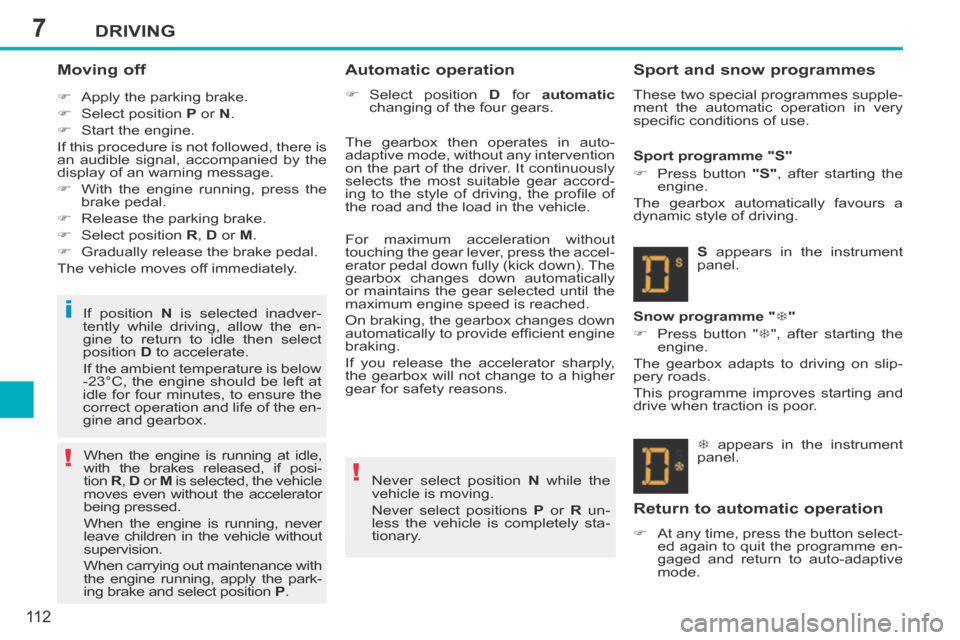
appears in the instrument
panel.
Snow programme " "
Press button "
", after starting the
engine.
The gearbox adapts to driving on slip-
pery roads.
This programme improves starting and
drive when traction is poor. S appears in the instrument
panel.
Sport programme "S"
Press button
"S" , after starting the
engine.
The gearbox automatically favours a
dynamic style of driving.
Never select position N while the
vehicle is moving.
Never select positions P or R un-
less the vehicle is completely sta-
tionary.
When the engine is running at idle,
with the brakes released, if posi-
tion
R , D or M is selected, the vehicle
moves even without the accelerator
being pressed.
When the engine is running, never
leave children in the vehicle without
supervision.
When carrying out maintenance with
the engine running, apply the park-
ing brake and select position P .
Sport and snow programmes
These two special programmes supple-
ment the automatic operation in very
specifi c conditions of use.
Return to automatic operation
At any time, press the button select-
ed again to quit the programme en-
gaged and return to auto-adaptive
mode.
For maximum acceleration without
touching the gear lever, press the accel-
erator pedal down fully (kick down). The
gearbox changes down automatically
or maintains the gear selected until the
maximum engine speed is reached.
On braking, the gearbox changes down
automatically to provide effi cient engine
braking.
If you release the accelerator sharply,
the gearbox will not change to a higher
gear for safety reasons.
Page 126 of 232
8CHECKS
124
207CC_EN_CHAP08_VERIFICATIONS_ED01-2014
CHECKING LEVELS
Check all of these levels regularly and
top them up if necessary, unless other-
wise indicated.
If a level drops signifi cantly, have the
corresponding system checked by a
PEUGEOT dealer or a qualifi ed work-
shop.
Take care when working under the bon-
net, as some parts of the engine can be
extremely hot (risk of burns).
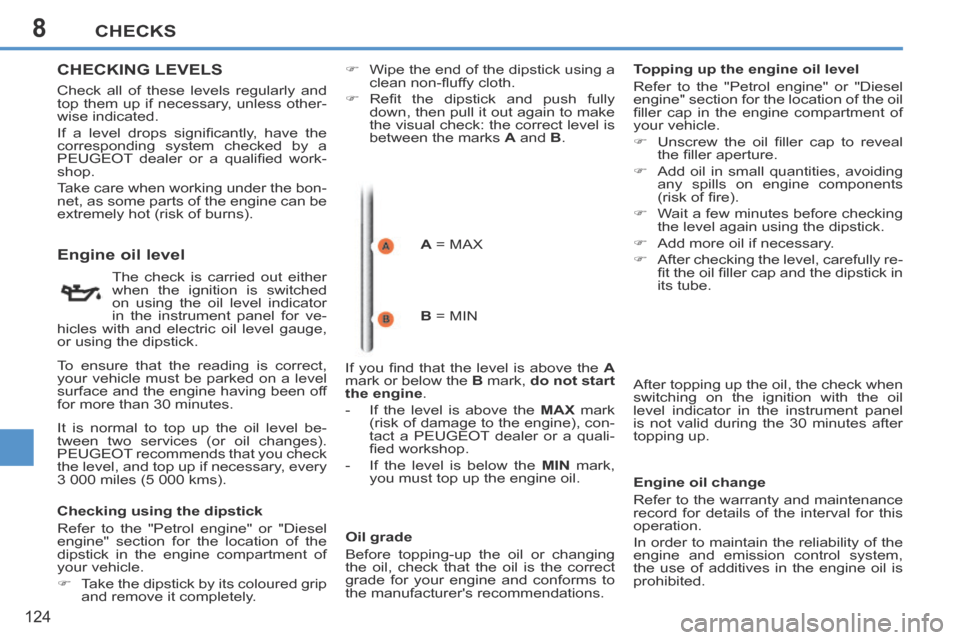
Engine oil level
The check is carried out either
when the ignition is switched
on using the oil level indicator
in the instrument panel for ve-
hicles with and electric oil level gauge,
or using the dipstick.
To ensure that the reading is correct,
your vehicle must be parked on a level
surface and the engine having been off
for more than 30 minutes.
It is normal to top up the oil level be-
tween two services (or oil changes).
PEUGEOT recommends that you check
the level, and top up if necessary, every
3 000 miles (5 000 kms).
Checking using the dipstick
Refer to the "Petrol engine" or "Diesel
engine" section for the location of the
dipstick in the engine compartment of
your vehicle.
Take the dipstick by its coloured grip and remove it completely. A = MAX
B = MIN
If you fi nd that the level is above the A
mark or below the B mark, do not start
the engine .
- If the level is above the MAX mark
(risk of damage to the engine), con-
tact a PEUGEOT dealer or a quali-
fi ed workshop.
- If the level is below the MIN mark,
you must top up the engine oil.
Oil grade
Before topping-up the oil or changing
the oil, check that the oil is the correct
grade for your engine and conforms to
the manufacturer's recommendations. Topping up the engine oil level
Refer to the "Petrol engine" or "Diesel
engine" section for the location of the oil
fi ller cap in the engine compartment of
your vehicle.
Unscrew the oil fi ller cap to reveal
the fi ller aperture.
Add oil in small quantities, avoiding any spills on engine components
(risk of fi re).
Wait a few minutes before checking the level again using the dipstick.
Add more oil if necessary.
After checking the level, carefully re- fi t the oil fi ller cap and the dipstick in
its tube.
After topping up the oil, the check when
switching on the ignition with the oil
level indicator in the instrument panel
is not valid during the 30 minutes after
topping up.
Engine oil change
Refer to the warranty and maintenance
record for details of the interval for this
operation.
In order to maintain the reliability of the
engine and emission control system,
the use of additives in the engine oil is
prohibited.
Wipe the end of the dipstick using a
clean non-fl uffy cloth.
Refi t the dipstick and push fully down, then pull it out again to make
the visual check: the correct level is
between the marks A and B .
Page 127 of 232
8
!
CHECKS
125
207CC_EN_CHAP08_VERIFICATIONS_ED01-2014
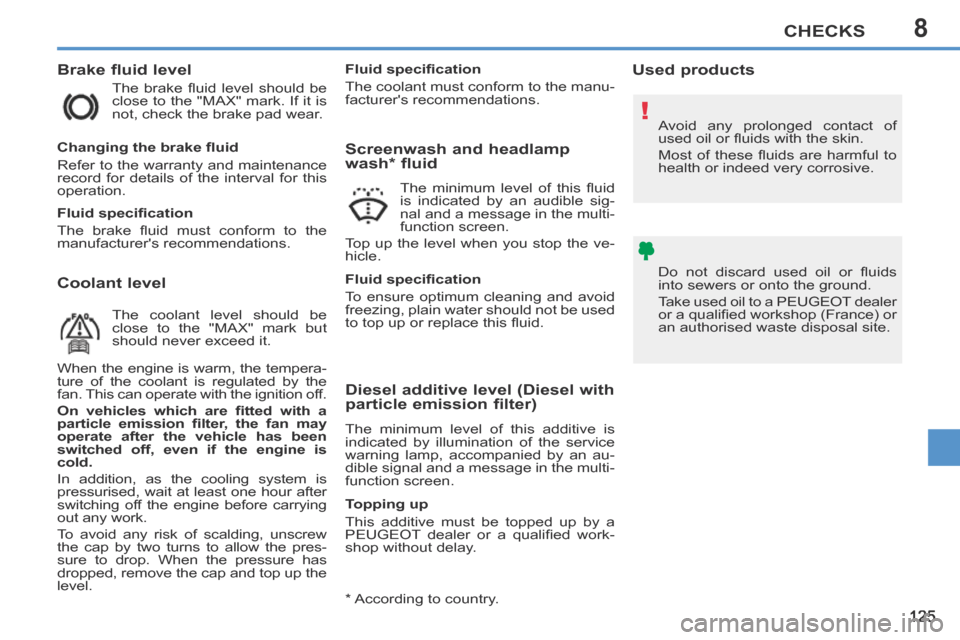
Coolant level Brake fluid level
The brake fl uid level should be
close to the "MAX" mark. If it is
not, check the brake pad wear.
The coolant level should be
close to the "MAX" mark but
should never exceed it.
When the engine is warm, the tempera-
ture of the coolant is regulated by the
fan. This can operate with the ignition off.
On vehicles which are fi tted with a
particle emission fi lter, the fan may
operate after the vehicle has been
switched off, even if the engine is
cold.
In addition, as the cooling system is
pressurised, wait at least one hour after
switching off the engine before carrying
out any work.
To avoid any risk of scalding, unscrew
the cap by two turns to allow the pres-
sure to drop. When the pressure has
dropped, remove the cap and top up the
level.
Screenwash and headlamp
wash * fluid
The minimum level of this fl uid
is indicated by an audible sig-
nal and a message in the multi-
function screen.
Top up the level when you stop the ve-
hicle.
* According to country.
Fluid specifi cation
The brake fl uid must conform to the
manufacturer's recommendations.
Fluid specifi cation
The coolant must conform to the manu-
facturer's recommendations.
Fluid specifi cation
To ensure optimum cleaning and avoid
freezing, plain water should not be used
to top up or replace this fl uid.
Changing the brake fl uid
Refer to the warranty and maintenance
record for details of the interval for this
operation.
Avoid any prolonged contact of
used oil or fl uids with the skin.
Most of these fl uids are harmful to
health or indeed very corrosive.
Do not discard used oil or fl uids
into sewers or onto the ground.
Take used oil to a PEUGEOT dealer
or a qualifi ed workshop (France) or
an authorised waste disposal site.
Diesel additive level (Diesel with
particle emission filter)
The minimum level of this additive is
indicated by illumination of the service
warning lamp, accompanied by an au-
dible signal and a message in the multi-
function screen.
Used products
Topping up
This additive must be topped up by a
PEUGEOT dealer or a qualifi ed work-
shop without delay.
Page 128 of 232
8
i
CHECKS
126
207CC_EN_CHAP08_VERIFICATIONS_ED01-2014
CHECKS
Unless otherwise indicated, check these
components as specifi ed in the warranty
and maintenance record for your engine.
Otherwise, have them checked by a
PEUGEOT dealer or a qualifi ed work-
shop.
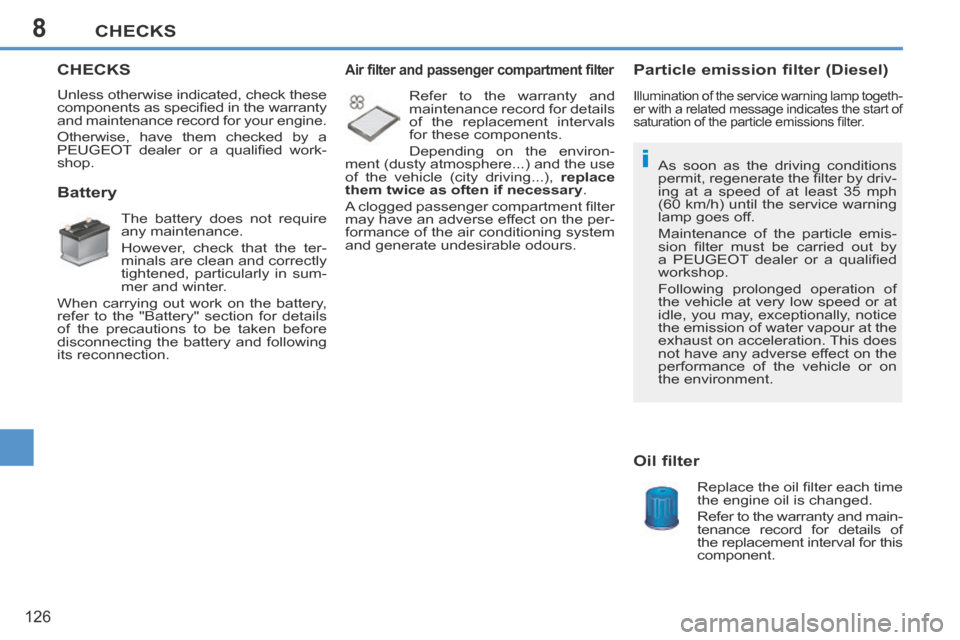
Battery
The battery does not require
any maintenance.
However, check that the ter-
minals are clean and correctly
tightened, particularly in sum-
mer and winter.
When carrying out work on the battery,
refer to the "Battery" section for details
of the precautions to be taken before
disconnecting the battery and following
its reconnection.
Air filter and passenger compartment filter
Refer to the warranty and
maintenance record for details
of the replacement intervals
for these components.
Depending on the environ-
ment (dusty atmosphere...) and the use
of the vehicle (city driving...), replace
them twice as often if necessary .
A clogged passenger compartment fi lter
may have an adverse effect on the per-
formance of the air conditioning system
and generate undesirable odours.
Particle emission filter (Diesel)
Illumination of the service warning lamp togeth-
er with a related message indicates the start of
saturation of the particle emissions fi lter.
Oil filter
Replace the oil fi lter each time
the engine oil is changed.
Refer to the warranty and main-
tenance record for details of
the replacement interval for this
component.
As soon as the driving conditions
permit, regenerate the fi lter by driv-
ing at a speed of at least 35 mph
(60 km/h) until the service warning
lamp goes off.
Maintenance of the particle emis-
sion fi lter must be carried out by
a PEUGEOT dealer or a qualifi ed
workshop.
Following prolonged operation of
the vehicle at very low speed or at
idle, you may, exceptionally, notice
the emission of water vapour at the
exhaust on acceleration. This does
not have any adverse effect on the
performance of the vehicle or on
the environment.
Page 129 of 232
8
!
CHECKS
127
207CC_EN_CHAP08_VERIFICATIONS_ED01-2014
Only use products recommended by
PEUGEOT or products of equivalent
quality and specifi cations.
In order to optimise the operation
of units as important as the braking
system, PEUGEOT selects and of-
fers very specifi c products.
To avoid damaging the electrical
units, the use of a high pressure
washer in the engine compartment
is strictly prohibited .
After washing the vehicle, or in hu-
mid or wintry conditions, ice can
form on the brake discs and pads
with a resulting loss of effi ciency of
the brakes. Make a few light brake
applications to defrost and dry the
brakes.
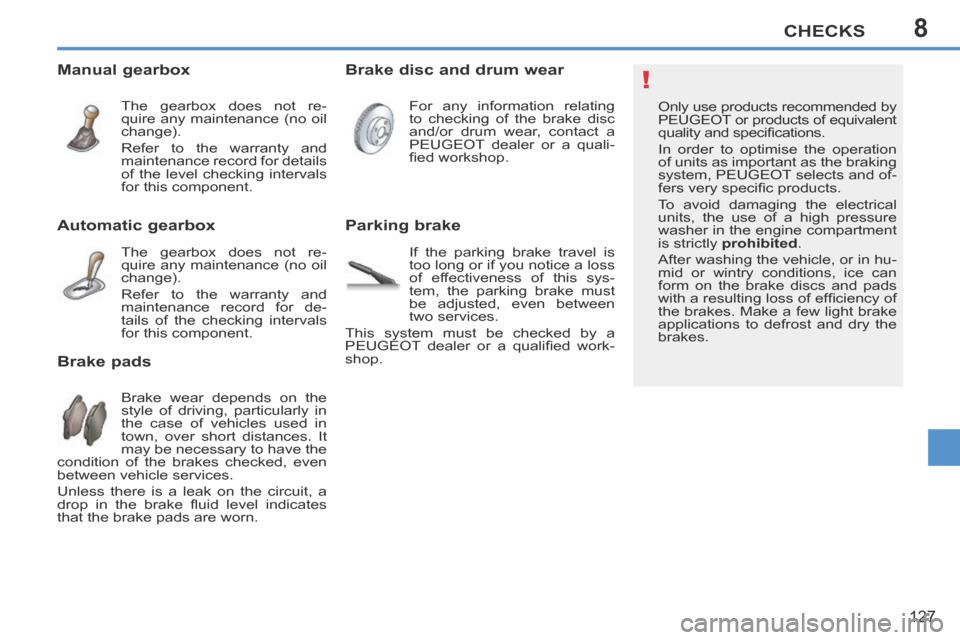
Automatic gearbox
The gearbox does not re-
quire any maintenance (no oil
change).
Refer to the warranty and
maintenance record for de-
tails of the checking intervals
for this component.
Brake disc and drum wear
For any information relating
to checking of the brake disc
and/or drum wear, contact a
PEUGEOT dealer or a quali-
fi ed workshop.
Manual gearbox
The gearbox does not re-
quire any maintenance (no oil
change).
Refer to the warranty and
maintenance record for details
of the level checking intervals
for this component.
Brake pads
Brake wear depends on the
style of driving, particularly in
the case of vehicles used in
town, over short distances. It
may be necessary to have the
condition of the brakes checked, even
between vehicle services.
Unless there is a leak on the circuit, a
drop in the brake fl uid level indicates
that the brake pads are worn.
Parking brake
If the parking brake travel is
too long or if you notice a loss
of effectiveness of this sys-
tem, the parking brake must
be adjusted, even between
two services.
This system must be checked by a
PEUGEOT dealer or a qualifi ed work-
shop.
Page 155 of 232
9
i
!
i
PRACTICAL INFORMATION
153
207CC_EN_CHAP09_INFO PRATIQUES_ED01-2014
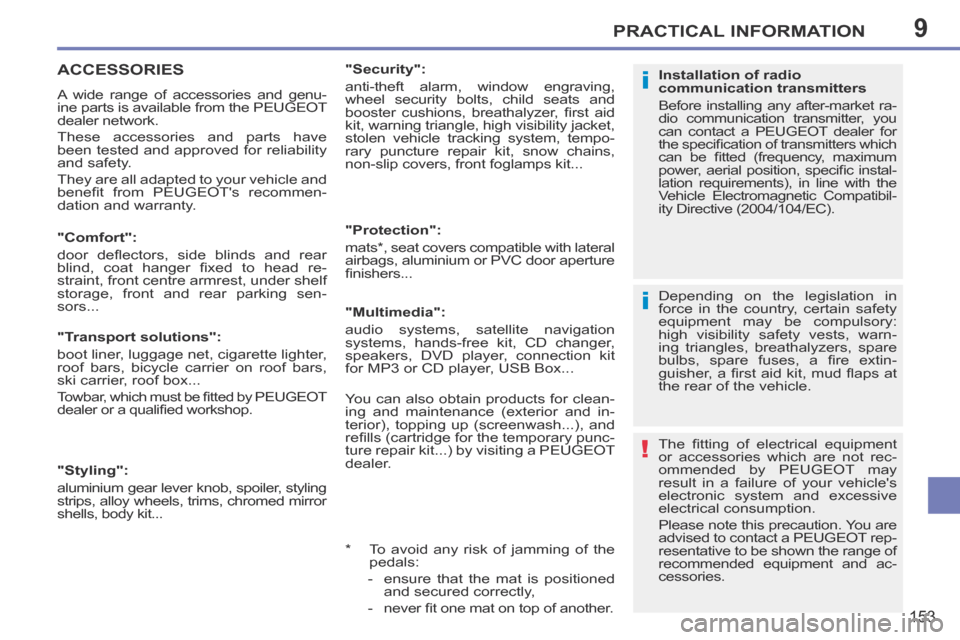
ACCESSORIES
A wide range of accessories and genu-
ine parts is available from the PEUGEOT
dealer network.
These accessories and parts have
been tested and approved for reliability
and safety.
They are all adapted to your vehicle and
benefi t from PEUGEOT's recommen-
dation and warranty. Depending on the legislation in
force in the country, certain safety
equipment may be compulsory:
high visibility safety vests, warn-
ing triangles, breathalyzers, spare
bulbs, spare fuses, a fi re extin-
guisher, a fi rst aid kit, mud fl aps at
the rear of the vehicle.
The fi tting of electrical equipment
or accessories which are not rec-
ommended by PEUGEOT may
result in a failure of your vehicle's
electronic system and excessive
electrical consumption.
Please note this precaution. You are
advised to contact a PEUGEOT rep-
resentative to be shown the range of
recommended equipment and ac-
cessories.
"Comfort":
door defl ectors, side blinds and rear
blind, coat hanger fi xed to head re-
straint, front centre armrest, under shelf
storage, front and rear parking sen-
sors...
Installation of radio
communication transmitters
Before installing any after-market ra-
dio communication transmitter, you
can contact a PEUGEOT dealer for
the specifi cation of transmitters which
can be fi tted (frequency, maximum
power, aerial position, specifi c instal-
lation requirements), in line with the
Vehicle Electromagnetic Compatibil-
ity Directive (2004/104/EC).
"Transport solutions":
boot liner, luggage net, cigarette lighter,
roof bars, bicycle carrier on roof bars,
ski carrier, roof box...
Towbar, which must be fi tted by PEUGEOT
dealer or a qualifi ed workshop.
"Styling":
aluminium gear lever knob, spoiler, styling
strips, alloy wheels, trims, chromed mirror
shells, body kit... * To avoid any risk of jamming of the pedals:
- ensure that the mat is positioned and secured correctly,
- never fi t one mat on top of another.
"Security":
anti-theft alarm, window engraving,
wheel security bolts, child seats and
booster cushions, breathalyzer, fi rst aid
kit, warning triangle, high visibility jacket,
stolen vehicle tracking system, tempo-
rary puncture repair kit, snow chains,
non-slip covers, front foglamps kit...
"Protection":
mats * , seat covers compatible with lateral
airbags, aluminium or PVC door aperture
fi nishers...
"Multimedia":
audio systems, satellite navigation
systems, hands-free kit, CD changer,
speakers, DVD player, connection kit
for MP3 or CD player, USB Box...
You can also obtain products for clean-
ing and maintenance (exterior and in-
terior), topping up (screenwash...), and
refi lls (cartridge for the temporary punc-
ture repair kit...) by visiting a PEUGEOT
dealer.
Page 220 of 232
218
VISUAL SEARCH
207CC_EN_CHAP12_RECHERCHE VISUELLE_ED01-2014
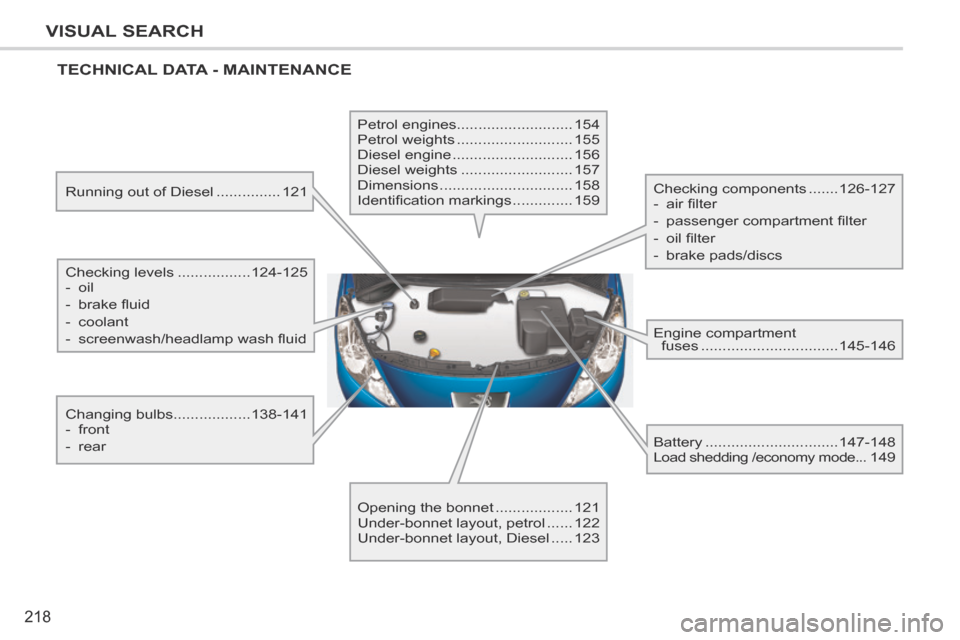
TECHNICAL DATA - MAINTENANCE
Running out of Diesel ...............121
Checking levels ................. 124-125
- oil
- brake fl uid
- coolant
- screenwash/headlamp wash fl uid
Changing bulbs ..................138-141
- front
- rear Petrol engines
........................... 154
Petrol weights ........................... 155
Diesel engine ............................ 156
Diesel weights .......................... 157
Dimensions ............................... 158
Identifi cation markings .............. 159
Opening the bonnet .................. 121
Under-bonnet layout, petrol ...... 122
Under-bonnet layout, Diesel ..... 123 Checking components .......
126-127
- air fi lter
- passenger compartment fi lter
- oil fi lter
- brake pads/discs
Engine compartment fuses ................................ 145-146
Battery ............................... 147-148
Load shedding /economy mode ...149