tow PEUGEOT 3008 2014 Owner's Guide
[x] Cancel search | Manufacturer: PEUGEOT, Model Year: 2014, Model line: 3008, Model: PEUGEOT 3008 2014Pages: 389, PDF Size: 22.92 MB
Page 210 of 389
Practical information
208
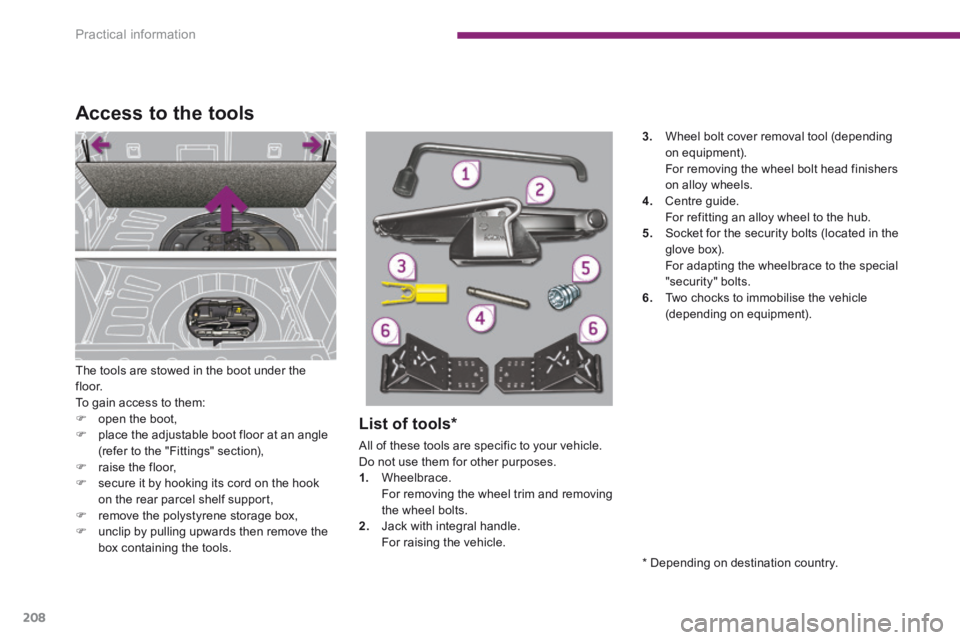
The tools are stowed in the boot under the f l o o r. To gain access to them: open the boot, place the adjustable boot floor at an angle (refer to the "Fittings" section), raise the floor, secure it by hooking its cord on the hook on the rear parcel shelf support, remove the polystyrene storage box, unclip by pulling upwards then remove the box containing the tools.
Access to the tools
* Depending on destination country.
List of tools *
All of these tools are specific to your vehicle. Do not use them for other purposes. 1. Wheelbrace. For removing the wheel trim and removing the wheel bolts. 2. Jack with integral handle. For raising the vehicle.
3. Wheel bolt cover removal tool (depending on equipment). For removing the wheel bolt head finishers on alloy wheels. 4. Centre guide. For refitting an alloy wheel to the hub.
5. Socket for the security bolts (located in the glove box). For adapting the wheelbrace to the special "security" bolts. 6. Two chocks to immobilise the vehicle (depending on equipment).
Page 211 of 389
11
Practical information209
Wheel with trim
When removing the wheel , detach the trim first using the wheelbrace 1 pulling at the valve passage hole. When refitting the wheel , refit the trim starting by placing its notch facing the valve and press around its edge with the palm of your hand.
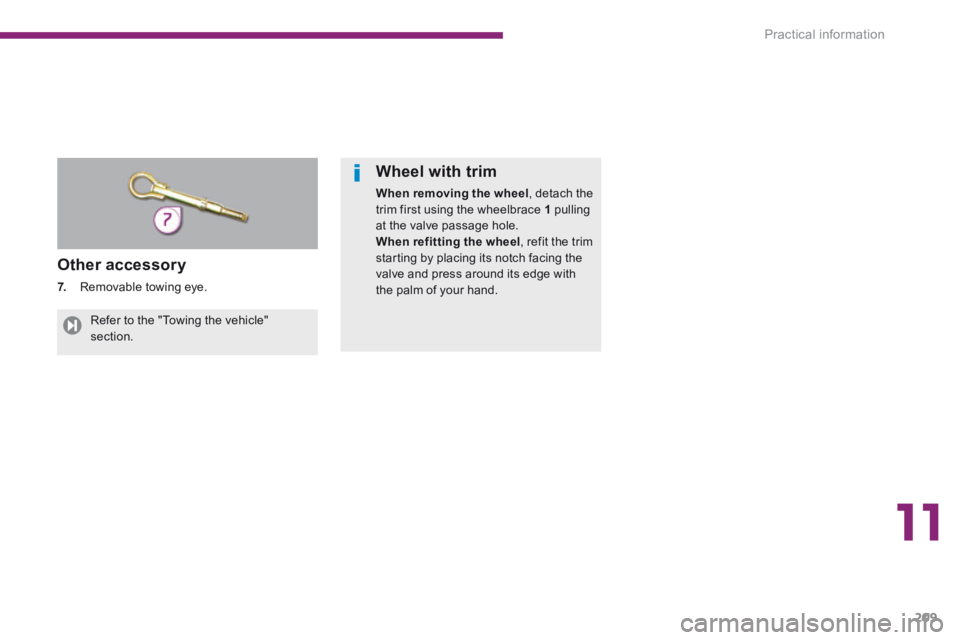
Refer to the "Towing the vehicle" section.
Other accessory
7. Removable towing eye.
Page 212 of 389
Practical information
210
Putting the wheel back in place
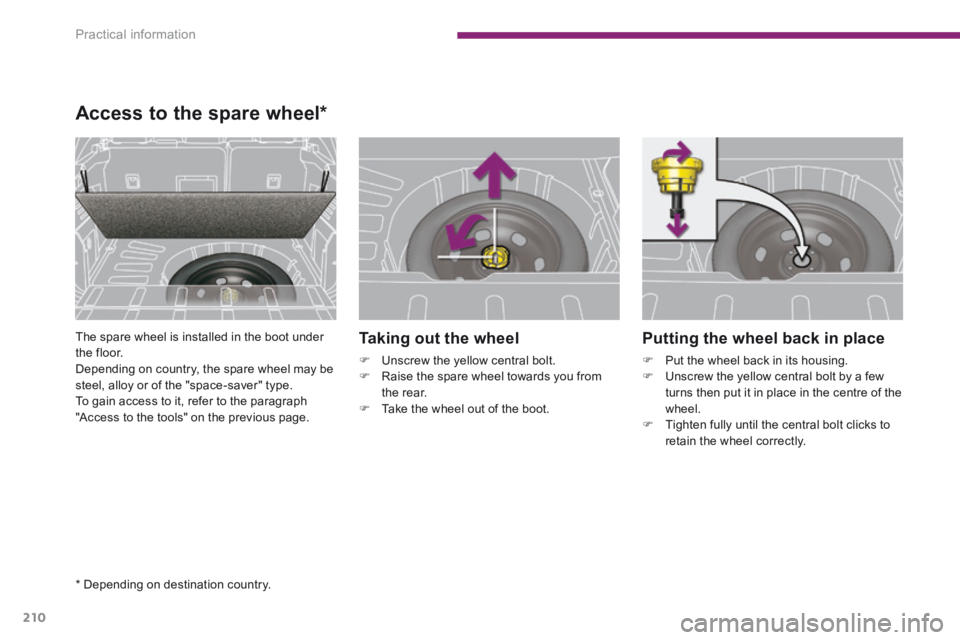
Put the wheel back in its housing. Unscrew the yellow central bolt by a few turns then put it in place in the centre of the wheel. Tighten fully until the central bolt clicks to retain the wheel correctly.
Access to the spare wheel *
The spare wheel is installed in the boot under the floor. Depending on country, the spare wheel may be steel, alloy or of the "space-saver" type. To gain access to it, refer to the paragraph "Access to the tools" on the previous page.
Taking out the wheel
Unscrew the yellow central bolt. Raise the spare wheel towards you from the rear. Take the wheel out of the boot.
* Depending on destination country.
Page 218 of 389
Practical information
216
Changing a bulb
Model with halogen headlamps
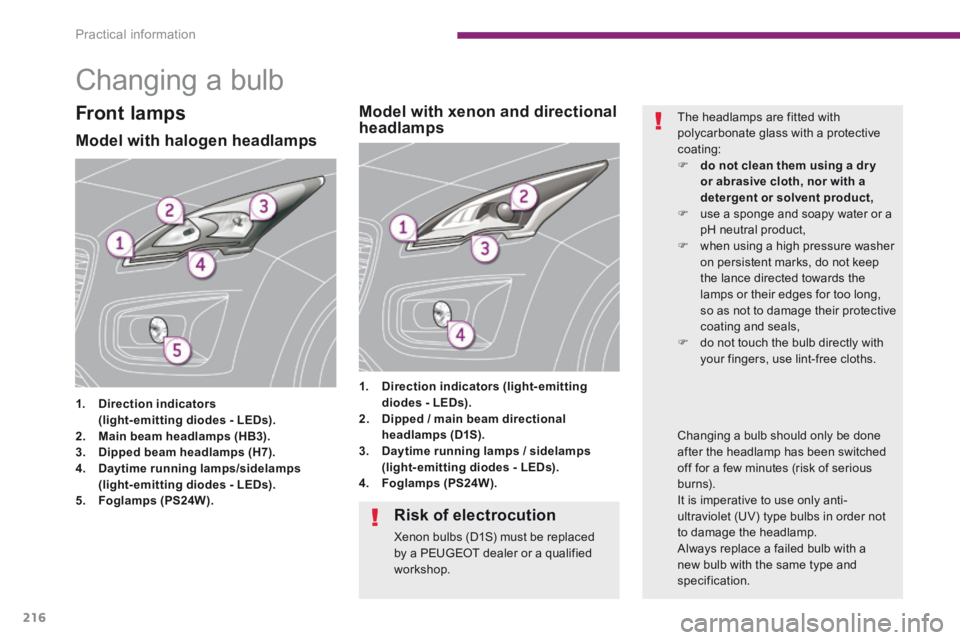
1. Direction indicators (light-emitting diodes - LEDs).2. Main beam headlamps (HB3).3. Dipped beam headlamps (H7).4. Daytime running lamps/sidelamps (light-emitting diodes - LEDs).5. Foglamps (PS24W).
1. Direction indicators (light-emitting diodes - LEDs).2. Dipped / main beam directional
headlamps (D1S).3. Daytime running lamps / sidelamps (light-emitting diodes - LEDs).4. Foglamps (PS24W).
Model with xenon and directional headlamps Front lamps The headlamps are fitted with polycarbonate glass with a protective coating: do not clean them using a dr y or abrasive cloth, nor with a detergent or solvent product, use a sponge and soapy water or a pH neutral product, when using a high pressure washer on persistent marks, do not keep the lance directed towards the lamps or their edges for too long, so as not to damage their protective coating and seals, do not touch the bulb directly with your fingers, use lint-free cloths.
Risk of electrocution
Xenon bulbs (D1S) must be replaced by a PEUGEOT dealer or a qualified workshop.
Changing a bulb should only be done after the headlamp has been switched off for a few minutes (risk of serious burns). It is imperative to use only anti-ultraviolet (UV) type bulbs in order not to damage the headlamp. Always replace a failed bulb with a new bulb with the same type and specification.
Page 220 of 389
Practical information
218
Changing foglamp bulbs
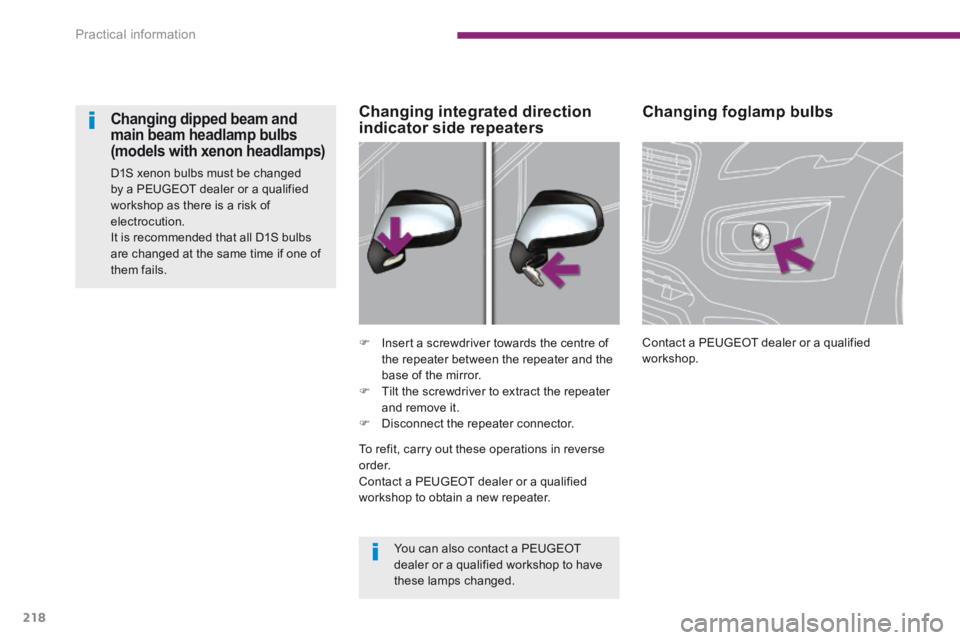
Contact a PEUGEOT dealer or a qualified workshop. Insert a screwdriver towards the centre of the repeater between the repeater and the base of the mirror. Tilt the screwdriver to extract the repeater and remove it. Disconnect the repeater connector.
Changing integrated direction indicator side repeaters Changing dipped beam and main beam headlamp bulbs (models with xenon headlamps)
D1S xenon bulbs must be changed by a PEUGEOT dealer or a qualified workshop as there is a risk of electrocution. It is recommended that all D1S bulbs are changed at the same time if one of them fails.
You can also contact a PEUGEOT dealer or a qualified workshop to have these lamps changed.
To refit, carry out these operations in reverse o r d e r. Contact a PEUGEOT dealer or a qualified workshop to obtain a new repeater.
Page 235 of 389
11
Practical information233
Changing a wiper blade
Removing
Raise the corresponding wiper arm. Unclip the wiper blade and remove it.
Fitting
Put the corresponding new wiper blade in place and clip it. Fold down the wiper arm carefully.
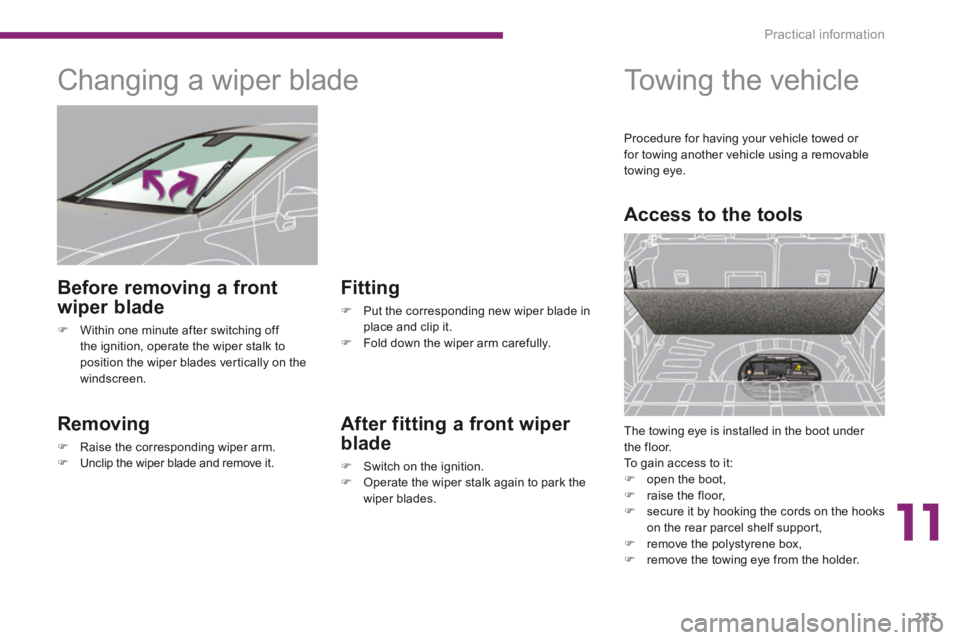
Before removing a front
wiper blade
Within one minute after switching off the ignition, operate the wiper stalk to position the wiper blades vertically on the windscreen.
After fitting a front wiper
blade
Switch on the ignition. Operate the wiper stalk again to park the wiper blades.
Towing the vehicle
Access to the tools
The towing eye is installed in the boot under the floor. To gain access to it: open the boot, raise the floor, secure it by hooking the cords on the hooks on the rear parcel shelf support, remove the polystyrene box, remove the towing eye from the holder.
Procedure for having your vehicle towed or for towing another vehicle using a removable towing eye.
Page 236 of 389
Practical information
234
Towing your vehicle
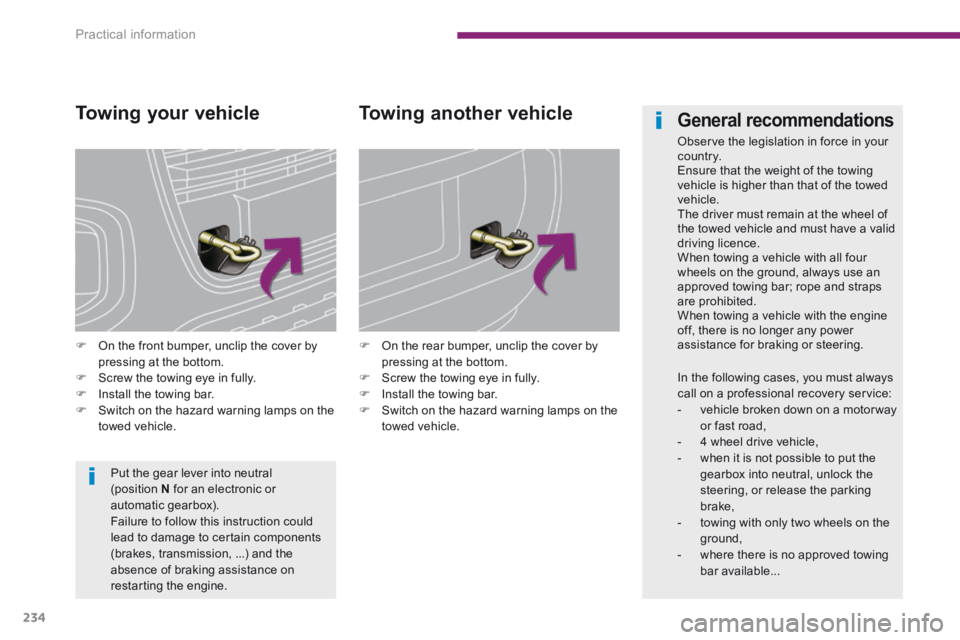
On the front bumper, unclip the cover by pressing at the bottom. Screw the towing eye in fully. Install the towing bar. Switch on the hazard warning lamps on the towed vehicle.
On the rear bumper, unclip the cover by pressing at the bottom. Screw the towing eye in fully. Install the towing bar. Switch on the hazard warning lamps on the
towed vehicle.
Towing another vehicle
Put the gear lever into neutral (position N for an electronic or automatic gearbox). Failure to follow this instruction could lead to damage to certain components (brakes, transmission, ...) and the absence of braking assistance on
restarting the engine.
General recommendations
Observe the legislation in force in your c o unt r y. Ensure that the weight of the towing vehicle is higher than that of the towed vehicle. The driver must remain at the wheel of the towed vehicle and must have a valid driving licence. When towing a vehicle with all four wheels on the ground, always use an approved towing bar; rope and straps are prohibited. When towing a vehicle with the engine off, there is no longer any power assistance for braking or steering.
In the following cases, you must always call on a professional recovery service: - vehicle broken down on a motor way or fast road, - 4 wheel drive vehicle, - when it is not possible to put the gearbox into neutral, unlock the steering, or release the parking brake, - towing with only two wheels on the
ground, - where there is no approved towing bar available...
Page 237 of 389
11
Practical information235
Towing a trailer
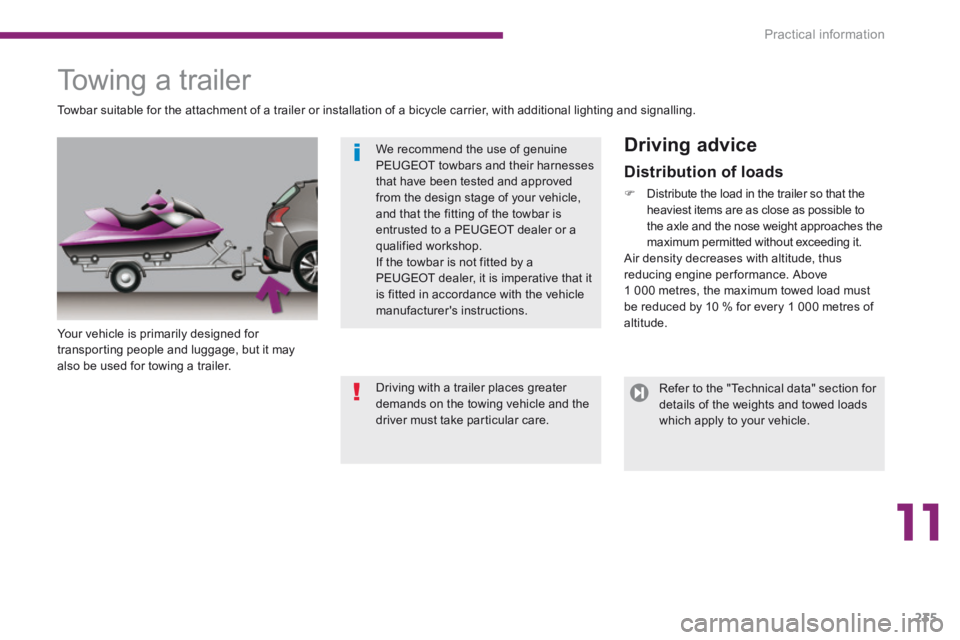
Your vehicle is primarily designed for transporting people and luggage, but it may also be used for towing a trailer.
Driving advice
Towbar suitable for the attachment of a trailer or installation of a bicycle carrier, with additional lighting and signalling.
Distribution of loads
Distribute the load in the trailer so that the heaviest items are as close as possible to the axle and the nose weight approaches the maximum permitted without exceeding it. Air density decreases with altitude, thus reducing engine performance. Above 1 000 metres, the maximum towed load must be reduced by 10 % for every 1 000 metres of altitude.
We recommend the use of genuine PEUGEOT towbars and their harnesses that have been tested and approved from the design stage of your vehicle, and that the fitting of the towbar is
entrusted to a PEUGEOT dealer or a qualified workshop. If the towbar is not fitted by a PEUGEOT dealer, it is imperative that it is fitted in accordance with the vehicle manufacturer's instructions.
Refer to the "Technical data" section for details of the weights and towed loads which apply to your vehicle.
Driving with a trailer places greater demands on the towing vehicle and the driver must take particular care.
Page 238 of 389
Practical information
236
Side wind
Take into account the increased sensitivity to side wind.
Cooling
Towing a trailer on a slope increases the temperature of the coolant. As the fan is electrically controlled, its cooling capacity is not dependent on the engine speed. To lower the engine speed, reduce your speed. The maximum towed load on a long incline depends on the gradient and the ambient temperature. In all cases, keep a check on the coolant temperature.
Braking
Towing a trailer increases the braking distance. To avoid overheating of the brakes on a long
mountain type of descent, the use of engine braking is recommended.
Ty r e s
Check the tyre pressures of the towing vehicle and of the trailer, observing the recommended pressures.
Lighting
Check the electrical lighting and signalling on the trailer.
If the warning lamp and the STOP warning lamp come on, stop the vehicle and switch off the engine as soon as possible.
The rear parking sensors will be deactivated automatically if a genuine PEUGEOT towbar is used.
Page 240 of 389
Practical information
238
Very cold climate screen
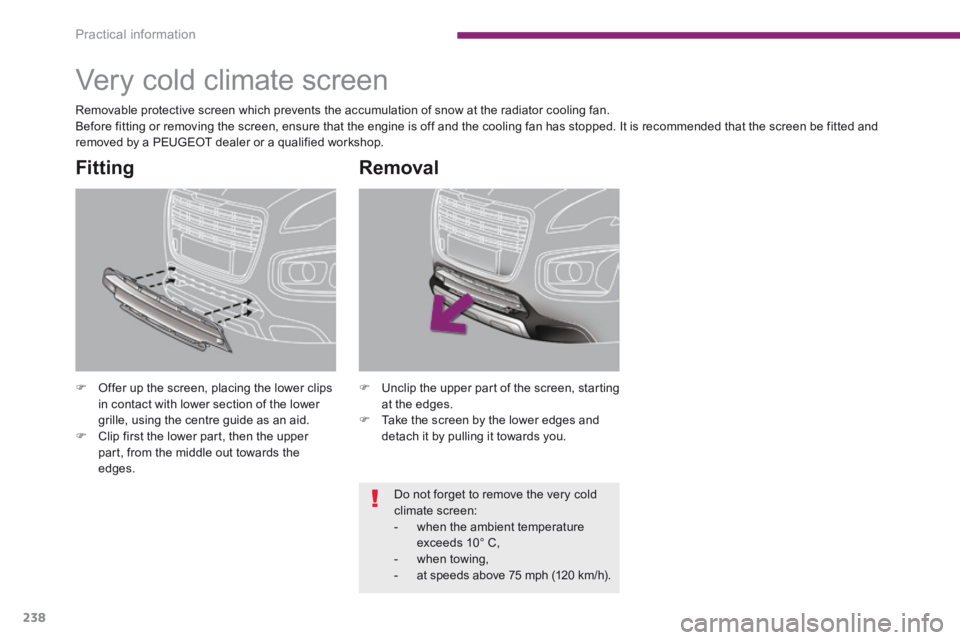
Offer up the screen, placing the lower clips in contact with lower section of the lower grille, using the centre guide as an aid. Clip first the lower part, then the upper part, from the middle out towards the edges.
Fitting
Unclip the upper part of the screen, starting at the edges. Take the screen by the lower edges and
detach it by pulling it towards you.
Removal
Removable protective screen which prevents the accumulation of snow at the radiator cooling fan. Before fitting or removing the screen, ensure that the engine is off and the cooling fan has stopped. It is recommended that the screen be fitted and removed by a PEUGEOT dealer or a qualified workshop.
Do not forget to remove the very cold climate screen: - when the ambient temperature exceeds 10° C, - when towing, - at speeds above 75 mph (120 km/h).