tow PEUGEOT 3008 2014 Owner's Manual
[x] Cancel search | Manufacturer: PEUGEOT, Model Year: 2014, Model line: 3008, Model: PEUGEOT 3008 2014Pages: 389, PDF Size: 22.92 MB
Page 154 of 389
Safety
152
Lateral airbags
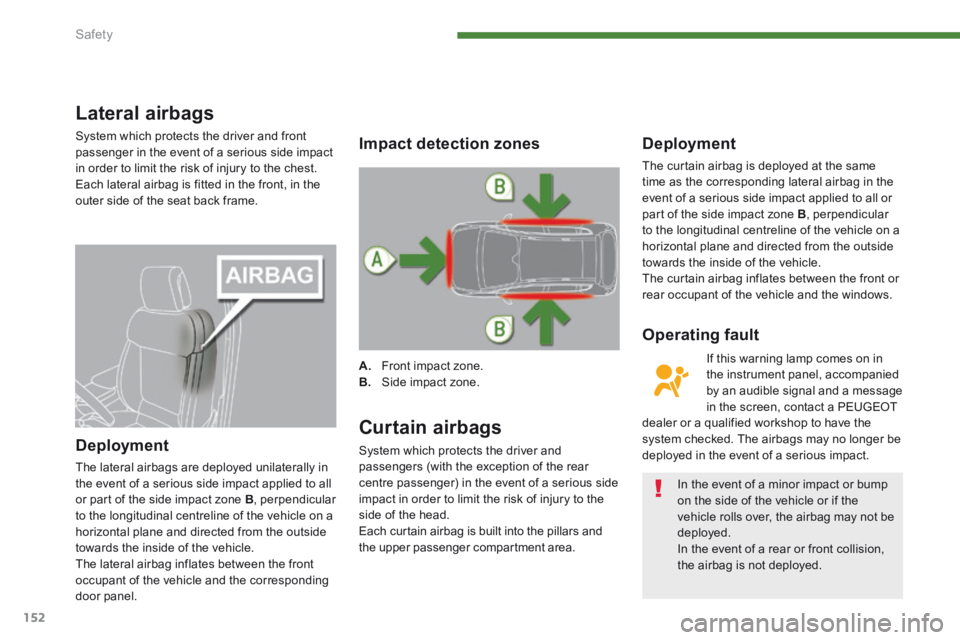
System which protects the driver and front passenger in the event of a serious side impact in order to limit the risk of injury to the chest. Each lateral airbag is fitted in the front, in the outer side of the seat back frame.
Deployment
The lateral airbags are deployed unilaterally in the event of a serious side impact applied to all or part of the side impact zone B , perpendicular to the longitudinal centreline of the vehicle on a horizontal plane and directed from the outside towards the inside of the vehicle. The lateral airbag inflates between the front occupant of the vehicle and the corresponding door panel.
Curtain airbags
System which protects the driver and passengers (with the exception of the rear centre passenger) in the event of a serious side impact in order to limit the risk of injury to the side of the head. Each curtain airbag is built into the pillars and the upper passenger compartment area.
Deployment
The curtain airbag is deployed at the same time as the corresponding lateral airbag in the event of a serious side impact applied to all or part of the side impact zone B , perpendicular to the longitudinal centreline of the vehicle on a horizontal plane and directed from the outside towards the inside of the vehicle. The curtain airbag inflates between the front or rear occupant of the vehicle and the windows.
Impact detection zones
A. Front impact zone. B. Side impact zone.
Operating fault
If this warning lamp comes on in the instrument panel, accompanied by an audible signal and a message in the screen, contact a PEUGEOT dealer or a qualified workshop to have the
system checked. The airbags may no longer be deployed in the event of a serious impact.
In the event of a minor impact or bump on the side of the vehicle or if the vehicle rolls over, the airbag may not be deployed. In the event of a rear or front collision, the airbag is not deployed.
Page 156 of 389
154Driving
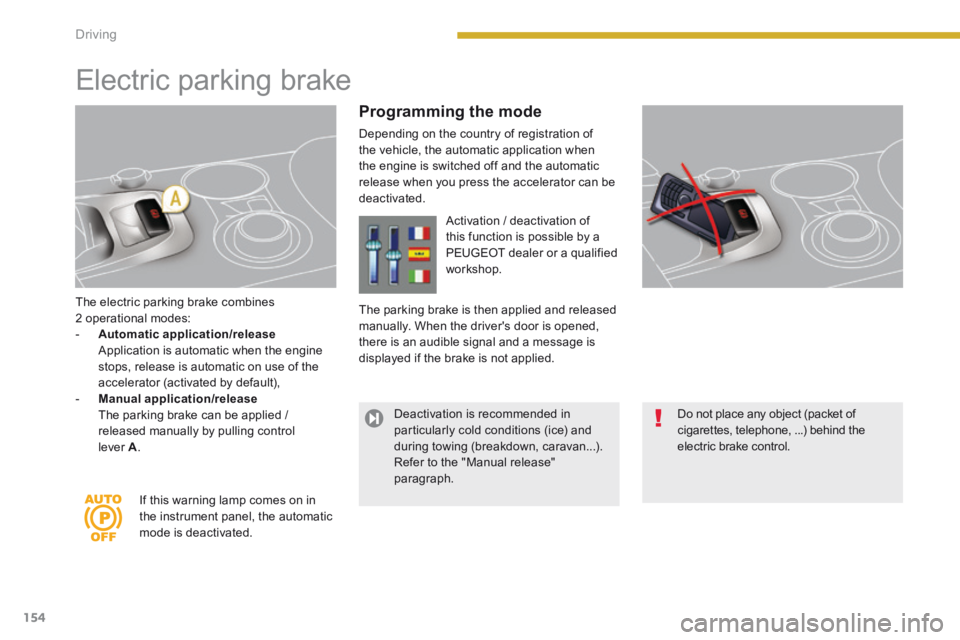
The electric parking brake combines 2 operational modes: - Automatic application/release Application is automatic when the engine stops, release is automatic on use of the accelerator (activated by default), - Manual application/release The parking brake can be applied /
released manually by pulling control lever A .
Electric parking brake
Programming the mode
Depending on the country of registration of the vehicle, the automatic application when the engine is switched off and the automatic release when you press the accelerator can be deactivated.
If this warning lamp comes on in the instrument panel, the automatic mode is deactivated.
Activation / deactivation of this function is possible by a PEUGEOT dealer or a qualified workshop.
The parking brake is then applied and released manually. When the driver's door is opened, there is an audible signal and a message is displayed if the brake is not applied.
Deactivation is recommended in particularly cold conditions (ice) and during towing (breakdown, caravan...). Refer to the "Manual release" paragraph.
Do not place any object (packet of cigarettes, telephone, ...) behind the electric brake control.
Page 157 of 389
9
155
Driving
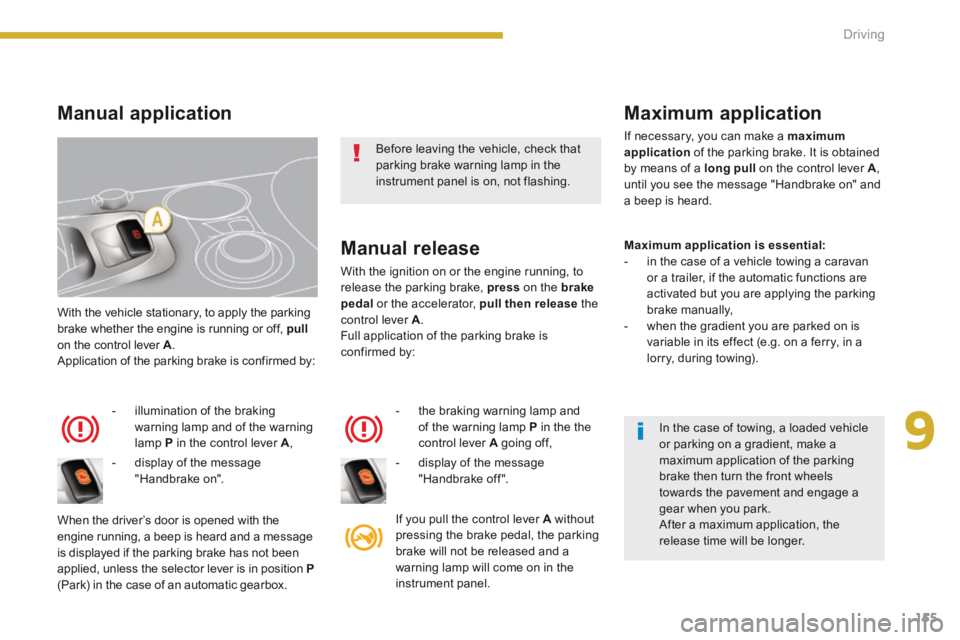
With the vehicle stationary, to apply the parking brake whether the engine is running or off, pull on the control lever A . Application of the parking brake is confirmed by:
- illumination of the braking warning lamp and of the warning lamp P in the control lever A ,
When the driver’s door is opened with the engine running, a beep is heard and a message is displayed if the parking brake has not been applied, unless the selector lever is in position P
(Park) in the case of an automatic gearbox.
Manual release
With the ignition on or the engine running, to release the parking brake, press on the brakepedal or the accelerator, pull then release the control lever A . Full application of the parking brake is confirmed by:
- the braking warning lamp and of the warning lamp P in the the control lever A going off,
If you pull the control lever A without pressing the brake pedal, the parking brake will not be released and a warning lamp will come on in the instrument panel.
Manual application Maximum application
If necessary, you can make a maximum application of the parking brake. It is obtained by means of a long pull on the control lever A , until you see the message "Handbrake on" and a beep is heard.
Maximum application is essential: - in the case of a vehicle towing a caravan or a trailer, if the automatic functions are activated but you are applying the parking brake manually, - when the gradient you are parked on is variable in its effect (e.g. on a ferry, in a lorry, during towing).
- display of the message "Handbrake on". - display of the message "Handbrake off ".
Before leaving the vehicle, check that parking brake warning lamp in the instrument panel is on, not flashing.
In the case of towing, a loaded vehicle or parking on a gradient, make a maximum application of the parking brake then turn the front wheels towards the pavement and engage a gear when you park. After a maximum application, the release time will be longer.
Page 158 of 389
156Driving
Automatic application,
engine off
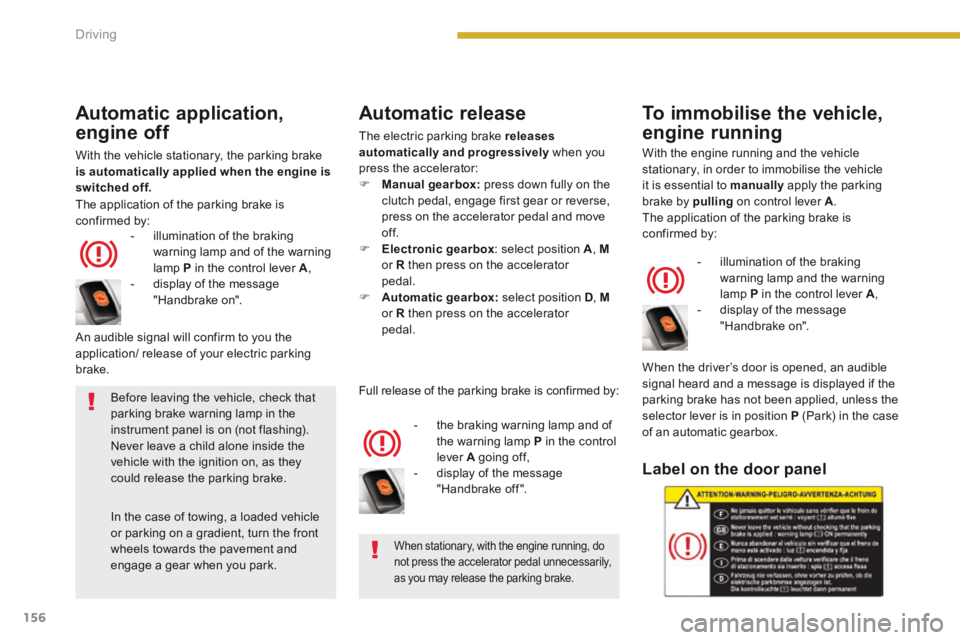
With the vehicle stationary, the parking brake is automatically applied when the engine is switched off.
- illumination of the braking warning lamp and of the warning lamp P in the control lever A ,
Automatic release
The electric parking brake releases automatically and progressively when you press the accelerator: Manual gearbox: press down fully on the clutch pedal, engage first gear or reverse, press on the accelerator pedal and move of f. Electronic gearbox : select position A , Mor R then press on the accelerator pedal. Automatic gearbox: select position D , Mor R then press on the accelerator pedal.
- the braking warning lamp and of the warning lamp P in the control lever A going off,
An audible signal will confirm to you the application/ release of your electric parking brake.
Full release of the parking brake is confirmed by:
To immobilise the vehicle,
engine running
With the engine running and the vehicle stationary, in order to immobilise the vehicle it is essential to manually apply the parking brake by pulling on control lever A . The application of the parking brake is
confirmed by:
- illumination of the braking warning lamp and the warning lamp P in the control lever A ,
When the driver’s door is opened, an audible signal heard and a message is displayed if the parking brake has not been applied, unless the selector lever is in position P (Park) in the case of an automatic gearbox.
The application of the parking brake is confirmed by:
- display of the message "Handbrake on".
- display of the message "Handbrake off ".
- display of the message "Handbrake on".
Label on the door panel
Before leaving the vehicle, check that parking brake warning lamp in the
instrument panel is on (not flashing). Never leave a child alone inside the vehicle with the ignition on, as they could release the parking brake.
In the case of towing, a loaded vehicle or parking on a gradient, turn the front wheels towards the pavement and engage a gear when you park.
When stationary, with the engine running, do not press the accelerator pedal unnecessarily, as you may release the parking brake.
Page 183 of 389
9
181
Driving
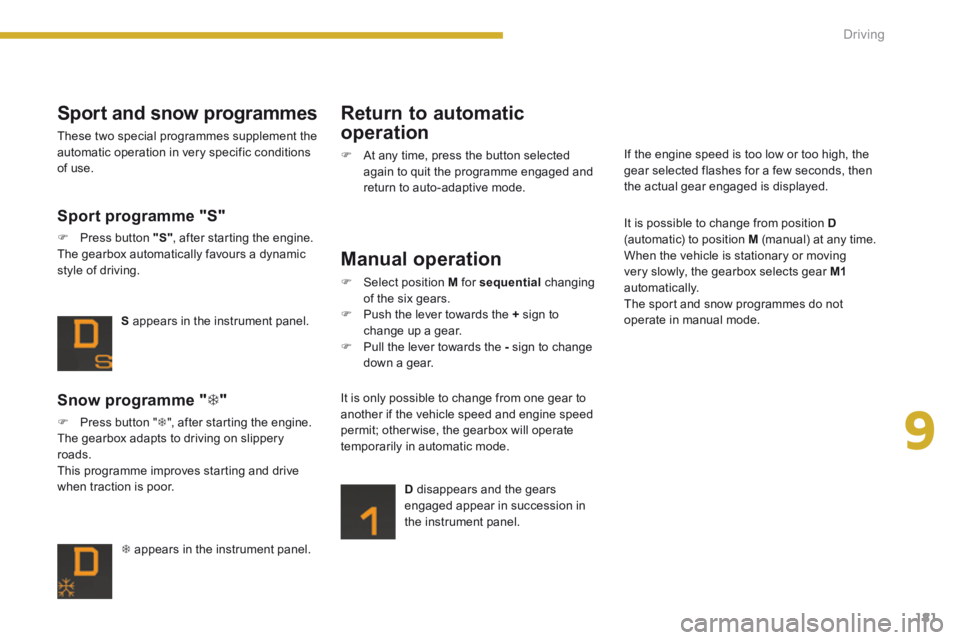
appears in the instrument panel.
Snow programme " "
Press button " ", after starting the engine. The gearbox adapts to driving on slippery roads. This programme improves starting and drive when traction is poor.
S appears in the instrument panel.
Sport programme "S"
Press button "S" , after starting the engine. The gearbox automatically favours a dynamic style of driving.
Sport and snow programmes
These two special programmes supplement the automatic operation in very specific conditions of use.
Return to automatic
operation
At any time, press the button selected again to quit the programme engaged and return to auto-adaptive mode.
Manual operation
Select position M for sequential changing of the six gears. Push the lever towards the + sign to change up a gear. Pull the lever towards the - sign to change down a gear.
D disappears and the gears engaged appear in succession in the instrument panel.
It is only possible to change from one gear to another if the vehicle speed and engine speed
permit; otherwise, the gearbox will operate temporarily in automatic mode.
It is possible to change from position D(automatic) to position M (manual) at any time. When the vehicle is stationary or moving very slowly, the gearbox selects gear M1automatically. The sport and snow programmes do not operate in manual mode.
If the engine speed is too low or too high, the gear selected flashes for a few seconds, then the actual gear engaged is displayed.
Page 189 of 389
9
187
Driving
The parking sensors are switched off : switched off : switched off - when you exit reverse gear, - when the speed is higher than 6 mph (10 km/h) in for ward gear, - when the vehicle has been stationary for more than three seconds in for ward gear.
Deactivation Operating fault
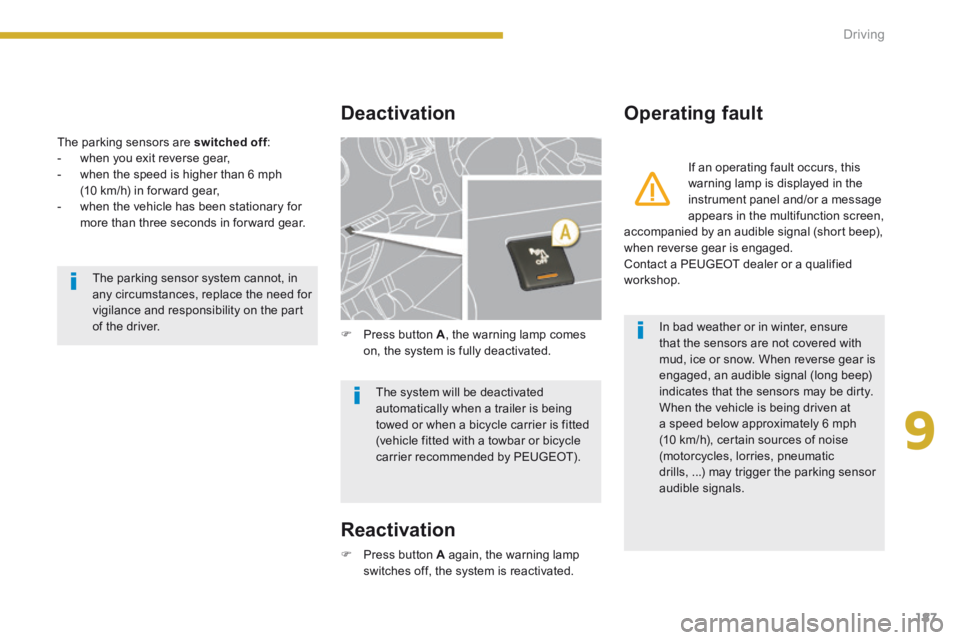
Press button A again, the warning lamp switches off, the system is reactivated.
Press button A , the warning lamp comes on, the system is fully deactivated.
If an operating fault occurs, this warning lamp is displayed in the instrument panel and/or a message appears in the multifunction screen, accompanied by an audible signal (short beep), when reverse gear is engaged. Contact a PEUGEOT dealer or a qualified workshop. The parking sensor system cannot, in any circumstances, replace the need for vigilance and responsibility on the part of the driver.
The system will be deactivated automatically when a trailer is being towed or when a bicycle carrier is fitted (vehicle fitted with a towbar or bicycle carrier recommended by PEUGEOT).
In bad weather or in winter, ensure that the sensors are not covered with mud, ice or snow. When reverse gear is engaged, an audible signal (long beep) indicates that the sensors may be dirty. When the vehicle is being driven at a speed below approximately 6 mph (10 km/h), certain sources of noise (motorcycles, lorries, pneumatic drills, ...) may trigger the parking sensor audible signals.
Reactivation
Page 202 of 389
Checks
200
Brake disc wear
Brake pads
Brake wear depends on the style of driving, particularly in the case of vehicles used in town, over short distances. It may be necessary to have the condition of the brakes checked, even between vehicle services. Unless there is a leak in the circuit, a drop in the brake fluid level indicates that the brake pads are worn.
For information on checking brake disc wear, contact a PEUGEOT dealer or a qualified workshop.
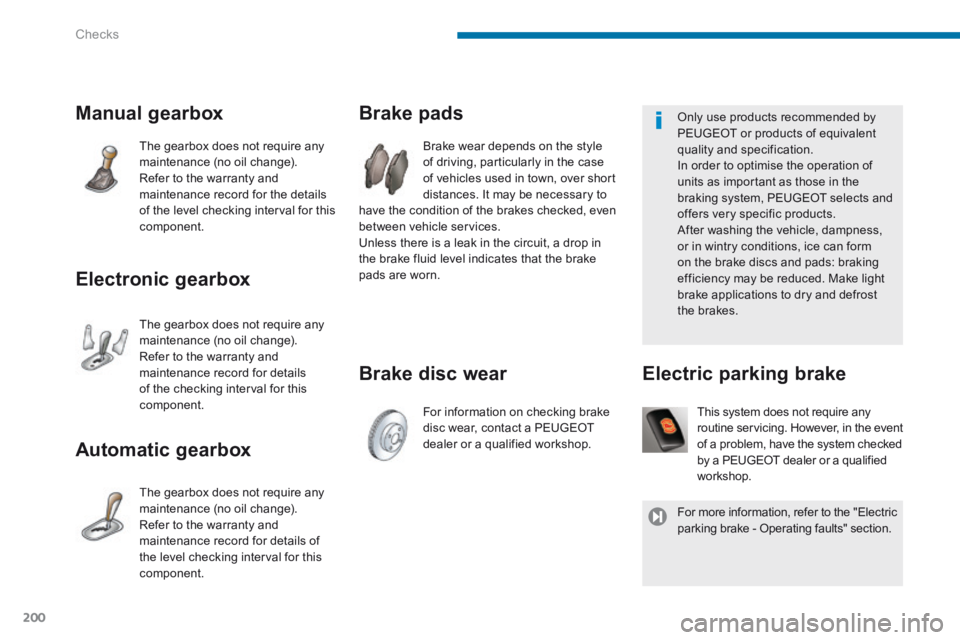
Manual gearbox
The gearbox does not require any maintenance (no oil change). Refer to the warranty and maintenance record for the details of the level checking interval for this component.
Electronic gearbox
The gearbox does not require any maintenance (no oil change). Refer to the warranty and maintenance record for details of the checking interval for this component.
Automatic gearbox
The gearbox does not require any maintenance (no oil change). Refer to the warranty and maintenance record for details of the level checking interval for this component.
This system does not require any routine servicing. However, in the event of a problem, have the system checked by a PEUGEOT dealer or a qualified workshop.
Electric parking brake
Only use products recommended by PEUGEOT or products of equivalent quality and specification. In order to optimise the operation of units as important as those in the braking system, PEUGEOT selects and offers very specific products. After washing the vehicle, dampness, or in wintry conditions, ice can form on the brake discs and pads: braking efficiency may be reduced. Make light brake applications to dry and defrost the brakes.
For more information, refer to the "Electric parking brake - Operating faults" section.
Page 203 of 389
11
Practical information201
Temporary puncture repair kit
The kit is stowed in the boot under the floor. It is installed in the tool box, located under the storage box.
Complete system consisting of a compressor and a sealant cartridge which permits temporary repair of a tyre so that you can temporary repair of a tyre so that you can temporary repairdrive to the nearest garage. It is designed to repair most punctures which could affect the tyre, located on the tyre tread or shoulder.
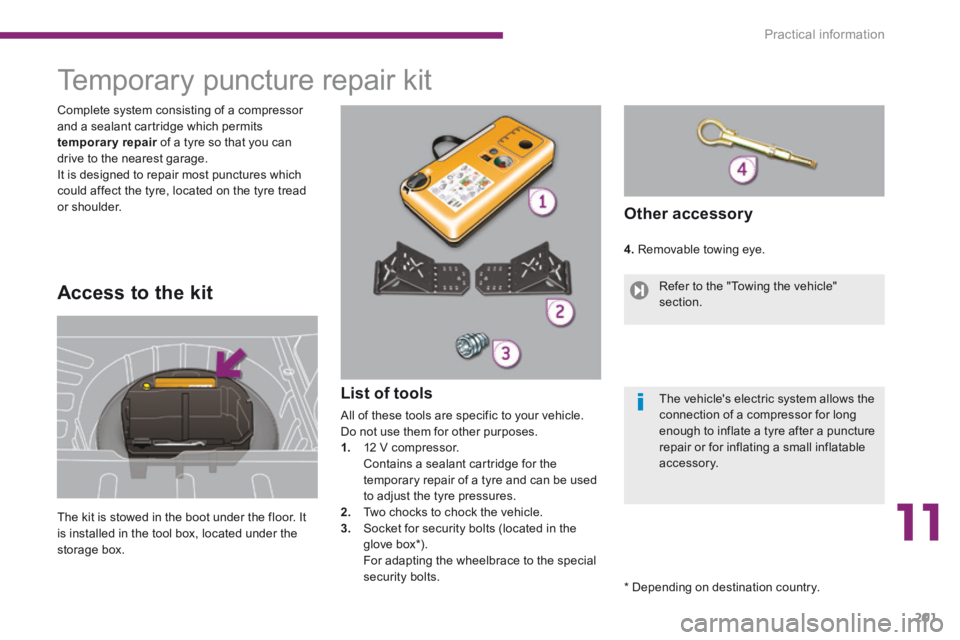
List of tools
All of these tools are specific to your vehicle.
Do not use them for other purposes. 1. 12 V compressor. Contains a sealant cartridge for the temporary repair of a tyre and can be used to adjust the tyre pressures. 2. Two chocks to chock the vehicle. 3. Socket for security bolts (located in the glove box*) . For adapting the wheelbrace to the special security bolts.
4. Removable towing eye.
Access to the kit
Other accessory
Refer to the "Towing the vehicle" section.
The vehicle's electric system allows the connection of a compressor for long enough to inflate a tyre after a puncture repair or for inflating a small inflatable accessory.
* Depending on destination country.
Page 207 of 389
11
Practical information205
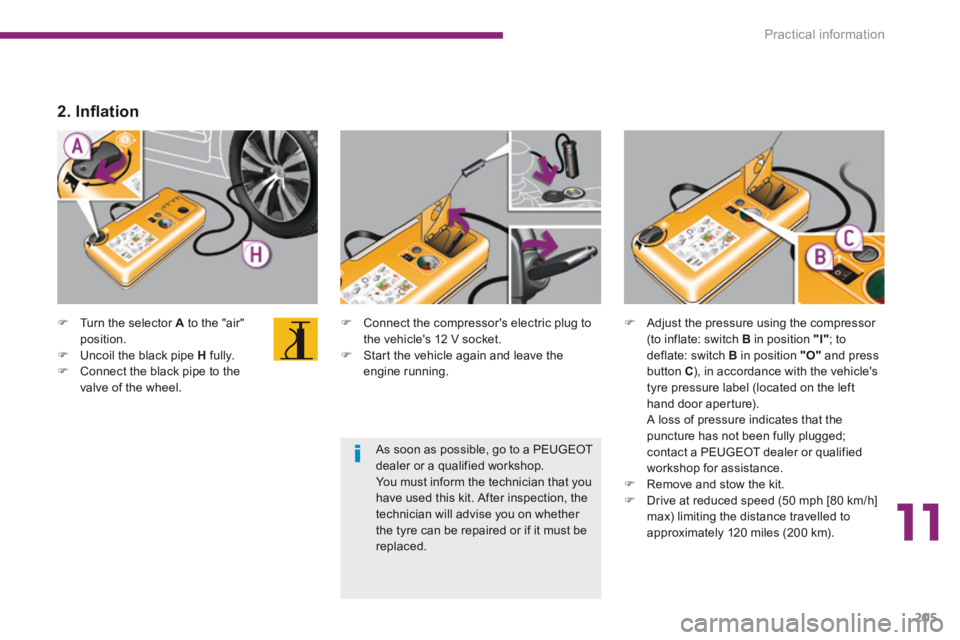
Turn the selector A to the "air" position. Uncoil the black pipe H fully. Connect the black pipe to the valve of the wheel.
Connect the compressor's electric plug to the vehicle's 12 V socket. Start the vehicle again and leave the engine running.
Adjust the pressure using the compressor (to inflate: switch B in position "I" ; to deflate: switch B in position "O" and press button C ), in accordance with the vehicle's tyre pressure label (located on the left hand door aperture). A loss of pressure indicates that the puncture has not been fully plugged; contact a PEUGEOT dealer or qualified workshop for assistance. Remove and stow the kit. Drive at reduced speed (50 mph [80 km/h] max) limiting the distance travelled to approximately 120 miles (200 km).
2 . I n fl a t i o n
As soon as possible, go to a PEUGEOT dealer or a qualified workshop. You must inform the technician that you have used this kit. After inspection, the technician will advise you on whether the tyre can be repaired or if it must be replaced.
Page 208 of 389
Practical information
206
Removing the cartridge
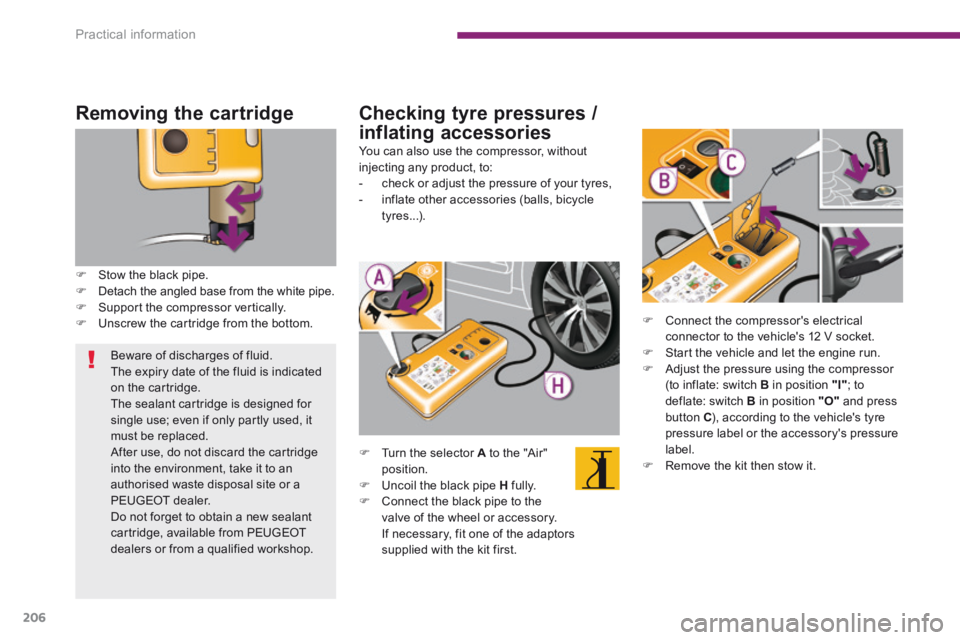
Stow the black pipe. Detach the angled base from the white pipe. Support the compressor vertically. Unscrew the cartridge from the bottom.
Checking tyre pressures /
inflating accessories
Turn the selector A to the "Air" position. Uncoil the black pipe H fully. Connect the black pipe to the valve of the wheel or accessory. If necessary, fit one of the adaptors supplied with the kit first.
You can also use the compressor, without injecting any product, to: - check or adjust the pressure of your tyres, - inflate other accessories (balls, bicycle tyres...).
Connect the compressor's electrical connector to the vehicle's 12 V socket. Start the vehicle and let the engine run. Adjust the pressure using the compressor (to inflate: switch B in position "I" ; to deflate: switch B in position "O" and press button C ), according to the vehicle's tyre
pressure label or the accessory's pressure label. Remove the kit then stow it.
Beware of discharges of fluid. The expiry date of the fluid is indicated on the cartridge. The sealant cartridge is designed for single use; even if only partly used, it
must be replaced. After use, do not discard the cartridge into the environment, take it to an authorised waste disposal site or a PEUGEOT dealer. Do not forget to obtain a new sealant cartridge, available from PEUGEOT dealers or from a qualified workshop.