fault PEUGEOT 3008 2017 Workshop Manual
[x] Cancel search | Manufacturer: PEUGEOT, Model Year: 2017, Model line: 3008, Model: PEUGEOT 3008 2017Pages: 566, PDF Size: 16.05 MB
Page 209 of 566
207
3008-2_en_Chap06_conduite_ed01-2016
Deactivating automatic operation
In some situations, such as very cold weather
or towing (caravan, recovery), it may be
necessary to deactivate automatic operation of
the system.
F
S
tart the engine.
F
A
pply the parking brake with the control
lever, if it is released.
F
T
ake your foot off the brake pedal.
F
P
ush and hold the control lever in the
release direction for at least 10 seconds
and no more than 15 seconds.
F
R
elease the control lever.
F
P
ress and hold the brake pedal.
F
P
ull the control lever in the apply direction
for 2 seconds.
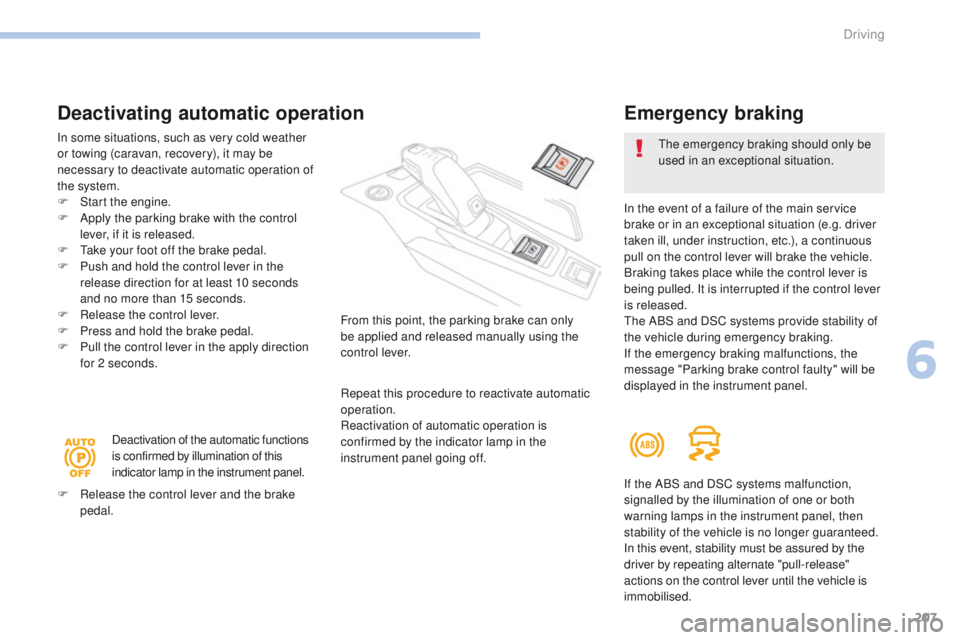
Deactivation of the automatic functions
is confirmed by illumination of this
indicator lamp in the instrument panel.
F
R
elease the control lever and the brake
pedal. From this point, the parking brake can only
be applied and released manually using the
control lever.
Repeat this procedure to reactivate automatic
operation.
Reactivation of automatic operation is
confirmed by the indicator lamp in the
instrument panel going off.
Emergency braking
The emergency braking should only be
used in an exceptional situation.
In the event of a failure of the main service
brake or in an exceptional situation (e.g. driver
taken ill, under instruction, etc.), a continuous
pull on the control lever will brake the vehicle.
Braking takes place while the control lever is
being pulled. It is interrupted if the control lever
is released.
The ABS and DSC systems provide stability of
the vehicle during emergency braking.
If the emergency braking malfunctions, the
message "Parking brake control faulty" will be
displayed in the instrument panel.
If the ABS and DSC systems malfunction,
signalled by the illumination of one or both
warning lamps in the instrument panel, then
stability of the vehicle is no longer guaranteed.
In this event, stability must be assured by the
driver by repeating alternate "pull-release"
actions on the control lever until the vehicle is
immobilised.
6
Driving
Page 210 of 566
208
3008-2_en_Chap06_conduite_ed01-2016
Operating faults
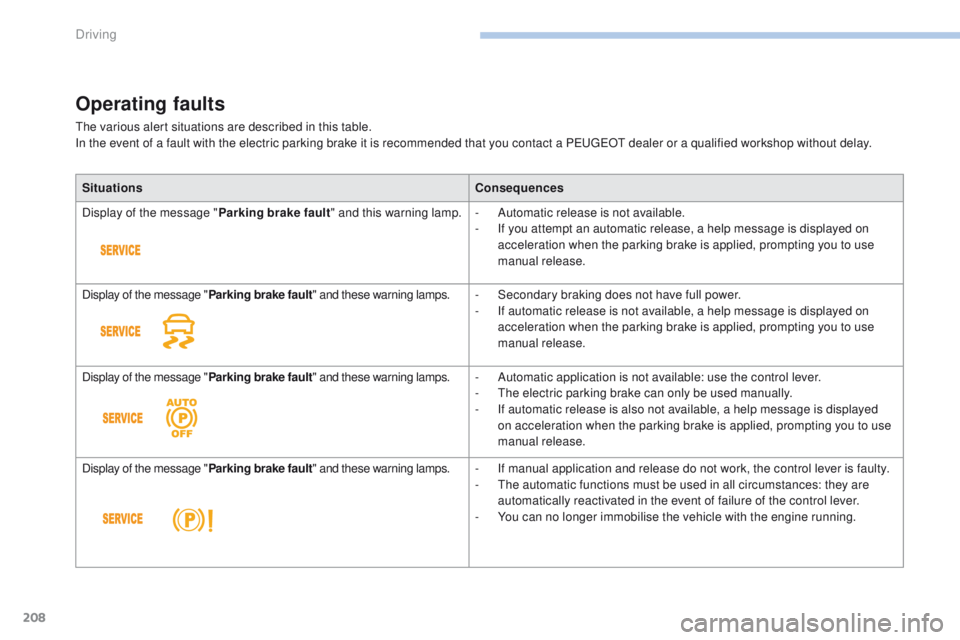
The various alert situations are described in this table.
In the event of a fault with the electric parking brake it is recommended that you contact a PEUGEOT dealer or a qualified workshop without delay.Situations Consequences
Display of the message " Parking brake fault" and this warning lamp. -
A
utomatic release is not available.
-
I
f you attempt an automatic release, a help message is displayed on
acceleration when the parking brake is applied, prompting you to use
manual release.
Display of the message " Parking brake fault" and these warning lamps. -
S
econdary braking does not have full power.
-
I
f automatic release is not available, a help message is displayed on
acceleration when the parking brake is applied, prompting you to use
manual release.
Display of the message " Parking brake fault" and these warning lamps. -
A
utomatic application is not available: use the control lever.
-
T
he electric parking brake can only be used manually.
-
I
f automatic release is also not available, a help message is displayed
on acceleration when the parking brake is applied, prompting you to use
manual release.
Display of the message " Parking brake fault" and these warning lamps. -
I
f manual application and release do not work, the control lever is faulty.
-
T
he automatic functions must be used in all circumstances: they are
automatically reactivated in the event of failure of the control lever.
-
Y
ou can no longer immobilise the vehicle with the engine running.
Driving
Page 211 of 566
209
3008-2_en_Chap06_conduite_ed01-2016
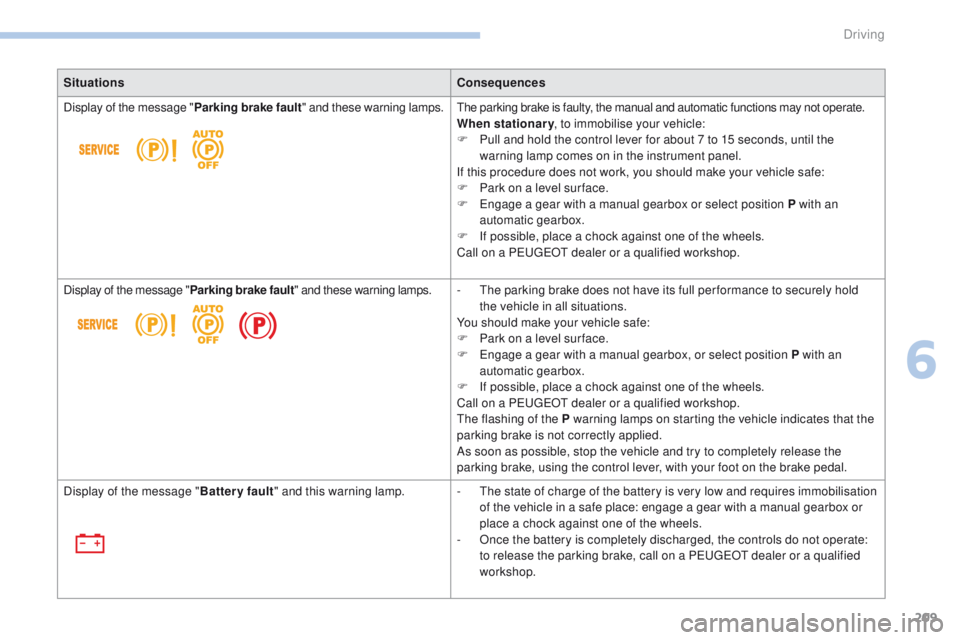
SituationsConsequences
Display of the message " Parking brake fault" and these warning lamps. The parking brake is faulty, the manual and automatic functions may not operate.
When stationary, to immobilise your vehicle:
F
P
ull and hold the control lever for about 7 to 15 seconds, until the
warning lamp comes on in the instrument panel.
If this procedure does not work, you should make your vehicle safe:
F
P
ark on a level sur face.
F
E
ngage a gear with a manual gearbox or select position P with an
automatic gearbox.
F
I
f possible, place a chock against one of the wheels.
Call on a PEUGEOT dealer or a qualified workshop.
Display of the message " Parking brake fault" and these warning lamps. -
T
he parking brake does not have its full per formance to securely hold
the vehicle in all situations.
You should make your vehicle safe:
F
P
ark on a level sur face.
F
E
ngage a gear with a manual gearbox, or select position P with an
automatic gearbox.
F
I
f possible, place a chock against one of the wheels.
Call on a PEUGEOT dealer or a qualified workshop.
The flashing of the P warning lamps on starting the vehicle indicates that the
parking brake is not correctly applied.
As soon as possible, stop the vehicle and try to completely release the
parking brake, using the control lever, with your foot on the brake pedal.
Display of the message " Battery fault" and this warning lamp. -
T
he state of charge of the battery is very low and requires immobilisation
of the vehicle in a safe place: engage a gear with a manual gearbox or
place a chock against one of the wheels.
-
O
nce the battery is completely discharged, the controls do not operate:
to release the parking brake, call on a PEUGEOT dealer or a qualified
workshop.
6
Driving
Page 217 of 566
215
3008-2_en_Chap06_conduite_ed01-2016
In severe wintry conditions (temperature
below -23°C), it is recommended that
the engine be allowed to run for a few
minutes before moving off, to ensure
the correct operation and durability of
the engine and gearbox.
Stopping the vehicle
Whatever the state of the gearbox when the
ignition is switched off, P mode is engaged
automatically, with the exception of N, in which
case P
mode will be engaged after a delay of
5 seconds (allowing the change to free-wheel).
Check that P mode has been engaged and
that the electric parking brake was applied
automatically; if not, apply it manually.
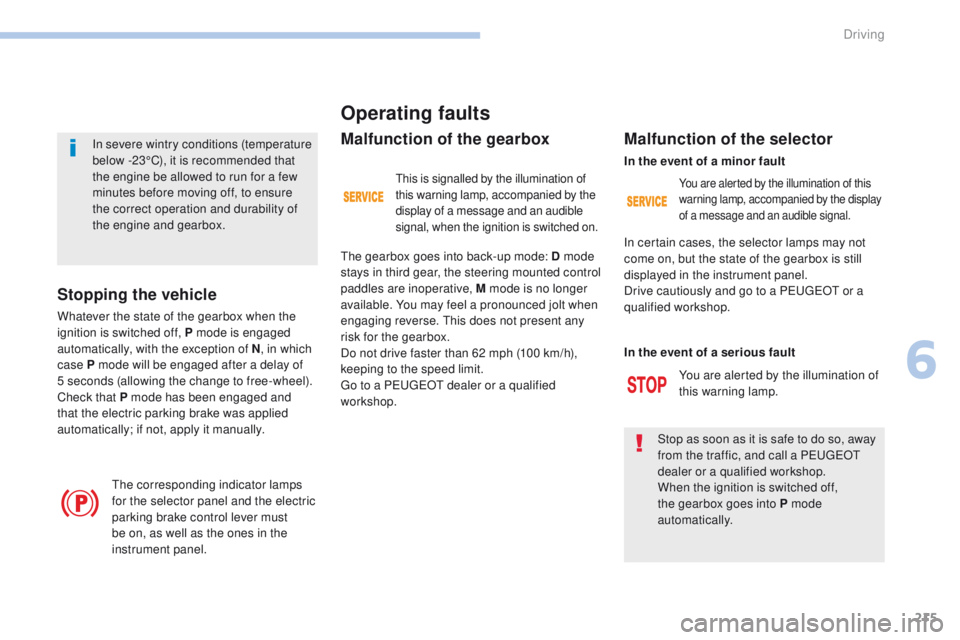
Operating faults
Malfunction of the gearbox Malfunction of the selector
In the event of a minor fault
In the event of a serious fault
Stop as soon as it is safe to do so, away
from the traffic, and call a PEUGEOT
dealer or a qualified workshop.
When the ignition is switched off,
the gearbox goes into P mode
automatically.You are alerted by the illumination of
this warning lamp.
The corresponding indicator lamps
for the selector panel and the electric
parking brake control lever must
be on, as well as the ones in the
instrument panel.
This is signalled by the illumination of
this warning lamp, accompanied by the
display of a message and an audible
signal, when the ignition is switched on.
The gearbox goes into back-up mode: D mode
stays in third gear, the steering mounted control
paddles are inoperative, M mode is no longer
available. You may feel a pronounced jolt when
engaging reverse. This does not present any
risk for the gearbox.
Do not drive faster than 62 mph (100 km/h),
keeping to the speed limit.
Go to a PEUGEOT dealer or a qualified
workshop.
You are alerted by the illumination of this
warning lamp, accompanied by the display
of a message and an audible signal.
In certain cases, the selector lamps may not
come on, but the state of the gearbox is still
displayed in the instrument panel.
Drive cautiously and go to a PEUGEOT or a
qualified workshop.
6
Driving
Page 218 of 566
216
3008-2_en_Chap06_conduite_ed01-2016
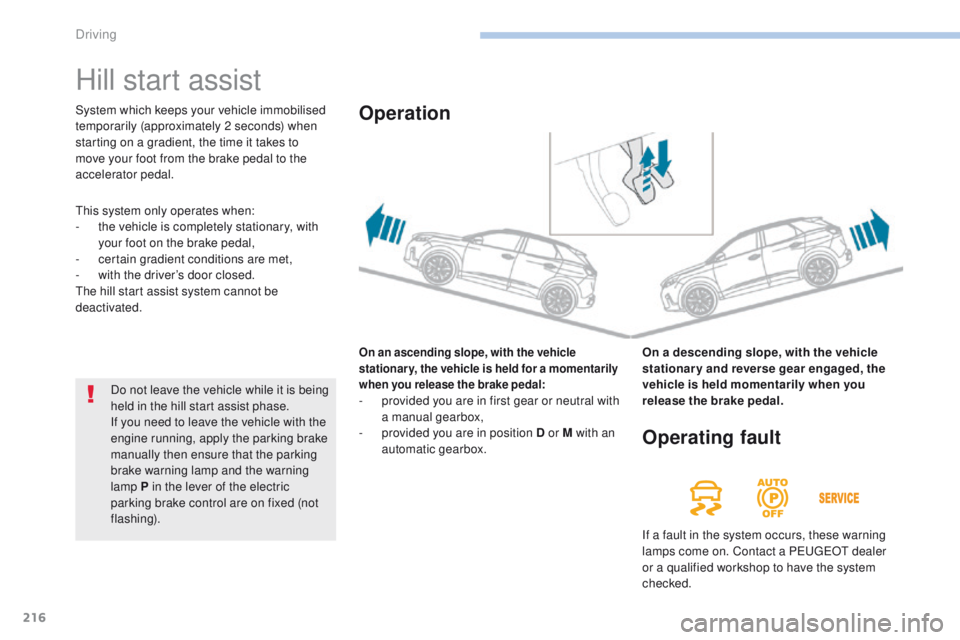
Hill start assist
On an ascending slope, with the vehicle
stationary, the vehicle is held for a momentarily
when you release the brake pedal:
- provided you are in first gear or neutral with a manual gearbox,
-
p
rovided you are in position D or M with an
automatic gearbox.
Operation
On a descending slope, with the vehicle
stationary and reverse gear engaged, the
vehicle is held momentarily when you
release the brake pedal.
Operating fault
If a fault in the system occurs, these warning
lamps come on. Contact a PEUGEOT dealer
or a qualified workshop to have the system
checked.
System which keeps your vehicle immobilised
temporarily (approximately 2 seconds) when
starting on a gradient, the time it takes to
move your foot from the brake pedal to the
accelerator pedal.
This system only operates when:
-
t
he vehicle is completely stationary, with
your foot on the brake pedal,
-
c
ertain gradient conditions are met,
-
w
ith the driver’s door closed.
The hill start assist system cannot be
deactivated.
Do not leave the vehicle while it is being
held in the hill start assist phase.
If you need to leave the vehicle with the
engine running, apply the parking brake
manually then ensure that the parking
brake warning lamp and the warning
lamp P in the lever of the electric
parking brake control are on fixed (not
flashing).
Driving
Page 224 of 566
222
3008-2_en_Chap06_conduite_ed01-2016
Operating fault
The Stop & Start system requires a
12 V battery of specific technology and
specification.
All work on this type of battery must be
carried out only by a PEUGEOT dealer
or a qualified workshop.
For more information on the
12 V batter y , refer to the corresponding
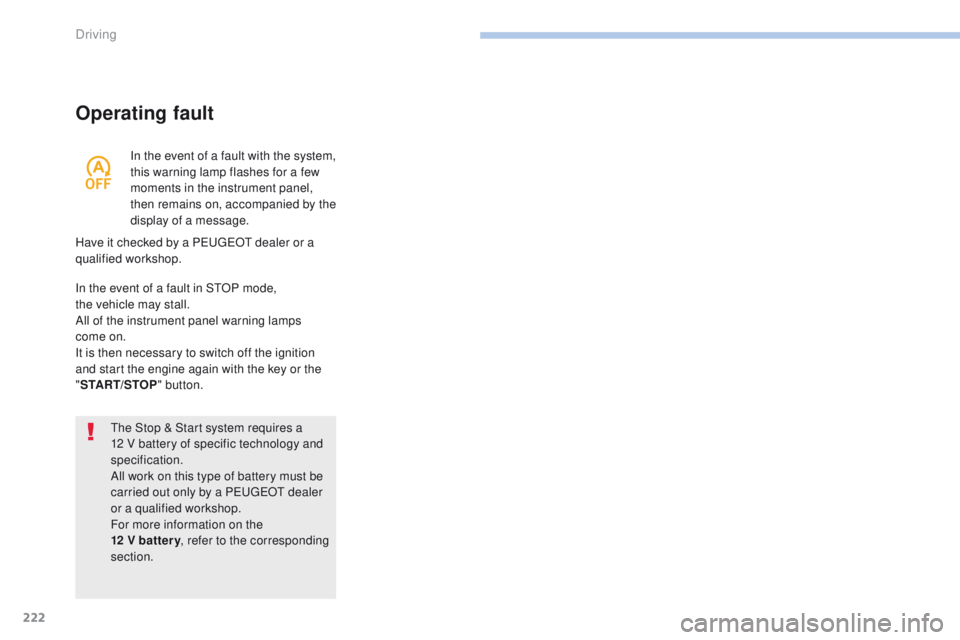
section. In the event of a fault with the system,
this warning lamp flashes for a few
moments in the instrument panel,
then remains on, accompanied by the
display of a message.
In the event of a fault in STOP mode,
the
vehicle may stall.
All of the instrument panel warning lamps
come
on.
It is then necessary to switch off the ignition
and start the engine again with the key or the
" START/STOP " button.
Have it checked by a PEUGEOT dealer or a
qualified workshop.
Driving
Page 227 of 566
225
3008-2_en_Chap06_conduite_ed01-2016
Touch screen
Monochrome screen C
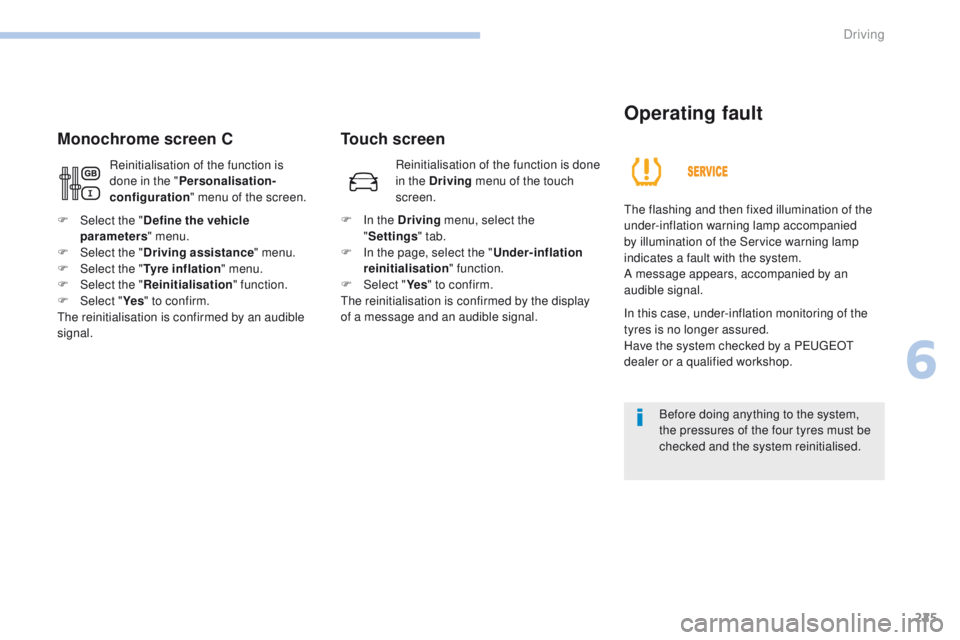
Operating fault
The flashing and then fixed illumination of the
under-inflation warning lamp accompanied
by illumination of the Service warning lamp
indicates a fault with the system.
A message appears, accompanied by an
audible signal.
In this case, under-inflation monitoring of the
tyres is no longer assured.
Have the system checked by a PEUGEOT
dealer or a qualified workshop.
Before doing anything to the system,
the pressures of the four tyres must be
checked and the system reinitialised.
Reinitialisation of the function is
done in the "
Personalisation-
configuration " menu of the screen.
F
Sel
ect the " Define the vehicle
parameters " menu.
F
Sel
ect the " Driving assistance " menu.
F
Sel
ect the " Tyre inflation " menu.
F
Sel
ect the " Reinitialisation " function.
F
Sel
ect " Ye s" to confirm.
The reinitialisation is confirmed by an audible
signal. Reinitialisation of the function is done
in the Driving
menu of the touch
screen.
F
I
n the Driving menu, select the
" Settings "
tab.
F
I
n the page, select the " Under-inflation
reinitialisation " function.
F
Sel
ect " Ye s" to confirm.
The reinitialisation is confirmed by the display
of a message and an audible signal.
6
Driving
Page 228 of 566
226
3008-2_en_Chap06_conduite_ed01-2016
Memorising speeds
This function allows speeds to be saved, which can then be offered to set the two systems: the speed limiter (to limit the speed of the vehicle) or the
cruise control (for a vehicle cruising speed).
You can memorise up to six speed settings for each of the two systems.
By default, some speed settings are already memorised.As a safety measure, the driver must
only modify the speed settings when
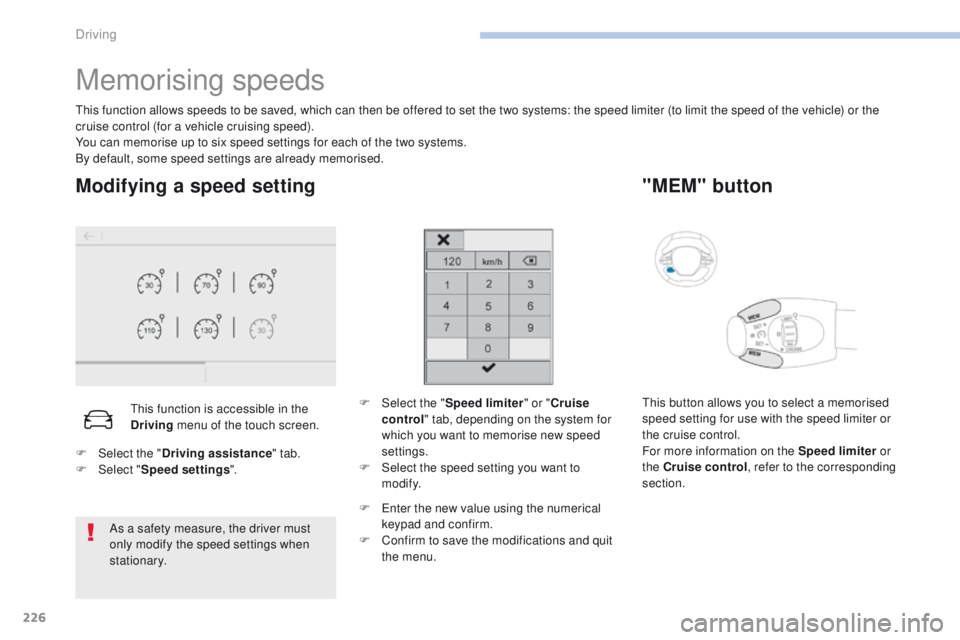
stationary.This function is accessible in the
Driving
menu of the touch screen.
F
Sel
ect the " Driving assistance " tab.
F
Sel
ect "Speed settings ". F
Sel
ect the "Speed limiter " or "Cruise
control" tab, depending on the system for
which you want to memorise new speed
settings.
F
S
elect the speed setting you want to
m o di f y.
F
E
nter the new value using the numerical
keypad and confirm.
F
C
onfirm to save the modifications and quit
the menu.
"MEM" button
Modifying a speed setting
This button allows you to select a memorised
speed setting for use with the speed limiter or
the cruise control.
For more information on the Speed limiter or
the Cruise control , refer to the corresponding
section.
Driving
Page 235 of 566
233
3008-2_en_Chap06_conduite_ed01-2016
On a steep descent or in the event of
sharp acceleration, the speed limiter
will not be able to prevent the vehicle
from exceeding the programmed speed.The use of mats not approved by
PEUGEOT may inter fere with the
operation of the speed limiter.
To avoid any risk of jamming of the
pedals:
-
e nsure that the mat is positioned
c o r r e c t l y,
-
d
o not fit one mat on top of another.
Temporarily exceeding the
programmed speed
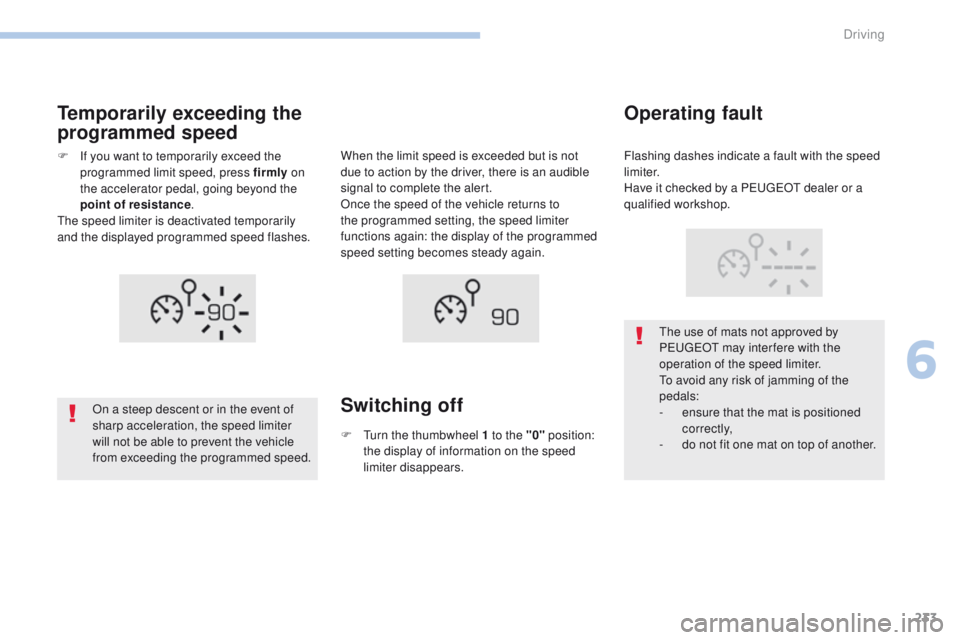
F If you want to temporarily exceed the programmed limit speed, press firmly on
the accelerator pedal, going beyond the
point of resistance .
The speed limiter is deactivated temporarily
and the displayed programmed speed flashes.
Switching off
When the limit speed is exceeded but is not
due to action by the driver, there is an audible
signal to complete the alert.
Once the speed of the vehicle returns to
the programmed setting, the speed limiter
functions again: the display of the programmed
speed setting becomes steady again.
F
T
urn the thumbwheel 1 to the "0" position:
the display of information on the speed
limiter disappears.
Operating fault
Flashing dashes indicate a fault with the speed
limiter.
Have it checked by a PEUGEOT dealer or a
qualified workshop.
6
Driving
Page 239 of 566
237
3008-2_en_Chap06_conduite_ed01-2016
Only use the cruise control if the traffic
conditions will allow you to drive for a
certain time at a steady speed and at a
safe distance from the vehicle ahead.
Do not activate the cruise control in
urban areas, in heavy traffic, on winding
or steep roads, on slippery or flooded
roads, or in conditions of poor visibility
(heavy rain, fog, falling snow...).
In some circumstances, it may not be
possible to maintain or reach the cruise
speed set: towing, vehicle heavily
loaded, steep climb.
The use of mats not approved by
PEUGEOT may inter fere with the
operation of the cruise control.
To avoid any risk of jamming of the
pedals:
-
e
nsure that the mat is positioned
c o r r e c t l y,
-
n
ever fit one mat on top of another.
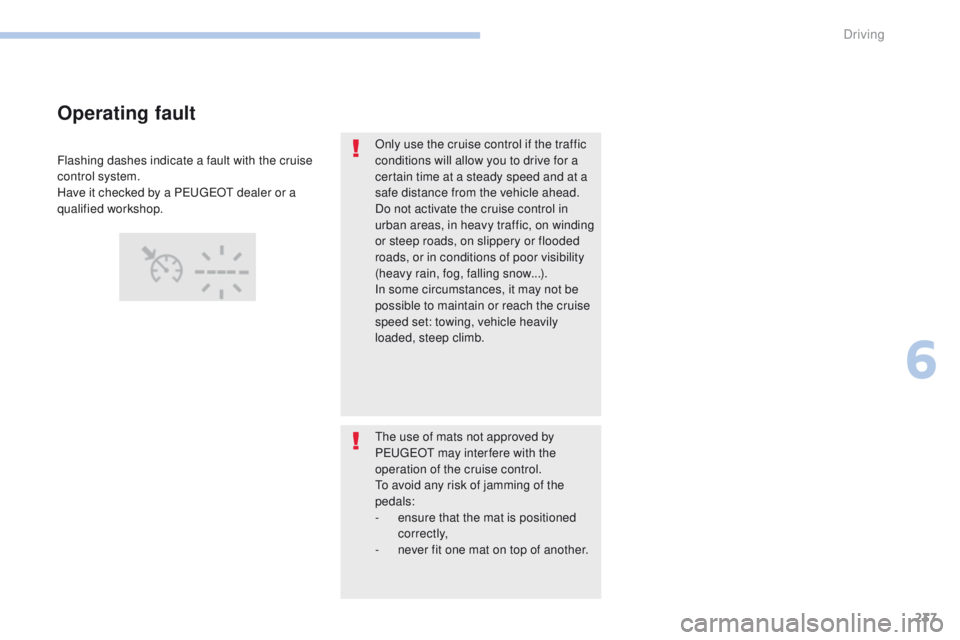
Operating fault
Flashing dashes indicate a fault with the cruise
control system.
Have it checked by a PEUGEOT dealer or a
qualified workshop.
6
Driving