wheel PEUGEOT 3008 HYBRID 4 2011 Owner's Manual
[x] Cancel search | Manufacturer: PEUGEOT, Model Year: 2011, Model line: 3008 Hybrid 4, Model: Peugeot 3008 Hybrid 4 2011Pages: 280, PDF Size: 16.5 MB
Page 129 of 280

127
ELECTRONIC STABILITY PROGRAMME (ESP)
Electronic stability programme (ESP)
incorporating the following systems:
- the anti-lock braking system (ABS)
and the electronic brake force distri-
bution system (EBFD),
- the emergency braking assistance,
- the traction control (ASR),
- the dynamic stability control (DSC).
Definitions
Anti-skid regulation (ASR)
The ASR system (also known as Trac-
tion Control) optimises traction in order
to avoid wheel slip by acting on the
brakes of the driving wheels and on the
engine. It also improves the directional
stability of the vehicle on acceleration.
Dynamic stability control (DSC)
If there is a difference between the path
followed by the vehicle and that re-
quired by the driver, the DSC monitors
each wheel and automatically acts on
the brake of one or more wheels and
on the engine to return the vehicle to
the required path, within the limits of the
laws of physics.
Emergency braking assistance
In an emergency, this system enables
you to reach the optimum braking pres-
sure more quickly and therefore reduce
the stopping distance.
It is triggered in relation to the speed at
which the brake pedal is pressed. This
is felt by a reduction in the resistance of
the pedal and an increase in the effec-
tiveness of the braking.
Anti-lock braking system (ABS) and
electronic brake force distribution
system (EBFD)
This system improves the stability and
manoeuvrability of your vehicle when
braking and offers improved control, in
particular on poor or slippery road sur-
faces.
The ABS prevents wheel lock in the
event of emergency braking.
The electronic brake force distribution
system manages the braking pressure
wheel by wheel.
When this warning lamp
comes on, accompanied by an
audible signal and a message,
it indicates that there is a fault
with the ABS, which could cause loss of
control of the vehicle when braking.
When this warning lamp comes
on, coupled with the STOP
warning lamp, accompanied
by an audible signal and a
message, it indicates that there is a fault
with the electronic brake force distribu-
tion (EBFD), which could cause loss of
control of the vehicle when braking.
You must stop as soon as it is safe
to do so.
In both cases, contact a PEUGEOT
dealer or a qualifi ed workshop.
When changing wheels (tyres
and rims), make sure that
these are approved for your
vehicle.
Normal operation of the ABS may
make itself felt by slight vibrations of
the brake pedal.
In emergency braking, press
very fi rmly without releasing
the pressure.
Anti-lock braking system (ABS) and
electronic brake force distribution
(EBFD)
Page 130 of 280
128
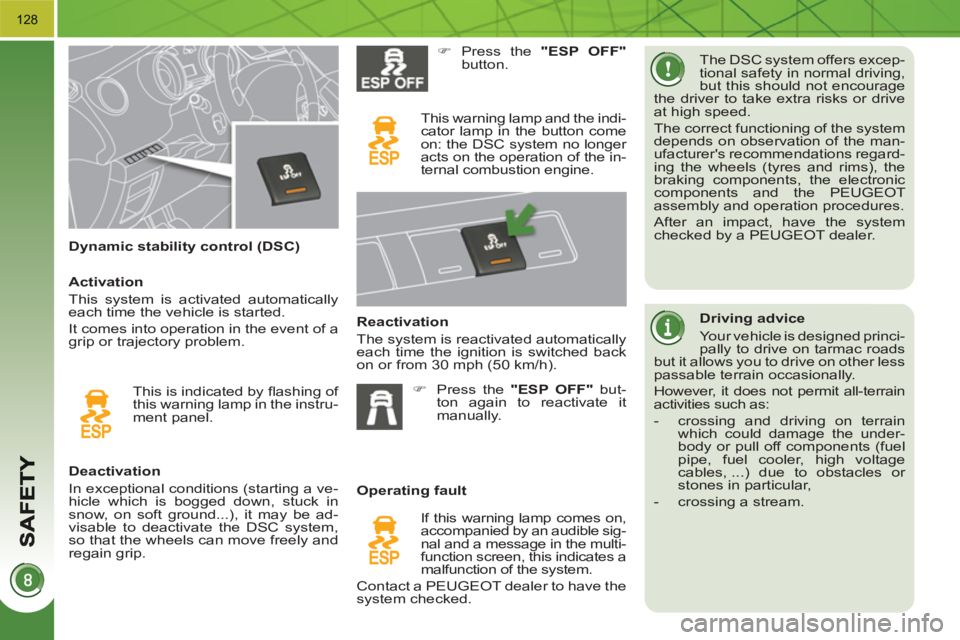
Dynamic stability control (DSC) The DSC system offers excep-
tional safety in normal driving,
but this should not encourage
the driver to take extra risks or drive
at high speed.
The correct functioning of the system
depends on observation of the man-
ufacturer's recommendations regard-
ing the wheels (tyres and rims), the
braking components, the electronic
components and the PEUGEOT
assembly and operation procedures.
After an impact, have the system
checked by a PEUGEOT dealer.
Deactivation
In exceptional conditions (starting a ve-
hicle which is bogged down, stuck in
snow, on soft ground...), it may be ad-
visable to deactivate the DSC system,
so that the wheels can move freely and
regain grip.
)
Press the "ESP OFF"
button.
This warning lamp and the indi-
cator lamp in the button come
on: the DSC system no longer
acts on the operation of the in-
ternal combustion engine.
Reactivation
The system is reactivated automatically
each time the ignition is switched back
on or from 30 mph (50 km/h).
Operating fault
If this warning lamp comes on,
accompanied by an audible sig-
nal and a message in the multi-
function screen, this indicates a
malfunction of the system.
Contact a PEUGEOT dealer to have the
system checked. This is indicated by fl ashing of
this warning lamp in the instru-
ment panel.
Activation
This system is activated automatically
each time the vehicle is started.
It comes into operation in the event of a
grip or trajectory problem.
)
Press the "ESP OFF"
but-
ton again to reactivate it
manually.
Driving advice
Your vehicle is designed princi-
pally to drive on tarmac roads
but it allows you to drive on other less
passable terrain occasionally.
However, it does not permit all-terrain
activities such as:
- crossing and driving on terrain
which could damage the under-
body or pull off components (fuel
pipe, fuel cooler, high voltage
cables, ...) due to obstacles or
stones in particular,
- crossing a stream.
Page 134 of 280

132
AIRBAGS
Deployment of the airbag(s) is
accompanied by a slight emis-
sion of harmless smoke and
a noise, due to the activation of the
pyrotechnic cartridge incorporated in
the system.
This smoke is not harmful, but sensi-
tive individuals may experience slight
irritation.
The noise of the detonation may re-
sult in a slight loss of hearing for a
short time.
Front airbags
System which protects the driver and
front passenger in the event of a seri-
ous front impact in order to limit the risk
of injury to the head and thorax.
The driver's airbag is fi tted in the centre
of the steering wheel; the front passen-
ger's airbag is fi tted in the dashboard
above the glove box.
Deployment
The airbags are deployed simultane-
ously, unless the passenger's front
airbag is deactivated, in the event of a
serious front impact to all or part of the
front impact zone A
, in the longitudinal
centreline of the vehicle on a horizontal
plane and directed from the front to the
rear of the vehicle.
The front airbag infl ates between the
thorax and head of the front occupant
of the vehicle and the steering wheel,
driver's side, and the dashboard, pas-
senger's side to cushion their forward
movement.
Impact detection zones
A.
Front impact zone.
B.
Side impact zone.
The airbags do not oper-
ate when the ignition is
switched off.
This equipment will only deploy once.
If a second impact occurs (during the
same or a subsequent accident), the
airbag will not be deployed again.
System designed to maximise the safety
of the occupants (with the exception of
the rear centre passenger) in the event
of violent collisions. It supplements the
action of the force-limiting seat belts
(with the exception of the rear centre
passenger).
If a collision occurs, the electronic de-
tectors record and analyse the front and
side impacts sustained in the impact
detection zones:
- in the case of a serious impact, the
airbags are deployed instantly and
protect the occupants of the vehicle
(with the exception of the rear centre
passenger); immediately after the
impact, the airbags defl ate rapidly
so that they do not hinder visibility
or the exit of the occupants,
- in the case of a minor or rear impact
or in certain roll-over conditions, the
airbags will not be deployed; the
seat belt alone is suffi cient to pro-
vide optimum protection in these
situations.
Page 137 of 280

135
For the airbags to be fully
effective, observe the
following safety rules:
Sit in a normal upright position.
Wear a correctly adjusted seat belt.
Do not leave anything between the
occupants and the airbags (a child,
pet, object...). This could hamper the
operation of the airbags or injure the
occupants.
After an accident or if the vehicle has
been stolen or broken into, have the
airbag systems checked.
All work on the airbag system is strict-
ly forbidden unless it is carried out by
qualifi ed personnel of the PEUGEOT
dealer network.
Even if all of the precautions men-
tioned are observed, a risk of injury
or of minor burns to the head, chest
or arms when an airbag is deployed
cannot be ruled out. The bag in-
fl ates almost instantly (within a few
milliseconds) then defl ates within
the same time discharging the hot
gas via openings provided for this
purpose.
Front airbags
Do not drive holding the steering
wheel by its spokes or resting your
hands on the centre part of the
wheel.
Passengers must not place their feet
on the dashboard.
If possible, do not smoke as deploy-
ment of the airbags can cause burns
or the risk of injury from a cigarette
or pipe.
Never remove or pierce the steering
wheel or hit it violently.
Lateral airbags
Use only approved covers on the
seats, compatible with the deployment
the lateral airbags. For information
on the range of seat covers suitable
for your vehicle, you can contact a
PEUGEOT dealer (see "Practical in-
formation - § Accessories").
Do not fi x or attach anything to the
seat backs (clothing...). This could
cause injury to the chest or arms if
the lateral airbag is deployed.
Do not sit with the upper part of the
body any nearer to the door than
necessary.
Curtain airbags
Do not fi x or attach anything to the
roof. This could cause injury to the
head if the curtain airbag is de-
ployed.
Do not remove the grab handles in-
stalled on the roof, they play a part in
securing the curtain airbags.
Page 139 of 280

137
With the vehicle stationary, to apply the
parking brake whether the engine is
running or off, pull
on control lever A
.
The application of the parking brake is
confi rmed by:
-
lighting of the braking warn-
ing lamp and of the warning
lamp P
in the control lever A
,
When the driver’s door is opened with
the engine running, there is an audible
signal and a message is displayed if
the parking brake has not been applied,
unless the gear lever is in position P
(Park).
Manual release
With the ignition on or the engine run-
ning, to release the parking brake, press
on the brake
pedal
or the accelerator,
pull then release
control lever A
.
The full application of the parking brake
is confi rmed by:
-
extinction of the braking warn-
ing lamp and of the warning
lamp P
in control lever lever A
,
If you pull control lever A
with-
out pressing the brake pedal,
the parking brake will not be
released and a warning lamp
will come on in the instrument
panel.
Manual applicationMaximum application
If necessary, you can utilise maximum
application
of the parking brake. It is
obtained by means of a long pull
on
control lever A
, until you see the mes-
sage "Handbrake on" and an audible
signal is heard.
In the case of towing, a loaded
vehicle or parking on a gradient,
make a maximum application
of the parking brake then turn the front
wheels towards the pavement and en-
gage a gear when you park.
After a maximum application, the re-
lease time will be longer.
Before leaving the vehicle,
check that parking brake
warning lamp in the instrument
panel is on fi xed, not fl ashing.
Maximum application is essential:
- in the case of a vehicle towing a
caravan or a trailer, if the automatic
functions are activated but you are
applying the parking brake manually,
- when the gradient you are parked
on is variable in its effect (e.g. on a
ferry, in a lorry, during towing),
- display of the message
"Handbrake on".
- display of the message
"Handbrake off".
Page 140 of 280

138
Automatic application,
engine off
With the vehicle stationary, the parking
brake is automatically applied when
the engine is switched off.
-
illumination of the braking
warning lamp and of the warn-
ing lamp P
in control lever A
,
Automatic release
The electric parking brake releases au-
tomatically and progressively
when
you press the accelerator:
)
Put the gear lever in position A
, M
or R
then press on the accelerator
pedal.
Before leaving the vehicle,
check that parking brake
warning lamp in the instru-
ment panel is on fi xed (not
fl ashing).
Never leave a child alone inside the
vehicle with the ignition on, as they
could release the parking brake.
- extinction of braking warn-
ing lamp and of the warning
lamp P
in control lever A
,
The noise of operation confi rms the ap-
plication/release of the electric parking
brake. Full release of the parking brake is con-
fi rmed by:
To immobilise the vehicle, engine running
With the engine running and the vehicle
stationary, in order to immobilise the
vehicle it is essential to manually apply
the parking brake by pulling
on control
lever A
.
The application of the parking brake is
confi rmed by:
-
illumination of the braking warn-
ing lamp and of the warning
lamp P
in control lever A
,
When the driver’s door is opened, there
is an audible signal and a message is
displayed if the parking brake has not
been applied, unless the gear lever is in
position P
(Park).
Before leaving the vehicle,
check that parking brake
warning lamp in the instrument
panel is on fi xed, not fl ashing.
When stationary, with the en-
gine running, do not press the
accelerator pedal unneces-
sarily, as you may release the
parking brake.
Application of the parking brake is con-
fi rmed by:
- display of the message
"Handbrake on".
In the case of towing, a loaded vehi-
cle or parking on a gradient, turn the
front wheels towards the pavement
and engage a gear when you park.
- display of the message
"Handbrake off".
- display of the message
"Handbrake on".
Page 142 of 280

140
Emergency release
For safety reasons, after this
manoeuvre it is essential to
contact a PEUGEOT dealer
urgently to replace the protec-
tive cover.
Following an emergency unlocking,
immobilisation of the vehicle is no
longer guaranteed once the manual
emergency release has been de-
ployed and the manual control does
not allow the re-application of your
parking brake.
Take no action, either on control le-
ver A
, or stopping starting the engine
while the release device is engaged.
Take care not to allow moisture or
dust in the proximity of the protective
cover.
)
Immobilise the vehicle (or keep
it stationary, if the brake pedal is
pressed), with the engine running,
by engaging gear lever position M
or R
.
)
Switch off the engine but leave the
ignition on. If it is impossible to im-
mobilise the vehicle, do not action
the control and urgently contact a
PEUGEOT dealer.
)
Fetch the two vehicle blocks and
the release device, located under
the boot carpet (see "Changing a
wheel" in the "Practical information"
section).
)
Immobilise the vehicle by placing
blocks in front and behind one of the
front wheels.
)
Slide the front left-hand seat back
as far as possible.
)
Lift up the fl oor plug B
in the carpet
under the seat.
)
Pierce the protective cover C
on the
tube D
with the release device.
)
Place the release device in the tube D
.
)
Turn the release device clockwise.
For safety reasons
, it is essential
to continue turning the device as far
as it will go. The parking brake is re-
leased.
)
Remove the release device and store
it with the blocks in the toolbox.
- The operation of the parking
brake reinitialises when the igni-
tion is switched off then on again.
If the reinitialisation of the parking
brake proves impossible, contact a
PEUGEOT dealer.
- The subsequent time required for
application may be longer than dur-
ing normal operation.
Front left seat moved back fully.
In the event of the electric parking brake
malfunctioning or the battery running
fl at, an emergency manual device can
release the parking brake.
Page 145 of 280

143
Situations
Consequences
Display of the message " Parking
brake control fault - auto parking
brake activated
" and of the following
warning lamps:
- Only the automatic application on switching off the engine and automatic re-
lease on acceleration functions are available.
- The manual application/release of the electric parking brake and the emer-
gency braking are not available.
and possibly
fl ashing
Battery fault
- If the battery warning lamp comes on you must stop immediately as soon as
the traffi c allows. Stop and immobilise your vehicle (if necessary, place the
two chocks under the wheels).
- Apply the electric parking brake before switching off the engine.
Page 152 of 280

150
6-SPEED ELECTRONIC GEAR CONTROL GEARBOXGear lever
Lift the gear knob to move to position R
or M
.
R.
Reverse
)
With your foot on the brake, move the
lever upwards to select this position.
N.
Neutral.
)
With your foot on the brake, select
this position to start.
A.
Automatic mode.
)
Move the lever downwards to select
this mode.
M.
Sequential mode with manual
changing of the gears at the steer-
ing wheel.
Steering mounted controls
+.
Change up paddle to the right of the
steering wheel.
)
Press the back of the "+"
steering
mounted paddle to change up a
gear.
-.
Change down paddle to the left of
the steering wheel.
)
Press the back of the "-"
steering
mounted paddle to change down a
gear.
The steering mounted paddles
do not permit the selection of
neutral or the engaging or dis-
engaging of reverse gear.
Six-speed electronic gear control gear-
box which offers a choice between the
comfort of fully automatic operation or
the pleasure of manual gear changing.
Three driving modes are offered:
- automatic
mode for automatic con-
trol of the gears by the gearbox,
- sequential
mode for manual chang-
ing of the gears by the driver,
- auto sequential
mode to overtake,
for example, remaining in automatic
mode while using the functions of
the sequential mode.
Page 165 of 280

PRACTICAL INFORMATION
163
All of these tools are specifi c to your
vehicle. Do not use them for other
purposes.
1.
12 V compressor.
Contains a sealant cartridge for
the temporary repair of a tyre and
can be used to adjust the tyre
pressures.
2.
Two chocks to chock the vehicle.
3.
Socket for security bolts (located
in the glove box) * .
For adapting the wheelbrace to
the special security bolts.
List of tools
Other accessories
4.
Removable towing eye.
Refer to "Electric parking brake"
in the "Driving" section.
Refer to the paragraph "Towing
the vehicle".
5.
Electric parking brake emergency
release control.
TEMPORARY PUNCTUREREPAIR KIT
Complete system consisting of a com-
pressor and a sealant cartridge which
permits the temporary repair
of a tyre
so that you can drive to the nearest
garage.
It is designed to repair most punctures
which could affect the tyre, located on
the tyre tread or shoulder.
Access to the kit
This kit is installed in the storage box,
under the boot fl oor.
*
Depending on destination country.