airbag Peugeot 3008 Hybrid 4 2013 Owner's Manual - RHD (UK. Australia)
[x] Cancel search | Manufacturer: PEUGEOT, Model Year: 2013, Model line: 3008 Hybrid 4, Model: Peugeot 3008 Hybrid 4 2013Pages: 340, PDF Size: 16.51 MB
Page 5 of 340
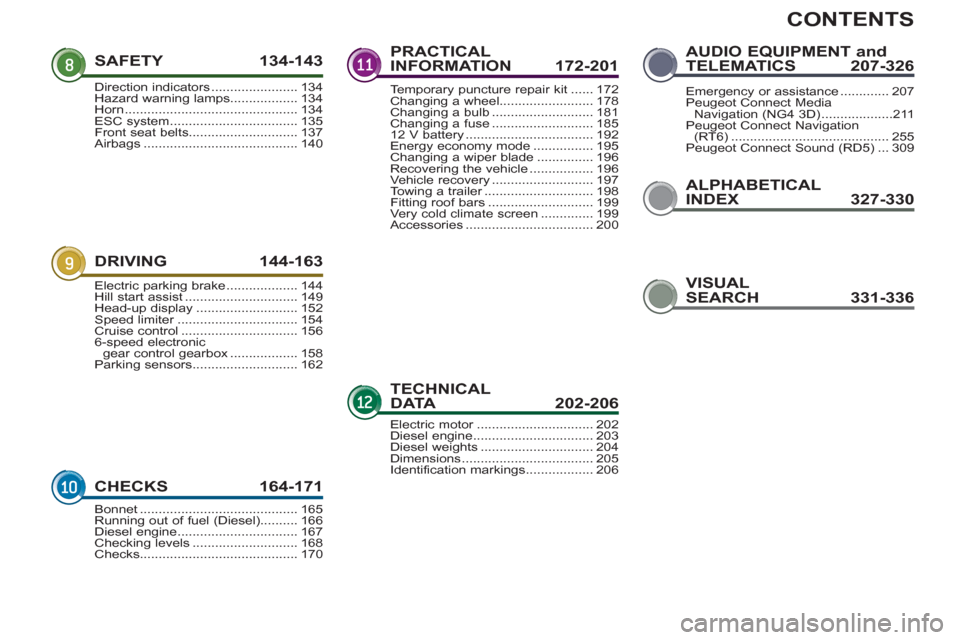
CONTENTS
ALPHABETICAL
INDEX 327-330 SAFETY 134-14
3
DRIVING 144-163
CHECKS 164-171
PRACTICAL
INFORMATION 172-201
TECHNICALDATA 202-206
AUDIO EQUIPMENT andTELEMATICS 207-326
Direction indicators.......................134Hazard warning lamps..................134Horn..............................................134ESC system ..................................135Front seat belts.............................137Airbags.........................................140
Electric parking brake ...................144Hill start assist..............................149Head-up display...........................152Speed limiter................................r154Cruise control...............................1566-speed electronic
gear control gearbox..................158Parking sensors ............................162
Bonnet..........................................165Running out of fuel (Diesel)..........166Diesel engine................................167Checking levels............................168Checks..........................................170
Temporary puncture repair kit......172Changing a wheel.........................178Changing a bulb...........................181Changing a fuse ...........................18512 V battery ..................................192Energy economy mode................195Changing a wiper blade...............196Recovering the vehicle.................196Vehicle recovery ...........................197Towing a trailer.............................r198Fitting roof bars............................199Very cold climate screen..............199Accessories..................................200
Electric motor...............................r202Diesel engine................................203Diesel weights ..............................204Dimensions ...................................205Identification markings..................206
VISUAL
SEARCH 331-336
Emergency or assistance.............207Peugeot Connect Media
Navigation (NG4 3D)...................211Peugeot Connect Navigation(RT6) ..........................................255Peugeot Connect Sound (RD5)...309
Page 15 of 340
13
FA
M
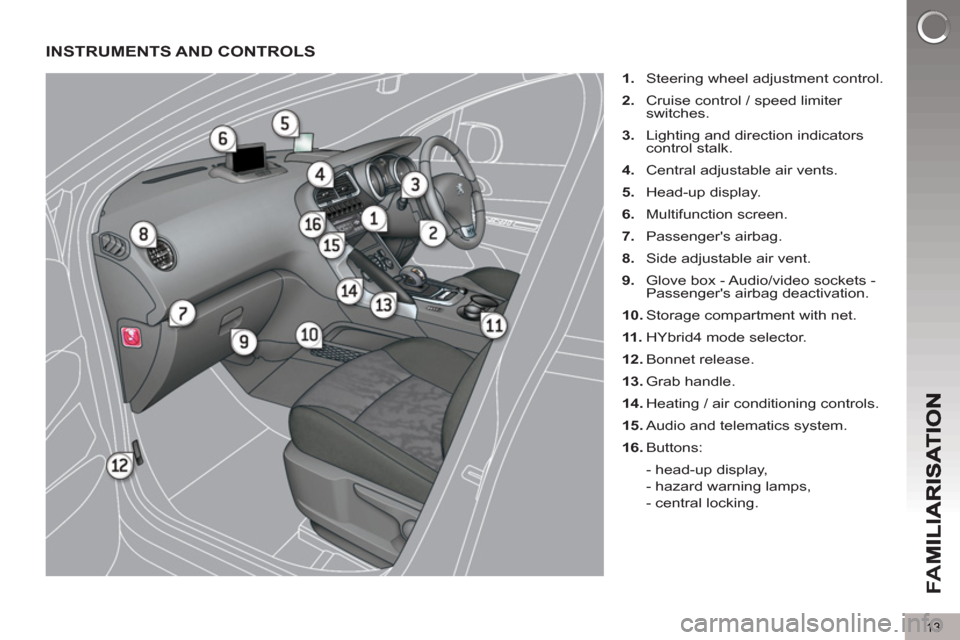
INSTRUMENTS AND CONTROLS
1.
Steering wheel adjustment control.
2.
Cruise control / speed limiter
switches.
3.
Lighting and direction indicators
control stalk.
4.
Central adjustable air vents.
5.
Head-up display.
6.
Multifunction screen.
7.
Passenger's airbag.
8.
Side adjustable air vent.
9.
Glove box - Audio/video sockets -
Passenger's airbag deactivation.
10.
Storage compartment with net.
11 .
HYbrid4 mode selector.
12.
Bonnet release.
13.
Grab handle.
14.
Heating / air conditioning controls.
15.
Audio and telematics system.
16.
Buttons:
- head-up display,
- hazard warning lamps,
- central locking.
Page 16 of 340
14
FA
M
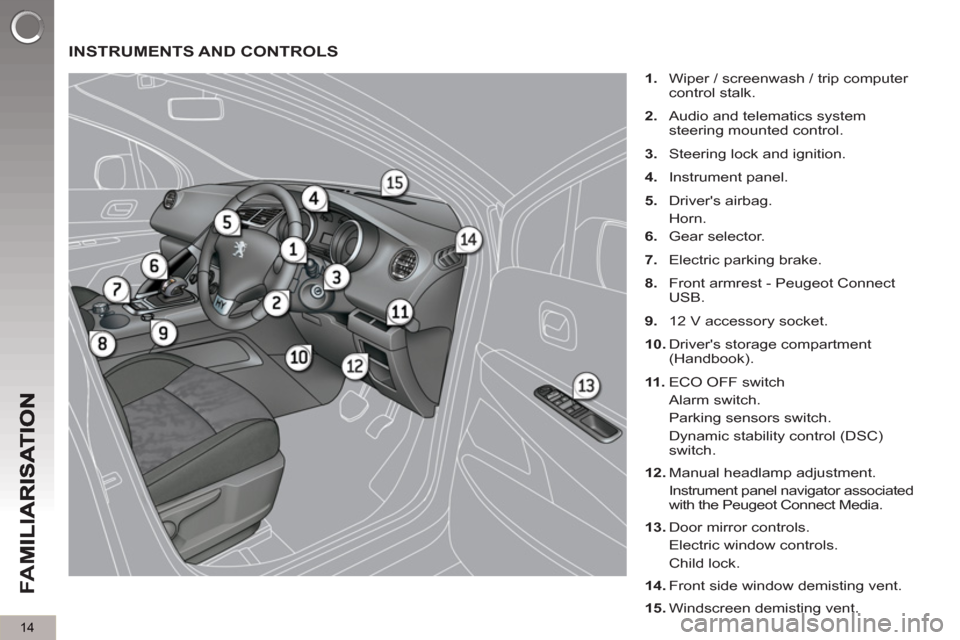
INSTRUMENTS AND CONTROLS
1.
Wiper / screenwash / trip computer
control stalk.
2.
Audio and telematics system
steering mounted control.
3.
Steering lock and ignition.
4.
Instrument panel.
5.
Driver's airbag.
Horn.
6.
Gear selector.
7.
Electric parking brake.
8.
Front armrest - Peugeot Connect
USB.
9.
12 V accessory socket.
10.
Driver's storage compartment
(Handbook).
11 .
ECO OFF switch
Alarm switch.
Parking sensors switch.
Dynamic stability control (DSC)
switch.
12.
Manual headlamp adjustment.
Instrument panel navigator associated
with the Peugeot Connect Media.
13.
Door mirror controls.
Electric window controls.
Child lock.
14.
Front side window demisting vent.
15.
Windscreen demisting vent.
Page 22 of 340
20
FA
M
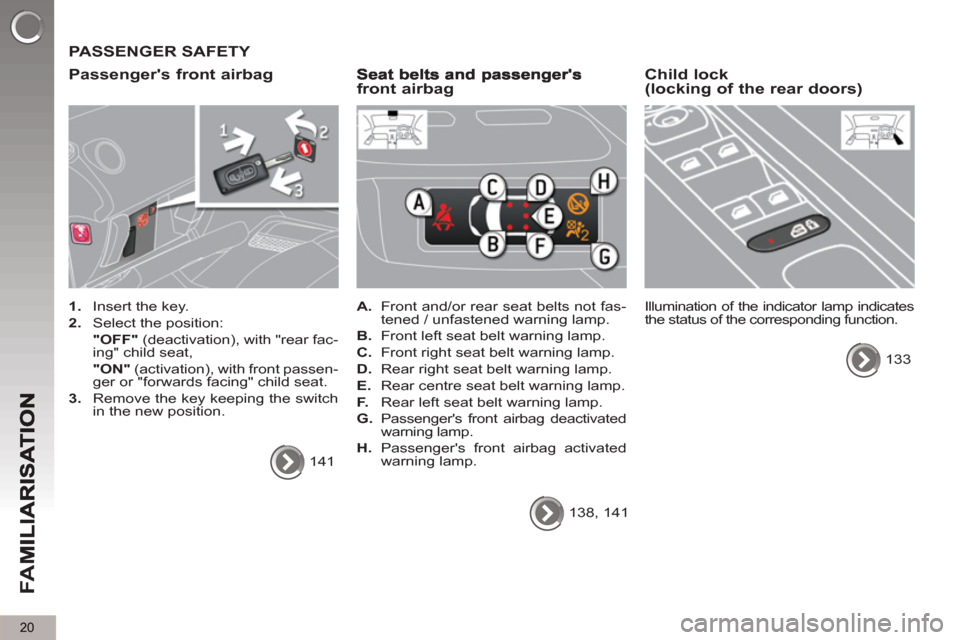
PASSENGER SAFETY
Passen
ger's front airbag
1.
Insert the key.
2.
Select the position:
"OFF"
(deactivation), with "rear fac-
ing" child seat,
"ON"
(activation), with front passen-
ger or "forwards facing" child seat.
3.
Remove the key keeping the switch
in the new position.
141
front airbag
A.
Front and/or rear seat belts not fas-
tened / unfastened warning lamp.
B.
Front left seat belt warning lamp.
C.
Front right seat belt warning lamp.
D.
Rear right seat belt warning lamp.
E.
Rear centre seat belt warning lamp.
F.
Rear left seat belt warning lamp.
G.
Passenger's front airbag deactivated
warning lamp.
H.
Passenger's front airbag activated
warning lamp.
138, 141
Child lock
(locking of the rear doors)
Illumination of the indicator lamp indicates
the status of the corresponding function.
133
Page 54 of 340
52
IN
S
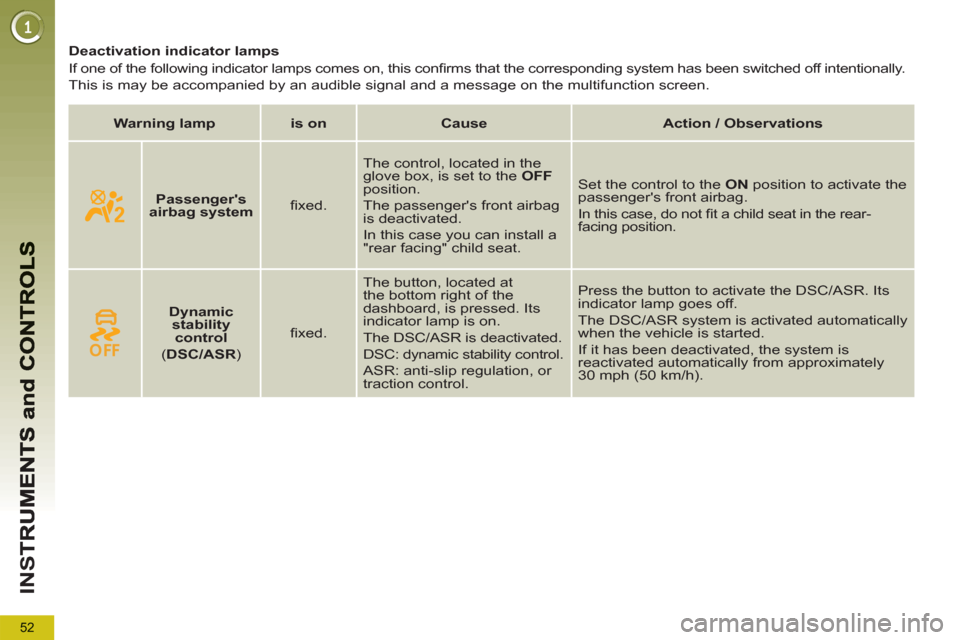
Deactivation indicator lamps
If one of the following indicator lamps comes on, this confi rms that the corresponding system has been switched off intentionally.
This is may be accompanied by an audible signal and a message on the multifunction screen.
Warning lamp
is on
Cause
Action / Observations
Passenger's
airbag system
fi xed. The control, located in the
glove box, is set to the OFF
position.
The passenger's front airbag
is deactivated.
In this case you can install a
"rear facing" child seat. Set the control to the ON
position to activate the
passenger's front airbag.
In this case, do not fi t a child seat in the rear-
facing position.
Dynamic
stability
control
( DSC/ASR
)
fi xed. The button, located at
the bottom right of the
dashboard, is pressed. Its
indicator lamp is on.
The DSC/ASR is deactivated.
DSC: dynamic stability control.
ASR: anti-slip regulation, or
traction control. Press the button to activate the DSC/ASR. Its
indicator lamp goes off.
The DSC/ASR system is activated automatically
when the vehicle is started.
If it has been deactivated, the system is
reactivated automatically from approximately
30 mph (50 km/h).
Page 58 of 340
56
IN
S
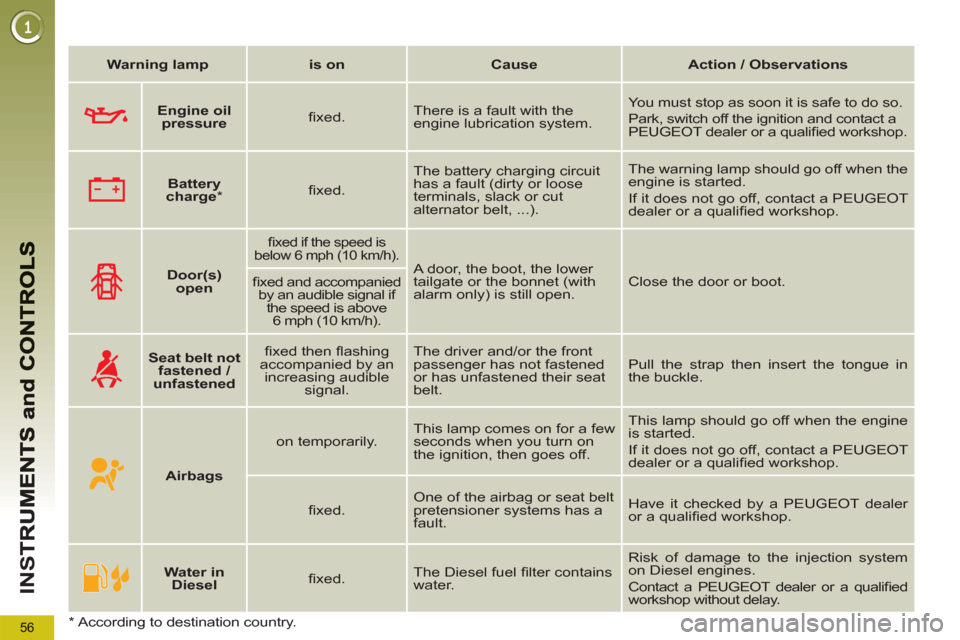
Warning lamp
is on
Cause
Action / Observations
Door(s)
open
fi xed if the speed is
below 6 mph (10 km/h).
A door, the boot, the lower
tailgate or the bonnet (with
alarm only) is still open. Close the door or boot.
fi xed and accompanied
by an audible signal if
the speed is above
6 mph (10 km/h).
Seat belt not
fastened /
unfastened
fi xed then fl ashing
accompanied by an
increasing audible
signal. The driver and/or the front
passenger has not fastened
or has unfastened their seat
belt. Pull the strap then insert the tongue in
the buckle.
Airbags
on temporarily. This lamp comes on for a few
seconds when you turn on
the ignition, then goes off. This lamp should go off when the engine
is started.
If it does not go off, contact a PEUGEOT
dealer or a qualifi ed workshop.
fi xed. One of the airbag or seat belt
pretensioner systems has a
fault. Have it checked by a PEUGEOT dealer
or a qualifi ed workshop.
Water in
Diesel
fi xed. The Diesel fuel fi lter contains
water. Risk of damage to the injection system
on Diesel engines.
Contact a PEUGEOT dealer or a qualifi ed
workshop without delay.
Engine oil
pressure
fi xed. There is a fault with the
engine lubrication system. You must stop as soon it is safe to do so.
Park, switch off the ignition and contact a
PEUGEOT dealer or a qualifi ed workshop.
Battery
charge
*
fi xed. The battery charging circuit
has a fault (dirty or loose
terminals, slack or cut
alternator belt, ...). The warning lamp should go off when the
engine is started.
If it does not go off, contact a PEUGEOT
dealer or a qualifi ed workshop.
*
According to destination country.
Page 91 of 340
AC
C
89
Lost keys
Visit a PEUGEOT dealer with the vehicle's registration document, your
personal identifi cation documents and if possible the key code label.
The PEUGEOT dealer will be able to look up the key code and the transponder
code required to order a new key.
Do not throw the remote control batteries away, they contain
metals which are harmful to
the environment.
Take them to an approved collection
point.
Remote control
The high frequency remote control is a sensitive system; do not operate it while it is in your
pocket as there is a possibility that it may unlock the vehicle, without you being aware of it.
Do not repeatedly press the buttons of your remote control out of range and
out of sight of your vehicle. You run the risk of stopping it from working and the
remote control would have to be reinitialised.
No remote control can operate when the key is in the ignition switch, even when
the ignition is switched off, except for reinitialisation.
Locking the vehicle
Driving with the doors locked may make access to the passenger compartment
by the emergency services more diffi cult in an emergency.
However, the vehicle unlocks automatically in the event of a serious impact
causing airbag deployment.
As a safety precaution, never leave children alone in the vehicle, except for a
very short period.
In all cases, it is essential to remove the key from the ignition switch when leaving
the vehicle.
Anti-theft protection
Do not make any modifi cations to the electronic engine immobiliser system; this
could cause malfunctions.
When purchasing a second-hand vehicle
Have the pairing of all of the keys in your possession checked by a PEUGEOT
dealer, to ensure that only your keys can be used to open and start the vehicle.
Page 124 of 340
CHILD SAFETY
122
PEUGEOT recommends
that
children should travel in the
outer
rear seats
of your ve-
hicle:
-
"rearwards-facing"
up to the age of 2,
-
"forwards-facing"
over the age of 2.
GENERAL POINTS RELATING TO CHILD SEATS
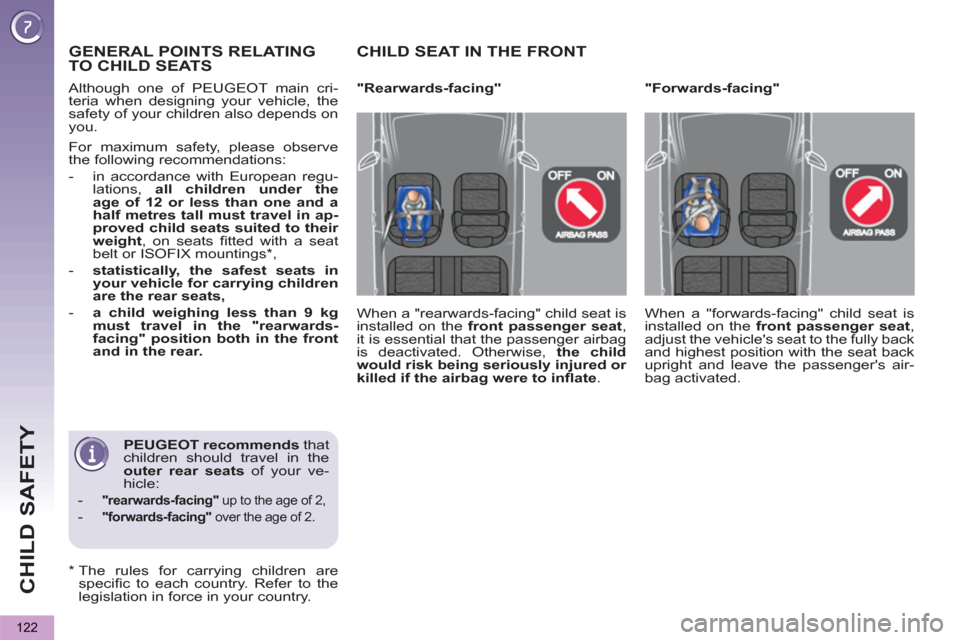
"Forwards-facing"
"Rearwards-facing"
Although one of PEUGEOT main cri-
teria when designing your vehicle, the
safety of your children also depends on
you.
CHILD SEAT IN THE FRONT
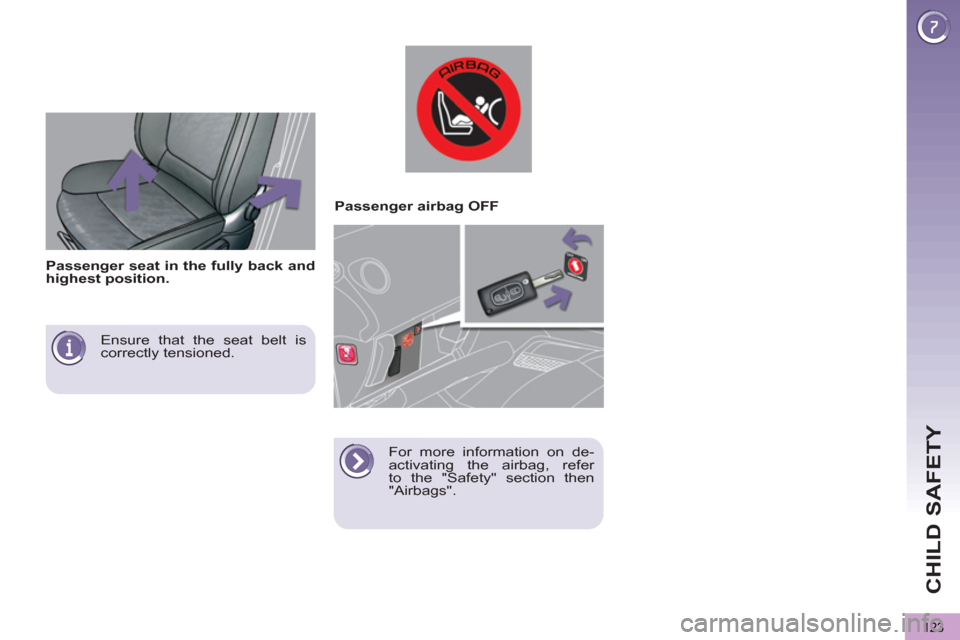
When a "rearwards-facing" child seat is
installed on the front passenger seat
,
it is essential that the passenger airbag
is deactivated. Otherwise, the child
would risk being seriously injured or
killed if the airbag were to infl ate
. When a "forwards-facing" child seat is
installed on the front passenger seat
,
adjust the vehicle's seat to the fully back
and highest position with the seat back
upright and leave the passenger's air-
bag activated.
For maximum safety, please observe
the following recommendations:
- in accordance with European regu-
lations, all children under the
age of 12 or less than one and a
half metres tall must travel in ap-
proved child seats suited to their
weight
, on seats fi tted with a seat
belt or ISOFIX mountings * ,
- statistically, the safest seats in
your vehicle for carrying children
are the rear seats,
- a child weighing less than 9 kg
must travel in the "rearwards-
facing" position both in the front
and in the rear.
*
The rules for carrying children are
specifi c to each country. Refer to the
legislation in force in your country.
Page 125 of 340
CHILD SAFETY
123
Ensure that the seat belt is
correctly tensioned.
Passenger seat in the fully back and
highest position.
Passenger airbag OFF
For more information on de-
activating the airbag, refer
to the "Safety" section then
"Airbags".
Page 126 of 340
AR
BG
НИКОГА НЕ инсталирайте детско столче на седалка с АКТИВИРАНА предна ВЪЗДУШНА ВЪЗГЛАВНИЦА. То в а можеда причини СМЪРТ
или СЕРИОЗНО НАРАНЯВАНЕ на детето.
CSNIKDY neumisťujte dětské zádržné zařízení orientované směrem dozadu na sedadlo chráněné AKTIVOVANÝM čelním AIRBAGEM. Hrozí
nebezpečí SMRTI DÍTĚTE nebo VÁŽNÉHO ZRANĚNÍ.
DABrug aldrig en bagudvendt barnestol på et sæde der er beskyttet af en aktiv airbag. Død eller alvorlig skade på barnet kan forekomme.
DEVerwenden Sie NIEMALS einen Kindersitz oder Babyschale gegen die Fahrtrichtung bei AKTIVIERTEM Airbag, TOD oder ERNSTHAFTE
VERLETZUNGEN können die Folge sein.
ELΜη χρησιμοποιείτε ΠΟΤΕ παιδικό κάθισμα με την πλάτη του προς το εμπρός μέρος του αυτοκινήτου, σε μια θέση που προστατεύεται από ΜΕΤΩΠΙΚΟ
αερόσακο που είναι ΕΝΕΡΓΟΣ. Αυτό μπορεί να έχει σαν συνέπεια το ΘΑΝΑΤΟ ή το ΣΟΒΑΡΟ ΤΡΑΥΜΑΤΙΣΜΟ του ΠΑΙΔΙΟΥ
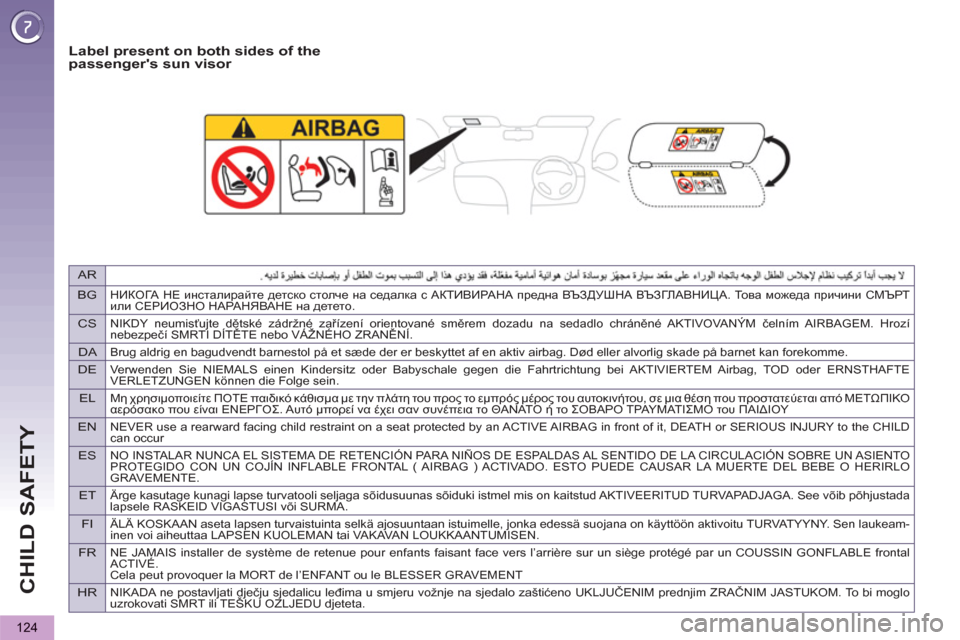
ENNEVER use a rearward facing child restraint on a seat protected by an ACTIVE AIRBAG in front of it, DEATH or SERIOUS INJURY to the CHILD
can occur
ESNO INSTALAR NUNCA EL SISTEMA DE RETENCIÓN PARA NIÑOS DE ESPALDAS AL SENTIDO DE LA CIRCULACIÓN SOBRE UN ASIENTO
PROTEGIDO CON UN COJÍN INFLABLE FRONTAL ( AIRBAG ) ACTIVADO. ESTO PUEDE CAUSAR LA MUERTE DEL BEBE O HERIRLO
GRAVEMENTE.
ETÄrge kasutage kunagi lapse turvatooli seljaga sõidusuunas sõiduki istmel mis on kaitstud AKTIVEERITUD TURVAPADJAGA. See võib põhjustada
lapsele RASKEID VIGASTUSI või SURMA.
FIÄLÄ KOSKAAN aseta lapsen turvaistuinta selkä ajosuuntaan istuimelle, jonka edessä suojana on käyttöön aktivoitu TURVATYYNY. Sen laukeam-
inen voi aiheuttaa LAPSEN KUOLEMAN tai VAKAVAN LOUKKAANTUMISEN.
FRNE JAMAIS installer de système de retenue pour enfants faisant face vers l’arrière sur un siège protégé par un COUSSIN GONFLABLE frontal
ACTIVÉ.
Cela peut provoquer la MORT de l’ENFANT ou le BLESSER GRAVEMENT
HRNIKADA ne postavljati dječju sjedalicu leđima u smjeru vožnje na sjedalo zaštićeno UKLJUČENIM prednjim ZRAČNIM JASTUKOM. To bi moglo
uzrokovati SMRT ili TEŠKU OZLJEDU djeteta.CHILD SAFETY
124
Label present on both sides of the
passenger's sun visor