Hybrid Use Peugeot 3008 Hybrid 4 2013 Owner's Manual
[x] Cancel search | Manufacturer: PEUGEOT, Model Year: 2013, Model line: 3008 Hybrid 4, Model: Peugeot 3008 Hybrid 4 2013Pages: 340, PDF Size: 16.54 MB
Page 3 of 340
Page reference:
this symbol invites you to refer
to the pages which provide de-
tails of the function.
Key
Protection of
the environment:
this symbol accompanies ad-
vice relating to protection of the envi-
ronment.
Information:
this symbol draws your atten-
tion to additional information
for better use of your vehicle.
Warning:
this symbol marks warnings
which it is essential to observe
for your own safety, for the safety of
others or to avoid any risk of damaging
your vehicle.
WELCOME
Thank you for choosing a 3008 HYbrid4,
a symbol of pleasure and innovation.
This handbook has been designed to
enable you to make the most of your
3008 HYbrid4.
On the fi rst few pages, you will fi nd a de-
tailed summary, followed by a quick refer-
ence guide intended to make it easier for
you to become familiar with your vehicle.
All of the details specifi c to your 3008
HYbrid4, comfort, safety, driving, are
then presented in this handbook, to in-
crease your appreciation of the vehicle
and help you make the most of it.
At the end of the handbook, illustra-
tions of the interior and exterior of the
vehicle will assist you in locating infor-
mation on equipment or a function in
the book.
Each model will be fi tted with only
some of the equipment mentioned in
this handbook, depending on its trim
level, model, version and the specifi ca-
tion for the country in which it is sold.
Page 6 of 340

4
FA
M
PRESENTATION OF THE HYBRID4 SYSTEM
26
Thank you for choosing a 3008 HYbrid4;
this vehicle has characteristics that are
different from conventional vehicles.
Study this handbook to learn about the
specifi c hybrid functions and for more
information, refer to the "Hybrid Sys-
tem" section.
The HYbrid4 technology allows two
sources of energy to be associated in
an effective manner: the Diesel HDi en-
gine, which drives the front wheels and
the electric motor, which drives the rear
wheels.
These two motors can operate alter-
nately or simultaneously, according to
the hybrid mode selected and the driv-
ing conditions.
The electric motor alone provides power
for the vehicle in "ZEV" (Zero Emissions
Vehicle) mode, and in "Auto" mode for
running at slow speed and low load. It
also assists the Diesel engine when
moving off, accelerating and changing
gear.
The battery that powers the electric
motor is recharged during phases of
deceleration and stores the energy for
subsequent use.
1.
Diesel HDi engine (front wheel drive).
2.
Electric motor (rear wheel drive).
3.
200 V battery.
4.
Electronic power supervisor.
5.
Stop & Start system.
6.
6-speed electronic gearbox.
7.
Electrical fl ow.
8.
HYbrid4 mode selector.
Page 8 of 340
6
FA
M
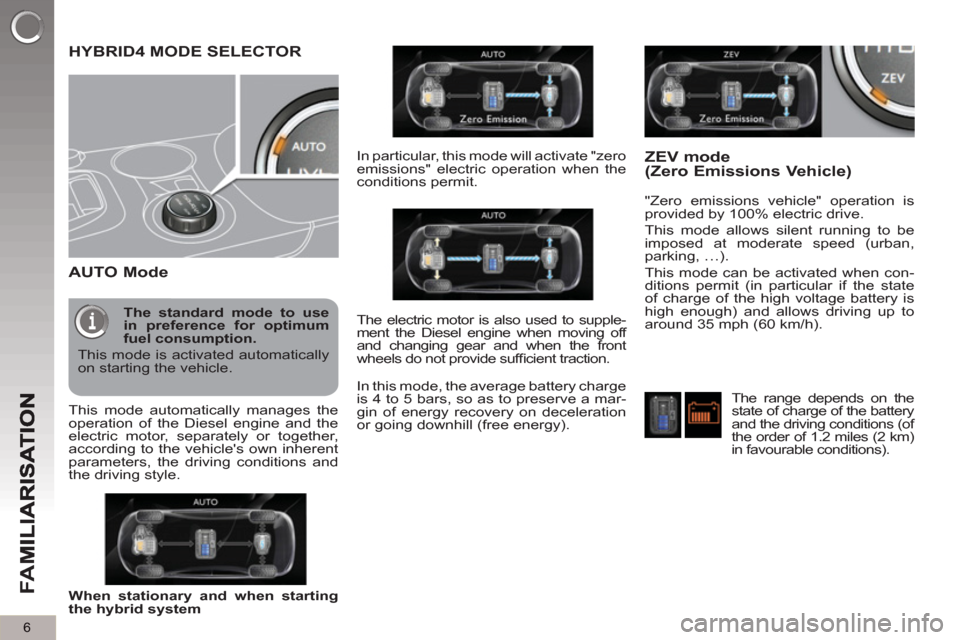
HYBRID4 MODE SELECTOR
AUTO Mode
"Zero emissions vehicle" operation is
provided by 100% electric drive.
This mode allows silent running to be
imposed at moderate speed (urban,
parking, …).
This mode can be activated when con-
ditions permit (in particular if the state
of charge of the high voltage battery is
high enough) and allows driving up to
around 35 mph (60 km/h).
ZEV mode(Zero Emissions Vehicle)
When stationary and when starting
the hybrid system
This mode automatically manages the
operation of the Diesel engine and the
electric motor, separately or together,
according to the vehicle's own inherent
parameters, the driving conditions and
the driving style.
The standard mode to use
in preference for optimum
fuel consumption.
This mode is activated automatically
on starting the vehicle.
In particular, this mode will activate "zero
emissions" electric operation when the
conditions permit.
The electric motor is also used to supple-
ment the Diesel engine when moving off
and changing gear and when the front
wheels do not provide suffi cient traction.
The range depends on the
state of charge of the battery
and the driving conditions (of
the order of 1.2 miles (2 km)
in favourable conditions).
In this mode, the average battery charge
is 4 to 5 bars, so as to preserve a mar-
gin of energy recovery on deceleration
or going downhill (free energy).
Page 10 of 340
8
FA
M
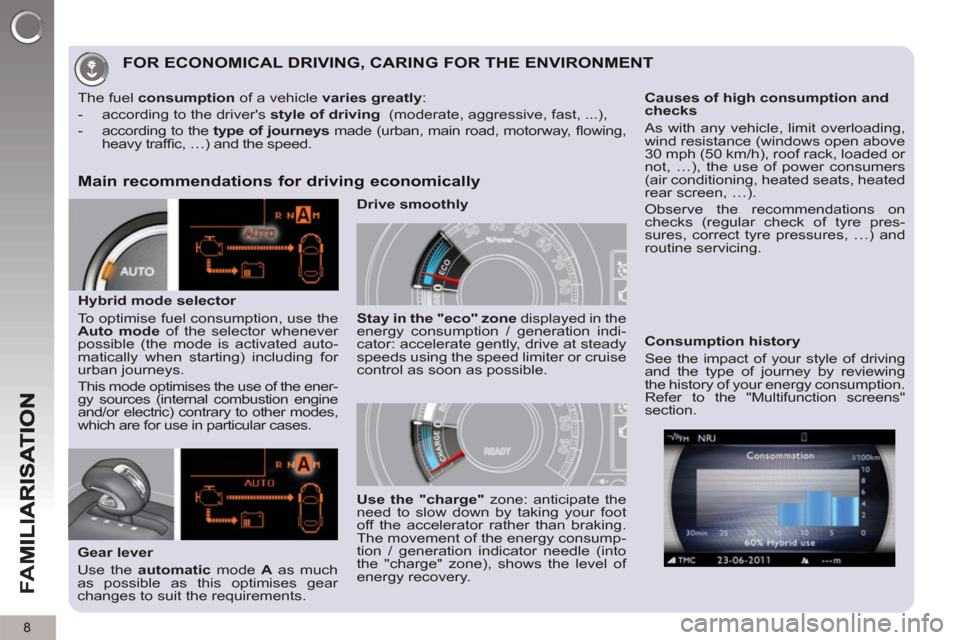
FOR ECONOMICAL DRIVING, CARING FOR THE ENVIRONMENT
Main recommendations for driving economically
Gear lever
Use the automatic
mode A
as much
as possible as this optimises gear
changes to suit the requirements.
The fuel consumption
of a vehicle varies greatly
:
- according to the driver's style of driving
(moderate, aggressive, fast, ...),
- according to the type of journeys
made (urban, main road, motorway, fl owing,
heavy traffi c, …) and the speed.
Hybrid mode selector
To optimise fuel consumption, use the
Auto
mode
of the selector whenever
possible (the mode is activated auto-
matically when starting) including for
urban journeys.
This mode optimises the use of the ener-
gy sources (internal combustion engine
and/or electric) contrary to other modes,
which are for use in particular cases.
Stay in the "eco" zone
displayed in the
energy consumption / generation indi-
cator: accelerate gently, drive at steady
speeds using the speed limiter or cruise
control as soon as possible.
Causes of high consumption and
checks
As with any vehicle, limit overloading,
wind resistance (windows open above
30 mph (50 km/h), roof rack, loaded or
not, …), the use of power consumers
(air conditioning, heated seats, heated
rear screen, …).
Observe the recommendations on
checks (regular check of tyre pres-
sures, correct tyre pressures, …) and
routine servicing.
Consumption history
See the impact of your style of driving
and the type of journey by reviewing
the history of your energy consumption.
Refer to the "Multifunction screens"
section.
Use the "charge"
zone: anticipate the
need to slow down by taking your foot
off the accelerator rather than braking.
The movement of the energy consump-
tion / generation indicator needle (into
the "charge" zone), shows the level of
energy recovery.
Drive smoothly
Page 28 of 340
HY
B
26
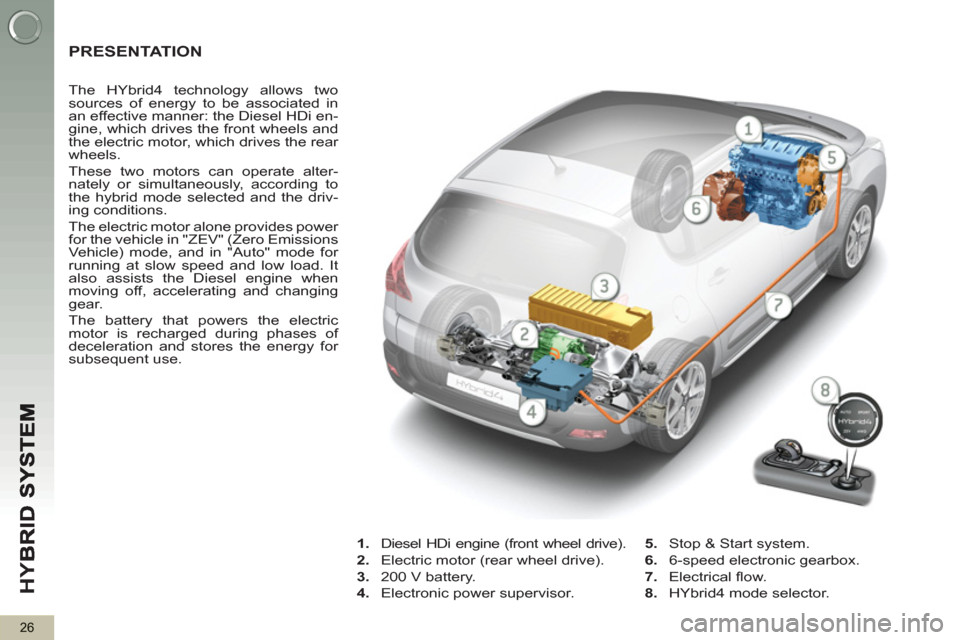
PRESENTATION
The HYbrid4 technology allows two
sources of energy to be associated in
an effective manner: the Diesel HDi en-
gine, which drives the front wheels and
the electric motor, which drives the rear
wheels.
These two motors can operate alter-
nately or simultaneously, according to
the hybrid mode selected and the driv-
ing conditions.
The electric motor alone provides power
for the vehicle in "ZEV" (Zero Emissions
Vehicle) mode, and in "Auto" mode for
running at slow speed and low load. It
also assists the Diesel engine when
moving off, accelerating and changing
gear.
The battery that powers the electric
motor is recharged during phases of
deceleration and stores the energy for
subsequent use.
1.
Diesel HDi engine (front wheel drive).
2.
Electric motor (rear wheel drive).
3.
200 V battery.
4.
Electronic power supervisor.
5.
Stop & Start system.
6.
6-speed electronic gearbox.
7.
Electrical fl ow.
8.
HYbrid4 mode selector.
Page 33 of 340
HY
B
31
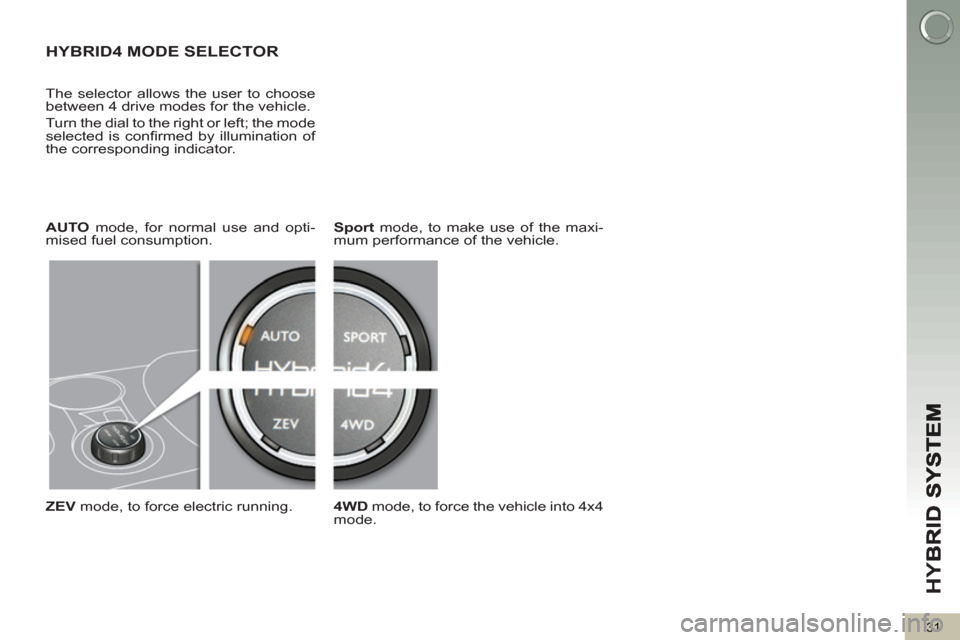
HYBRID4 MODE SELECTOR
The selector allows the user to choose
between 4 drive modes for the vehicle.
Turn the dial to the right or left; the mode
selected is confi rmed by illumination of
the corresponding indicator.
ZEV
mode, to force electric running.
Sport
mode, to make use of the maxi-
mum performance of the vehicle.
4WD
mode, to force the vehicle into 4x4
mode.
AUTO
mode, for normal use and opti-
mised fuel consumption.
Page 36 of 340
HY
B
34
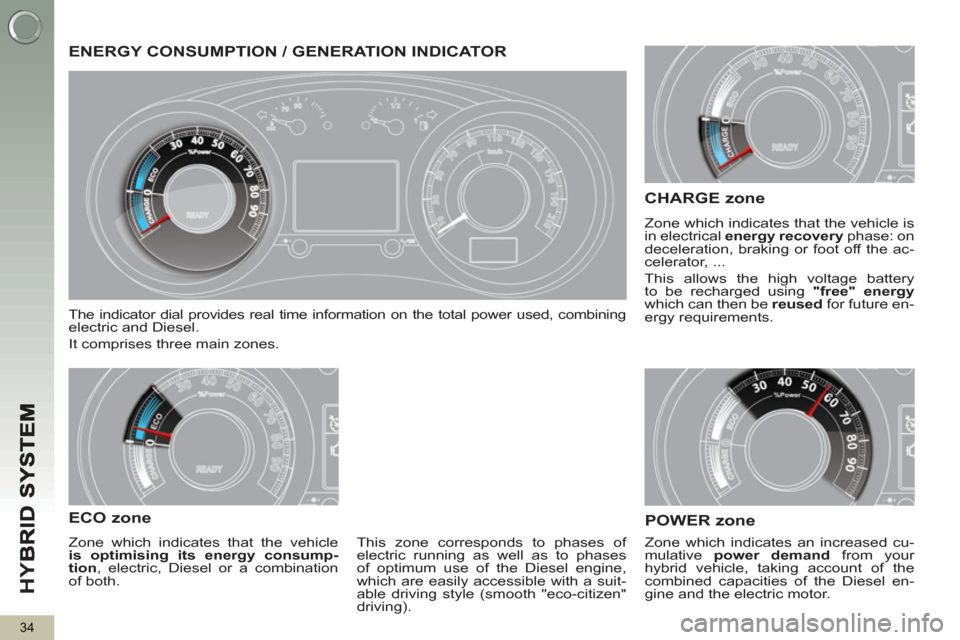
ENERGY CONSUMPTION / GENERATION INDICATOR
The indicator dial provides real time information on the total power used, combining
electric and Diesel.
It comprises three main zones.
ECO zone
POWER zone
CHARGE zone
Zone which indicates that the vehicle is
in electrical energy recovery
phase: on
deceleration, braking or foot off the ac-
celerator, ...
This allows the high voltage battery
to be recharged using "free" energy
which can then be reused
for future en-
ergy requirements.
This zone corresponds to phases of
electric running as well as to phases
of optimum use of the Diesel engine,
which are easily accessible with a suit-
able driving style (smooth "eco-citizen"
driving). Zone which indicates that the vehicle
is optimising its energy consump-
tion
, electric, Diesel or a combination
of both. Zone which indicates an increased cu-
mulative power demand
from your
hybrid vehicle, taking account of the
combined capacities of the Diesel en-
gine and the electric motor.
Page 43 of 340
41
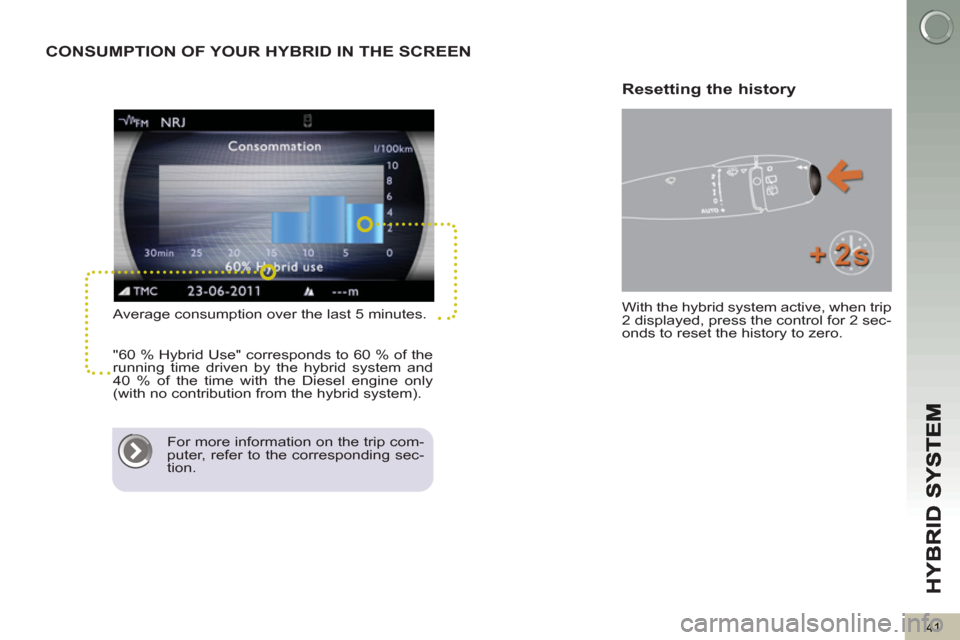
CONSUMPTION OF YOUR HYBRID IN THE SCREEN
Average consumption over the last 5 minutes.
"60 % Hybrid Use" corresponds to 60 % of the
running time driven by the hybrid system and
40 % of the time with the Diesel engine only
(with no contribution from the hybrid system).
For more information on the trip com-
puter, refer to the corresponding sec-
tion. With the hybrid system active, when trip
2 displayed, press the control for 2 sec-
onds to reset the history to zero.
Resetting the history
Page 44 of 340
HY
B
42
200 V HIGH VOLTAGE BATTERY
The 200 V high voltage battery cannot
be recharged from a mains supply.
The battery is Ni-MH (Nickel Metal Hy-
dride) and is located below the boot
fl oor, close to the electric motor.
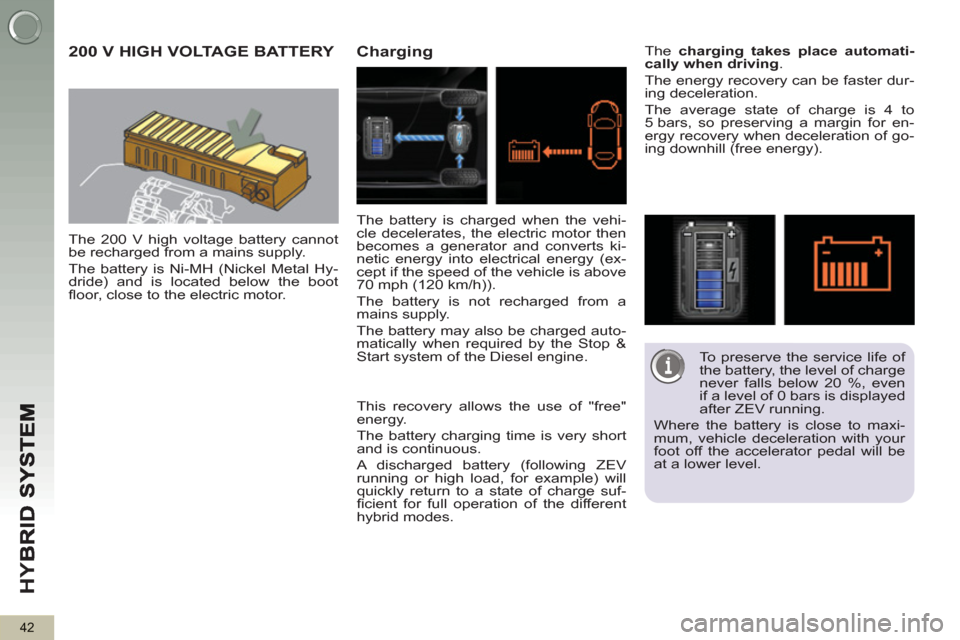
Charging
The charging takes place automati-
cally when driving
.
The energy recovery can be faster dur-
ing deceleration.
The average state of charge is 4 to
5 bars, so preserving a margin for en-
ergy recovery when deceleration of go-
ing downhill (free energy).
The battery is charged when the vehi-
cle decelerates, the electric motor then
becomes a generator and converts ki-
netic energy into electrical energy (ex-
cept if the speed of the vehicle is above
70 mph (120 km/h)).
The battery is not recharged from a
mains supply.
The battery may also be charged auto-
matically when required by the Stop &
Start system of the Diesel engine.
To preserve the service life of
the battery, the level of charge
never falls below 20 %, even
if a level of 0 bars is displayed
after ZEV running.
Where the battery is close to maxi-
mum, vehicle deceleration with your
foot off the accelerator pedal will be
at a lower level.
This recovery allows the use of "free"
energy.
The battery charging time is very short
and is continuous.
A discharged battery (following ZEV
running or high load, for example) will
quickly return to a state of charge suf-
fi cient for full operation of the different
hybrid modes.
Page 45 of 340
HY
B
43
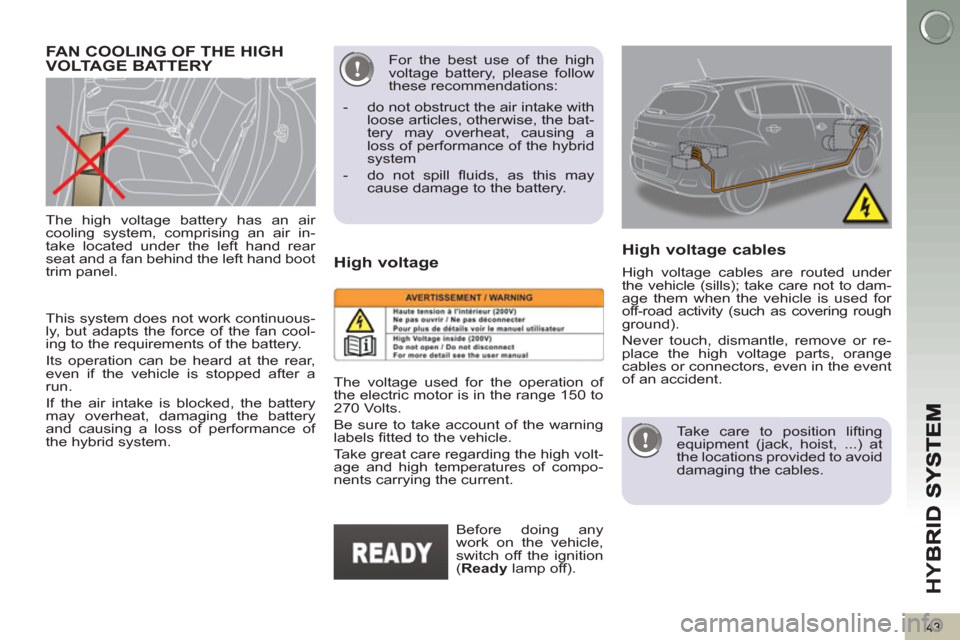
This system does not work continuous-
ly, but adapts the force of the fan cool-
ing to the requirements of the battery.
Its operation can be heard at the rear,
even if the vehicle is stopped after a
run.
If the air intake is blocked, the battery
may overheat, damaging the battery
and causing a loss of performance of
the hybrid system.
FAN COOLING OF THE HIGHVOLTAGE BATTERY
For the best use of the high
voltage battery, please follow
these recommendations:
- do not obstruct the air intake with
loose articles, otherwise, the bat-
tery may overheat, causing a
loss of performance of the hybrid
system
- do not spill fl uids, as this may
cause damage to the battery.
The high voltage battery has an air
cooling system, comprising an air in-
take located under the left hand rear
seat and a fan behind the left hand boot
trim panel.
High voltage
The voltage used for the operation of
the electric motor is in the range 150 to
270 Volts.
Be sure to take account of the warning
labels fi tted to the vehicle.
Take great care regarding the high volt-
age and high temperatures of compo-
nents carrying the current.
Before doing any
work on the vehicle,
switch off the ignition
( Ready
lamp off).
High voltage cables are routed under
the vehicle (sills); take care not to dam-
age them when the vehicle is used for
off-road activity (such as covering rough
ground).
Never touch, dismantle, remove or re-
place the high voltage parts, orange
cables or connectors, even in the event
of an accident.
High voltage cables
Take care to position lifting
equipment (jack, hoist, ...) at
the locations provided to avoid
damaging the cables.