Service Peugeot 301 2015 User Guide
[x] Cancel search | Manufacturer: PEUGEOT, Model Year: 2015, Model line: 301, Model: Peugeot 301 2015Pages: 285, PDF Size: 13.55 MB
Page 40 of 285
38
301_en_Chap02_ouvertures_ed01-2014
Locking / unlocking from the inside
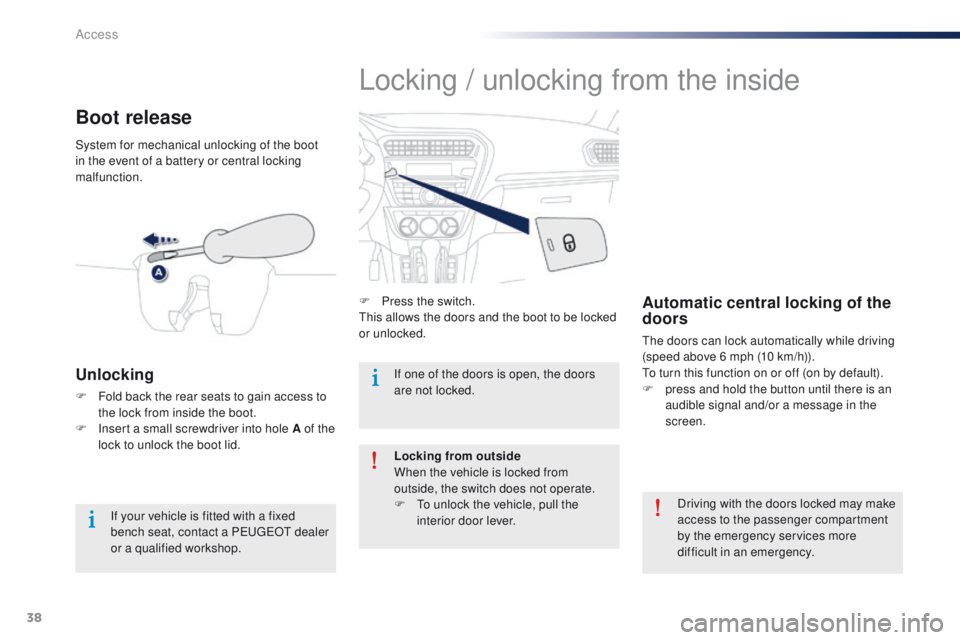
F Press the switch.
This allows the doors and the boot to be locked
or unlocked.Automatic central locking of the
doors
The doors can lock automatically while driving
(speed above 6 mph (10 km/h)).
To turn this function on or off (on by default).
F
p
ress and hold the button until there is an
audible signal and/or a message in the
screen.
Locking from outside
When the vehicle is locked from
outside, the switch does not operate.
F
T
o unlock the vehicle, pull the
interior door lever.
If one of the doors is open, the doors
are not locked.
Driving with the doors locked may make
access to the passenger compartment
by the emergency services more
difficult in an emergency.
Boot release
Unlocking
F Fold back the rear seats to gain access to the lock from inside the boot.
F
I
nsert a small screwdriver into hole A of the
lock to unlock the boot lid.
System for mechanical unlocking of the boot
in the event of a battery or central locking
malfunction.
If your vehicle is fitted with a fixed
bench seat, contact a PEUGEOT dealer
or a qualified workshop.
Access
Page 95 of 285
93
301_en_Chap07_securite_ed01-2014
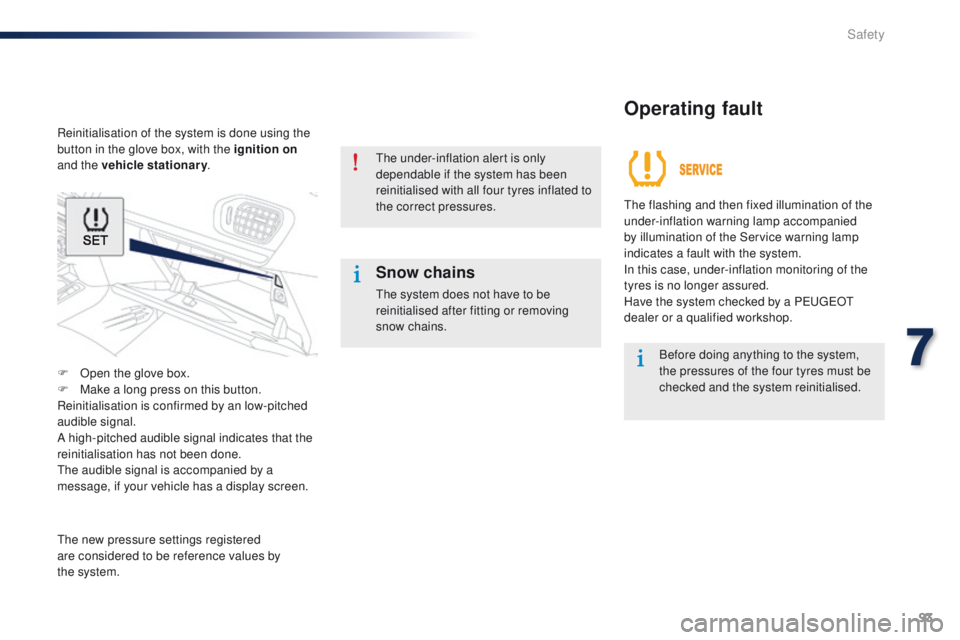
Reinitialisation of the system is done using the
button in the glove box, with the ignition on
and the vehicle stationary .
F
O
pen the glove box.
F
M
ake a long press on this button.
Reinitialisation is confirmed by an low-pitched
audible signal.
A high-pitched audible signal indicates that the
reinitialisation has not been done.
The audible signal is accompanied by a
message, if your vehicle has a display screen.
The new pressure settings registered
are considered to be reference values by
the
system.
Operating fault
The under-inflation alert is only
dependable if the system has been
reinitialised with all four tyres inflated to
the correct pressures.
Snow chains
The system does not have to be
reinitialised after fitting or removing
snow chains. Before doing anything to the system,
the pressures of the four tyres must be
checked and the system reinitialised.
The flashing and then fixed illumination of the
under-inflation warning lamp accompanied
by illumination of the Service warning lamp
indicates a fault with the system.
In this case, under-inflation monitoring of the
tyres is no longer assured.
Have the system checked by a PEUGEOT
dealer or a qualified workshop.
7
Safety
Page 154 of 285
152
301_en_Chap09_info-pratiques_ed01-2014
Towing the vehicle
Access to the tools
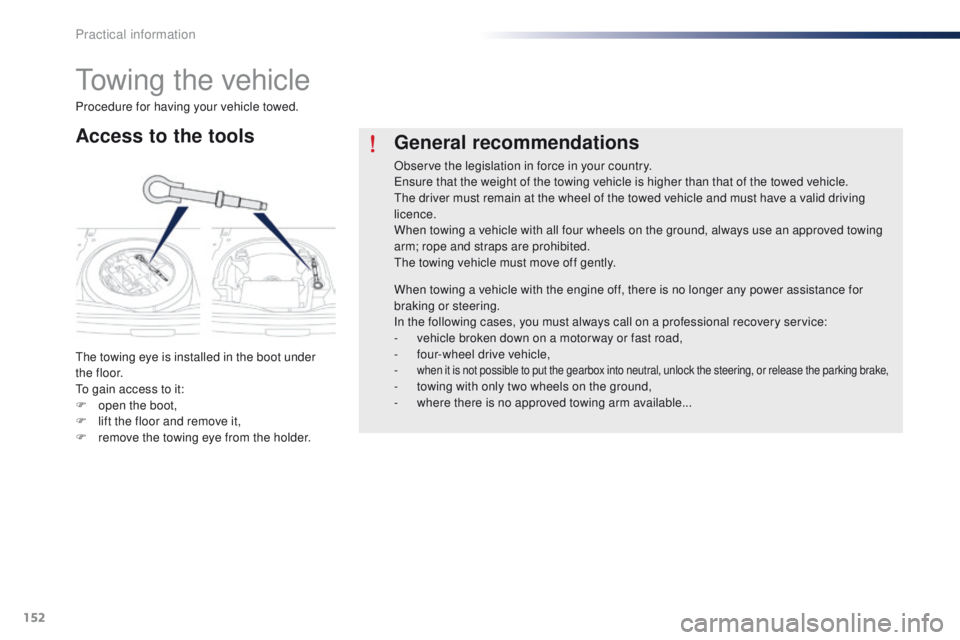
The towing eye is installed in the boot under
t h e f l o o r.
To gain access to it:
F
o
pen the boot,
F
l
ift the floor and remove it,
F
r
emove the towing eye from the holder.
General recommendations
Observe the legislation in force in your country.
Ensure that the weight of the towing vehicle is higher than that of the towed vehicle.
The driver must remain at the wheel of the towed vehicle and must have a valid driving
licence.
When towing a vehicle with all four wheels on the ground, always use an approved towing
arm; rope and straps are prohibited.
The towing vehicle must move off gently.
When towing a vehicle with the engine off, there is no longer any power assistance for
braking or steering.
In the following cases, you must always call on a professional recovery service:
-
v
ehicle broken down on a motor way or fast road,
-
f
our-wheel drive vehicle,
-
when it is not possible to put the gearbox into neutral, unlock the steering, or release the parking brake,- towing with only two wheels on the ground,
- w here there is no approved towing arm available...
Procedure for having your vehicle towed.
Practical information
Page 167 of 285
165
301_en_Chap10_verifications_ed01-2014
Checking levels
Oil level
The check of the oil level is carried
out with the dipstick, located under
the bonnet. For the position of the dipstick,
refer to the under-bonnet view on a previous
page.
Checking with dipstick
Refer to the under-bonnet view for the location
of the dipstick on your vehicle.
F
T
ake the dipstick by its coloured grip and
pull it out completely.
F
W
ith the end of the dipstick with a clean
and non-fluffy cloth.
F
R
efit the dipstick and push it fully down,
then pull it out again for a visual check of
the oil level:
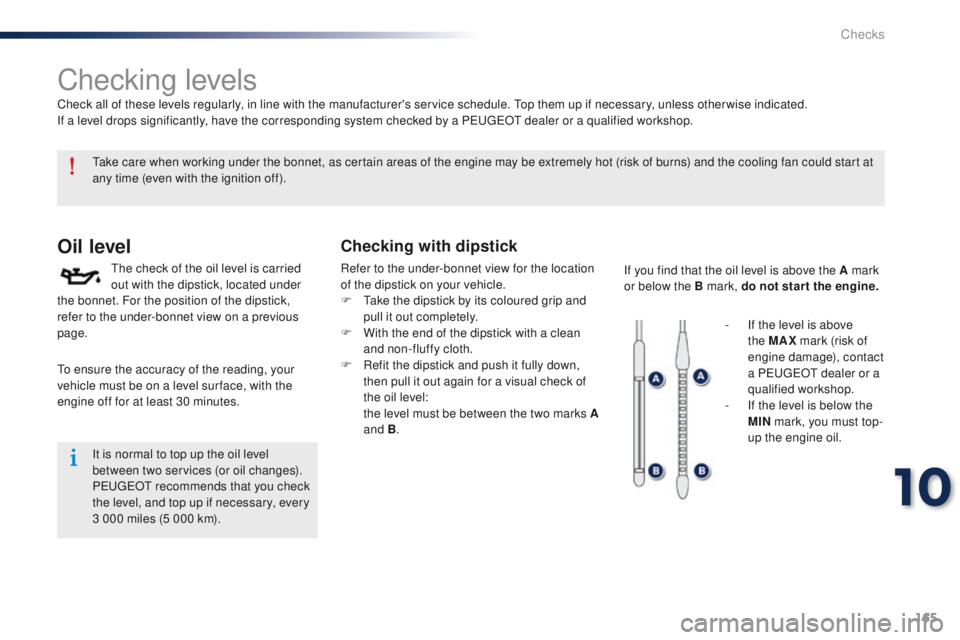
the level must be between the two marks
A
and B . If you find that the oil level is above the A mark
or below the B mark, do not star t the engine.
Take care when working under the bonnet, as certain areas of the engine may be extremely hot (risk of burns) and the cooling fan could start at
any time (even with the ignition off).
Check all of these levels regularly, in line with the manufacturer's service schedule. Top them up if necessary, unless other wise indicated.
If a level drops significantly, have the corresponding system checked by a PEUGEOT dealer or a qualified workshop.
It is normal to top up the oil level
between two services (or oil changes).
PEUGEOT recommends that you check
the level, and top up if necessary, every
3 000 miles (5 000 km).
To ensure the accuracy of the reading, your
vehicle must be on a level sur face, with the
engine off for at least 30 minutes.
-
I
f the level is above
the MAX mark (risk of
engine damage), contact
a PEUGEOT dealer or a
qualified workshop.
-
I
f the level is below the
MIN mark, you must top-
up the engine oil.
10
Checks
Page 168 of 285
166
301_en_Chap10_verifications_ed01-2014
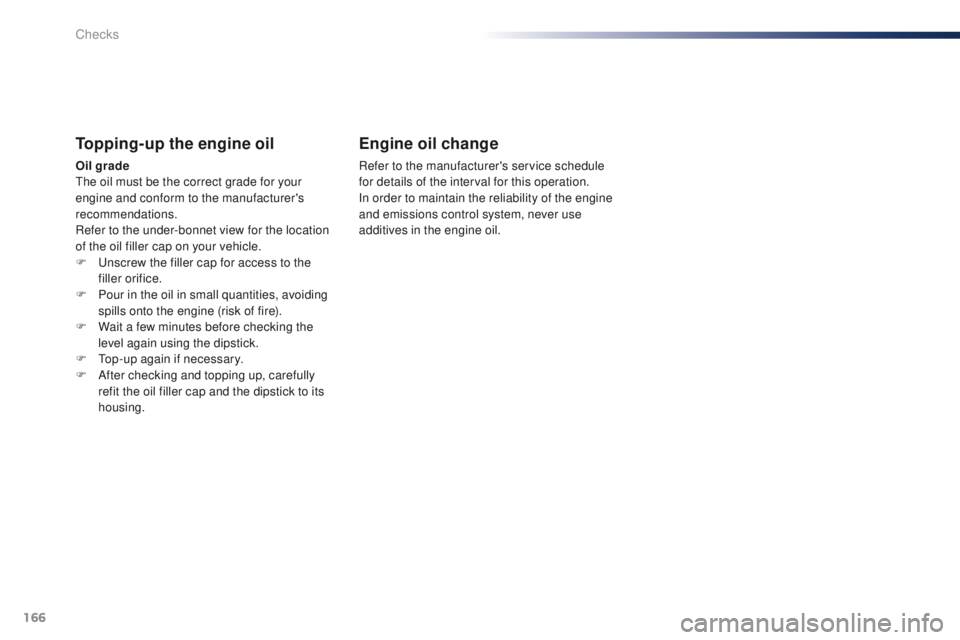
Topping-up the engine oil
Oil grade
The oil must be the correct grade for your
engine and conform to the manufacturer's
recommendations.
Refer to the under-bonnet view for the location
of the oil filler cap on your vehicle.
F
U
nscrew the filler cap for access to the
filler orifice.
F
P
our in the oil in small quantities, avoiding
spills onto the engine (risk of fire).
F
W
ait a few minutes before checking the
level again using the dipstick.
F
T
op-up again if necessary.
F
A
fter checking and topping up, carefully
refit the oil filler cap and the dipstick to its
housing.
Engine oil change
Refer to the manufacturer's service schedule
for details of the interval for this operation.
In order to maintain the reliability of the engine
and emissions control system, never use
additives in the engine oil.
Checks
Page 169 of 285
167
301_en_Chap10_verifications_ed01-2014
Coolant level
The coolant level should be close
to the "MA X" mark but should never
exceed it.
In addition, as the cooling system is
pressurised, wait at least one hour after
switching off the engine before carrying out any
work.
To avoid any risk of scalding, unscrew the cap
by two turns to allow the pressure to drop.
When the pressure has dropped, remove the
cap and top up the level.Changing the coolant
The coolant does not have to be replaced at
routine services.
Fluid specification
The coolant must conform to the
manufacturer's recommendations.
When the engine is warm, the temperature of
the coolant is regulated by the fan.
The cooling fan may star t after switching
off the engine: take care with ar ticles and
clothing that might be caught by the fan
blades.
The brake fluid level should be close
to the "MA X" mark. If it is not, check
the brake pad wear.
Brake fluid level
Changing the fluid
Refer to the manufacturer's service schedule
for details of the interval for this operation.
Fluid specification
The brake fluid must conform to the
manufacturer's recommendations.
10
Checks
Page 170 of 285
168
301_en_Chap10_verifications_ed01-2014
Fluid specification
For optimum cleaning and to avoid freezing,
this fluid must not be topped up or replaced
with plain water.
In wintry conditions, it is recommended that you
use an ethyl alcohol or methanol based fluid.
Screenwash fluid level
Top up the level when necessary.Avoid prolonged contact of used oil or
fluids with the skin.
Most of these fluids are harmful to
health or indeed very corrosive.
Do not discard used oil or fluids into
sewers or onto the ground.
Take used oil to a PEUGEOT dealer or
a qualified workshop (France) or to an
authorised waste disposal site.
Used products
To p p i n g u p
This additive must be topped up by a
PEUGEOT dealer or a qualified workshop
without delay.
Diesel additive level (Diesel
engine with particle filter)
A low additive level is indicated by illumination
of the service warning lamp, accompanied
by an audible warning and a message in the
screen (if a display screen is fitted).
Checks
Page 171 of 285
169
301_en_Chap10_verifications_ed01-2014
Checks
12 V battery
The battery does not require any maintenance.
However, check that the terminals are clean
and correctly tightened, particularly in summer
and winter.
Particle filter (Diesel)
The start of saturation of the
particle filter is indicated by
the fixed illumination of this warning lamp
accompanied by a warning message in the
screen (if a display screen is fitted).
As soon as the traffic conditions permit,
regenerate the filter by driving at a speed of at
least 40 mph (60 km/h) until the warning lamp
goes off.
If the warning lamp stays on, this indicates a
low additive level.
On a new vehicle, the first particle
filter regeneration operations may be
accompanied by a "burnt" smell, which
is perfectly normal.
Following prolonged operation of the
vehicle at very low speed or at idle,
you may, in exceptional circumstances,
notice the emission of water vapour at
the exhaust on acceleration. This does
not affect the behaviour of the vehicle
or the environment.
Unless otherwise indicated, check these components in accordance with the manufacturer's service schedule and according to your engine.
Other wise, have them checked by a PEUGEOT dealer or a qualified workshop.
Air filter and passenger compartment filter
Refer to the manufacturer's
service schedule for details of the
replacement intervals for these
components.
Oil filter
Replace the oil filter each time the
engine oil is changed.
Refer to the manufacturer's
service schedule for details of
the replacement interval for this
component.
When carrying out work on the battery, refer
to the "Practical information" section for
details of the precautions to be taken before
disconnecting the battery and following its
reconnection.
Depending on the environment (e.g. dusty
atmosphere) and the use of the vehicle (e.g.
city driving), replace them twice as often if
necessary
.
A clogged passenger compartment filter may
have an adverse effect on the per formance
of the air conditioning system and generate
undesirable odours.
10
Checks
Page 172 of 285
170
301_en_Chap10_verifications_ed01-2014
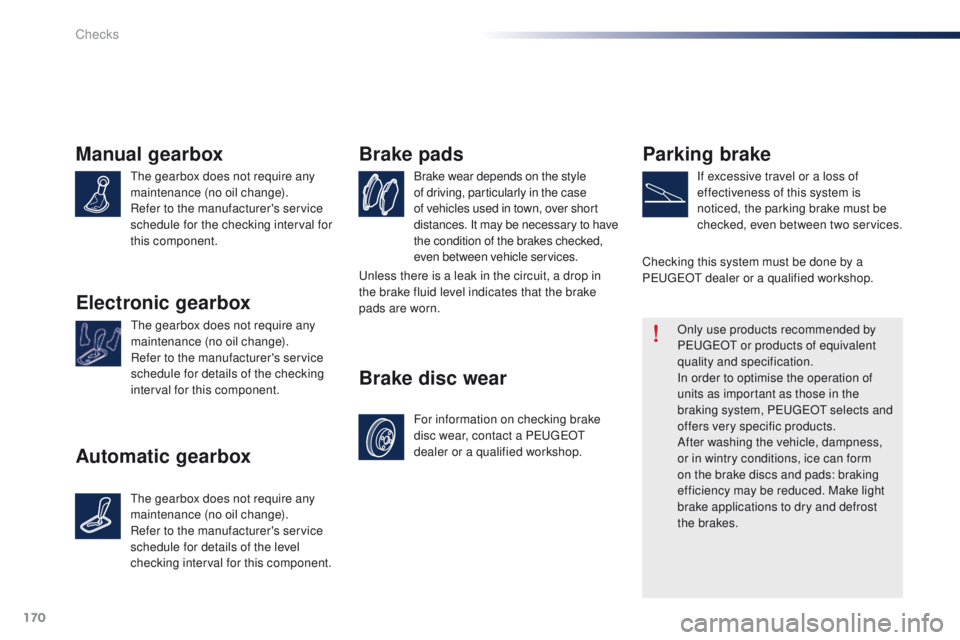
Manual gearbox
The gearbox does not require any
maintenance (no oil change).
Refer to the manufacturer's service
schedule for the checking interval for
this component.
Electronic gearbox
The gearbox does not require any
maintenance (no oil change).
Refer to the manufacturer's service
schedule for details of the checking
interval for this component.
Automatic gearbox
The gearbox does not require any
maintenance (no oil change).
Refer to the manufacturer's service
schedule for details of the level
checking interval for this component.Brake wear depends on the style
of driving, particularly in the case
of vehicles used in town, over short
distances. It may be necessary to have
the condition of the brakes checked,
even between vehicle services.
Brake pads
For information on checking brake
disc wear, contact a PEUGEOT
dealer or a qualified workshop.
Brake disc wear
Parking brake
If excessive travel or a loss of
effectiveness of this system is
noticed, the parking brake must be
checked, even between two services.
Only use products recommended by
PEUGEOT or products of equivalent
quality and specification.
In order to optimise the operation of
units as important as those in the
braking system, PEUGEOT selects and
offers very specific products.
After washing the vehicle, dampness,
or in wintry conditions, ice can form
on the brake discs and pads: braking
efficiency may be reduced. Make light
brake applications to dry and defrost
the brakes.
Checking this system must be done by a
PEUGEOT dealer or a qualified workshop.
Unless there is a leak in the circuit, a drop in
the brake fluid level indicates that the brake
pads are worn.
Checks
Page 193 of 285
_ed01-2014
USING THE TELEPHONE
Pairing a telephone
First connection
The services offered depend on the network, the SIM card and the compatibility of the B\
luetooth tel")
05
191
301_en_Chap12a_RD5(RD45)_ed01-2014
USING THE TELEPHONE
Pairing a telephone
First connection
The services offered depend on the network, the SIM card and the compatibility of the B\
luetooth telephone used.
Consult your telephone's manual and your operator to find out which services are available to you.
Activate the telephone's Bluetooth function and
ensure that it is "visible to all" (refer to the telephone
user guide). Press MENU. A window is displayed "
Search in progress…".
Select the telephone to be connected
from the list. Only one telephone can
be connected at a time. Select "Search for a device".
For safety reasons and because they require prolonged attention on the p\
art of the driver, the operations for pairing of the Bluetooth mobile
telephone with the Bluetooth hands-free system of your audio system must\
be carried out with the
vehicle stationary and the ignition on.
Visit www.peugeot.co.uk for more information (compatibility, additional help, ...).
Select "Bluetooth connection " and
confirm.