Wing Peugeot 301 2015 Owner's Guide
[x] Cancel search | Manufacturer: PEUGEOT, Model Year: 2015, Model line: 301, Model: Peugeot 301 2015Pages: 285, PDF Size: 13.55 MB
Page 156 of 285
154
301_en_Chap09_info-pratiques_ed01-2014
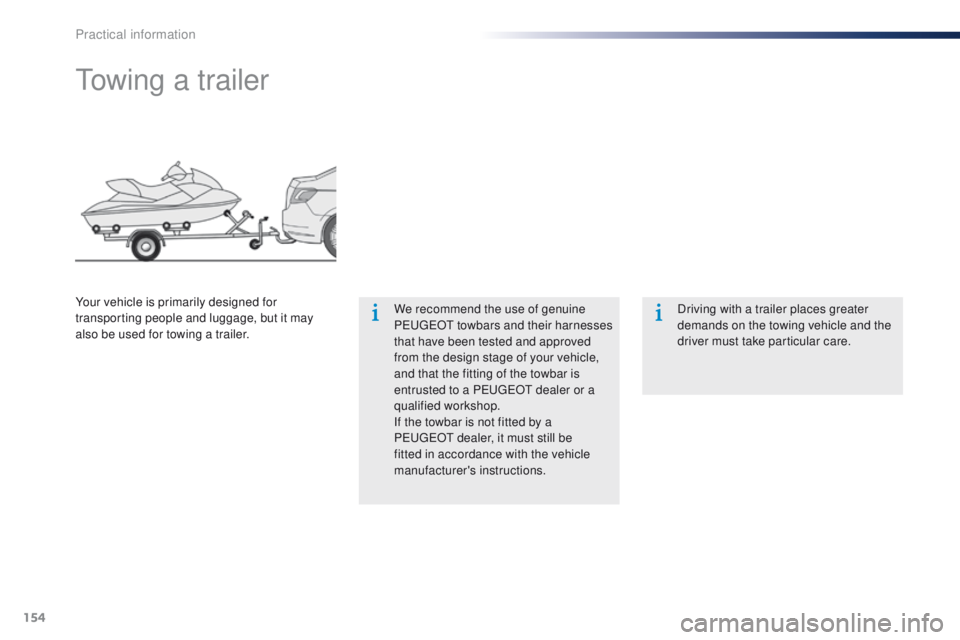
Towing a trailer
We recommend the use of genuine
PEUGEOT towbars and their harnesses
that have been tested and approved
from the design stage of your vehicle,
and that the fitting of the towbar is
entrusted to a PEUGEOT dealer or a
qualified workshop.
If the towbar is not fitted by a
PEUGEOT dealer, it must still be
fitted in accordance with the vehicle
manufacturer's instructions.
Your vehicle is primarily designed for
transporting people and luggage, but it may
also be used for towing a trailer.
Driving with a trailer places greater
demands on the towing vehicle and the
driver must take particular care.
Practical information
Page 157 of 285
155
301_en_Chap09_info-pratiques_ed01-2014
Driving advice
Distribution of loads
F Distribute the load in the trailer so that the heaviest items are as close as possible to
the axle and the nose weight approaches the
maximum permitted without exceeding it.
Air density decreases with altitude, thus
reducing engine performance. Above
1
000 metres, the maximum towed load must
be reduced by 10
% for every 1 000 metres of
altitude.
Side wind
F Take into account the increased sensitivity to side wind.
Cooling
Towing a trailer on a slope increases the
temperature of the coolant.
As the fan is electrically controlled, its cooling
capacity is not dependent on the engine speed.
F
T
o lower the engine speed, reduce your
speed.
The maximum towed load on a long incline
depends on the gradient and the ambient
temperature.
In all cases, keep a check on the coolant
temperature.
F
I
f the warning lamp and the
STOP warning lamp come on,
stop the vehicle and switch off
the engine as soon as possible.
Braking
Towing a trailer increases the braking distance.
To avoid overheating of the brakes on a long
mountain type of descent, the use of engine
braking is recommended.
Ty r e s
F Check the tyre pressures of the towing vehicle and of the trailer, observing the
recommended pressures.
Lighting
F Check the electrical lighting and signalling on the trailer.
Refer to the "Technical data" section for details
of the weights and towed loads which apply to
your vehicle.
The rear parking sensors will be
deactivated automatically if a genuine
PEUGEOT towbar is used.
9
Practical information
Page 158 of 285
156
301_en_Chap09_info-pratiques_ed01-2014
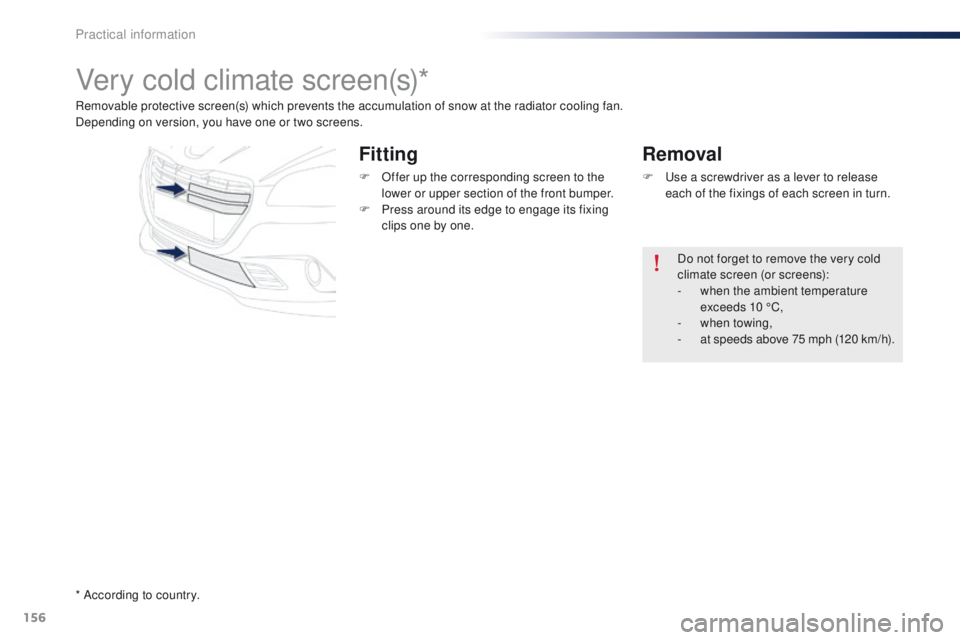
Very cold climate screen(s)*
Removable protective screen(s) which prevents the accumulation of snow at the radiator cooling fan.
Depending on version, you have one or two screens.
Fitting
F Offer up the corresponding screen to the lower or upper section of the front bumper.
F
P
ress around its edge to engage its fixing
clips one by one.
Removal
F Use a screwdriver as a lever to release each of the fixings of each screen in turn.
* According to country. Do not forget to remove the very cold
climate screen (or screens):
-
w
hen the ambient temperature
exceeds 10 °C,
-
w
hen towing,
-
a
t speeds above 75 mph (120 km/h).
Practical information
Page 171 of 285
169
301_en_Chap10_verifications_ed01-2014
Checks
12 V battery
The battery does not require any maintenance.
However, check that the terminals are clean
and correctly tightened, particularly in summer
and winter.
Particle filter (Diesel)
The start of saturation of the
particle filter is indicated by
the fixed illumination of this warning lamp
accompanied by a warning message in the
screen (if a display screen is fitted).
As soon as the traffic conditions permit,
regenerate the filter by driving at a speed of at
least 40 mph (60 km/h) until the warning lamp
goes off.
If the warning lamp stays on, this indicates a
low additive level.
On a new vehicle, the first particle
filter regeneration operations may be
accompanied by a "burnt" smell, which
is perfectly normal.
Following prolonged operation of the
vehicle at very low speed or at idle,
you may, in exceptional circumstances,
notice the emission of water vapour at
the exhaust on acceleration. This does
not affect the behaviour of the vehicle
or the environment.
Unless otherwise indicated, check these components in accordance with the manufacturer's service schedule and according to your engine.
Other wise, have them checked by a PEUGEOT dealer or a qualified workshop.
Air filter and passenger compartment filter
Refer to the manufacturer's
service schedule for details of the
replacement intervals for these
components.
Oil filter
Replace the oil filter each time the
engine oil is changed.
Refer to the manufacturer's
service schedule for details of
the replacement interval for this
component.
When carrying out work on the battery, refer
to the "Practical information" section for
details of the precautions to be taken before
disconnecting the battery and following its
reconnection.
Depending on the environment (e.g. dusty
atmosphere) and the use of the vehicle (e.g.
city driving), replace them twice as often if
necessary
.
A clogged passenger compartment filter may
have an adverse effect on the per formance
of the air conditioning system and generate
undesirable odours.
10
Checks
Page 174 of 285
172
301_en_Chap11_caracteristiques-techniques_ed01-2014
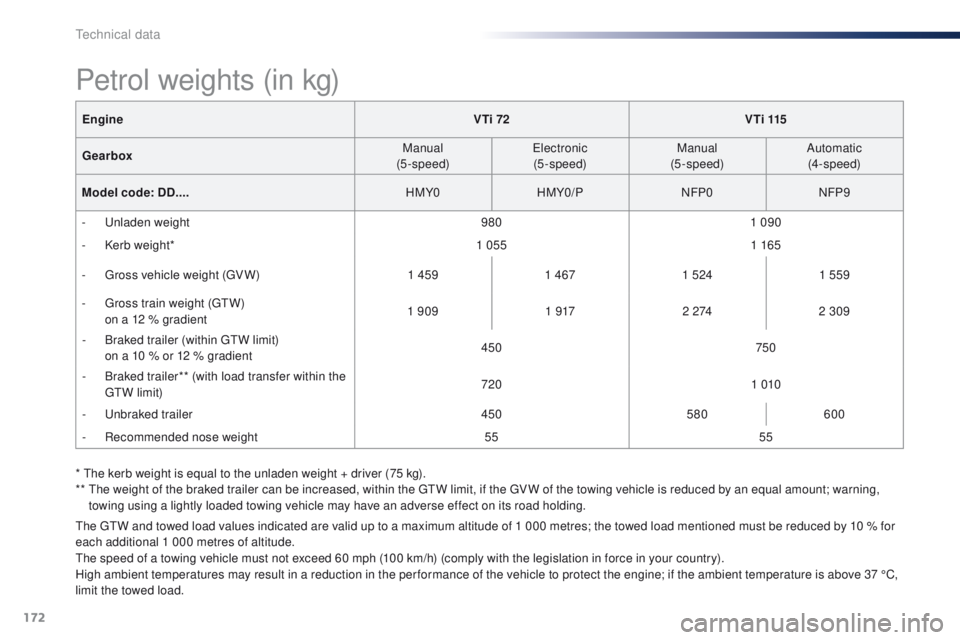
EngineVTi 72V T i 115
Gearbox Manual
(5-speed) Electronic
(5-speed) Manual
(5-speed) Automatic
(4-speed)
Model code: DD.... HMY0HMY0/P NFP0NFP9
-
U
nladen weight 9801 090
-
K
erb weight* 1 0551 165
-
G
ross vehicle weight (GV W) 1 4591 467 1 5241 559
-
G
ross train weight (GTW)
o
n a 12 % gradient 1 909
1 9172 2 742 309
-
B
raked trailer (within GTW limit)
o
n a 10 % or 12 % gradient 450
750
-
B
raked trailer** (with load transfer within the
GTW limit) 720
1 010
-
U
nbraked trailer 450580600
-
R
ecommended nose weight 5555
* The kerb weight is equal to the unladen weight + driver (75 kg).
**
T
he weight of the braked trailer can be increased, within the GTW limit, if the GV W of the towing vehicle is reduced by an equal amount; warning,
towing using a lightly loaded towing vehicle may have an adverse effect on its road holding.
The GTW and towed load values indicated are valid up to a maximum altitude of 1 000 metres; the towed load mentioned must be reduced by 10 % for
each additional 1 000 metres of altitude.
The speed of a towing vehicle must not exceed 60 mph (100 km/h) (comply with the legislation in force in your country).
High ambient temperatures may result in a reduction in the per formance of the vehicle to protect the engine; if the ambient temperature is above 37 °C,
limit the towed load.
Petrol weights (in kg)
Technical data
Page 176 of 285
174
301_en_Chap11_caracteristiques-techniques_ed01-2014
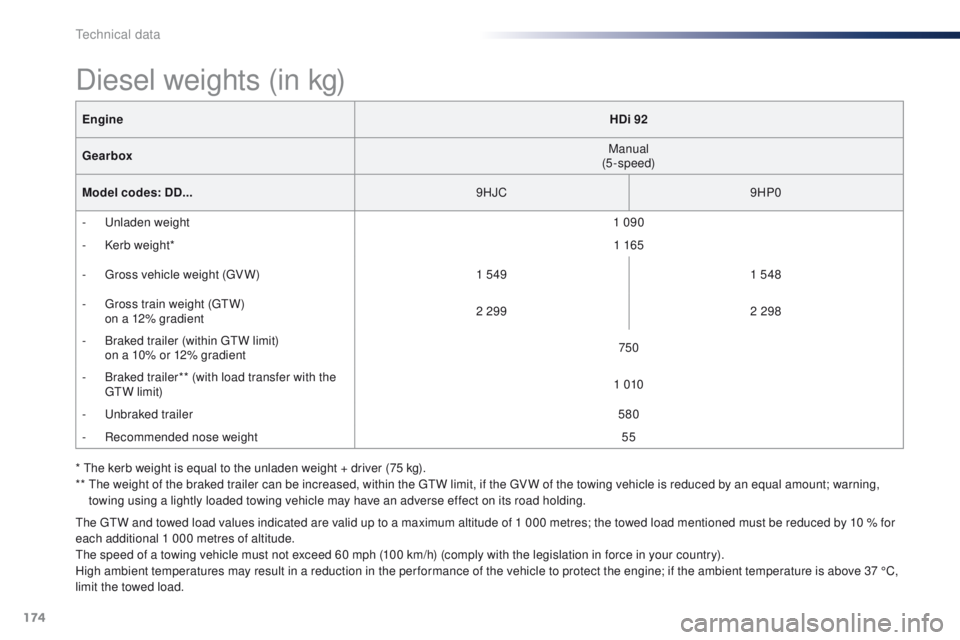
The GTW and towed load values indicated are valid up to a maximum altitude of 1 000 metres; the towed load mentioned must be reduced by 10 % for
each additional 1 000 metres of altitude.
The speed of a towing vehicle must not exceed 60 mph (100 km/h) (comply with the legislation in force in your country).
High ambient temperatures may result in a reduction in the per formance of the vehicle to protect the engine; if the ambient temperature is above 37 °C,
limit the towed load. * The kerb weight is equal to the unladen weight + driver (75 kg).
**
T
he weight of the braked trailer can be increased, within the GTW limit, if the GV W of the towing vehicle is reduced by an equal amount; warning,
towing using a lightly loaded towing vehicle may have an adverse effect on its road holding.
Engine
HDi 92
Gearbox Manual
(5-speed)
Model codes: DD... 9HJC9HP0
-
U
nladen weight
1 090
-
K
erb weight*
1 165
-
G
ross vehicle weight (GV W)
1 5491 548
-
G
ross train weight (GTW)
o
n a 12% gradient
2 299
2 298
-
B
raked trailer (within GTW limit)
o
n a 10% or 12% gradient
750
-
B
raked trailer** (with load transfer with the
GTW limit) 1 010
-
U
nbraked trailer
580
-
R
ecommended nose weight
55
Diesel weights (in kg)
Technical data
Page 178 of 285
176
301_en_Chap11_caracteristiques-techniques_ed01-2014
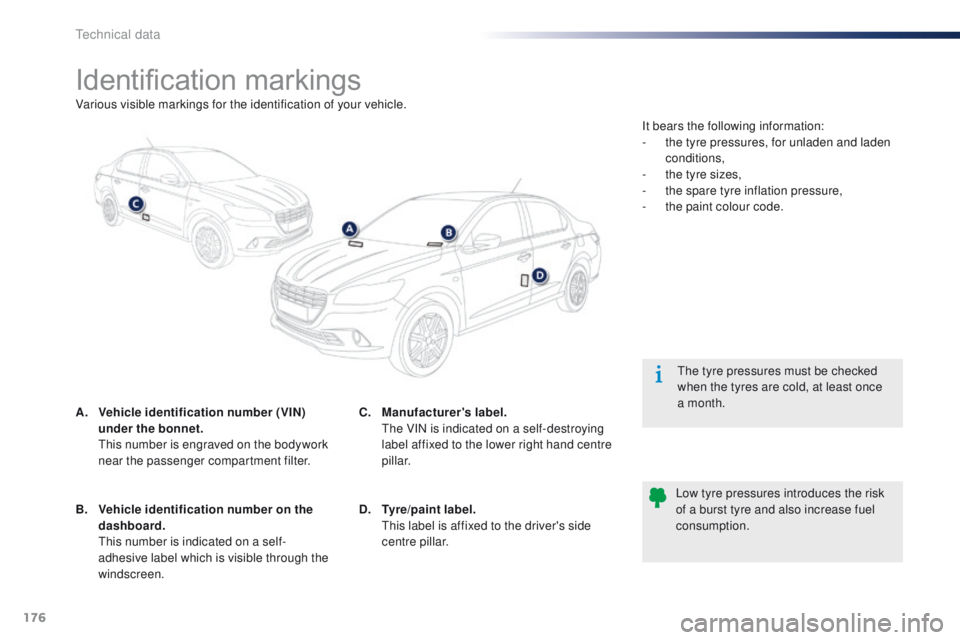
Identification markings
A. Vehicle identification number (VIN) under the bonnet.
T
his number is engraved on the bodywork
near the passenger compartment filter. The tyre pressures must be checked
when the tyres are cold, at least once
a month.
Low tyre pressures introduces the risk
of a burst tyre and also increase fuel
consumption.
B.
V
ehicle identification number on the
dashboard.
T
his number is indicated on a self-
adhesive label which is visible through the
windscreen. C. M
anufacturer's label.
T
he VIN is indicated on a self-destroying
label affixed to the lower right hand centre
pillar.
D.
T
yre/paint label.
T
his label is affixed to the driver's side
centre pillar. It bears the following information:
-
t
he tyre pressures, for unladen and laden
conditions,
-
t
he tyre sizes,
-
t
he spare tyre inflation pressure,
-
t
he paint colour code.
Various visible markings for the identification of your vehicle.
Technical data
Page 189 of 285
04
BACK
187
301_en_Chap12a_RD5(RD45)_ed01-2014
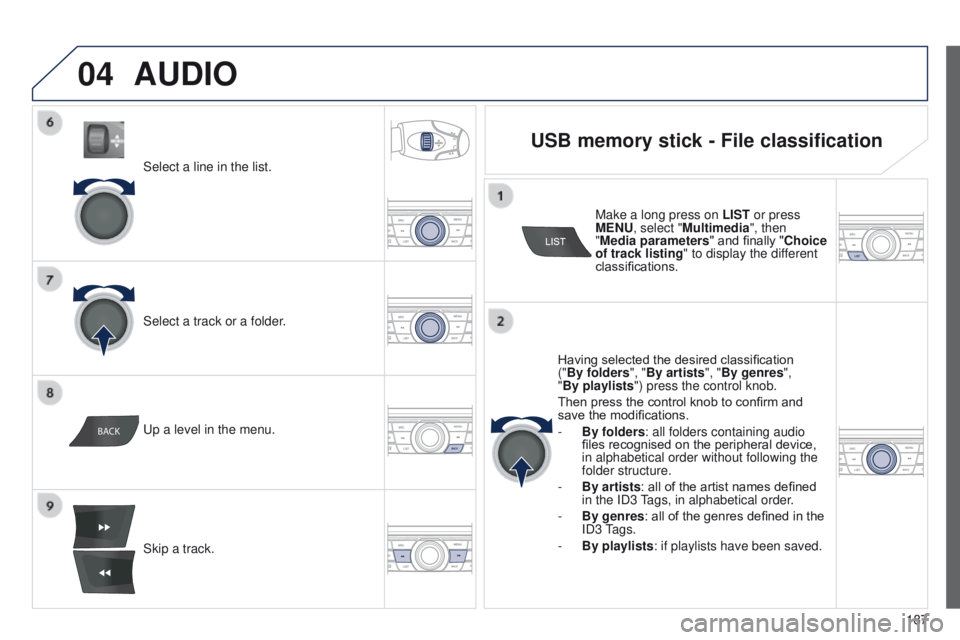
Select a line in the list.
Select a track or a folder.
Skip a track. Up a level in the menu.
AUDIO
USB memory stick - File classification
Having selected the desired classification
("By folders", "By artists", "By genres",
"By playlists") press the control knob.
Then press the control knob to confirm and
save the modifications.
-
By folders
: all folders containing audio
files recognised on the peripheral device,
in alphabetical order without following the
folder structure.
-
By artists : all of the artist names defined
in the ID3
Tags, in alphabetical order.
-
By genres
: all of the genres defined in the
ID3 Tags.
-
By playlists
: if playlists have been saved.
Make a long press on
LIST or press
MENU, select "Multimedia", then
"Media parameters " and finally "Choice
of track listing " to display the different
classifications.
Page 205 of 285
_ed01-2014
FREqUENTLY ASKED q UESTIONS
The following tables contain answers to the most frequently asked questi\
ons.
q
UESTION ANSWER SOLUTION
There is a difference in")
203
301_en_Chap12a_RD5(RD45)_ed01-2014
FREqUENTLY ASKED q UESTIONS
The following tables contain answers to the most frequently asked questi\
ons.
q
UESTION ANSWER SOLUTION
There is a difference in
sound quality between
the different audio
sources (radio, CD...). For optimum sound quality, the audio settings (Volume, Bass, Treble,
Ambience, Loudness) can be adapted to the different sound sources,
which may result in audible differences when changing source (radio,
CD...). Check that the audio settings (Volume, Bass,
Treble, Ambience, Loudness) are adapted to
the sources listened to. It is advisable to set
the AUDIO functions (Bass, Treble, Front-Rear
Fader, Left-Right Balance) to the middle position,
select the musical ambience "None" and set the
loudness correction to the "Active" position in CD
mode or to the "Inactive" position in radio mode.
When changing the
settings for treble and
bass, the ambience
setting is deselected.
When changing the
ambience setting, treble
and bass are reset to
zero. Choosing an ambience imposes settings for treble and bass. Modifying
one without the other is not possible.
Modify the treble and bass settings or the
ambience setting to obtain the desired sound
quality.
When changing the
balance setting,
distribution is deselected. Choosing a distribution setting imposes a balance setting. Modifying one\
without the other is not possible.
Modify the balance setting or the distribution
setting to obtain the desired sound quality.
Page 223 of 285
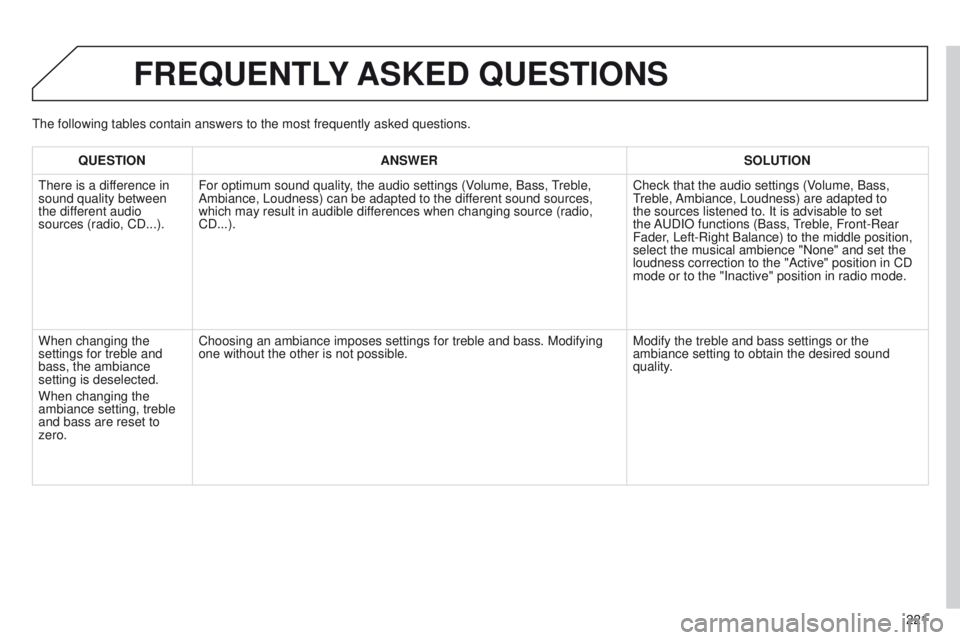
221
301_en_Chap12b_RDE1_ed01-2014
FREqUENTLY ASKED q UESTIONS
qUESTION ANSWER SOLUTION
There is a dif ference in
sound quality between
the different audio
sources (radio, CD...). For optimum sound quality, the audio settings (Volume, Bass, Treble,
Ambiance, Loudness) can be adapted to the different sound sources,
which may result in audible differences when changing source (radio,
CD...). Check that the audio settings (Volume, Bass,
Treble, Ambiance, Loudness) are adapted to
the sources listened to. It is advisable to set
the AUDIO functions (Bass, Treble, Front-Rear
Fader, Left-Right Balance) to the middle position,
select the musical ambience "None" and set the
loudness correction to the "Active" position in CD
mode or to the "Inactive" position in radio mode.
When changing the
settings for treble and
bass, the ambiance
setting is deselected.
When changing the
ambiance setting, treble
and bass are reset to
zero. Choosing an ambiance imposes settings for treble and bass. Modifying
one without the other is not possible.
Modify the treble and bass settings or the
ambiance setting to obtain the desired sound
quality.
The following tables contain answers to the most frequently asked questi\
ons.