Wing Peugeot 301 2015 Service Manual
[x] Cancel search | Manufacturer: PEUGEOT, Model Year: 2015, Model line: 301, Model: Peugeot 301 2015Pages: 285, PDF Size: 13.55 MB
Page 226 of 285
224
301_en_Chap13_recherche-visuelle_ed01-2014
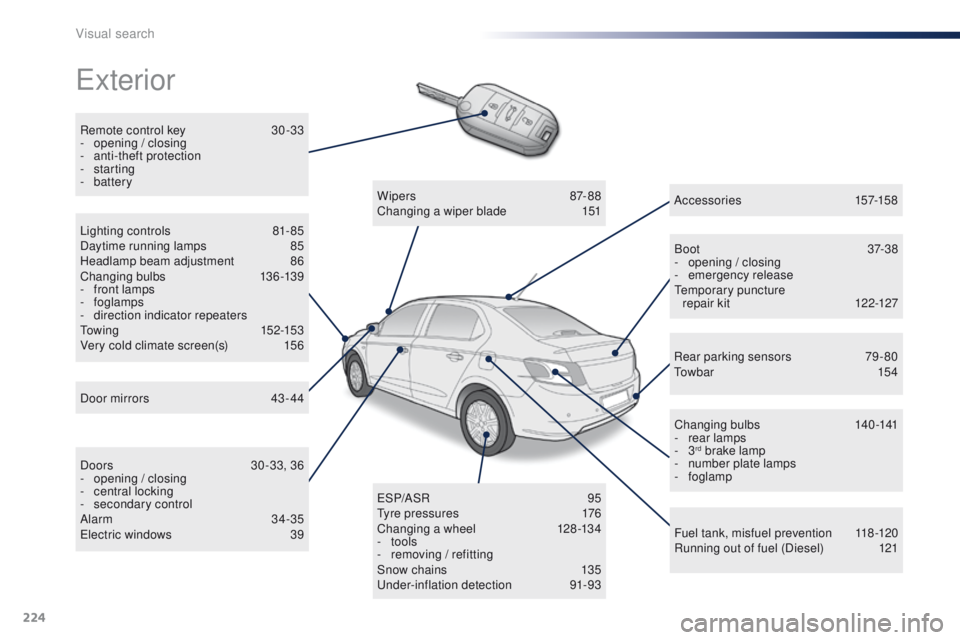
Exterior
Remote control key 30 -33
- ope ning / closing
-
a
nti-theft protection
-
starting
-
battery
Boot
3
7-38
-
ope
ning / closing
-
em
ergency release
Temporary puncture repair kit
1
22-127
Wipers
87- 88
Changing a wiper blade
1
51
Changing bulbs
1
40-141
-
r
ear lamps
-
3
rd brake lamp
-
n
umber plate lamps
-
foglamp
Fuel tank, misfuel prevention
1
18-120
Running out of fuel (Diesel)
1
21
Accessories
157-158
ESP/ASR
95
Tyre pressures
1
76
Changing a wheel
1
28-134
-
tools
-
r
emoving / refitting
Snow chains
1
35
Under-inflation detection
9
1-93
Lighting controls
8
1-85
Daytime running lamps
8
5
Headlamp beam adjustment
8
6
Changing bulbs
1
36-139
-
f
ront lamps
-
foglamps
-
d
irection indicator repeaters
Towing
152-153
Very cold climate screen(s)
1
56
Door mirrors
4
3 - 44
Doors
3
0 -33, 36
-
ope
ning / closing
-
c
entral locking
-
s
econdary control
Alarm
34-35
Electric windows
3
9 Rear parking sensors
7
9-80
To w b a r
15 4
Visual search
Page 234 of 285
232
301_en_Chap14_index-alpha_ed01-2014
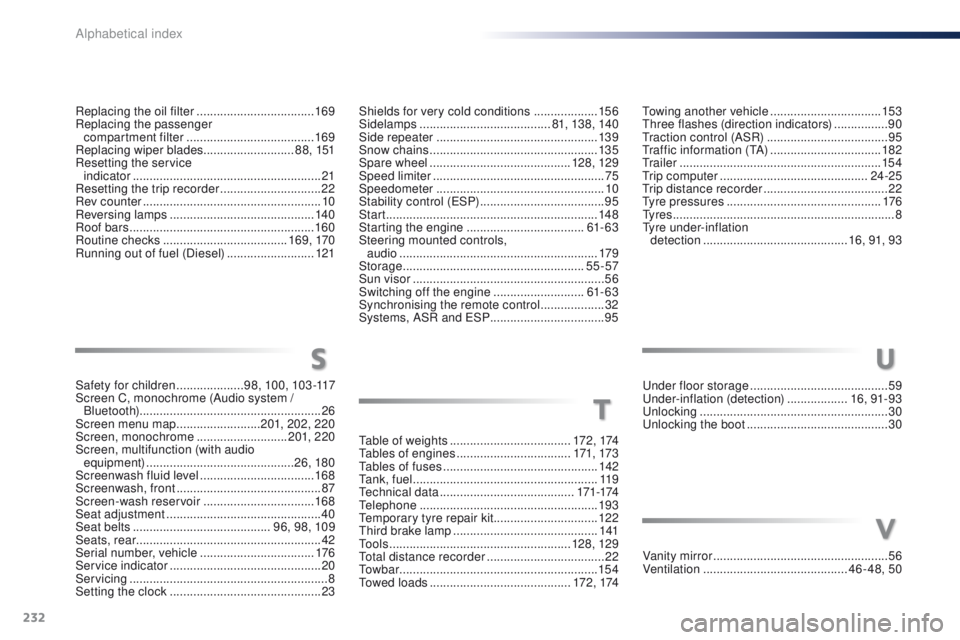
Replacing the oil filter ...................................16 9
Replacing the passenger compartment filter
...................................... 169
Replacing wiper blades ...........................8 8 , 151
Resetting the service indicator
........................................................ 21
Resetting the trip recorder
..............................22
Rev counter
..................................................... 10
Reversing lamps
........................................... 140
Roof bars
....................................................... 16
0
Routine checks
..................................... 16 9, 170
Running out of fuel (Diesel)
..........................12
1
Safety for children
....................98, 10 0, 103 -117
Screen C, monochrome (Audio system / Bluetooth) ...................................................... 26
Screen menu map
.........................201, 202, 220
Screen, monochrome
...........................201, 220
Screen, multifunction (with audio equipment)
............................................ 26, 180
Screenwash fluid level
..................................168
Screenwash, front
........................................... 87
Screen-wash reservoir
.................................168
Seat adjustment
...............................
...............40
Seat belts
......................................... 9
6, 98, 109
Seats, rear
....................................................... 42
Serial number, vehicle
.................................. 17
6
Service indicator
............................................. 20
Servicing
...............................
............................8
Setting the clock
............................................. 23
S
Towing another vehicle .................................15 3
Three flashes (direction indicators) ................90
Traction control (ASR)
....................................95
Traffic information (TA)
.................................182
Tr a i l e r
............................................................ 15 4
Trip computer
............................................ 24-25
Trip distance recorder
..................................... 22
Tyre pressures
.............................................. 176
Ty r e s
.................................................................. 8
Tyre under-inflation detection
........................................... 16, 91, 93
Table of weights
.................................... 17
2 , 174
Tables of engines
.................................. 171, 173
Tables of fuses
.............................................. 142
Ta n k , f u e l
....................................................... 11 9
Technical data
........................................ 171-174
Telephone
..................................................... 193
Temporary tyre repair kit ...............................12 2
Third brake lamp
........................................... 141
To o l s
...................................................... 128, 129
Total distance recorder
................................... 22
To w b a r
........................................................... 15 4
Towed loads
.......................................... 172 , 174Under floor storage
......................................... 59
Under-inflation (detection)
.................. 16
, 91- 93
Unlocking
..............................
..........................30
Unlocking the boot
.......................................... 30
Vanity mirror
.................................................... 56
V
entilation
..............................
.............46-48, 50
T
U
V
Shields for very cold conditions ................... 15 6
Sidelamps ....................................... 81, 138, 140
Side repeater
..............................
..................13 9
Snow chains
.................................................. 13
5
Spare wheel
...............................
...........128, 129
Speed limiter
................................................... 75
Speedometer
.................................................. 10
Stability control (ESP)
..................................... 95
Start
...............................
................................148
Starting the engine
................................... 61- 63
Steering mounted controls, audio
........................................................... 179
Storage
...................................................... 55-57
Sun visor
......................................................... 56
Switching off the engine
........................... 61
- 63
Synchronising the remote control
...................32
Systems, ASR and ESP
..................................95
Alphabetical index
Page 243 of 285
25
11
Technical data
301-add_en_Chap11_caracteristiques-techniques_ed01-2014
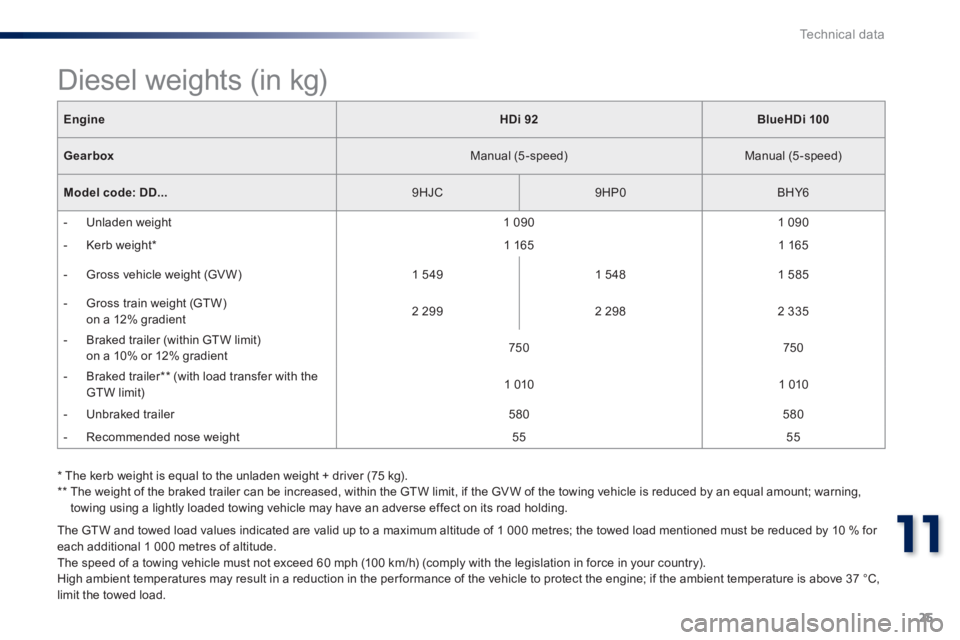
The GTW and towed load values indicated are valid up to a maximum altitude of 1 000 metres; the towed load mentioned must be reduced by 10 % for each additional 1 000 metres of altitude. The speed of a towing vehicle must not exceed 60 mph (100 km/h) (comply with the legislation in force in your country). High ambient temperatures may result in a reduction in the per formance of the vehicle to protect the engine; if the ambient temperature is above 37 °C,
limit the towed load.
* The kerb weight is equal to the unladen weight + driver (75 kg). ** The weight of the braked trailer can be increased, within the GTW limit, if the GV W of the towing vehicle is reduced by an equal amount; warning, towing using a lightly loaded towing vehicle may have an adverse effect on its road holding.
EngineHDi 92BlueHDi 100
Gearbox Manual (5-speed) Manual (5-speed)
Model code: DD... 9HJC 9HP0 BHY6
- Unladen weight 1 090 1 090
- Kerb weight * 1 165 1 165
- Gross vehicle weight (GV W) 1 549 1 548 1 585
- Gross train weight (GTW) on a 12% gradient 2 299 2 298 2 335
- Braked trailer (within GTW limit) on a 10% or 12% gradient 750 750
- Braked trailer ** (with load transfer with the GTW limit) 1 010 1 010
- Unbraked trailer 580 580
- Recommended nose weight 55 55
Diesel weights (in kg)
Page 246 of 285
1
3
Monitoring
301-add_en_Chap01_controle-de-marche_ed01-2014
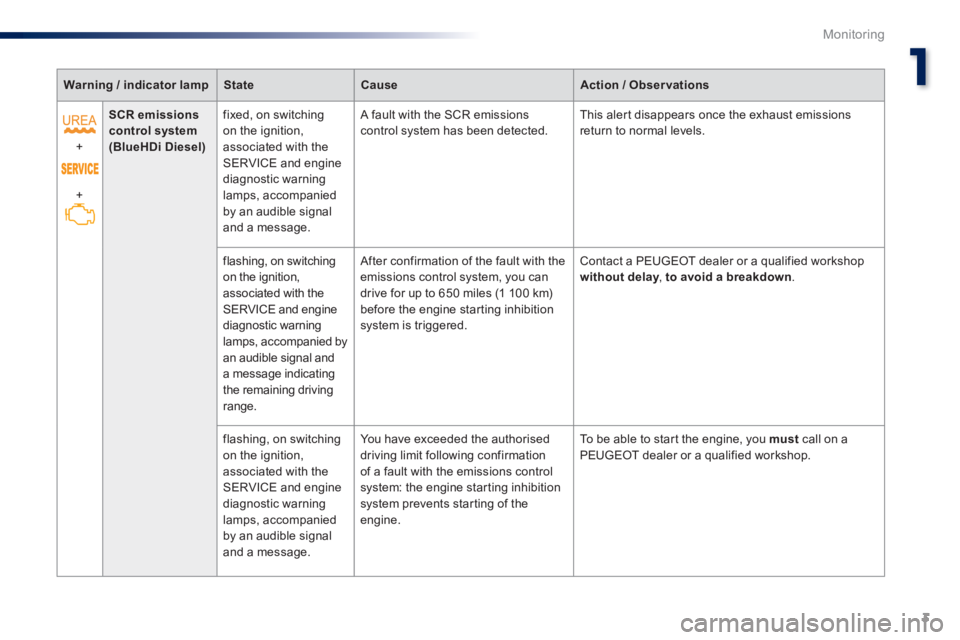
Warning / indicator lampStateCauseAction / Observations
+
+
SCR emissions control system (BlueHDi Diesel)
fixed, on switching on the ignition, associated with the SERVICE and engine diagnostic warning lamps, accompanied by an audible signal
and a message.
A fault with the SCR emissions control system has been detected. This alert disappears once the exhaust emissions return to normal levels.
flashing, on switching on the ignition, associated with the SERVICE and engine diagnostic warning lamps, accompanied by an audible signal and a message indicating the remaining driving range.
After confirmation of the fault with the emissions control system, you can drive for up to 650 miles (1 100 km) before the engine starting inhibition system is triggered.
Contact a PEUGEOT dealer or a qualified workshop without delay , without delay , without delayto avoid a breakdown .
flashing, on switching on the ignition, associated with the SERVICE and engine diagnostic warning lamps, accompanied by an audible signal and a message.
You have exceeded the authorised driving limit following confirmation of a fault with the emissions control system: the engine starting inhibition system prevents starting of the engine.
To be able to start the engine, you must call on a PEUGEOT dealer or a qualified workshop.
Page 262 of 285
19
10
Checks
301-add_en_Chap10_verifi cations_ed01-2014
Freezing of the AdBlue® additive
The AdBlue ® additive freezes at ® additive freezes at ®
temperatures below around -11°C. The SCR system includes a heater for the AdBlue ® tank, allowing you to ® tank, allowing you to ®
continue driving in very cold conditions.
Topping-up the AdBlue ®Topping-up the AdBlue ®Topping-up the AdBlue additive ® additive ®
Precautions in use
Use only AdBlue ® additive that meets the ® additive that meets the ®
ISO 22241 standard.
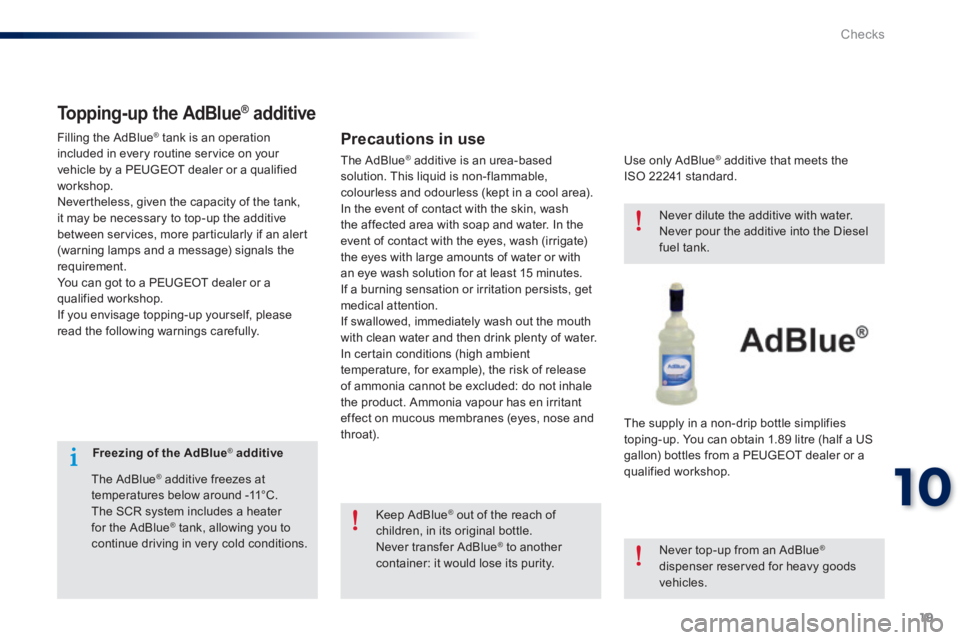
The supply in a non-drip bottle simplifies toping-up. You can obtain 1.89 litre (half a US gallon) bottles from a PEUGEOT dealer or a qualified workshop.
Keep AdBlue ® out of the reach of ® out of the reach of ®
children, in its original bottle.
Never transfer AdBlue ® to another ® to another ®
container: it would lose its purity.
Never dilute the additive with water.
Never pour the additive into the Diesel fuel tank.
Never top-up from an AdBlue ®
dispenser reserved for heavy goods vehicles.
Filling the AdBlue ® tank is an operation ® tank is an operation ®
included in every routine service on your vehicle by a PEUGEOT dealer or a qualified workshop. Nevertheless, given the capacity of the tank, it may be necessary to top-up the additive between services, more particularly if an alert (warning lamps and a message) signals the requirement. You can got to a PEUGEOT dealer or a qualified workshop. If you envisage topping-up yourself, please read the following warnings carefully.
The AdBlue ® additive is an urea-based ® additive is an urea-based ®
solution. This liquid is non-flammable, colourless and odourless (kept in a cool area). In the event of contact with the skin, wash the affected area with soap and water. In the event of contact with the eyes, wash (irrigate) the eyes with large amounts of water or with an eye wash solution for at least 15 minutes. If a burning sensation or irritation persists, get medical attention. If swallowed, immediately wash out the mouth with clean water and then drink plenty of water. In certain conditions (high ambient temperature, for example), the risk of release of ammonia cannot be excluded: do not inhale the product. Ammonia vapour has en irritant effect on mucous membranes (eyes, nose and throat).
Page 265 of 285
23
11
Technical data
301-add_en_Chap11_caracteristiques-techniques_ed01-2014
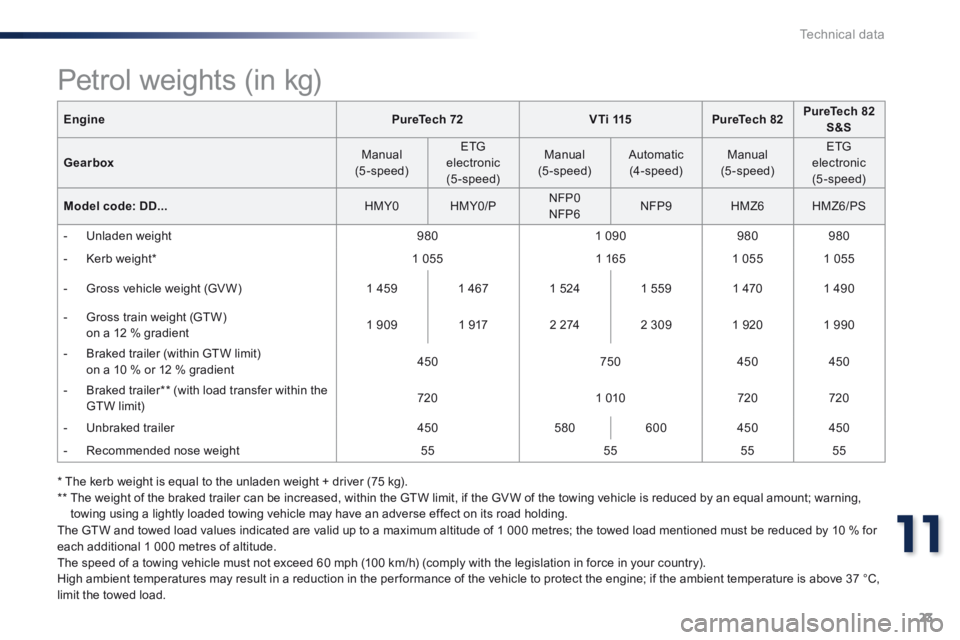
EnginePureTech 72V T i 115PureTech 82PureTech 82 S&S
Gearbox Manual (5-speed)
ETG electronic (5-speed)
Manual (5-speed) Automatic (4-speed) Manual (5-speed)
ETG electronic (5-speed)
Model code: DD... HMY0 HMY0/P NFP0 NFP6 NFP9 HMZ6 HMZ6/PS
- Unladen weight 980 1 090 980 980
- Kerb weight * 1 055 1 165 1 055 1 055
- Gross vehicle weight (GV W) 1 459 1 467 1 524 1 559 1 470 1 490
- Gross train weight (GTW) on a 12 % gradient 1 909 1 917 2 274 2 309 1 920 1 990
- Braked trailer (within GTW limit) on a 10 % or 12 % gradient 450 750 450 450
- Braked trailer ** (with load transfer within the GTW limit) 720 1 010 720 720
- Unbraked trailer 450 580 600 450 450
- Recommended nose weight 55 55 55 55
* The kerb weight is equal to the unladen weight + driver (75 kg). ** The weight of the braked trailer can be increased, within the GTW limit, if the GV W of the towing vehicle is reduced by an equal amount; warning, towing using a lightly loaded towing vehicle may have an adverse effect on its road holding.
The GTW and towed load values indicated are valid up to a maximum altitude of 1 000 metres; the towed load mentioned must be reduced by 10 % for each additional 1 000 metres of altitude. The speed of a towing vehicle must not exceed 60 mph (100 km/h) (comply with the legislation in force in your country). High ambient temperatures may result in a reduction in the per formance of the vehicle to protect the engine; if the ambient temperature is above 37 °C,
limit the towed load.
Petrol weights (in kg)
Page 273 of 285
Audio and Telematics
10
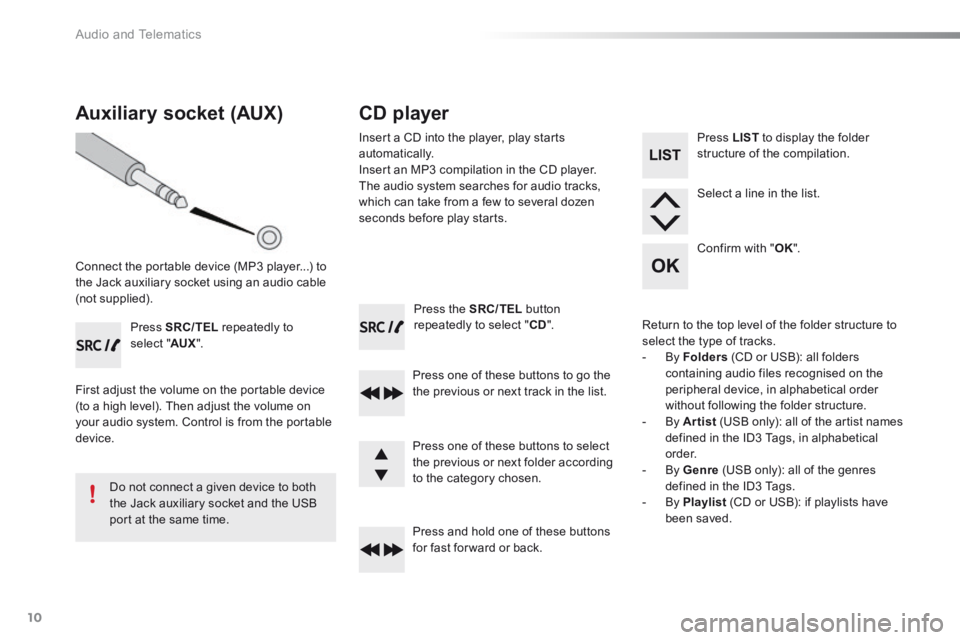
Press the SRC/TEL button repeatedly to select " CD ".
Press one of these buttons to go the the previous or next track in the list.
Press and hold one of these buttons for fast for ward or back.
Auxiliary socket (AUX)
Connect the portable device (MP3 player...) to the Jack auxiliary socket using an audio cable (not supplied).
Press SRC/TEL repeatedly to select " AUX ".
First adjust the volume on the portable device (to a high level). Then adjust the volume on your audio system. Control is from the portable device.
Do not connect a given device to both the Jack auxiliary socket and the USB port at the same time.
CD player
Insert a CD into the player, play starts automatically. Insert an MP3 compilation in the CD player. The audio system searches for audio tracks, which can take from a few to several dozen seconds before play starts.
Press one of these buttons to select the previous or next folder according to the category chosen.
Press LIST to display the folder structure of the compilation.
Select a line in the list.
Confirm with " OK ".
Return to the top level of the folder structure to select the type of tracks. - By Folders (CD or USB): all folders containing audio files recognised on the peripheral device, in alphabetical order without following the folder structure. - By Artist (USB only): all of the artist names defined in the ID3 Tags, in alphabetical o r d e r. - By Genre (USB only): all of the genres defined in the ID3 Tags. - By Playlist (CD or USB): if playlists have been saved.
Page 282 of 285
.
Audio and Telematics 19
301-add-2_en_Chap12_RDE2_ed01-2014
Frequently asked questions
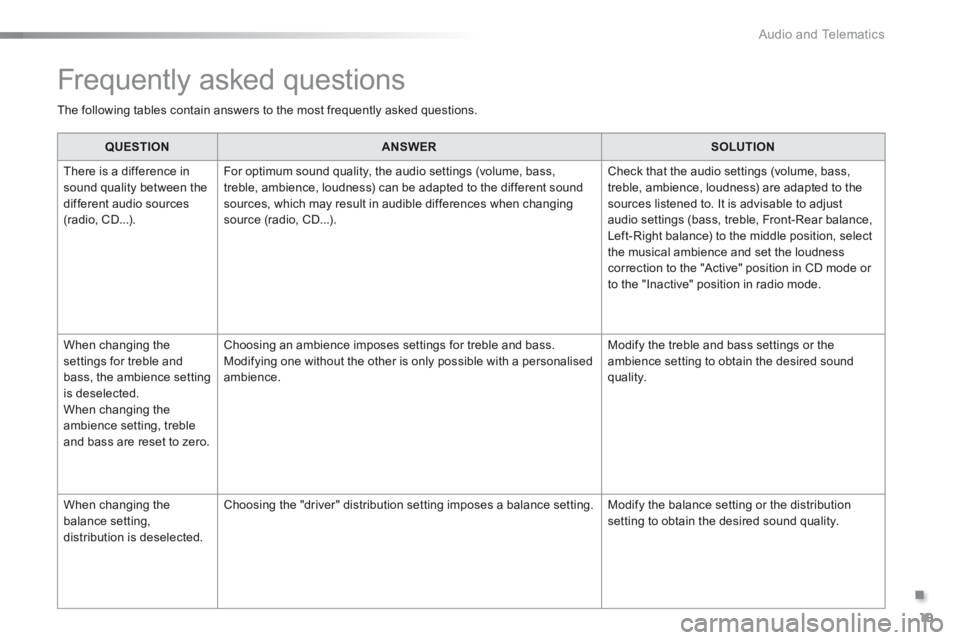
The following tables contain answers to the most frequently asked questions.
QUESTIONANSWERSOLUTION
There is a difference in sound quality between the different audio sources (radio, CD...).
For optimum sound quality, the audio settings (volume, bass, treble, ambience, loudness) can be adapted to the different sound sources, which may result in audible differences when changing source (radio, CD...).
Check that the audio settings (volume, bass, treble, ambience, loudness) are adapted to the sources listened to. It is advisable to adjust audio settings (bass, treble, Front-Rear balance, Left-Right balance) to the middle position, select the musical ambience and set the loudness correction to the "Active" position in CD mode or to the "Inactive" position in radio mode.
When changing the settings for treble and bass, the ambience setting is deselected. When changing the ambience setting, treble and bass are reset to zero.
Choosing an ambience imposes settings for treble and bass. Modifying one without the other is only possible with a personalised ambience.
Modify the treble and bass settings or the ambience setting to obtain the desired sound quality.
When changing the balance setting,
distribution is deselected.
Choosing the "driver" distribution setting imposes a balance setting. Modify the balance setting or the distribution setting to obtain the desired sound quality.