Speed Peugeot 301 2017 User Guide
[x] Cancel search | Manufacturer: PEUGEOT, Model Year: 2017, Model line: 301, Model: Peugeot 301 2017Pages: 306, PDF Size: 9.87 MB
Page 37 of 306
35
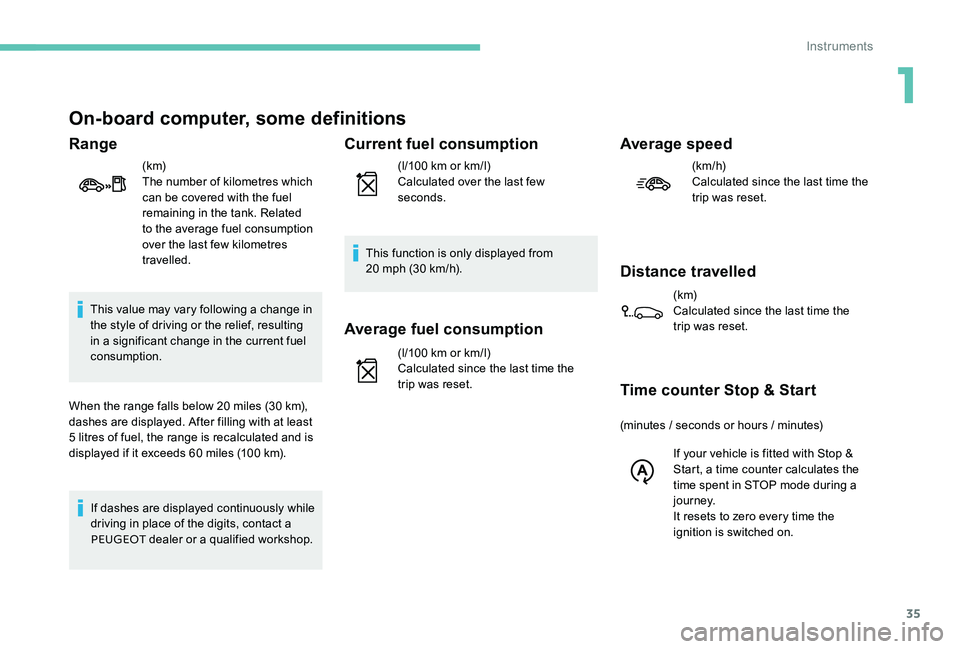
On-board computer, some definitions
Range
(k m)
The number of kilometres which
can be covered with the fuel
remaining in the tank. Related
to the average fuel consumption
over the last few kilometres
travelled.
This value may vary following a change in
the style of driving or the relief, resulting
in a significant change in the current fuel
consumption.
When the range falls below 20 miles (30 km),
dashes are displayed. After filling with at least
5 litres of fuel, the range is recalculated and is
displayed if it exceeds 60 miles (100 km).
If dashes are displayed continuously while
driving in place of the digits, contact a
PEUGEOT dealer or a qualified workshop.
Current fuel consumption
(l/100 km or km/l)
Calculated over the last few
seconds.
This function is only displayed from
20 mph (30 km/h).
Average fuel consumption
(l/100 km or km/l)
Calculated since the last time the
trip was reset.
Average speed
(km/h)
Calculated since the last time the
trip was reset.
Distance travelled
(k m)
Calculated since the last time the
trip was reset.
Time counter Stop & Start
If your vehicle is fitted with Stop &
Start, a time counter calculates the
time spent in STOP mode during a
j o u r n ey.
It resets to zero every time the
ignition is switched on.
(minutes / seconds or hours / minutes)
1
Instruments
Page 43 of 306
41
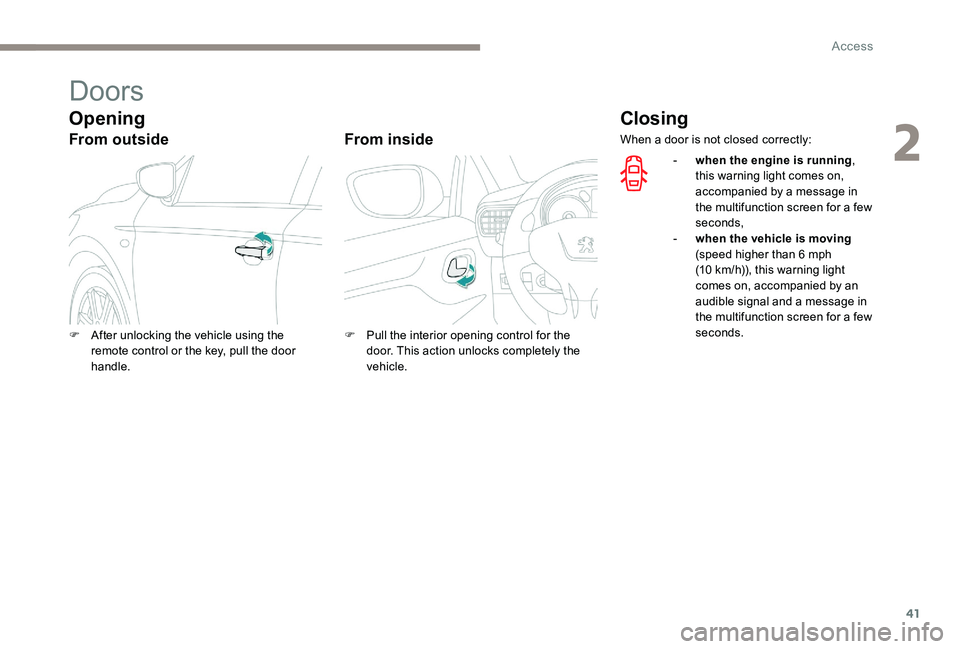
Doors
Opening
From outsideFrom inside
Closing
F After unlocking the vehicle using the
remote control or the key, pull the door
handle. F
P ull the interior opening control for the
door. This action unlocks completely the
vehicle. When a door is not closed correctly:
-
w
hen the engine is running
,
this warning light comes on,
accompanied by a message in
the multifunction screen for a few
seconds,
-
w
hen the vehicle is moving
(speed higher than 6 mph
(10 km/h)), this warning light
comes on, accompanied by an
audible signal and a message in
the multifunction screen for a few
seconds.
2
Access
Page 45 of 306
43
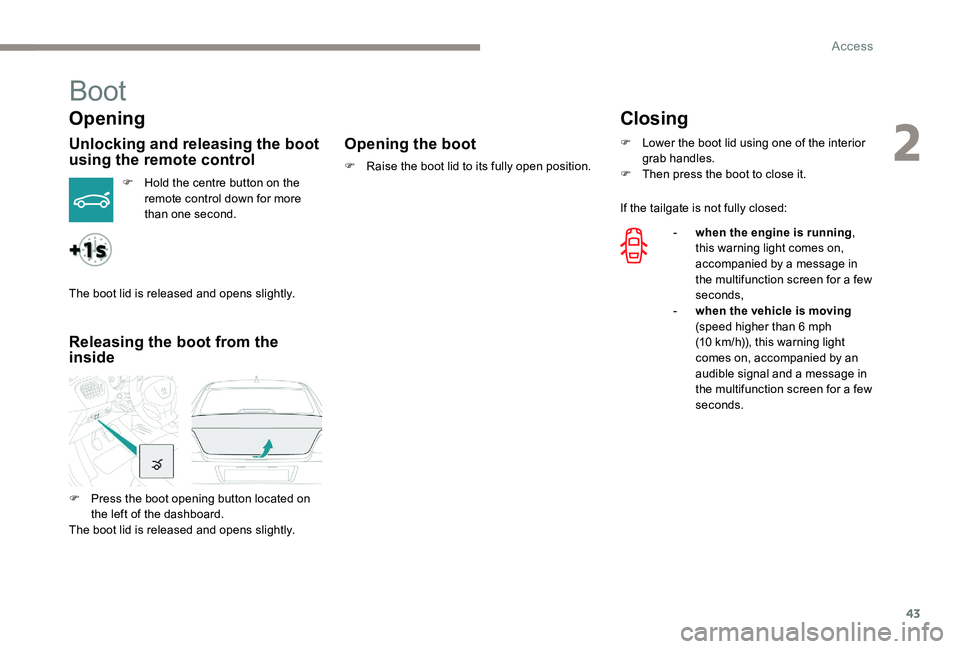
Boot
Opening
Unlocking and releasing the boot
using the remote control
F Hold the centre button on the remote control down for more
than one second.
Releasing the boot from the
inside Opening the boot
F Raise the boot lid to its fully open position.
Closing
F Lower the boot lid using one of the interior
grab handles.
F
T
hen press the boot to close it.
If the tailgate is not fully closed: -
w
hen the engine is running ,
this warning light comes on,
accompanied by a message in
the multifunction screen for a few
seconds,
-
w
hen the vehicle is moving
(speed higher than 6 mph
(10 km/h)), this warning light
comes on, accompanied by an
audible signal and a message in
the multifunction screen for a few
seconds.
The boot lid is released and opens slightly.
F
P
ress the boot opening button located on
the left of the dashboard.
The boot lid is released and opens slightly.
2
Access
Page 46 of 306
44
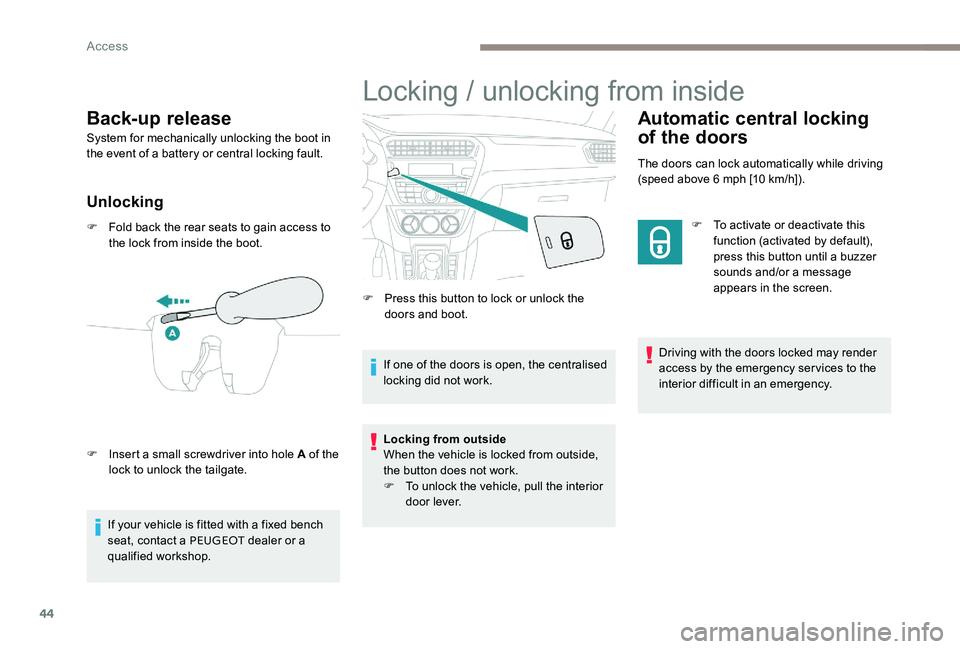
Back-up release
System for mechanically unlocking the boot in
the event of a battery or central locking fault.
Unlocking
F Fold back the rear seats to gain access to the lock from inside the boot.
F
I
nsert a small screwdriver into hole A of the
lock to unlock the tailgate.
If your vehicle is fitted with a fixed bench
seat, contact a PEUGEOT dealer or a
qualified workshop.
Locking / unlocking from inside
F Press this button to lock or unlock the doors and boot.
If one of the doors is open, the centralised
locking did not work.
Locking from outside
When the vehicle is locked from outside,
the button does not work.
F
T
o unlock the vehicle, pull the interior
door lever.
Automatic central locking
of the doors
The doors can lock automatically while driving
(speed above 6 mph [10 km/h]).
Driving with the doors locked may render
access by the emergency services to the
interior difficult in an emergency. F
T
o activate or deactivate this
function (activated by default),
press this button until a buzzer
sounds and/or a message
appears in the screen.
Access
Page 65 of 306
63
Storage box
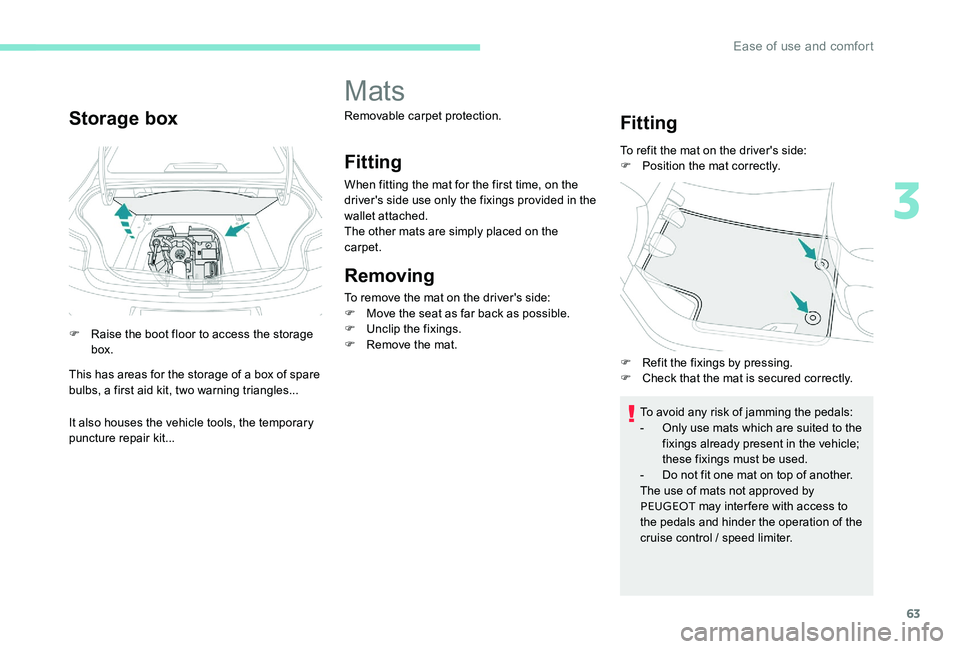
F Raise the boot floor to access the storage box.
This has areas for the storage of a box of spare
bulbs, a first aid kit, two warning triangles...
It also houses the vehicle tools, the temporary
puncture repair kit...
Mats
Removable carpet protection.
Fitting
When fitting the mat for the first time, on the
driver's side use only the fixings provided in the
wallet attached.
The other mats are simply placed on the
carpet.
Removing
To remove the mat on the driver's side:
F M ove the seat as far back as possible.
F
U
nclip the fixings.
F
R
emove the mat.
Fitting
To refit the mat on the driver's side:
F P osition the mat correctly.
To avoid any risk of jamming the pedals:
-
O
nly use mats which are suited to the
fixings already present in the vehicle;
these fixings must be used.
-
D
o not fit one mat on top of another.
The use of mats not approved by
PEUGEOT may inter fere with access to
the pedals and hinder the operation of the
cruise control / speed limiter.
F
R
efit the fixings by pressing.
F
C
heck that the mat is secured correctly.
3
Ease of use and comfort
Page 70 of 306
68
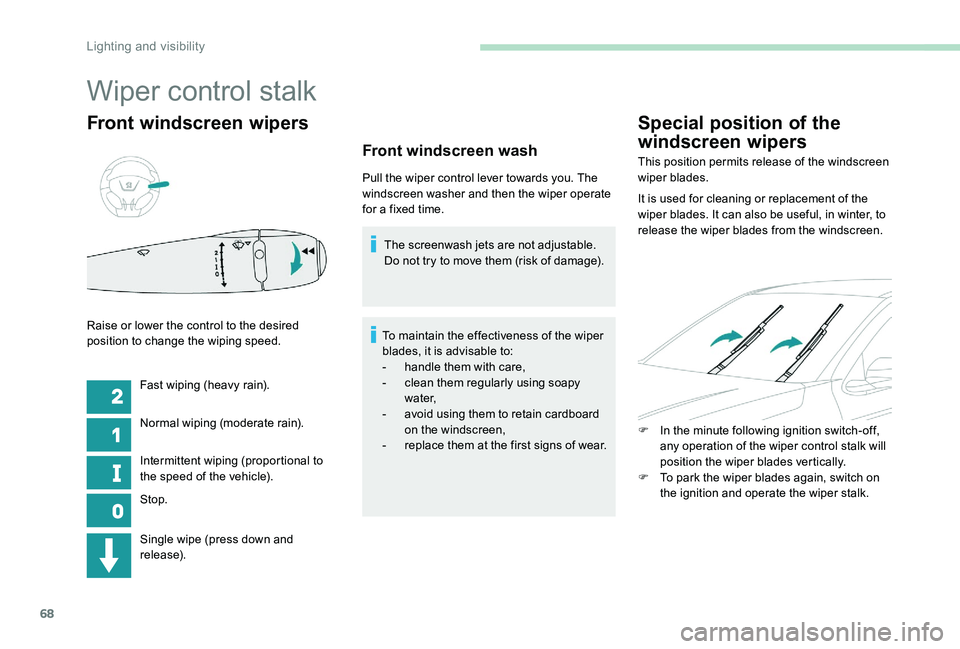
Front windscreen wipers
Fast wiping (heavy rain).
Normal wiping (moderate rain).
Intermittent wiping (proportional to
the speed of the vehicle).
Stop.
Raise or lower the control to the desired
position to change the wiping speed.
Single wipe (press down and
release).
Front windscreen wash
Pull the wiper control lever towards you. The
windscreen washer and then the wiper operate
for a fixed time.The screenwash jets are not adjustable.
Do not try to move them (risk of damage).
Special position of the
windscreen wipers
This position permits release of the windscreen
wiper blades.
It is used for cleaning or replacement of the
wiper blades. It can also be useful, in winter, to
release the wiper blades from the windscreen.
F
I
n the minute following ignition switch-off,
any operation of the wiper control stalk will
position the wiper blades vertically.
F
T
o park the wiper blades again, switch on
the ignition and operate the wiper stalk.
To maintain the effectiveness of the wiper
blades, it is advisable to:
-
h
andle them with care,
-
c
lean them regularly using soapy
water,
-
a
void using them to retain cardboard
on the windscreen,
-
r
eplace them at the first signs of wear.
Wiper control stalk
Lighting and visibility
Page 76 of 306
74
Tyre under-inflation detection
System which automatically checks the
pressures of the tyres while driving.
The system monitors the pressures in the four
tyres, once the vehicle is moving.
It compares the information given by the four
wheel speed sensors with reference values,
which must be reinitialised ever y time the
tyre pressures are adjusted or a wheel
changed.
The system triggers an alert as soon as it
detects a drop in the inflation pressure of one
or more tyres.Under-inflation alert
The under-inflation detection system does
not replace the need for vigilance on the
part of the driver.
This system does not avoid the need to
check the tyre pressures (including the
spare wheel) every month as well as
before a long journey.
Driving with under-inflated tyres worsens
road-holding, lengthens braking distances,
causes premature wear of the tyres,
particularly in adverse conditions (heavy
loads, high speeds, long journeys). Driving with under-inflated tyres
increases fuel consumption.
The inflation pressures defined for your
vehicle can be found on the tyre pressure
label.
For more information on the
Identification markings , refer to the
corresponding section.
Checking tyre pressures
This check should be done when the tyres
are "cold" (vehicle stopped for 1 hour or
after a journey of less than 6 miles (10 km)
at moderate speeds).
Other wise, add 0.3 bar to the pressures
shown on the label. This warning is indicated by
continuous illumination of the light,
an audible signal and a message
displayed on the screen.
F
R
educe speed immediately, avoid
excessive steering movements and sudden
braking.
F
S
top as soon as it is safe to do so.
The loss of pressure detected does not
always cause visible bulging of the tyre.
Do not rely on a simple visual check.
F I f you have a compressor (such as the
one in the temporary puncture repair kit),
check the pressures of the four tyres when
cold. If it is not possible to make this check
immediately, drive carefully at reduced
speed.
or
F
I
n the event of a puncture, use the
temporary puncture repair kit or the spare
wheel (depending on equipment).
The warning remains active until the
system is reinitialised.
Safety
Page 79 of 306
77
Electronic stability programme (ESC)
Electronic Stability Programming including the
following systems:
-
a
nti-lock braking system (ABS) and
electronic brake force distribution (EBFD),
-
em
ergency braking assistance (EBA),
-
w
heel anti-slip regulation (ASR) or traction
control,
-
d
ynamic stability control (DSC).
Definitions
Anti-lock braking system (ABS)
and electronic brake force
distribution (EBFD)
These systems improve the stability and
manoeuvrability of your vehicle when braking
and contribute towards improved control in
corners, in particular on poor or slippery road
surfaces.
The ABS prevents wheel lock in the event of
emergency braking.
The electronic brake force distribution system
manages the braking pressure wheel by wheel.
Emergency braking assistance
In an emergency, this system enables you to
reach the optimum braking pressure more
quickly and therefore reduce the stopping
distance.
It is triggered in relation to the speed at which
the brake pedal is pressed. The effect of this is
a reduction in the resistance of the pedal and
an increase in braking efficiency.
Anti-slip regulation (ASR)
This system optimises traction in order to
avoid wheel slip by acting on the brakes of
the driving wheels and on the engine. It also
improves the directional stability of the vehicle
on acceleration.
Dynamic stability control (DSC)
If there is a difference between the path
followed by the vehicle and that required by the
driver, this system monitors each wheel and
automatically acts on the brake of one or more
wheels and on the engine to return the vehicle
to the required path, within the limits of the laws
of physics.
Anti-lock braking system
(ABS) and electronic brake
force distribution (EBFD)
The fixed illumination of this warning
lamp signals that there is a fault with
the ABS.
The vehicle retains conventional braking. Drive
carefully at moderate speed.
Contact a PEUGEOT dealer or a qualified
workshop as soon as possible.
Illumination of this warning lamp,
coupled with the STOP and ABS
warning lamps, accompanied by
the display of a message and an
audible signal, signals that there is a
fault with the electronic brake force
distribution (EBFD).
You must stop as soon as it is safe to do so.
Call on a PEUGEOT dealer or a qualified
workshop.
5
Safety
Page 81 of 306
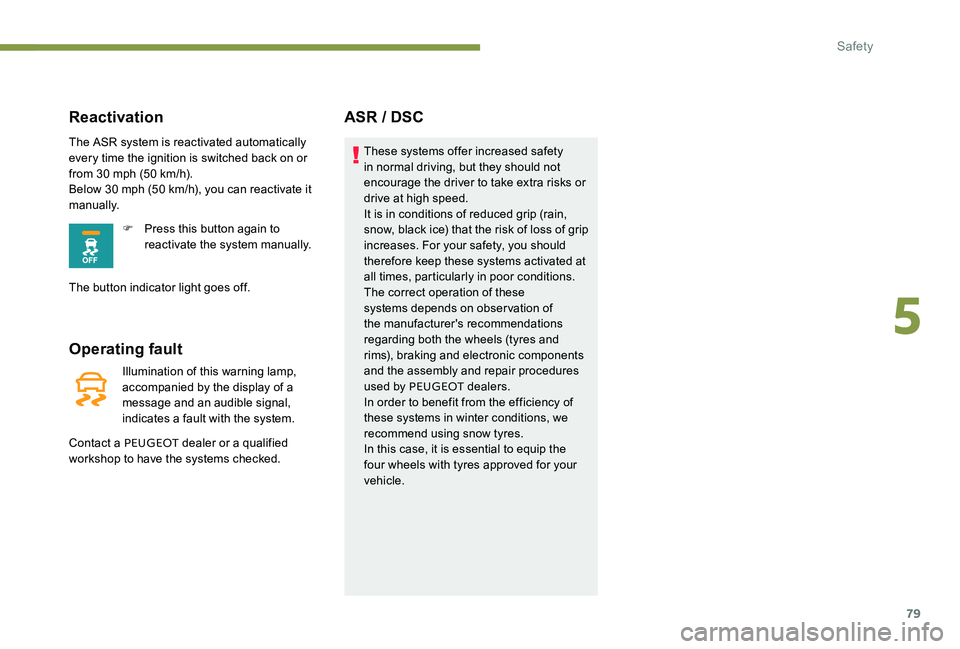
79
Operating fault
Illumination of this warning lamp,
accompanied by the display of a
message and an audible signal,
indicates a fault with the system.
Contact a PEUGEOT dealer or a qualified
workshop to have the systems checked.
ASR / DSC
Reactivation
The ASR system is reactivated automatically
every time the ignition is switched back on or
from 30 mph (50 km/h).
Below 30 mph (50 km/h), you can reactivate it
manually.
F
P
ress this button again to
reactivate the system manually.
The button indicator light goes off. These systems offer increased safety
in normal driving, but they should not
encourage the driver to take extra risks or
drive at high speed.
It is in conditions of reduced grip (rain,
snow, black ice) that the risk of loss of grip
increases. For your safety, you should
therefore keep these systems activated at
all times, particularly in poor conditions.
The correct operation of these
systems depends on observation of
the manufacturer's recommendations
regarding both the wheels (tyres and
rims), braking and electronic components
and the assembly and repair procedures
used by PEUGEOT
dealers.
In order to benefit from the efficiency of
these systems in winter conditions, we
recommend using snow tyres.
In this case, it is essential to equip the
four wheels with tyres approved for your
vehicle.
5
Safety
Page 105 of 306
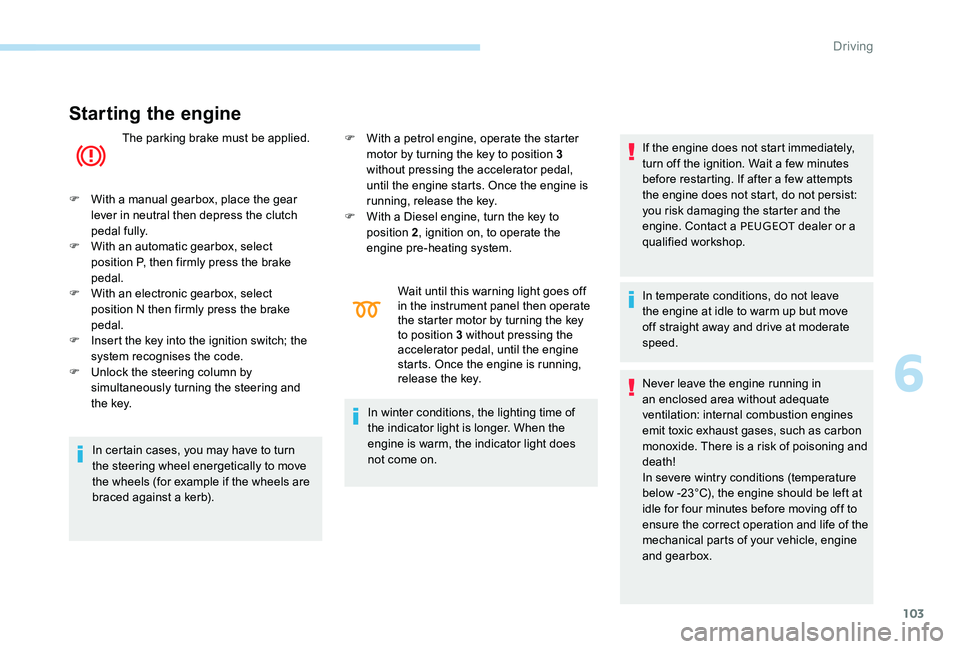
103
Starting the engine
The parking brake must be applied.
F
W
ith a manual gearbox, place the gear
lever in neutral then depress the clutch
pedal fully.
F
W
ith an automatic gearbox, select
position P, then firmly press the brake
pedal.
F
W
ith an electronic gearbox, select
position N then firmly press the brake
pedal.
F
I
nsert the key into the ignition switch; the
system recognises the code.
F
U
nlock the steering column by
simultaneously turning the steering and
t h e key.
In certain cases, you may have to turn
the steering wheel energetically to move
the wheels (for example if the wheels are
braced against a kerb). F
W ith a petrol engine, operate the starter
motor by turning the key to position 3
without pressing the accelerator pedal,
until the engine starts. Once the engine is
running, release the key.
F
W
ith a Diesel engine, turn the key to
position 2 , ignition on, to operate the
engine pre-heating system.
Wait until this warning light goes off
in the instrument panel then operate
the starter motor by turning the key
to position 3 without pressing the
accelerator pedal, until the engine
starts. Once the engine is running,
release the key.
In winter conditions, the lighting time of
the indicator light is longer. When the
engine is warm, the indicator light does
not come on. If the engine does not start immediately,
turn off the ignition. Wait a few minutes
before restarting. If after a few attempts
the engine does not start, do not persist:
you risk damaging the starter and the
engine. Contact a PEUGEOT
dealer or a
qualified workshop.
In temperate conditions, do not leave
the engine at idle to warm up but move
off straight away and drive at moderate
speed.
Never leave the engine running in
an enclosed area without adequate
ventilation: internal combustion engines
emit toxic exhaust gases, such as carbon
monoxide. There is a risk of poisoning and
death!
In severe wintry conditions (temperature
below -23°C), the engine should be left at
idle for four minutes before moving off to
ensure the correct operation and life of the
mechanical parts of your vehicle, engine
and gearbox.
6
Driving