tow Peugeot 308 2014 User Guide
[x] Cancel search | Manufacturer: PEUGEOT, Model Year: 2014, Model line: 308, Model: Peugeot 308 2014Pages: 400, PDF Size: 10.05 MB
Page 93 of 400
91
3
Comfort
308_EN_CHAP03_CONFORT_ED02-2013
Boot fi ttings (SW)
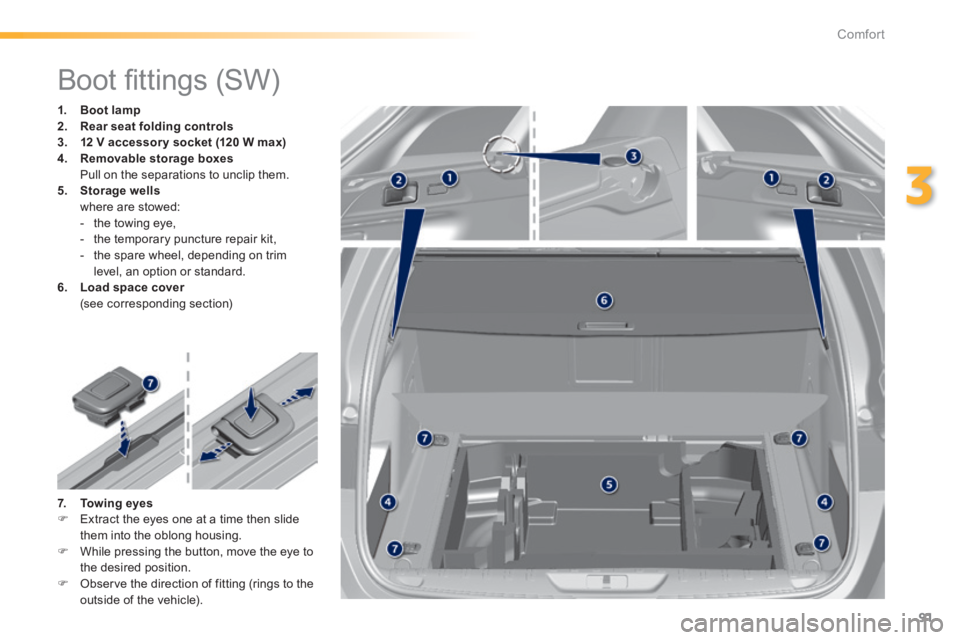
1. Boot lamp2. Rear Rear Rearseat folding controls3. 12 V accessor y socket (120 W max)4. Removable storage boxes Pull on the separations to unclip them. 5. Storage wells where are stowed: - the towing eye, - the temporary puncture repair kit, - the spare wheel, depending on trim level, an option or standard. 6. Load space cover Load space cover Load space cover (see corresponding section)
7. Towing eyes Extract the eyes one at a time then slide them into the oblong housing. While pressing the button, move the eye to the desired position. Observe the direction of fitting (rings to the
outside of the vehicle).
Page 94 of 400
92
Comfort
308_EN_CHAP03_CONFORT_ED02-2013
Luggage cover, roller blind (SW)
To reel in To remove Storage
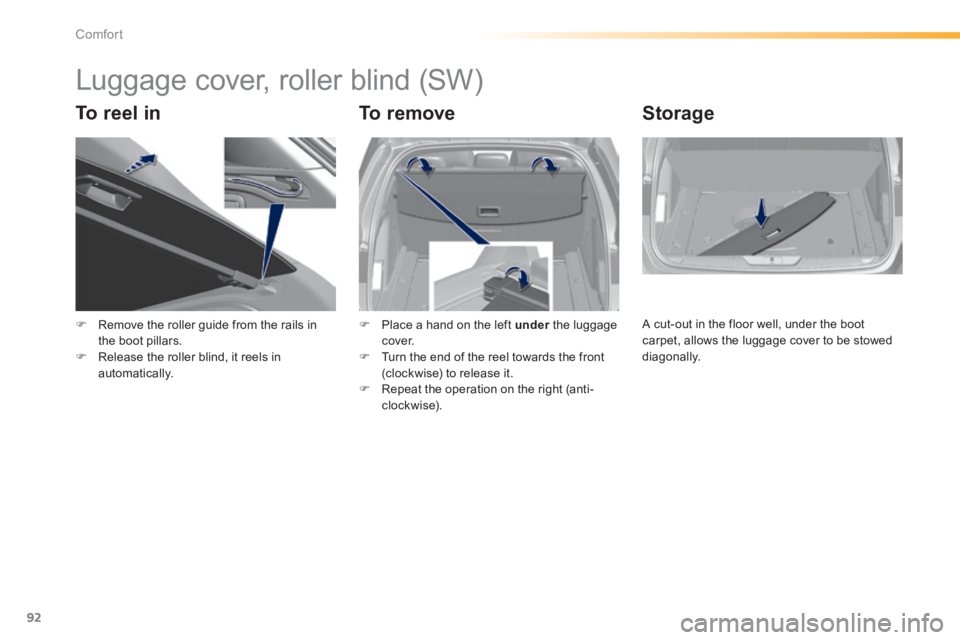
Remove the roller guide from the rails in the boot pillars. Release the roller blind, it reels in automatically.
Place a hand on the left under the luggage under the luggage undercover. Turn the end of the reel towards the front (clockwise) to release it. Repeat the operation on the right (anti-clockwise).
A cut-out in the floor well, under the boot carpet, allows the luggage cover to be stowed diagonally.
Page 96 of 400
94
Comfort
308_EN_CHAP03_CONFORT_ED02-2013
Warning triangle (stowing)
Before getting out of your vehicle to assemble the triangle and place it on the road, put on your high visibility vest.
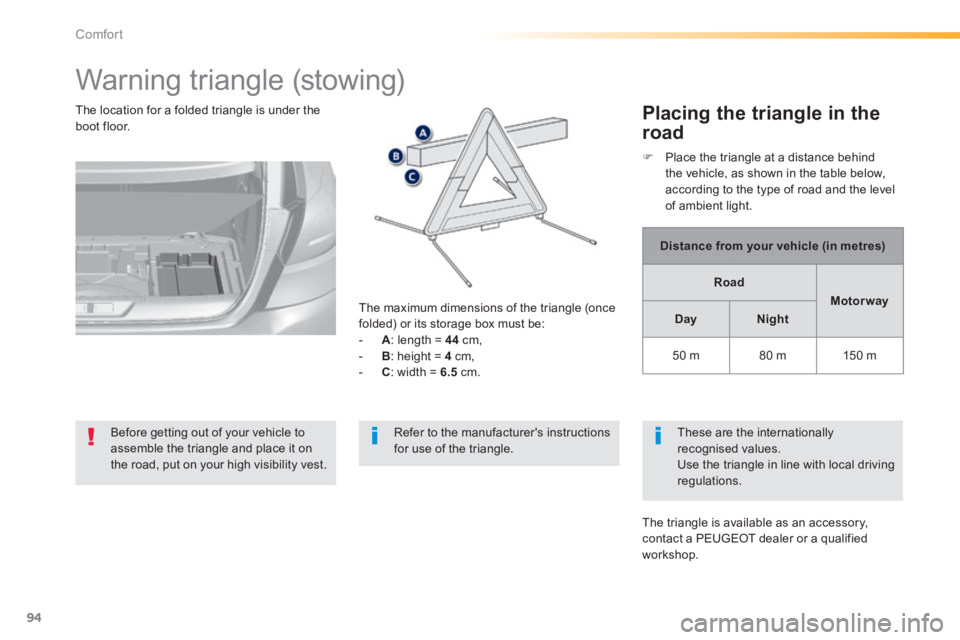
The maximum dimensions of the triangle (once folded) or its storage box must be: - A : length = 44 cm, - B : height = 4 cm, - C : width = 6.5 cm.
The location for a folded triangle is under the boot floor. Placing the triangle in the
road
Distance from your vehicle (in metres)
Road
Motor way
DayNight
50 m 80 m 150 m
These are the internationally recognised values. Use the triangle in line with local driving regulations.
The triangle is available as an accessory, contact a PEUGEOT dealer or a qualified workshop.
Place the triangle at a distance behind the vehicle, as shown in the table below, according to the type of road and the level of ambient light.
Refer to the manufacturer's instructions for use of the triangle.
Page 98 of 400
96
Comfort
308_EN_CHAP03_CONFORT_ED02-2013
In order for these systems to be fully effective, follow the operation and maintenance guidelines below: To obtain an even air distribution, take care not to obstruct the exterior air intake grilles located at the base of the windscreen, the nozzles, the vents and the air outlets, as well as the air extractor located in the boot. Do not cover the sunshine sensor, located on the dashboard; this is used for regulation of the air conditioning system. Operate the air conditioning system for at least 5 to 10 minutes, once or twice a month to keep it in per fect working order. Ensure that the passenger compartment filter is in good condition and have the filter elements replaced regularly. We recommend the use of a combined passenger compartment filter. Thanks to its special active additive, it contributes to the purification of the air breathed by the occupants and the cleanliness of the passenger compartment (reduction of allergic symptoms, bad odours and greasy deposits). To ensure correct operation of the air conditioning system, you are also advised to have it checked regularly as recommended in the warranty and maintenance record. If the system does not produce cold air, switch it off and contact a PEUGEOT dealer or a qualified workshop.
Recommendations for ventilation and air conditioning
If after an extended stop in sunshine, the interior temperature is very high, first ventilate the passenger compartment for a few moments. Put the air flow control at a setting high enough to quickly change the air in the passenger compartment.
The air conditioning system does not contain chlorine and does not present any danger to the ozone layer.
The condensation created by the air conditioning results in a discharge of water under the vehicle which is per fectly normal.
When towing the maximum load on a steep gradient in high temperatures, switching off the air conditioning increases the available engine power and so improves the towing ability.
Stop & Start
The heating and air conditioning systems only work when the engine
is running. To maintain a comfortable temperature in the passenger compartment, you can temporarily deactivate the Stop & Start system (see the corresponding section).
Page 108 of 400
106
Comfort
308_EN_CHAP03_CONFORT_ED02-2013
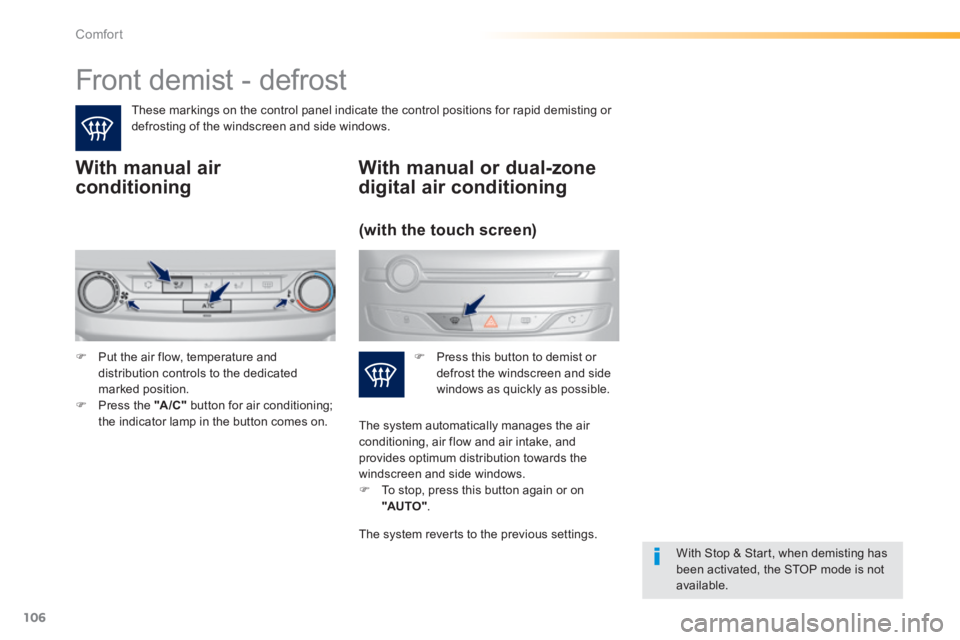
Front demist - defrost
These markings on the control panel indicate the control positions for rapid demisting or defrosting of the windscreen and side windows.
With manual air
conditioning
With Stop & Start, when demisting has been activated, the STOP mode is not available.
With manual or dual-zone
digital air conditioning
Put the air flow, temperature and distribution controls to the dedicated marked position. Press the "A /C " button for air conditioning; the indicator lamp in the button comes on.
Press this button to demist or defrost the windscreen and side windows as quickly as possible.
(with the touch screen)
The system automatically manages the air conditioning, air flow and air intake, and provides optimum distribution towards the windscreen and side windows. To stop, press this button again or on "AUTO" .
The system reverts to the previous settings.
Page 110 of 400
108
Driving
308_EN_CHAP04_CONDUITE_ED02-2013
Starting-switching off the engine, remote control
Put the gear lever into neutral.
A heavy object (key fob...), attached to the key and weighing down on its shaft in the ignition switch, could cause a malfunction.
Key left in the "Ignition on" position
On opening the driver's door, an alert message is displayed, accompanied by an audible signal, to remind you that the key is still in the ignition switch at position 1 (Stop) .
If the key has been left in the ignition switch at position 2 (Ignition on) , the ignition will be switched off automatically after one hour. To switch the ignition back on, turn the key to position 1 (Stop) , then back to position 2 (Ignition on) .
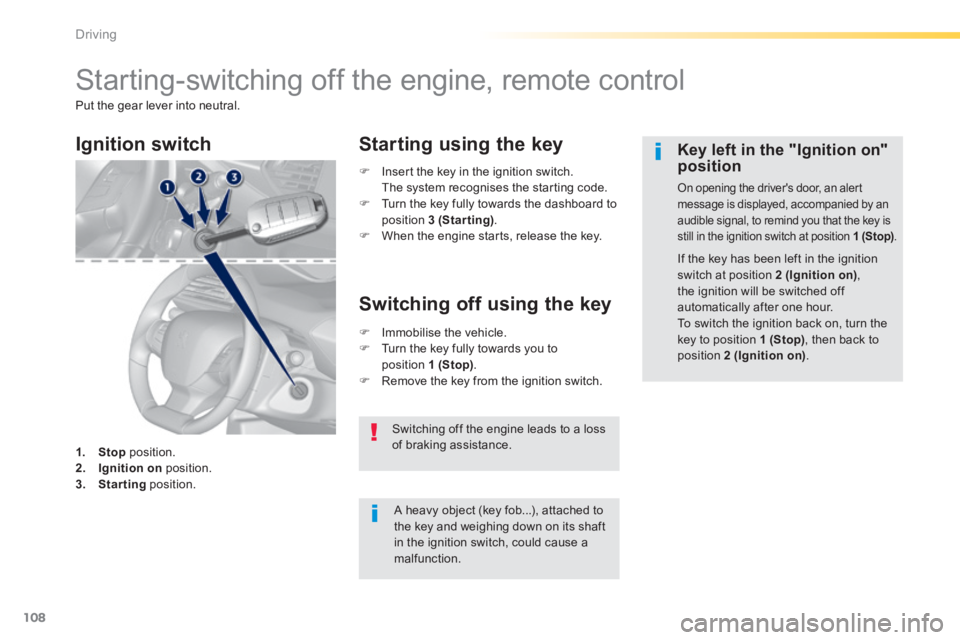
Ignition switch
1. Stop position. 2. Ignition on position. 3. Starting position.
Starting using the key
Insert the key in the ignition switch. The system recognises the starting code. Turn the key fully towards the dashboard to position 3 (Starting) .
When the engine starts, release the key.
Immobilise the vehicle. Turn the key fully towards you to position 1 (Stop) . Remove the key from the ignition switch.
Switching off using the key
Switching off the engine leads to a loss of braking assistance.
Page 116 of 400
114
Driving
308_EN_CHAP04_CONDUITE_ED02-2013
Electric parking brake
Never leave a child alone inside the vehicle with the ignition on, as they could release the parking brake. Indicator lamp
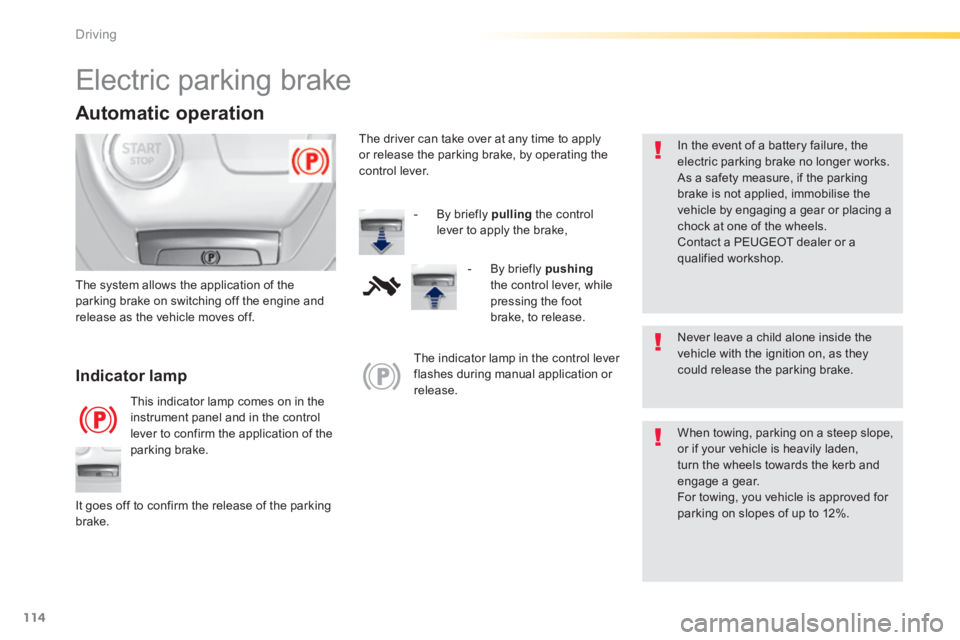
This indicator lamp comes on in the instrument panel and in the control lever to confirm the application of the parking brake.
The system allows the application of the parking brake on switching off the engine and release as the vehicle moves off.
When towing, parking on a steep slope, or if your vehicle is heavily laden, turn the wheels towards the kerb and engage a gear. For towing, you vehicle is approved for parking on slopes of up to 12%. It goes off to confirm the release of the parking brake.
The indicator lamp in the control lever flashes during manual application or release.
In the event of a battery failure, the electric parking brake no longer works. As a safety measure, if the parking brake is not applied, immobilise the vehicle by engaging a gear or placing a chock at one of the wheels. Contact a PEUGEOT dealer or a qualified workshop.
Automatic operation
The driver can take over at any time to apply or release the parking brake, by operating the control lever.
- By briefly pulling the control
lever to apply the brake,
- By briefly pushingthe control lever, while pressing the foot brake, to release.
Page 120 of 400
118
Driving
308_EN_CHAP04_CONDUITE_ED02-2013
Emergency braking
In the event of a failure of the main service brake or in an exceptional situation (e.g. driver taken ill, under instruction, etc) a continuous pull on the control lever will brake the vehicle. Braking takes place while the control lever is being pulled. It is interrupted if the control lever is released. The ABS and DSC systems provide stability of the vehicle during emergency braking. If the emergency braking malfunctions, the message "Parking brake control faulty" will be displayed.
The emergency braking should only be used in an exceptional situation.
Repeat this procedure to reactivate automatic operation. Reactivation of automatic operation is confirmed by the indicator lamp in the instrument panel going off.
Deactivating automatic operation
In some situations, such as very cold weather or towing (caravan, recovery), it may be necessary to deactivate automatic operation of the system. Start the engine. Apply the parking brake with the control
lever, if it is released. Take your foot off the brake pedal. Push and hold the control lever in the release direction for at least 10 seconds and no more than 15 seconds. Release the control lever. Press and hold the brake pedal. Pull the control lever in the apply direction for 2 seconds.
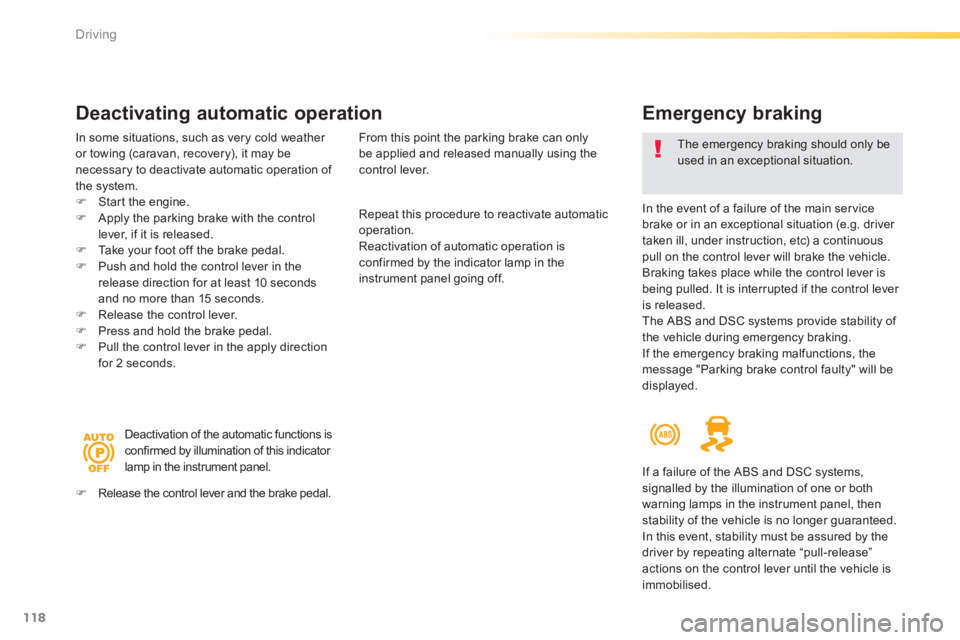
Deactivation of the automatic functions is confirmed by illumination of this indicator lamp in the instrument panel.
Release the control lever and the brake pedal.
From this point the parking brake can only be applied and released manually using the control lever.
If a failure of the ABS and DSC systems, signalled by the illumination of one or both warning lamps in the instrument panel, then stability of the vehicle is no longer guaranteed. In this event, stability must be assured by the driver by repeating alternate “pull-release” actions on the control lever until the vehicle is
immobilised.
Page 129 of 400
127
4
Driving
308_EN_CHAP04_CONDUITE_ED02-2013
Select position M for sequential changing of the six gears. Pull the lever towards the + sign to change up a gear. Push the lever towards the - sign to change down a gear. It is only possible to change from one gear to another if the vehicle speed and engine speed permit; otherwise, the gearbox will operate temporarily in automatic mode.
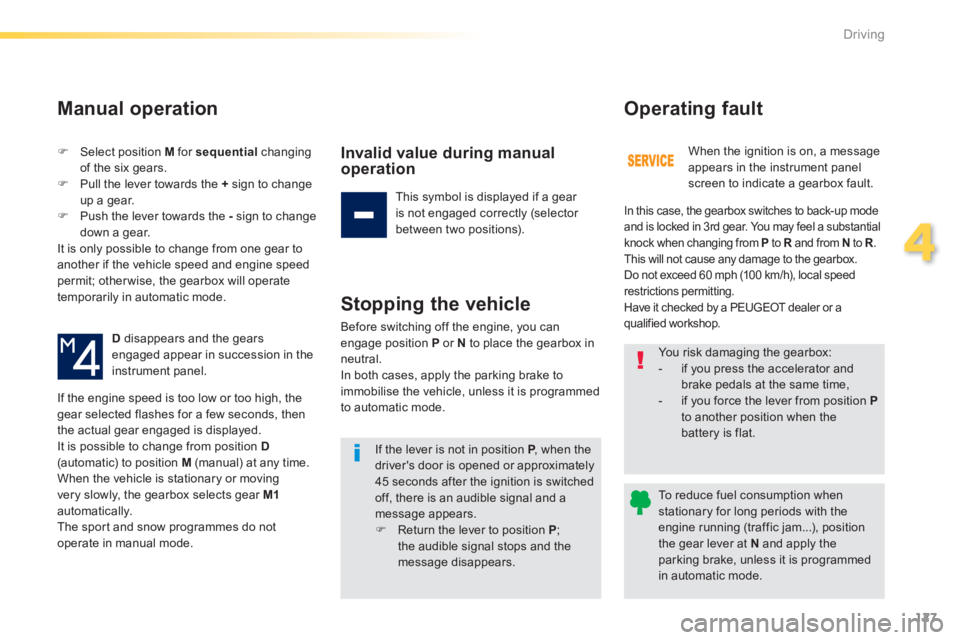
D disappears and the gears engaged appear in succession in the instrument panel.
If the engine speed is too low or too high, the gear selected flashes for a few seconds, then
the actual gear engaged is displayed. It is possible to change from position D(automatic) to position M (manual) at any time. When the vehicle is stationary or moving very slowly, the gearbox selects gear M1automatically. The sport and snow programmes do not operate in manual mode.
Manual operation
Invalid value during manual operation
This symbol is displayed if a gear is not engaged correctly (selector between two positions).
Stopping the vehicle
Before switching off the engine, you can engage position P or N to place the gearbox in neutral. In both cases, apply the parking brake to immobilise the vehicle, unless it is programmed
to automatic mode.
If the lever is not in position P , when the P , when the Pdriver's door is opened or approximately 45 seconds after the ignition is switched off, there is an audible signal and a message appears. Return the lever to position P ; the audible signal stops and the message disappears.
When the ignition is on, a message appears in the instrument panel screen to indicate a gearbox fault.
Operating fault
In this case, the gearbox switches to back-up mode and is locked in 3rd gear. You may feel a substantial knock when changing from P to R and from R and from RN to R . R . RThis will not cause any damage to the gearbox. Do not exceed 60 mph (100 km/h), local speed restrictions permitting. Have it checked by a PEUGEOT dealer or a qualified workshop.
You risk damaging the gearbox: - if you press the accelerator and brake pedals at the same time, - if you force the lever from position Pto another position when the battery is flat.
To reduce fuel consumption when stationary for long periods with the engine running (traffic jam...), position
the gear lever at N and apply the parking brake, unless it is programmed in automatic mode.
Page 140 of 400
138
Driving
308_EN_CHAP04_CONDUITE_ED02-2013
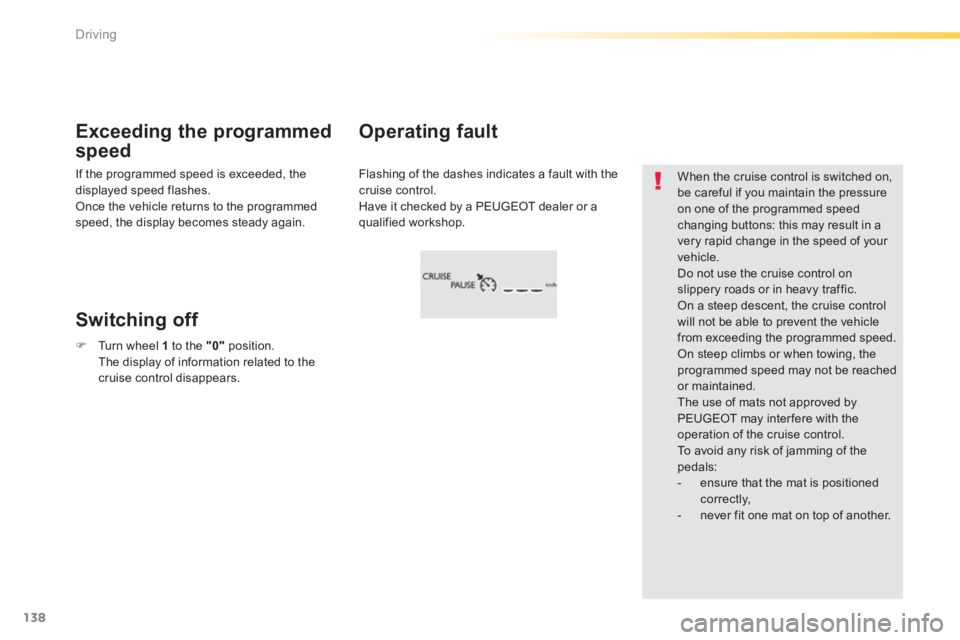
Flashing of the dashes indicates a fault with the cruise control. Have it checked by a PEUGEOT dealer or a qualified workshop.
Operating fault Exceeding the programmed
speed
Switching off
When the cruise control is switched on, be careful if you maintain the pressure on one of the programmed speed
changing buttons: this may result in a very rapid change in the speed of your vehicle. Do not use the cruise control on slippery roads or in heavy traffic. On a steep descent, the cruise control will not be able to prevent the vehicle from exceeding the programmed speed. On steep climbs or when towing, the programmed speed may not be reached or maintained. The use of mats not approved by PEUGEOT may inter fere with the operation of the cruise control. To avoid any risk of jamming of the pedals: - ensure that the mat is positioned c o r r e c t l y, - never fit one mat on top of another.
If the programmed speed is exceeded, the displayed speed flashes. Once the vehicle returns to the programmed speed, the display becomes steady again.
Turn wheel 1 to the "0" position. The display of information related to the cruise control disappears.